Clothing Manufacturer MOQ Explained: Why It Exists and How to Reduce It
Minimum order quantity is often the first obstacle a buyer meets when developing custom apparel. A supplier may be willing to make one sample, but bulk production begins only when the order can support material purchasing, pattern and artwork preparation, machine setup, labor planning, quality control and customized components. The number is not chosen only to make buyers purchase more. It is the point at which the proposed product and process can usually be organized into a workable production order.
This guide explains clothing manufacturer MOQ from a B2B buyer’s perspective. It uses JIUMU’s current starting quantities—50 pieces for custom hats, 50 pieces for jerseys and apparel, and 20 pieces for custom backpacks—rather than presenting unsupported “industry average” numbers. These are starting points, not unconditional promises. A complex product, exclusive fabric, many colors, broad size range or custom hardware may require a different quantity.
Quick Answer: A clothing manufacturer MOQ exists because fabric, dyeing, pattern development, decoration, machine setup, custom trims and packing each create minimum purchasing quantities or fixed costs. Buyers can often reduce MOQ by using available materials, fewer colors, an existing pattern, standard components, a simpler logo method and consolidated sizes. At JIUMU, starting MOQs are 50 pieces for custom hats, 50 pieces for custom jerseys and apparel, and 20 pieces for custom backpacks, subject to the final specification and production feasibility.
What Does Clothing Manufacturer MOQ Mean?
MOQ means the minimum quantity a supplier will accept for a defined product configuration. The important words are “defined configuration.” An offer of 50 hats may mean 50 pieces in one style and fabric with an agreed color breakdown. It does not necessarily mean 50 unrelated hat styles, each using a different fabric, closure, embroidery program and label.
Buyers should ask which level the MOQ applies to:
- Total purchase order
- Product category
- Style or pattern
- Fabric or material article
- Color
- Decoration method or artwork
- Custom component
- Packaging configuration
These levels can overlap. A manufacturer may accept 50 jerseys in mixed adult sizes because every size uses the same fabric, color and sublimated design. The same supplier may not accept 50 pieces split across five unrelated garment styles because each style requires separate patterns, cutting, sewing instructions and setup.
JIUMU Starting MOQ by Product Category
| Product category | JIUMU starting MOQ | What buyers should understand |
|---|---|---|
| Custom hats | 50 pieces | Usually depends on hat structure, fabric, color count, embroidery or patch design, closure, labels and packaging |
| Custom jerseys and apparel | 50 pieces | Usually depends on garment style, fabric, colorways, size breakdown, print or embroidery, labels and construction |
| Custom backpacks | 20 pieces | Usually depends on bag structure, material, color, webbing, zipper, hardware, logo method and packaging |
“Starting MOQ” means the lowest normal entry point for a suitable specification. Final quantity is confirmed only after JIUMU reviews the style, artwork, material, dimensions, colors, size breakdown, components, packaging, destination and required schedule. A buyer should not treat the table as authorization to divide the minimum across any combination of products.
Why Do Clothing Manufacturers Have MOQs?
MOQ is normally the result of several linked minimums and fixed activities. The highest constraint may control the order. A sewing line might handle 50 pieces, but the requested exclusive fabric may require a larger purchase. Conversely, fabric may be available in stock, but a custom molded buckle may have a higher tooling or component minimum.
1. Fabric and Material Purchasing
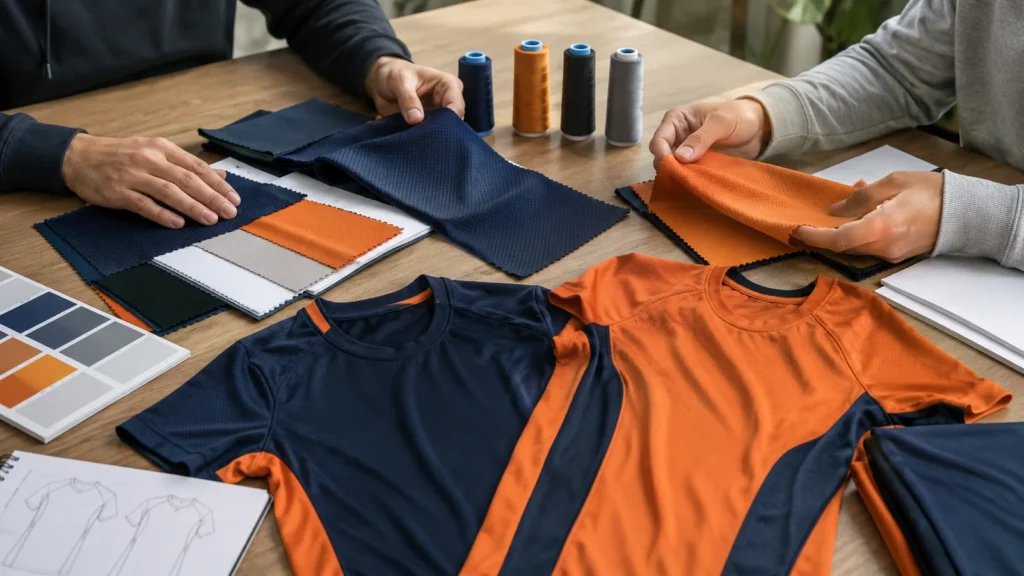
Fabric is rarely purchased as exactly the net amount sewn into the final garments. The supplier must allow for width, cutting layout, defects, shade control, sampling, test pieces and production loss. Mills and fabric distributors may sell by roll, batch, kilogram or defined minimum. Custom dyeing or finishing can introduce another minimum because the mill must prepare color, chemicals, equipment and quality checks for a production lot.
An in-stock fabric in an available color can support a lower order more easily than an exclusive fabric that must be knitted, woven, coated or dyed. “The same fiber content” does not automatically mean the same material. Yarn, structure, weight, stretch, finish and color source also matter.
For low-MOQ development, ask:
- Is the material already available?
- Is the selected color stocked or made to order?
- Must the supplier purchase a full roll?
- Can multiple products share the same fabric article?
- Will leftover material be stored, charged or used only with written approval?
- Is the material source fixed for repeat orders?
2. Pattern Development, Grading and Sampling
A custom garment requires a pattern, measurements, construction instructions and often several sample revisions. Once the base size is approved, the pattern may need grading across youth, adult or extended sizes. These activities are performed before or independently of the number of bulk units, so their cost does not disappear when the order is small.
If a buyer orders 50 units, development and setup costs are allocated across fewer pieces than in a larger order. The unit price may therefore be higher even when the supplier accepts the lower quantity. This is not necessarily a penalty. It reflects that the same pattern, artwork review, communication and production preparation support a smaller production run.
Using an existing, proven pattern may reduce development work, but only if its fit, construction and size range meet the project. A buyer should not select an unsuitable stock pattern merely to reach a lower MOQ.
3. Machine, Cutting and Line Setup
Production equipment and workstations must be prepared for the style. Cutting requires markers, spreading and bundling. Sewing requires machine settings, folders or attachments, thread colors, operator instructions and a first-piece check. Pressing, decoration and packing areas also need order-specific preparation.
Setup consumes time whether the run contains 20, 50 or 500 pieces. Very small runs can spend a high proportion of their production time moving materials, changing thread, loading artwork and confirming the first acceptable piece. Manufacturers use MOQ to keep these transitions workable.
Different styles should not be assumed to share one setup. A hoodie, baseball jersey and team jacket may use different machines, seams, trims and routes even when the order uses one logo.
4. Color Count and Color Minimums
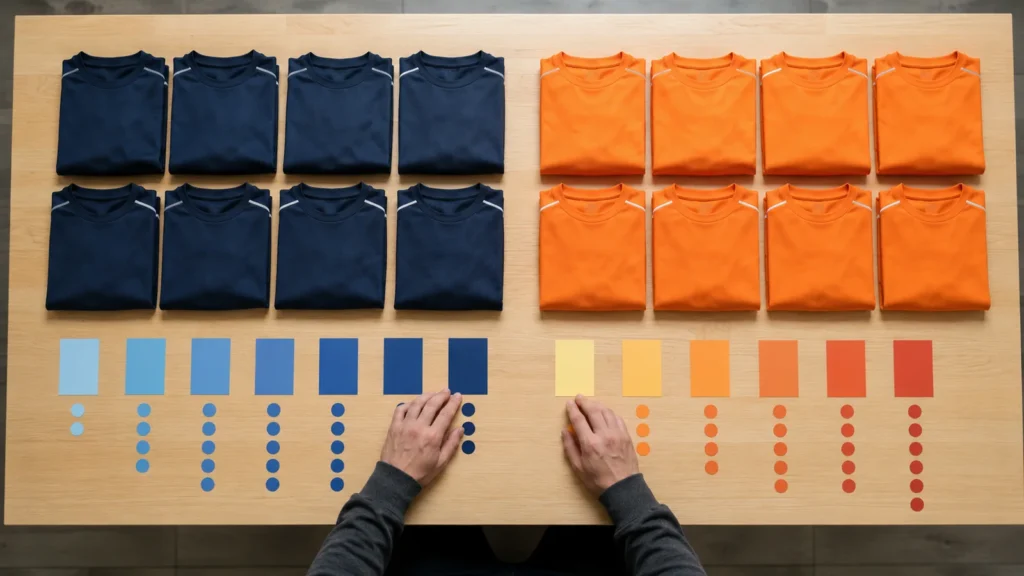
Each additional color can split fabric purchasing, cutting bundles, thread, decoration and quality review into smaller groups. Fifty pieces in one color is operationally different from fifty pieces divided into ten colors.
Mixed colors may be possible when the same approved material is available in stock and all other construction details remain unchanged. A custom-dyed color, however, may carry its own material minimum. Accessories can add further color constraints: rib, zipper tape, drawcord, lining, mesh, webbing and thread must coordinate with the body material.
To reduce MOQ pressure, begin with one or two commercially important colors. Add additional colors after demand is validated or combine them in a repeat order when the material plan supports it.
5. Size Breakdown
Mixed sizes are often easier to accommodate than mixed styles because the product may share material, color, logo and construction. However, every size still affects pattern grading, cutting markers, labels, bundle control and inspection.
A highly fragmented size breakdown—especially one or two units in many sizes—can increase complexity and error risk. Youth and adult ranges may use different patterns, logo scales or components. Extended sizes may require additional material and separate markers.
Send the complete quantity-by-size table early. Do not request a total quotation and add the size breakdown after the sample is approved. The supplier needs to confirm that the range can be produced and labeled correctly at the proposed MOQ.
6. Logo and Decoration Setup
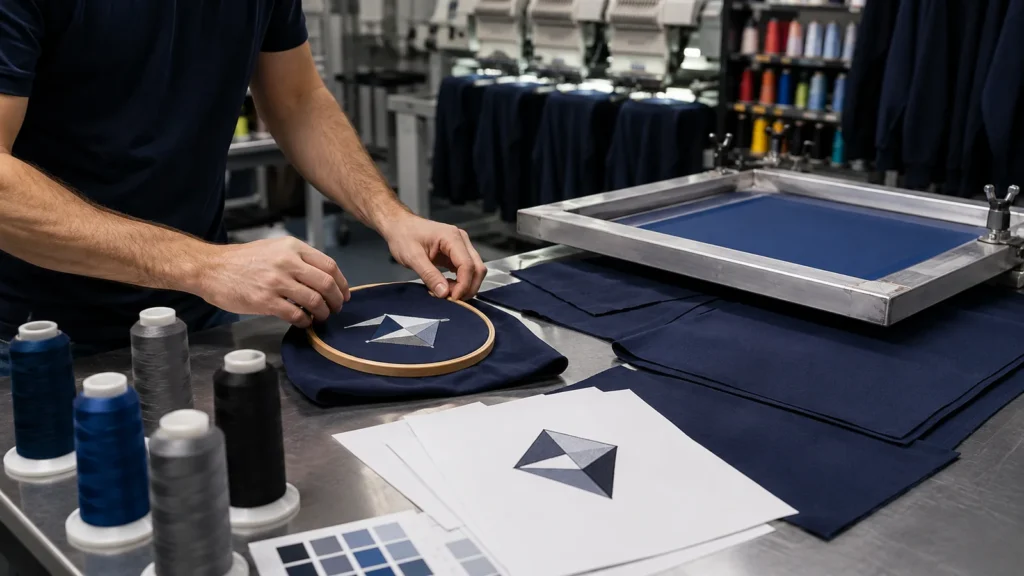
Embroidery, screen printing, sublimation and heat transfer have different preparation requirements. Embroidery may require digitizing, thread setup, hooping and sew-out approval. Screen printing may require artwork separation, screens, ink setup and curing controls. Sublimation requires print files, color management and panel alignment. Heat transfer involves artwork preparation, cutting or printed transfer production and application settings.
The decoration MOQ may apply per artwork, size, location or color configuration. Fifty garments with one small chest logo are simpler than fifty garments carrying multiple individual designs, names and sponsor arrangements.
Personalized names and numbers do not always increase the product MOQ, but they increase data-control and production complexity. Buyers should provide a clean, final roster and define how spelling, size and number assignments will be approved.
7. Custom Trims, Hardware and Accessories
Private-label apparel and bags can contain components sourced from specialist suppliers: woven labels, molded zipper pulls, branded buttons, snaps, buckles, webbing, elastic, patches, rubber marks, hangtags and printed bags. Each component supplier may impose a purchasing minimum that is independent of the garment assembly MOQ.
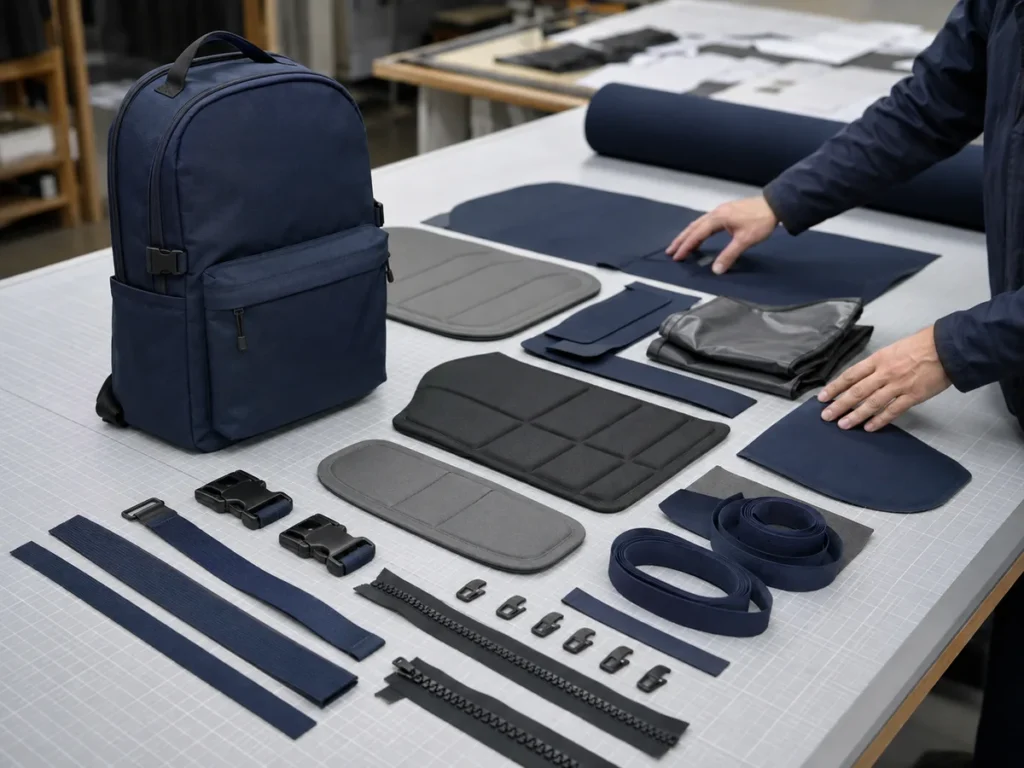
Backpacks are particularly sensitive because one product can include several fabrics, foam, lining, mesh, zippers, sliders, webbing, buckles, binding and reinforcement. JIUMU’s backpack starting MOQ is 20 pieces, but a fully custom material or hardware program may require a higher quantity or a different component approach.
Standard components in an approved color can reduce the minimum. A custom molded buckle or exclusive zipper pull can raise development cost and quantity. Buyers should decide which details are essential to the brand launch and which can be introduced after sales are proven.
8. Private Labels and Packaging
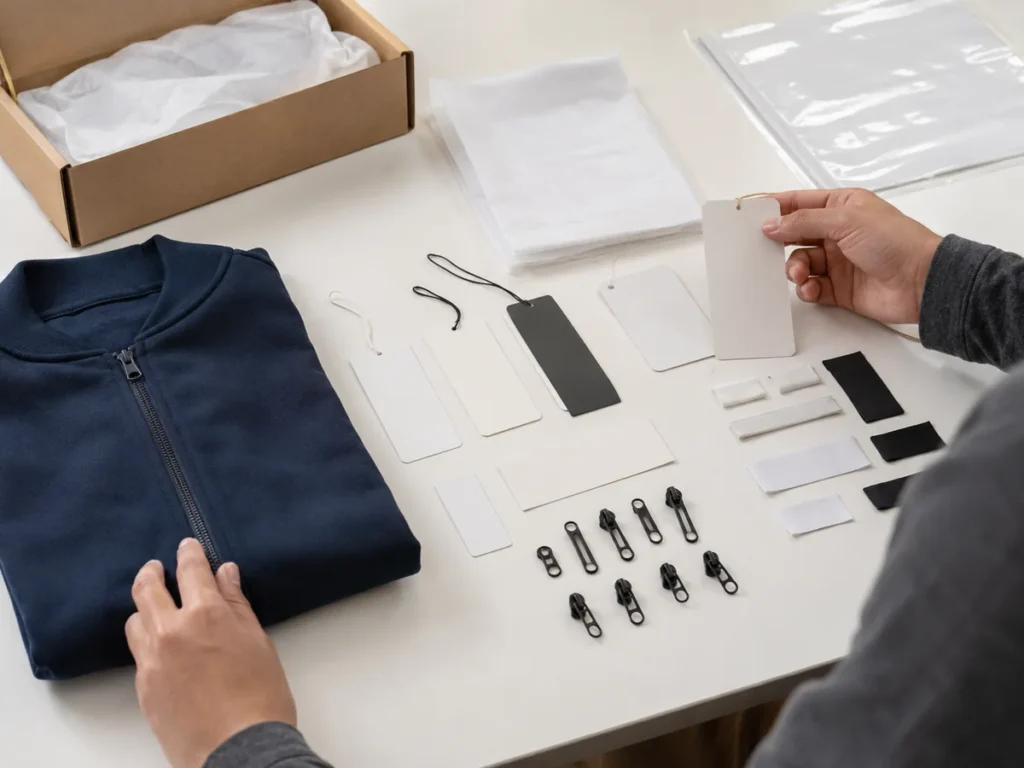
Woven labels, care labels, hangtags, barcode stickers, printed polybags and cartons may each have separate minimums. Even if a label supplier can make the quantity, very small production can carry a relatively high setup cost per piece.
Buyers can sometimes reduce the initial burden by using a standard package with an approved product sticker, postponing a custom polybag, or ordering extra labels for planned repeat production. This approach requires careful control: unused labels contain brand identity and should be stored, counted and used only for authorized orders.
Packaging must still meet product protection, identification, shipping and destination-market requirements. Lower MOQ is not a reason to omit required care, fiber, origin or safety information.
9. Quality Control, Testing and Production Scheduling
Small orders still require specification review, first-piece confirmation, in-process checks and final inspection. A test or third-party inspection may carry a fixed charge regardless of the order quantity. When a buyer requires special colorfastness, dimensional, safety or regulatory testing, the sample quantity, lead time and cost should be planned separately.
Production scheduling also matters. A manufacturer must place the order among other material arrivals, cutting plans and line commitments. A small run does not automatically mean immediate production. It may be grouped into a suitable production window or priced to reflect a dedicated setup.
Review the supplier’s Quality Control and Manufacturing Capabilities information, then confirm which controls apply to the actual order.
How MOQ Works for Hats, Apparel and Backpacks
Custom Hats: Starting From 50 Pieces
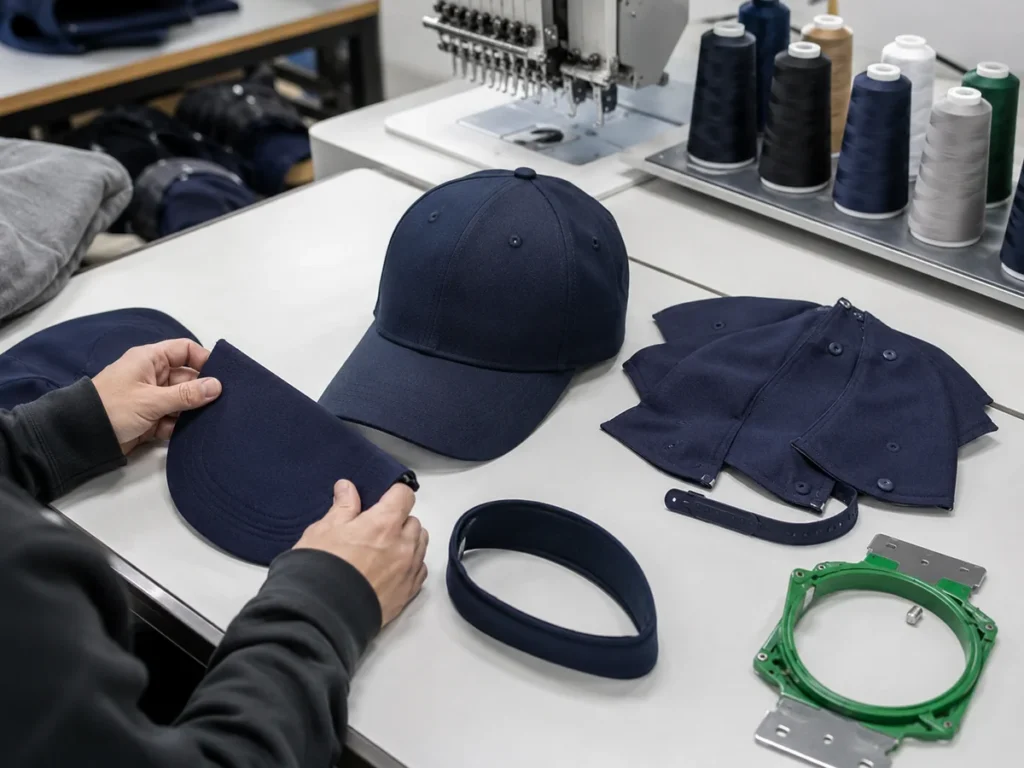
For custom hats, structure and component choices influence MOQ. A cap may include crown panels, visor, buckram, sweatband, eyelets, closure, top button, labels and embroidery or patch decoration. Using a standard cap structure, available fabric and one logo helps keep the order near the starting point. Custom dyeing, multiple cap shapes, special closure hardware or several embroidery programs can raise the requirement.
Custom Jerseys and Apparel: Starting From 50 Pieces
For custom team jerseys and apparel, pattern, fabric, colors, size range and decoration route are central. Sublimated jerseys may support multiple printed colors within one approved design, while cut-and-sew garments can require separate material colors and trims. Hoodies, jackets and jerseys should not be treated as one style merely because they carry the same team identity.
Custom Backpacks: Starting From 20 Pieces
For custom team bags, the 20-piece starting MOQ can suit a design based on feasible materials and components. Bag complexity matters: compartments, padding, reinforcement, custom lining, molded hardware and multiple logo locations can change the requirement. The buyer should provide dimensions, use case, load expectations and component preferences before relying on the starting figure.
Can Buyers Mix Colors, Sizes or Styles?
| Request | More likely to be feasible near starting MOQ | More likely to raise MOQ or cost |
|---|---|---|
| Mixed sizes | Same style, fabric, color, construction and logo | Very wide size range, different patterns or logo scales |
| Mixed colors | Stocked colors in the same approved material | Custom dye lots, different trims or many low-quantity colors |
| Mixed logo details | One artwork with controlled names/numbers | Many unrelated artworks, locations or decoration methods |
| Mixed styles | Small construction variation using shared materials | Hats, hoodies, jerseys and bags counted as one production setup |
| Mixed packaging | One standard pack with variable size sticker | Several retail packs, barcode systems or custom printed bags |
The correct question is not “Can I mix anything?” Ask: Which materials, patterns, setups and components remain shared, and which must be prepared separately? The answer reveals whether the proposed split is operationally one order or several small orders.
How to Reduce Clothing MOQ Responsibly
Use Available Materials
Ask for materials and colors already available through the supplier’s approved sources. Review physical swatches before approval. Do not accept an unsuitable fabric solely because it is available; confirm weight, hand feel, stretch, opacity, color and intended performance.
Reduce the Number of Colors
Launch with the strongest one or two colors. This consolidates fabric, trims, cutting and quality review. Additional colors can be added after demand is measured or combined with a planned repeat order.
Start From an Existing Pattern or Product Platform
An existing pattern can reduce development and setup when its fit and construction are appropriate. Customize color, logo, labels and selected details instead of redesigning every panel. Request a sample and measurement chart before approval.
Simplify the Decoration Program
Use one logo size and location across the initial order where possible. Limit thread colors, print locations and separate artwork versions. A simpler launch design can still be distinctive when the color and placement are well controlled.
Use Standard Trims and Hardware
Choose available zippers, buckles, closures, drawcords and webbing in suitable colors. Reserve custom molds or exclusive finishes for volumes that support tooling and component minimums.
Consolidate the Size Breakdown
Base the first order on a realistic demand forecast. Avoid one-piece quantities across an unnecessarily broad range. This does not mean excluding required users; it means using sales, roster or preorder data to plan sizes rather than guessing.
Stage Private-Label Features
Keep required labels correct from the beginning, but consider whether optional custom polybags, elaborate hangtags or molded logo components are essential for the pilot. Add them in a repeat order when the forecast is clearer.
Accept the Real Unit-Cost Trade-Off
A lower order spreads development, setup and quality-control activity across fewer units. The manufacturer may offer the quantity at a higher unit price, charge a separate setup fee or propose a simpler specification. Compare total inventory risk—not only unit price. Paying more per piece for a controlled pilot can be rational if it avoids excess stock and validates the product.
Plan a Repeatable Pilot Order
Tell the supplier that the order is a pilot, but do not promise unsupported future volume. Freeze materials, colors, patterns, artwork and labels so the next order can repeat the same specification. Ask which components should be reserved and how long approved references remain available.
Request an MOQ feasibility review: Send JIUMU the product type, quantity, colors, size breakdown, reference images or tech pack, fabric preference, logo method, labels, packaging, destination and target date. JIUMU can identify which details fit the starting MOQ and which require a different material, component, price or quantity. Send your project details.
MOQ, Unit Price, Customization and Lead Time
| Buyer priority | Likely decision | Trade-off to review |
|---|---|---|
| Lowest feasible MOQ | Available materials, standard trims, fewer colors | Higher unit price and less exclusive customization |
| Lowest unit price | Larger consolidated production run | Greater inventory and cash commitment |
| Maximum customization | Custom materials, colors, hardware and packaging | Higher MOQ, development cost and longer preparation |
| Fastest feasible schedule | Approved available materials and simple setup | Fewer custom options and dependence on current capacity |
| Repeat-order consistency | Controlled BOM, Golden Sample and approved sources | May require planned material purchasing or reservation |
MOQ should not be optimized alone. The best order structure balances inventory risk, brand requirements, unit economics, schedule and repeatability. Review JIUMU’s MOQ & Lead Time page, then request an order-specific confirmation.
What to Send for an Accurate MOQ and Quotation
Provide:
- Product category and intended use
- Reference image, drawing or tech pack
- Total quantity and quantity by style, color and size
- Fabric composition, weight, finish and color preference
- Product dimensions and construction requirements
- Logo artwork, size, location and decoration method
- Personalized names or numbers
- Labels, hangtags, barcode and packaging requirements
- Destination country and relevant test or compliance requirements
- Sample deadline, bulk delivery target and shipping destination
A quotation based only on “50 custom shirts” cannot define the true MOQ. The supplier needs enough information to identify the material, pattern, decoration and component minimums.
Questions to Ask a Clothing Manufacturer About MOQ
- Does the MOQ apply per order, style, color, material or artwork?
- Can sizes be mixed, and are youth and adult sizes treated separately?
- Which materials and colors are available near the starting MOQ?
- Does the quote assume standard or custom trims?
- Are sample, digitizing, screen, mold or test costs separate?
- Can leftover custom material or labels be stored for repeat orders?
- What specification change would reduce MOQ most effectively?
- How would a lower quantity affect price and lead time?
- What must remain identical for mixed colors or sizes to share one MOQ?
- When is the final MOQ confirmed?
Common MOQ Negotiation Mistakes
Asking for the lowest number before defining the product. The answer cannot be reliable without material, color, size and customization details.
Trying to combine unrelated products. Hats, jerseys and backpacks use different materials, patterns, machines and components.
Adding colors after quotation. More colors can introduce separate fabric or trim minimums.
Expecting the same unit price at every quantity. Fixed development and setup work is allocated across fewer pieces in a small run.
Removing quality controls to lower MOQ. The order still needs approved specifications and appropriate inspection.
Using a cheaper substitute without documentation. A reduced minimum is not worthwhile if the bulk product no longer matches the approved sample.
Promising a large future order to secure a pilot. Discuss the current order honestly and design it to be repeatable.
How JIUMU Approaches MOQ
JIUMU supports custom teamwear, logo apparel, hats, uniforms, bags and branded merchandise for B2B buyers. The starting MOQ is 50 pieces for hats, 50 pieces for jerseys and apparel, and 20 pieces for backpacks. These entry points are intended to support practical custom projects, but the final quantity is reviewed against the complete specification.
Customization can include embroidery, sublimation, screen printing, heat transfer, patches, fabric sourcing, color matching, private labels, hangtags and packaging. The buyer’s best route to a lower feasible MOQ is to identify essential brand features, remain flexible on nonessential components and provide a clear quantity matrix.
Frequently Asked Questions
Final Recommendation
Treat MOQ as an engineering and purchasing question, not a number to negotiate in isolation. Define the product, identify which requirements are essential, and ask which minimum is controlling the order. Then reduce complexity where it does not weaken fit, function, compliance, brand identity or repeatability.
For JIUMU projects, begin with the real starting points—50 hats, 50 jerseys or apparel pieces, or 20 backpacks—and send the complete variation matrix. JIUMU can then confirm whether the proposed materials, colors, sizes, logos, trims and packaging fit that starting quantity.