
Factory Audit Checklist Before Placing a Custom Apparel Order
Short answer: A factory audit is a pre-order supplier and system check. It verifies legal identity, process ownership, subcontracting, material traceability, production control and corrective-action capability. It is not the same as a pre-shipment inspection, which checks finished goods before release.
Factory Audit vs Pre-Shipment Inspection
| Activity | Main question | Typical timing |
|---|---|---|
| Factory audit | Can this supplier reliably control the required process? | Before order placement and periodically during cooperation |
| In-line inspection | Is current production following the approved standard? | During production |
| Pre-shipment inspection | Does the finished lot meet agreed acceptance criteria? | After production, before shipment |
A good finished-goods inspection cannot fully compensate for an unsuitable supplier. Conversely, a passed audit does not prove that every future shipment will conform.
1. Verify Legal and Payment Identity
- Compare the business license name with contracts, invoices and payment beneficiary.
- Confirm the operating address and whether the audited site matches the contracting entity.
- Record registration details and responsible contacts.
- Investigate unexplained differences between legal, trading and factory names.
Request evidence appropriate to the transaction and verify it independently where practical. Do not rely only on a logo, website or sales presentation.
2. Map Owned and Outsourced Processes
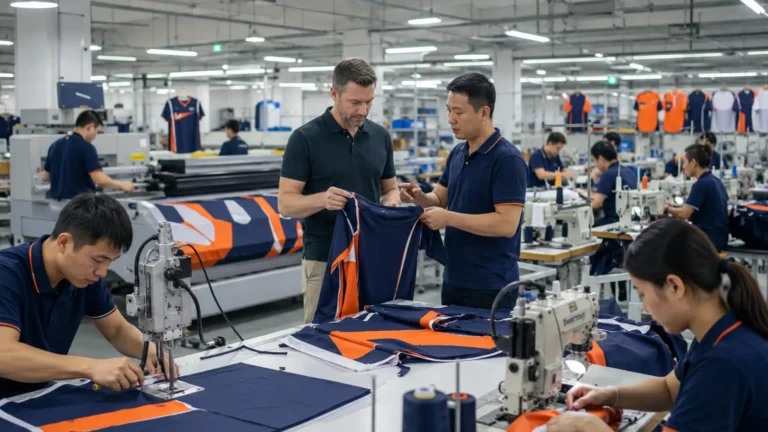
List every required step: material sourcing, pattern making, cutting, sewing, printing, embroidery, washing, finishing, inspection and packing. Mark which processes are performed at the site and which are subcontracted. For outsourced work, identify the provider, approval method, transport controls and incoming verification.
| Stage | Main purpose | Typical timing |
|---|---|---|
| Factory audit | Verify identity, capability and systems | Before supplier approval |
| During-production inspection | Find process or quality drift early | After production has begun |
| Pre-shipment inspection | Check finished quantity, quality and packing | Before shipment release |
3. Confirm Capacity with Records, Not Headcounts
Machine quantities and employee numbers alone do not prove usable capacity. Review relevant machine models or IDs, staffing by operation, maintenance condition, recent production records, bottleneck processes and current workload. Capacity should be evaluated against the proposed product, quantity and deadline.
4. Review Material Traceability
- Approved supplier list and purchase records.
- Roll, batch or lot identification.
- Incoming inspection criteria and status labels.
- Segregation of approved, pending and rejected materials.
- Shade-lot control and material issuance records.
Ask staff to trace one material from receiving through cutting and one finished item back to its production documents.
5. Follow the Sample-to-Bulk Instruction Flow
Check how approved samples, tech packs, bills of materials, artwork and comments reach production. Operators and inspectors should have the current controlled version. Ask what prevents an old email attachment or superseded artwork from being used.
6. Inspect Process Quality Controls
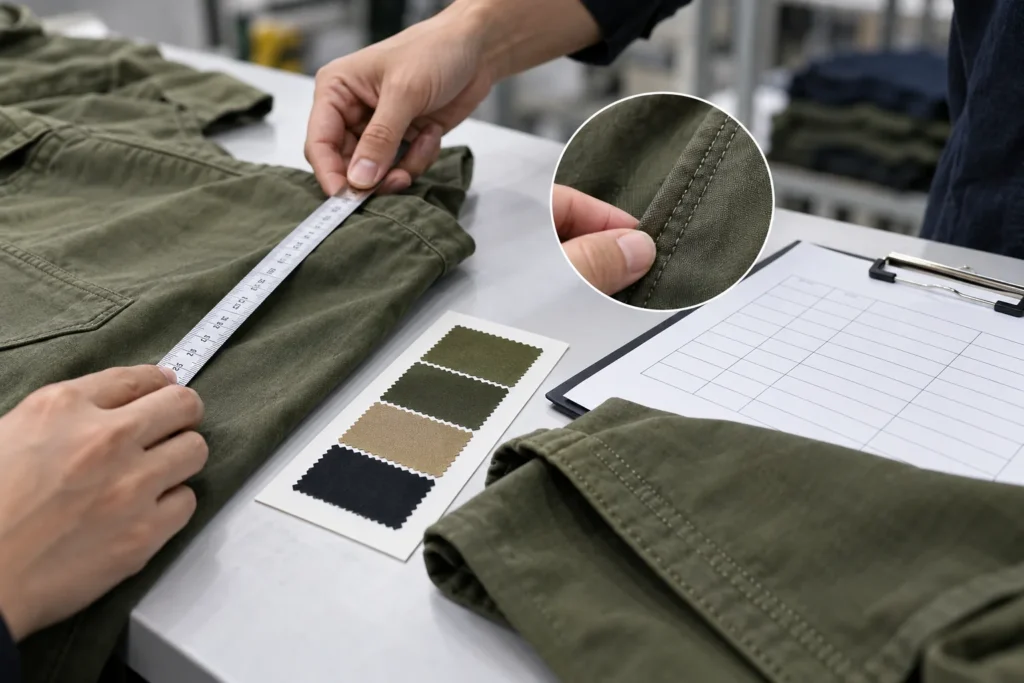
Look for defined first-piece checks, in-line checkpoints, measurement methods, decoration standards and final inspection records. Acceptance criteria should be measurable. Inspectors need adequate tools, lighting, training and authority to isolate nonconforming goods.
7. Check Nonconforming Product Control
Rejected or pending materials and garments should be physically identified and separated. Review how defects are recorded, dispositioned, repaired and re-inspected. Ask for a recent example of root-cause analysis and corrective action, with sensitive commercial data removed where necessary.
8. Review Equipment Maintenance and Calibration
Relevant equipment should have maintenance records. Measurement devices used for acceptance decisions should be identified and checked at a defined interval. The goal is not paperwork volume; it is confidence that process drift and inaccurate measurements are detected.
9. Evaluate Compliance Evidence
Requirements depend on product and destination market. Review whether reports identify the tested material or product, method, date, laboratory and applicant. Check scope and validity instead of accepting a certificate image without context. Never assume an audit replaces product-specific testing or legal advice.
10. Assess Communication and Change Control
Confirm who receives buyer changes, who approves feasibility and how revisions are distributed. Review escalation rules for material substitutions, schedule risk, quality failures and subcontractor changes. One responsible approval channel reduces conflicting instructions.
Risk-Rated Audit Outcome
| Rating | Meaning | Action |
|---|---|---|
| Critical | Identity, safety, compliance or control failure creates unacceptable risk | Hold order placement |
| Major | System weakness could affect repeated conformity | Require corrective action and evidence |
| Minor | Limited gap with contained impact | Set owner and closure date |
| Observation | Improvement opportunity without current nonconformity | Monitor |
Corrective-Action Follow-Up
An audit is incomplete without closure. Each finding should identify evidence, risk, required action, owner and deadline. Review corrected documents, photos, records or a follow-up visit according to severity. Do not close a finding only because the supplier says it was fixed.
Frequently Asked Questions
Can a video call replace an on-site audit?
It can support screening, but camera selection and limited record access reduce assurance. Match the method to order risk.
Does an audit prove product quality?
No. It evaluates supplier capability and controls. Samples, in-line checks and finished-goods inspection remain separate.
Should every subcontractor be audited?
Prioritize processes that create high quality, safety, compliance or continuity risk. At minimum, verify how the main supplier approves and controls them.
How often should an audit be repeated?
Use risk and change triggers: new processes, repeated defects, site changes, ownership changes, major capacity shifts or significant order growth.
Next Step After Supplier Approval
Once the supplier is qualified, define order-level inspection. Use the pre-shipment inspection checklist for finished goods. To discuss a specification-based project, contact JIUMU with product, quantity, required processes and destination.