Best Fitted Hat Styles for Teams and Brands
Fitted hats give teams and brands a clean, uninterrupted silhouette: no snap, strap, or metal buckle breaks the back of the cap. That polished shape works especially well for baseball clubs, school programs, company uniforms, fan merchandise, streetwear collections, and private-label headwear. It also makes the buying process less forgiving. A fitted cap must match the intended wearer, decoration, activity, and size distribution.
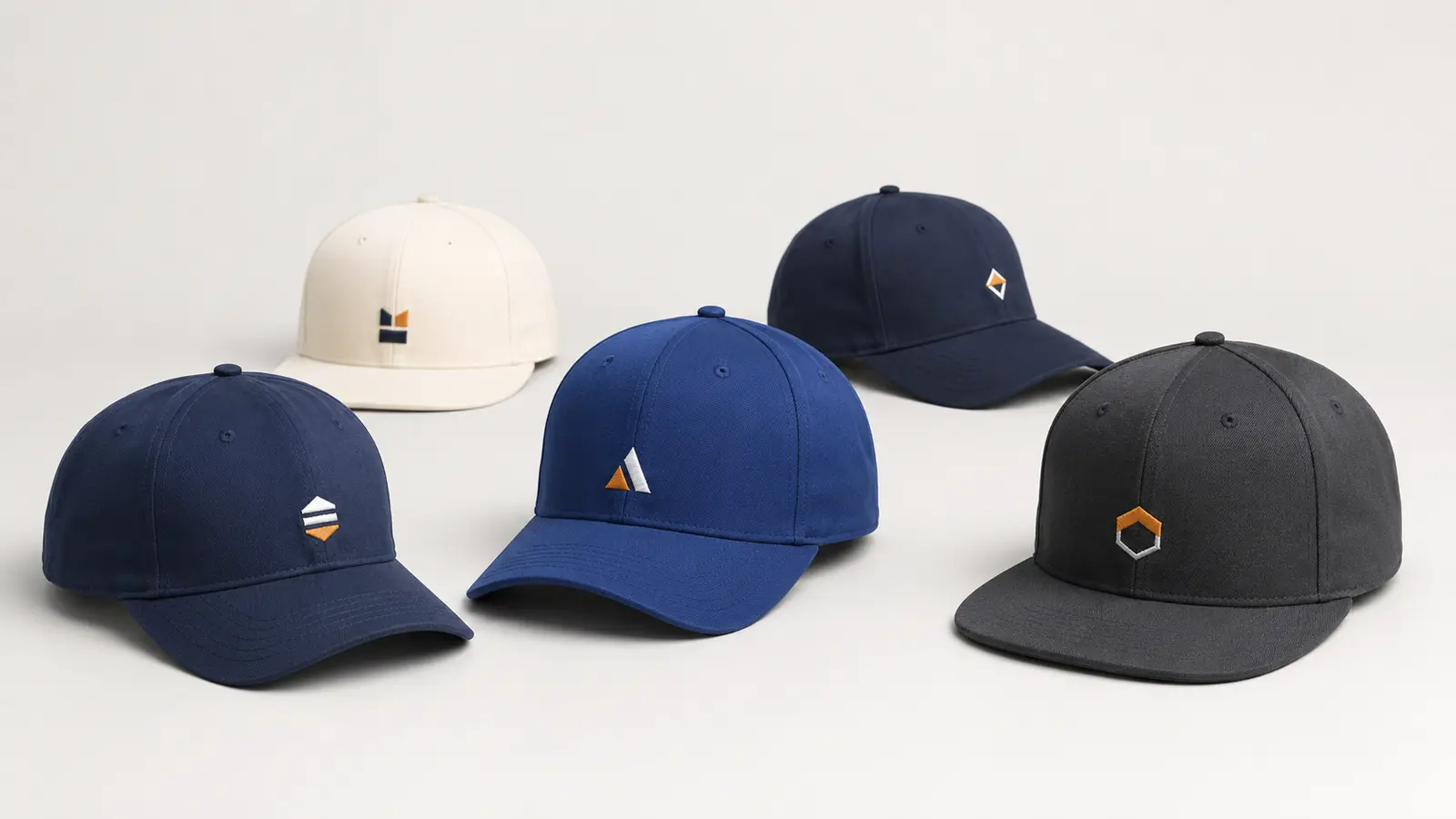
For a bulk buyer, the “best” fitted hat is not universal. It is the style whose crown, visor, fabric, sizing system, sweatband, and logo method fit the program. A high-profile flat-brim cap may be right for branded merchandise, while a mid-profile stretch-fitted performance cap may be better for an active roster. A low-profile curved-brim cap can suit staff uniforms or golf events, but it offers a different front decoration area.
This guide compares the most useful fitted hat styles for teams and brands, explains the specifications that affect fit and appearance, and provides a practical process for samples, quality control, and repeat orders.
Quick Answer: Which Fitted Hat Style Is Best?
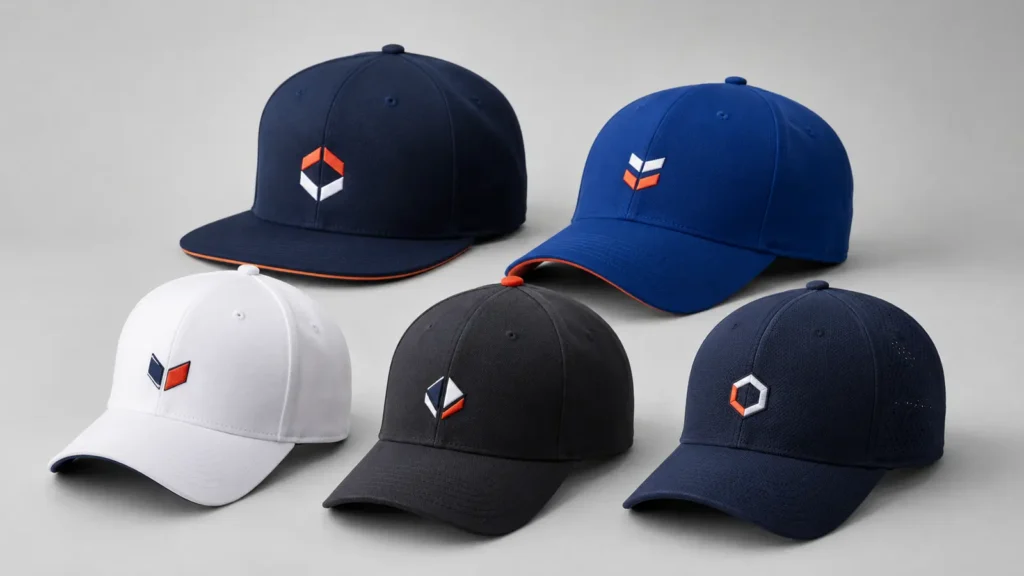
For most sports teams, a structured six-panel, mid-profile stretch-fitted cap with a curved visor and moisture-managing sweatband offers a practical balance of on-field stability, size coverage, decoration space, and comfort. For fashion labels and fan merchandise, a structured high-profile true-fitted cap with a flat visor creates a stronger streetwear silhouette and supports larger front embroidery. For corporate uniforms, golf programs, and understated merchandise, a low- or mid-profile curved-brim fitted cap usually looks more approachable.
Choose the style by use case:
- On-field teams: mid-profile, performance fabric, curved visor, secure stretch-fitted sizing.
- Fan merchandise and streetwear: high-profile, flat visor, true fitted sizes, bold front embroidery.
- Schools and youth clubs: mid-profile, flexible size ranges, lightweight fabric, clear size confirmation.
- Corporate and golf programs: low- or mid-profile, curved visor, refined tonal decoration.
- Private-label collections: custom crown, fabric, underbill, interior labels, and packaging approved through a physical sample.
What Is a Fitted Hat?
A fitted hat has a closed back and no visible adjustable closure. The circumference is controlled either by a specific numeric size or by elastic or stretch components that cover a size range.
This distinction matters in procurement:
- True fitted hats are ordered in individual sizes. They can create a precise, traditional silhouette, but the buyer must forecast the size curve accurately.
- Stretch-fitted hats combine a closed back with an elasticized sweatband or stretch fabric. They are usually offered in broader ranges such as S/M and L/XL, although every supplier’s chart must be checked.
Official brand examples illustrate the difference. New Era describes its 59FIFTY as a fitted silhouette with a full crown and flat visor, while its Low Profile version uses a lower crown and pre-curved visor. Flexfit states that its stretch-fitted caps cover size ranges rather than individual traditional fitted sizes. These examples are useful for terminology, but a custom buyer should approve the actual supplier sample rather than assume one brand’s measurements apply to another product. Sources: New Era 59FIFTY silhouette guide, New Era Low Profile 59FIFTY collection, and Flexfit sizing guidance.
Best Fitted Hat Styles at a Glance
| Fitted hat style | Crown and visor | Best for | Main decoration advantage | Buying caution |
|---|---|---|---|---|
| High-profile six-panel true fitted | Tall structured crown; flat visor | Streetwear, fan merchandise, premium retail | Large, stable front area for bold embroidery | Requires a reliable individual-size curve |
| Mid-profile athletic stretch fitted | Structured crown; curved or shapeable visor | Baseball, softball, clubs, coaching staff | Balanced front logo area and active fit | Size ranges differ by supplier |
| Low-profile curved-brim fitted | Lower crown; pre-curved visor | Corporate uniforms, golf, hospitality, casual merchandise | Refined, less dominant branding | Reduced vertical embroidery height |
| Performance fitted cap | Mid profile; curved visor; ventilation options | Training, tournaments, outdoor staff | Technical appearance and lightweight logo methods | Fabric and sweatband claims require sample testing |
| Wool-blend heritage fitted | Structured crown; flat or curved visor | Baseball-inspired collections, alumni merchandise | Rich texture for embroidery and patches | Fiber content, hand feel, and care need confirmation |
| Five-panel or A-frame fitted | Pinched or uninterrupted front panel; often flat visor | Fashion capsules, lifestyle brands, modern club merchandise | Clean front panel for patches or centered artwork | Shape can vary sharply among patterns |
| Youth-proportioned fitted | Shallower crown and smaller circumference options | Youth leagues and school programs | Better visual scale for younger wearers | Do not simply shrink an adult order without fitting |
| Custom private-label fitted | Buyer-defined crown, visor, fabric, trims, and labels | Retailers, distributors, established brands | Full control of brand system and packaging | Development requires disciplined sample approval |
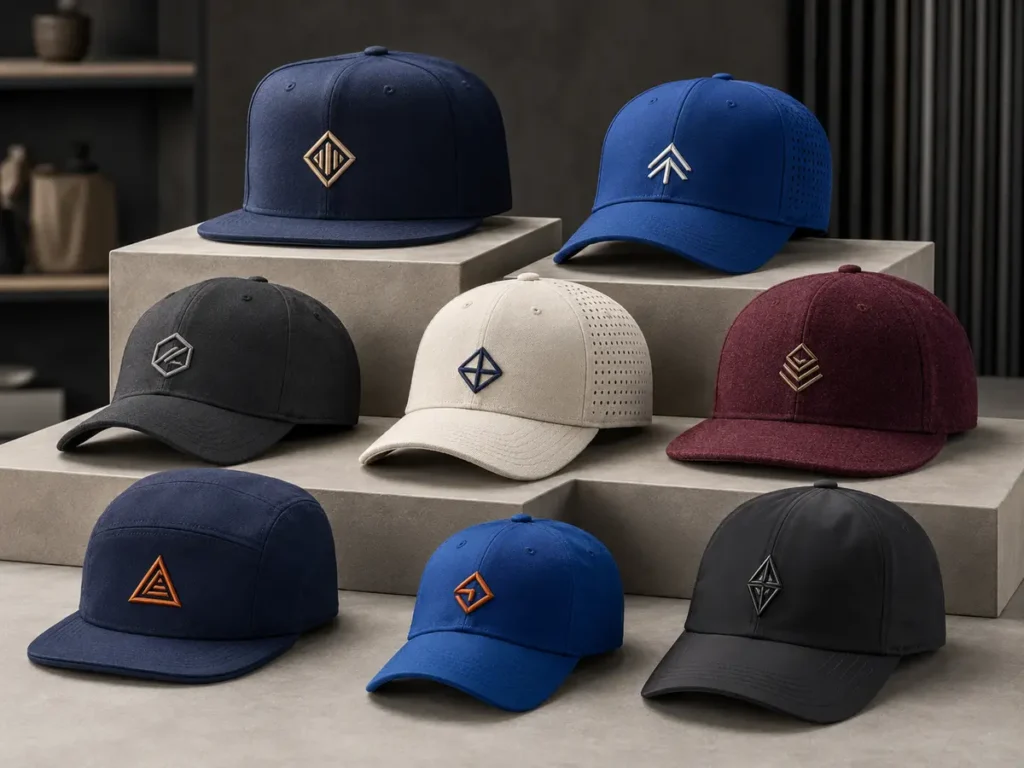
1. High-Profile Six-Panel True-Fitted Cap
The high-profile six-panel fitted cap is the strongest choice when the hat itself should be a visible part of the brand identity. Its taller crown creates a broad front surface, while buckram or another stabilizer helps the cap maintain shape. A flat visor reinforces the modern baseball and streetwear look.
This style is well suited to:
- Retail and ecommerce headwear collections
- Fan shops and supporter merchandise
- Tournament drops
- Music, lifestyle, and streetwear brands
- Alumni or anniversary merchandise
- Premium corporate merchandise with a fashion-led brief
The crown can support flat embroidery, raised embroidery, appliqué, or certain patch types. However, the artwork must be planned around the center seam of a six-panel cap. Fine vertical lines or small lettering placed directly across the seam may distort. A physical embroidery strike-off or cap sample is more useful than a flat digital mockup for evaluating registration.
The main operational challenge is sizing. True fitted hats can require multiple individual sizes. Buyers should use actual wearer data, sales history, or a controlled preorder rather than guessing an even distribution. Keep a record of the approved circumference, crown depth, and measurement method for repeat orders.
2. Mid-Profile Athletic Stretch-Fitted Cap
For many teams, the mid-profile stretch-fitted cap is the most versatile option. It sits between a low casual crown and a tall fashion crown, offers a stable front for a team mark, and reduces the number of inventory sizes compared with a true fitted program.
This cap works well for baseball and softball teams, school athletic departments, travel clubs, coaching staff, training academies, event crews, and sports distributors. A curved visor feels familiar for active use, while stretch components help the cap stay secure across a defined head-size range.
Flexfit’s official product information provides a useful market example: its 6100NU is a structured, six-panel, stretch-fitted cap with a mid profile, closed back, hard buckram, and specific S/M and L/XL ranges. That specification should not be copied blindly, but it shows why buyers must evaluate the whole system—crown structure, stretch technology, fabric blend, sweatband, and actual size chart—rather than order only by the phrase “fitted cap.” Source: Flexfit 6100NU product specification.
For team orders, confirm the circumference range for every labeled size, source of stretch, recovery after wear, crown depth, visor shape, sweatband, and shrinkage expectations for the selected fabric.
3. Low-Profile Curved-Brim Fitted Cap
A low-profile fitted cap sits closer to the head and presents a more relaxed silhouette. Paired with a curved visor, it works for corporate programs, golf clubs, hospitality teams, campus merchandise, work crews, and buyers who want a cap that feels less fashion-forward than a tall flat-brim style.
The reduced crown height changes the logo strategy. Wide horizontal marks, small centered emblems, initials, and tonal embroidery often work better than tall crests. The exact available embroidery field depends on the pattern and front-panel construction, so artwork should be adjusted after the blank sample is approved.
Low profile does not always mean unstructured. A low crown can still contain support material, and a structured cap can still feel visually compact. Buyers should specify both profile and structure instead of treating them as the same feature.
4. Performance Fitted Cap
A performance fitted cap is designed around active or warm-weather use. Common specifications may include lightweight polyester, perforated panels, mesh zones, moisture-managing sweatbands, quick-drying constructions, or UV-related fabric options. These are not interchangeable claims. Each must be tied to a specific material, construction, or documented test if it will appear in product marketing.
This style is appropriate for:
- Baseball and softball training
- Outdoor tournament staff
- Running clubs and fitness events
- Golf programs
- Landscaping and field-service teams
- Summer camps and school athletics
Performance caps often benefit from lower-weight decoration. A small flat embroidery, woven patch, thin rubber/PVC patch, or approved heat-transfer application may preserve flexibility better than a very dense raised design. The correct method depends on fabric heat sensitivity, perforation placement, water resistance treatments, and the intended wash or care method.
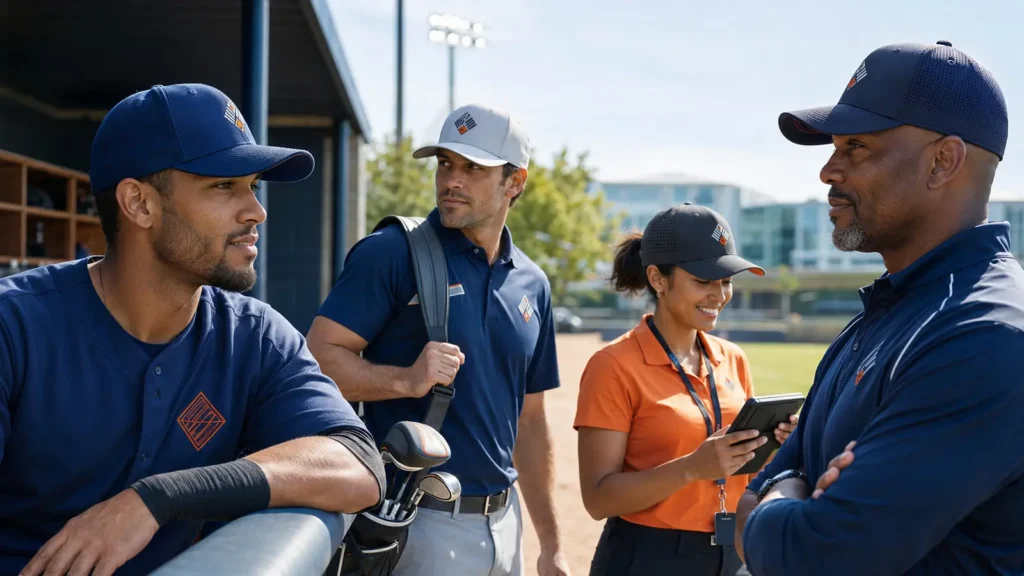
5. Wool-Blend Heritage Fitted Cap
Wool-blend fitted hats reference traditional baseball headwear and can give a brand collection a substantial, textured appearance. Modern “wool-like” caps may also use synthetic blends, so the buyer should request exact fiber content rather than judge from a product name.
A heritage direction works for baseball clubs, alumni shops, winter merchandise, anniversary programs, breweries, restaurants, and lifestyle labels. It can be paired with felt appliqué, chain-stitch-inspired artwork, direct embroidery, or a woven emblem, provided the decoration method is sampled on the actual fabric.
Confirm the fiber composition, fabric weight, pilling expectations, dye-lot consistency, sweatband, shrinkage, care, recovery after packing, and availability for repeat orders.
6. Five-Panel or A-Frame Fitted Cap
Five-panel and A-frame constructions can give private-label collections a distinct front shape. A five-panel cap may remove the center seam from the main decoration area. An A-frame pattern typically creates a pinched, higher front that feels more directional and vintage-inspired.
New Era describes its fitted A-Frame as merging the two front panels into one to create a vintage look and shape. For custom manufacturing, the important lesson is that panel architecture changes both the silhouette and the decoration surface. Source: New Era A-Frames overview.
This style is best used when the buyer has a clear visual brief. Front patches, script logos, compact emblems, and appliqué can work well, but the pattern should be evaluated from front, side, and three-quarter angles. A technically correct logo can still look too high or too narrow if the front panel has an unfamiliar pitch.
7. Youth-Proportioned Fitted Cap
Youth teams need more than a smaller circumference. Crown depth, visor length, front-panel height, and logo scale all affect whether the cap looks and feels appropriate. An adult crown on a small elastic band may sit too deep or obscure the wearer’s face.
For schools and youth leagues, collect age bands and measured head circumferences from a representative group. Approve at least one sample in each intended size range. Check the cap during normal movement, not only while standing still.
Youth orders also require careful artwork scaling. A logo digitized for an adult front panel may need fewer details or a different stitch plan at a smaller size. Maintain visual consistency without forcing identical physical dimensions across all caps.
8. Fully Custom Private-Label Fitted Hat
A fully custom fitted hat gives retailers, distributors, and private-label brands control over the crown pattern, sizing system, visor, fabric, colors, decoration placements, underbill, sweatband, interior taping, labels, hangtags, stickers, and retail packaging.
This approach produces the most distinctive result but requires the strongest specification discipline. The approved sample should be treated as a measurable standard. Photograph it, record materials and color references, retain artwork files, and define acceptable production tolerances. If a repeat order changes fabric or decoration, approve the change rather than assuming the first sample still represents the product.
Crown Profile, Structure, and Visor: The Three Shape Decisions
Buyers often focus on color and logo first, but three shape decisions determine how a fitted hat is perceived.
Crown profile
- Low profile: sits close to the head; suited to understated programs and curved visors.
- Mid profile: balanced and widely adaptable; a strong starting point for team and staff use.
- High profile: creates a taller front and stronger fashion statement; useful for bold retail decoration.
Structure
- Structured: uses buckram or another support material to hold the front shape and stabilize embroidery.
- Unstructured or lightly structured: conforms more to the head and feels casual, but may not support large or dense decoration as cleanly.
Visor
- Flat visor: associated with modern fitted merchandise and streetwear; can sometimes be shaped by the wearer.
- Pre-curved visor: familiar for athletic, golf, staff, and uniform applications.
- Sandwich or contrast visor: adds color without changing the crown; useful when the team palette needs a secondary accent.
New Era’s official 59FIFTY guide describes a full crown and flat visor, while its Low Profile collection describes a lower, less structured crown. These terms are useful references, but custom patterns vary. Always judge the supplier’s physical sample. Sources: New Era 59FIFTY silhouette guide and Low Profile 59FIFTY.
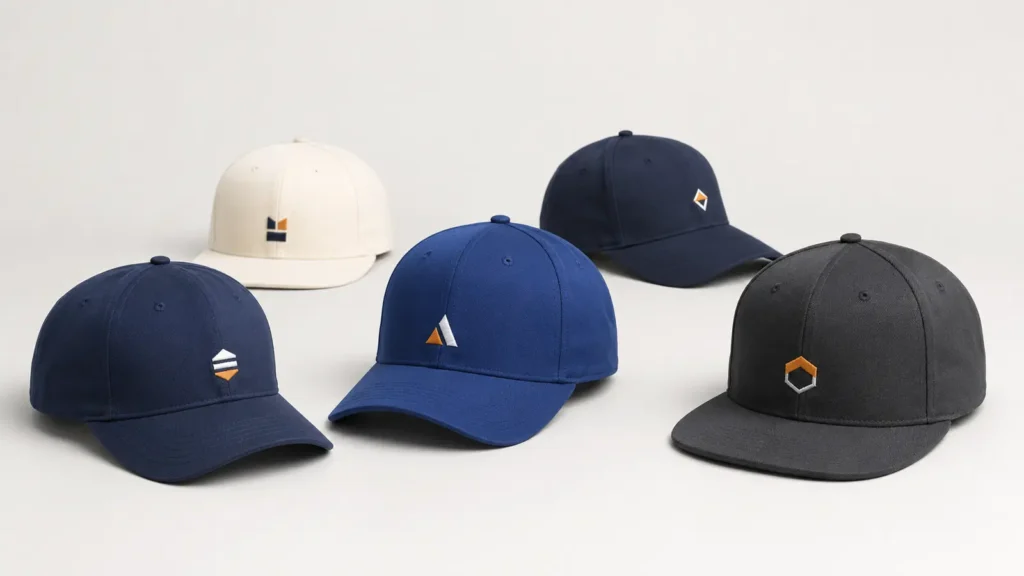
How to Choose Materials for Fitted Hats
| Material direction | Typical advantages | Suitable programs | Questions to confirm |
|---|---|---|---|
| Cotton twill | Familiar hand feel, matte surface, broad color potential | Corporate, casual, school and lifestyle merchandise | Shrinkage, colorfastness, weight, structure |
| Polyester | Shape retention and performance options | Teams, events, outdoor staff, training | Breathability, heat sensitivity, moisture claims |
| Wool or wool blend | Heritage texture and substantial appearance | Baseball-inspired retail, alumni, seasonal collections | Exact fiber content, pilling, care, dye-lot consistency |
| Acrylic or poly-wool-look blend | Consistent uniform appearance and accessible color range | Team caps, fan merchandise, distributors | Hand feel, stretch recovery, fiber label |
| Nylon or technical woven | Lightweight feel and modern performance look | Golf, running, outdoor and travel programs | Noise, wrinkling, coatings, decoration compatibility |
| Mesh or perforated panel construction | Increased airflow in selected areas | Training and warm-weather applications | Panel stability, logo placement, snag resistance |
| Recycled-content option | Supports a documented material brief | Brands with verified sourcing requirements | Certification or transaction documentation, exact percentage, availability |
Material selection must be connected to end use. A dense cotton twill can feel dependable for corporate merchandise but warmer during tournament play. A lightweight polyester may support active use but can react differently to high embroidery density or heat transfer. Request a fabric swatch and decorated sample before approving bulk production.
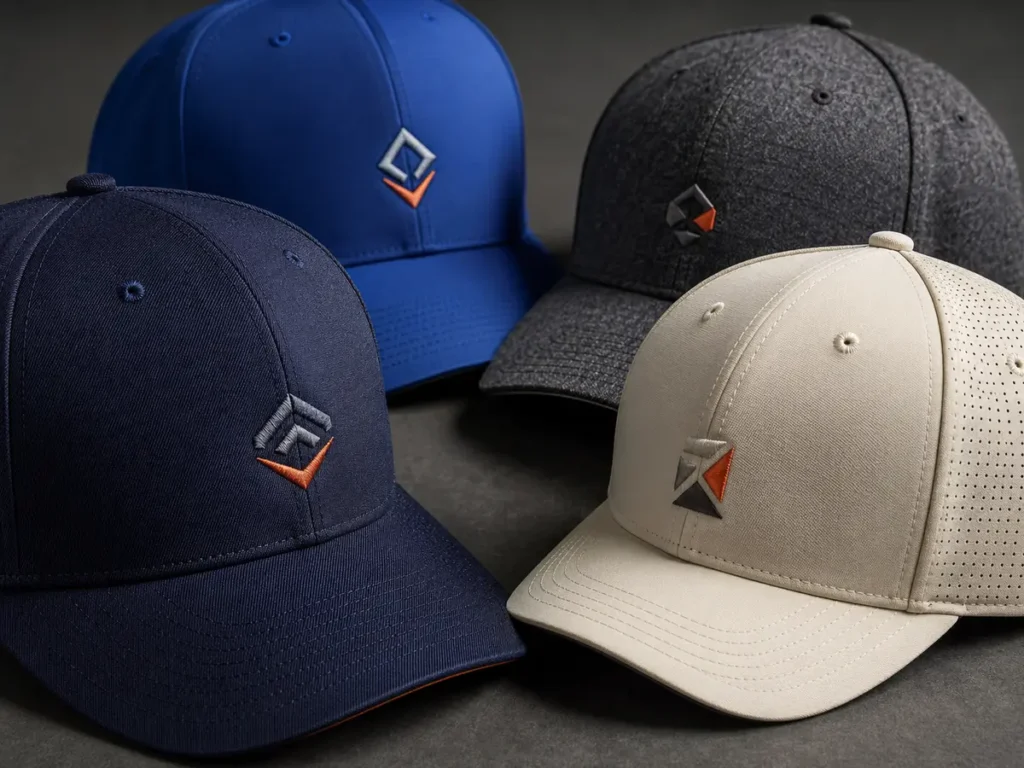
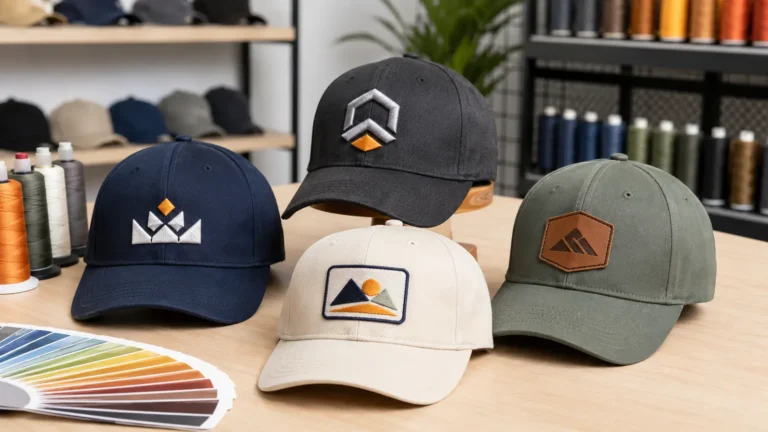
Logo and Decoration Methods
The best decoration method is the one that reproduces the artwork at the correct scale without damaging the crown or making the cap uncomfortable.
| Method | Visual result | Best use | Main control point |
|---|---|---|---|
| Flat embroidery | Clean stitched logo with moderate detail | Team marks, text, side logos | Small text, thread density, seam crossing |
| 3D or puff embroidery | Raised, dimensional front mark | Bold letters and simplified emblems | Foam coverage, edge definition, minimum line width |
| Woven patch | Fine detail and smooth surface | Crests, compact multicolor artwork | Patch edge, attachment, color matching |
| Embroidered patch | Traditional textured badge | Heritage and sports programs | Thickness, border, placement |
| Rubber/PVC patch | Modern dimensional appearance | Outdoor, performance and lifestyle programs | Weight, flexibility, attachment method |
| Leather-style patch | Refined or workwear direction | Corporate, outdoor and private label | Material specification, deboss clarity, care |
| Heat transfer | Lightweight printed detail | Technical fabrics and selected graphics | Fabric compatibility, adhesion, wash test |
| Appliqué or tackle-twill style | Layered athletic look | Baseball heritage and statement designs | Edge stitching, bulk, shape accuracy |
Do not approve embroidery only from a screen rendering. Ask for a digitized sew-out on the selected fabric or a finished cap sample. Check small text, thread gaps, puckering, front-panel distortion, and the appearance across the center seam.
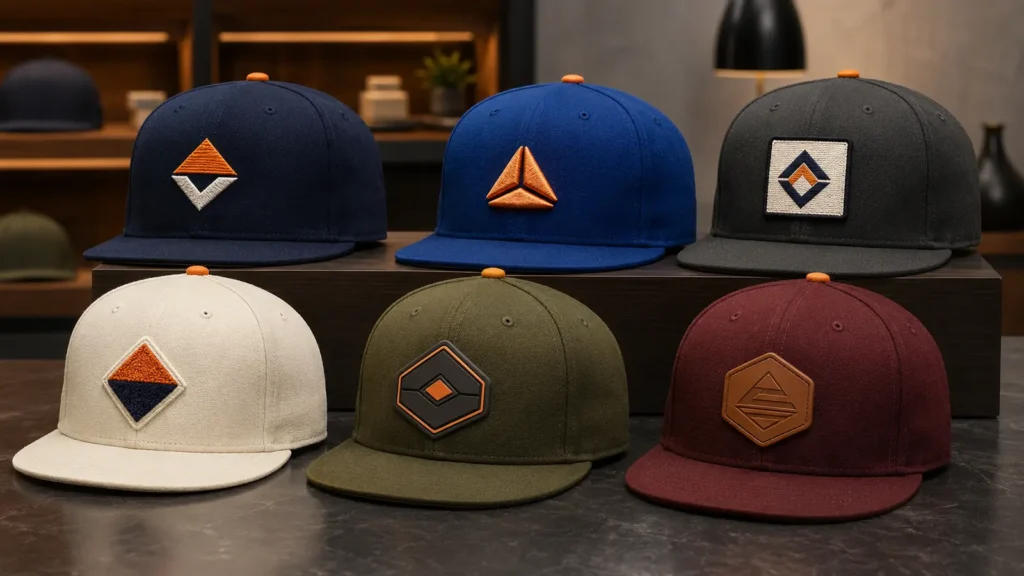
Fitted Hat Sizing for Bulk Orders
Sizing is the largest inventory risk in a fitted hat program. A style can be visually correct and still fail if the size curve is wrong.
True fitted sizing
True fitted caps are labeled by individual sizes. They are useful when buyers want a precise traditional fit and have reliable demand data. They also create more SKUs, more picking complexity, and more leftover-size risk.
Stretch-fitted sizing
Stretch-fitted caps cover a range through the sweatband, fabric, or both. They simplify team allocation and can reduce SKUs. They are not “one size fits all.” Flexfit explicitly advises buyers to measure the head and match it to the product’s size guide. Source: Flexfit sizing chart.
A practical sizing process
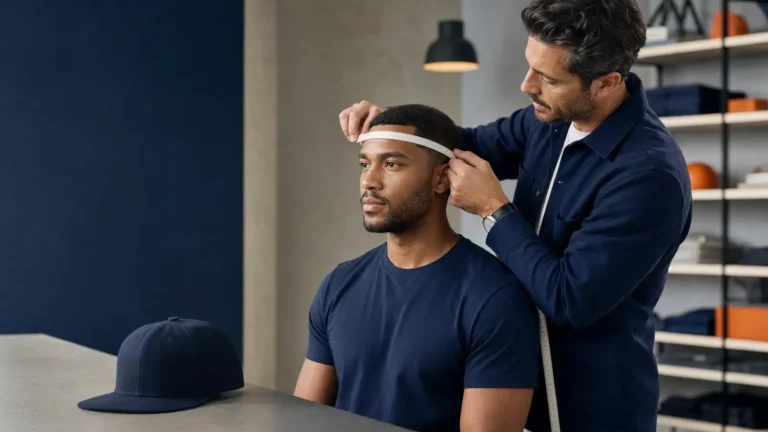
- Define the measurement method in the order sheet.
- Measure around the head where the sweatband will sit.
- Collect data from a representative wearer group.
- Compare measurements with the supplier’s actual chart.
- Order a sample size set when the program is large or recurring.
- Test comfort for at least several minutes and during movement.
- Record the final size distribution and actual issue rate.
- Use the data to refine repeat orders.
Avoid converting another brand’s hat size directly into a custom order. Pattern, sweatband, material stretch, and production tolerance can change the fit.
Translating Features Into Procurement Decisions
| If the buyer needs… | Prioritize… | Avoid assuming… |
|---|---|---|
| A consistent team appearance | One approved crown profile, common fabric lot, controlled logo placement | Every color behaves identically |
| Fewer size SKUs | Stretch-fitted ranges with tested recovery | “Stretch fitted” means universal fit |
| A premium retail silhouette | Custom crown, visor, interior trims, labels and packaging | A larger logo automatically looks more premium |
| Active comfort | Lightweight fabric, ventilation plan, sweatband and low-bulk decoration | “Performance” is a measurable claim without evidence |
| Repeat-order consistency | Retained specification, color references, approved sample and QC record | A style name alone identifies the same construction |
| A youth program | Youth-specific crown depth, visor scale and size trials | Adult proportions can simply be reduced at checkout |
What Drives the Cost of Custom Fitted Hats?
Bulk pricing depends on the total specification, not only the hat style. Important cost drivers include order quantity by color and size, number of fitted sizes, stock or custom-dyed fabric, crown complexity, material composition, visor and underbill treatment, embroidery stitch count, decoration placements, patch construction, interior trims, labels, retail packaging, sampling, testing requirements, shipping destination, and target date.
To receive a comparable quotation, send the same specification to each shortlisted supplier. A low quote based on generic embroidery and stock fabric cannot be fairly compared with a quote for a custom crown, Pantone matching, multiple fitted sizes, interior branding, and retail packaging.
Send JIUMU your reference image or tech pack, intended users, total quantity, size plan, crown profile, visor shape, fabric, logo files, packaging needs, destination country, and target delivery date. JIUMU can review the brief for OEM/ODM development, digital mockups, sampling, decoration, and bulk-order planning. Explore custom fitted hats or contact JIUMU.
Sample Approval and Quality Control
A good sample process separates aesthetic approval from measurable product control.
Stage 1: Confirm the written specification
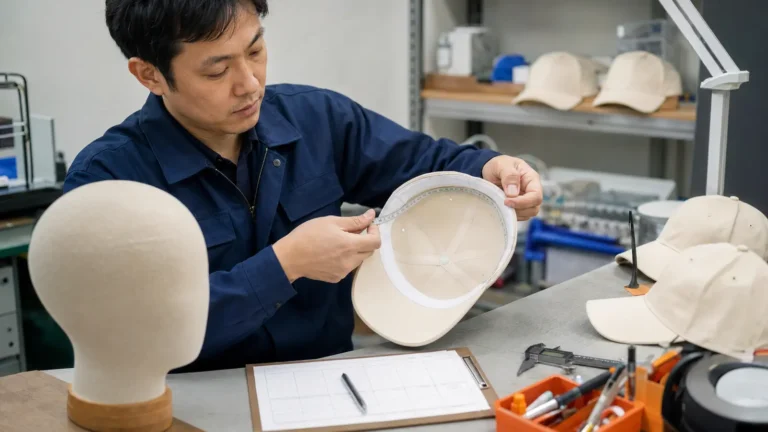
The order sheet should identify the crown, panel count, structure, sizing system, measurements, fabric, colors, visor, sweatband, interior taping, logo size and placements, decoration colors, labels, packaging, carton marks, and pack ratio.
Stage 2: Review the physical sample
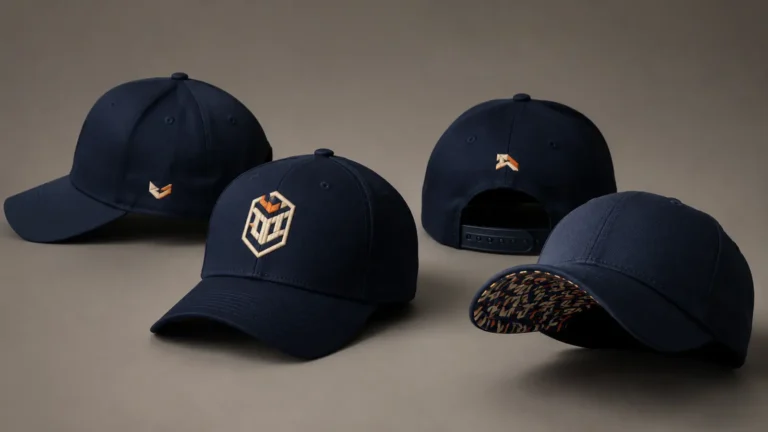
Evaluate the sample in natural light and photograph it from front, back, side, top, and three-quarter views. Check fit on representative wearers. Compare decoration against the approved artwork, then record any correction numerically—for example, moving a logo by a specific distance—rather than saying it “looks slightly low.”
Stage 3: Set the bulk reference
Once approved, identify which sample and document version control the order. Keep a reference for color, dimensions, logo placement, and packaging. If any material changes after approval, record and approve the substitution.
Bulk inspection checklist
- Correct purchase order, style, colors, and size quantities
- Circumference and crown depth within agreed tolerance
- Symmetrical panels and consistent front shape
- Visor centered, properly sewn, and consistently curved or flat
- No broken stitches, open seams, loose threads, stains, or holes
- Embroidery density and registration consistent with approval
- Patches aligned and securely attached
- Sweatband, taping, labels, and size marks correct
- Color consistent within the inspected lot
- Packaging, barcodes, carton marks, and size assortments correct
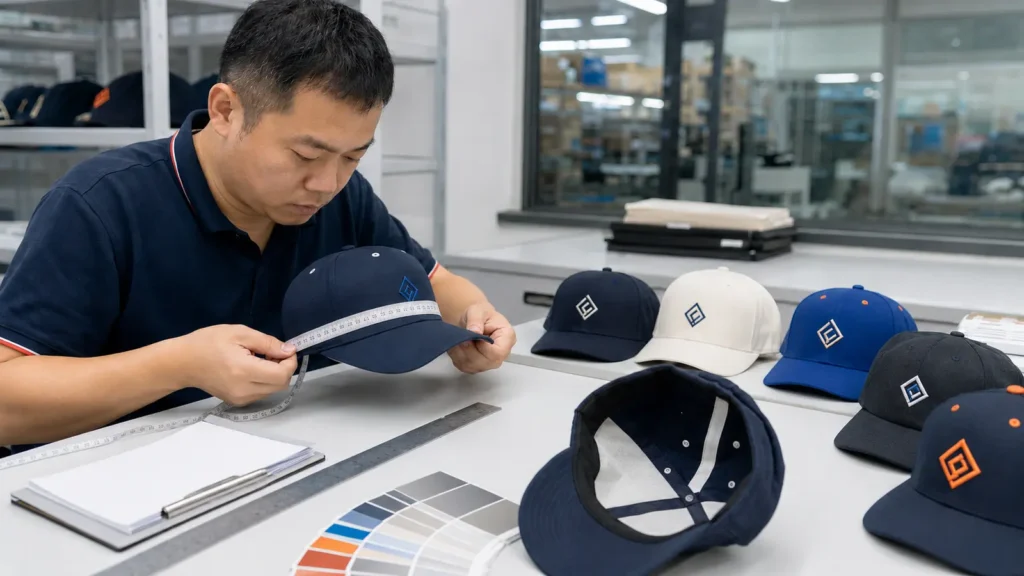
Bulk-Order Planning Process
- Define the role. Decide whether the hats are equipment, uniforms, promotional items, retail merchandise, or a private-label collection.
- Choose the silhouette and sizing system. Confirm profile, structure, panel count, visor, and whether true fitted or stretch fitted best matches the size data.
- Select fabric and colors. Confirm swatches or approved color references.
- Prepare decoration files. Supply vector artwork where possible and identify exact placements.
- Plan interior branding and packaging. Add labels, hangtags, stickers, and pack ratios before sampling.
- Approve mockups and physical samples. Treat mockups as layout tools and samples as product evidence.
- Confirm and inspect production. Lock quantities, destination, timing, approved sample, and tolerances.
- Record results. Save the final size curve, issue rate, artwork, colors, and specification version.
Questions to Ask a Fitted Hat Supplier
- Is the cap true fitted or stretch fitted, and what creates the stretch?
- What are the measured circumference ranges and crown depths for each size?
- Can you provide a sample size set?
- Which crown profiles, panel patterns, fabrics, and decoration methods are available?
- What is the usable decoration area after seam and panel limitations?
- How will Pantone colors and materials be approved?
- Which private-label and packaging elements can be customized?
- What sample stages are recommended before bulk production?
- Which measurements and visual criteria are checked during QC?
- How are nonconforming units handled, and which records support repeat orders?
Common Buying Mistakes
Choosing by photo alone
A front-view photo does not show crown depth, rear shape, stretch, sweatband, or fit. Request specifications and a physical sample.
Treating profile and structure as identical
Low, mid, and high describe crown profile. Structured and unstructured describe support. Specify both.
Guessing the size curve
An even split across sizes rarely reflects real team or retail demand. Use measurements, order history, or preorders.
Using overly detailed artwork
Small lettering, thin outlines, and complex gradients may not translate to embroidery. Simplify intelligently or select a patch or print method better suited to the art.
Approving only a digital mockup
A mockup cannot reveal puckering, seam distortion, patch thickness, crown shape, or fit.
Ordering “performance” without a testable specification
Ask what the term means: fiber, construction, sweatband, drying behavior, ventilation, or a documented test. Use only supportable claims in marketing.
Why JIUMU for Custom Fitted Hats?
JIUMU is a Guangdong-based B2B custom teamwear, logo apparel, hats, uniforms, bags, and branded merchandise supplier established in 2010. It supports North American and European teams, schools, clubs, distributors, uniform dealers, promotional companies, retailers, and private-label brands.
Relevant capabilities include OEM/ODM development, digital mockups, physical samples, embroidery, woven and dimensional patches, fabric sourcing, Pantone color matching, private labels, hangtags, packaging, bulk quality control, and export support.
The typical MOQ is 50 pieces, subject to product structure and customization. Buyers should share the total quantity, size breakdown, style, colors, logo, packaging, and delivery requirements so the team can confirm feasibility and quotation details.
Explore custom fitted hats, compare custom baseball caps, or build a coordinated program through custom team uniforms.
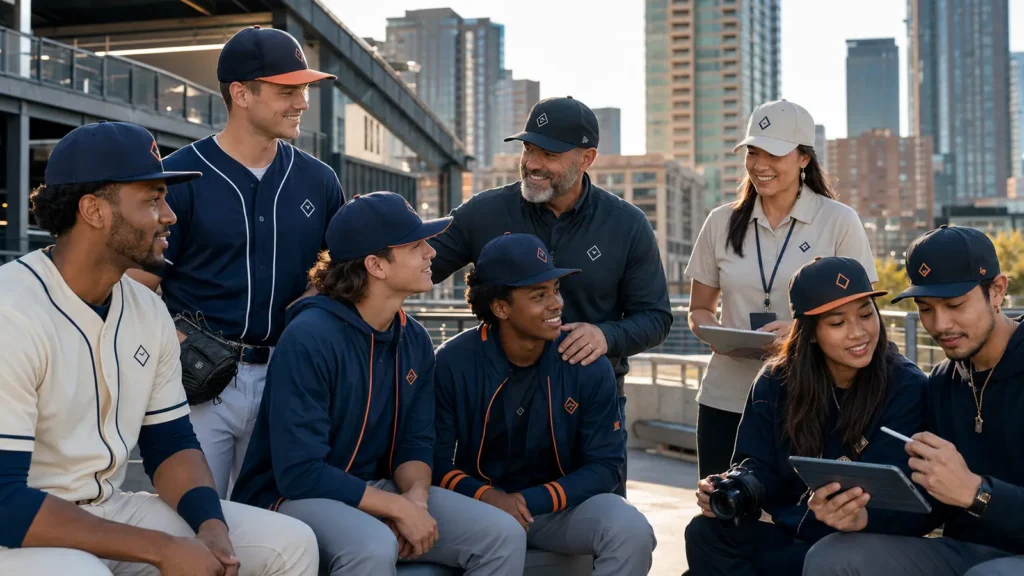
Frequently Asked Questions
Final Recommendation
Start with the wearer and commercial use, not the decoration. For active teams, prioritize a tested mid-profile stretch-fitted system. For retail and fan merchandise, consider a high-profile true-fitted cap with a flat visor. For corporate or golf programs, evaluate a lower-profile curved-brim style. Private-label brands should control the complete product—crown, visor, fabric, fit, interior trims, decoration, and packaging—through a written specification and approved sample.
Sources and Further Reading
- New Era 59FIFTY Silhouette Guide
- New Era Low Profile 59FIFTY Collection
- New Era A-Frames Overview
- Flexfit Sizing Chart
- Flexfit 6100NU Product Specification
About JIUMU
Established in 2010 in Guangdong, China, JIUMU supports B2B buyers with custom hats, teamwear, logo apparel, bags and branded merchandise. Capabilities include OEM/ODM development, sampling, embroidery, patches, labels, packaging, quality control and export support.