
Custom Hat Packaging Options for Retail Brands
Custom hat packaging has to do more than make a cap look attractive when a box is opened. It must protect the crown and brim, identify every color and size correctly, carry the required retail or fulfillment barcode, fit the buyer’s warehouse process, and survive international transportation without creating unnecessary volume.
For retail brands, distributors, and ecommerce sellers, the best solution is usually a layered packaging specification rather than one universal package. A soft unstructured dad hat can often travel in a compact individual bag. A high-crown structured snapback may need an insert, controlled nesting, or a retail box. A unit going to a third-party fulfillment center may also require a seller-supplied product label, while the master carton needs its own shipping marks and warehouse labels.
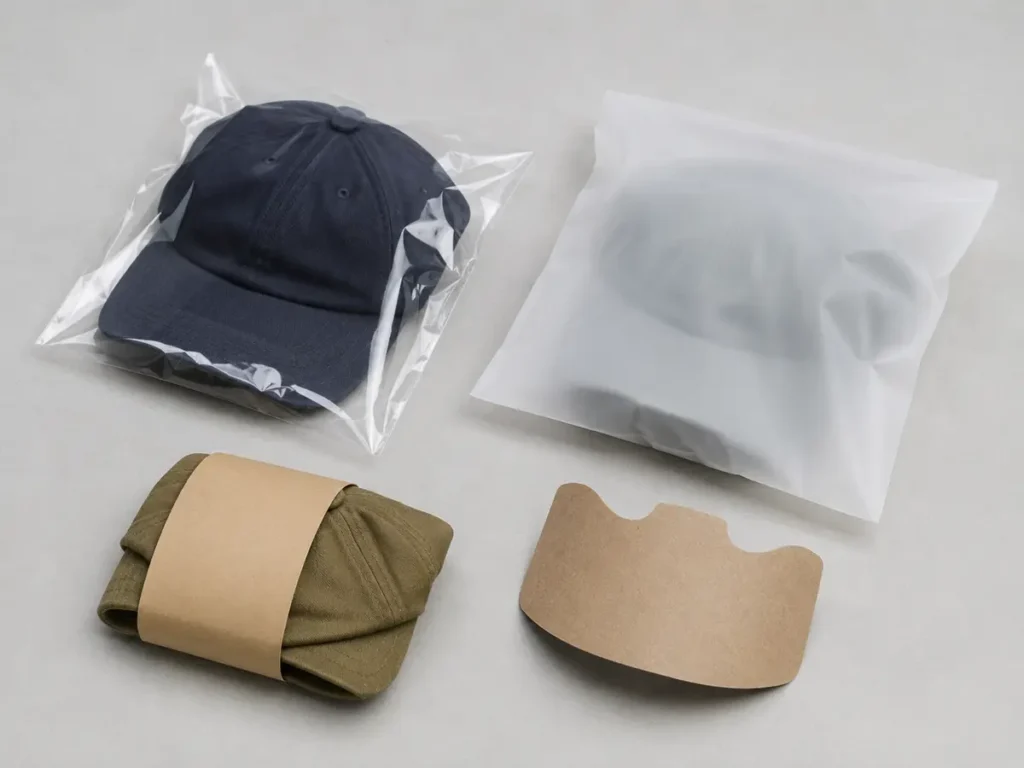
Quick Answer: Yes, custom hats can be individually packaged with clear or frosted bags, paper bands, tissue, cardboard crown supports, retail boxes, or multi-cap boxes. Brands can also add hangtags, size stickers, SKU labels, UPC/EAN barcodes, marketplace labels, carton marks, and packing lists.
The correct combination depends on the cap structure, sales channel, warehouse rules, order quantity, environmental-claim policy, and freight method. Structured caps need more crown and brim protection than unstructured caps. Retail boxes improve presentation but increase packaging cost and volumetric weight. For fulfillment orders, the buyer should provide the current label files and shipment instructions generated by its marketplace or warehouse account. Final packaging should be approved with a physical packed sample, a barcode scan test, a color-size-SKU reconciliation, and a trial master carton before bulk dispatch.
Think in Five Packaging Layers
Packaging problems often occur because the buyer specifies only the visible retail package. A practical hat-packaging brief should control five separate layers:
| Layer | Main purpose | Typical components | Approval question |
|---|---|---|---|
| Product support | Preserve crown, brim, decoration, and closure | Tissue, crown insert, brim spacer, divider | Does the cap recover its intended shape after unpacking? |
| Individual package | Protect one saleable unit from dust, handling, and mix-ups | Clear bag, frosted bag, paper band, individual carton | Is each unit closed, identifiable, and presentation-ready? |
| Retail branding | Communicate brand, size, price, care, and merchandising information | Hangtag, size sticker, belly band, printed box, insert card | Are artwork, legal copy, and attachment positions approved? |
| Fulfillment identification | Connect a physical unit to the buyer’s inventory record | SKU, GTIN barcode, FNSKU or warehouse-specific label | Does the correct code scan and match the exact variant? |
| Transport packaging | Move the order through export, carrier, and receiving operations | Master carton, liner, dividers, carton mark, shipping label | Can the carton protect the caps and be received without relabeling? |
Treating these layers separately helps procurement teams compare cost and risk. A custom retail box, for example, may solve presentation but still fail if the inner cap is loose, the wrong SKU is applied, or the master carton crushes during stacking.
Custom Hat Packaging Options at a Glance
| Packaging option | Best use | Protection level | Branding potential | Main tradeoff |
|---|---|---|---|---|
| Bulk pack without individual bag | Low-cost wholesale transfer where the buyer repacks locally | Basic | Low | More exposure to dust and handling; higher sorting burden |
| Clear individual bag | Wholesale, team, retail, and many fulfillment programs | Moderate | Sticker or printed bag | Plastic use and warning/label requirements must be checked |
| Frosted or custom-printed bag | Private-label ecommerce and retail | Moderate | High | Printing MOQ, artwork setup, and reduced product visibility |
| Paper band or belly band | Compact retail presentation for suitable cap styles | Low to moderate | High | Does not provide full moisture or dust enclosure |
| Crown support plus individual bag | Structured snapbacks, trucker caps, high crowns | Moderate to high | Moderate | More material and packing volume |
| Folding retail carton | Ecommerce shipment or retail display | High when fitted correctly | High | Higher unit cost and volumetric weight |
| Rigid retail box | Gift, collaboration, launch, or premium presentation | High | Very high | Highest cost, storage space, and freight volume |
| Multi-cap box | Sets, bundles, subscriptions, and coordinated collections | High with dividers | High | Bundle identity and “do not separate” controls are needed |
The lowest-price package is not automatically the lowest landed-cost choice. A small increase in support material may reduce deformation, repacking labor, returns, and warehouse exceptions. Conversely, an oversized rigid box can add more freight and storage cost than the brand value it creates.
Individual Bags, Paper Packaging, and Hat Supports
Clear individual bags
A clear bag lets warehouse staff identify the hat without opening it and allows an internal product barcode to remain visible when the receiving system permits scanning through the film. The specification should define material, thickness, dimensions, closure, ventilation if needed, warning requirements, print area, label position, and whether excess film must be folded or trimmed.
For marketplace programs, do not assume any generic bag will qualify. Amazon’s current U.S. FBA guidance, for example, includes rules for bag thickness, sealing, barcode visibility, and suffocation warnings for specified opening sizes. Requirements can change and may differ by marketplace. Review the current Amazon product packaging requirements and bagging requirements in the seller account before artwork and bag dimensions are frozen.
Frosted or printed bags
Frosted film hides minor handling marks and can create a more deliberate private-label presentation. Printing can add a brand mark, care message, disposal instruction, or warning. However, opacity affects visibility and barcode placement. If a unit identifier cannot be scanned reliably through the bag, place the approved label on the outside in a flat, accessible area.
Paper bands and sleeves
A belly band can carry brand information while using little space. It works best when the cap can be folded without damaging the crown, decoration, or brim. It is not a complete barrier against dust, moisture, or handling. A band may be combined with tissue or a protective shipping carton when the presentation benefit is useful but a full plastic bag is not desired.
Crown inserts, brim spacers, and tissue
Cardboard or molded-paper supports can help a structured crown resist inward collapse. Tissue can separate embroidery or hardware from adjacent products. Brim spacers and carton dividers can reduce pressure points. The insert should support the cap without overstretching the sweatband or leaving a crease.
Are Recyclable Hat Packaging Options Available?
Potential options include paper bands, paperboard inserts, corrugated boxes, mono-material bags, and films containing documented recycled content. Availability depends on the packaging supplier, required dimensions, printing, order quantity, and destination market.
The claim on the package must be more precise than the material name. A package that is technically recyclable may not be accepted by local collection systems. A film with recycled content is not automatically recyclable, and a paper package with plastic lamination, metallic foil, magnets, adhesives, or mixed components may require a qualified claim.
For the U.S. market, the Federal Trade Commission’s Green Guides summary advises marketers to qualify partial recycled-content claims and avoid misleading environmental statements. The FTC also explains that environmental claims should be truthful and substantiated. Buyers should have legal or compliance owners approve on-pack wording for each sales market rather than asking a supplier to add a generic “eco-friendly” logo.
For a packaging quotation, distinguish these requests:
- Material type and supplier specification
- Percentage and type of recycled content, if claimed
- Certification or chain-of-custody document required by the buyer
- Whether the complete pack or only one component is recyclable
- Destination-market disposal wording and symbols
- Ink, coating, lamination, adhesive, and closure restrictions
- Required performance in humidity, stacking, and transit
An environmental option is useful only if it still protects the product. Replacing a compact bag with a heavy oversized box may shift rather than eliminate environmental and cost impacts. Compare material use, damage risk, freight volume, disposal route, and claim accuracy together.
What Protects Structured Caps Best?
Structured hats usually require more shape control than unstructured hats because their front panels are designed to hold a defined profile. High crowns, flat brims, 3D puff embroidery, front patches, and rigid front buckram can be damaged by heavy compression or incorrect nesting.
Useful controls include:
- A crown insert sized to the finished cap profile
- Consistent cap orientation and nesting depth
- A spacer that prevents the next brim from pressing into the decoration
- Dividers between rows or retail units
- A master carton with enough compression strength for the distribution route
- A packing count that avoids both overfilling and excessive movement
Unstructured dad hats and soft washed caps can usually be folded more compactly, but careless folding can still crease a brim, distort a patch, or mark a metal closure. The packing sample should define exactly how the back panels, closure, and brim are positioned.
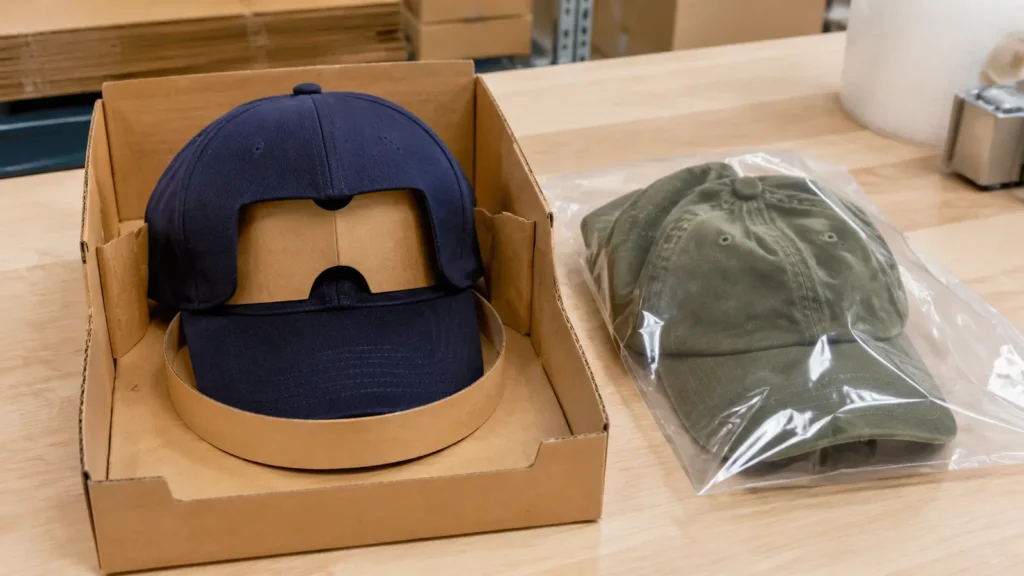
A cap should not be judged immediately after aggressive compression without an agreed recovery period. During sample approval, unpack the hat, reshape it using the approved method, and review its profile from the front, side, and top. If the crown retains a permanent dent or the brim curvature changes, revise the insert, nesting direction, carton count, or box strength.
Retail Boxes and Multi-Cap Packaging
A retail box can function as presentation packaging, ecommerce shipping protection, or both. The first design decision is whether the box must survive courier distribution without an outer shipper. A beautiful folding carton may work inside a master carton but arrive damaged when used directly as a parcel.
Common formats include:
- Folding corrugated mailer for one cap
- Paperboard retail carton placed inside a shipping carton
- Rigid two-piece or magnetic-style presentation box
- Drawer-style box for collaborations or gift programs
- Two-, three-, or multi-cap bundle box with dividers
- Display-ready retail carton for shelf or counter presentation
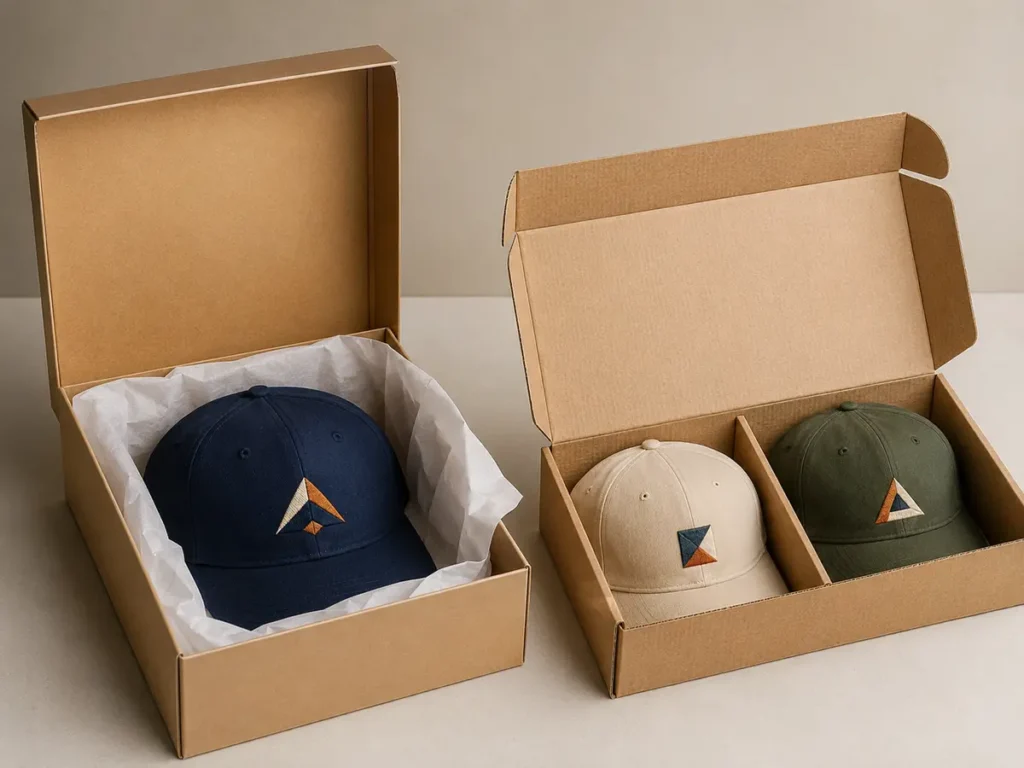
Approve the internal dimensions using the actual finished hat, not only a CAD drawing. Check whether the top button rubs the lid, the brim is forced flat, the closure catches on tissue, or the logo touches the wall. For multi-cap packs, define sequence, color assortment, divider position, bundle SKU, and whether the warehouse may separate the set.
Printed packaging artwork should include a dieline, bleed, safe area, color references, finish, substrate, copy version, barcode quiet zone, and proof-approval process. Foil, embossing, spot varnish, lamination, windows, ribbons, and magnets can affect price, production time, recyclability statements, and minimum quantities.
Hangtags, Size Stickers, SKU Labels, and Retail Barcodes
Retail brands often need several identifiers on one cap. Each identifier has a different purpose:
| Identifier | Owner | Main purpose | Typical location |
|---|---|---|---|
| Style number | Brand | Defines the product model | ERP, hangtag, packing list |
| Color code | Brand | Defines the exact color variant | Hangtag, unit label, inner label |
| Size code | Brand | Defines adjustable, youth/adult, or fitted size | Size sticker, label, hangtag |
| SKU | Brand or retailer | Internal inventory identity for one sellable variant | Hangtag or unit package |
| GTIN / UPC / EAN | Brand through GS1 or authorized owner | Global trade-item identification and retail scanning | Printed package or barcode label |
| FNSKU / marketplace identifier | Marketplace seller account | Marketplace-specific fulfillment identification where required | Outside of saleable unit package |
| Carton code | Buyer, warehouse, or carrier | Identifies carton contents or shipment | Master carton exterior |
GS1 explains that GTINs identify trade items and that UPC/EAN symbols are widely used at retail point of sale. The brand owner should obtain and control its identifiers through the appropriate GS1 barcode process, then send production-ready data or labels to the supplier. A manufacturer should not invent a UPC, reuse one across unrelated variants, or substitute its own internal code for the buyer’s retail identifier.

Recommended SKU and label data table
Use one row for every sellable variant:
| Field | Example format | Required check |
|---|---|---|
| Brand style | CAP-2401 | Matches purchase order and artwork |
| Brand color name | Navy | Matches approved sample terminology |
| Internal color code | NVY01 | Unique and consistent across systems |
| Size | Adjustable Adult | Matches sewn label and listing |
| Brand SKU | CAP-2401-NVY-ADJ | Unique for the variant |
| GTIN / UPC / EAN | Buyer-supplied data | Check digit and ownership verified by buyer |
| Marketplace SKU | Buyer-supplied data | Matches seller account listing |
| FNSKU or warehouse label file | Buyer-supplied PDF or approved artwork | Correct unit and current shipment workflow |
| Hangtag artwork version | HT-V3 | Correct language, price policy, and legal copy |
| Unit pack | Clear bag + crown insert | Matches approved packaging specification |
| Units per carton | 24 | Matches carton plan and warehouse limits |
A spreadsheet alone does not prevent errors. Before production, print representative labels, scan them, and compare the decoded value with the buyer’s approved data. During packing, use controlled label batches so operators cannot mix navy and black, youth and adult, or single-unit and multipack labels.
Can Hats Be Packed for Amazon FBA or Other Fulfillment Centers?
Yes, hats can be prepared for a fulfillment program when the buyer provides current requirements, account-generated labels, shipment plan, routing details, and approval authority. “FBA-ready” or “3PL-ready” should be treated as a project specification, not a permanent packaging feature.
Amazon distinguishes between eligible manufacturer barcodes and Amazon barcodes, and its requirements depend on the product and seller relationship. Its current guidance states that resellers are required to use Amazon barcodes while eligible products may use manufacturer barcodes. Review the current Amazon barcode guidance for the actual listing.
Amazon also states that, from January 1, 2026, it no longer offers prep and item-labeling services for FBA shipments in the U.S. store. That makes upstream preparation and verification more important, but sellers should still confirm the current policy in Seller Central before production. See the official FBA prep service notice.
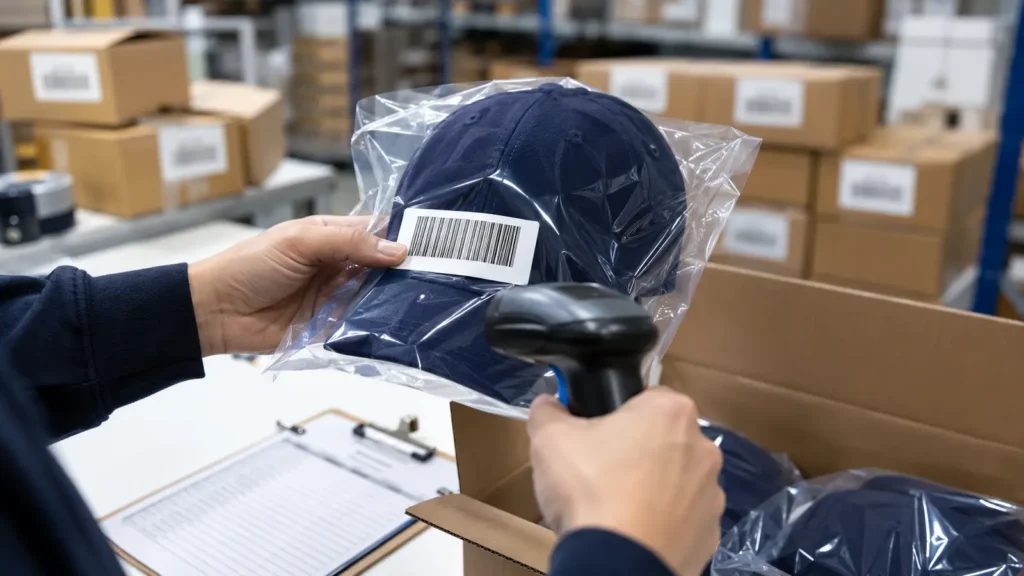
A safe approval process is:
- Buyer creates the listing and confirms the exact sellable unit.
- Buyer sends the current unit label file exported from its account.
- Supplier maps each file to style, color, size, and bundle configuration.
- Supplier prepares a photographed and physically scanned pack sample.
- Buyer confirms placement, visibility, covered barcodes, warning text, and scannability.
- Supplier locks the version and applies labels during controlled packing.
- Carton contents are reconciled with the shipment plan.
- Buyer supplies the final carton or pallet labels at the correct stage.
For Amazon small-parcel deliveries, official guidance says every box needs an FBA box ID label and a carrier label. Shipment labels are specific to the created shipment, so they should not be guessed or permanently preprinted. See Amazon’s Send to Amazon box-label instructions.
Third-party logistics providers, department stores, and distributors may require routing guides, advance shipping notices, carton labels, pallet configurations, appointment numbers, or chargeback rules. Ask for the current vendor manual and a named approval contact.
Outer Cartons, Carton Marks, Moisture, and Crush Protection
The master carton is part of the product-protection system. Specify carton style, internal dimensions, board grade or performance requirement, maximum gross weight, packing count, assortment, liner, dividers, sealing method, carton marks, and pallet pattern when applicable.
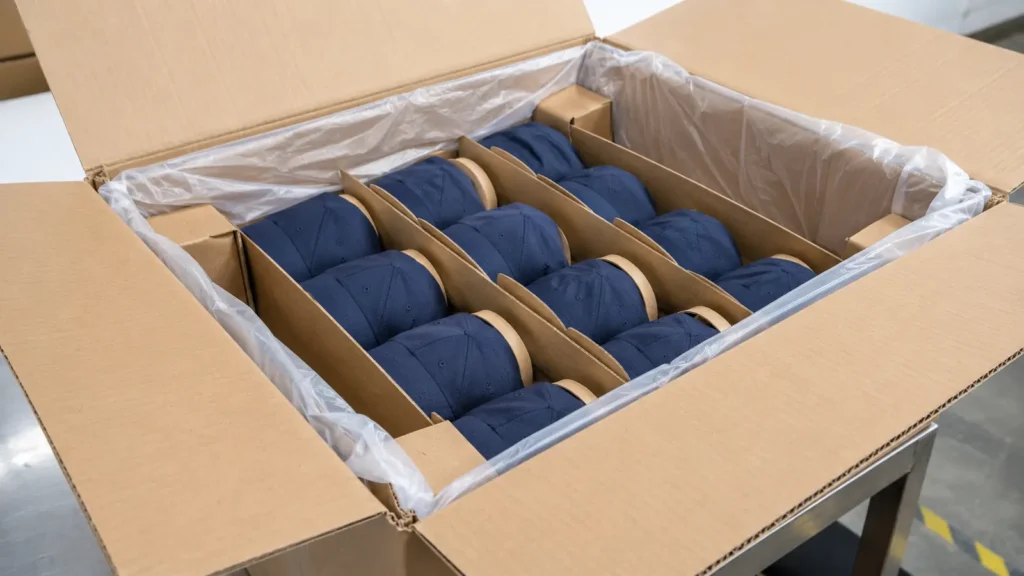
Carton marks can include buyer name or code, purchase order, destination, style, color, size, quantity, carton sequence, country of origin, gross and net weight, and dimensions. The buyer should approve the exact fields and language. Do not place confidential retail information or an unapproved brand mark on the export carton.
Moisture control may involve dry packing conditions, a clean carton liner, moisture-barrier materials, and project-appropriate desiccant. The correct method depends on route, season, product moisture, packaging material, destination, and buyer policy. Desiccant is not a substitute for dry goods, sound cartons, or correct container management. Its type, quantity, placement, warnings, and destination compliance should be specified by a qualified packing plan.
For structured caps, test the proposed carton with the actual packing count. A sample carton can be reviewed for compression, handling, stacking, and recovery after transit simulation. Drop or compression testing may be useful when the buyer, carrier, or retail program defines a method and acceptance criteria. Avoid claiming a carton is “shipping-proof” without an agreed test.
Packaging MOQ, Cost, and Lead-Time Drivers
Packaging MOQ is often different from the hat MOQ. A standard clear bag or generic kraft insert may be available in small quantities, while a custom-printed bag, specialty paper, molded insert, or rigid box may require a larger run. A brand can sometimes purchase excess packaging for future reorders, but storage conditions, artwork changes, and inventory ownership must be agreed.
Key cost drivers include:
- Standard versus custom material and dimensions
- Number of print colors and print process
- Dieline and tooling requirements
- Foil, embossing, coating, lamination, window, ribbon, or magnet
- Individual versus bundle packing
- Crown inserts, dividers, tissue, liners, and special protection
- Number of SKUs and label versions
- Variable-data printing and barcode application
- Scan verification and assortment complexity
- Retail-box assembly labor
- Master-carton strength, count, and pallet configuration
- Increased volumetric freight and warehouse storage
Ask for packaging costs as separate line items when possible: material, printing/tooling, label application, special packing labor, sample or proof, and freight-volume effect. This makes it easier to remove decorative features without accidentally removing required protection or identification.
Send JIUMU your cap style, structure, colors, sizes, quantity, sales channel, packaging reference, dieline, hangtag artwork, SKU table, barcode files, warehouse guide, carton requirements, destination, and target delivery date. We can review which items need physical samples and which labels must be supplied by your account before quotation.
Packaging Sample and Approval Process
Packaging should be approved as a system with the final cap inside it.
1. Approve the packaging specification
Record every material, dimension, color, print, finish, closure, insert, label, and carton requirement. Assign version numbers to artwork, dielines, SKU tables, and warehouse instructions.
2. Make a representative packed sample
Use the actual hat construction, logo method, brim shape, hangtag, labels, insert, bag or box, and carton arrangement. A digital mockup can approve layout intent but cannot prove fit, compression, closure quality, or barcode scanning.
3. Check presentation and product recovery
Open the sample as a consumer or warehouse operator would. Check crown profile, brim curvature, embroidery contact, loose threads, dust, wrinkles, odor, film marks, and how quickly a structured cap recovers.
4. Scan every identifier type
Scan the retail barcode and fulfillment label from the finished package. Confirm the decoded values against the approved variant table. Check that old or conflicting codes are covered when required by the receiving program.
5. Approve a sample carton
Verify packing count, orientation, assortment, dividers, empty space, liner, gross weight, dimensions, sealing, and carton marks. Photograph the open carton layer by layer and the sealed carton from multiple sides.
6. Retain the approved reference
Keep an approved packaged unit, label files, physical print sample, packing diagram, carton photo, and signed approval record. Link them to the purchase order and version-controlled packing instruction.
Final Packaging Quality-Control Checklist
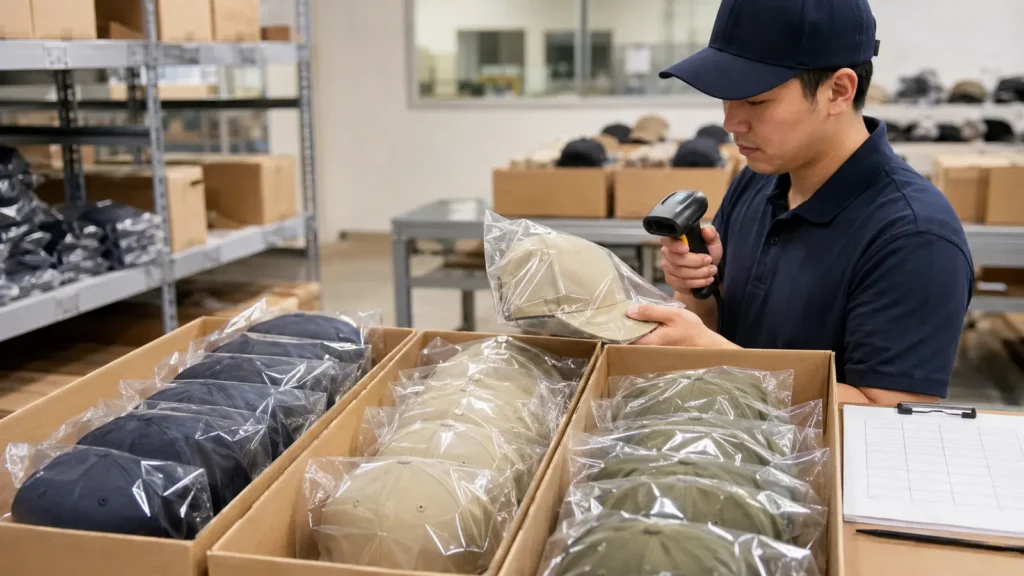
Use these checks before shipment:
- Cap condition: Crown, brim, button, closure, decoration, sweatband, and labels are clean and undamaged.
- Variant identity: Style, color, size, and decoration match the physical SKU.
- Retail branding: Hangtag artwork, attachment, size sticker, insert, and packaging print match the approved versions.
- Unit barcode: Correct code is present, flat, legible, and successfully scan-tested.
- Fulfillment label: Correct current label is applied to the required surface; conflicting visible codes are handled according to the warehouse guide.
- Bag or box: Dimensions, closure, warnings, ventilation, tissue, and inserts match the specification.
- Product recovery: Sampled caps recover to the approved shape after unpacking.
- Assortment: Counts by style, color, and size match the purchase order and packing list.
- Master carton: Count, orientation, dividers, liner, carton strength, sealing, dimensions, and weight are correct.
- Carton identification: Purchase order, carton sequence, contents, destination, and buyer labels match the shipping plan.
- Photographic record: Unit pack, label position, open carton, sealed carton, and carton marks are documented.
- Exception control: Any substitution, overage, shortage, or relabeling is approved in writing before shipment.
What to Send for a Packaging Quotation
Provide one consolidated packaging brief:
- Hat type, structure, crown height, brim shape, and decoration method
- Quantity by style, color, and size
- Sales channel: wholesale, retail, DTC, Amazon, other marketplace, or 3PL
- Standard bag, paper band, retail box, multipack, or other concept
- Reference photos and required internal dimensions
- Packaging material, color, print, and finish requirements
- Editable artwork, dielines, fonts converted to outlines, and color standards
- Hangtag material, size, string, attachment point, and copy
- Size-sticker and price-sticker rules
- Variant/SKU spreadsheet and buyer-owned GTIN data
- Current fulfillment label files and vendor routing guide
- Units per carton, assortment, carton-mark layout, and pallet requirements
- Environmental claim wording and supporting document requirements
- Delivery country, shipping method, and target date
If some fields are not decided, identify them as open decisions. The supplier can quote a standard route and one or two upgrade options, but should not invent regulatory copy, retail prices, barcodes, or marketplace identifiers on the buyer’s behalf.
Common Packaging Mistakes
Choosing the retail box before measuring the finished cap
Logo height, crown structure, top button, brim curve, and closure all affect internal fit. Approve the box around the physical cap.
Calling a package recyclable without qualification
Material, coatings, labels, local collection, and the exact claim matter. Require documentation and market-specific approval.
Sending barcode images without a variant map
A folder of labels cannot show which code belongs to navy adult, black youth, or a two-cap set. Supply one controlled row per sellable SKU.
Using the same SKU for a single cap and a multipack
The bundle is a different sellable unit and normally needs its own inventory identity. Confirm with the retailer or marketplace.
Approving label placement from a digital mockup only
Curved crowns, glossy film, seams, folds, and box edges can affect scan access. Scan the finished package.
Overpacking structured caps
A higher carton count can reduce freight per unit but create permanent crown or brim deformation. Validate the physical carton.
Treating “FBA-ready” as a permanent standard
Marketplace rules and shipment labels change. Use current account guidance and buyer-generated files for each order.
Mixing packaging revisions during bulk packing
Old hangtags, labels, or cartons can remain in the work area. Quarantine obsolete materials and issue one approved version to the packing line.
How JIUMU Supports Retail-Ready Hat Packaging
JIUMU is a Guangdong-based B2B supplier established in 2010, supporting custom hats, teamwear, logo apparel, uniforms, bags, and branded merchandise. Relevant capabilities include OEM/ODM product development, embroidery and patches, private labels, hangtags, packaging customization, physical samples, quality control, and export support.
Buyers can use JIUMU’s Private Label Services to coordinate brand-facing details, review Manufacturing Capabilities for customization and export preparation, and visit Custom Hats Manufacturer for the broader cap program. Typical MOQ is 50 pieces, subject to hat structure and customization; packaging materials, printing, box construction, and label complexity may have separate minimums.
JIUMU can review a buyer’s packaging specification, arrange physical samples, apply buyer-supplied label data, confirm packing methods, and document final pack-out. Marketplace eligibility, barcode ownership, environmental copy, legal warnings, and warehouse routing remain subject to the buyer’s current account and destination requirements.
Frequently Asked Questions
Final Recommendation
Choose custom hat packaging by starting with the finished cap and the receiving channel. Protect the crown and brim first. Then define the individual package, brand presentation, variant labels, fulfillment identifiers, and master carton. Keep the SKU table, artwork, label files, physical packed sample, and carton plan under version control.
This approach creates a package that can be manufactured, scanned, shipped, received, and reordered—not merely photographed.
Request a custom packaging quotation: Contact JIUMU with your cap specification, quantity by variant, packaging concept, artwork, SKU and barcode table, fulfillment instructions, carton requirements, destination, and target delivery date. Email zhengdong@jiumugear.com or WhatsApp/phone +86 18507502899.