Snapback vs Baseball Cap: What Is the Difference?
When a buyer compares a snapback vs baseball cap, the first thing to understand is that these terms do not describe two completely separate product families. A baseball cap is the broad category: a brimmed cap with a paneled crown, visor, sweatband, and a shape associated with baseball uniforms and everyday casual headwear. A snapback is a specific type of adjustable baseball-style cap, defined mainly by the plastic snap closure at the back.
That distinction matters when you source custom caps for a sports team, school, apparel brand, event, company store, or promotional program. If a quotation says only “baseball cap,” the supplier still needs to know whether you want a snapback, fitted cap, fabric-strap cap, buckle-back cap, stretch-fit cap, or another closure. The crown profile, front-panel structure, brim shape, material, size system, and logo method also affect the final appearance and cost.
This guide explains the differences in practical product-development terms. It also shows how to turn a style preference into a clear bulk-order specification that a custom cap supplier can sample, price, and reproduce.
Quick answer: A snapback is a baseball-style cap with an adjustable plastic snap closure. It often—but not always—uses a structured medium- or high-profile crown and a flat or slightly curved brim. “Baseball cap” is the wider category and can use a snap closure, fabric strap, metal buckle, hook-and-loop tab, elastic stretch band, or closed fitted back. Choose a snapback when visible adjustability, a bold front logo area, and streetwear styling are priorities. Choose another baseball-cap construction when you need a softer profile, curved brim, quieter closure, performance fit, or a more traditional team look.
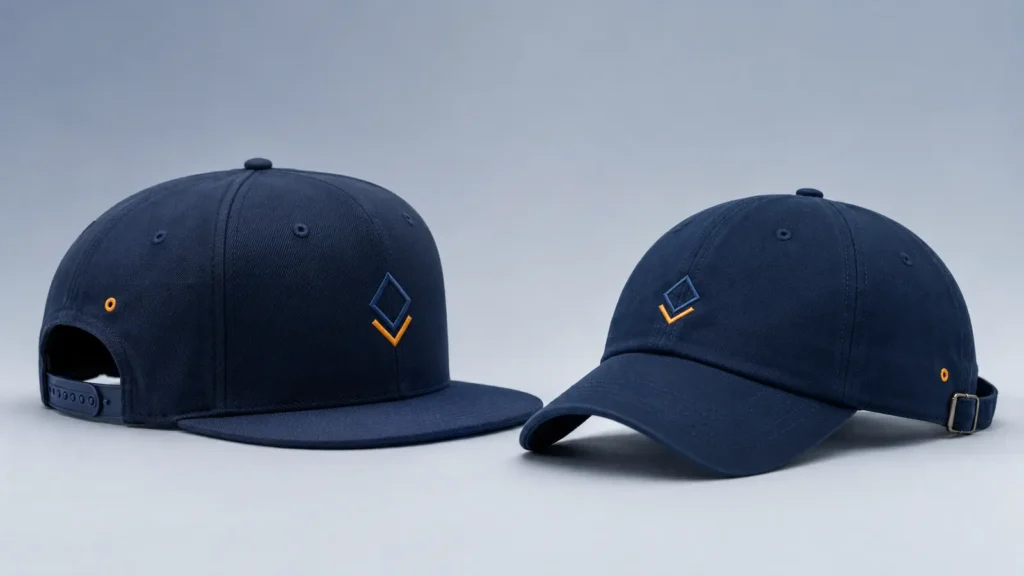
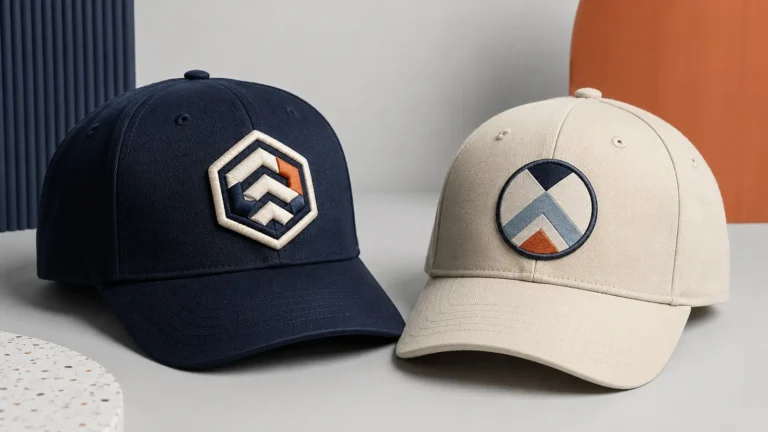
Navy snapback and curved-brim baseball cap compared in a premium studio setting
Snapback vs Baseball Cap Comparison
The table below describes common market configurations. These are useful starting points, not universal rules. A custom manufacturer can combine many of these features—for example, a low-profile snapback with a curved brim or a structured buckle-back baseball cap.
| Comparison point | Typical snapback | Other common baseball-cap styles | B2B buying implication |
|---|---|---|---|
| Product relationship | A subtype of baseball-style cap | The wider category | Do not treat “baseball cap” as a complete production specification |
| Rear closure | Adjustable plastic snaps with rows of holes and pegs | Fabric strap, metal buckle, hook-and-loop, stretch fit, or closed fitted back | Closure affects sizing, appearance, unit cost, comfort, and packaging |
| Crown | Often structured, medium or high profile | Structured or unstructured; low, medium, or high profile | Crown shape determines the logo canvas and overall silhouette |
| Brim | Commonly flat or slightly curved | Commonly curved, but flat brims are also available | Confirm the approved brim curve rather than relying on the style name |
| Fit | Adjustable across a defined head-size range | Adjustable, stretch fit, or exact fitted sizes | Size planning and inventory complexity differ |
| Back opening | Visible opening above the snap closure | May have an opening or a closed back | Influences rear embroidery space and visual balance |
| Front logo | Well suited to bold embroidery and patches | Suitable for small or large decoration depending on crown structure | Logo size must match panel seams and crown height |
| Common positioning | Streetwear, fan merchandise, lifestyle brands, clubs, promotions | Teams, workwear, golf, schools, uniforms, retail, promotions | Select by audience and use case—not by fashion label alone |
| Sampling focus | Snap alignment, crown symmetry, flatness or curve of brim, rear opening | Closure security, fitted sizing or strap finish, crown profile, brim curve | Approval checklist should match the chosen construction |
Is a Snapback a Baseball Cap?
Yes. In normal product taxonomy, a snapback is one type of baseball-style cap. The word snapback describes the adjustable rear closure, while baseball cap describes the general form.
This is similar to saying that a button-up baseball jersey is still a baseball jersey: one term names the category, while the other identifies a construction feature. In retail conversations, people sometimes use “baseball cap” to mean a curved-brim strapback and “snapback” to mean a flat-brim cap. That shortcut is understandable, but it is not precise enough for manufacturing.
An official example of this distinction appears in New Era’s style system. Its 9FIFTY silhouette guide describes a classic snapback shape that follows its fitted-cap silhouette, while its 59FIFTY guide identifies a true fitted construction. These branded product names are not generic standards, but they illustrate how closure and silhouette are treated as separate specification layers.
For a custom order, identify at least four layers:
- Category: baseball-style cap, trucker cap, dad cap, performance cap, golf cap, and so on.
- Closure: snapback, strapback, buckle, hook-and-loop, stretch fit, or fitted.
- Silhouette: low, medium, or high profile; structured or unstructured.
- Decoration: embroidery, patch, print, heat transfer, private label, or a combination.
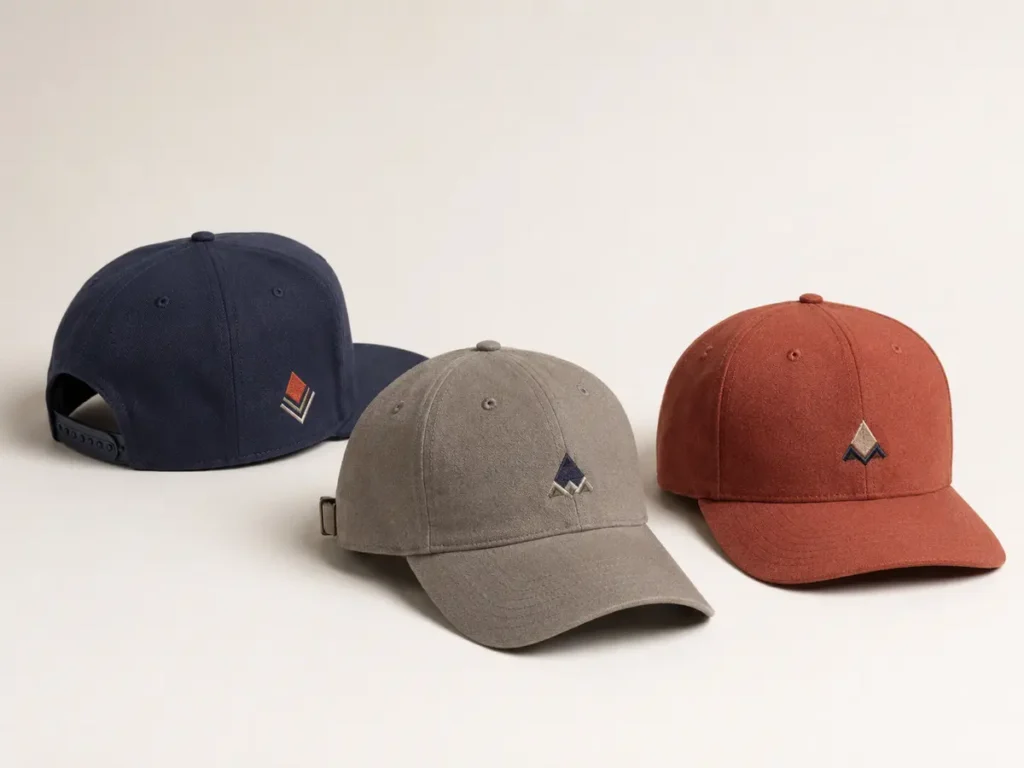
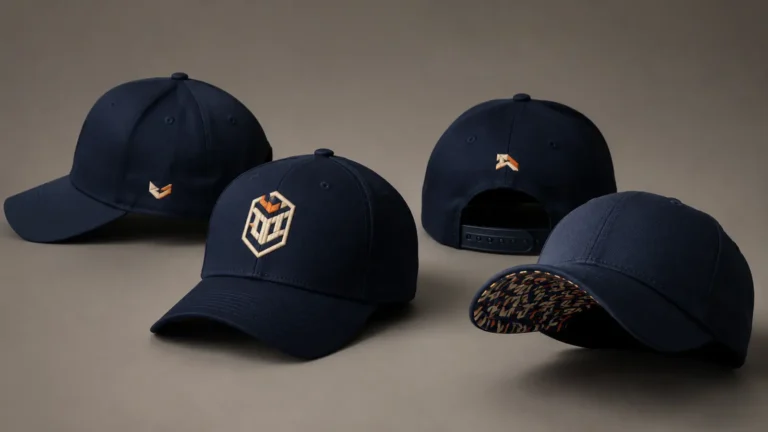
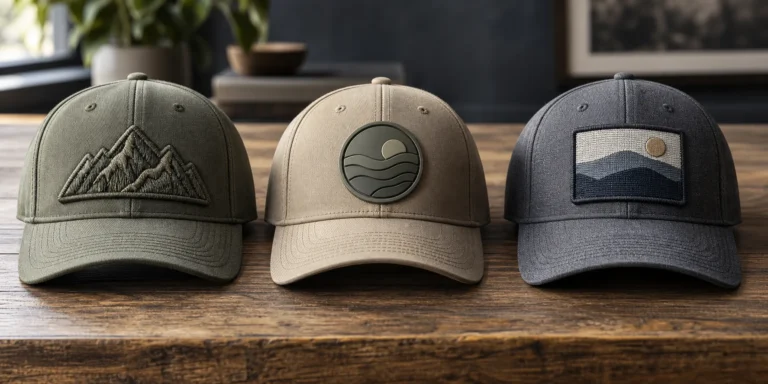
Three original baseball-cap constructions arranged as a custom headwear lineup
What Defines a Snapback?
Plastic snap closure
The defining component is the rear plastic closure. One side normally has projecting pegs; the other has a row of receiving holes. The wearer adjusts the circumference by connecting the two strips at different positions.
For bulk orders, specify the snap color, number of adjustment positions, material feel, and whether the snap should match or contrast with the crown. Also check that the closure is centered, securely attached, comfortable against the head, and easy to operate without feeling brittle.
Open-back construction
Most snapbacks have a rear opening between the bottom of the crown and the closure. Its width and shape affect the look from behind. It can also limit the available space for back embroidery. If you want a small website, team name, player number, or slogan above the opening, approve the exact placement on a physical sample.
Structured front panels
Many snapbacks have reinforced front panels. The reinforcement helps the crown hold its shape and gives a stable area for a prominent front logo. However, structured is not synonymous with snapback. A cap can have a snap closure and softer front panels, and a buckle-back cap can still be structured.
Flat or pre-curved brim
The flat brim is strongly associated with modern snapbacks, but it is a styling convention rather than a required feature. Snapbacks can be supplied with a flat visor, a slight pre-curve, or a traditional curve. Buyers should approve brim length, width, stiffness, top stitching, underside color, and curve.
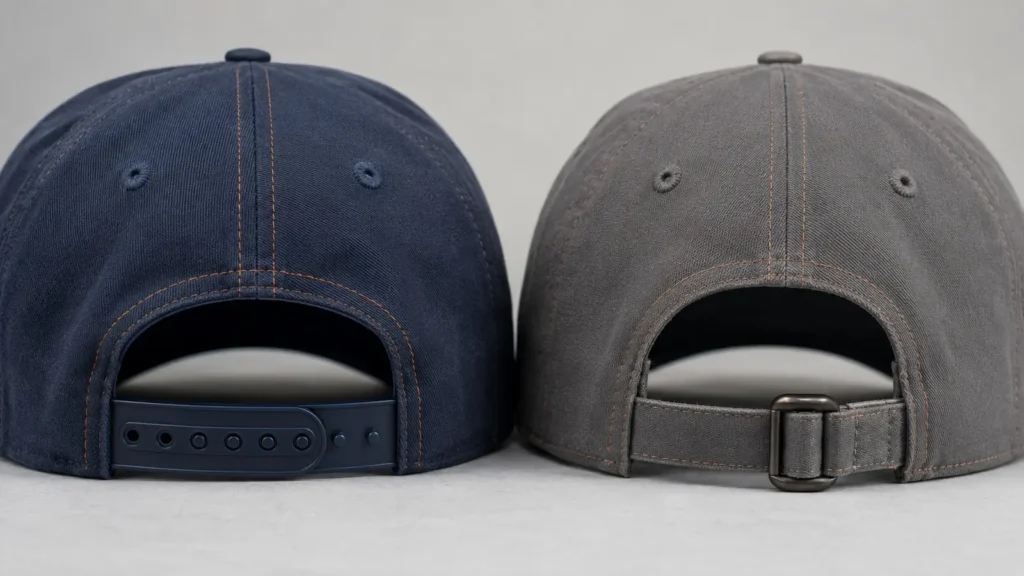
Plastic snap closure and fabric buckle strap shown from the rear
What Defines a Baseball Cap?
A baseball cap normally has a crown made from five, six, or another defined number of panels, a projecting visor, a sweatband inside the lower edge, and a fit system. Beyond those fundamentals, the category is highly configurable.
Common baseball-cap constructions include:
- Snapback: adjustable plastic snaps.
- Strapback: fabric, leather-style, or synthetic strap, often with a tuck-in opening.
- Buckle-back: strap adjusted through a metal or plastic buckle.
- Hook-and-loop: quick adjustment, often selected for uniforms, events, or practical workwear.
- Fitted: closed back in exact hat sizes or grouped sizes.
- Stretch fit: elastic or stretch sweatband, sometimes combined with grouped sizes.
The common consumer image of a baseball cap is a six-panel, curved-brim cap with a fabric strap. That is only one version. From a manufacturing perspective, “baseball cap” must be followed by the construction details.
Crown, Brim, and Fit: The Differences Buyers Actually See
Crown profile
The crown profile influences the cap more than many first-time buyers expect.
- A low-profile crown sits closer to the head and often looks relaxed or athletic.
- A medium-profile crown balances logo area and everyday wearability.
- A high-profile crown creates a taller front surface and a bolder streetwear silhouette.
Profile terminology can vary between suppliers and cap blocks. The safest approach is to send a reference image and request the supplier’s crown-height measurement, panel shape, and sample photos from front, side, and three-quarter views.
Structured vs unstructured
A structured crown uses reinforcement—commonly in the front panels—to retain its form. It is generally better for a clean, upright logo presentation. An unstructured crown collapses more easily and creates a softer, worn-in look.
If the logo uses large 3D embroidery, a tall patch, or detailed lettering, a stable front panel can make placement more predictable. If the brand wants a relaxed dad-cap aesthetic, a lower unstructured crown may be more appropriate.
Brim shape
A flat visor creates a graphic, contemporary appearance and provides a broad visible underside. A curved visor usually reads as more traditional, casual, or performance-oriented. Either shape can be used with several closure types.
When approving a sample, do not simply write “curved.” Define whether the brim should be lightly pre-curved or strongly curved. Buyers should also confirm:
- brim length and width;
- number and color of stitch rows;
- same-color or contrast underside;
- sandwich piping;
- printed or patterned underside;
- stiffness and recovery after packing.
Fit and size management
Snapbacks reduce size complexity because one adjustable cap can cover a practical range of head sizes. That can simplify inventory for events, fan merchandise, corporate programs, and mixed groups. However, “one size fits all” should not be treated as an unlimited promise. Crown depth, opening shape, sweatband, and the actual adjustment range still affect comfort.
Fitted caps can offer a clean closed-back appearance, but they require a size curve. A buyer must estimate demand by size and maintain more SKUs. Strapback and buckle-back caps also provide adjustment, usually with a softer visual finish than plastic snaps.
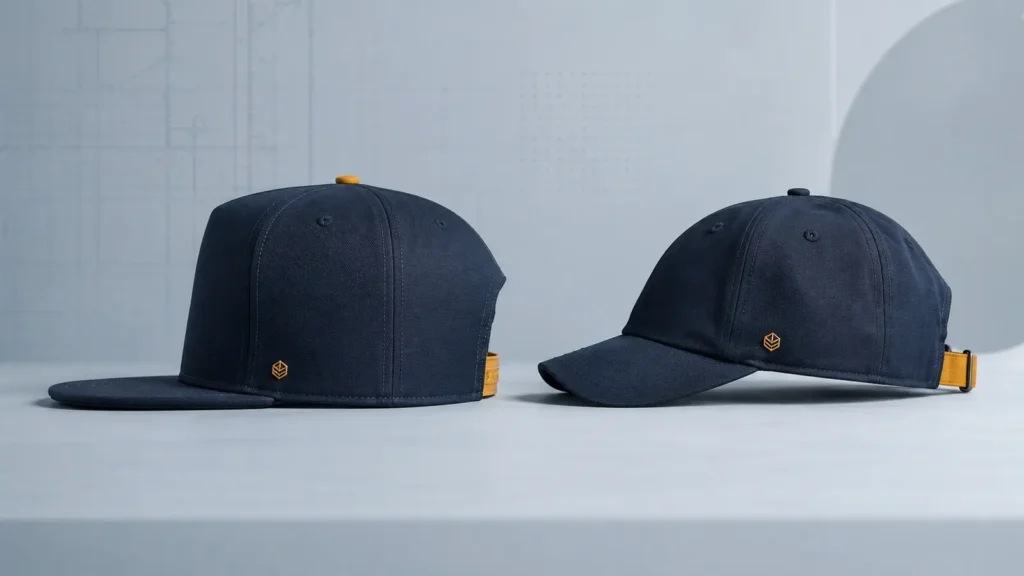
Structured high-profile snapback and lower curved-brim baseball cap in side profile
Which Style Is Better for Different B2B Programs?
Neither style is automatically better. The correct construction depends on the audience, brand positioning, decoration, order size, and distribution method.
| Program | Recommended starting point | Why | Confirm before ordering |
|---|---|---|---|
| Streetwear or private-label drop | Structured snapback, medium/high profile, flat or slight-curve brim | Bold silhouette and visible rear closure support the intended aesthetic | Crown block, snap color, embroidery height, labels, packaging |
| Baseball or softball team | Structured or lightly structured baseball cap; snapback, fitted, or stretch fit | Can match uniform tradition and player preference | Size plan, on-field rules, sweatband, brim curve, repeat-order colors |
| School club or spiritwear | Adjustable snapback or strapback | Easier distribution across mixed users | Youth/adult fit, logo scale, closure comfort |
| Corporate merchandise | Curved-brim buckle-back or premium snapback | Select based on brand tone: understated vs bold | Fabric hand feel, metal finish, logo size, packaging |
| Promotional campaign | Adjustable construction | Reduces size-management complexity | Budget, decoration coverage, event date, carton packing |
| Golf or outdoor program | Low/medium-profile performance baseball cap | Lighter visual profile and performance fabrics may suit active use | Moisture management requirement, testing, closure, ventilation |
| Retail assortment | Two or more silhouettes | Gives customers a meaningful fit and style choice | SKU count, color plan, labeling, replenishment |
Choose a snapback when:
- the plastic closure is part of the desired visual identity;
- the audience expects streetwear or fan-merchandise styling;
- the logo needs a strong structured front presentation;
- adjustable sizing is important;
- a contrast closure can support the color story.
Choose another baseball-cap construction when:
- the buyer wants a softer, lower-profile look;
- a metal buckle or fabric strap better matches the brand;
- the program needs exact fitted sizing;
- the rear area must be closed;
- performance materials or stretch fit are more important than snapback styling.
Materials for Snapbacks and Baseball Caps
Closure type does not determine fabric. Both snapbacks and other baseball caps can be made from cotton twill, polyester, acrylic blends, wool blends, nylon, corduroy, denim, mesh, recycled-content fabric, or performance textiles. Availability and minimums depend on the selected fabric, color, construction, and supplier.
Cotton twill
Cotton twill has a familiar natural hand feel and works across casual, workwear, and lifestyle programs. Weight and finish influence structure: brushed cotton feels softer, while heavier twill can support a more substantial crown. Ask about colorfastness expectations, shrinkage control, and whether the exact color is stock or custom dyed.
Polyester and performance fabrics
Polyester can provide a crisp surface, color consistency, and practical drying performance. Specific moisture-management, UV, water-resistance, or recycled-content claims should be confirmed through material documentation or testing rather than assumed from the fiber name.
Wool and acrylic blends
These blends are often selected for a traditional sports or structured cap appearance. Confirm fiber content, hand feel, seasonality, and care requirements.
Mesh and hybrid constructions
Mesh rear panels can improve ventilation and create a trucker-cap look. A cap can still use a snapback closure, but “trucker cap” and “snapback” are not identical: one describes a common crown/material construction, while the other describes the closure.
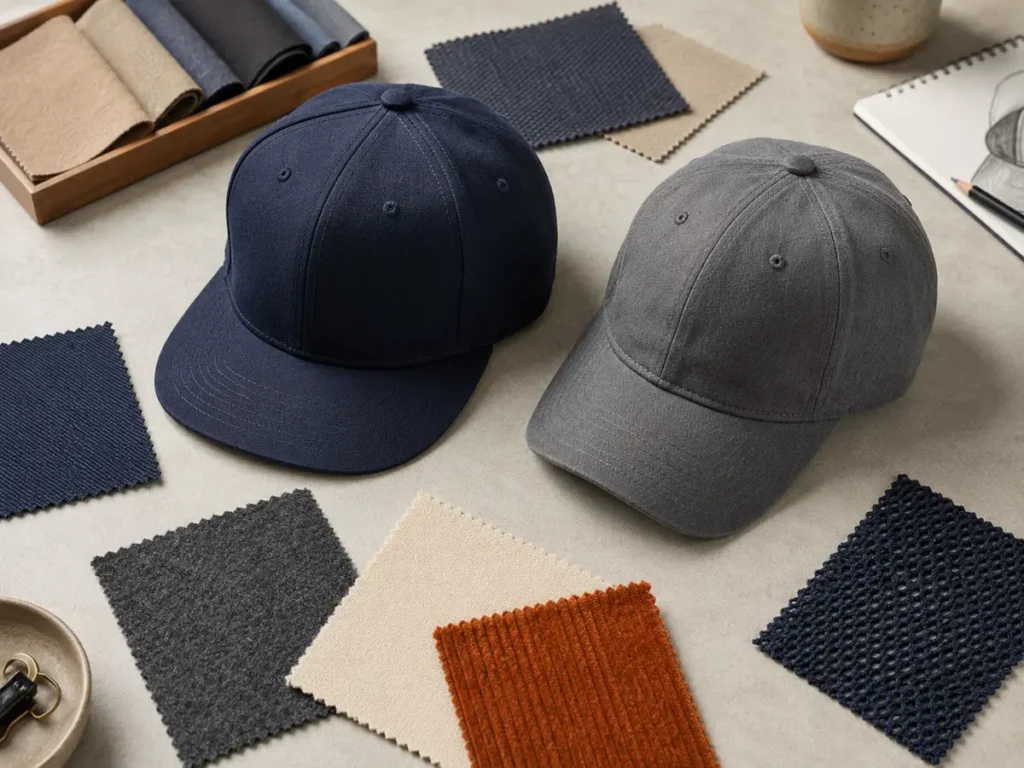
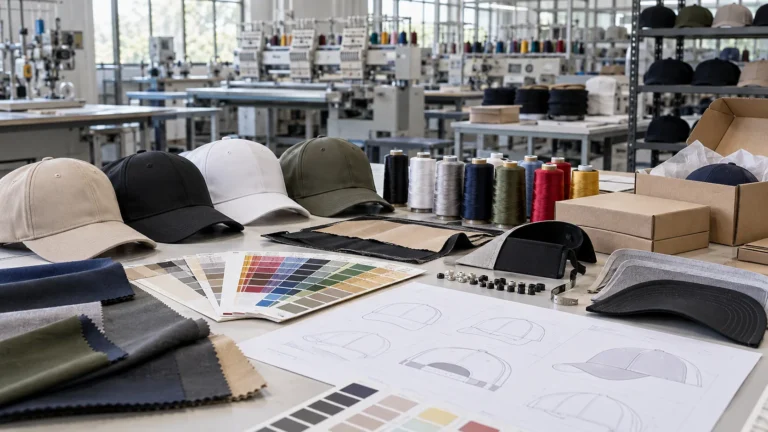
Custom caps with cotton twill, polyester, mesh, wool-blend, and corduroy swatches
Custom Logo and Private-Label Options
The best decoration method depends on the artwork, crown stability, order quantity, target price, and desired texture.
Flat embroidery
Flat embroidery works for text, outlines, small symbols, and many team or company marks. Simplify very small lettering and thin lines before sampling. Approve thread colors, stitch density, final dimensions, and placement relative to the center seam.
3D or raised embroidery
Foam under the stitching produces a raised effect. It is most suitable for bold shapes with adequate stroke width. Fine details and very small text may need to remain flat. A combined flat-and-3D design can create hierarchy without making every element thick.
Woven and embroidered patches
Woven patches can hold finer graphic detail than some direct embroidery applications, while embroidered patches deliver visible thread texture. Buyers should approve patch shape, border, attachment method, and edge position.
Rubber/PVC and leather-style patches
Rubber/PVC patches can create a molded, modern effect. Leather-style patches suit heritage, workwear, or outdoor positioning. Confirm color, thickness, surface finish, attachment, and any material claims.
Side, back, and internal branding
Custom caps can include side embroidery, back embroidery, woven labels, printed seam tape, sweatband branding, hangtags, stickers, and packaging. Each added position increases artwork setup, production steps, and inspection requirements.
Planning a custom cap program? Send JIUMU your target quantity, cap reference, crown profile, closure, brim shape, fabric, colors, logo files, decoration positions, packaging, and required delivery date. Explore custom baseball caps or request a quotation.
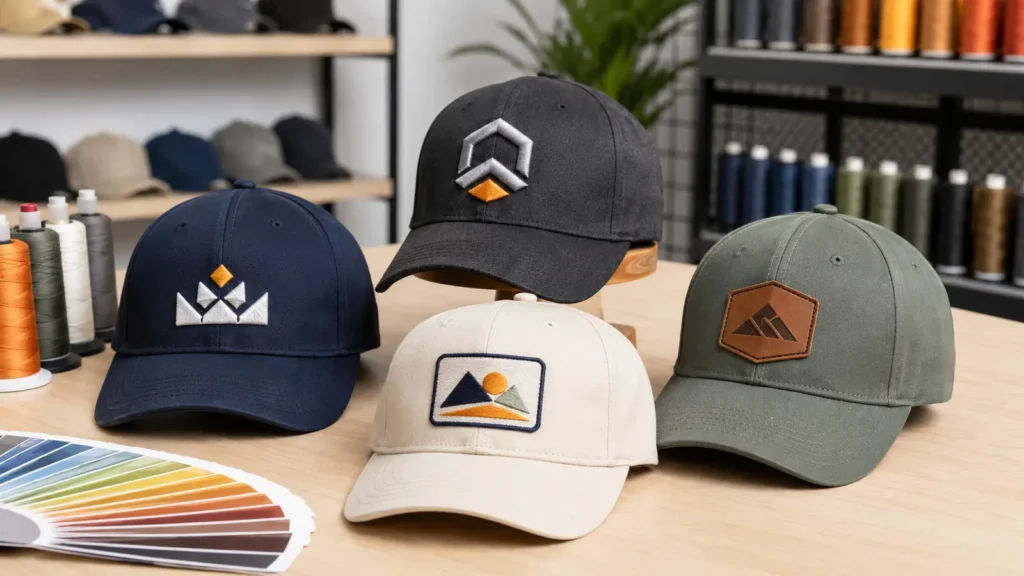
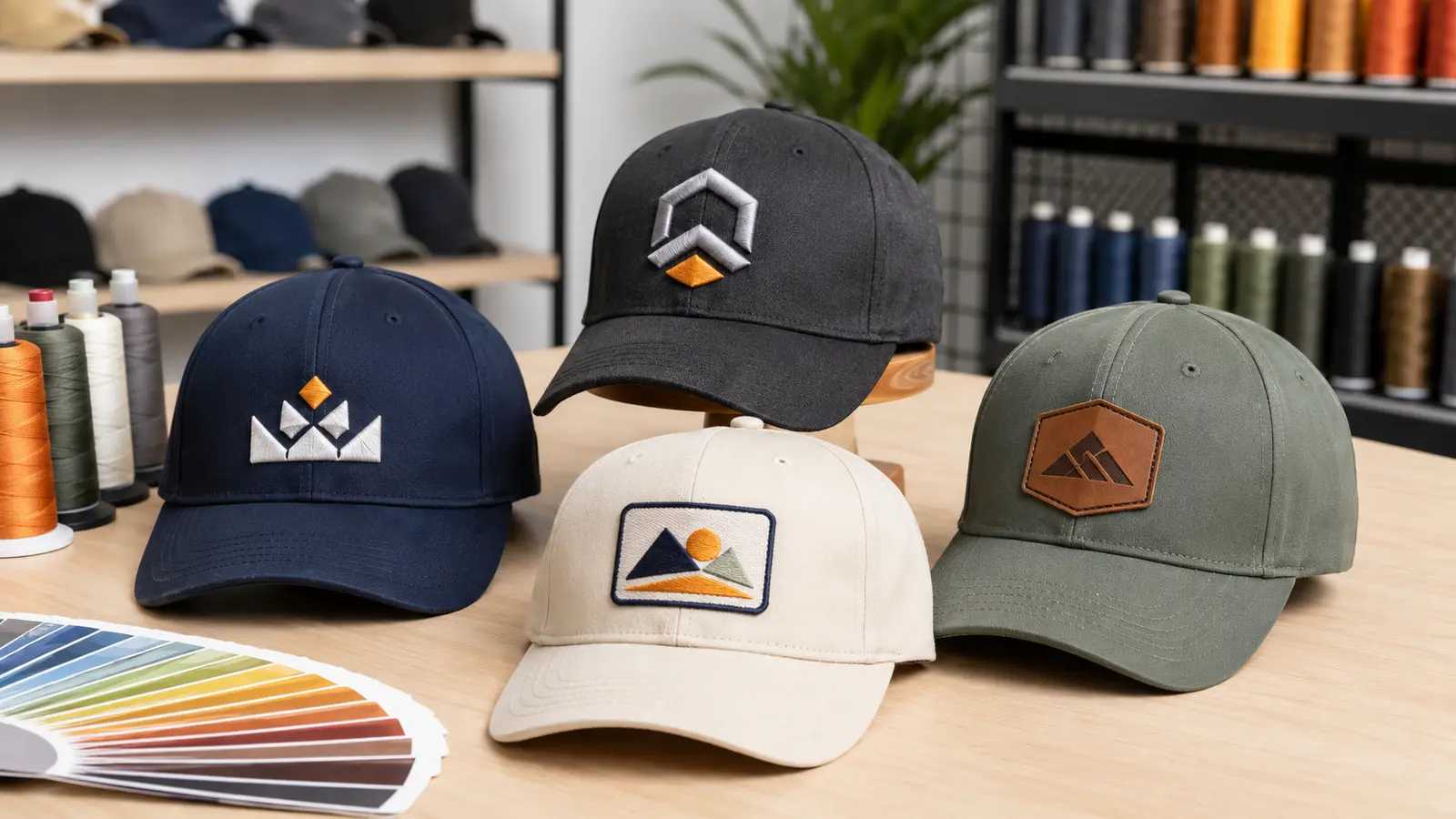
Custom caps demonstrating flat embroidery, raised embroidery, woven patches, and leather-style patches
What Changes the Cost of a Custom Cap?
The words “snapback” or “baseball cap” do not determine a complete price. A reliable quotation is based on a specification.
Major cost drivers include:
- stock fabric versus custom material or custom dyeing;
- five-panel, six-panel, or specialized crown construction;
- structured reinforcement and sweatband specification;
- closure type and hardware finish;
- direct embroidery stitch count and number of positions;
- 3D embroidery, patches, appliqué, printing, or mixed techniques;
- custom labels, seam tape, hangtags, stickers, and retail packaging;
- size assortment for fitted caps;
- sample quantity and revision rounds;
- order quantity by style and color;
- inspection, carton requirements, and delivery terms.
A basic snap closure may be cost-efficient, but a highly customized snapback with several embroidered positions, special fabric, branded tape, labels, and individual boxes can cost more than a simple buckle-back cap. Compare quotations only when suppliers are pricing the same specification and trade terms.
Sample Approval and Quality Control
A digital mockup is useful for position and color planning, but it cannot fully demonstrate crown fit, fabric feel, brim stiffness, closure operation, or embroidery texture. A physical sample is the most reliable approval point before bulk production.
Use this checklist:
- Overall silhouette: Compare front, side, rear, and top views with the approved reference.
- Crown measurements: Check crown height, panel symmetry, circumference range, and rear opening.
- Brim: Measure length and width; verify curve, stiffness, stitching, and underside.
- Closure: Test adjustment positions, attachment, alignment, edges, and hardware finish.
- Logo: Measure width, height, and position; inspect thread coverage, loose threads, patch edges, and color.
- Seams and eyelets: Confirm alignment, reinforcement, and clean finishing.
- Sweatband and inside: Check comfort, labels, seam tape, and interior cleanliness.
- Color: Review fabric, thread, closure, brim underside, and accessories under consistent light.
- Packaging: Confirm shape protection, polybag or box, barcode, hangtag, carton quantity, and shipping marks.
- Repeat-order record: Retain an approved sample, color references, artwork, measurements, and bill of materials.
For bulk inspection, agree on the inspection method and acceptance criteria before production. “Good quality” is not measurable; crown-height tolerance, logo-position tolerance, color reference, workmanship defects, packaging, and quantity are.
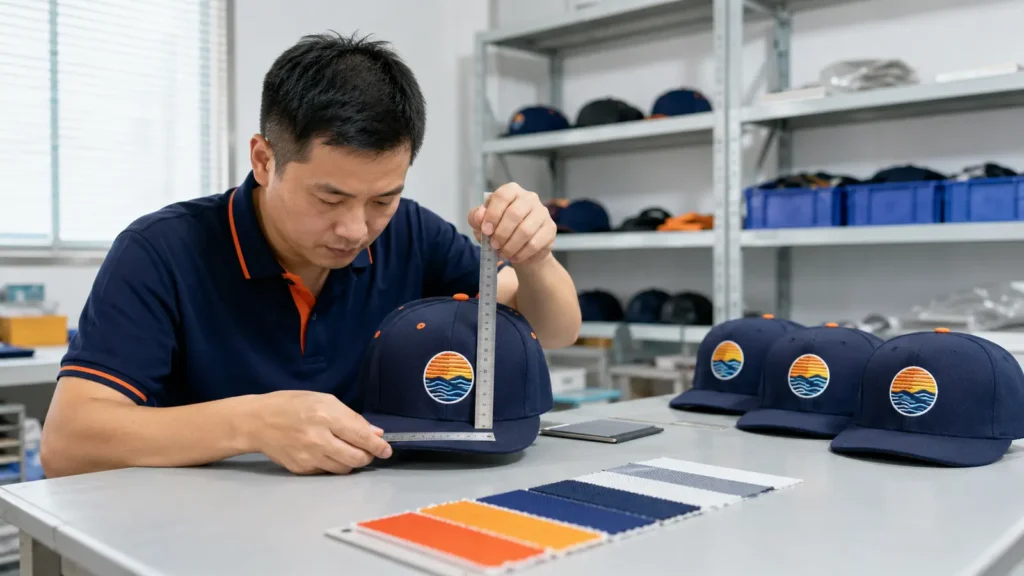
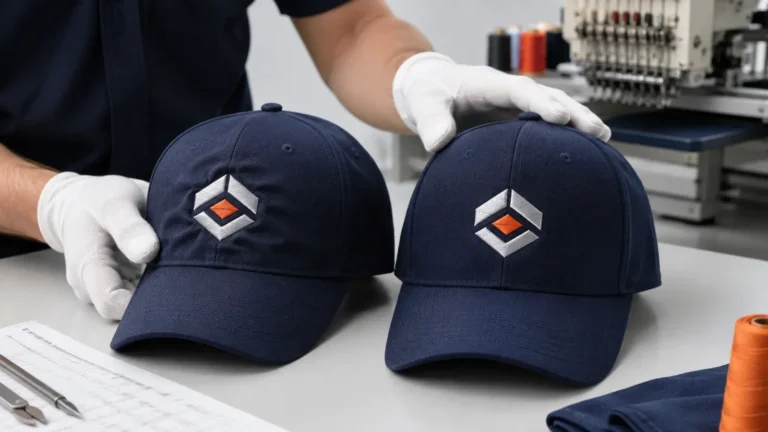
Quality inspector measuring a custom cap and checking embroidery alignment
How to Prepare a Clear Request for Quotation
A complete RFQ reduces back-and-forth and makes supplier quotations easier to compare.
Send the following:
| RFQ field | Example of useful information |
|---|---|
| Buyer and market | School distributor for the United States; private-label brand for the UK |
| Quantity | 300 pieces total, 150 per color |
| Cap type | Six-panel structured snapback |
| Crown | Medium profile with reinforced front panels |
| Brim | Flat, six stitch rows, contrast underside |
| Closure | Seven-position plastic snap, matching navy |
| Fabric | Midweight cotton twill; supplier to propose stock options |
| Colors | Navy crown, gray undervisor, orange details; provide color references |
| Decoration | Front 3D embroidery, side flat embroidery, back woven label |
| Artwork | Vector logo plus reference JPG |
| Labels and packaging | Woven inside label, hangtag, individual polybag |
| Sampling | One pre-production sample for approval |
| Compliance or testing | Specify destination-market and buyer requirements |
| Delivery | Required arrival date, destination, preferred trade term |
If the design is still open, tell the supplier which elements are fixed and which can be optimized. For example: “The front mark and navy/orange color identity are fixed; please recommend a stock fabric and closure that meet the target budget.”
Questions to Ask a Custom Cap Supplier
Before placing a bulk order, ask:
- Which crown blocks match the reference image, and what are their measurements?
- Is the proposed fabric stock, made to order, or custom dyed?
- What adjustment range does the closure provide?
- Which logo method best reproduces the artwork, and what details need simplification?
- Can the supplier provide a digital mockup and physical sample?
- What is included in the quotation: labels, packaging, inspection, and freight?
- What factors may change the quoted lead time?
- How are bulk color and logo placement checked against the approved sample?
- Can materials and measurements be recorded for repeat orders?
- What information is required for export packing and destination-market documentation?
Common Buying Mistakes
Using only a product name
“Black snapback with logo” leaves crown height, structure, brim, fabric, closure color, embroidery size, labels, and packaging undefined. A photo plus written measurements is much safer.
Assuming every snapback has a flat brim
Many do, but the brim can be flat, slightly curved, or pre-curved. Approve the physical curve.
Assuming every baseball cap is a strapback
Baseball caps include several closure systems. State the closure in the RFQ and purchase order.
Ignoring the rear view
The closure, opening, back embroidery, and side logos are visible product features. Approve all views, not only the front mockup.
Choosing decoration before reviewing artwork
Fine text may not suit raised embroidery; gradients may require printing or a patch; a tall patch may conflict with crown seams. Let construction and artwork be evaluated together.
Skipping a physical sample
On-screen color and proportions do not fully represent the product. Physical sampling is especially important for a new crown block, material, or logo technique.
Why Source Custom Caps with JIUMU?
JIUMU is a Guangdong-based B2B custom teamwear, logo apparel, custom hats, uniforms, bags, and branded merchandise supplier established in 2010. The company supports buyers in the United States, Canada, the United Kingdom, and Europe.
For custom cap programs, JIUMU can support:
- OEM and ODM product development;
- logo embroidery, heat transfer, screen printing, and multiple patch options;
- fabric sourcing and Pantone color matching;
- private labels, woven labels, hangtags, and packaging customization;
- digital mockups and physical samples;
- bulk production, quality control, and export support.
The typical MOQ is 50 pieces, subject to the selected cap construction and customization. Buyers can use one specification process to coordinate cap style, teamwear, bags, and other branded merchandise when a wider program requires consistent colors and logos.
Learn more about JIUMU or share your cap concept through the contact page.
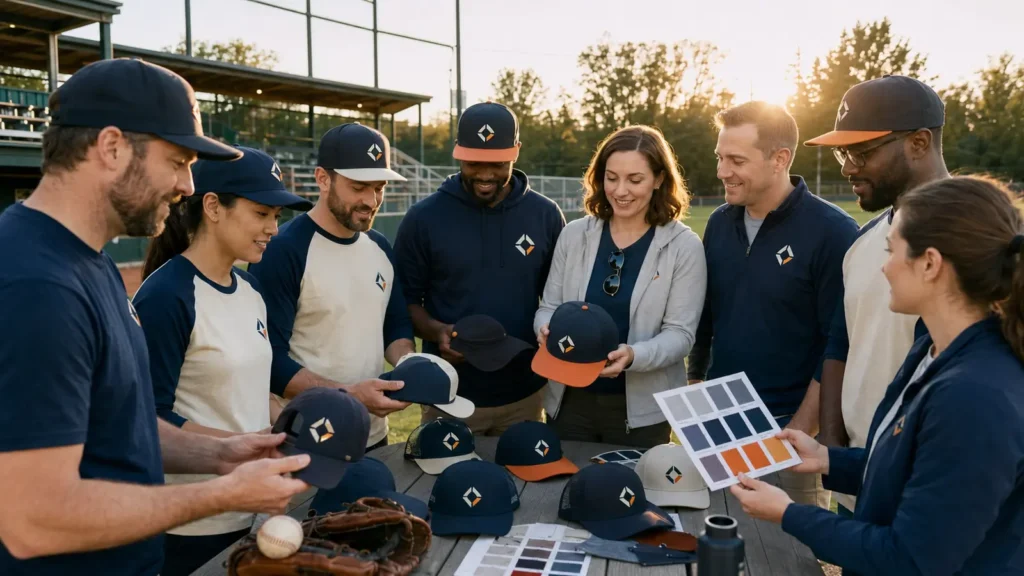
Baseball club and merchandise buyers reviewing custom cap samples
Frequently Asked Questions
Final Recommendation
The practical answer to snapback vs baseball cap is not “one or the other.” A snapback is one adjustable construction inside the larger baseball-cap category. For sourcing, start with the audience and use case, then define closure, crown profile, structure, brim, fit, fabric, decoration, labels, packaging, and sample approval.
Choose a snapback for visible adjustability, a strong front logo area, and a bold lifestyle or fan-merchandise look. Choose a strapback, buckle-back, stretch-fit, or fitted baseball cap when a softer finish, performance fit, traditional team appearance, or closed back matters more.
Sources and Editorial Notes
- New Era 9FIFTY silhouette guide — manufacturer example of a classic snapback silhouette.
- New Era 59FIFTY silhouette guide — manufacturer example of a fitted cap silhouette.
Product terminology varies by supplier. Measurements, adjustment ranges, performance claims, material claims, lead times, and minimums should be confirmed against the approved quotation, sample, and order documentation.
About the author
JIUMU Product Development Team prepares practical sourcing guidance for teams, schools, distributors, promotional buyers, and private-label brands.