Best Custom Baseball Caps for Teams: A Complete Buyer’s Guide
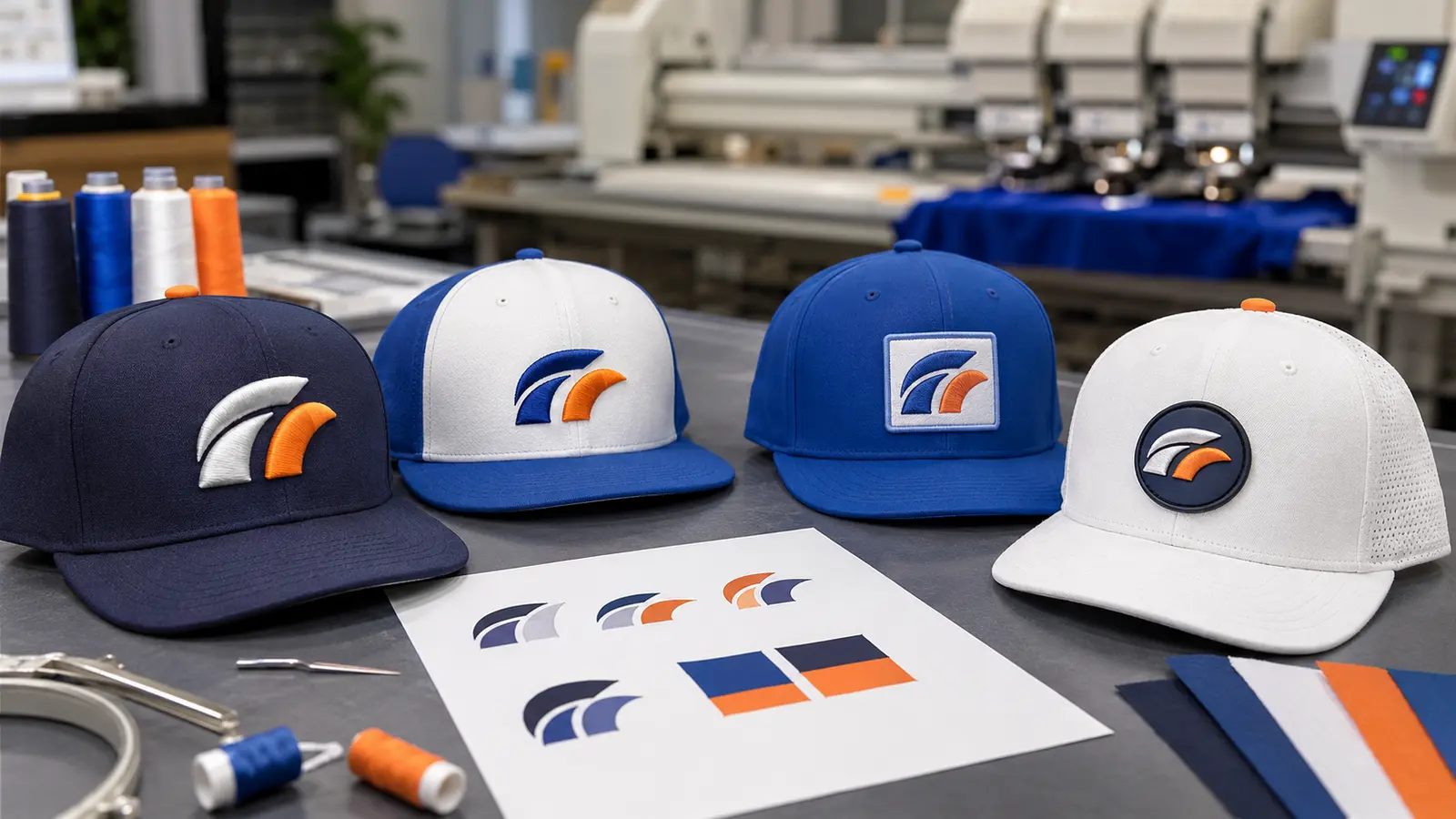
Choosing the best custom baseball caps for teams involves more than selecting a color and adding a logo. A cap must fit the roster, support active use, reproduce the team identity, and remain practical to reorder. This guide compares structure, brim, closure, fabric, decoration, sizing, quality control, and bulk-order requirements. It treats “best” as a use-case decision—not a brand ranking.
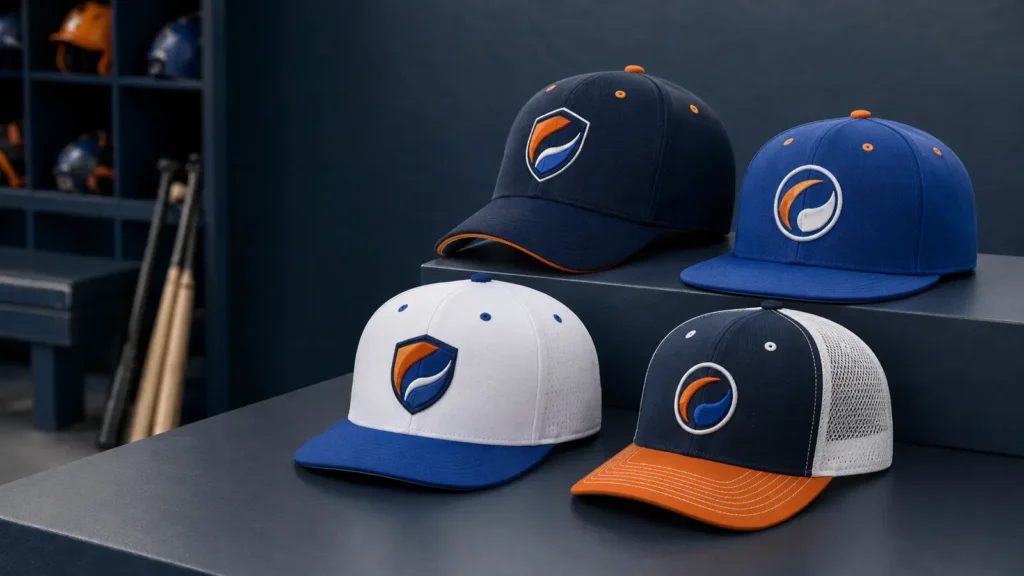
The best team cap is the style that matches your players, use case, climate, and logo program.
Quick Answer: What Are the Best Custom Baseball Caps for Teams?
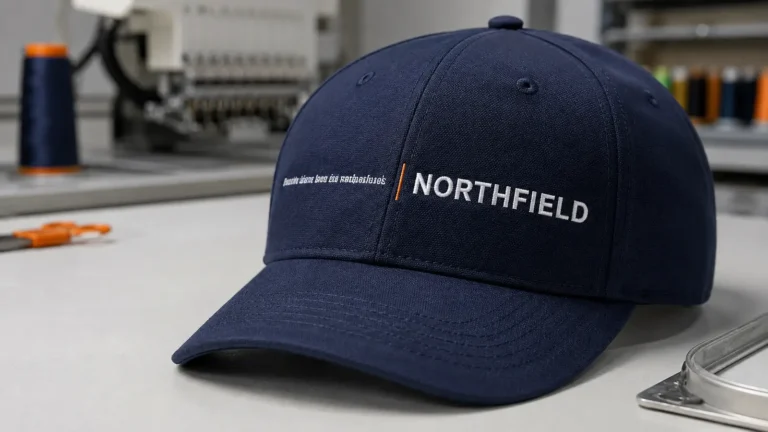
For most competitive teams, a structured six-panel cap with a curved brim, performance polyester, an absorbent sweatband, and flat or moderately raised front embroidery is a versatile starting point. It supports a recognizable silhouette and adjustable, stretch-fit, or fitted sizing.
However, there is no single cap specification that is best for every program:
- Choose fitted or stretch-fit caps when a uniform appearance and close athletic fit matter and the roster can provide accurate head sizes.
- Choose snapbacks or other adjustable closures when the roster changes frequently, the cap is used for fundraising or merchandise, or simplified inventory is a priority.
- Choose mesh-back trucker caps for warm-weather practice, staff, supporter merchandise, and casual club use.
- Choose unstructured low-profile caps for off-field apparel, alumni programs, staff, and lifestyle collections rather than formal on-field uniform use.
- Choose performance polyester for active use and faster drying; choose cotton twill when a natural hand feel and classic appearance are more important.
Confirm the decision with a physical sample because crown height, pattern, brim curve, sweatband, fabric weight, and reinforcement change fit.
Why the Team Cap Decision Matters
A cap is highly visible. Small errors—a high logo, collapsing crown, uncomfortable sweatband, or inconsistent navy—affect the program. Fitted sizes look clean but require more stock-keeping units; adjustable caps simplify allocation.
The best purchasing decision balances four outcomes:
- Player function: stable fit, comfort, visibility, and climate suitability.
- Brand consistency: accurate colors, logo proportions, and placement.
- Operational simplicity: manageable size range, roster allocation, and reorders.
- Commercial control: a specification that can be quoted, sampled, inspected, and repeated.
Best Team Baseball Cap Styles Compared
| Cap style | Best use | Fit system | Main advantage | Main purchasing consideration |
|---|---|---|---|---|
| Structured six-panel | Competitive teams and complete uniforms | Fitted, stretch-fit, or adjustable | Classic baseball shape and strong front logo area | Crown height and front reinforcement must be approved |
| Fitted cap | Competitive clubs, college programs, premium uniforms | Multiple exact sizes | Clean rear appearance and close fit | Requires accurate size collection and more inventory |
| Stretch-fit cap | Teams wanting a fitted look with fewer sizes | S/M, M/L, L/XL or supplier system | Flexible fit with a clean silhouette | Size ranges differ by pattern and material |
| Snapback cap | Youth teams, merchandise, events, changing rosters | Adjustable plastic snap | Simple allocation and recognizable athletic style | Closure color, hole count, and rear opening affect appearance |
| Hook-and-loop cap | Camps, schools, coaches, and value-focused programs | Adjustable tab | Fast adjustment and broad fit range | Closure quality and long-term appearance should be sampled |
| Trucker cap | Warm-weather practice, staff, fans, and casual programs | Usually snapback | High ventilation and casual appeal | Foam or fabric front, mesh stiffness, and front-panel shape vary |
| Unstructured dad cap | Off-field teamwear, alumni, golf, and lifestyle merchandise | Buckle, strap, or adjustable tab | Comfortable relaxed appearance | Softer crown may not suit a formal on-field uniform |
| Five-panel cap | Modern clubs, streetwear, and promotional collections | Usually adjustable | Wide uninterrupted front panel | More lifestyle-oriented than traditional baseball styling |
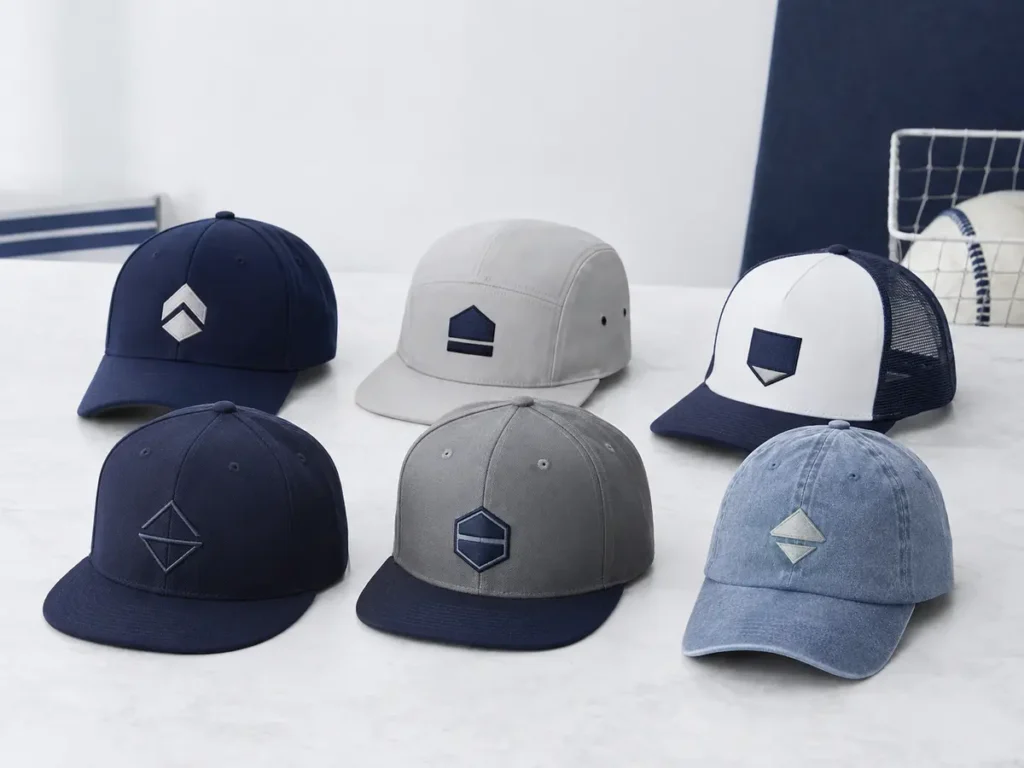
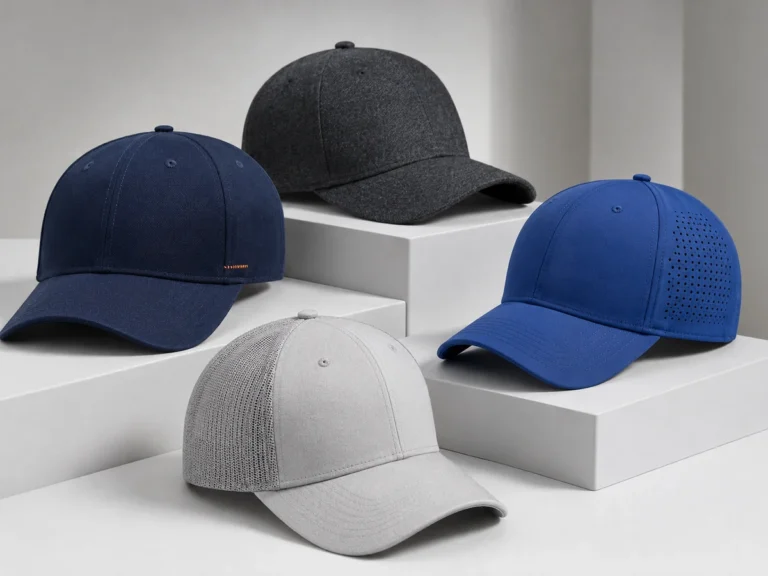
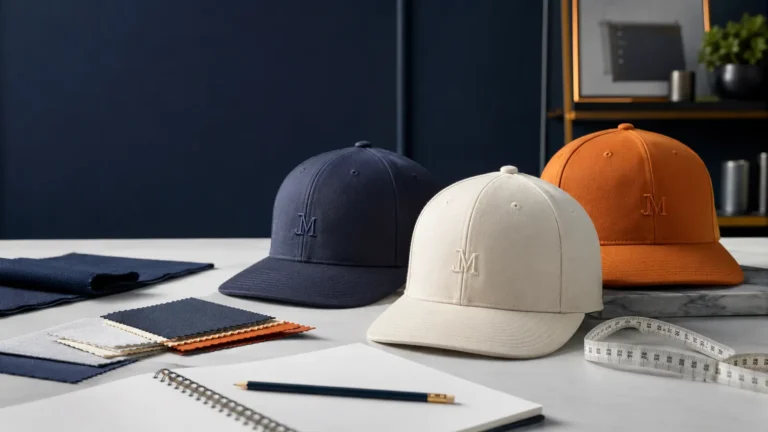
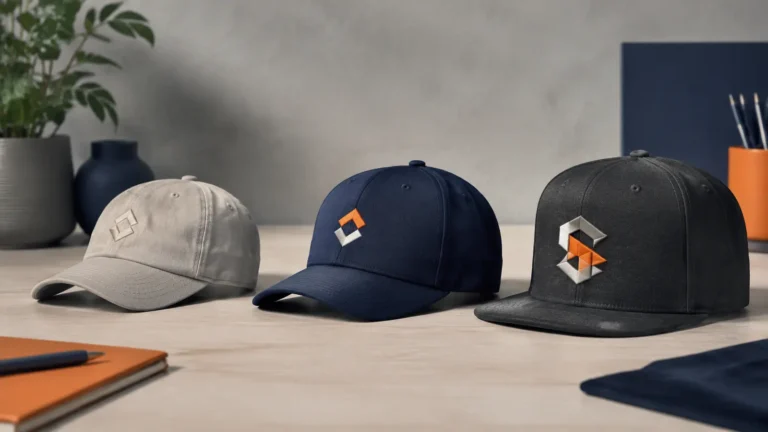
Compare crown structure, brim shape, closure, and mesh before choosing a team cap program.
Structured Six-Panel Caps: The Safest On-Field Starting Point
A traditional six-panel cap uses triangular crown sections that meet at the top button. In a structured version, the two front panels are reinforced to maintain their shape. This gives the front logo a stable base and produces the familiar on-field baseball profile.
For most uniform programs, begin by defining:
- low-, mid-, or high-profile crown;
- curved or flat brim;
- front-panel reinforcement stiffness;
- fitted, stretch-fit, or adjustable closure;
- sweatband material and width;
- eyelet color and construction;
- top-button and brim color;
- front, side, and rear logo placements.
A structured crown gives embroidery a stable base and presents consistently in team lineups.
Fitted Caps: Best for a Clean, Uniform Appearance
Fitted caps have no adjustable rear opening. Their uninterrupted back creates a polished silhouette and provides additional space for a small rear logo or league mark. They can be an excellent choice for competitive teams that want a professional uniform presentation.
The trade-off is sizing. Buyers need a reliable measurement process, a confirmed chart, and spare units in common sizes. Do not assume that the same numerical size fits identically across different cap patterns.
Review JIUMU’s custom fitted hats category when a closed-back team cap is central to the uniform brief.
Snapback Caps: Best for Flexible Rosters and Merchandise
Snapbacks use an adjustable plastic closure. They reduce the number of sizes that a team must manage, making them practical for youth programs, tournament merchandise, promotional campaigns, and teams that add players throughout a season.
Specify whether the cap should have a flat or pre-curved brim, the closure color, the rear opening shape, and whether the front crown should be high or mid profile. A snapback is not one fixed shape; a high-crown streetwear cap and a mid-profile athletic cap can use the same closure while looking completely different.
Explore custom snapback hats for adjustable team, fan, and private-label programs.
Trucker Caps: Best for Ventilation and Casual Team Use
A trucker cap combines solid front panels with mesh rear panels. It can suit summer practice, coaches, volunteers, supporter merchandise, and outdoor events.
For a team order, compare mesh stiffness, front-panel fabric, crown shape, rear seam quality, and the transition between solid and mesh panels. A very stiff high crown may suit retail merchandise but feel too tall for players accustomed to a traditional baseball cap.
Unstructured and Five-Panel Caps: Best for Off-Field Collections
An unstructured cap follows the wearer’s head, while a five-panel cap offers a broad front area. Both work well for travel, alumni apparel, club stores, and streetwear-oriented collections. For a classic competitive look, a structured six-panel shape is more recognizable.
How Should Teams Choose Crown Profile and Brim Shape?
The crown profile influences both style and comfort:
- Low profile: sits closer to the head and creates a relaxed, compact shape.
- Mid profile: balances logo space with a traditional athletic silhouette.
- High profile: provides more front area and a stronger streetwear or snapback look.
The brim affects visual identity and how the cap is worn. A pre-curved brim is familiar for traditional baseball uniforms and requires less shaping by the player. A flat brim creates a modern merchandise or club look and can be curved later, depending on the internal brim material. A sandwich brim adds a contrast color between brim layers; an underside color can reinforce the team palette without changing the front view.
Record brim length, width, curve reference, stitching-row count, and underside color. Terms such as “slightly curved” are subjective; a reference sample is more reliable.
Fit, Closures, and Roster Planning
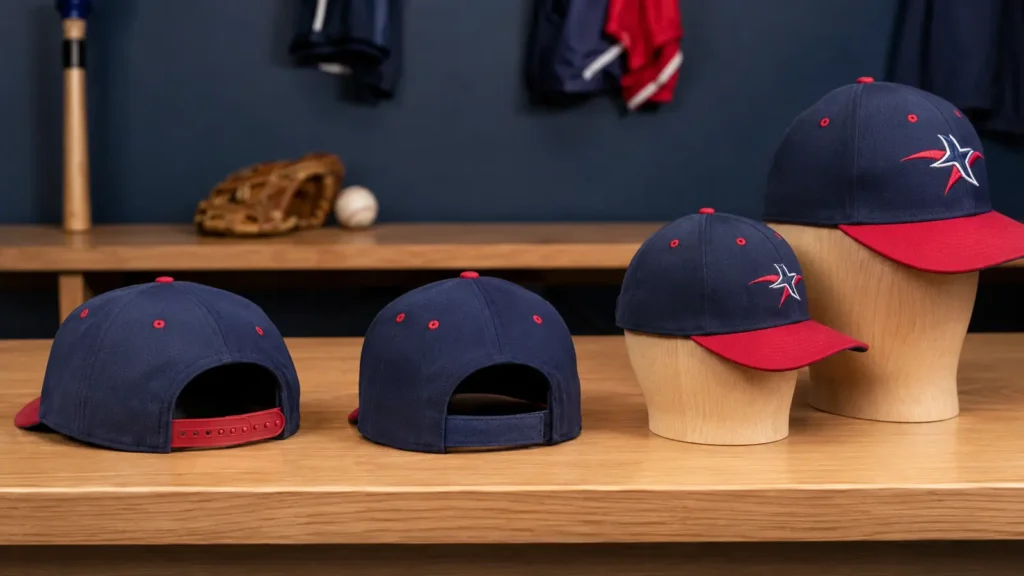
A team-wide fit plan should account for roster ages, head sizes, and replacement orders.
Plan fit at program level using roster age range, head-size distribution, membership changes, and whether caps also go to coaches or supporters.
For fitted caps, collect head circumference using a consistent method: place a flexible tape around the head where the sweatband will sit, keep it level, and measure without pulling tightly. Compare the measurements with the supplier’s chart for the exact sampled cap pattern. For youth teams, do not rely on age alone because head sizes vary.
For adjustable caps, request the practical fit range of the finished sample. A closure may technically fasten at its smallest or largest setting but still produce an awkward rear opening or crown shape. Check:
- comfort at both ends of the claimed range;
- whether the closure contacts hair or skin;
- stability during running and fielding;
- appearance from the rear;
- ease of adjustment;
- closure strength after repeated use.
Keep spare units in common sizes and retain the approved chart with the purchase record.
Which Materials Work Best for Team Baseball Caps?
The correct material depends on when and how the cap will be used. Fabric names alone are not enough; weight, weave, finish, colorfastness, stretch, and lamination can all change performance.
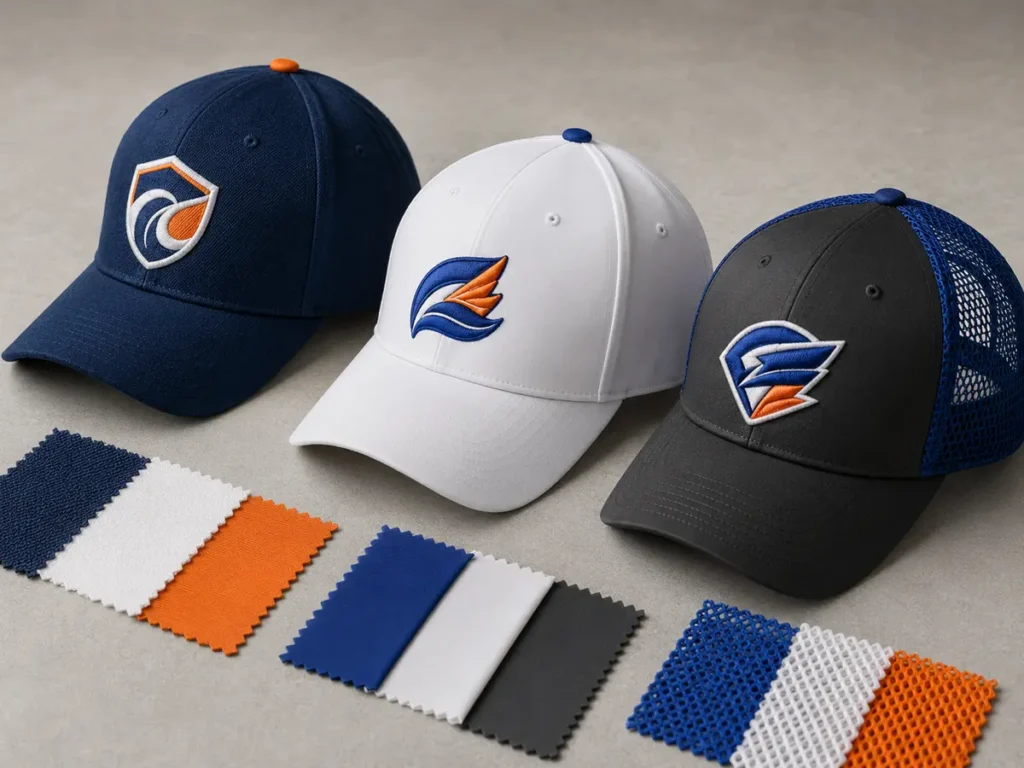
Material choice affects hand feel, structure, drying behavior, ventilation, and decoration compatibility.
| Material | Practical strengths | Best for | Questions to confirm |
|---|---|---|---|
| Cotton twill | Natural hand feel, classic appearance, good embroidery base | Heritage uniforms, staff caps, lifestyle merchandise | Weight, shrinkage tendency, color consistency, care method |
| Brushed cotton twill | Soft surface and casual premium feel | Alumni, coaches, club retail | Surface change after washing or abrasion |
| Performance polyester | Lower moisture absorption and generally faster drying than cotton | Games, training, warm climates | Fabric weight, breathability, finish, verified performance claims |
| Polyester mesh | High airflow and light rear construction | Trucker caps and hot-weather use | Hole size, stiffness, snag resistance, color matching |
| Polyester-spandex blend | Stretch for flexible size systems | Stretch-fit athletic caps | Recovery, size range, heat sensitivity during decoration |
| Wool or wool-blend fabric | Traditional substantial appearance | Heritage-inspired or cooler-weather programs | Fiber content, care, labeling, cost, color consistency |
| Recycled-content fabric | Supports a documented material strategy when properly verified | Brands with defined sourcing requirements | Supplier documentation, exact content, traceability, claim wording |
Cotton Twill for a Traditional Look
Cotton twill is familiar, comfortable, and visually appropriate for classic teamwear. It accepts embroidery well, but it can absorb more moisture than many synthetic fabrics. If the cap will be used in hot, humid, or rainy conditions, approve how the fabric looks after perspiration and drying.
Performance Polyester for Active Use
Polyester fabrics are common in active team caps because they can be lightweight, dimensionally stable, and faster drying. However, “performance” is a broad commercial term. Ask for the actual fabric composition, weight, stretch, surface construction, and any test documentation behind specific claims.
Do not advertise a cap as moisture-wicking, UV-protective, water-resistant, or antimicrobial only because the fabric is polyester. Those claims may depend on construction, treatment, and testing.
Mesh for Ventilation
Mesh is useful when airflow is a priority. Evaluate the mesh next to the solid front fabric because color can appear different on an open structure. The rear panels should recover after compression and should not feel excessively rigid against the head.
Construction Details That Affect Durability and Appearance
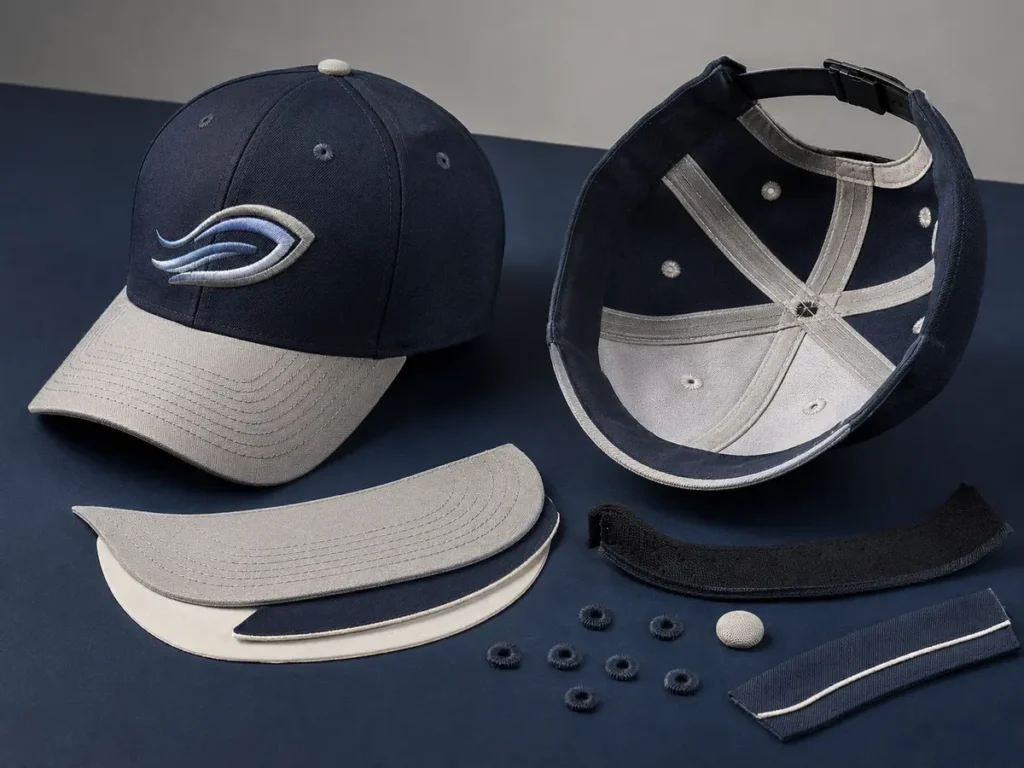
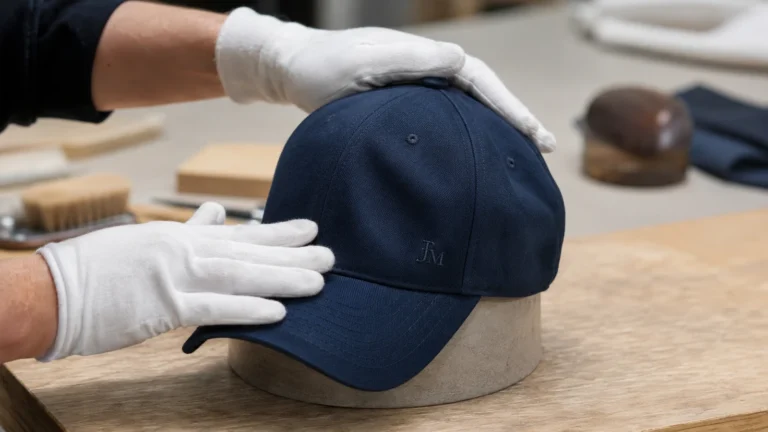
Approve internal construction details as carefully as the front logo.
Two caps can look similar in a digital mockup yet perform differently because of internal construction. Include the following in sample approval:
- crown pattern and panel symmetry;
- front-panel reinforcement;
- seam allowance and seam tape;
- top-button attachment;
- embroidered or metal eyelets;
- sweatband width, softness, stretch, and joining seam;
- brim insert material and curve;
- number and spacing of brim stitching rows;
- closure attachment and alignment;
- inside-label placement;
- loose-thread and edge-finishing standard.
Check the cap from front, side, rear, top, and inside. The front seam should be centered, the brim should align with the crown, and the logo should appear level when the cap is worn—not only when it lies on a table.
What Is the Best Logo Method for Custom Team Caps?
The best decoration method depends on logo detail, desired texture, cap material, crown structure, quantity, and budget.
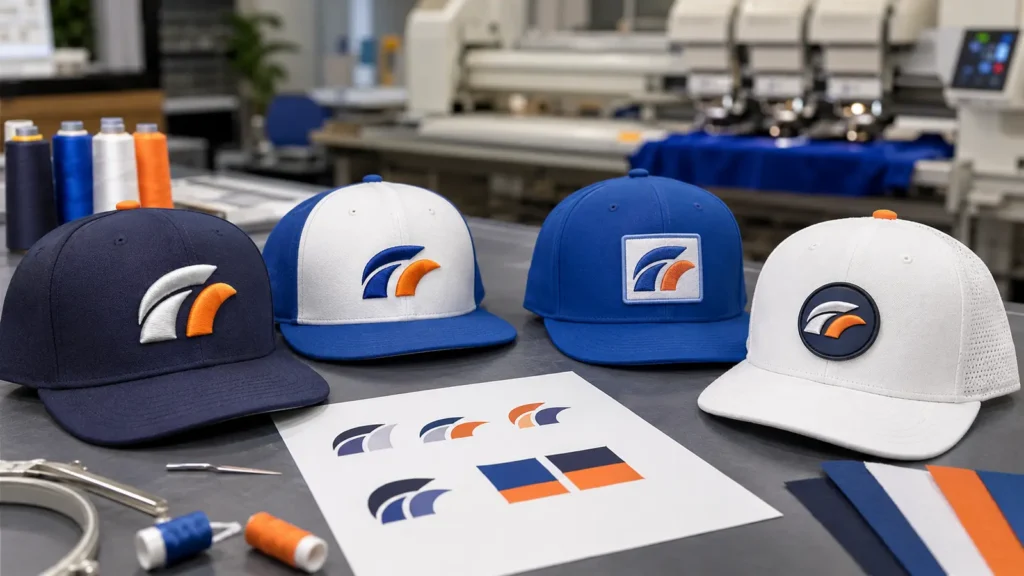
Decoration should be selected after reviewing logo detail, cap structure, and intended use.
Flat Embroidery
Flat embroidery is the most versatile starting point for team initials, crests, mascots, and wordmarks. It can reproduce moderate detail and works on many structured caps. The embroidery file should be digitized for the actual size and fabric. Very small text, narrow gaps, and thin outlines may need simplification.
3D or Puff Embroidery
3D embroidery uses foam beneath selected stitches to create a raised effect. It works best for bold letters and simple shapes with enough stroke width. Fine details, sharp internal corners, and small text are usually better kept flat. A logo can combine puff and flat embroidery, but the sample must confirm height, edge coverage, and readability.
Woven Patches
Woven patches can reproduce finer lines than many direct-embroidery applications. They are useful for detailed crests, anniversary marks, and multi-element branding. Confirm patch border type, backing, attachment stitch, final thickness, and whether the patch must follow the crown curve.
Embroidered, Leather-Style, and Rubber/PVC Patches
An embroidered patch offers a traditional textured look. A leather-style patch can support heritage or outdoor collections, while a rubber/PVC patch creates a clean dimensional surface for modern programs. Material composition and claim wording should be accurate; use “leather-style” when the patch is synthetic.
Heat Transfer and Printing
Heat transfer or printed applications can reproduce gradients and detailed graphics, especially on compatible polyester fabrics. The production team must confirm temperature, pressure, adhesion, and whether the cap shape allows consistent placement. Request a sample when the graphic is near seams or curved crown areas.
For more decoration options, visit custom baseball caps.
Preparing a team cap brief? Send JIUMU your quantity, cap reference, roster size needs, team colors, logo file, decoration preference, delivery country, and required date. The product-development team can review the specification and prepare a custom quotation. Request a custom baseball cap quote.
How to Plan Colors, Logos, and Team Identity
Color matching should cover the whole uniform program. A navy cap can differ visually from a navy jersey because materials and textures differ. Provide Pantone references when available, but approve physical fabric and thread samples for critical colors and retain them for reorders.
For logo placement, define dimensions and position from stable construction points. “Centered on the front” may not be precise enough on a six-panel cap because the center seam, brim edge, and crown curve interact. Record:
- finished logo width and height;
- distance above the brim seam;
- relationship to the center seam;
- side-logo distance from the front panel seam;
- rear-logo position relative to the opening or back seam;
- approved thread or patch colors.
If the cap is part of a complete uniform, compare it with jerseys, pants, socks, jackets, and bags. JIUMU’s baseball team uniform packages are intended for buyers coordinating multiple teamwear categories.
What Information Should a Buyer Send for a Quotation?
A complete inquiry reduces assumptions and makes quotations easier to compare.
| Information | What to provide |
|---|---|
| Buyer and program | Team, school, club, distributor, retailer, or promotional use |
| Quantity | Total units plus expected size or color breakdown |
| Cap style | Six-panel, fitted, snapback, trucker, five-panel, or reference image |
| Fit system | Fitted sizes, stretch-fit range, or closure type |
| Materials | Preferred fiber, weight, mesh, stretch, or performance requirements |
| Colors | Pantone references, uniform photos, or approved physical standards |
| Logo | Vector artwork where possible; placement and finished dimensions |
| Decoration | Flat embroidery, 3D embroidery, patch, transfer, or supplier recommendation |
| Branding | Main label, size label, care/fiber label, hangtag, barcode, or retail packaging |
| Compliance market | Countries where the finished caps will be sold or distributed |
| Delivery | Destination, required arrival date, shipping terms, and event deadlines |
Share hard deadlines at inquiry stage so artwork, sampling, production, inspection, packing, and freight can be planned.
Sample Approval and Quality Control
The digital mockup confirms layout, but the physical sample confirms the product. Review the sample on a wearer and in the lighting where the cap will be used.
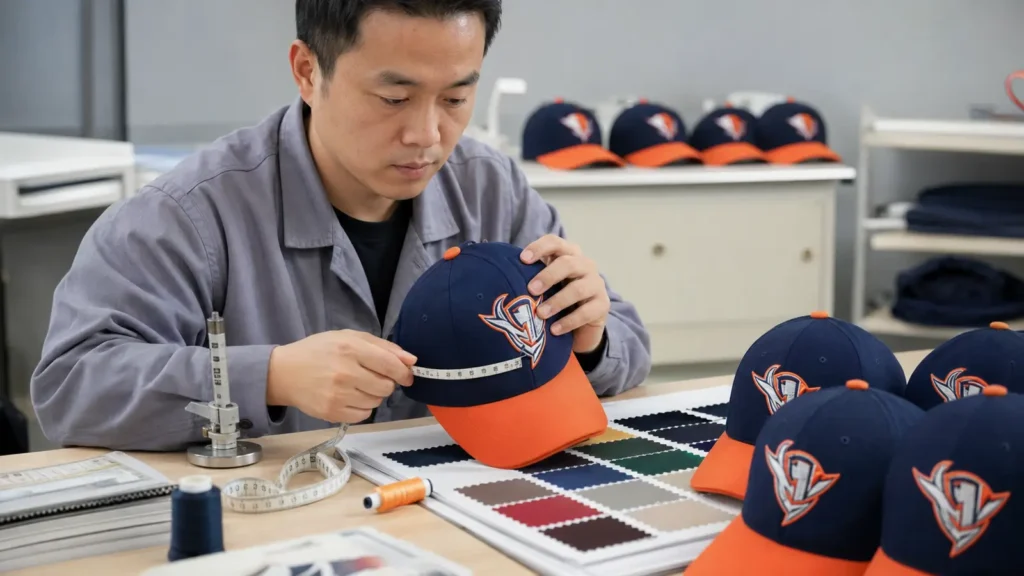
A signed-off reference sample and measurable tolerances make bulk inspection more objective.
Use a written sample-approval checklist:
- Confirm the cap style, profile, panel pattern, and brim.
- Measure key finished dimensions and practical fit.
- Compare fabric, mesh, thread, closure, and trim colors.
- Review logo size, position, stitch coverage, patch edges, and surface distortion.
- Inspect inside seams, sweatband, labels, and loose threads.
- Wear the cap to check stability, comfort, pressure points, and appearance.
- Photograph the approved sample from consistent angles.
- Record every approved change in the specification before bulk production.
For bulk inspection, define what is measurable: quantity, color reference, size distribution, logo position tolerance, cap dimensions, closure function, packing, carton marks, and workmanship. A statement such as “good quality” is too vague for consistent inspection.
What Drives the Cost of Custom Team Baseball Caps?
The lowest unit price is not always the lowest program cost. Poor fit or inconsistent reorders can create replacement and administration costs.
Major price drivers include:
- order quantity and the number of colorways;
- custom pattern or standard cap shape;
- fabric and mesh selection;
- fitted size count;
- embroidery stitch count and number of positions;
- 3D embroidery or combined techniques;
- custom patches, trims, closures, labels, and taping;
- individual packaging, barcodes, and hangtags;
- sample rounds and testing requirements;
- inspection standard, freight method, destination, and delivery schedule.
Ask suppliers to quote the same specification; a lower quote may exclude side embroidery, labels, packaging, or a complex size breakdown.
JIUMU’s typical MOQ is 50 pieces, subject to cap structure and customization. Confirm the MOQ for the exact style, color breakdown, decoration, and packaging before planning the program.
Labeling and Market Compliance Considerations
Compliance responsibilities depend on the product, destination, buyer role, and sales channel. This section is general sourcing guidance, not legal advice.
For the United States, the Federal Trade Commission explains that most covered textile products require labels identifying fiber content, country of origin, and the manufacturer or another responsible business. Buyers should confirm how the final cap and its components are classified and who will appear on the label. See the FTC’s textile and wool labeling guide.
For the European Union, Regulation (EU) No 1007/2011 sets rules for textile-fiber names and related fiber-composition labeling. The EU’s General Product Safety Regulation also establishes obligations for consumer products placed on the EU market; the European Commission provides a current product-safety overview.
Before production, confirm with the importer or compliance adviser:
- required fiber, country-of-origin, identity, care, and traceability information;
- label language and placement;
- children’s-product requirements when applicable;
- chemical restrictions and test documentation requested by the market or retailer;
- packaging, barcode, and warning requirements;
- substantiation for environmental or performance claims.
Questions to Ask a Custom Baseball Cap Supplier
Use these questions to compare suppliers on process, not only price:
- Which cap pattern and crown profile do you recommend for our use case?
- Can you provide the finished size chart and practical fit range?
- Which fabric specifications are available, and what documentation supports performance claims?
- How will our logo be adapted for embroidery or patch production?
- What is included in the sample, and how are revisions handled?
- Which physical references will control fabric and thread color?
- How do you record approved measurements and logo placement for bulk production?
- What inspections are performed before packing?
- Can private labels, hangtags, barcodes, and custom packaging be included?
- How are repeat orders matched to the original specification?
- What are the production and shipping assumptions behind the quoted schedule?
- Which buyer-supplied documents or market requirements must be confirmed before production?
Common Buying Mistakes
Choosing From a Front-View Mockup Only
A front view does not show crown depth, rear opening, closure, mesh stiffness, side-logo position, or internal construction. Approve the complete cap.
Using One Adult Size for a Mixed Youth Roster
“One size fits most” still has a practical limit. Sample the cap with representative players or use a measured roster.
Making the Logo Too Detailed
Fine outlines, tiny text, and narrow negative spaces may close during embroidery. Ask for a production-size embroidery proof and simplify the artwork when needed.
Approving Color on a Screen
Screens, fabric, thread, mesh, and print reflect color differently. Use physical approval for critical team colors.
Ignoring Reorder Planning
Record the approved cap pattern, materials, colors, embroidery file, dimensions, labels, and packaging. A photo alone is not a complete reorder specification.
Treating Unsupported Claims as Product Features
Terms such as recycled, antimicrobial, UV-protective, or waterproof should be tied to a defined material and appropriate evidence. If documentation is unavailable, use accurate, limited language.
Why Work With JIUMU for Custom Team Caps?
JIUMU is a Guangdong-based B2B custom teamwear, logo apparel, custom hat, uniform, bag, and branded-merchandise supplier established in 2010. The company supports sports teams, schools, clubs, distributors, uniform dealers, promotional buyers, retailers, and private-label brands serving North American and European markets.
Relevant capabilities include:
- OEM and ODM product development;
- flat and 3D embroidery;
- woven, rubber/PVC, and leather-style patches;
- fabric sourcing and Pantone color matching;
- private labels, woven labels, hangtags, and packaging customization;
- digital mockups and physical samples;
- bulk-production quality control and export support;
- coordination with jerseys, pants, jackets, hoodies, bags, and team packages.
These capabilities help buyers manage the cap as part of a repeatable teamwear specification rather than an isolated promotional item. Learn more about JIUMU.
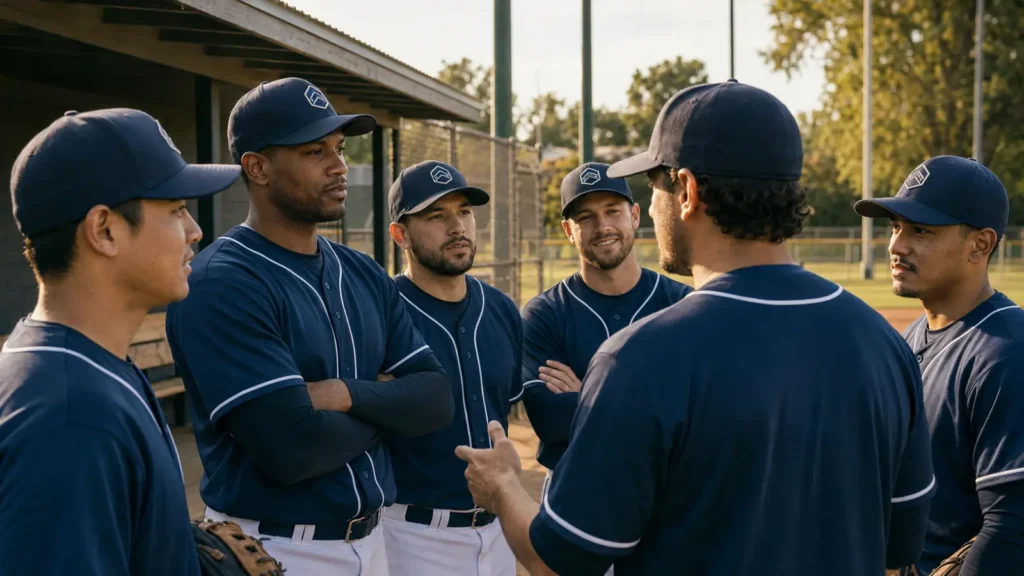
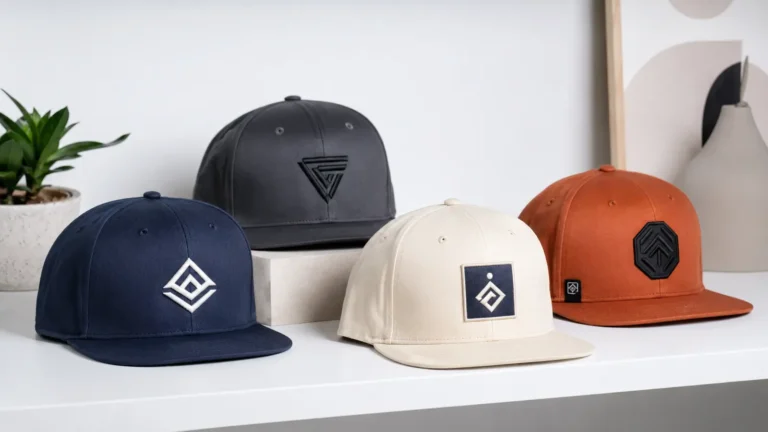
Coordinated caps help complete a consistent team identity across games, travel, and events.
Frequently Asked Questions
Final Recommendation
The best custom baseball caps for teams are built from a clear use case and an approved specification. For a traditional competitive uniform, start with a structured six-panel, mid-profile cap, curved brim, suitable performance fabric, comfortable sweatband, and a logo method proven on a physical sample. Move to fitted sizing when appearance justifies the added inventory; use adjustable caps when flexibility is the stronger operational need.
Do not finalize the order from a catalog name or mockup alone. Compare the cap on representative wearers, record measurable details, approve materials and color physically, and plan replacements before bulk production.
About JIUMU
JIUMU Product Development Team prepares practical sourcing guidance for custom hats, team uniforms, bags and logo apparel. JIUMU has served B2B custom-product programs since 2010.