Best Business Travel Backpacks for Professionals
Business travel backpacks have moved far beyond the basic laptop bag. For consultants, sales teams, field managers, executives, and frequent flyers, the right design must protect electronics, organize work tools, carry a short-trip wardrobe, and still look appropriate in a client meeting. For companies buying custom backpacks, the decision also involves materials, branding, quality control, repeat-order consistency, and airline compatibility.
This guide explains how professional buyers can compare business travel backpack types, specifications, construction, and customization options. It does not rank retail brands. Instead, it provides a practical framework for selecting or developing a backpack for corporate programs, distributors, uniform dealers, promotional buyers, and private-label collections.
Quick Answer: The best business travel backpacks for professionals usually combine a clean 20–30 L profile, a padded and raised laptop compartment, clamshell or wide-opening access, organized pockets, comfortable shoulder straps, a luggage pass-through, and materials appropriate to the intended price and use. There is no universal “airline-approved” size: buyers and travelers must check the operating airline’s current limits. For custom orders, approve a physical sample using a written specification that covers dimensions, materials, component brands or performance levels, logo placement, packaging, and test methods.
What Makes a Backpack Suitable for Business Travel?
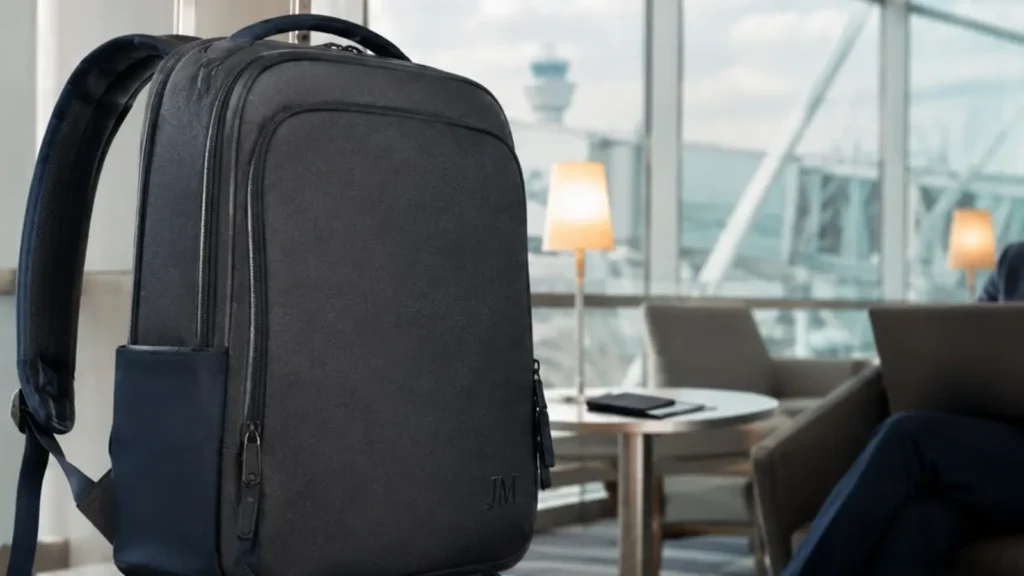
A business travel backpack differs from a casual daypack in the way it manages access, protection, appearance, and movement. The exterior should remain controlled when the bag is partly full. The laptop area should limit impact from the bottom and sides. Work items should be reachable without unpacking clothes. Hardware should tolerate repeated opening, security checks, train transfers, and overhead-bin handling.
For procurement, “best” is therefore a specification match, not a single style. A sales team taking one-night trips may value a clamshell main compartment and luggage sleeve. A service engineer may need stronger fabric, tool organization, and a stable base. A conference program may prioritize a slim silhouette and understated logo. A private-label buyer may need a clear feature story, consistent colors, and packaging ready for retail.
The right evaluation question is: Which design protects the user’s essential work kit while fitting the trip length, dress code, transport mode, and target cost?
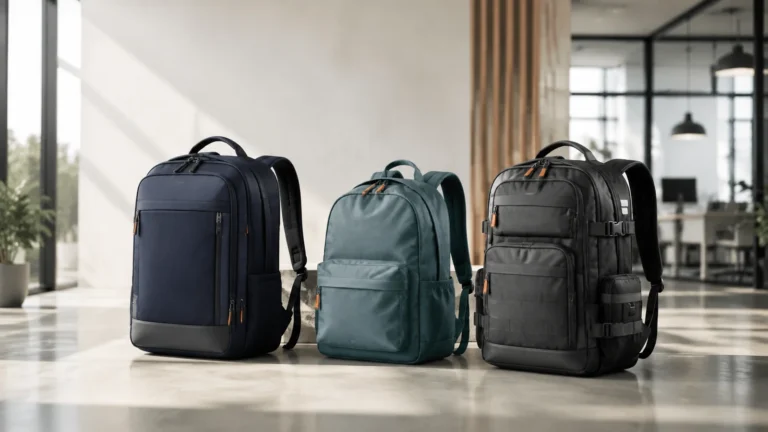
Business Travel Backpack Types Compared
| Backpack type | Typical working capacity | Best use | Main advantage | Procurement caution |
|---|---|---|---|---|
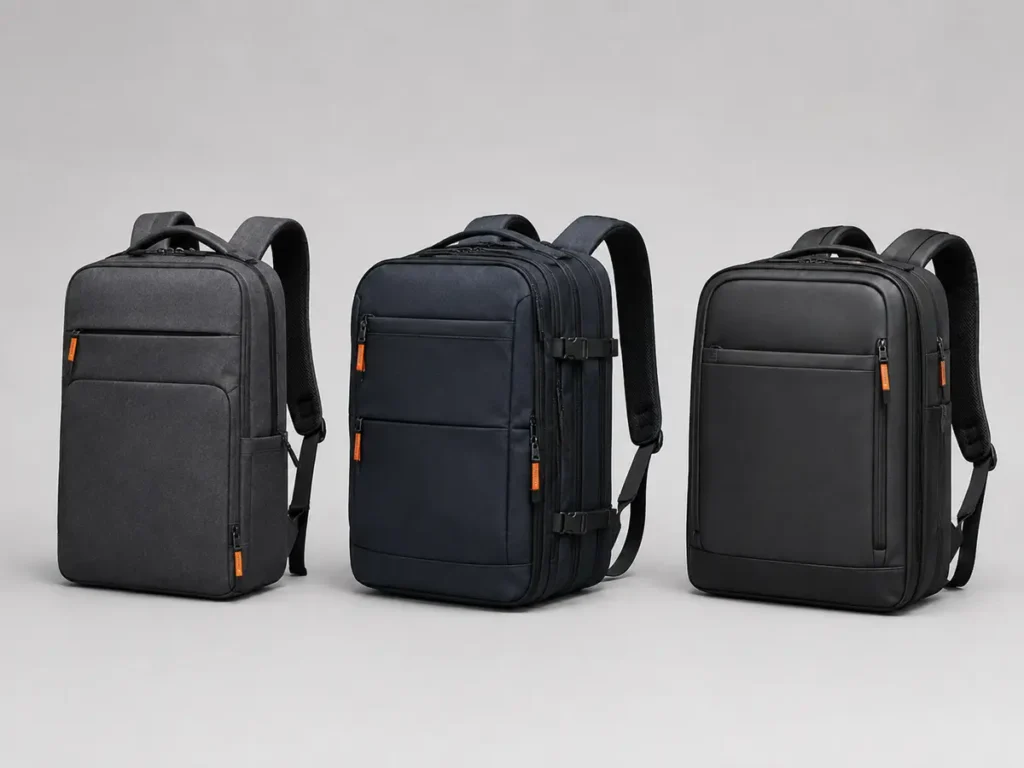
| Slim laptop commuter | 15–22 L | Daily office travel, conferences, client visits | Professional profile and low bulk | Limited clothing capacity; overpacking can distort the shape |
| Expandable overnight | 22–32 L | One- to three-night business trips | Flexible volume and clamshell packing | Expansion may exceed a carrier’s personal-item limit |
| Executive structured | 18–26 L | Corporate gifts, management teams, premium programs | Holds its shape and presents well | Extra structure can add weight and reduce usable internal volume |
| Convertible backpack–briefcase | 18–28 L | Travelers moving between transit and formal meetings | Multiple carry modes | Hidden straps and handles need careful ergonomic testing |
| Rolling-compatible backpack | 20–30 L | Frequent flyers using a suitcase | Luggage pass-through reduces shoulder load | Sleeve width and placement must match common handle systems |
| Technical work-travel pack | 24–35 L | Field teams, technicians, sales demonstrations | Strong organization and protection | May look too utilitarian for executive programs |
Slim Commuter Backpacks
Choose a slim commuter when most users travel with a laptop, charger, notebook, headphones, bottle, and light personal items. A depth of roughly 12–18 cm can help maintain a clean profile, but the final dimensions should follow the intended device and transport requirement. A gusset that opens too widely can spill contents; one that barely opens makes cable access frustrating.
Expandable and Clamshell Backpacks
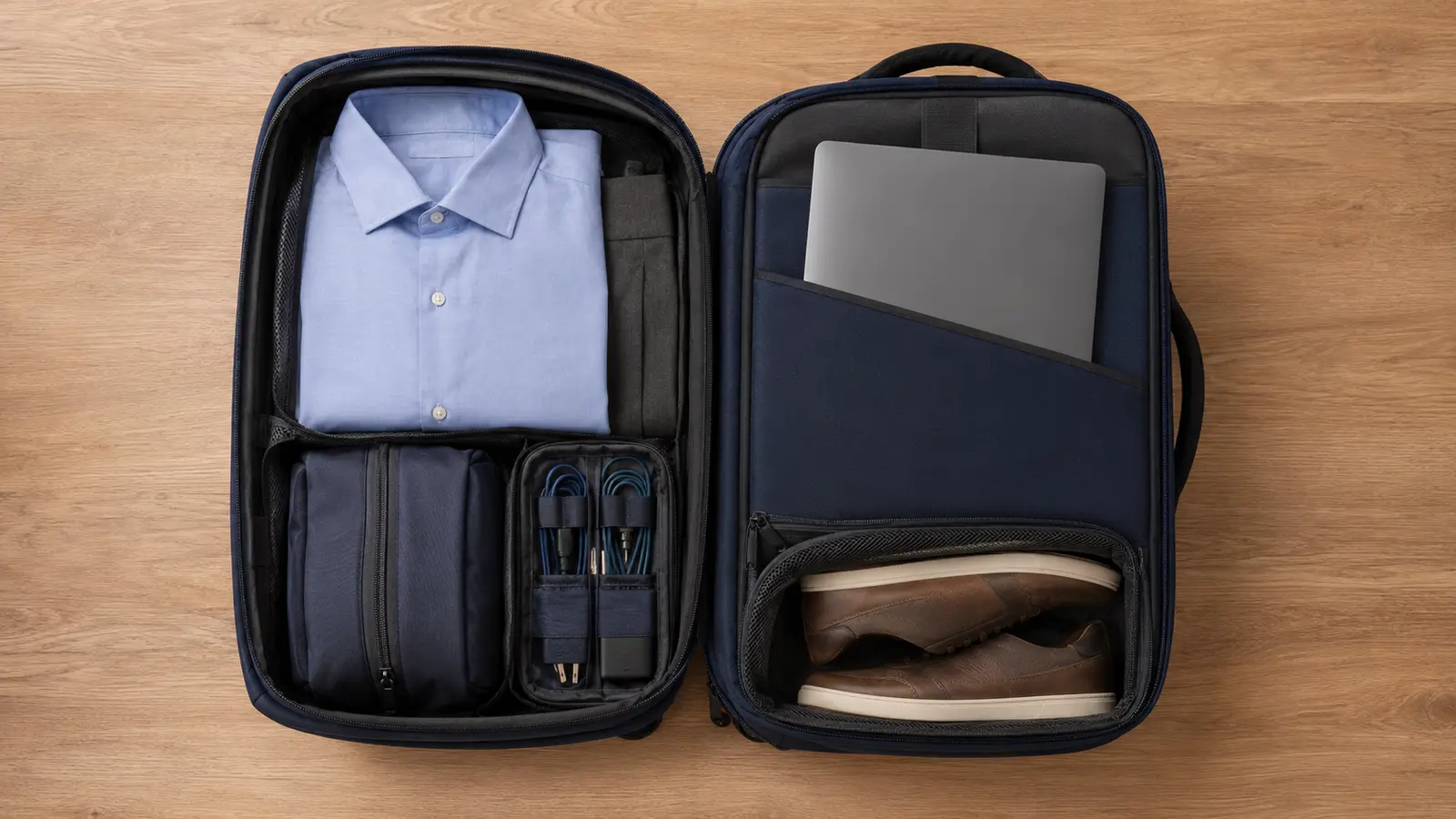
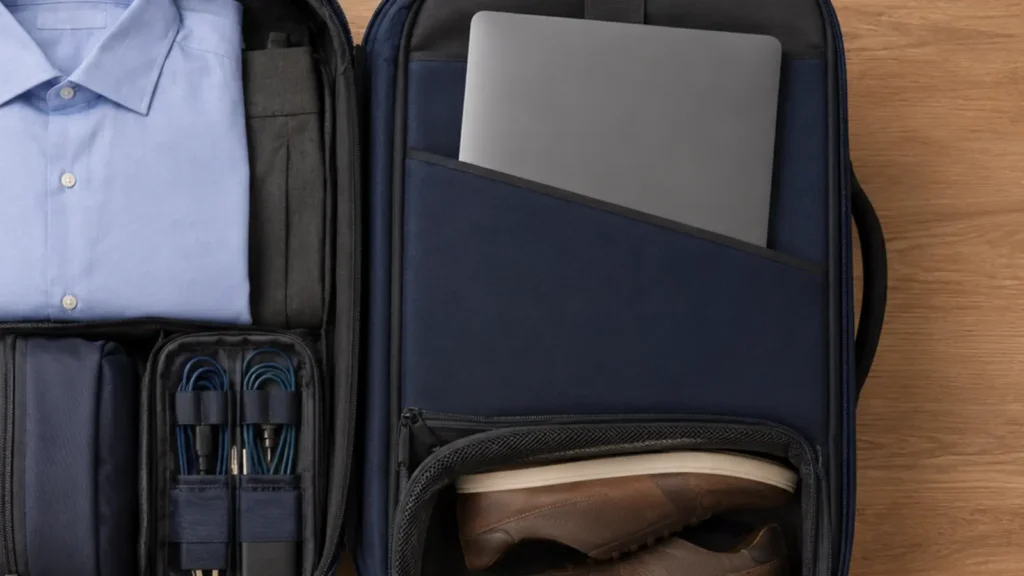
An expandable travel backpack works well for short trips because clothing can be separated from work gear. The most useful designs open like a suitcase while keeping the laptop accessible from a dedicated zipper. Buyers should test the bag both compressed and expanded. Expansion changes balance, stress on the zipper chain, and compliance with baggage limits.
Structured Executive Backpacks
Structured panels, controlled curves, matte hardware, and tonal branding create a more formal appearance. Structure may come from foam, PE board, molded panels, or layered fabrics. Ask the supplier to identify the reinforcement rather than accepting a vague phrase such as “premium structure.” Too much board can make the pack stiff and heavy; too little can cause collapse.
Convertible Designs
Convertible bags can shift from backpack to briefcase carry. The concept is useful only when every mode works well. Check whether shoulder straps stow cleanly, the briefcase handle feels balanced, and loose buckles touch clothing. A feature that looks clever in a rendering can become a nuisance in daily use.
Capacity: How Many Liters Are Enough?
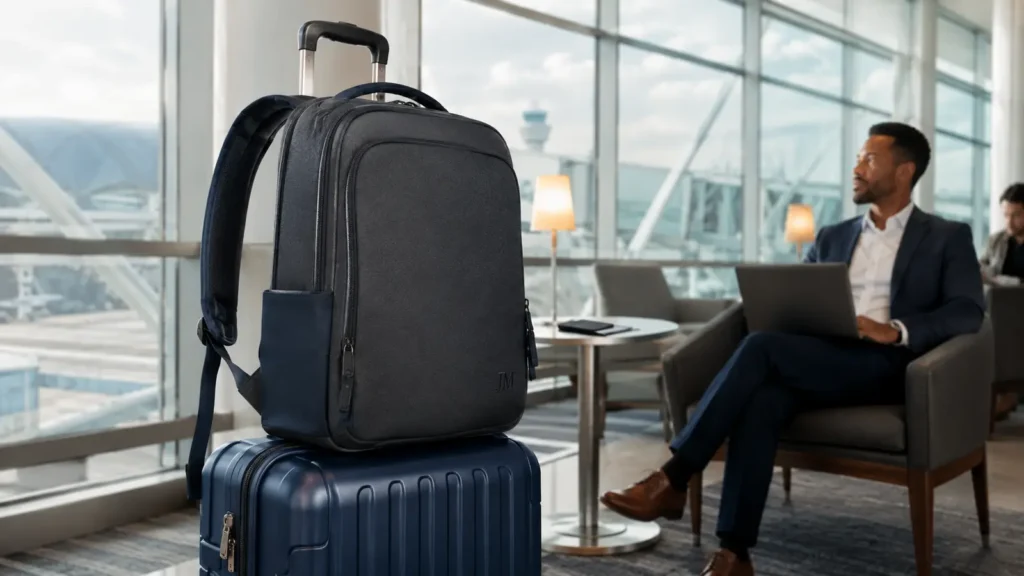
Capacity labels are useful for comparison but not sufficient for purchasing. Two 25 L bags may carry very different loads because padding, curved panels, pocket construction, and internal dividers consume volume. Request finished external dimensions, main-compartment dimensions, laptop-sleeve dimensions, and a physical packing demonstration.
| Intended trip | Useful design range | Example load | Recommended configuration |
|---|---|---|---|
| Daily commute | 15–22 L | Laptop, charger, notebook, lunch, small accessories | Slim opening, quick-access work organizer, bottle pocket |
| Overnight | 20–26 L | Work kit plus one clothing change and toiletries | Wide opening, separate laptop access, compact clothing zone |
| Two to three nights | 25–32 L | Work kit, two outfits, toiletries, compact shoes | Clamshell layout, compression straps, expandable option |
| Equipment-heavy travel | 28–35 L | Laptop, samples, tools, cables, personal items | Dividers, reinforced base, stable harness, documented load test |
These are design-planning ranges, not airline guarantees. IATA advises passengers to check baggage information with their airline because allowances vary. Airlines may apply different limits by route, fare, aircraft, or whether the bag is treated as a personal item or cabin bag. A custom buyer should define the target carrier set and desired unexpanded dimensions, while avoiding the claim “airline approved” unless the claim is precisely qualified and maintained.
Laptop Protection and Security-Screening Access
The laptop sleeve is often the most important functional area. Specify the maximum device dimensions rather than only a diagonal screen size. Two laptops sold as 16-inch devices can have different bodies. The sleeve should hold the device without excessive movement while leaving enough clearance for normal insertion.
Look for these elements:
- A suspended or raised sleeve bottom that keeps the device above the exterior base.
- Closed-cell or resilient foam on the back, front, bottom, and critical corners.
- A soft lining that does not trap abrasive debris.
- A retention strap or controlled opening when the zipper orientation could let the device slide.
- Independent laptop access so clothing need not be exposed at checkpoints or meetings.
- A zipper path that does not scrape the device edge.
TSA’s public guidance says laptops generally need to be removed and placed in a separate bin in standard screening lanes, while procedures can differ for TSA PreCheck and at checkpoints using different screening technology. TSA also recommends placing large electronics near the top layer for accessibility. The procurement implication is simple: make the electronics compartment quick to reach, but do not market a bag as “TSA approved.” Screening rules belong to the authority, not the bag.
Materials: Match the Fabric to the Program
Polyester
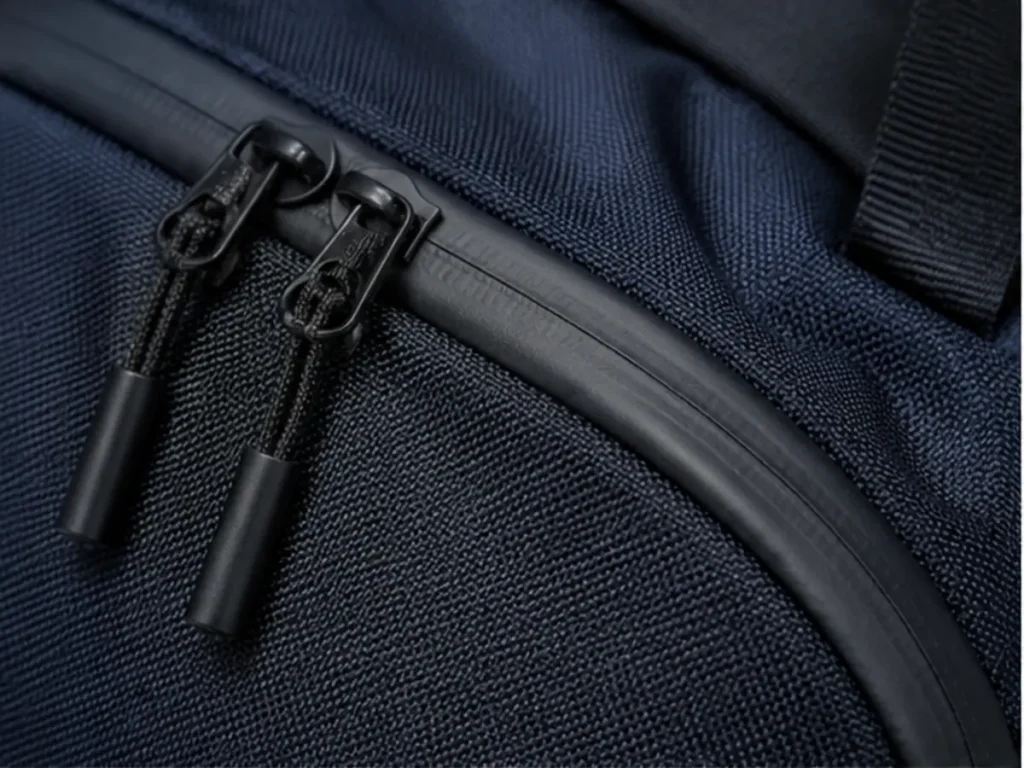
Polyester is widely used because it offers broad choices in weight, texture, finish, color, and cost. A tightly woven face can create a clean corporate appearance. Specify denier or fabric weight where appropriate, weave, coating, color standard, and required test performance. “600D polyester” alone does not define coating quality, tensile performance, or colorfastness.
Nylon
Nylon can provide a refined hand feel and strong abrasion performance in suitable constructions. It can also cost more and may behave differently in color matching. Confirm the exact nylon type, yarn, backing, and finishing. Do not assume all nylon automatically outperforms all polyester.
Coated and Laminated Fabrics
PU-coated, TPU-laminated, or other treated fabrics can improve water resistance and create a modern surface. Performance depends on seams, zipper construction, coating thickness, adhesion, and aging—not only the face fabric. Use “water-resistant” only when the finished bag has been tested to an agreed method and the claim states its limits. A backpack with ordinary stitched seams should not be described as waterproof simply because the fabric resists water.
Recycled-Content Materials
Recycled polyester can support a buyer’s material strategy, but claims require documentation. Ask what percentage applies, whether it is pre- or post-consumer material, which components are included, and what transaction or certification records will accompany the order. The U.S. FTC Green Guides state that environmental claims should be truthful, substantiated, and appropriately qualified; recycled-content claims should identify partial content when a product is not entirely made from recycled material.
Lining, Mesh, Foam, and Reinforcement
Secondary materials affect experience and durability. Light-colored lining improves visibility. Spacer mesh may improve perceived ventilation but needs snag and abrasion review. Foam density influences strap comfort and long-term compression. Board or sheet reinforcement controls shape. Request a bill of materials for the approved sample so a repeat order does not quietly substitute these less-visible components.
Construction Details That Predict Durability
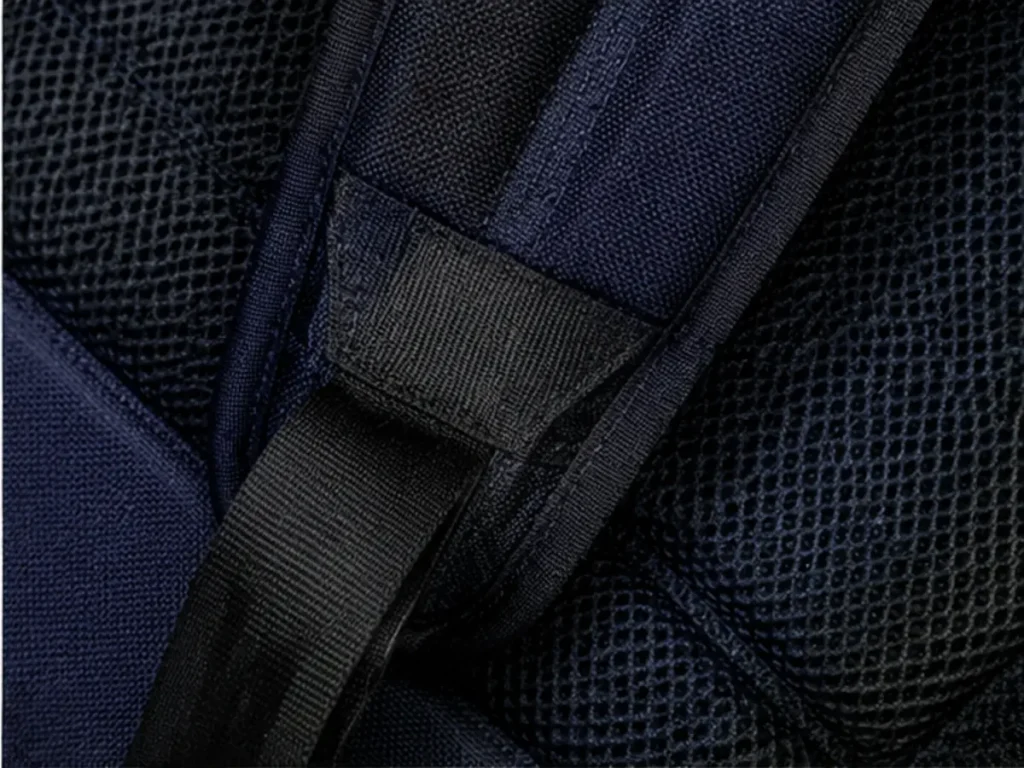
A strong face fabric cannot compensate for weak attachment points. Most real-world stress concentrates at shoulder-strap roots, top handles, zipper ends, compression straps, and the base. The specification should define how these areas are reinforced.
Useful construction checks include:
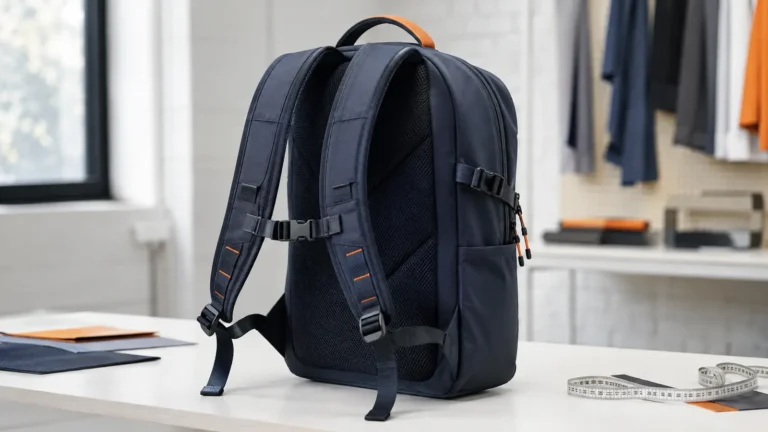
- Strap attachment: Look for an adequate overlap, reinforcing webbing or panel, and consistent box-X or multi-row stitching where appropriate.
- Handle anchoring: Pull force should transfer into a structural panel, not only the lining.
- Zipper installation: Curves should run smoothly without waves, fabric catching, or excessive tension at corners.
- Seam allowance: Interior seams should be securely bound or finished and remain consistent around curves.
- Base protection: The bottom should resist abrasion and prevent the laptop from striking the floor.
- Hardware security: Buckles, adjusters, and zipper pulls should fit the selected webbing and remain stable under repeated cycles.
- Symmetry: Strap length, panel alignment, pocket placement, and logo position should match the approved tolerance.
For a bulk program, convert these observations into measurable acceptance points. A golden sample plus an inspection checklist is much more useful than approving appearance through photographs alone.
Comfort and Ergonomics for Frequent Travelers
Comfort depends on load, body variation, strap geometry, back-panel shape, and how the contents are distributed. Thick padding is not automatically comfortable. Straps that are too thick can sit awkwardly; soft foam may collapse; narrow spacing may rub the neck.
Evaluate a loaded sample with representative users. Include shorter and taller users when the program serves a broad workforce. Pack the expected laptop, charger, clothing, bottle, and accessories. Walk, climb stairs, sit, place the bag on a suitcase, and retrieve the laptop. Check:
- Whether the bag pulls away from the upper back.
- Whether strap edges press into the neck or chest.
- Whether adjusters hold their position.
- Whether a sternum strap is useful or visually excessive for the target group.
- Whether the back panel causes clothing abrasion.
- Whether the luggage sleeve positions the bag securely on a rolling case.
For heavier professional loads, buyers can define a working-load test and a comfort trial. The pass condition and test weight should be agreed before sample approval.
Organization Features Professionals Actually Use
Feature count should not replace usability. Too many small pockets add sewing operations, weight, and cost while limiting flexibility. Begin with the user’s objects and access sequence.
A well-planned professional layout may include:
- Separate padded laptop and tablet areas.
- A top pocket for passport, phone, or earbuds.
- A cable and charger organizer with enough depth for bulky adapters.
- A document section that keeps papers flat.
- One discreet security pocket against the back panel.
- A bottle pocket that does not intrude heavily into the main compartment.
- A clamshell clothing area with restraint straps or a mesh divider.
- A key leash, pen slots, and one flexible pocket rather than many tiny fixed slots.
Power-bank cable ports are often marketed as “smart” features, but they can complicate construction and user understanding. FAA guidance requires spare lithium batteries and power banks to remain in carry-on baggage and, if the bag is gate-checked, to be removed and kept in the cabin. Buyers should avoid permanently integrated battery concepts unless the regulatory, carrier, labeling, and service implications have been properly reviewed.
Corporate Customization and Private Label Options
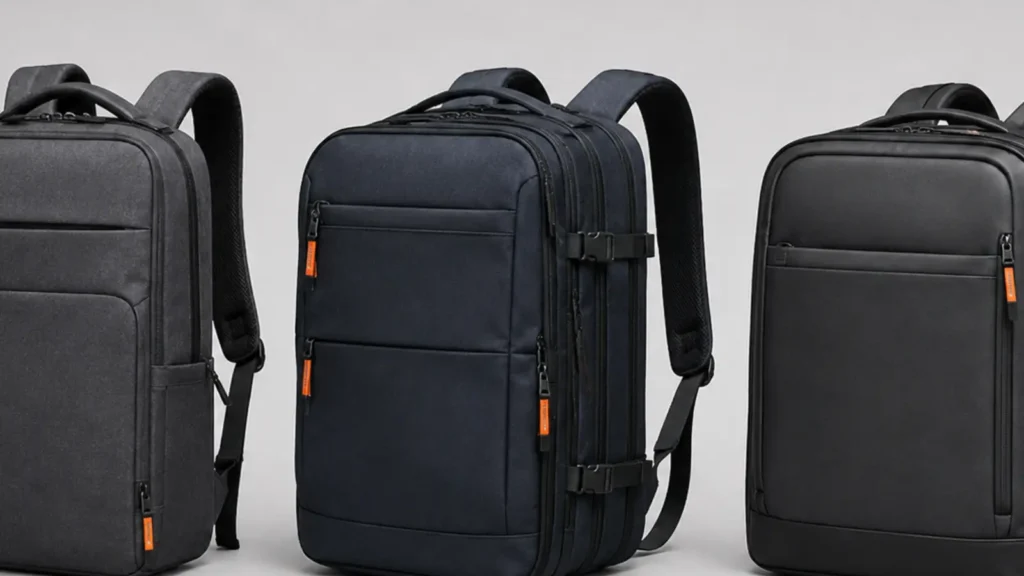
Business travel backpacks usually benefit from controlled branding. A large, bright front logo may reduce use after an event; a tonal embroidery, woven side label, custom zipper pull, debossed patch, or lining repeat can feel more considered.
JIUMU supports OEM and ODM product development, embroidery, screen printing, heat transfer, woven and rubber/PVC patches, leather-style patches, fabric sourcing, Pantone color matching, private labels, hangtags, and custom packaging. The appropriate method depends on logo detail, material surface, target appearance, quantity, and budget.
| Branding method | Visual effect | Best suited to | Key approval points |
|---|---|---|---|
| Flat embroidery | Durable, familiar textile finish | Corporate logos, school marks, initials | Thread color, stitch density, backing, distortion |
| Tonal embroidery | Discreet and executive | Employee gifts, management programs | Contrast under real light, legibility at final size |
| Woven label | Fine detail and brand-system consistency | Side seam or internal branding | Edge finish, fold, placement, color match |
| Rubber/PVC patch | Modern and dimensional | Technical or outdoor-influenced bags | Relief depth, color, attachment, temperature behavior |
| Leather-style patch | Warm, premium appearance | Lifestyle and executive concepts | Material disclosure, deboss clarity, edge finish |
| Heat transfer | Smooth, precise artwork | Coated panels and lightweight concepts | Adhesion, flexing, heat compatibility, aging test |
| Custom zipper pull | Subtle product-level identity | Private-label collections | Tooling, pull strength, finish consistency, minimum quantity |
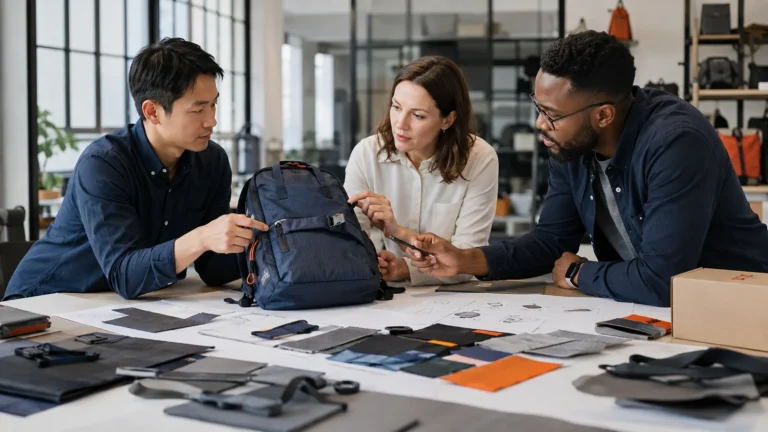
Develop a backpack around your users, not a stock feature list. Send JIUMU your target quantity, trip length, laptop dimensions, preferred capacity, reference images, colors, logo file, packaging needs, target market, and required delivery date. JIUMU can review the concept and prepare a custom quotation. Explore custom team and business bags or contact the team.
Cost Drivers in a Custom Business Backpack
The unit price is determined by the total construction, not one headline material. Important cost drivers include:
- Main fabric, lining, coating, mesh, foam, and reinforcement layers.
- Backpack size and number of panels.
- Zipper specification, sliders, pulls, buckles, and metal hardware.
- Number and complexity of compartments.
- Molded or structured components.
- Embroidery stitch count, patch tooling, print colors, and logo locations.
- Custom-dyed fabric or webbing and Pantone matching.
- Labels, hangtags, polybags, cartons, and retail packaging.
- Sample rounds, testing, inspection level, and shipping method.
- Order quantity and color split.
To compare quotations fairly, send the same specification to each supplier and identify what is included. A lower quote may use lighter fabric, generic hardware, less foam, fewer reinforcements, simpler packaging, or different inspection assumptions. Request clarification before treating prices as equivalent.
JIUMU’s typical MOQ is 50 pieces, subject to product structure and customization. Projects involving special materials, new molds, custom-dyed components, or many colorways may require different minimums. Confirm the feasible quantity after the design is defined.
How to Approve a Sample
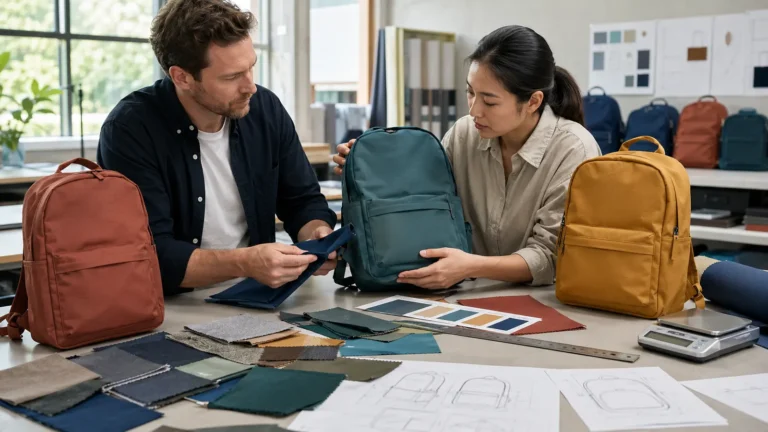
A physical sample is the bridge between an idea and repeatable production. Review it in a consistent sequence:
- Confirm identity: style code, revision number, color, logo version, and sample date.
- Measure: finished height, width, depth, strap dimensions, handle drop, key pocket openings, and laptop sleeve.
- Weigh and pack: record empty weight, load the intended kit, and photograph the arrangement.
- Inspect materials: compare fabric, lining, foam, reinforcement, zippers, webbing, thread, and hardware with the specification.
- Use every feature: cycle zippers, adjust straps, use the luggage sleeve, insert devices, and open the bag in a confined space.
- Review appearance: check panel symmetry, puckering, color variation, logo position, stitch cleanliness, and silhouette when empty and loaded.
- Test critical claims: apply agreed methods for seam strength, handle/strap load, zipper cycles, abrasion, colorfastness, water resistance, or other claimed performance.
- Document decisions: mark approved, approved with changes, or rejected. Create a signed golden sample or an equivalent controlled record.
Do not rely on “same as sample” without preserving the sample’s material and component information. The supplier and buyer should share the latest revision and approval record.
Bulk-Order Quality Control Checklist
Inspection should focus on both function and appearance. Define sampling method and acceptance criteria with your inspection provider or quality team. A practical checklist can cover:
- Purchase order, style, quantity, color, and size assortment.
- Finished measurements and tolerances.
- Main fabric, lining, trims, padding, boards, and hardware.
- Color comparison under agreed lighting.
- Logo artwork, size, color, position, and orientation.
- Zipper operation and puller security.
- Seam quality, reinforcement, loose threads, skipped stitches, and binding.
- Strap symmetry, adjustment, attachment, and load test.
- Laptop protection and pocket dimensions.
- Odor, stains, marks, sharp edges, and foreign matter.
- Label content, barcode or SKU where required, and packaging.
- Carton assortment, markings, dimensions, and shipping protection.
If a feature is important enough to advertise, it is important enough to define and inspect.
Information to Send for an Accurate Quotation
An efficient RFQ reduces assumptions. Include:
- Buyer type and target market.
- Intended user and trip length.
- Target order quantity and quantity per color.
- Required finished dimensions or target capacity.
- Maximum laptop dimensions.
- Reference photos, sketch, tech pack, or existing sample.
- Main material preference and performance needs.
- Required pockets, opening style, luggage sleeve, and carry modes.
- Logo vector file, method, size, color, and placement.
- Pantone colors or physical color reference.
- Labels, hangtags, retail or bulk packaging, and carton requirements.
- Testing or compliance requirements for the destination market.
- Sample deadline, target delivery date, destination, and shipping preference.
- Target price range, if available, so engineering choices can be realistic.
Questions to Ask a Backpack Supplier
- Which materials and components are included in the quotation?
- Can you provide a bill of materials for the approved sample?
- Which dimensions and tolerances will be controlled in bulk?
- How will laptop fit and bottom protection be verified?
- What reinforcements are used at handles and shoulder straps?
- Which tests are available, and who performs them?
- How are Pantone colors evaluated across fabric, webbing, thread, and patches?
- What changes would affect MOQ, price, or lead time?
- How are pre-production and bulk samples approved?
- What is the inspection plan before shipment?
- How will approved materials be maintained for repeat orders?
- What packaging protects the bag without creating unnecessary volume?
Common Buying Mistakes
Calling a Bag “Airline Approved”
Airline policies vary. Publish actual dimensions and advise users to confirm their airline’s current allowance. If the backpack expands, show both compressed and expanded dimensions.
Choosing Capacity Without a Packing Test
Liter ratings do not reveal usable shape. Approve the bag with a realistic work-and-clothing load.
Specifying Only the Main Fabric
Lining, foam, reinforcement, zipper, webbing, thread, and hardware strongly affect quality. Control the full bill of materials.
Adding Every Possible Pocket
More pockets can reduce usable volume and increase cost. Map pockets to real objects and access moments.
Approving Logos Only on a Digital Mockup
Fabric texture, panel curvature, padding, and stitch density change the result. Approve decoration on the production material.
Using Unsupported Environmental Claims
Request evidence, state the recycled percentage or scope accurately, and qualify claims. Avoid broad terms such as “green” without substantiation.
Ignoring Gate-Check Scenarios
Travelers may need to surrender a carry-on at the gate. The FAA says spare lithium batteries and power banks must be removed and kept in the aircraft cabin when a carry-on is gate-checked. A dedicated, quickly accessible power-bank pocket can support that user action.
Why JIUMU for Custom Business Travel Backpacks?
JIUMU is a Guangdong-based B2B supplier established in 2010. The company supports custom bags alongside teamwear, uniforms, logo apparel, hats, and branded merchandise for buyers in North America and Europe.
For backpack programs, relevant capabilities include OEM/ODM development, fabric sourcing, Pantone color matching, embroidery, screen printing, heat transfer, woven and rubber/PVC patches, leather-style patches, private labels, hangtags, packaging customization, digital mockups, physical samples, quality control, and export support.
This capability set is useful when a backpack must coordinate with corporate apparel, event merchandise, team uniforms, or a broader branded kit. Buyers can develop the bag as a controlled product rather than simply adding a logo to an unknown stock model.
Frequently Asked Questions
Final Recommendation
The best business travel backpack is the one that fits the user’s real trip, device, dress code, and transport pattern—and can be reproduced consistently. Start with a 20–30 L design window for general professional use, then validate dimensions and packing efficiency. Prioritize laptop protection, a stable harness, luggage compatibility, direct access, reinforced stress points, and a restrained exterior. For bulk customization, approve a physical sample against a complete specification and preserve the bill of materials for repeat orders.
Request a Custom Business Backpack Quotation: Send JIUMU your quantity, target users, dimensions or capacity, laptop size, reference image or tech pack, materials, colors, logo file, packaging, destination, and target delivery date. Email zhengdong@jiumugear.com, contact WhatsApp/Phone +86 18507502899, or submit an inquiry.