Best Business Laptop Backpacks: Features That Matter
Choosing a business laptop backpack is not simply a matter of selecting a fashionable bag with a padded pocket. For a company, distributor, promotional-products buyer, school, or private-label brand, the decision affects device protection, daily comfort, brand presentation, replacement rates, and repeat-order consistency. The best specification is the one that fits the actual laptop fleet, commuting pattern, travel frequency, dress code, and customization plan.
This guide explains which features matter, how to translate marketing language into measurable requirements, and what to inspect before approving a bulk order. It is written for professional buyers comparing custom or private-label business laptop backpacks rather than consumers looking for a retail ranking.
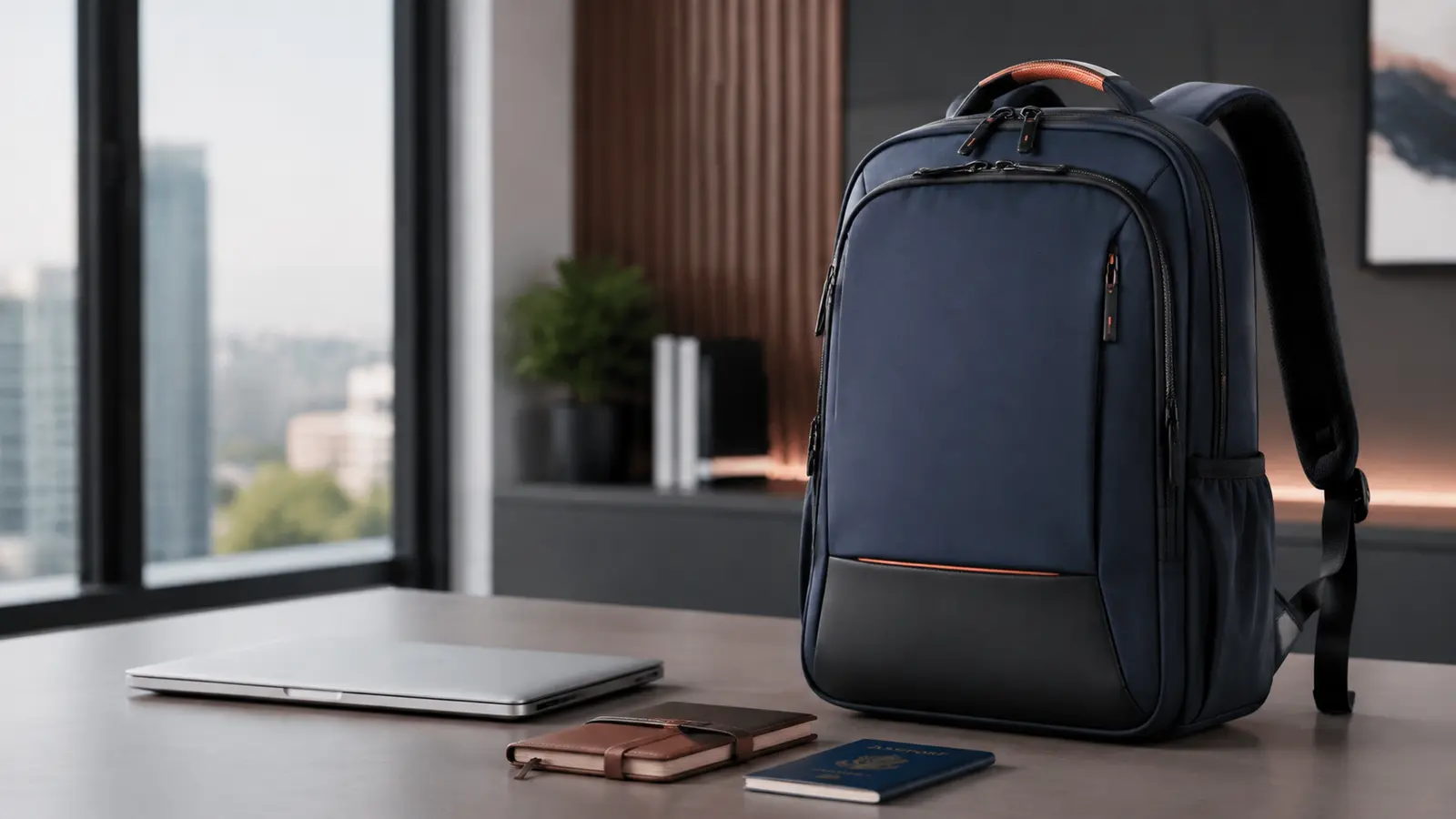
Quick Answer: The best business laptop backpacks combine a correctly sized, suspended and padded device compartment; balanced shoulder straps and a stable back panel; durable fabric and reinforced high-stress seams; practical organization; controlled water resistance; and a form that suits the intended workplace. For bulk orders, buyers should approve a physical sample using the actual laptop, loaded-weight and zipper tests, then lock the materials, dimensions, logo method, packaging and inspection standard in the purchase specification.
Why the Business Laptop Backpack Decision Matters
A laptop backpack is part protective equipment, part mobile workspace and part branded merchandise. If the laptop sleeve is too large, the device can move and strike the bag walls. If it is too tight, staff may force the zipper or stress the seams. If shoulder straps are narrow or poorly anchored, a bag that looks acceptable when empty may become uncomfortable after adding a laptop, charger, water bottle and documents.
Corporate buyers also face a consistency problem. A single sample may look good, but a bulk order must reproduce the same fabric hand, color, compartment size, stitch density, trim and logo position across many units. A clear specification and documented approval sample are therefore more valuable than a long list of loosely defined “premium” features.
Business Laptop Backpack Types Compared
| Backpack type | Typical use | Useful design priorities | Main trade-off |
|---|---|---|---|
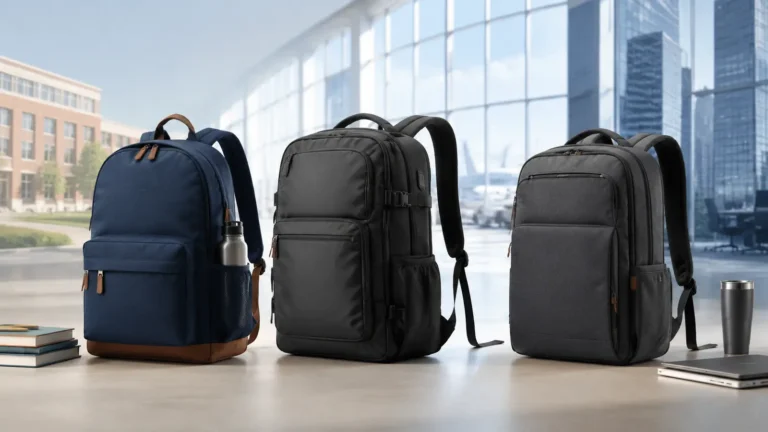
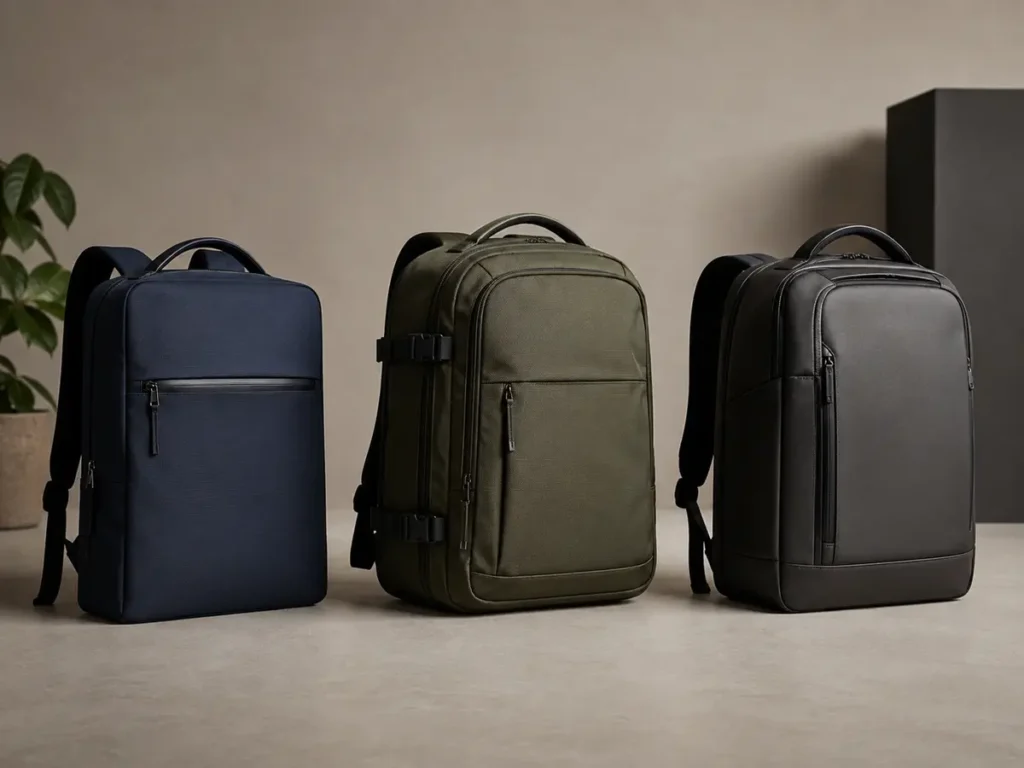
| Slim commuter | Office, train, short urban trips | Low-profile shape, quick-access pocket, protected laptop sleeve | Limited space for clothing or bulky equipment |
| Executive structured | Client meetings, professional uniforms, corporate gifts | Shape retention, restrained branding, organized interior | More structure may add weight |
| Expandable travel-work | One- to three-day trips and hybrid work | Expansion gusset, clamshell access, trolley sleeve, separate tech storage | Wider profile when fully packed |
| Tech organizer | IT teams, field service and mobile sales | Cable pockets, device dividers, accessory visibility | Too many pockets can reduce usable main volume |
| Convertible backpack | Mixed formal and casual settings | Stowable straps, top/side handles, clean exterior | More components and construction complexity |
The category should follow the user journey. A sales team moving between airports and client offices may benefit from an expandable travel-work model. A financial-services welcome kit may need a structured, minimal design. Field technicians may prioritize labeled organization, but a creative agency may prefer a lighter, softer commuter silhouette.
Start With the Laptop Compartment, Not the Screen Size
“Fits a 16-inch laptop” is an incomplete specification. Screen size is measured diagonally and does not define the full width, depth or thickness of a computer. Two laptops marketed under the same screen class can have different chassis dimensions. Buyers should obtain the physical dimensions of the largest intended device and test the actual unit or an accurate dummy during sampling.
For a current reference point, Apple lists its 16-inch MacBook Pro at 14.01 × 9.77 inches (35.57 × 24.81 cm), excluding the thickness consideration. A bag should not be specified from that example alone; it simply shows why the internal sleeve must be measured in three dimensions. [Apple technical specifications]
Laptop Protection Features Worth Specifying
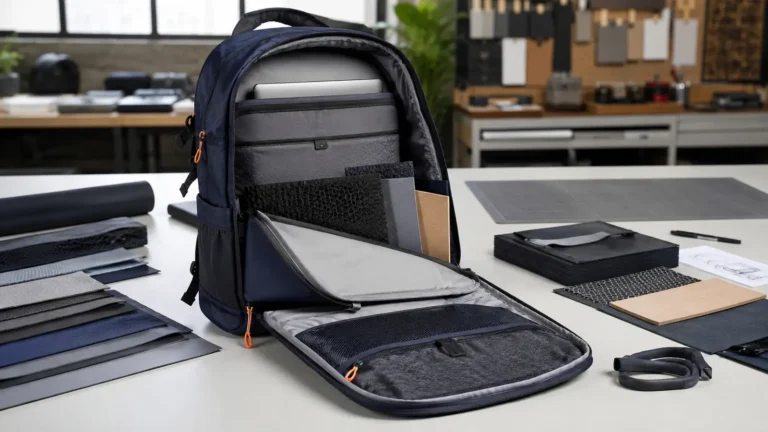
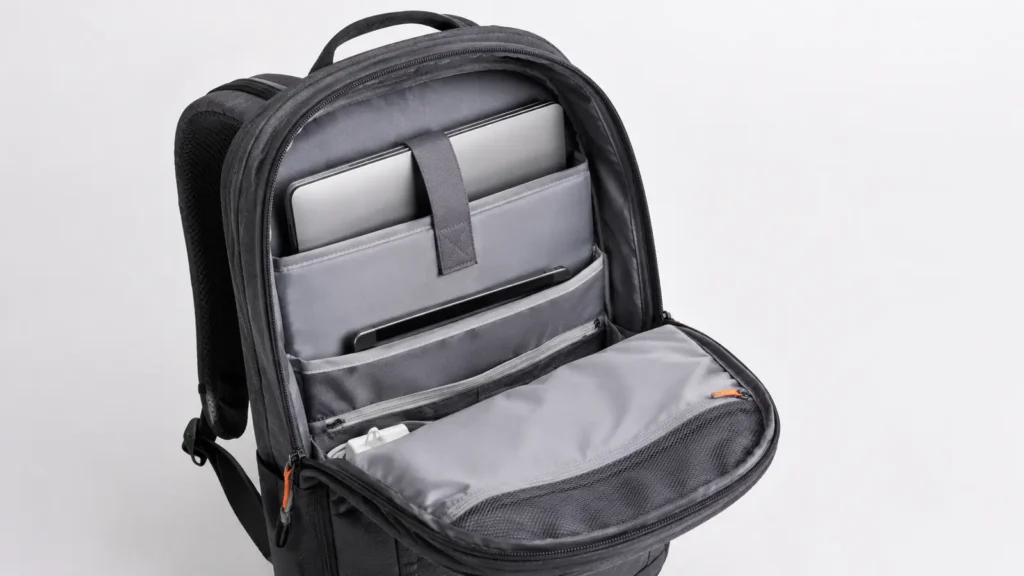
- Usable internal sleeve dimensions: State width, height and practical thickness after lining and padding are installed.
- Suspended bottom: The sleeve should end above the external base so the computer is less likely to contact the floor when the bag is set down. Specify and inspect the actual clearance.
- Side and back padding: Foam should cover the device contact area without creating pressure points.
- Closure and retention: A strap, zipper or fitted sleeve can limit device movement. Confirm that hardware cannot scratch the laptop.
- Soft lining: The device-facing surface should be clean, smooth and colorfast.
- False-bottom construction: A raised internal floor provides a second buffer, especially in travel-oriented bags.
- Separate tablet divider: This prevents two devices from rubbing directly together.
Do not assume that thicker foam is always better. Foam density, coverage, recovery and placement matter. Overly soft foam can compress under load, while bulky foam can reduce usable space. The sample should be tested with the target device inserted and the bag filled as a user would carry it.
Capacity and Internal Organization
Liter capacity is helpful for comparing overall scale, but it does not reveal whether the shape is useful. Curved corners, thick dividers and numerous small pockets can reduce the volume available for documents, lunch containers, samples or clothing. Ask for finished external dimensions, practical internal dimensions and a packing demonstration with representative items.
| User profile | Practical organization | Features to avoid or qualify |
|---|---|---|
| Daily office commuter | Laptop sleeve, document area, charger pocket, quick-access top pocket | Oversized travel compartments and excessive depth |
| Frequent business traveler | Clamshell or wide opening, trolley sleeve, passport pocket, cable organization | External pockets that interfere with luggage handles |
| Mobile salesperson | Sample space, tablet divider, business-card pocket, stable bottle pocket | Deep unstructured cavity where small items disappear |
| IT or field-service team | Multiple accessory pockets, reinforced base, clear access to adapters | Fragile internal mesh or narrow openings |
| Corporate gift recipient | Flexible main compartment, simple organizer, understated exterior | Highly specialized pockets that limit general use |
Organization should reduce friction, not merely increase pocket count. Each added pocket adds material, sewing operations and potential failure points. A procurement team can improve the specification by listing the five to eight items users carry most often and assigning each one a logical place.
Carrying Comfort and Ergonomics
A comfortable backpack keeps the load stable and close to the body. Comfort cannot be proven by appearance alone, and it varies with torso size, clothing, load and trip duration. For procurement, focus on observable construction and conduct a loaded wear trial with several representative users.
Look for shoulder straps with sufficient width, smooth edge binding and foam that does not collapse immediately. The strap curve should sit naturally without cutting into the neck. Reinforcement at the upper strap anchors is critical because this area transfers much of the carried load to the bag body. Adjustable webbing should move smoothly through the buckles but hold its position during use.
A padded back panel can spread pressure and create air channels, although “ventilated” should not be interpreted as sweat-proof. A sternum strap may improve stability for cycling, long walks or heavier loads, but may be unnecessary for a minimalist executive model. Load lifters and waist belts are generally more relevant to outdoor or heavy-duty packs than compact office bags.
A Simple Loaded-Wear Approval Test
- Pack the target laptop, charger, bottle, notebook and typical accessories.
- Record the total loaded weight so samples are compared consistently.
- Adjust the straps for each tester and walk for at least 15–20 minutes.
- Check for neck contact, strap slippage, lower-back pressure and bag sway.
- Open frequently used pockets while standing and seated.
- Collect feedback from different body sizes rather than relying on one approver.
This is an internal comparison method, not a medical or ergonomic certification. It produces more actionable evidence than judging an empty bag on a table.
Materials: Fabric, Lining, Foam and Hardware
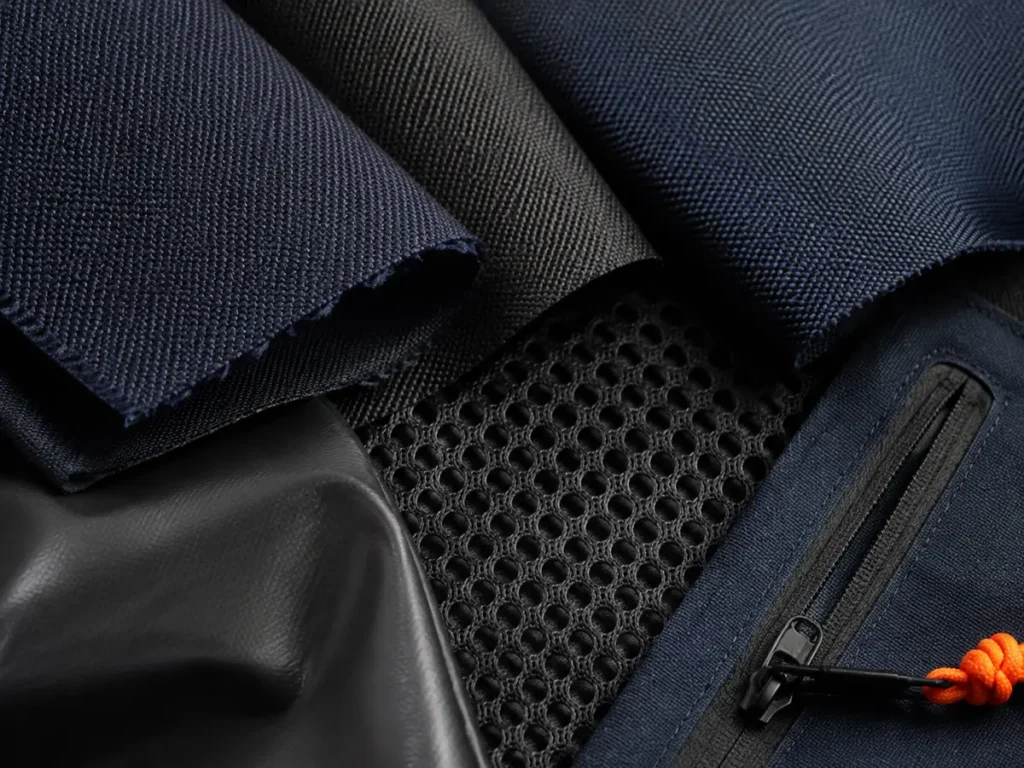
Fabric names alone do not establish performance. Polyester and nylon are available in many yarn sizes, constructions, coatings and finishes. “Ballistic” is also used broadly in marketing and should be tied to an actual material specification. Buyers should request a swatch, construction description, color standard, weight or density information where available, and any required test method.
Common Material Choices
Polyester is widely used because it offers flexible color and cost options. It can be suitable for corporate programs when the weave, coating and colorfastness meet the brief. Nylon is often selected where abrasion resistance and a technical hand feel are priorities, but the exact grade matters. Coated or laminated textiles can improve resistance to rain exposure, yet seams, zippers and openings remain potential entry points.
The lining affects visibility, cleaning and perceived quality. A light or contrasting lining makes small items easier to find, but it may show marks sooner. Dense woven lining is generally preferable around pocket edges and device compartments. Mesh should be evaluated for snagging and seam security.
Foam should be specified by location and function: shoulder-strap comfort, back-panel support, device protection or structure. Hardware includes zipper chains, sliders, pullers, buckles, adjusters, hooks and snaps. Confirm the material, finish, color and functional requirement for each important component.
Water Resistance: Use Precise Language
Most business backpacks are better described as water-resistant or designed for light rain unless the complete bag construction has been tested to a defined waterproof requirement. A coated face fabric does not make the finished product waterproof. Needle holes, seams, zipper tracks and openings can admit water.
Procurement language should state the expected use case: for example, temporary exposure during an urban commute rather than prolonged heavy rain or submersion. If a measurable requirement is important, agree on the test method, sample conditioning, acceptance level and tested components before production. Avoid printing unsupported “waterproof” claims on packaging.
Construction Details That Predict Durability
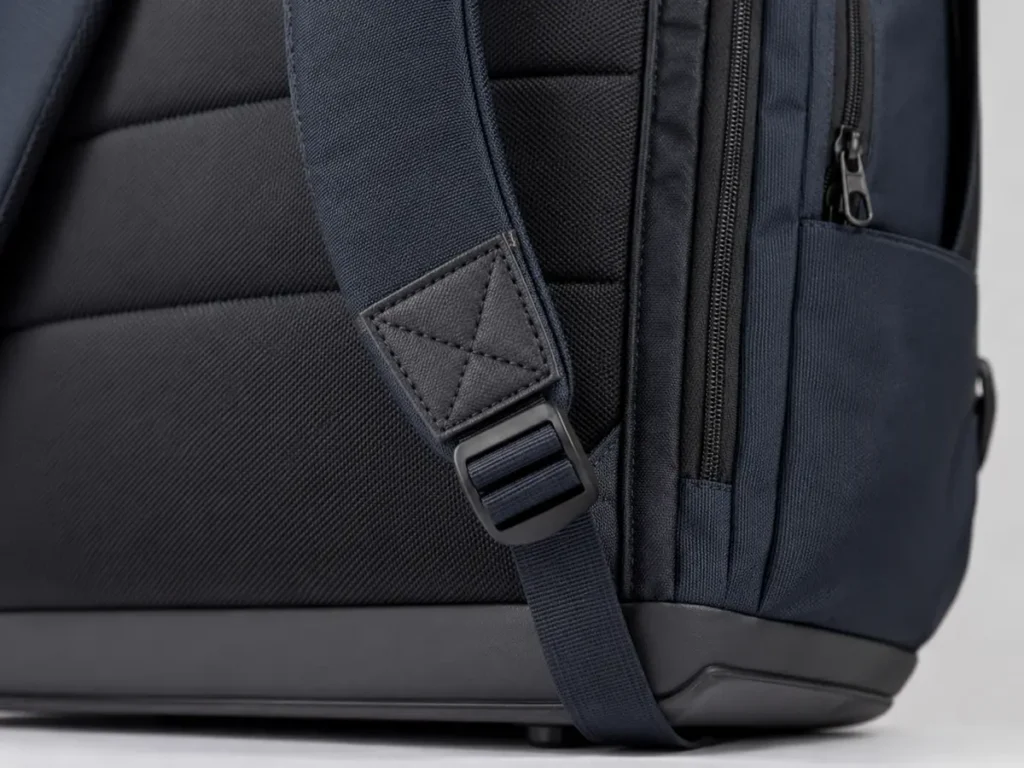
Durability depends on the whole construction system. Inspect the following areas on the approved sample and again during production:
- Upper shoulder-strap attachments and carry-handle anchors
- Zipper ends, corners and areas where the slider changes direction
- Bottom panel seams and protective base material
- Pocket openings and organizer dividers
- Trolley-sleeve attachment seams
- Binding at raw internal edges
- Stress points around buckles and webbing
- Laptop-sleeve corners and suspended-bottom attachment
Reinforcement may use box stitching, bar tacks, additional backing material or another engineered method. The correct choice depends on the fabric and load path. Ask the supplier to identify critical reinforcement points on the sample rather than writing “reinforced everywhere,” which is difficult to inspect.
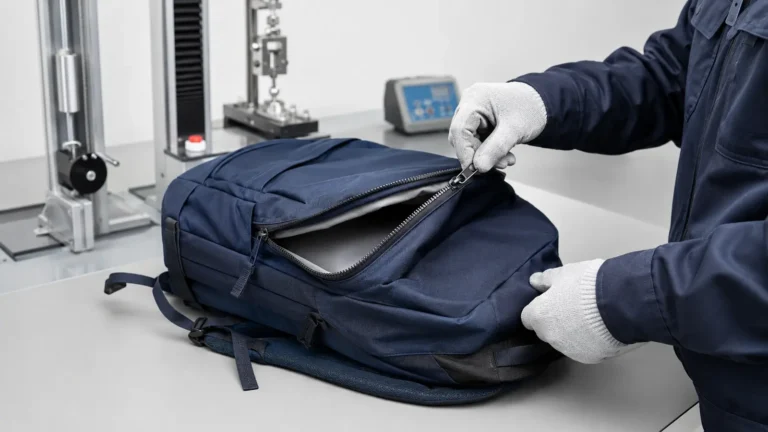
Zippers should operate smoothly around curves without catching the lining. Test them with the bag empty and fully packed. Pullers need enough grip for frequent use, but long loose cords may look inappropriate in a formal setting. A self-repairing coil zipper can be practical for soft bags; molded-tooth zippers create a different look and feel. The zipper should be selected as part of the design, not treated as a generic component.
Security and Travel Features
Useful security features include an internal passport pocket, a pocket positioned against the wearer’s back, controlled openings and lock-compatible zipper pullers. No backpack is “anti-theft” in an absolute sense. Buyers should describe the actual feature rather than promise theft prevention.
For U.S. airport screening, TSA states that travelers are generally asked to remove laptops and other personal electronic devices larger than a cell phone from carry-on bags and place them in a bin; procedures can differ for TSA PreCheck and at lanes with newer screening equipment. TSA also advises placing large electronics on the top layer for accessibility. A wide-opening or easily reached laptop compartment can therefore reduce friction, but buyers should avoid claiming that a bag is universally “checkpoint approved.” [TSA security screening] [TSA travel checklist]
A trolley sleeve should fit common suitcase handle arrangements without sagging. Test the sleeve on more than one suitcase if travel is central to the program. Confirm that the bag remains balanced and that pockets are still accessible when mounted.
Translate Features Into Procurement Decisions
| Marketing phrase | Better procurement question | Possible specification evidence |
|---|---|---|
| Fits most 16-inch laptops | What are the finished usable sleeve dimensions? | Measured sleeve plus fit check using target device |
| Waterproof fabric | Which components were tested, by what method and to what level? | Material report and finished-bag test if required |
| Ergonomic straps | What are the width, foam construction, curve and anchor reinforcement? | Dimensioned sample and loaded-wear trial |
| Heavy-duty zipper | What zipper type, size, slider and puller are used? | Locked trim list and cycle test protocol |
| Premium material | What fiber, weave, weight/density, finish and color standard apply? | Approved swatch and bill of materials |
| Anti-theft | Which specific access-control feature is included? | Visible pocket or zipper construction |
| Eco-friendly | What is the claimed recycled content and supporting documentation? | Supplier documentation tied to exact material lot |
This translation is one of the most important steps in sourcing. It turns subjective expectations into characteristics that a sample room, production team and inspector can verify.
Customization and Private-Label Options
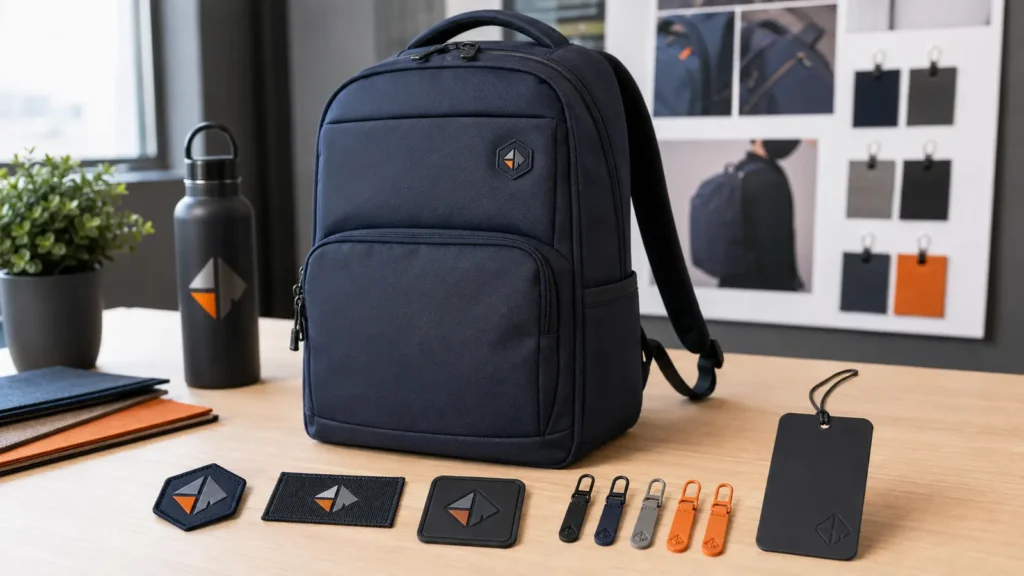
Business laptop backpacks can be customized with embroidery, screen print, heat transfer, woven patches, rubber/PVC patches, leather-style patches, custom zipper pullers, woven labels, hangtags and packaging. The right method depends on the logo artwork, desired finish, fabric, order quantity and budget.
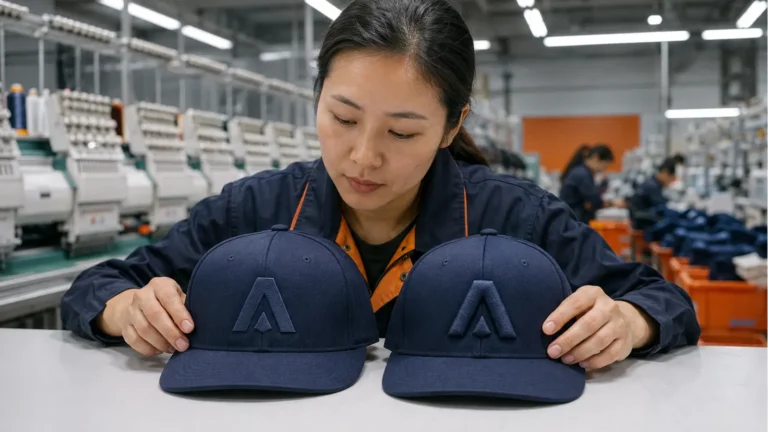
Embroidery provides texture and durability but adds needle penetrations and backing; dense artwork can distort thin fabric. Heat transfer can reproduce fine details and gradients when compatible with the textile and coating. A woven patch is useful for detailed flat artwork, while a rubber/PVC patch creates a more technical appearance. A restrained logo usually suits executive bags better than a very large decoration.
Ask for the maximum decoration area, exact placement measured from seams, thread or ink color standard, backing method and appearance on the inside of the panel. The logo sample should be approved on the actual production fabric, not only on a generic swatch.
Planning a custom backpack program? Send JIUMU your target quantity, laptop dimensions, preferred bag size, colors, logo artwork, decoration method, packaging needs and target delivery date. The team can review OEM/ODM options, prepare a digital mockup and discuss a physical sample. Explore custom team bags or request a quotation.
Cost Drivers in a Bulk Business Backpack Order
The unit price is influenced by more than the exterior fabric. Important drivers include bag dimensions, number of panels, pocket count, lining complexity, foam and reinforcement, zipper and buckle specifications, expansion systems, trolley sleeves, molded or custom components, logo method, labeling, packaging, testing and quantity.
Two bags that look similar from the front can have very different labor and material requirements. A clamshell travel bag with bound internal seams and multiple organizer sections requires more components and sewing operations than a simple two-compartment commuter bag. Custom zipper pull molds or specialized trims can add development cost and minimums.
For accurate comparison, send the same specification to every supplier and ask them to identify exclusions or alternatives. A lower quote based on a lighter fabric, smaller dimensions or generic hardware is not directly comparable with a quote based on the approved specification.
Sample Approval and Quality-Control Checklist
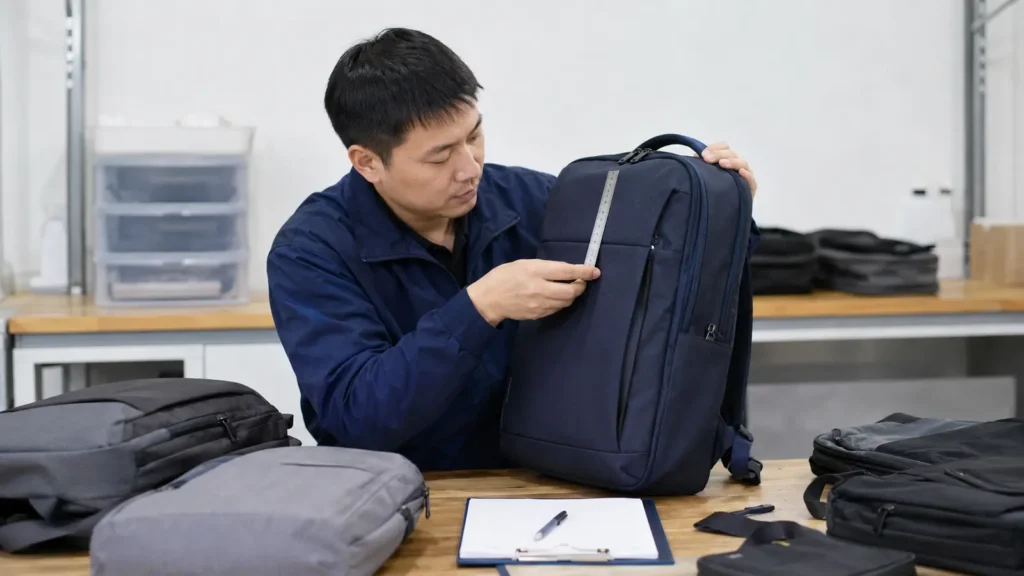
Use a signed or otherwise controlled approval sample as the visual and functional reference. Record every approved change; do not rely on chat messages spread across multiple threads.
Before Approving the Sample
- Measure external dimensions and usable laptop-sleeve dimensions.
- Insert the actual target laptop and confirm closure, clearance and retention.
- Verify the suspended sleeve or false-bottom distance.
- Pack the normal load and conduct a wear trial.
- Operate every zipper around its complete path repeatedly.
- Inspect strap anchors, handle anchors, bottom seams and pocket corners.
- Compare exterior and lining colors with the approved standard under consistent light.
- Confirm logo size, placement, color and reverse-side appearance.
- Check trolley-sleeve fit, bottle-pocket retention and pocket access.
- Review labels, warnings, packaging, barcode placement and carton marks.
During and After Production
Quality checks may be scheduled at incoming-material, in-line, pre-shipment or combined stages depending on the order risk. Define the inspection sample size and acceptance criteria with your quality team or third-party inspector. Critical defects—such as a sleeve that cannot fit the specified device—should be separated from cosmetic tolerances. Inspection should reference the approved sample, measurement table, color standard, bill of materials and packaging instructions.
Bulk-Order Planning Process
- Define users and use cases. Document who will carry the bag, how far, with which devices and in what setting.
- Create the specification. Include dimensions, capacity target, compartment map, materials, trims, color, logo and packaging.
- Request a digital mockup. Confirm proportions, branding and pocket layout before physical sampling.
- Develop and test a physical sample. Use target devices and a repeatable loaded-wear test.
- Revise and freeze the sample. Record changes and approve a final reference.
- Confirm commercial terms. Lock quantity, unit price, development charges, packing, production schedule, shipping terms and payment terms.
- Monitor production. Use milestone updates and appropriate material or in-line checks.
- Inspect and ship. Verify product, packaging and carton requirements before release.
JIUMU’s typical MOQ is 50 pieces, subject to product structure and customization. More complex components, materials or packaging can require different minimums, so the final MOQ should be confirmed after reviewing the design.
What to Send for a Useful Quotation
A complete inquiry saves time and reduces inaccurate assumptions. Send:
- Intended users and use case
- Target quantity and expected repeat-order plan
- Laptop brand/model or exact device dimensions
- Desired external bag dimensions or capacity range
- Reference images, sketches or tech pack
- Exterior fabric, lining and color preferences
- Required pockets, trolley sleeve, expansion and security features
- Logo artwork in vector format where possible
- Preferred decoration, labels and packaging
- Required tests, compliance documentation or market-specific labeling
- Delivery destination, shipping preference and target date
If some details are undecided, rank them as fixed, preferred or open to supplier recommendation. This helps the development team propose alternatives without changing the essential function.
Questions to Ask a Supplier
- What are the finished usable laptop-sleeve dimensions and measurement tolerance?
- How is the laptop compartment protected at the bottom, sides and back?
- Which fabric, lining, foam, zipper and hardware specifications are quoted?
- Which high-stress areas are reinforced, and how?
- Can the logo method be sampled on the actual production material?
- Which materials or custom components have separate minimum quantities?
- How will color be approved and controlled across repeat orders?
- What sample stages are available and how are revisions documented?
- Which production quality checks are performed and what inspection options can be agreed?
- What information is required to confirm production and delivery timing?
Common Buying Mistakes
Buying by screen-size label alone. Always use chassis dimensions and a physical fit test.
Equating coated fabric with a waterproof bag. Finished-bag performance also depends on seams, zippers and openings.
Adding too many pockets. Complexity can increase cost and reduce flexible capacity.
Approving an empty-bag appearance. Load the bag and test comfort, shape and zipper operation.
Using vague material descriptions. Lock the actual swatch and component specification.
Treating the logo as a final-step add-on. Decoration can affect panel construction, backing and water resistance.
Skipping packaging approval. Creasing, moisture protection, labels and carton packing affect arrival condition and warehouse processing.
Comparing prices without aligning specifications. Make every quotation identify material, dimensions, features and exclusions.
Why JIUMU Is Relevant to Business Backpack Buyers
JIUMU, established in 2010 in Guangdong, China, supplies B2B custom bags, teamwear, logo apparel, hats, uniforms and branded merchandise for buyers in North America and Europe. Its approved capabilities include OEM/ODM development, fabric sourcing, Pantone color matching, embroidery, screen printing, heat transfer, woven and rubber/PVC patches, private labels, hangtags, customized packaging, digital mockups, physical samples, bulk production, quality control and export support.
For a laptop backpack program, this means buyers can discuss the bag structure and the full branding system together: exterior colors, logo method, labels, pullers, packaging and repeat-order consistency. Capabilities and minimums should still be confirmed against the exact design.
Frequently Asked Questions
Final Recommendation
The best business laptop backpack is not the model with the longest feature list. It is the bag whose device compartment, carrying system, organization, materials, construction and branding have been matched to a defined user and verified on a controlled sample. Begin with the laptop dimensions and user load, then specify the protection system, reinforced stress points, usable organization and realistic weather requirement. For bulk purchasing, lock every important material and measurement before production and inspect against the same reference.

Request a custom business laptop backpack quotation. Share your quantity, target laptop dimensions, reference design, colors, logo file, preferred decoration, packaging, destination and target delivery date with JIUMU. Email zhengdong@jiumugear.com, WhatsApp +86 18507502899, or use the JIUMU contact page.