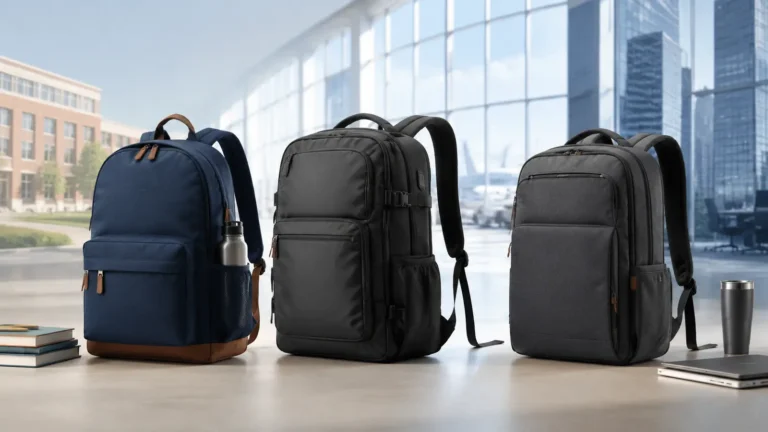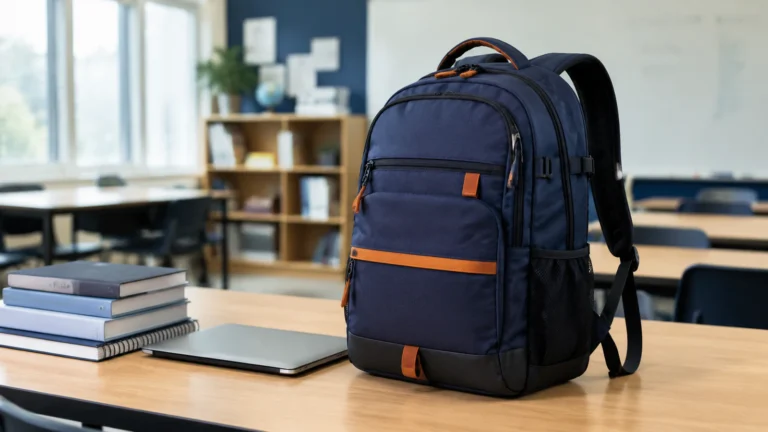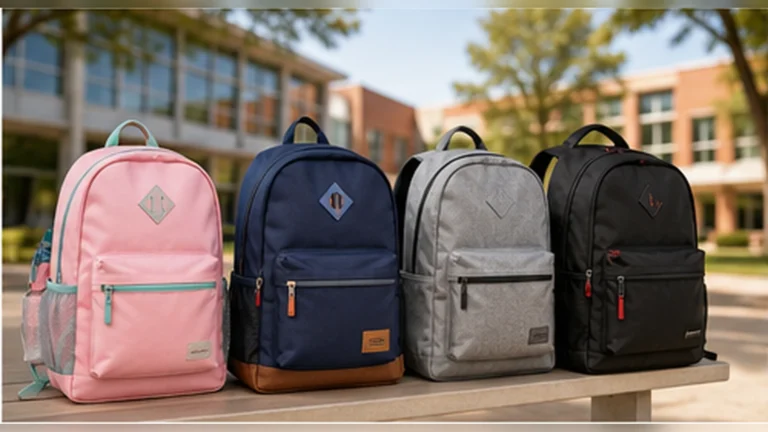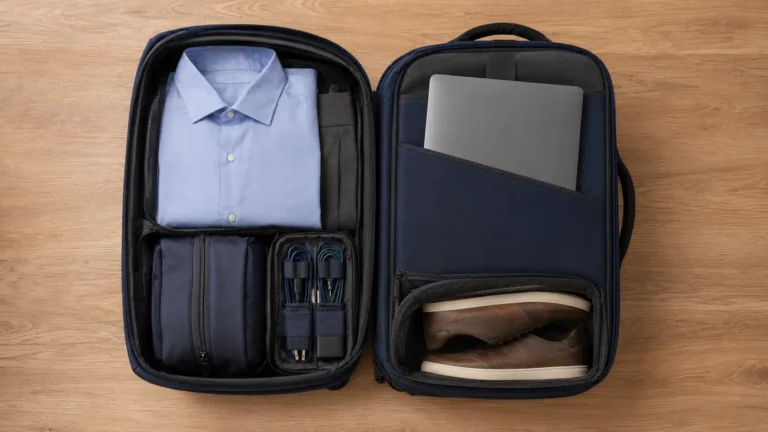
Best Waterproof Backpacks for School
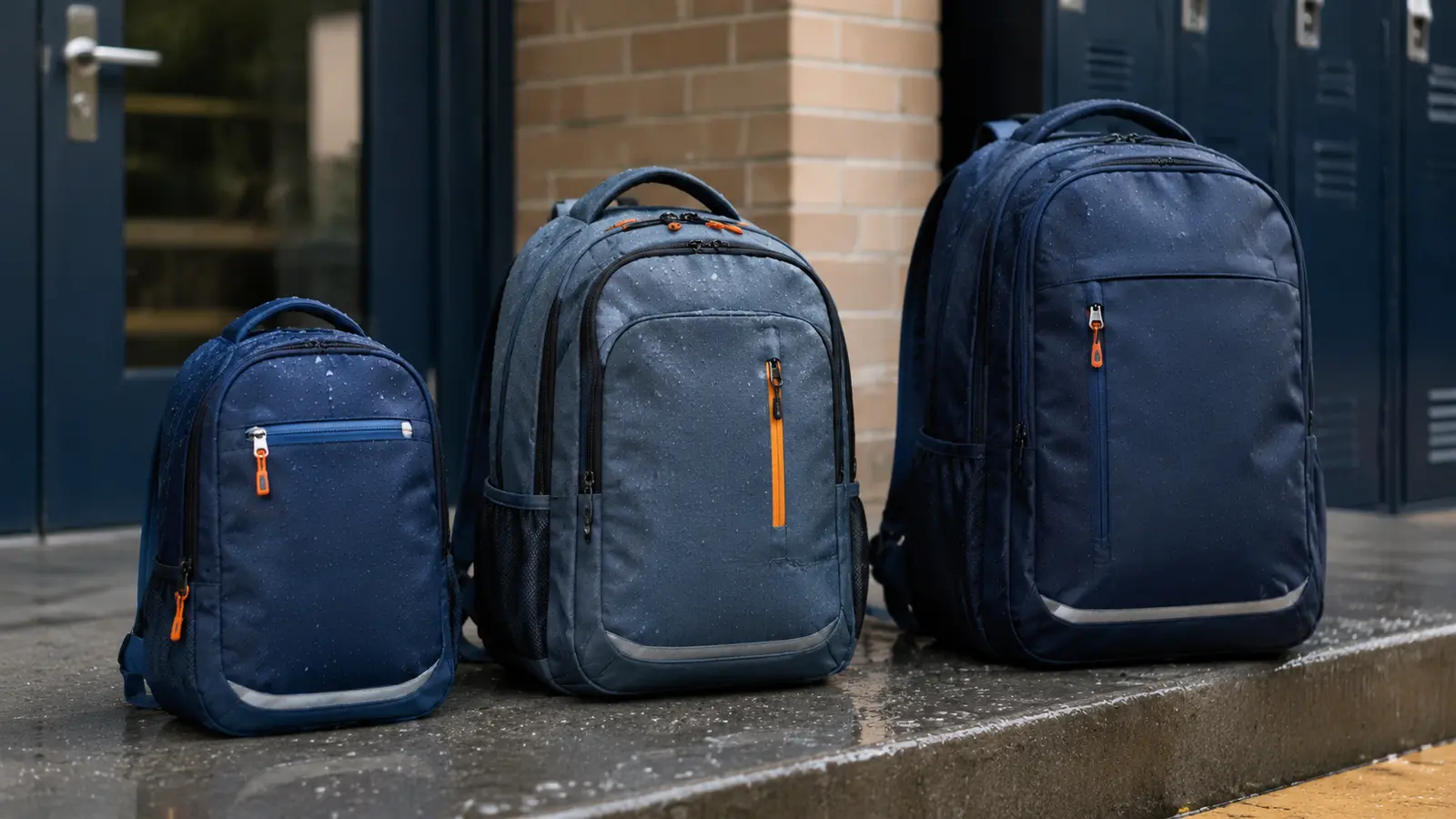
School backpacks face a simple but demanding job: protect books, laptops, uniforms, and personal items through rain, wet bus stops, crowded corridors, and daily handling. For a school, distributor, uniform dealer, or private-label brand, however, choosing the best waterproof backpacks for school is not a matter of selecting the bag with the strongest product-page claim. It requires a specification that matches the weather exposure, student age, load, expected service life, branding method, and budget.
The most important distinction is that a waterproof fabric does not automatically create a waterproof backpack. Water can enter through needle holes, ordinary zippers, open seams, exposed pocket openings, or a poorly designed top. A reliable sourcing decision therefore evaluates the complete bag system: face fabric, coating or membrane, seams, closures, base, construction, and verified test method.
Quick Answer
The best waterproof backpack for school procurement is the least complex construction that reliably protects the intended contents in the expected weather. For most everyday school programs, a coated polyester or nylon backpack with protected zippers, reinforced seams, a water-resistant base, and a documented whole-bag spray test provides the best balance of protection, comfort, decoration, and cost. For students who walk or cycle in frequent heavy rain, consider a roll-top or coated-shell design with welded or sealed critical seams. If a conventional backpack needs occasional storm protection, a fitted rain cover may be more practical than converting every component to a fully waterproof construction.
Before using the word “waterproof” in a tender, catalog, or product listing, define the required test, duration, water exposure, and pass/fail condition. ISO 811 specifies a hydrostatic-pressure method for measuring a fabric’s resistance to water penetration; it assesses fabric, not automatically the finished backpack. A whole-bag spray or rain-chamber protocol should therefore supplement material testing when the performance claim applies to the complete product.
Waterproof, Water-Resistant, and Water-Repellent Are Not the Same
These terms are frequently blended in ecommerce copy, but professional buyers should treat them as different specification levels.
| Term | Practical meaning for a school backpack | Typical construction | Appropriate claim basis |
|---|---|---|---|
| Water-repellent | Water beads on the surface initially, but may enter with time or pressure | Woven fabric with a surface finish | Documented spray-test result for the fabric, with limitations stated |
| Water-resistant | Resists light or moderate rain for a defined period | Coated fabric, protected openings, conventional sewn seams | Fabric data plus a defined whole-bag spray test |
| Waterproof | Prevents water ingress under a clearly defined test condition | Coated or laminated shell, sealed/welded seams, waterproof closure system | Relevant material and finished-product testing with stated conditions |
| Backpack with rain cover | Conventional bag gains temporary external protection | Standard pack plus fitted coated cover | Rain-cover material and whole-system use test |
ISO 4920 addresses resistance to surface wetting through a spray test, while ISO 811 uses hydrostatic pressure to assess resistance to penetration. These methods answer different questions. A fabric can shed surface water well without sustaining much pressure, and a strong fabric result does not validate zipper, seam, or pocket performance. Buyers should request the test name, specimen condition, result, date, and laboratory or internal-test procedure instead of accepting a detached number.
“Submersible” is a substantially stronger requirement and is rarely necessary for school use. Unless the bag is designed and tested for immersion, avoid language implying that it can be placed underwater. Clear, qualified claims reduce returns and help distributors maintain consistent product descriptions across markets.
What Type of Waterproof School Backpack Is Best?
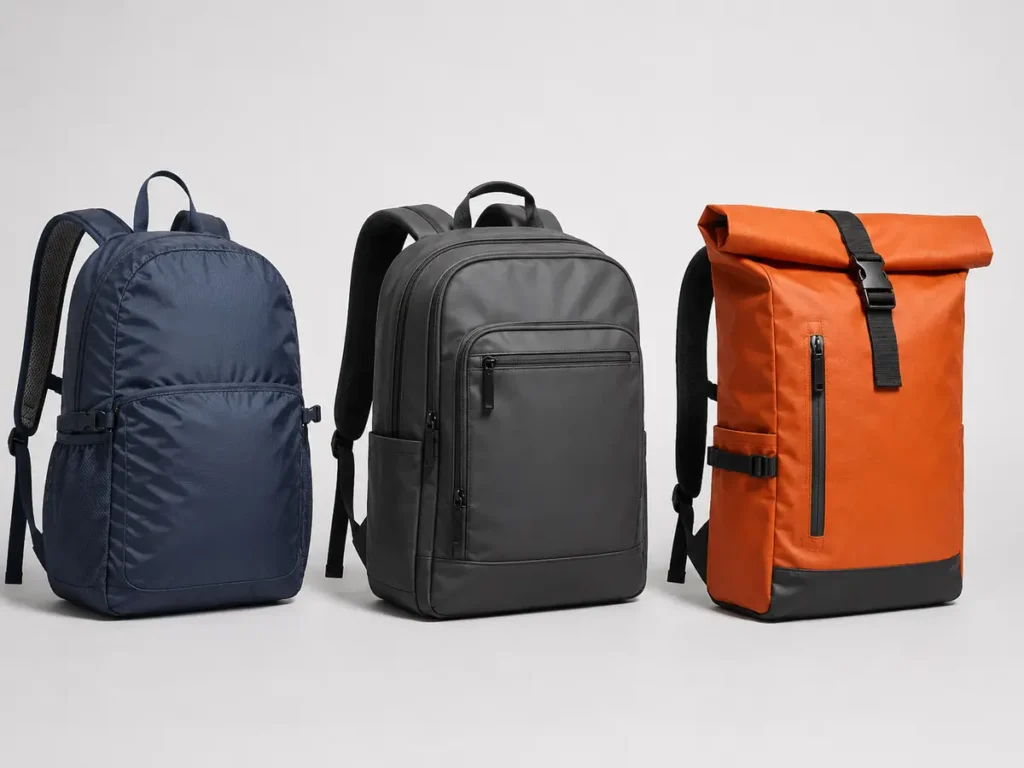
There is no single construction that is best for every student. The correct choice follows the exposure scenario.
1. Coated woven daypack for general school use
This familiar zip-opening format is usually the strongest all-around option for elementary and middle-school programs. A polyester or nylon shell with a polyurethane-type or similar coating can offer useful rain resistance without making the bag too rigid. Multiple compartments, mesh bottle pockets, organizer panels, embroidery, patches, and school colors are relatively easy to integrate.
Its limitation is the number of entry points. Every zipper and stitched pocket introduces a potential water path. Specify zipper garages or covered zipper tracks, sensible pocket orientation, a raised or coated base, and a whole-bag spray check.
2. Coated-shell commuter backpack
A smoother coated or laminated exterior suits older students carrying laptops and devices. The reduced seam count and coated zipper appearance support a cleaner, more technical design. It may be easier to wipe clean, but buyers should review cold-weather flexibility, surface scratching, crease behavior, and adhesion after aging. A sleek shell can still leak at sewn seams.
3. Roll-top backpack for frequent rain
A roll-top reduces dependence on a long curved zipper at the main opening. When rolled correctly, it can provide a robust barrier to rain. It is appropriate for walking, cycling, outdoor education, coastal regions, and campuses with limited covered routes. The trade-offs are slower access, less familiar organization, and the need for clear closure instructions. Side access zippers must receive the same scrutiny as the top closure.
4. Backpack with a detachable rain cover
A rain cover can deliver strong occasional weather protection while preserving a lightweight, conventional bag. It is useful when heavy rain is infrequent or when the procurement budget cannot support sealed construction. Check whether the cover fits a fully loaded pack, attaches securely in wind, drains away from the back panel, and stores in a dedicated pocket. Covers can be lost, so replacement planning matters.
5. Dry-bag-inspired school pack
Welded panels, limited openings, and a roll closure can provide the highest protection in this category. Use this structure only where the exposure justifies the added weight, stiffness, cost, and reduced organization. It can work for outdoor academies or wet-weather transport programs, but it may be excessive for normal classroom use.
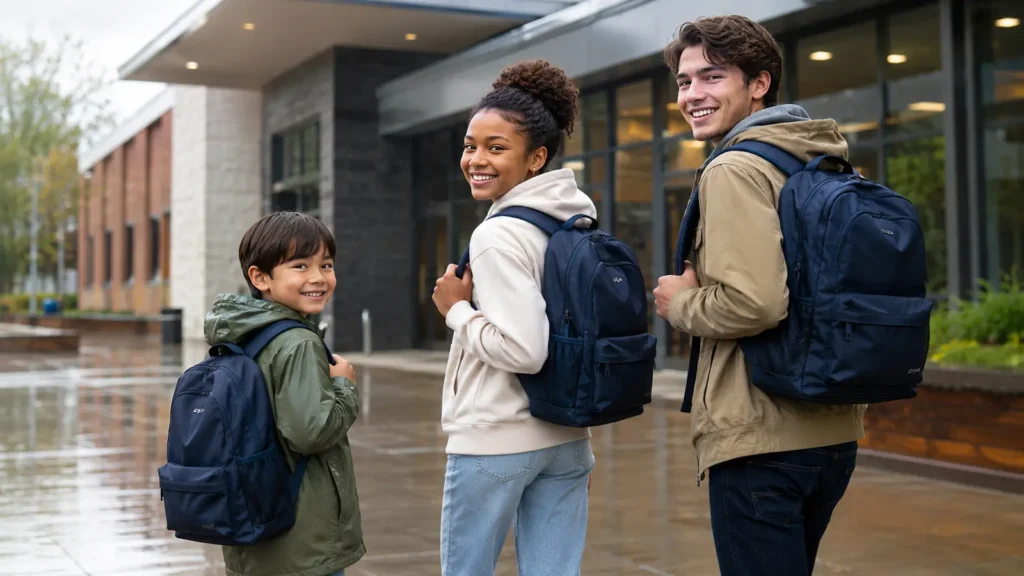
Match Capacity and Fit to the Student Group
Capacity labels are only a starting point. Two bags marked with the same liter volume can fit differently because of their depth, taper, padding, and pocket allocation. The better approach is to approve external dimensions, internal dimensions where critical, and a representative loading set.
| Buyer group | Planning range, not a universal rule | Typical contents | Specification priorities |
|---|---|---|---|
| Early elementary | Approximately 12–18 L | Folders, lunch, light clothing, bottle | Short back length, low empty weight, easy pulls, name-label area |
| Upper elementary | Approximately 16–22 L | Books, folder, lunch, activity items | Balanced compartments, reinforced base, adjustable straps |
| Middle school | Approximately 20–28 L | Textbooks, binder, tablet or laptop | Organization, device sleeve, strong strap anchors, weather protection |
| High school | Approximately 24–32 L | Laptop, multiple books, sports or club items | Load management, laptop protection, durable base, commuter features |
These ranges are planning references, not fit guarantees. Buyers should check the actual curriculum, device dimensions, locker use, lunch system, sports needs, and local age group. A deep pack may pull the load away from the body even when its nominal capacity is correct.
For sampling, prepare a load list with the largest binder, standard textbooks, device and case, lunch box, bottle, and optional jacket. Photograph the loaded sample from the side and back on representative users or fit forms. Confirm that the bag does not sit excessively low, that shoulder straps adjust across the size range, and that hard objects do not press directly into the wearer’s back.
Comfort comes from proportion and load control rather than padding thickness alone. Useful elements include contoured shoulder straps, a stable padded back panel, smooth binding at contact areas, an adjustable sternum strap where suitable, and a handle that does not rub the neck. For younger users, avoid unnecessary hardware and weight.
Materials That Support Rain Protection and Daily Durability
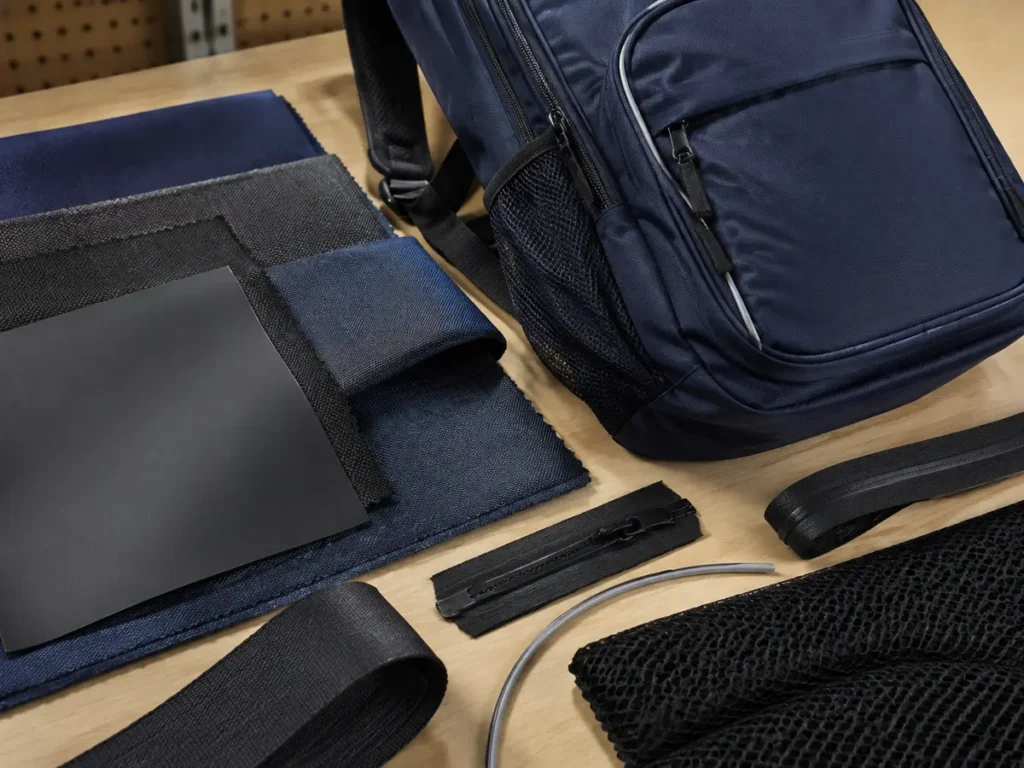
Material descriptions should include fiber, construction, nominal weight or density where relevant, backing/coating type, color, finish, and test requirements. “Oxford,” for example, describes a weave or market style but does not by itself establish fiber, mass, coating, abrasion performance, or water resistance.
Polyester
Polyester is widely used for school bags because it offers color consistency, practical abrasion performance, broad sourcing options, and cost control. Coated polyester can support everyday water resistance. Buyers should still specify the base cloth and coating rather than relying on a broad denier label.
Nylon
Nylon can provide a favorable strength-to-weight balance and a technical hand feel. It is useful for lightweight commuter designs, but the exact weave, yarn, finish, and coating determine performance. Review shade control and finish behavior across repeat orders.
TPU- or PU-type coated/laminated materials
Coatings and laminations can create a smoother barrier and reduce water absorption by the face structure. The formulation and bond matter. Ask for aging, flex, adhesion, and low-temperature checks appropriate to the destination market. Buyers should not infer environmental superiority from a material abbreviation alone.
Recycled-content fabrics
Recycled polyester options may support a buyer’s material strategy, but the claim must be specific and substantiated. The U.S. Federal Trade Commission’s Green Guides advise marketers to qualify partial recycled-content claims—for example by stating the percentage—rather than using broad, unqualified environmental language. Confirm whether a stated percentage applies to the face fabric, lining, entire bag, or packaging, and retain supporting chain-of-custody or supplier documentation where required.
Linings, mesh, and padding
Lining makes inspection and cleaning easier and can provide a secondary barrier, but it should not be used to conceal leakage. Light-colored lining may improve visibility inside the bag. Bottle-pocket mesh needs recovery and snag resistance; back-panel mesh should be reviewed for pilling and color transfer. Foam thickness must be consistent and should not retain excessive water.
Construction Details That Decide Real-World Performance
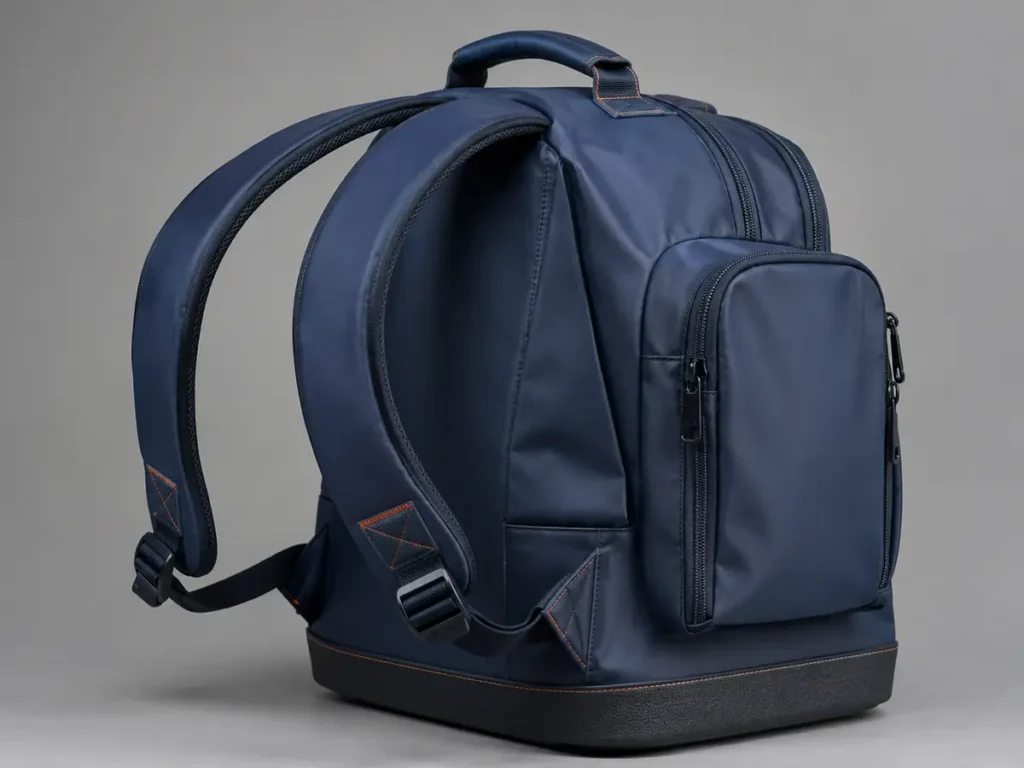
A waterproof school backpack succeeds or fails at its weakest route. Evaluate the following areas on the physical sample.
Seams and needle holes
Ordinary sewing punctures coated fabric. Seam tape can cover selected seams, while welding can join compatible materials without conventional needle holes. Neither method should be assumed: identify exactly which seams are treated. Curves, three-dimensional pocket shapes, and strap attachments can complicate sealing. In many school designs, a practical target is sealed critical body seams combined with reinforced conventional sewing at load-bearing areas, followed by a finished-bag test.
Zippers and openings
Water-resistant coated zippers can slow ingress but usually are not equivalent to a waterproof diving closure. Curved tracks, two-way sliders, zipper ends, and garages deserve attention. Flaps can provide simple protection but must not catch in the slider. Roll-tops should state the required number of folds and closure direction.
Base panel
The base contacts wet floors, pavement, bus steps, and rough surfaces. A raised, coated, or reinforced panel often adds more practical protection than applying a premium finish to a decorative front pocket. Check corner abrasion, seam placement, and whether water pools along the bottom seam.
Shoulder straps and handles
Load-bearing seams require reinforcement suitable for the expected load. Review bartack or box-stitch placement, webbing overlap, thread tension, symmetry, and attachment to the internal structure. Water protection must not weaken these safety-critical joins.
Reflective elements
Reflective piping or patches can improve conspicuity in dim, wet conditions, but buyers should define placement, dimensions, appearance, and any required performance test. Do not use “high visibility” or regulatory language without supporting requirements and evidence.
Turn Features Into Procurement Decisions
| Feature | Benefit | Buyer decision | Verification |
|---|---|---|---|
| Coated face fabric | Slows water penetration and absorption | Define composition, coating and approved hand feel | Material sheet, hydrostatic or agreed test result, sample review |
| Protected zipper | Reduces direct exposure at opening | Choose flap, coated track, garage, or roll closure | Timed spray test with tissue inside |
| Sealed critical seams | Reduces entry through needle holes | Mark treated seams on tech pack | Inside-out sample inspection and water test |
| Reinforced base | Improves wet-floor and abrasion resistance | Specify base material and seam location | Abrasion protocol and loaded placement test |
| Laptop sleeve | Separates device from main load | Provide maximum device dimensions with case | Fit test with actual gauge block or device mockup |
| Rain cover | Adds storm protection economically | Confirm storage, attachment and full-load fit | Fit, wind-retention and spray checks |
| Reflective trim | Improves night-time visibility cues | Define visible area and location | Approved trim sample and placement measurement |
This translation step prevents feature lists from becoming vague marketing. Every selected feature should correspond to a use case, specification line, approval sample, and inspection point.
How to Specify Water-Resistance Testing
A test requirement should be reproducible. At minimum, record the sample state, test setup, water pressure or spray intensity, duration, orientation, loading condition, and pass/fail rule.
For fabric, ISO 811 provides a hydrostatic-pressure method for resistance to water penetration. ISO 4920 addresses resistance to surface wetting. A buyer may also use another recognized method required by the target market or an agreed internal method, but the purchase order and test report should use the exact designation and edition.
For the finished bag, create a protocol that reflects actual use. One practical method is to load the backpack with standardized absorbent paper or moisture indicators, close it exactly as instructed, expose all relevant faces to controlled spray for a defined period, allow drainage, then inspect and weigh or grade the internal indicators. Include zipper ends, top seams, pocket openings, strap anchors, and base contact. Repeat after conditioning or flexing if durability of protection is important.
The pass rule should distinguish cosmetic surface wetting from internal ingress. It may state, for example, that no visible droplets are permitted in the main compartment after the agreed test, while a noncritical external bottle pocket is excluded. This is only an example; the buyer and supplier should agree on a rule suited to the product and claim.
Buyer note: Never copy a hydrostatic-head number from a fabric supplier into a finished-backpack claim. Verify the material lot and test the complete construction under the conditions you intend to describe.
Customization Without Creating New Leak Paths
School identity and private-label presentation are important, but decoration changes the structure.
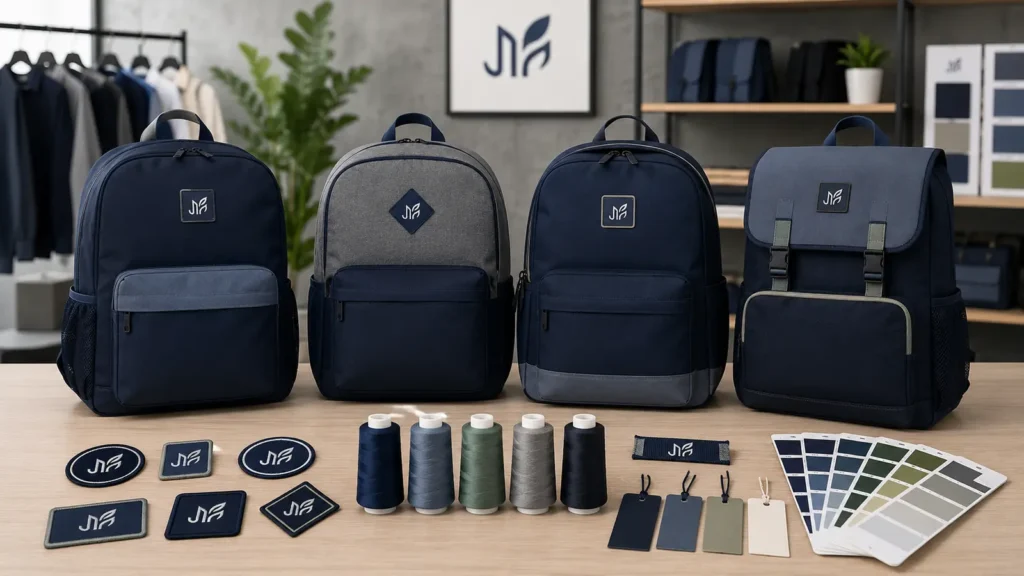
Direct embroidery punctures the shell many times. On a water-resistant front panel, this may be acceptable if the embroidery zone does not open directly into the main compartment or if an internal backing/sealing approach is approved. A separately embroidered patch can reduce the decorated area, although attaching the patch still requires stitching or adhesive. Rubber/PVC-style, woven, or leather-style patches can suit technical designs. Heat transfer avoids embroidery holes but requires compatibility testing for coating, temperature, pressure, adhesion, and flex.
Plan logo placement early. The cleanest zone may also be the most exposed to rain or flex. Keep decoration away from zipper bends, high-abrasion corners, structural bartacks, and seam-tape paths. Ask for artwork dimensions, color references, stitch or transfer sample, placement tolerance, and a decorated pre-production sample.
Private-label elements may include woven labels, printed labels, hangtags, zipper pulls, color-matched webbing, packaging, and carton marks. For a coordinated school program, align backpack colors with custom team uniforms, custom team jackets, or custom hoodies while maintaining material-specific color approval.
What Drives the Cost of a Waterproof School Backpack?
Quoting requires a defined construction. The largest cost drivers usually include:
- face fabric, coating or laminate and lining specification;
- number, type, and length of zippers;
- seam taping or welding coverage;
- number of compartments and shaped panels;
- molded, reinforced, or coated base components;
- foam, mesh, webbing, buckles, reflective trim, and custom hardware;
- decoration method, logo size, colors, and number of placements;
- size and color assortment;
- sample rounds, test requirements, inspection plan, and packaging;
- order quantity and repeat-order forecast;
- shipping method, carton limits, destination, and requested delivery date.
A fully welded roll-top is not automatically the best value. If the program needs protection only during short walks from a bus, a conventional coated pack with thoughtful opening protection may deliver a better experience at lower cost. Conversely, removing seam sealing from a frequent-rain commuter design may create a false economy through complaints and replacements.
JIUMU’s typical MOQ is 50 pieces, subject to product structure and customization. Final pricing and feasible assortments depend on the approved specification rather than the article’s planning examples.
Sample Approval and Quality-Control Checklist
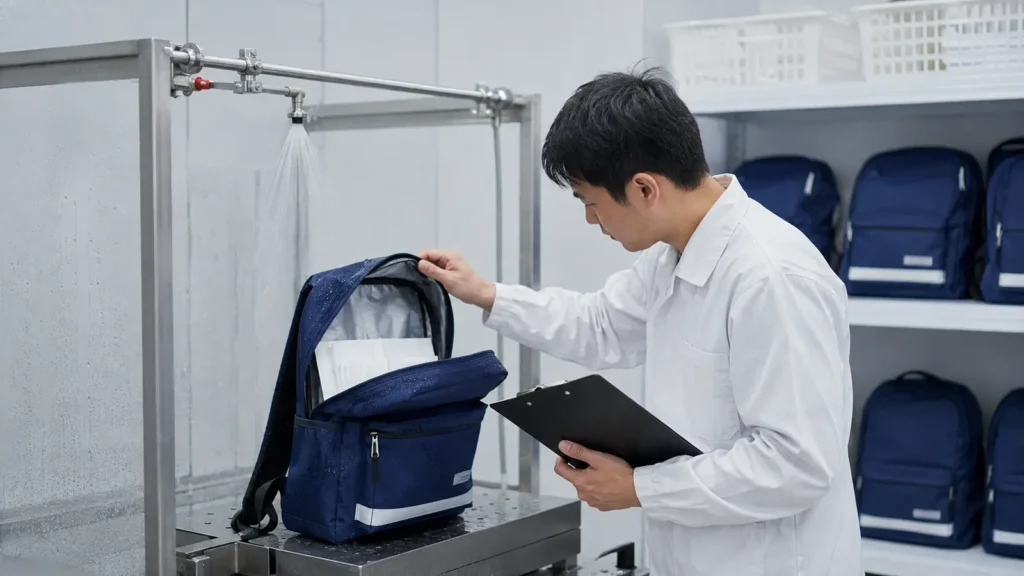
Approve a golden sample or clearly controlled pre-production sample before bulk production. Record every measurable item instead of relying on photos alone.
Appearance and dimensions
- Confirm overall height, width, depth, empty weight, and usable opening.
- Measure pockets, laptop sleeve, strap range, handle drop, and logo placement.
- Approve face fabric, lining, zipper tape, webbing, buckles, thread, and trims under consistent lighting.
- Check left/right symmetry, panel shape, piping, wrinkles, stains, scratches, and color variation.
Function and load
- Load the bag with the agreed contents and weight.
- Operate every zipper repeatedly and check curved sections and end stops.
- Adjust straps through their full intended range.
- Inspect strap anchors, handle, base, and internal binding after the load cycle.
- Confirm the laptop sleeve fits the specified device dimensions and protects the bottom and corners.
Rain and material performance
- Verify material documents correspond to the selected material and color.
- Conduct the agreed whole-bag spray test in closed, correctly loaded condition.
- Inspect the main compartment, laptop sleeve, front pocket, seam intersections, zipper ends, and base.
- Repeat testing after any agreed flex, aging, or wash/cleaning conditioning.
- Record photos, sample ID, date, result, and deviations.
Branding and packaging
- Compare logo dimensions, colors, stitch/print quality, and placement with approved artwork.
- Check that decoration did not damage coating or seal paths.
- Verify labels, warnings or care information required by the buyer, hangtags, polybags or alternative packaging, carton quantity, and shipping marks.
- Confirm carton dimensions and gross weight before final logistics planning.
Inspection sampling level and acceptance criteria should be agreed in the purchase contract. AQL terminology alone is incomplete unless the inspection standard, lot size, defect categories, and acceptance numbers are identified.
How to Plan a Bulk Order
Step 1: Define the use case
State the student age group, destination country, sales channel, typical commute, rainfall exposure, contents, expected service period, and target price position. Decide whether the main promise is “resists everyday rain,” “weather-protected commuter bag,” or another accurately qualified statement.
Step 2: Build the specification
Provide dimensions, capacity target, material and color, compartments, maximum device size, closure type, critical sealed seams, reinforcement, straps, reflective elements, logo method, labels, packaging, and tests. Mark all critical-to-quality items.
Step 3: Request material options and a mockup
Ask the supplier to explain alternatives rather than merely quoting “waterproof fabric.” Compare hand feel, structure, coating, appearance, color availability, decoration compatibility, and testing. Approve a digital layout before physical sampling.
Step 4: Develop and test the sample
Load the physical sample with representative items. Test access, comfort, zipper operation, stability, wet-floor behavior, and the agreed rain exposure. Record revisions in one consolidated change list.
Step 5: Approve the pre-production standard
Freeze materials, colors, hardware, logo, measurements, workmanship, water-test protocol, packaging, and labeled sample identity. Define how substitutions will be approved.
Step 6: Inspect bulk production and shipment
Use in-process checks for critical operations and final random inspection for completed goods. Review cartons and shipping documents against the order. Keep the approved sample and specification for repeat-order comparison.
Information to Send for an Accurate Quotation
For a faster, more comparable quote, send:
- target student group and destination market;
- order quantity by color and size/style;
- reference image, sketch, tech pack, or preferred structure;
- external dimensions, capacity target, and maximum laptop/tablet size;
- fabric preference and required water-exposure claim;
- closure, compartments, lining, padding, base, straps, and reflective details;
- logo artwork, dimensions, colors, method, and placement;
- private labels, hangtags, packaging, and carton requirements;
- required tests and inspection criteria;
- target delivery date, destination, and preferred shipping mode.
Planning a school, distributor, or private-label backpack program? Share these details with JIUMU to request a specification review and custom quotation. Explore custom team bags or contact JIUMU.
Questions to Ask a Waterproof Backpack Supplier
- Which component is described as waterproof: the face fabric or the complete backpack?
- What is the exact fabric composition, construction, coating/laminate, and color reference?
- Which test methods and editions support the proposed water-resistance claim?
- Which seams are taped, welded, bound, or left conventionally sewn?
- What closure is used, and what limitations apply to its water resistance?
- Can the supplier perform an agreed whole-bag spray test on the decorated sample and bulk goods?
- How will embroidery, patches, or heat transfer affect the barrier?
- What load and repeated-use checks are proposed for straps, handle, zipper, and base?
- How are shade, coating hand feel, and appearance controlled on repeat orders?
- What changes require written buyer approval after the sample is signed off?
- What are the feasible MOQ, color split, sampling stages, and packaging options?
- Which documents and retained samples will be available if a claim is challenged?
Common Buying Mistakes
Treating a fabric rating as a complete-bag rating
This is the most important error. Seams and openings often fail before the fabric. Require finished-product verification.
Specifying “100% waterproof” without conditions
Absolute language is difficult to substantiate and may imply immersion. Define exposure and pass criteria, then use qualified copy.
Overbuilding the product
Welded construction, heavy coatings, and complex closures can add cost, weight, stiffness, and repair difficulty. Match protection to the route to school.
Ignoring a fully loaded sample
An empty bag may look compact and shed rain well, but loading changes seam tension, zipper curvature, balance, and rain-cover fit.
Choosing decoration after construction
Late embroidery or patch placement can puncture sealed areas or interfere with pocket access. Integrate branding in the tech pack.
Focusing on liters and forgetting dimensions
Capacity is an estimate. Check folders, binders, laptop cases, lunch boxes, and back length with physical gauges.
Making broad sustainability claims
“Green,” “eco-friendly,” and recycled claims need precise scope and evidence. State documented material percentages and applicable components.
Approving only photographs
Color, hand feel, zipper operation, load balance, coating behavior, and leakage require a controlled physical sample.
Why Work With JIUMU on Custom School Backpacks?
JIUMU, established in 2010 in Guangdong, China, supplies custom teamwear, logo apparel, hats, uniforms, bags, and branded merchandise for professional buyers in North America and Europe. Relevant capabilities include OEM and ODM development, fabric sourcing, Pantone color matching, embroidery, sublimation, screen printing, heat transfer, woven and rubber/PVC-style patches, private labels, hangtags, packaging customization, digital mockups, physical samples, bulk-production quality control, and export support.
For waterproof school backpack projects, the value is a controlled development process: translate the intended use into a specification, select compatible materials and branding, review a physical sample, agree on a finished-bag test, and retain the approved standard for bulk and repeat orders. The typical MOQ is 50 pieces, subject to product structure and customization.
JIUMU does not need to call every bag “fully waterproof.” A transparent specification allows schools, distributors, and brands to choose a realistic protection level and market it responsibly. Read more about JIUMU.
Frequently Asked Questions
Final Recommendation
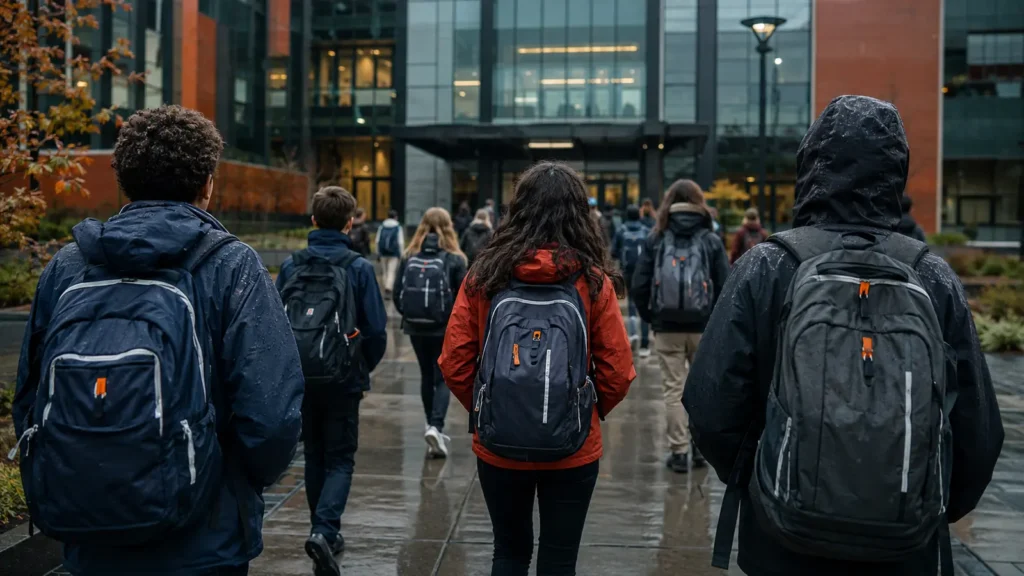
The best waterproof backpacks for school are not defined by one fabric or the highest unsupported rating. They are defined by fit-for-purpose protection and repeatable evidence. For most bulk school programs, begin with a coated polyester or nylon daypack, protect the primary openings, reinforce the base and load points, and specify a finished-bag rain test. Move to roll-top, sealed, or rain-cover solutions only when the commute and climate justify them.
Treat wording as part of the product specification. State whether a claim applies to fabric or finished bag, name the agreed test, and qualify limitations. This creates better tenders, clearer quotations, more reliable inspections, and fewer downstream disputes.
Request a custom waterproof school backpack quotation from JIUMU. Send your quantity, student age group, dimensions or reference, target contents, logo, colors, required rain exposure, packaging, destination, and delivery date to zhengdong@jiumugear.com or WhatsApp/phone +86 18507502899. You can also use the JIUMU contact page.
About JIUMU
Established in 2010 in Guangdong, China, JIUMU supports professional buyers with OEM/ODM development, custom branding, private labels, sampling, bulk quality control and export coordination. Typical MOQ: 50 pieces, subject to structure and customization.