Best Backpacks for School, Travel and Daily Commuting
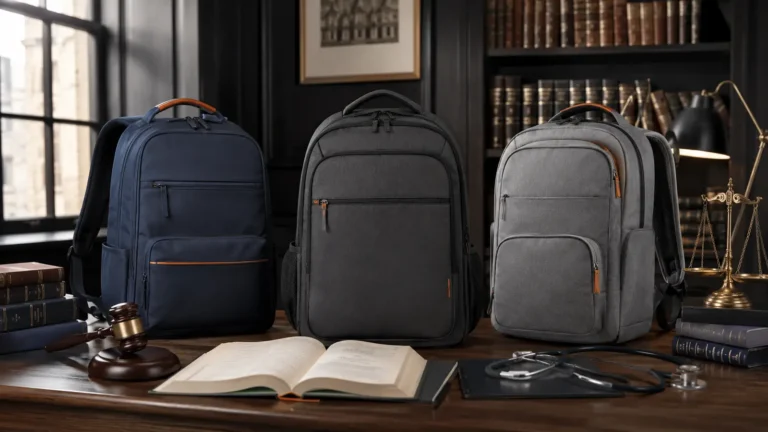
The best backpack is not simply the one with the most pockets or the largest advertised capacity. It is the bag whose dimensions, carrying system, organization, materials and branding match a defined user and a repeatable purchasing program. For schools, travel companies, employers, retailers, distributors and promotional buyers, that distinction matters: one design may need to protect books and lunch, another must work within airline baggage policies, and a third must organize a laptop and daily work tools without looking bulky.
This guide explains how to compare backpacks for school, travel and daily commuting from a B2B sourcing perspective. It covers product types, recommended specification ranges, materials, construction, customization, sampling, quality control and quotation preparation. The goal is not to rank retail brands. It is to help a buyer create a backpack specification that a supplier can sample, price and reproduce consistently.
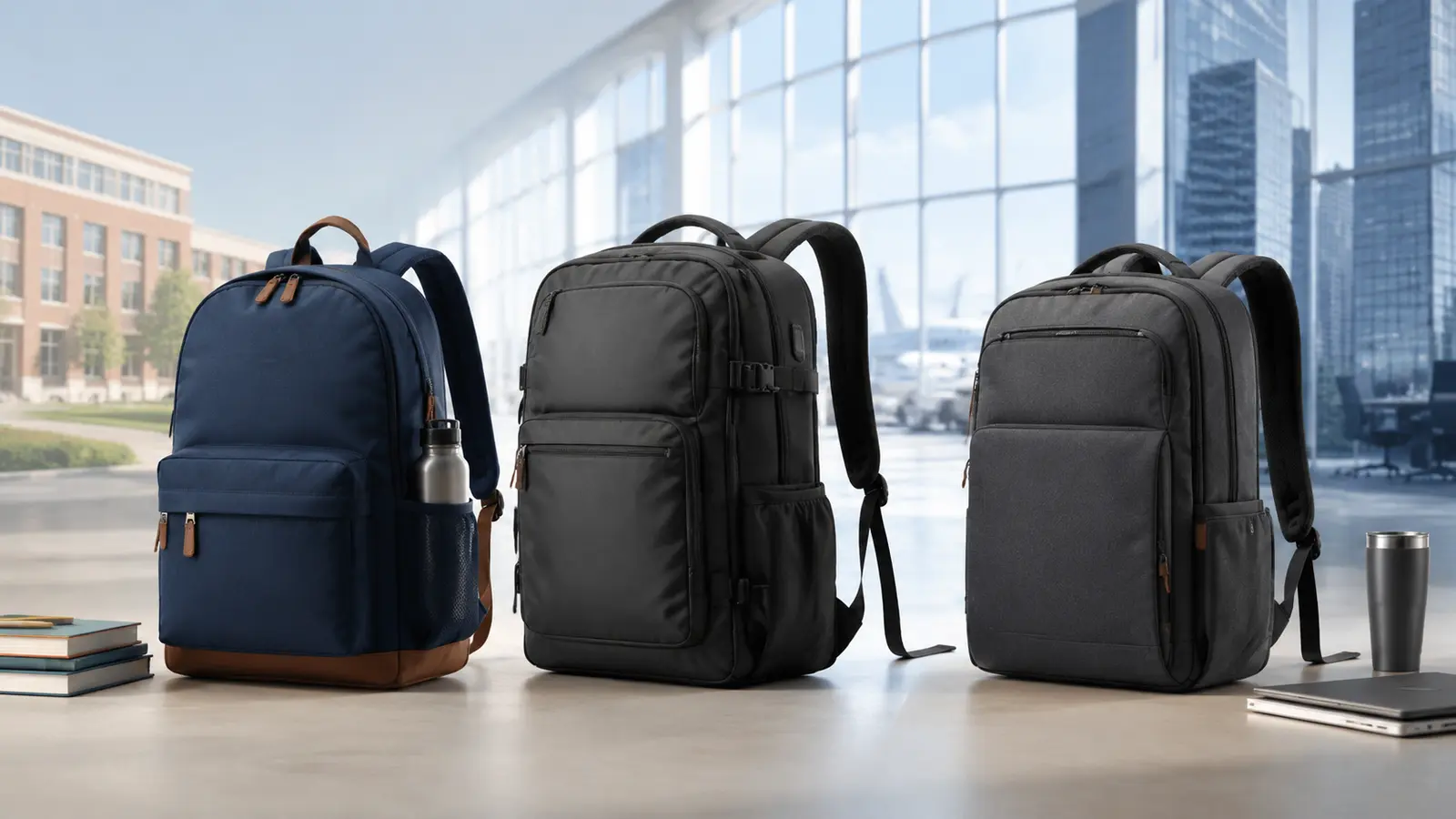
Quick answer: For school programs, prioritize age-appropriate dimensions, wide padded straps, a structured back panel, balanced compartments and easy-clean materials. For travel, prioritize airline-specific external dimensions, opening style, secure organization, compression and comfortable load transfer. For commuting, prioritize a protected laptop compartment, compact depth, weather-conscious construction, professional styling and quick-access storage. A multi-use backpack can serve all three contexts when it uses a moderate profile, a suspended laptop sleeve, a clamshell or wide opening, reinforced carry points and restrained branding—but a single design should not be forced onto users with substantially different body sizes or load requirements.
What makes a backpack “best” for a purchasing program?
For a consumer, “best” may mean personal taste. For a professional buyer, it should mean the strongest fit between the intended user, expected load, purchase price, required customization and acceptable risk. A useful backpack brief therefore starts with five questions:
- Who will carry the bag, and what body-size range must it accommodate?
- What items must fit, including the largest laptop, binder, bottle or travel cube?
- How long and how often will users carry it?
- Where will the bag be stored—under a desk, in a locker, under an airline seat or in an overhead bin?
- Which logo method, colors, labels, packaging and delivery schedule does the program require?
These questions translate vague preferences into measurable specifications. They also prevent a common sourcing error: approving an attractive exterior before testing the interior volume and carry comfort with realistic contents.
School vs travel vs commuter backpacks: quick comparison
| Buying criterion | School backpack | Travel backpack | Daily commuter backpack |
|---|---|---|---|
| Main load | Books, folders, tablet/laptop, lunch, bottle | Clothing, toiletries, electronics, documents | Laptop, charger, notebook, personal items |
| Typical design priority | Balanced comfort and everyday durability | Packing access, security and efficient dimensions | Device protection and streamlined organization |
| Opening | Panel or wide U-shaped opening | Clamshell, suitcase-style or large panel opening | Panel opening with quick-access pockets |
| Back system | Padded, breathable and size appropriate | More structured; sternum strap useful for heavier loads | Low-profile padded panel with ventilation channels |
| Key compartments | Main book area, device sleeve, bottle pockets | Main packing area, device sleeve, document pocket | Suspended laptop sleeve, admin panel, bottle pocket |
| External profile | Avoid excessive depth for smaller users | Sized to target airline or travel mode | Compact enough for transit and office use |
| Branding | School crest, team name or program identity | Travel-company, event or private-label branding | Corporate logo or discreet private label |
| Useful validation | Fit and loaded-carry trial | Packed dimension and zipper stress trial | Laptop fit, drop protection and commute simulation |
The table is a starting point, not a universal size chart. Capacity claims can vary because brands may calculate internal volume differently, and soft bags change shape when packed. Buyers should approve physical dimensions and a packing test rather than relying only on a liter value.
Which backpack types suit each use case?
School daypacks
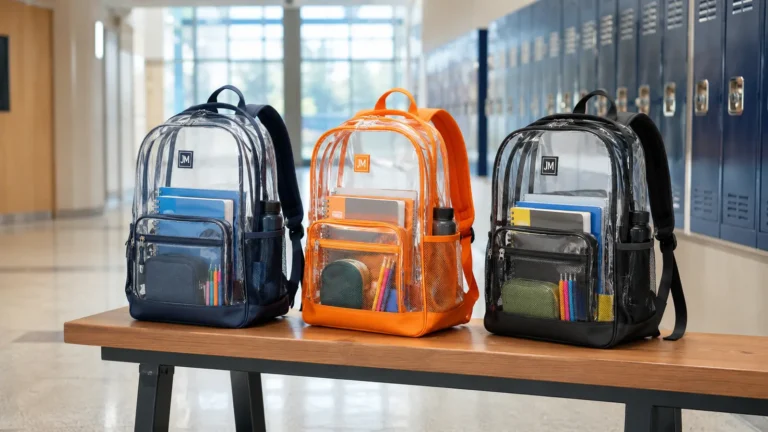
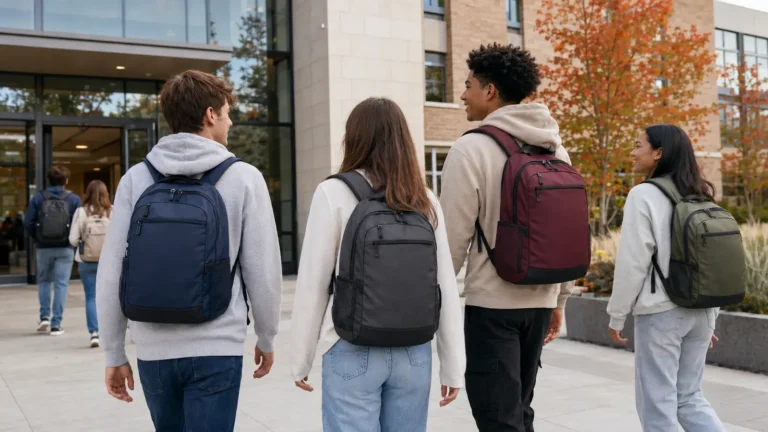
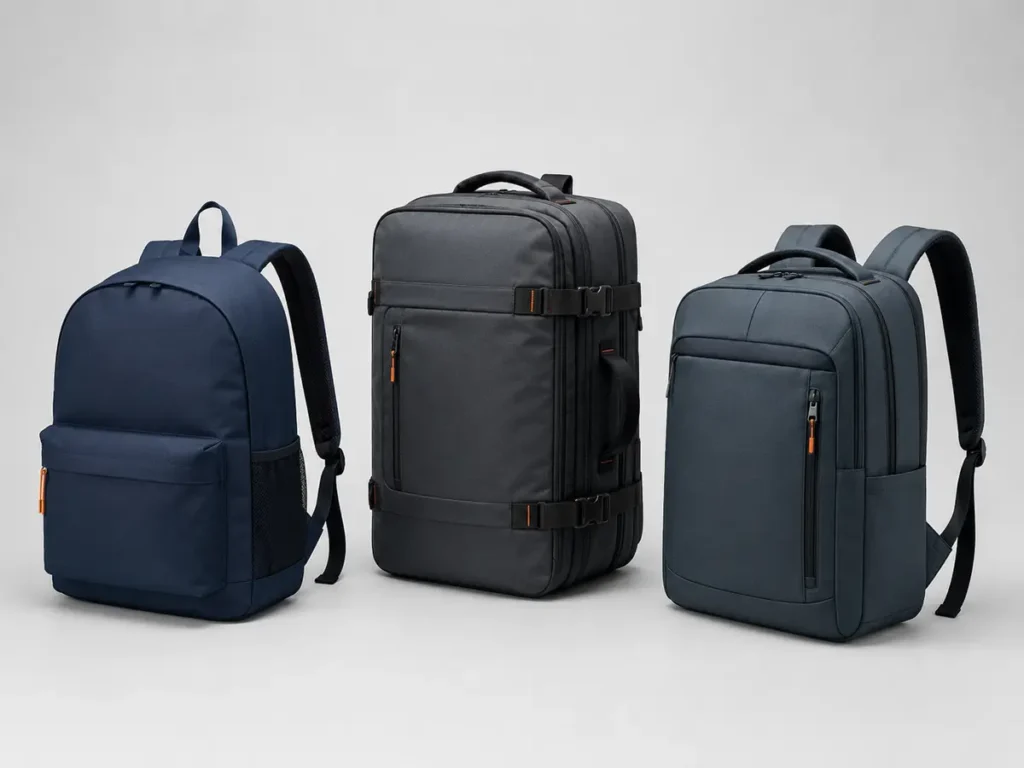
A school daypack usually has a simple panel-loading body, two shoulder straps, a main compartment and one or more front pockets. The most useful versions separate heavy books from small accessories and keep a bottle upright. For older students, a padded device sleeve is often expected. For younger students, smaller overall height and simpler zipper paths can be more valuable than maximum capacity.
The American Academy of Pediatrics advises choosing wide padded shoulder straps and a padded back, using compartments to distribute contents, and packing heavier items close to the center of the back. Its family guidance also recommends keeping the loaded backpack within 10%–20% of a child’s body weight. Buyers should treat that range as general health guidance, not as a claim that any bag makes a heavy load safe. The program still needs age-appropriate bag dimensions and a policy for removing unnecessary contents.
Campus and multi-activity backpacks
College and campus users may carry a laptop, textbooks, gym clothing, chargers and food during the same day. A larger main compartment, separated laptop access and an expandable front area can work well. However, excessive empty volume encourages overpacking. A moderate-size body with good organization is usually more practical than a very deep bag.
Carry-on travel backpacks
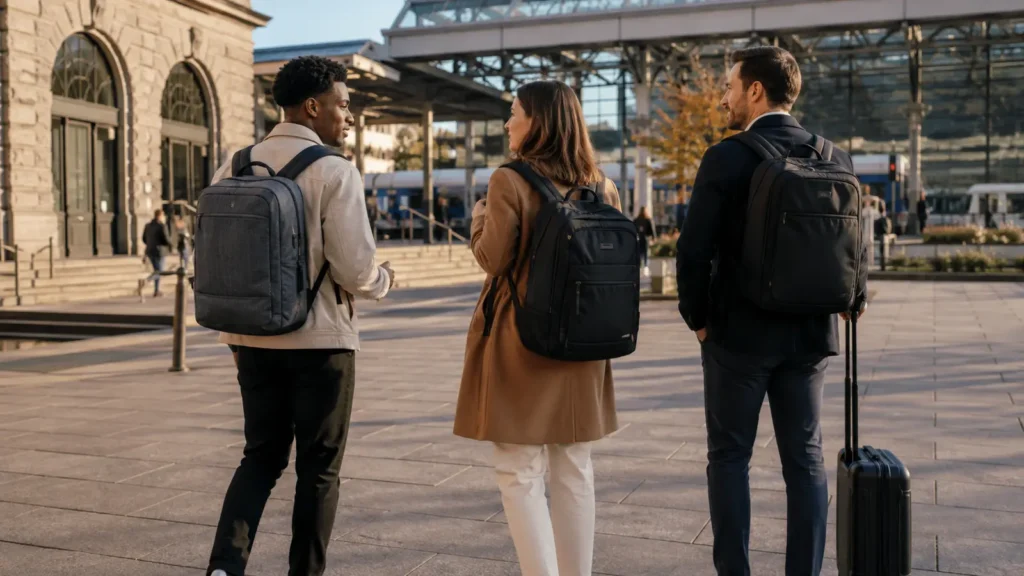
Travel backpacks convert rectangular space into efficient packing volume. A clamshell opening makes clothing and packing cubes easier to arrange, while compression straps help control depth. Useful features can include a document pocket, lock-compatible zipper pulls, a separate laptop opening, luggage-handle pass-through and a stowable or tidy strap system.
Travel buyers should specify a target airline or a conservative maximum external size. IATA notes that cabin baggage allowances vary by airline, cabin class and aircraft; it gives 56 × 45 × 25 cm (22 × 18 × 10 in) only as a general reference used by many airlines. A supplier therefore should not label a design “airline approved” as a universal promise. Measure the finished, packed bag—including handles, padding and any protruding pocket—and instruct end users to check the operating airline.
Personal-item travel backpacks
A personal-item backpack is smaller and intended to fit under a seat where the airline permits it. These bags need disciplined depth, a shape that remains stable when packed and enough organization to keep travel documents and electronics accessible. Because under-seat allowances differ widely, buyers should define a specific dimension envelope based on target routes rather than use a generic label.
Professional laptop backpacks
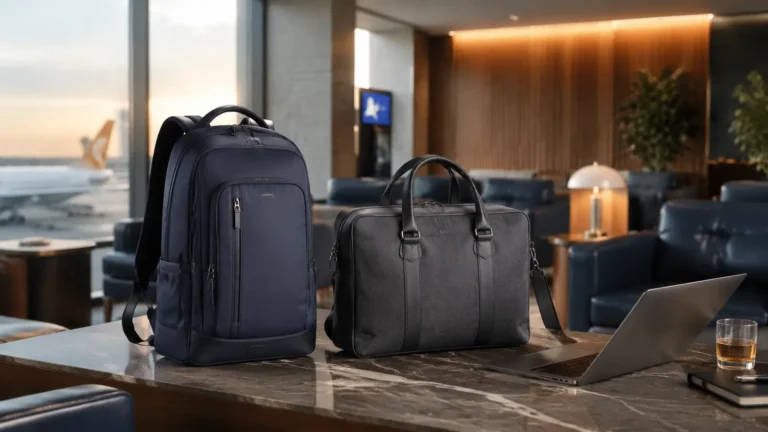
Commuter backpacks should protect electronics without looking like oversized outdoor equipment. Common features include a suspended laptop sleeve, tablet pocket, cable organization, quick-access top pocket, key clip, bottle pocket and luggage pass-through. A false bottom or raised sleeve can reduce direct contact between the device and the ground, but the physical sample must confirm the actual clearance.
Convertible and hybrid designs
Convertible bags may include tuck-away shoulder straps or side handles for backpack and briefcase carrying. They can suit consultants, field teams and short business trips. The tradeoff is added hardware, weight and construction complexity. If the program does not require conversion, a dedicated backpack often offers cleaner ergonomics and a lower failure risk.
How should buyers choose capacity and dimensions?
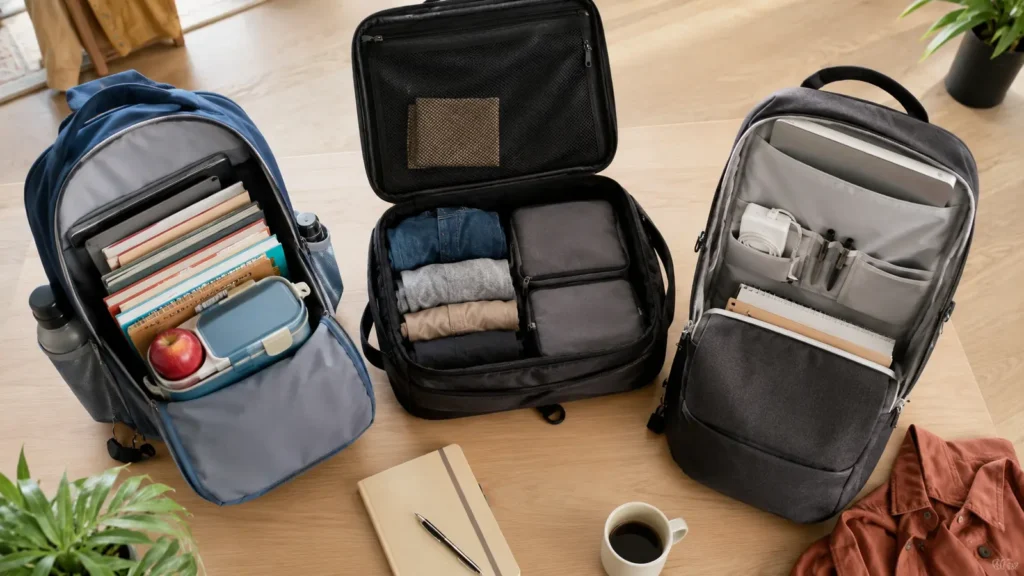
Capacity should be derived from a packing list. Begin with the largest rigid object, such as a 16-inch laptop or A4 binder, then add the expected soft goods and accessories. Define both internal fit and external maximum dimensions. This avoids approving a sleeve that fits a nominal laptop size but not the actual device dimensions, or a travel bag that fits the contents but exceeds the target carrier’s limit once fully packed.
| Requirement | What to specify | How to validate the sample |
|---|---|---|
| Laptop fit | Maximum device width × height × thickness; sleeve padding | Insert target device or dimensional dummy; close bag without pressure |
| Book/binder fit | Largest binder and textbook dimensions | Load realistic set; confirm zipper clearance and balanced position |
| Travel packing | Itemized packing list and target trip length | Pack the actual list; measure filled external dimensions |
| Bottle storage | Bottle diameter and height | Check retention while walking and when bag is placed down |
| Locker/under-seat fit | Maximum external envelope | Measure at the fullest points with bag packed |
| User fit | Torso range and intended age group | Conduct loaded wear trial with representative users |
Do not use “one size fits all” casually. Shoulder-strap length, anchor position, bag height and sternum-strap placement interact with torso size. A school district serving young children and teenagers may need two size grades even when the colors and logo remain consistent. A corporate program may need one core body with adjustable straps, while a travel retail line may justify several capacities.
Which materials are practical for bulk backpacks?
Polyester
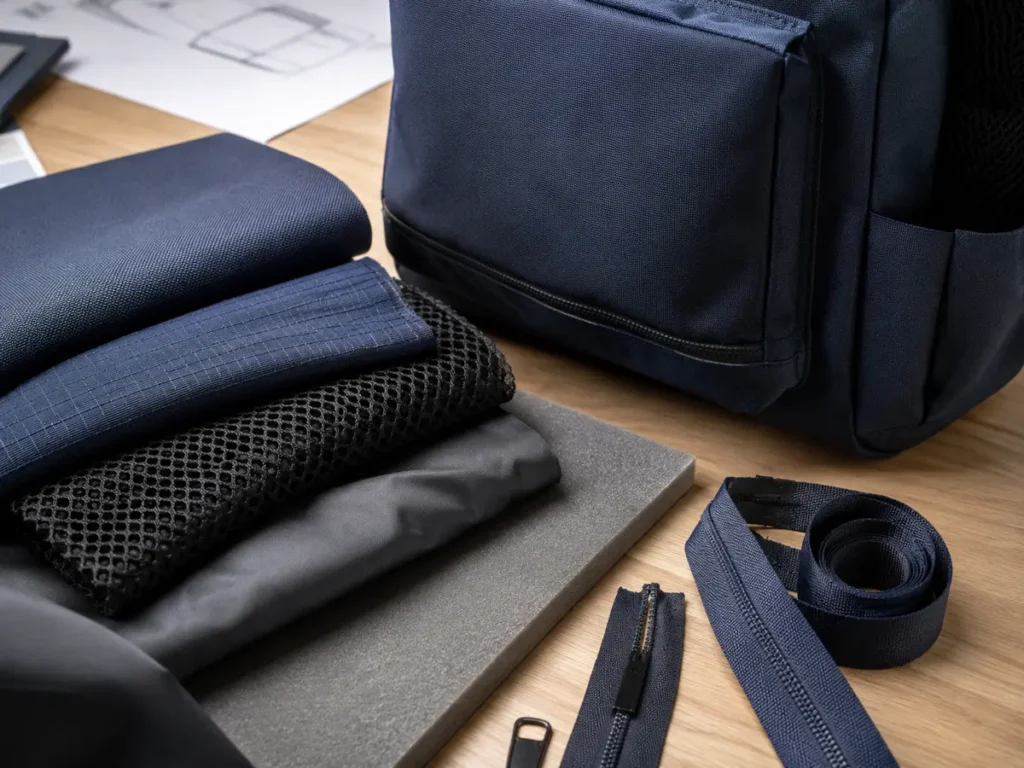
Polyester is widely used for school and promotional backpacks because it offers flexible appearance, print compatibility and cost options. Denier labels such as 300D or 600D describe yarn mass, but they do not independently prove abrasion strength, coating quality or finished durability. Buyers should compare actual fabric specifications and approved swatches rather than treat a denier number as a quality grade.
Nylon
Nylon can provide a strong, refined shell for commuter and travel bags. Ripstop constructions add a visible reinforcement grid, but the grid alone does not establish performance. Nylon options may raise material cost, and color behavior can differ from polyester. Confirm shade, hand feel, coating and appearance through lab dips or sample yardage.
Coatings and laminated fabrics
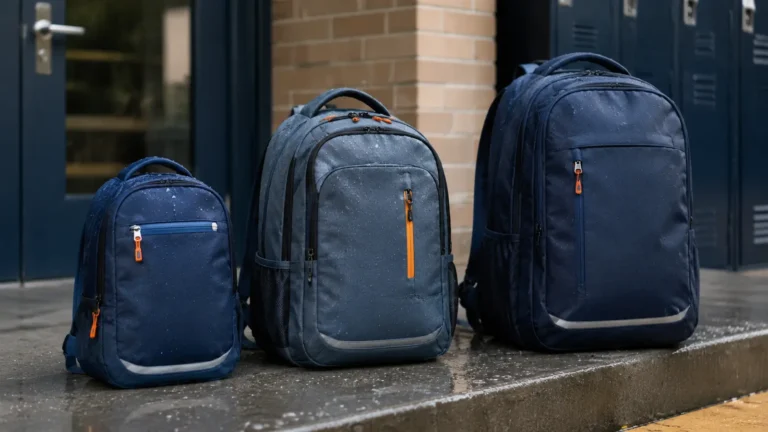
PU coatings, TPU laminations and other backing systems can improve resistance to moisture entering through the fabric face. They do not automatically make a finished backpack waterproof. Seams, zipper construction, needle holes and openings remain potential entry points. Use precise terms such as “coated fabric” or “water-resistant construction” only when supported by an agreed test method and acceptance criterion.
Lining, mesh and padding
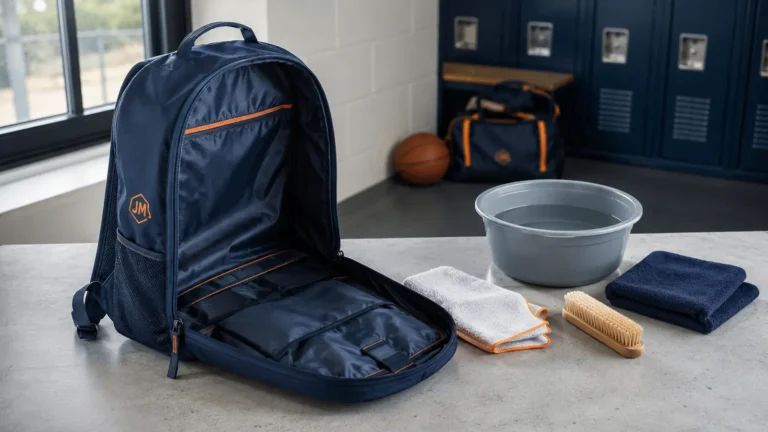
Lining color affects visibility inside the bag; a lighter lining can make small items easier to find. Spacer mesh can improve the feel and airflow of shoulder straps and back panels, while foam thickness and density influence comfort and shape retention. More foam is not always better: very thick foam may add heat and bulk. Ask for the foam type and thickness and evaluate it after loaded compression.
Zippers, buckles and webbing
Hardware is a system. Zipper size, slider, puller, tape, curve radius and sewing alignment affect operation together. Buckles should be sized for the webbing and expected load. Webbing should feed smoothly but hold adjustment. Color-matched components may require higher minimums or longer preparation, so confirm which parts can match a Pantone target and which are selected from supplier color cards.
What construction details improve durability and comfort?
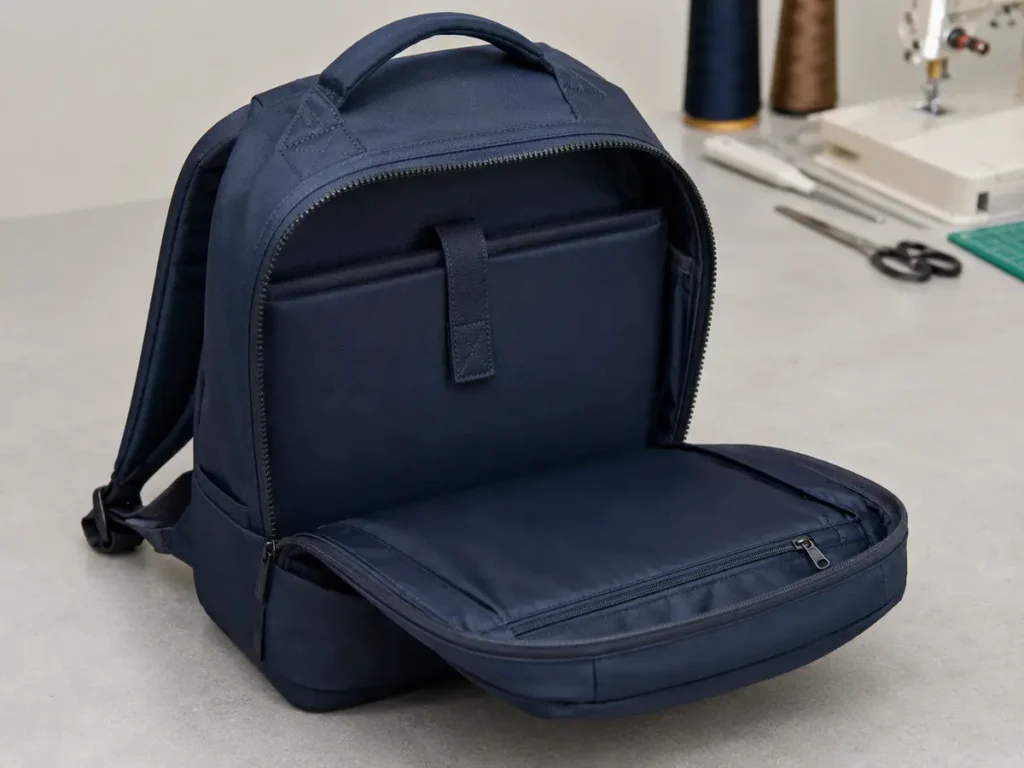
The highest-risk areas are usually the shoulder-strap anchors, grab handle, zipper ends, bottom corners and points where stiff and flexible materials meet. Practical construction controls include reinforced stitching or bartacks at load points, seam allowance consistency, internal binding where appropriate, smooth zipper paths and sufficient backing behind patches or embroidery.
A comfortable carrying system also depends on geometry. Shoulder straps should follow the body without cutting into the neck. Their anchor spacing and curvature matter as much as padding thickness. A sternum strap can stabilize a travel load, but it needs an appropriate vertical range. Back-panel channels can reduce direct contact, although ventilation depends on climate, clothing and load.
Translate each feature into an acceptance check. Instead of asking for “strong shoulder straps,” define the seam construction, reinforcement position and any pull-test protocol to be agreed with the supplier or testing laboratory. Instead of asking for “smooth zippers,” approve a zipper sample and define a repeated opening check during inspection. Observable requirements reduce disagreement.
Can one backpack work for school, travel and commuting?
Yes, if the target users and load range are compatible. A balanced hybrid specification might include:
- A clean rectangular panel-loading silhouette with moderate depth.
- A padded and raised laptop sleeve sized for the target device.
- A wide opening that supports both book access and travel packing.
- Two bottle or utility pockets that lie relatively flat when empty.
- A structured back panel and wide adjustable shoulder straps.
- A front admin pocket plus one discreet quick-access pocket.
- Reinforcement at the top handle and shoulder-strap anchors.
- A luggage-handle pass-through for travel.
- Subtle logo placement suitable for school, corporate or retail use.
The compromise is that a hybrid will not be optimized for every extreme. A compact school bag will not replace a high-capacity travel pack, and a clamshell travel pack may offer more opening complexity than a young student needs. Buyers should choose a shared platform only when it simplifies inventory without reducing fit or usability.
Planning a custom backpack program? Send JIUMU your intended users, quantity, target dimensions, packing list, fabric preference, colors, logo artwork, packaging and required delivery date. We can review the concept for a digital mockup and physical sample. Request a custom backpack quotation or explore custom team bags.
How can custom backpacks be branded?
Embroidery
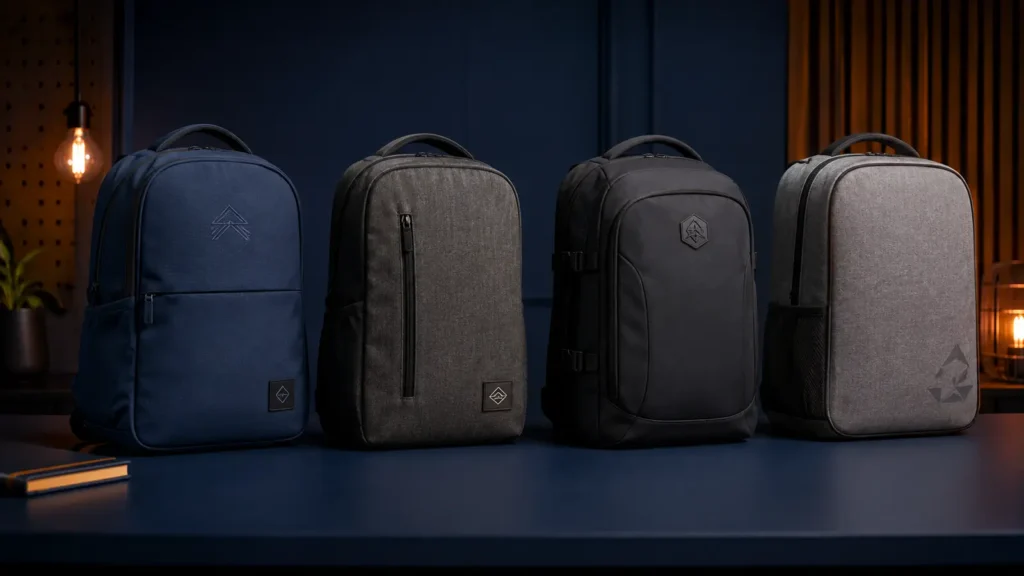
Embroidery provides a dimensional, durable appearance for school crests, company marks and team identities. It works best when fine lines and small text are simplified for thread. Dense embroidery adds stiffness and can affect the panel behind it, so placement and backing should be approved on the actual fabric.
Screen printing and heat transfer
Screen printing can be efficient for suitable artwork and quantities, while heat-transfer methods can reproduce more detailed graphics. The correct process depends on the shell fabric, coating, color count, artwork and durability requirement. Confirm adhesion, color, hand feel and any visible press marks on a decorated sample.
Woven and rubber/PVC patches
Woven patches can capture fine graphic detail with a textile look. Rubber/PVC patches produce a dimensional, weather-conscious aesthetic. Patch thickness, edge treatment, attachment method and backing area all affect the final appearance. Leather-style patches can suit professional or lifestyle collections, but material claims should accurately describe whether the patch is genuine leather or a synthetic alternative.
Private labels and packaging
Brand ownership extends beyond the front logo. A private-label program may use woven labels, printed labels, zipper pullers, hangtags, care or information labels and custom packaging. Buyers selling in multiple markets should confirm the responsible-party, country-of-origin, material-composition and other required information with qualified compliance advisers. In the EU, textile products composed of at least 80% textile fibers generally fall within fiber-composition labeling rules; the precise application to a mixed-material bag should be checked for the final product and market.
JIUMU can support embroidery, sublimation where suitable, screen printing, heat transfer, woven and rubber/PVC patches, leather-style patches, Pantone color matching, private labels, hangtags and packaging customization. Feasibility and minimum quantity depend on the product structure and decoration.
What drives the cost of a custom backpack?
Backpack pricing depends on more than shell fabric. The main cost drivers usually include:
- Pattern complexity and number of panels.
- Fabric type, coating, lining and material usage.
- Foam, reinforcement boards and molded components.
- Number, size and specification of zippers, buckles and pullers.
- Compartments, laptop protection and organizational details.
- Logo method, size, stitch count, color count or patch construction.
- Custom-dyed components and Pantone matching.
- Labels, hangtags, individual bags, cartons and retail packaging.
- Sample rounds, testing requirements, inspection plan and shipping method.
- Order quantity and color/SKU breakdown.
For comparable quotations, send the same specification and packaging requirements to each supplier. A lower quote may exclude internal binding, use a different lining, reduce padding, substitute hardware or omit packaging. Ask suppliers to identify assumptions and exclusions rather than comparing only the total.
How should a buyer approve a backpack sample?
Sample approval should be a controlled decision, not a casual photo review. Use a written comment sheet with measurements and annotated images. Record the sample version, date and requested change so that corrected details are not lost between rounds.
Sample-approval checklist
| Area | Checks before approval |
|---|---|
| Dimensions | Empty and packed external measurements; key pocket and sleeve sizes |
| Appearance | Silhouette, symmetry, color, logo scale and placement |
| Carry comfort | Loaded wear trial, strap adjustment, handle feel and balance |
| Organization | Realistic packing test; access to laptop, bottle and small items |
| Workmanship | Stitch consistency, seam allowance, binding and trimmed threads |
| Hardware | Zipper travel, slider alignment, buckle engagement and webbing adjustment |
| Decoration | Color, registration, edge quality, backing and fabric distortion |
| Packaging | Folding method, shape recovery, labels, protective bag and carton plan |
Approve a sealed reference sample after all changes are incorporated. Retain one approved sample with the buyer and one with the supplier when practical. For repeat orders, the approved sample, bill of materials, color references and artwork files form the baseline for consistency.
What should be checked during bulk production?
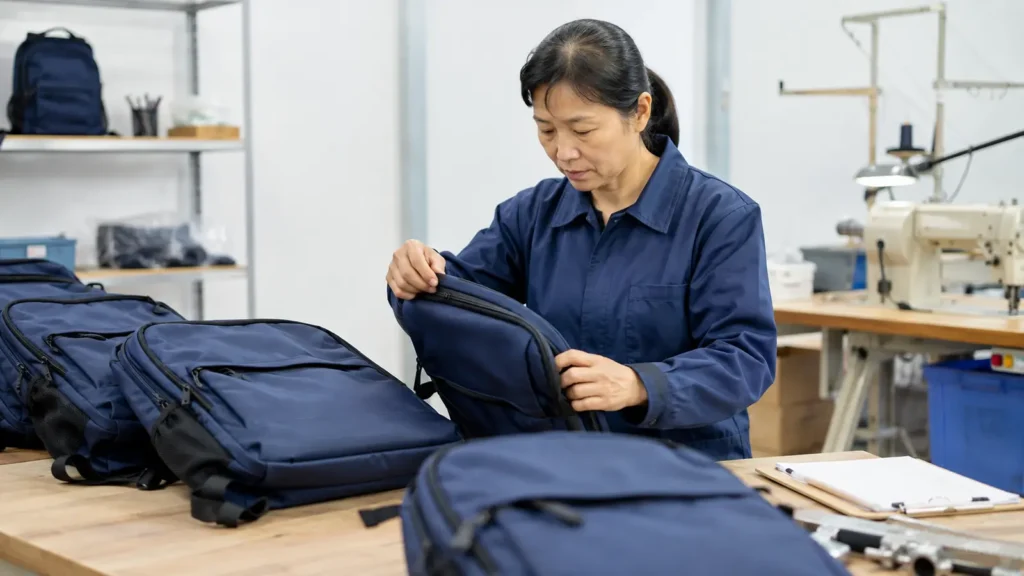
Quality control should address incoming materials, in-process construction and finished goods. Material approval can include fabric shade, hand feel, coating, lining, webbing and hardware. In-process checks should focus on panel orientation, reinforcement, logo placement and assembly accuracy before errors become expensive to correct. Final inspection can review quantity, workmanship, measurements, function, appearance, packaging and carton markings according to the agreed plan.
Testing should be relevant and specified in advance. Depending on the program and risk level, a buyer may consider zipper cycling, seam or handle strength, strap attachment, abrasion, colorfastness, coating performance, restricted substances or loaded drop evaluation through an appropriate laboratory or protocol. Do not request a generic “all tests passed” statement. Identify the method, sample size and pass/fail criterion, and confirm which party is responsible for cost and timing.
For products entering the EU, material and chemical compliance should be reviewed for the final bill of materials. ECHA maintains the REACH Candidate List of substances of very high concern; requirements and the list can change. Buyers should define their market-specific restricted-substance expectations and use qualified compliance support rather than rely on a fabric name alone.
How should a bulk backpack order be planned?
- Define the users and use case. Separate school, travel and commuter needs where they materially differ.
- Build the packing list. Record the dimensions of the largest rigid items.
- Set the specification. Define bag dimensions, fabrics, lining, foam, pockets, hardware, colors and decoration.
- Share artwork and brand controls. Provide vector artwork, Pantone references and placement dimensions.
- Request a digital mockup. Confirm proportions before sampling, while recognizing that a mockup cannot validate fit or materials.
- Develop and test the physical sample. Pack it, wear it and measure it.
- Approve the sealed standard. Record every accepted component and change.
- Confirm commercial details. Finalize quantity by color, packaging, inspection, shipping terms and target date.
- Monitor production and quality. Use checkpoints appropriate to the order’s complexity and risk.
- Review the delivered order. Record findings for replenishment and future revisions.
JIUMU’s typical MOQ is 50 pieces, subject to the backpack structure and customization. Programs with several colors or highly customized components may need different quantity planning, so disclose the SKU breakdown at the quotation stage.
What information should buyers send for a quotation?
A complete inquiry produces a more useful quotation and reduces repeated clarification. Send:
- Buyer type and destination market.
- Intended use: school, travel, commuting, event, team or retail.
- Total quantity and quantity per color/design.
- Target dimensions or required packing list.
- Reference images or a technical drawing, with the features you want to keep or change.
- Preferred shell, lining, padding and hardware—or the target performance and budget if materials are open.
- Logo artwork, decoration method if known, dimensions and placement.
- Pantone or other color references.
- Private-label, hangtag, barcode and packaging requirements.
- Required testing, inspection or documentation.
- Delivery country, target date and preferred shipping basis.
If the design is still early, say which variables are flexible. A supplier can then propose alternatives without assuming that every reference detail is mandatory.
Questions to ask a backpack supplier
- Which specifications and materials are included in the quotation?
- Which components are stock colors and which require custom color development?
- What is the MOQ for the overall order and for each color or design?
- How will laptop sleeve size and packed external dimensions be measured?
- Which load points receive reinforcement, and how will they be inspected?
- What sample stages are recommended and how are revisions documented?
- Can the supplier provide an itemized bill of materials or approved component record?
- Which logo methods suit the selected fabric and artwork?
- What packaging is included, and how will bags be folded without permanent deformation?
- Which tests or compliance documents can be arranged for the destination market?
- How will color and workmanship be controlled on repeat orders?
- What information is needed to confirm production and shipping timing?
Common backpack buying mistakes
Selecting by liter capacity alone
Nominal volume does not reveal usable shape, laptop fit or external packed dimensions. Validate the actual packing list.
Overloading the design with pockets
Every pocket adds seams, hardware, labor and potential failure points. Include a pocket only when it has a defined item or access purpose.
Assuming coated fabric means waterproof
Finished water protection depends on fabric, seams, zippers and construction. Use qualified claims tied to testing.
Approving color on a screen
Screens and digital mockups do not establish physical color. Approve swatches, lab dips or component samples under suitable lighting.
Ignoring packed dimensions
A soft travel backpack can expand past an airline limit even if its empty body appears compliant. Measure the packed sample and avoid universal airline-approval claims.
Skipping representative fit trials
Adult sample reviewers cannot reliably judge fit for young students, and one body type cannot represent every commuter. Test with representative users and realistic loads.
Changing packaging after sample approval
Folding and compression can affect shape, decoration and delivery condition. Approve packaging as part of the product system.
Why source custom backpacks with JIUMU?
JIUMU is a Guangdong, China-based B2B supplier established in 2010. We support custom teamwear, logo apparel, hats, uniforms, bags and branded merchandise for buyers in the United States, Canada, the United Kingdom and Europe. Relevant capabilities include OEM and ODM development, digital mockups, physical samples, fabric sourcing, Pantone color matching, multiple logo methods, private labels, packaging customization, bulk production, quality control and export support.
Our role is to help turn a reference image or product idea into a clearer specification. For backpack projects, that means aligning the user, packing list, dimensions, construction, materials, artwork and packaging before production. The typical MOQ is 50 pieces, subject to product structure and customization. Buyers can also coordinate backpacks with custom team uniforms, custom hoodies or baseball team uniform packages.
Frequently Asked Questions
Final recommendation
The best backpacks for school, travel and daily commuting are built from a clear use case rather than a fashionable feature list. School buyers should control fit, load placement and everyday access. Travel buyers should control packed dimensions, opening efficiency and carrying stability. Commuter buyers should control laptop protection, compact organization and professional appearance. Multi-use programs work when the shared design is validated with real contents and representative users.
Before comparing prices, create one written specification, one packing test and one sample-approval checklist. Those three tools make supplier quotations more comparable and make bulk quality easier to control.
Request a custom backpack quotation: Share your quantity, destination market, intended users, target dimensions, packing list, materials, colors, logo artwork, packaging and delivery date. JIUMU can help develop a digital mockup and physical sample for review. Email zhengdong@jiumugear.com, contact WhatsApp/Phone +86 18507502899, or send your project brief.