Custom Printed Hoodies: Product and Design Guide
Custom printed hoodies can be uniforms, school merchandise, staff apparel, retail products or promotional gifts. A successful bulk order depends on how the fabric, construction, print chemistry, artwork, fit, labeling and intended use work together.
For a buyer, the key question is not simply “Which printing method is best?” It is “Which product-and-print combination will produce the right appearance, hand feel, durability, unit economics and repeat-order consistency for this program?”
This guide covers hoodie specifications, screen printing, DTG, DTF, heat transfer, design placement, artwork, sampling, quality control, labeling and quotation requirements.
Quick Answer: How Should You Choose Custom Printed Hoodies?
Choose the hoodie and printing process as one system. Start with the wearer, climate, sales channel, expected use, order quantity and target price. Then define the fabric composition and weight, fit, color, construction details, print locations, artwork colors, desired print feel and testing standard.
Screen printing is usually a strong choice for repeatable bulk graphics with a controlled number of colors. DTG can suit detailed, full-color art and smaller or more varied runs, especially on compatible cotton-rich surfaces. DTF and other heat-applied transfers can handle detailed multicolor artwork and flexible placement, but the transfer, fabric and application settings must be tested together. Specialty effects such as puff, high density or reflective print require additional sampling because they change the print surface and curing requirements.
Review a production-representative physical sample and perform agreed wash and appearance checks before bulk production.
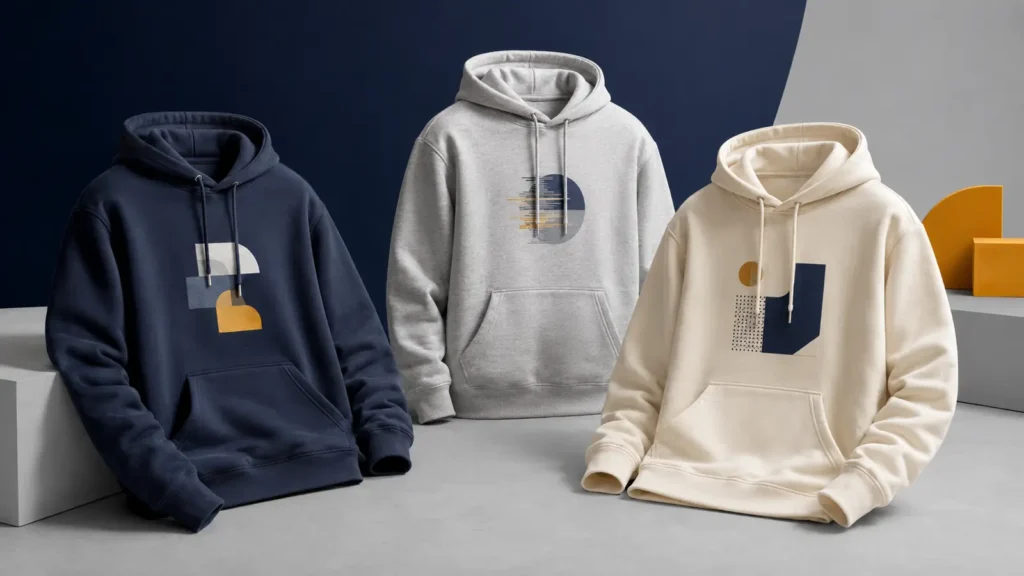
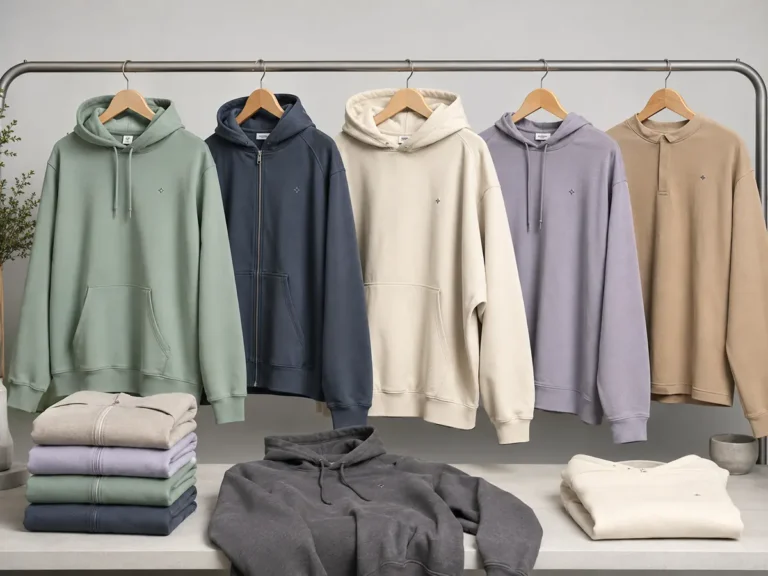
Three hoodie colors and original graphic treatments illustrate how garment choice and print design must be developed together.
Why the Product and Print Must Be Specified Together
A print can look sharp on one hoodie and disappointing on another even when the same artwork file is used. The surface of a smooth cotton-rich fleece behaves differently from a textured polyester performance knit. A dark garment may require an underbase or white ink layer. A highly brushed or irregular face can reduce fine-detail clarity. Seams, pockets, zippers and drawcords can interfere with placement or heat-press pressure.
The hoodie also affects the buyer’s commercial result. A lightweight French terry style may be suitable for indoor staff uniforms or transitional weather. A heavyweight brushed fleece may support a streetwear collection or cold-weather team merchandise. A polyester-rich garment may be preferred for quicker drying or athletic use, while a cotton-rich face can provide a familiar casual feel and a favorable surface for many print processes.
Treating the garment and decoration as separate purchases creates avoidable risks: unsuitable artwork scale, interference from pockets or zippers, dye migration, excessive print stiffness, poor contrast and inconsistent repeat orders. The practical solution is one product specification connecting fabric, construction, color, artwork and process requirements.
Custom Printed Hoodie Types and Best-Fit Use Cases
The garment silhouette should support the program rather than follow a trend by default. The following overview helps narrow the choice.
| Hoodie type | Typical strengths | Design considerations | Suitable B2B programs |
|---|---|---|---|
| Pullover hoodie | Familiar shape, uninterrupted front area, efficient for team and merchandise programs | Large front designs must account for the kangaroo pocket and drawcords | Schools, clubs, work crews, events, brand merchandise |
| Full-zip hoodie | Easy layering and temperature control | Front artwork is divided by the zipper; left-chest or back prints are often cleaner | Staff uniforms, corporate apparel, clubs, travel teams |
| Oversized or heavyweight hoodie | Fashion-led silhouette and substantial hand feel | Drop shoulders and larger body proportions change standard print placement | Streetwear, private label, premium merchandise |
| Lightweight or French terry hoodie | Comfortable in mild weather and indoor settings | Thinner fabric may show pressure marks or require lighter print deposits | Fitness, hospitality, events, transitional seasons |
| Performance hoodie | Often polyester-rich with quicker-drying behavior | Heat sensitivity, dye migration and surface texture require process testing | Training, outdoor crews, sports academies |
| Youth hoodie | Team and school relevance | Size grading, print scaling and drawstring safety require special attention | Youth clubs, schools, camps |
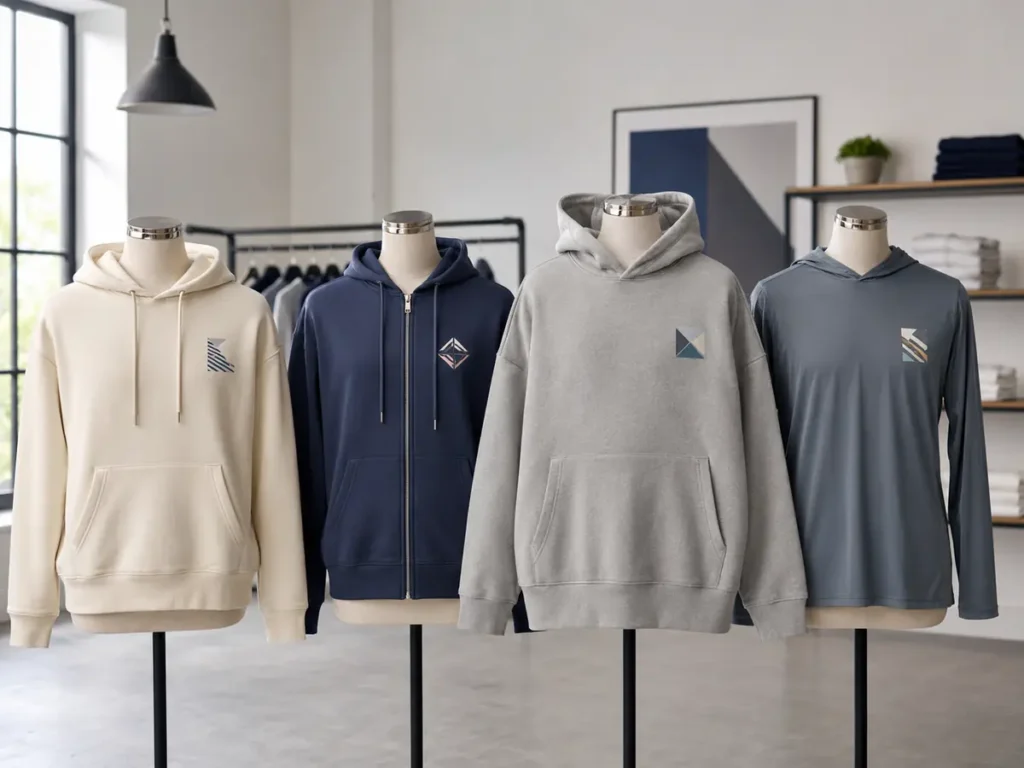
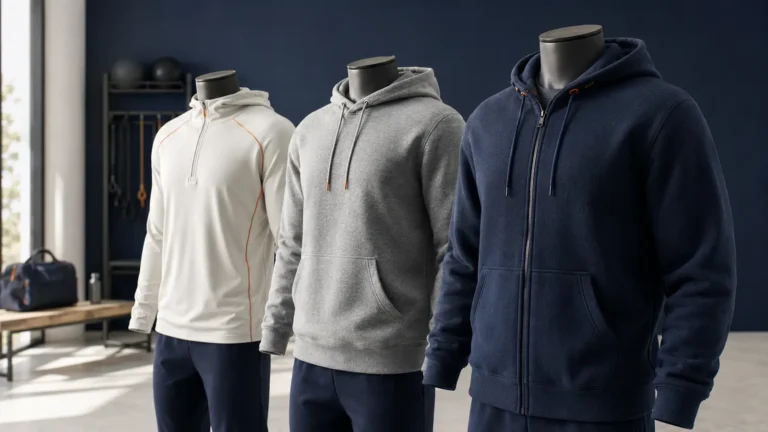
Pullover, full-zip, oversized and lightweight performance silhouettes require different print-placement decisions.
Pullover or Zip-Up?
Pullover hoodies provide the largest continuous front print area. They are useful when the design itself is central to the product. Full-zip hoodies are more practical for layering, but a centered front logo may need to be split, aligned across the zipper or replaced by two smaller placements. If visual continuity is important, request a sample with the actual zipper, seam allowance and print method.
Retail Fit or Team Fit?
A private-label streetwear program may want dropped shoulders, a wider body, longer ribbing and a heavier fabric. A team order may prioritize predictable unisex sizing, ease of movement and simple reordering. Buyers should not rely on labels such as “regular,” “relaxed” or “oversized” without garment measurements. Request a size chart that includes chest width, body length and sleeve length, plus measurement tolerances.
Adult and Youth Programs
When one design spans youth and adult sizes, it may need more than one artwork scale. A graphic proportioned for an adult XL can overwhelm a youth small. Confirm whether the supplier will use a single print size, two grouped sizes or fully graded artwork.
For products entering the United States, children’s upper outerwear deserves an additional safety review. The U.S. Consumer Product Safety Commission has identified neck or hood drawstrings on children’s upper outerwear, including sweatshirts, as an entanglement and strangulation hazard. Buyers should verify the current requirements for the intended size range and market rather than simply copying an adult hoodie construction. See the CPSC drawstring guidance and rule material.
How to Specify Hoodie Fabric for Printing
Fabric composition is only the starting point. Two hoodies with the same fiber percentages may differ in weight, yarn quality, surface smoothness, shrinkage, pilling behavior, brushing and print performance.
Cotton-Rich Fleece
Cotton-rich fleece is widely used for casual and merchandise hoodies because it can provide a soft hand and a print-friendly outer face. A smooth, tightly knitted face supports cleaner edges than a loose or hairy surface. However, cotton content alone does not guarantee a result. The supplier should confirm the actual fabric construction and test the selected print process on the selected color.
Cotton-Polyester and Performance Blends
Blends can balance hand feel, dimensional stability and drying behavior, but they may require process adjustments. Brother’s garment-printer guidance describes different pretreatment handling for cotton and cotton/polyester garments, illustrating why the production recipe must match the fabric. Polyester-rich hoodies also require attention to heat sensitivity and possible dye migration into light decoration. Review the actual color after heat exposure and washing. See Brother’s pretreatment guidance.
Brushed Fleece vs. French Terry
Brushed fleece has a soft, raised interior that traps warmth. French terry uses loops on the inside and is often lighter and less insulating. The print is usually applied to the outer face, but the overall thickness affects platen setup, heat transfer and the buyer’s desired hand feel.
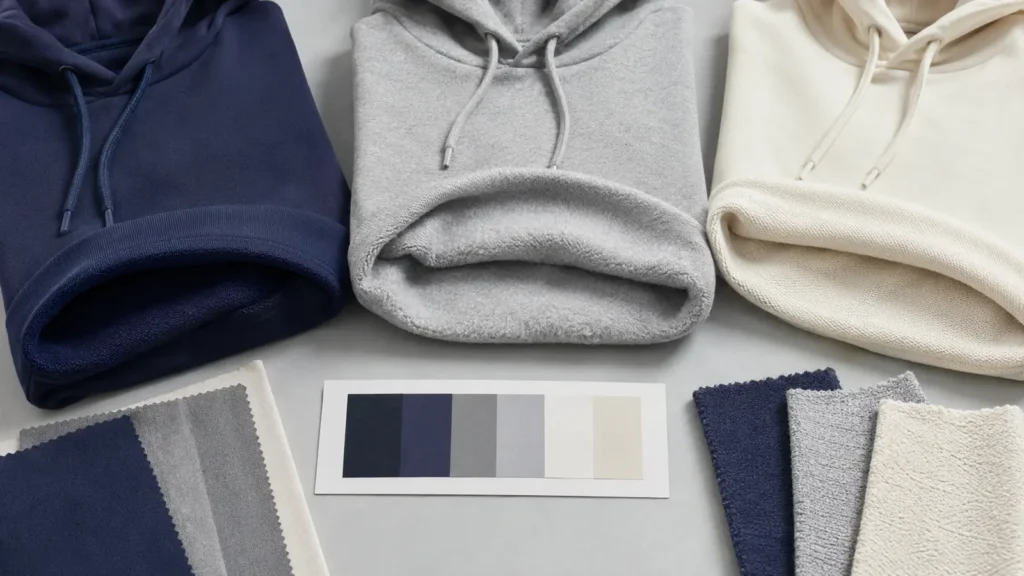
Fabric composition, surface smoothness and interior construction all influence comfort and print behavior.
Fabric Weight and Surface
Fabric weight is commonly expressed in grams per square meter, but GSM should not be treated as a quality score. Higher weight can create a more substantial garment, while lower weight can improve layering and warm-weather usability. Buyers should specify a target range that suits the program and confirm:
- Fiber composition and permissible tolerance
- Fabric weight or agreed weight range
- Outer-face smoothness
- Interior finish: brushed, loopback or unbrushed
- Shrinkage expectation and test method
- Pilling and colorfastness requirements, if applicable
- Whether the fabric is preshrunk or stabilized
- Garment color standard and dye-lot control
- Any requested certification, including the exact scope and valid documentation
If a buyer requires a textile-safety claim, ask for current, verifiable documentation covering the relevant material or finished product. For example, OEKO-TEX STANDARD 100 is a specific testing and certification system for harmful substances; the name should not be used as a generic synonym for “safe” or claimed without an applicable certificate.
Printing Methods for Custom Hoodies
There is no single process that wins on every criterion. The right choice depends on artwork, fabric, color, quantity, placement, hand feel, durability expectations and budget.
| Method | Strong fit | Main advantages | Buyer checks |
|---|---|---|---|
| Screen printing | Repeated graphics, controlled color count, medium and large runs | Consistent spot colors, scalable production, many specialty ink options | Screen setup, underbase, ink system, cure, registration, print hand |
| DTG | Detailed or photographic art, smaller or variable runs, compatible cotton-rich garments | Fine detail, broad color range, direct digital workflow | Pretreatment, white ink, fabric compatibility, cure and wash result |
| DTF transfer | Detailed multicolor graphics, flexible quantities and placements | Sharp detail, broad artwork flexibility, useful on many garment types when tested | Transfer film/powder quality, hand feel, edge, pressure, temperature and peel |
| Heat-transfer vinyl or cut film | Names, numbers, simple logos and short runs | Clean shapes, personalization, straightforward color control | Film type, fabric compatibility, press pressure, edge lift and layer thickness |
| Water-based screen print | Soft, matte fashion print on compatible garments | Softer hand and integrated appearance | Fabric color, opacity, cure and supplier capability |
| Puff/high-density/specialty print | Accent graphics and fashion details | Texture and visual differentiation | Artwork suitability, expansion consistency, cure and wash durability |
Screen Printing
Screen printing pushes ink through a stencil onto the garment. Each spot color typically requires its own screen and setup. That setup makes the process efficient when the same graphic is repeated across a meaningful quantity, but it can increase cost for many colors or numerous artwork variations.
For dark hoodies, an underbase may be needed to keep colors bright. The underbase, color layers and curing conditions affect thickness and hand feel. Plastisol systems can provide strong opacity and a more deposited surface, while water-based systems can create a softer, more matte appearance on suitable garments. These are general tendencies, not guaranteed outcomes; ink formulation, mesh, deposit, fabric and cure all matter.
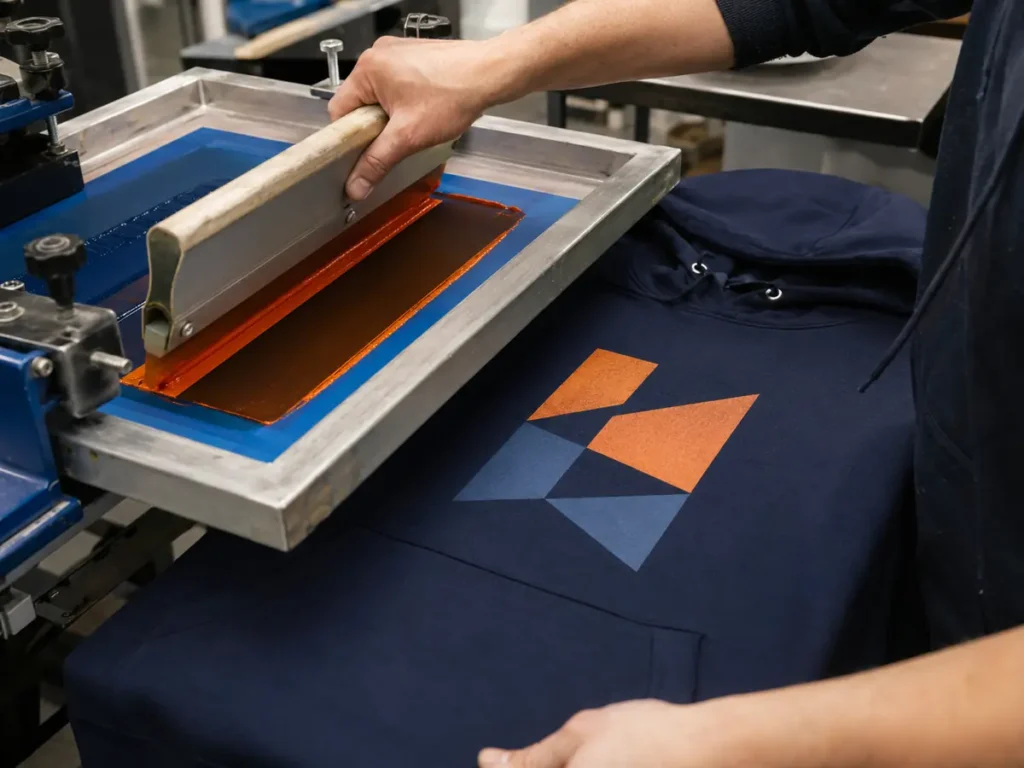
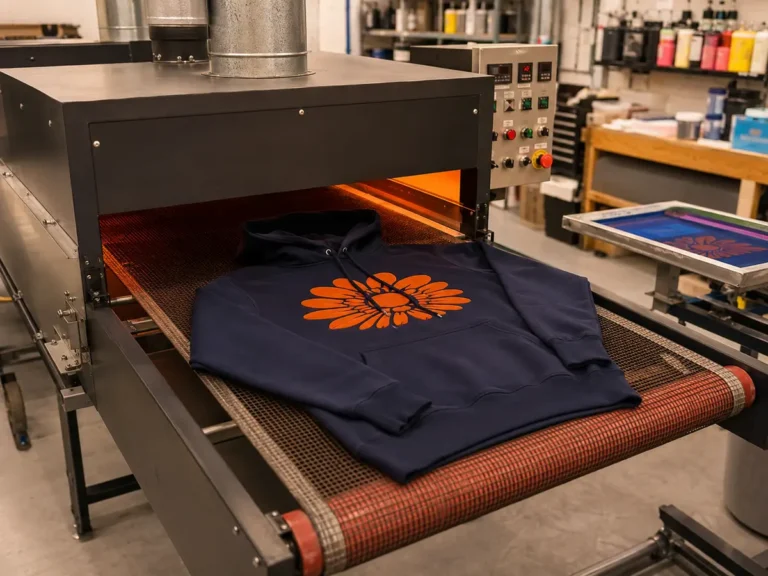
Screen printing is effective for repeatable bulk graphics when screens, ink layers, registration and curing are controlled.
Direct-to-Garment Printing
DTG prints digital artwork directly onto the garment. It is well suited to detailed graphics, gradients and designs with many colors when the fabric and production workflow are compatible. Dark garments generally require white ink and pretreatment. Epson describes a typical DTG workflow as pretreating where needed, printing directly onto the garment and curing the ink with heat; this reinforces the need to evaluate the entire process, not the printer alone. See Epson’s DTG process overview.
Buyers should check the whiteness and evenness of the underbase, fine-detail clarity, color appearance on the actual hoodie, pretreatment marks, hand feel and wash result. The same digital file can look different on navy, black, heather gray and cream garments.
Direct-to-Film Transfers
DTF prints artwork onto a film, adds adhesive and transfers the design to the garment with heat and pressure. It can reproduce detailed, multicolor graphics and is useful for varied quantities or placements. However, quality is not defined by the process name. Film, ink, adhesive powder, curing, pressing and peeling all influence the result.
Evaluate edge sharpness, hand feel, opacity, adhesion after washing, press marks and compatibility with the hoodie’s fiber content and finish.
Heat-Transfer Vinyl and Other Heat-Applied Graphics
Cut vinyl is practical for names, numbers and simple logos. It is often selected for team rosters or personalization because each garment can carry different information. Heat-applied methods depend on a controlled combination of time, temperature, pressure and peel procedure. Seams, pockets, zippers and thick fleece can make pressure uneven, so the operator may need appropriate platens or support.
Specialty Effects
Puff, high-density, reflective, metallic and glow effects can create distinctive merchandise, but they should be used intentionally. Puff ink changes during curing, so fine lines and tightly spaced artwork may merge or distort. Reflective or metallic materials can have different care and stretch characteristics from standard ink. Request a physical strike-off or garment sample and define the accepted effect before bulk production.
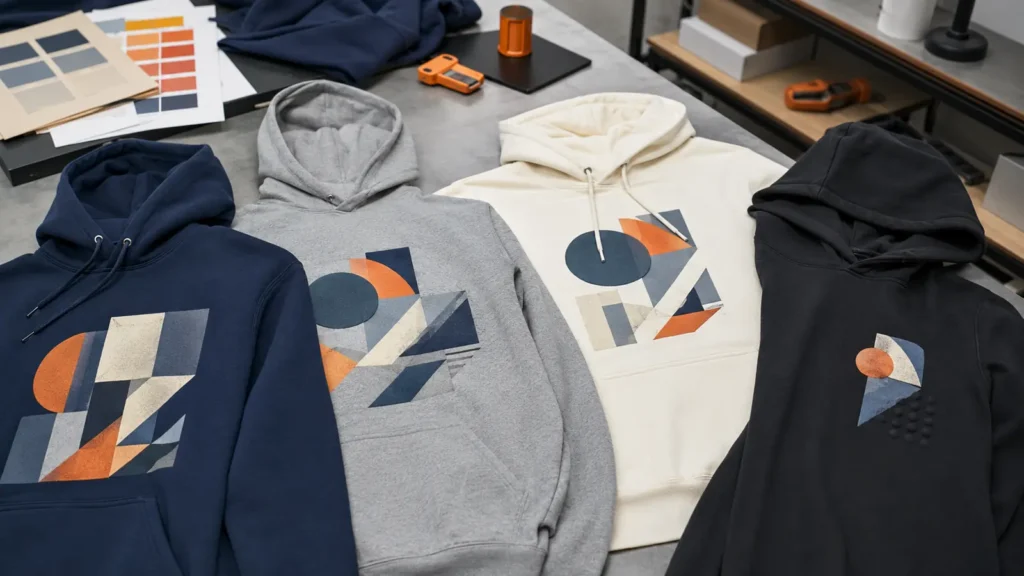
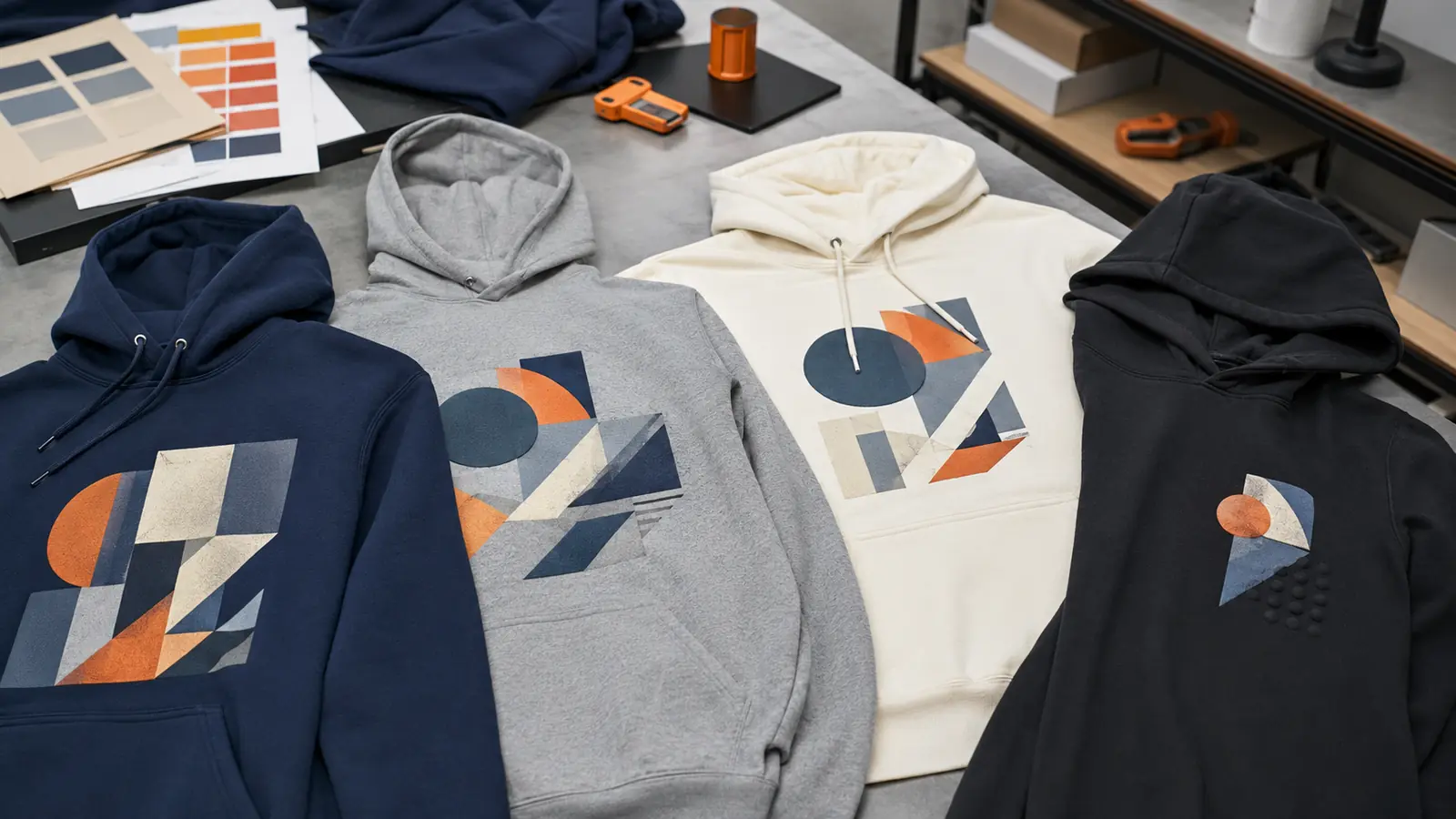
Screen print, DTG-style detail, DTF-style transfer and a raised specialty accent demonstrate why texture and edge quality should be reviewed physically.
How to Design Artwork That Works on a Hoodie
A good hoodie graphic is not merely attractive on screen. It must survive color separation, printing, garment curvature, size grading and repeated wear.
Start With the Garment Color
The hoodie color is part of the design. Navy, black or forest green may require light ink or an underbase. Heather fabrics can visually interact with translucent or water-based prints. Cream and natural colors can support softer palettes but may reduce contrast for pale artwork.
Use a defined color reference. Pantone matching can help communicate an intended spot color, but the final appearance depends on ink, fabric color, opacity and lighting. Approve a physical sample or color strike-off when color precision is commercially important.
Build Print-Ready Artwork
Vector artwork is preferred for flat logos, typography and spot-color graphics because it can be resized without loss of edge quality. High-resolution raster files can work for photographic or textured art. A supplier normally needs:
- Original AI, EPS, PDF, SVG, PSD or high-resolution PNG/TIFF files
- Fonts converted to outlines or supplied legally
- Defined print dimensions
- Spot-color references or an approved CMYK/RGB target
- Transparent background where appropriate
- Separate layers for specialty effects
- A placement map for each location
Do not send only a compressed screenshot pulled from social media. It may hide rough edges, color artifacts or an incorrect background.
Control Minimum Detail
Thin lines, small gaps, distress textures and tiny type can close up or disappear depending on the method. Ask the supplier to state practical minimum line widths and text sizes for the selected process. The answer should be based on the actual ink, screen mesh, printer, transfer and garment—not a generic number copied from another program.
Design for the Full Size Range
There are three common approaches:
- One print size for all garments. Simple and economical, but may look small on large sizes and large on youth sizes.
- Grouped print sizes. For example, one scale for youth/small sizes and another for larger adult sizes.
- Fully graded artwork. Provides more consistent visual proportion but increases setup and production complexity.
The buyer should approve the chosen approach and list which garment sizes use each artwork size.
Print Placement and Measurement
Placement should be defined from stable garment landmarks. “Center chest” is too vague for production. State the graphic width and height, centerline, distance from the collar seam or other agreed point, and placement tolerance.
Common locations include:
- Center chest
- Left chest
- Full back
- Upper back below the hood
- Sleeve
- Cuff
- Hood
- Near-hem or side placement
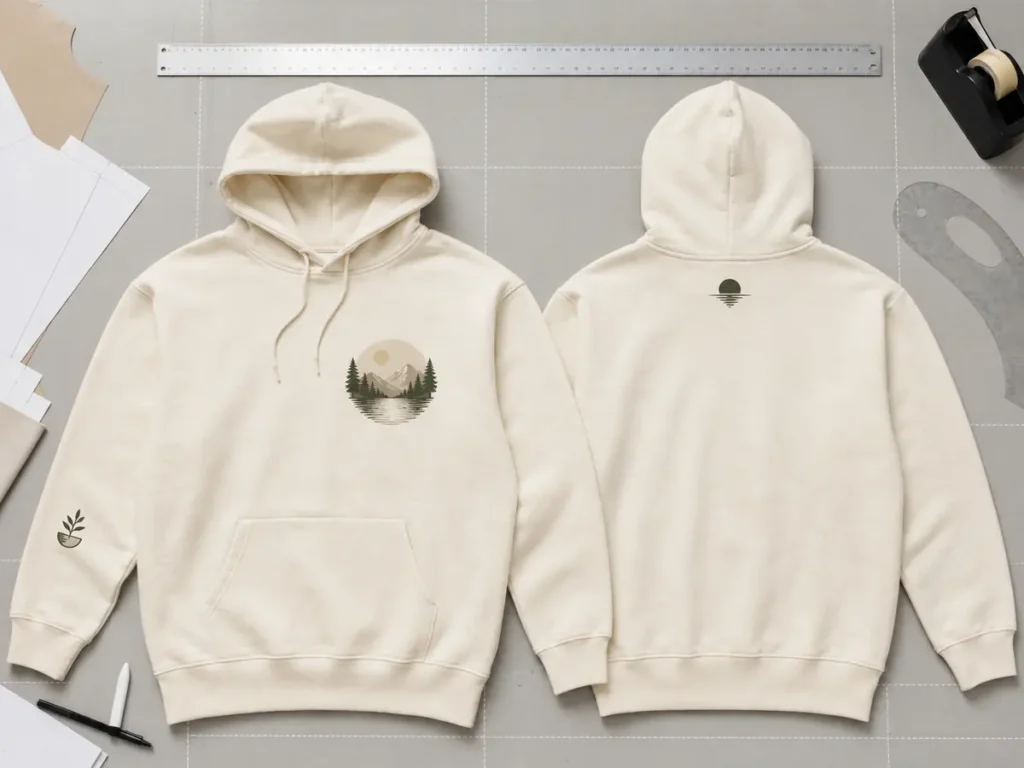
Front, sleeve and upper-back graphics need individual dimensions, landmarks and tolerances.
Watch the Hood and Pocket
A back print placed too high can be hidden by the hood when worn. A front print placed too low can cross the kangaroo pocket seam. A design on a zip-up must account for zipper alignment. Sleeve printing must consider taper, seam position and the available platen or transfer surface.
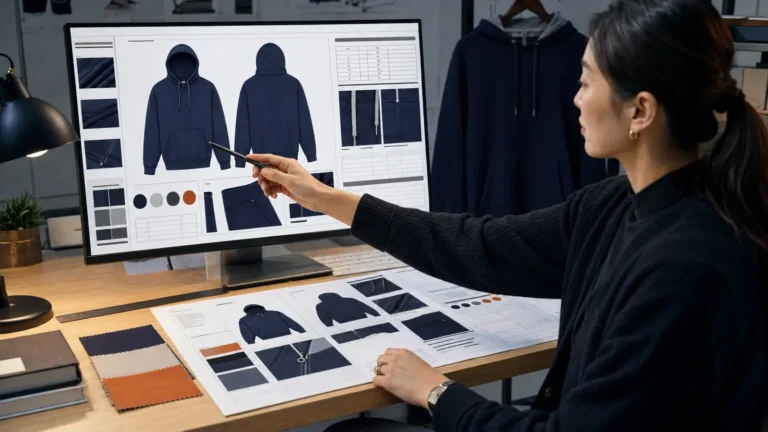
For each placement, ask the supplier to include the visible dimensions in the digital mockup and confirm them again on the sample. The mockup should identify the garment size being shown, since the same graphic occupies a different proportion on each size.
Matching a Printing Method to the Buying Program
Use the following decision sequence rather than selecting a process from appearance alone.
- Define the commercial model. Retail products may prioritize silhouette, hand feel and labels; uniforms may prioritize repeatability; event merchandise may prioritize deadline and budget.
- Define the order structure. Record quantities by color and size, artwork versions and personalized names or numbers. One 500-piece graphic differs greatly from ten 50-piece designs.
- Define the required look and feel. Translate references into observable terms such as matte, soft, raised, crisp, vintage, tonal or textured.
- Confirm fabric compatibility. Test the actual garment and color, especially for polyester-rich, heavily brushed, garment-dyed or specialty-finished hoodies.
- Compare total program cost. Include garment, setup, decoration, personalization, samples, labels, packaging, inspection and freight—not only the print unit price.
What Drives the Cost of Custom Printed Hoodies?
Pricing varies by specification and should not be estimated from artwork alone. Major cost drivers include:
| Cost driver | Why it changes the quote | How the buyer can control it |
|---|---|---|
| Garment fabric and weight | Fiber, yarn, GSM, finishing and construction affect material and production cost | Set a performance-based target range rather than an arbitrary maximum |
| Hoodie construction | Custom panels, heavy rib, double-layer hoods, special zippers and trims add work | Prioritize details that support the brand or use case |
| Printing method | Screens, pretreatment, transfer materials, ink layers and curing differ | Match the method to artwork and quantity |
| Number of colors | More spot colors can mean more screens and registrations | Simplify colors when visual impact is retained |
| Print size and locations | Larger areas use more ink/material; multiple locations add handling | Rank essential and optional placements |
| Artwork variations | Each design, roster or personalized name adds setup and sorting | Consolidate versions and send final data in a controlled file |
| Sampling | Multiple rounds increase time and cost but reduce bulk risk | Approve a complete brief before sampling |
| Labels and packaging | Woven labels, hangtags, bags, barcodes and assortment rules add materials and labor | Provide a packaging specification and destination rules early |
| Quantity and size breakdown | Short runs and fragmented variants reduce efficiency | Confirm final quantities before quotation |
| Delivery requirement | Production planning and freight method affect landed cost | Share the required arrival date and destination at the first inquiry |
Plan Your Custom Hoodie Program
If you are comparing printing methods, send JIUMU your artwork, target quantity, size breakdown, hoodie color, fabric preference, print locations, packaging needs and required delivery date. JIUMU can review the product-and-print combination, prepare a digital mockup and recommend a sampling route. Explore custom hoodies or request a quotation.
Sampling and Quality Control
A digital mockup verifies content and approximate placement, but it cannot prove fabric hand feel, ink surface, actual color or wash performance. A disciplined approval flow normally includes:
- Specification review. Confirm garment, fabric, color, size chart, artwork, placements, labels and packaging.
- Digital mockup. Check design version, dimensions, placement and color references.
- Material and color confirmation. Review fabric swatches or garment samples where needed.
- Decoration strike-off or physical sample. Evaluate the selected process on representative fabric.
- Preproduction approval. Sign off the final sample and record comments clearly.
- Bulk production controls. Use the approved sample and specification as references.
- Final inspection and packing check. Verify quantity, assortment, appearance, labels and packaging.
What to Inspect on the Sample
- Correct hoodie style, fabric, color and size
- Garment measurements against the agreed chart
- Print dimensions and location
- Registration between colors
- Opacity and coverage on dark fabric
- Fine-detail clarity
- Print edge quality
- Surface hand and flexibility
- Shade match and adhesion
- Scorch, shine or press marks
- Shrinkage, distortion, cracking, peeling, fading or dye migration after agreed washing
- Correct labels, hangtags and packaging
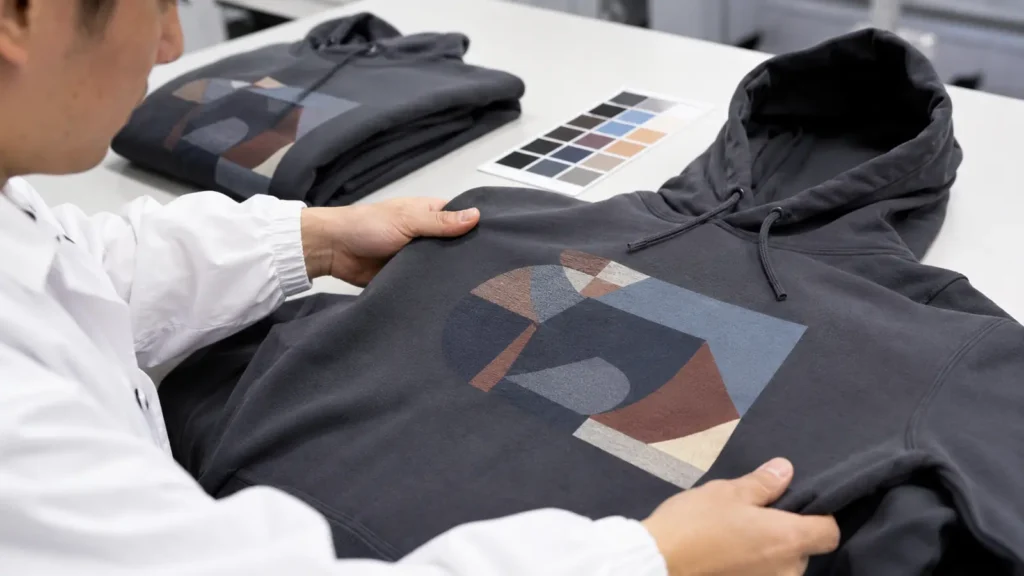
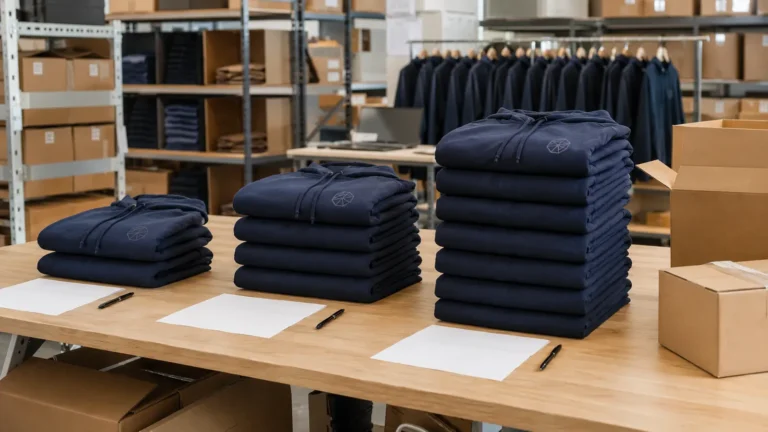
A production-representative sample should be checked for dimensions, placement, color, adhesion and appearance after agreed care testing.
Agree on Test Conditions
“Wash tested” is not specific enough. State the number of cycles, wash temperature, detergent type if relevant, drying method and evaluation criteria. The care instruction used for testing should match the care label ultimately supplied with the product.
For U.S. sales, the Federal Trade Commission’s Care Labeling Rule requires manufacturers and importers to attach care instructions to clothing and certain piece goods. The FTC also states that care instructions and warnings need a reasonable basis. Buyers should confirm the current rule and their legal responsibilities with qualified advisers. See the FTC Care Labeling guidance.
Labeling and Market Requirements
Labeling is part of the product specification, not an end-of-line graphic task. Requirements vary by destination and buyer role.
In the United States, the FTC explains that most textile products need labels identifying fiber content, country of origin and a responsible business; care labeling is addressed separately. See the FTC textile labeling guide. In the European Union, Regulation (EU) No 1007/2011 governs textile fiber names and related fiber-composition labeling. Review the official EUR-Lex regulation.
The brand owner or importer should confirm the final legal text for each market. Ask about:
- Main brand label
- Size label
- Fiber and country-of-origin label
- Care label
- RN or responsible-company identification where applicable
- Hangtag
- Barcode, SKU or carton label
- Polybag warnings and packaging rules
- Language requirements
Do not place an unverified certification mark on the garment or hangtag. Confirm the certificate owner, product scope, validity period and rules for label use.
Questions to Ask a Custom Hoodie Supplier
Use questions that produce measurable answers:
- Which hoodie fabric and surface do you recommend for this artwork and why?
- What printing methods can you produce on the selected composition and color?
- Will the design require an underbase, pretreatment or migration blocker?
- What will the finished print feel like compared with the reference?
- What minimum line width and detail can be reproduced reliably?
- Will the artwork use one size or graded sizes across the garment range?
- What placement tolerance can you control?
- How will color be approved and recorded?
- Can you produce a strike-off or physical sample on representative fabric?
- What wash or appearance checks will be performed, and under what conditions?
- How are bulk prints compared with the approved sample?
- How do you manage names, numbers, SKUs and packing assortments?
- What is included in the quotation, what is the MOQ, and what creates extra charges?
- How will the approved fabric, color and print recipe be recorded for repeat orders?
What to Send for an Accurate Quotation
A complete inquiry shortens the quotation cycle and reduces assumptions. Send:
- Buyer type and target market
- Intended use: retail, team, uniform, school, event or promotion
- Pullover or zip-up style
- Adult, youth or mixed size range
- Quantity by color and size
- Fabric composition and target weight, if known
- Preferred fit and garment measurements
- Hoodie color reference
- Vector or high-resolution artwork
- Print dimensions and each placement
- Preferred method or desired visual/hand-feel result
- Pantone or other color references
- Brand labels, care labels and hangtags
- Individual bag, barcode and carton requirements
- Shipping destination
- Required delivery date
- Reference product or target budget, if relevant
If some decisions are open, label them as options. For example, request a comparison between cotton-rich fleece with screen printing and a blended fleece with DTF rather than asking for “the cheapest hoodie.”
Common Buying Mistakes
- Choosing the print before the hoodie: define the actual fabric and color before selecting DTG, DTF or screen printing.
- Approving only a digital mockup: it cannot show hand feel, opacity, press marks or wash behavior.
- Using one graphic size without review: check proportion on the smallest and largest garments.
- Ignoring seams and hardware: zippers, pockets, drawcords and thick seams affect placement and pressure.
- Treating certifications as marketing words: request the certificate and its precise product scope.
- Comparing unlike quotes: normalize garment weight, construction, labels, packing and service scope before comparing price.
Why JIUMU for Custom Printed Hoodies
JIUMU is a Guangdong-based B2B supplier established in 2010, serving buyers in the United States, Canada, the United Kingdom and Europe. Its focus includes custom teamwear, logo apparel, hats, uniforms, bags and branded merchandise.
For custom hoodie programs, JIUMU can support OEM and ODM development, fabric sourcing, Pantone color matching, screen printing, heat transfer, sublimation where the product construction is suitable, embroidery and patch options. Private labels, neck labels, woven labels, hangtags and packaging can be integrated into the order.
The typical MOQ is 50 pieces, subject to product structure and customization. Digital mockups and physical samples are available as part of an approval workflow, followed by bulk production, quality control and export support. The appropriate process and MOQ should be confirmed against the actual design, quantity breakdown and destination.
For broader coordinated apparel, buyers can also explore custom team uniforms, custom team jackets and custom team jerseys.
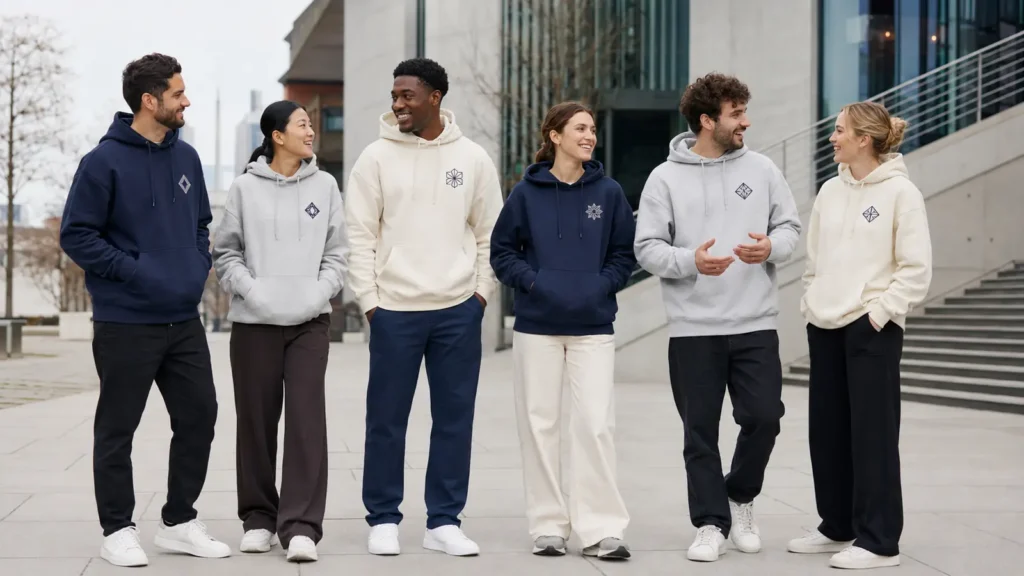
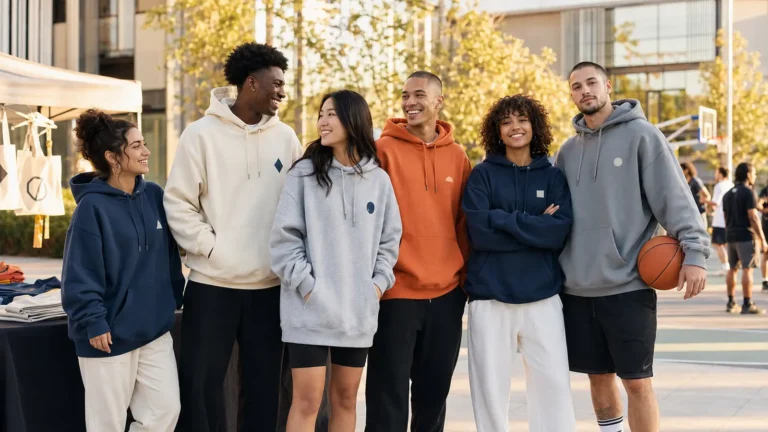
Coordinated hoodie colors and restrained logo placements can support teams, schools, companies and branded communities.
Frequently Asked Questions
Final Recommendation
The most reliable custom printed hoodie program begins with a complete buying brief. Define the wearer, use, silhouette, fabric, color, artwork, placements, desired print feel, quality checks and destination-market labeling.
Compare feasible product-and-print combinations using physical samples. Approve fabric, size, color, placement and decoration before bulk production, then record the approved specification for repeat orders.
For a JIUMU quotation, send your artwork, quantity by size and color, print locations, labels, packaging, destination and required delivery date. Contact zhengdong@jiumugear.com, WhatsApp/Phone +86 18507502899, or use the inquiry page.
JIUMU Editorial Team
JIUMU publishes practical sourcing guidance for teams, schools, distributors and private-label buyers. Established in 2010 in Guangdong, China.