Snapback vs Dad Hat: Fit, Structure, Style and Customization
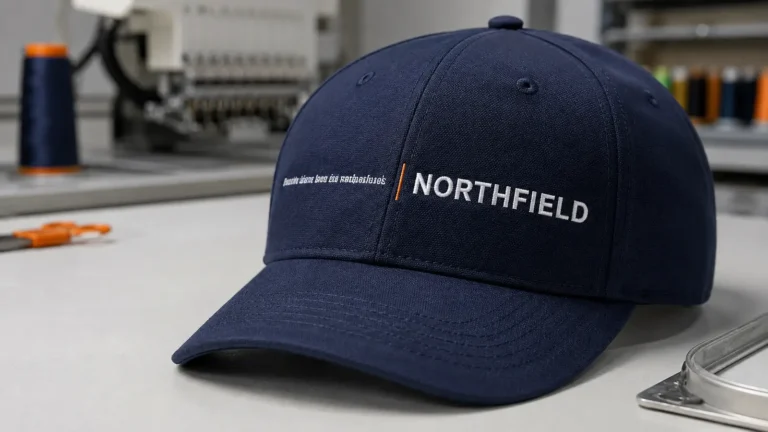
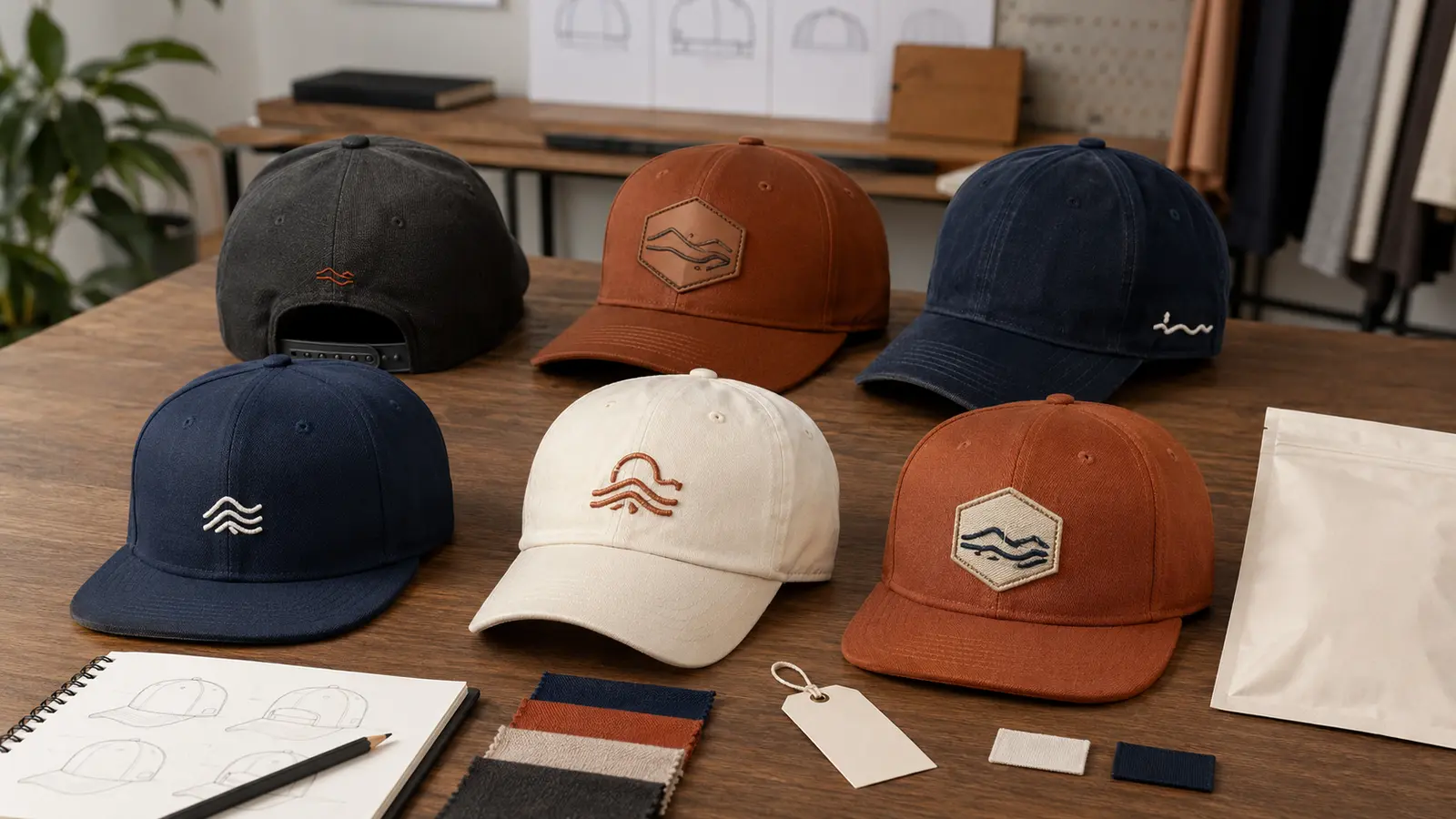
For a retail label, sports organization, school, distributor, or promotional buyer, choosing between a snapback and a dad hat is more than a style decision. The cap shape affects how a logo appears, how broadly the product fits, how it feels when worn, how it should be packed, and how customers understand the brand.
Both styles can be customized for bulk programs, but they communicate different ideas. A snapback usually creates a structured, graphic and streetwear-oriented look. A dad hat usually creates a softer, more relaxed and everyday look. Neither is universally better. The right choice depends on the wearer, brand position, artwork, material, intended use and target price.
This B2B guide compares snapback vs dad hat construction, fit, styling and customization. It also explains what buyers should approve before bulk production and when it makes sense to offer both.
Quick Answer: What Is the Difference Between a Snapback and a Dad Hat?
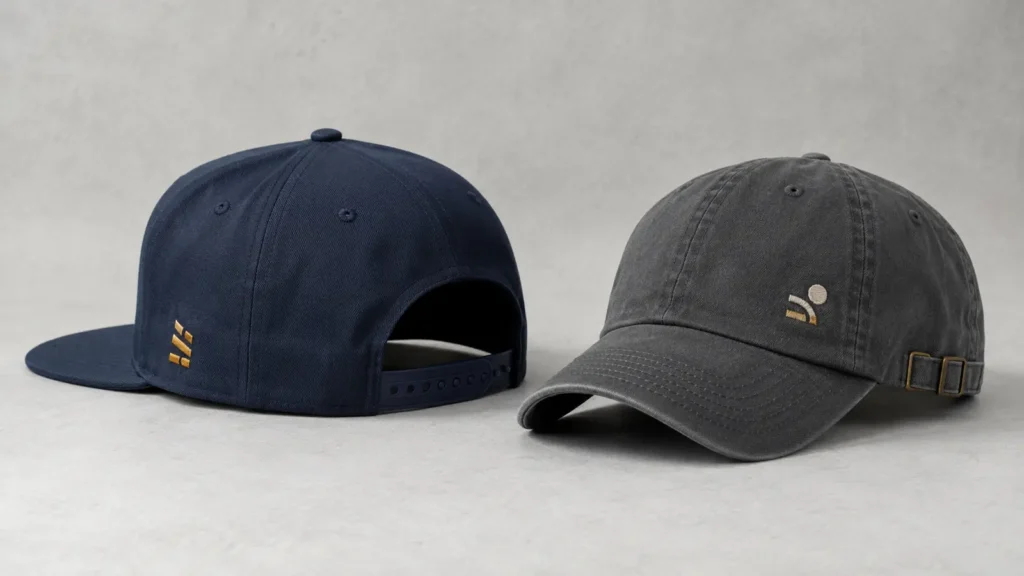
A snapback is generally an adjustable cap with a plastic snap closure, a more structured crown and a flat or moderately curved brim. A dad hat is generally an unstructured, low-profile cap with a pre-curved brim and an adjustable fabric strap, often paired with a metal buckle.
For custom orders, snapbacks are well suited to bold logos, sports-inspired graphics, streetwear collections and merchandise that needs a defined silhouette. Dad hats are well suited to understated embroidery, lifestyle brands, company merchandise, campus programs and casual uniforms. Buyers should confirm every feature in the specification because “snapback” and “dad hat” are market categories, not universal technical standards.
Snapback vs Dad Hat Comparison Table
| Decision factor | Snapback | Dad hat | Procurement implication |
|---|---|---|---|
| Crown | Commonly structured; mid or high profile | Commonly unstructured; low profile | Changes logo presentation, packing and overall silhouette |
| Front panels | Often supported to hold a firm shape | Usually soft and flexible | Dense or dimensional embroidery needs different testing |
| Brim | Commonly flat; can be pre-curved | Normally pre-curved | Confirm brim curve, length, rows of stitching and underside color |
| Closure | Adjustable plastic snaps | Fabric strap with buckle, slider or tuck-in | Hardware color and adjustment range must be approved |
| Visual character | Bold, graphic, athletic, streetwear | Relaxed, understated, heritage, casual | Match the shape to the brand and use case |
| Fit feel | More defined around the crown | Softer and closer to the head | Wear tests are more useful than relying on “one size” language |
| Common logo approach | Larger front embroidery, patches, side marks | Small front embroidery, text, tonal marks | Artwork may need separate digitizing for each style |
| Typical fabrics | Cotton twill, polyester, acrylic blends, wool-blend styles | Washed cotton twill, canvas, denim, corduroy, performance fabrics | Fabric weight and finishing affect color and hand feel |
| Packability | Needs more shape protection | More flexible, but brim still needs protection | Carton size and inner supports may differ |
| Best-known applications | Streetwear, sports merchandise, events, fanwear | Lifestyle retail, staff gear, campus, casual promotion | A mixed assortment may serve a wider audience |
Why This Choice Matters in a Bulk Custom Hat Program
At consumer level, a buyer may simply try on both hats. At B2B level, the decision is multiplied across dozens, hundreds or thousands of units. A small mismatch between product shape and customer expectation can lead to weak sell-through, inconsistent uniform appearance or repeat-order problems.
The decision affects at least five commercial areas:
- Brand expression. A firm, flat-brim silhouette makes a different statement from a soft, washed cap.
- Wearer acceptance. People who like close, low-profile caps may reject a tall structured crown, and the reverse is also true.
- Artwork execution. The same logo can look larger or more dimensional on a supported front panel than on soft washed fabric.
- Assortment planning. A retailer may use the styles for different customer segments, colors or price positions.
- Production control. Crown shape, brim curve, closure components, embroidery stability and wash effect require different approval points.
For this reason, “Use our logo on a cap” is not a complete sourcing brief. The style must be translated into measurable or visually approved specifications.
What Is a Snapback?
A snapback is defined most clearly by its adjustable snap closure: two interlocking plastic straps at the back. In modern apparel and sports merchandising, the term also commonly suggests a structured crown, prominent front panels and a flat brim. However, suppliers may offer curved-brim, low-profile or unstructured variations with the same closure.
Typical Snapback Construction
A custom snapback commonly includes:
- Five or six crown panels
- Supported front panels that maintain shape
- A mid-profile or high-profile crown
- Flat or slightly curved brim
- Plastic adjustable snap closure
- Embroidered eyelets
- Interior sweatband and seam taping
- Front, side and rear decoration positions
The supported front is useful when a brand wants a bold presentation. It provides a stable surface for flat embroidery, dimensional embroidery and many patch constructions. That stability does not remove the need for sampling: stitch density, backing, logo size and panel seams can still affect the result.
Common Snapback Use Cases
Snapbacks are often selected for streetwear capsules, team merchandise, music and event merchandise, fan collections, youth lifestyle programs, branded workwear and promotional retail. The silhouette reads clearly in product photography and can support a visible front logo.
Explore JIUMU’s custom snapback hats for product-specific customization options.
What Is a Dad Hat?
A dad hat is a relaxed baseball-style cap, usually with an unstructured crown, low profile and pre-curved brim. The back commonly uses a fabric strap with a buckle or slider. Washed cotton is strongly associated with the category, although unwashed twill, corduroy, denim, canvas and performance fabrics can also be used.
The name describes a casual aesthetic rather than a wearer’s age or gender. Dad hats are widely used in unisex lifestyle collections because the soft silhouette works with understated branding and everyday clothing.
Typical Dad Hat Construction
A custom dad hat commonly includes:
- Six-panel unstructured crown
- Soft front panels without firm internal support
- Low-profile fit
- Pre-curved brim
- Fabric strap with metal buckle, slider or tuck-in opening
- Cotton twill or washed fabric
- Embroidered eyelets
- Small or medium front decoration
Soft construction allows the crown to conform more closely to the wearer’s head. It also means the fabric can move during embroidery. Fine text, tiny gaps and dense fill areas must be digitized and tested for the selected material.
Common Dad Hat Use Cases
Dad hats are frequently chosen for lifestyle brands, hospitality teams, campus merchandise, creative agencies, company gifts, nonprofit programs, golf or leisure collections and understated promotional campaigns.
Explore JIUMU’s custom dad hats for relevant styles and branding methods.
Fit: How Do Snapbacks and Dad Hats Wear Differently?
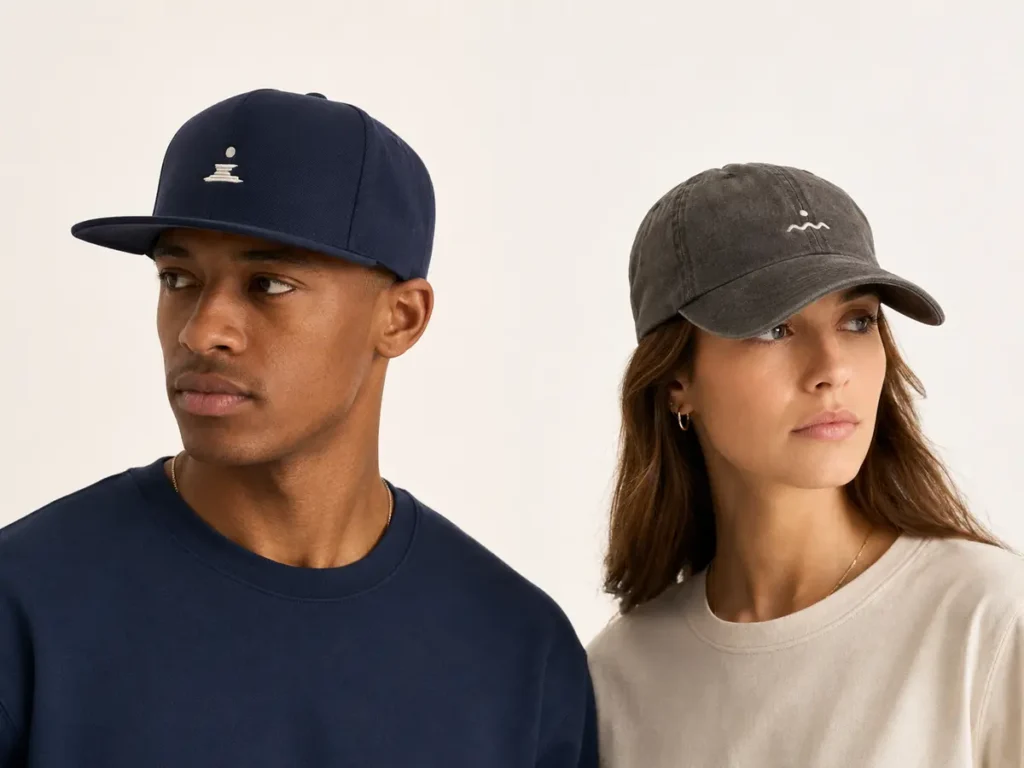
Both categories are usually adjustable, but “adjustable” does not mean they fit identically. The crown geometry, sweatband, opening, closure length and fabric flexibility all influence comfort.
Crown Height and Head Contact
A structured snapback tends to hold its own form. On the wearer, the crown may sit higher and create space above the head. This can suit buyers who prefer a defined cap shape or need a strong merchandising silhouette.
A dad hat tends to follow the head more closely. The soft front may show natural folds when not worn and become smoother on the wearer. For customers who prefer a low-profile fit, this can feel less prominent.
Adjustment Range
Plastic snaps provide visible incremental settings. Fabric straps usually slide through a buckle or metal closure and permit smaller adjustments. Neither closure should be described as fitting “everyone.” Buyers should request the proposed head-circumference range and evaluate samples on representative wearers.
For broad staff, event or retail programs, consider:
- Minimum and maximum comfortable circumference
- Depth from crown top to sweatband
- Rear opening shape and size
- Whether hair can pass through the opening comfortably
- Sweatband width and softness
- Pressure around the forehead and temples
- Fit with the closure near both ends of its range
One Size Does Not Remove the Need for a Fit Sample
“One size fits most” is a commercial description, not a precise guarantee. It is safer to approve the supplier’s actual measurements and conduct a wearer test. If the audience includes children, unusually small or large adult sizes, or uniform requirements, ask whether separate youth or extended-size patterns are available.
Structure: Crown, Panels, Brim and Closure
Structured vs Unstructured Front Panels
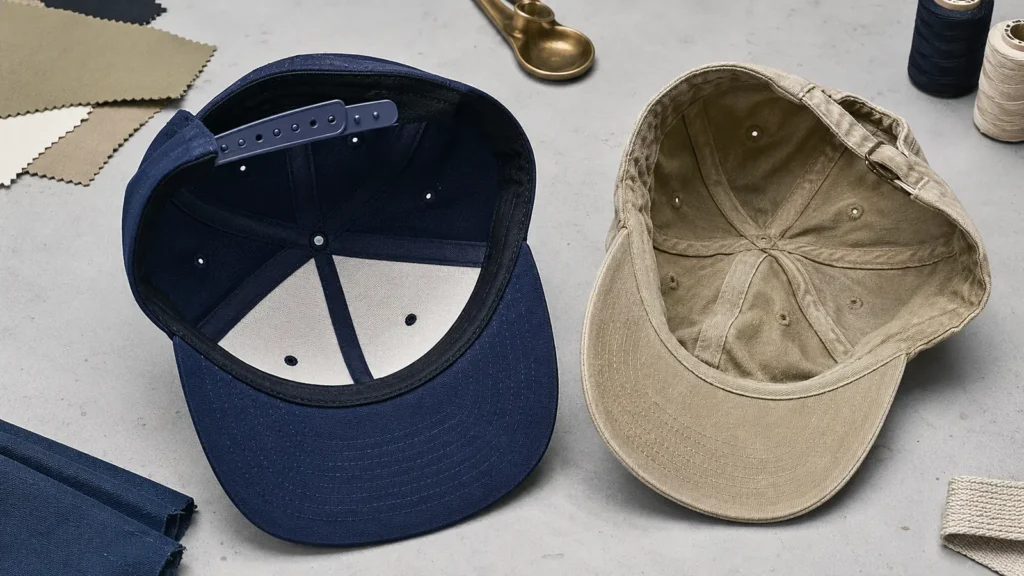
The core structural difference is usually the front support. A structured cap uses an internal layer to help the front panels stand upright. An unstructured cap relies mainly on the shell fabric and seams.
This affects:
- How the hat looks on a shelf or in ecommerce photography
- How much the crown changes when worn
- How easily the product can be packed
- How stable the fabric remains during embroidery
- How large or dense a logo can appear comfortably
For a snapback, buyers should approve front-panel firmness, crown height and whether the panel seam intersects the artwork. For a dad hat, buyers should approve softness, natural wrinkling and how the logo sits on the curved surface.
Five-Panel vs Six-Panel Options
The panel count is independent of the closure. Many classic snapbacks use six panels, while five-panel snapbacks can provide a broader uninterrupted front area. Dad hats are commonly six-panel, but other constructions exist.
A six-panel center seam can divide a logo. This is not automatically a problem, but small text or narrow vertical elements may be distorted. A five-panel front can simplify some artwork placements, although its shape and fit must still match the design brief.
Flat vs Curved Brim
Snapbacks are commonly associated with flat brims. Dad hats are strongly associated with pre-curved brims. A custom program may modify either style, so specify:
- Flat, lightly curved or strongly curved
- Brim length and width
- Number and spacing of top-stitch rows
- Shell color and underside color
- Sandwich or contrast edge, if used
- Printed or patterned underside, if required
Brim shape should be approved from front, side and three-quarter angles. A written phrase such as “slightly curved” can be interpreted differently by different teams.
Plastic Snap vs Fabric Strap
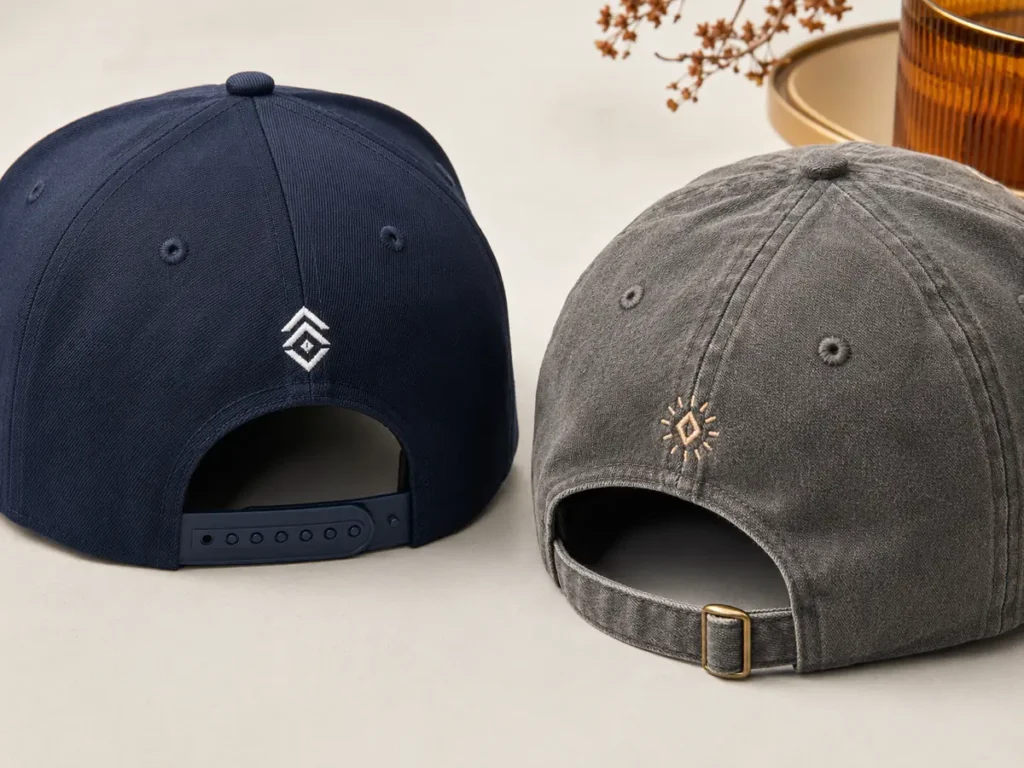
Plastic snaps are durable, easy to adjust and visually connected with athletic and streetwear styling. The snap color can match or contrast with the shell. Confirm the number of adjustment positions, plastic color, flexibility and attachment quality.
Fabric straps create a softer appearance. Hardware may be brass tone, silver tone, black or color coated. Confirm buckle finish, strap width, adjustment method, metal-edge smoothness and how excess strap is stored. For private-label programs, the strap or rear opening can also carry a small woven label or embroidery.
Style: Which Hat Better Matches the Brand?
The useful question is not “Which hat is more fashionable?” Trends change, and both forms remain established headwear categories. The better question is “Which shape supports the brand’s visual language and the customer’s wearing context?”
Choose a Snapback When the Program Needs:
- A defined, recognizable silhouette
- Strong sports or streetwear character
- A flat-brim option
- Large front artwork or a prominent patch
- Graphic ecommerce presentation
- A color-blocked or high-contrast design
- A familiar adjustable closure for fanwear or merchandise
Choose a Dad Hat When the Program Needs:
- A relaxed, approachable silhouette
- Subtle or small-scale branding
- A pre-curved brim
- Washed, vintage or tactile fabric character
- Casual employee or event wear
- Lifestyle merchandise that combines easily with everyday clothing
- A heritage or understated private-label direction
When Offering Both Is the Better Decision
A two-style assortment can serve different preferences without forcing one compromise design. A brand might use one color system and logo family across both, then vary scale and placement:
- Bold front patch on the snapback
- Small tonal embroidery on the dad hat
- Shared side mark or woven label
- Coordinated packaging and hangtags
This approach is useful for retailers, clubs, corporate merchandise programs and events with varied audiences. It adds sample and inventory complexity, so buyers should confirm whether the expected demand justifies separate stock keeping units.
Materials and Finishes
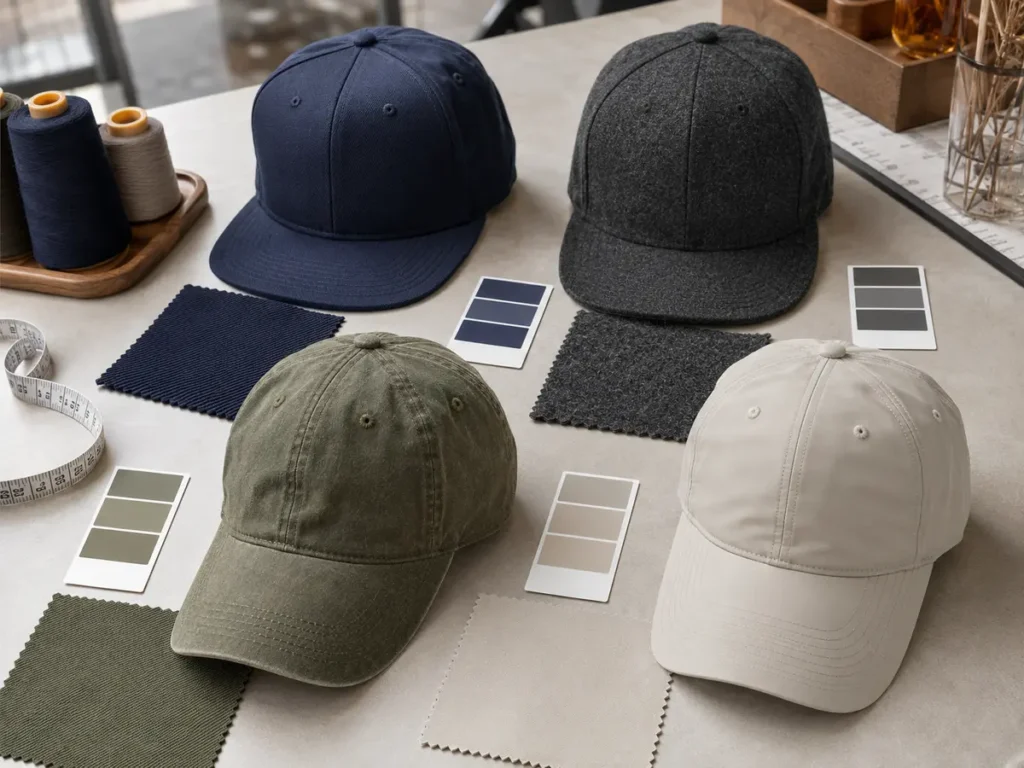
Material choice can reinforce or soften the style distinction.
| Material or finish | Snapback application | Dad hat application | Buyer checks |
|---|---|---|---|
| Cotton twill | Clean casual or team look | Classic soft cap | Weight, shrinkage allowance, color consistency |
| Polyester or acrylic blend | Stable color, athletic character | Lightweight casual or performance direction | Hand feel, breathability, pilling expectation |
| Wool-blend style | Heritage sports or streetwear | Less common but possible | Fiber composition, seasonal use, care label |
| Washed cotton | Softens a snapback concept | Signature vintage dad-hat effect | Wash variation, fading, panel distortion |
| Canvas | Firm workwear or outdoor look | Textured casual profile | Stiffness, seam bulk, embroidery behavior |
| Corduroy | Fashion and seasonal capsules | Relaxed heritage collections | Wale direction, pile crushing, logo legibility |
| Denim | Streetwear statement | Casual lifestyle product | Dye transfer risk, wash consistency, stitching contrast |
| Performance fabric | Sport or outdoor merchandise | Lightweight team or leisure cap | Moisture handling claims must be supported and specified |
Washed Effects Require Range Approval
Garment washing can create deliberate variation. Buyers should not approve only one attractive sample and assume every bulk unit will be visually identical. Ask the supplier to define the acceptable light-to-dark range, crease character and abrasion effect. Review preproduction or bulk reference samples where appropriate.
Color Matching Depends on the Substrate
A Pantone reference is a starting point, not a promise that every fabric, plastic snap, thread and metal finish will appear identical. Different materials reflect light differently. Approve the combination as a set: shell, mesh if any, brim, underside, closure, embroidery thread, patch border, label and packaging.
Customization: Logo Methods and Private Label Options
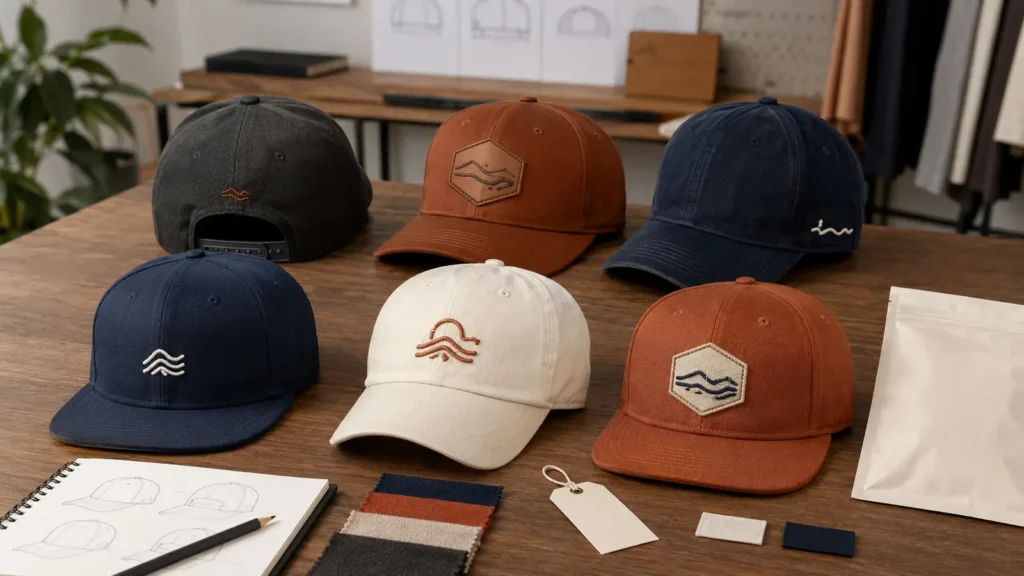
Flat Embroidery
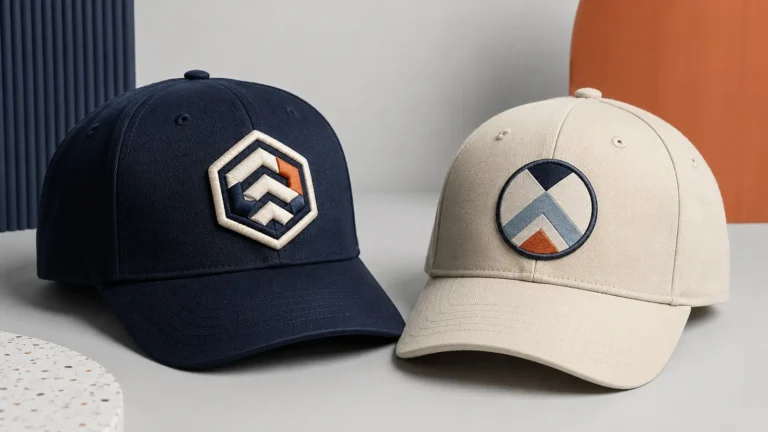
Flat embroidery works on both styles and is appropriate for text, icons and moderately detailed logos. The cap structure changes how the result appears. A supported snapback front may carry a larger design. A soft dad-hat front often performs best with a controlled size and stitch density.
Dimensional Embroidery
Raised embroidery can create a strong front mark, especially on structured caps. It is not suitable for every artwork element. Fine details, small text and narrow lines may need flat stitching while selected areas receive dimension. Approve the height, edge clarity and combination of techniques in the physical sample.
Woven and Embroidered Patches
Woven patches can reproduce finer lines than many direct-embroidery applications. Embroidered patches provide a textured, classic finish. Patch size, border, backing, placement and attachment method should be confirmed. A rigid patch on a very soft crown may change the way the panel drapes.
Leather-Style and Rubber/PVC Patches
Leather-style patches support outdoor, workwear and heritage themes. Rubber/PVC patches can support bold modern branding and weather-oriented aesthetics, but any performance or weather-resistance claim must be based on the actual material and test requirement.
Printing and Heat Transfer
Printing or heat transfer may suit gradients, fine details or lightweight designs when compatible with the fabric. Confirm edge feel, stretch behavior, color opacity and expected care conditions. A sample is essential because curved panels and washed finishes can alter adhesion or appearance.
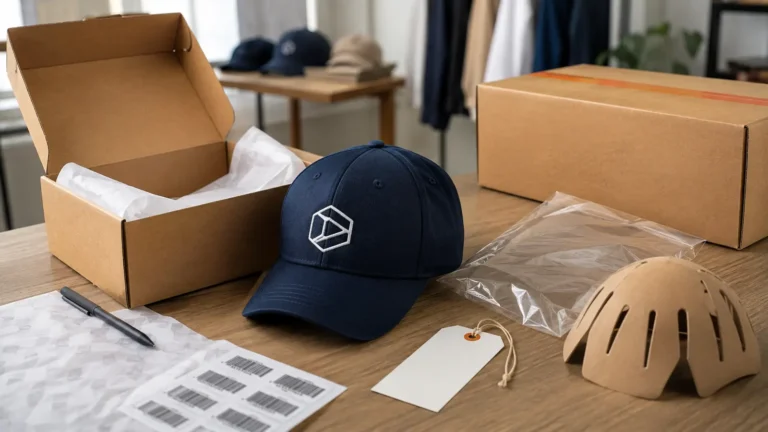
Secondary Branding and Packaging
Private-label value often comes from consistent details rather than one large logo. Options may include:
- Side and rear embroidery
- Woven labels at the closure or interior
- Branded seam tape
- Custom sweatband print where technically suitable
- Hangtags
- Size or care labels
- Individual bags, cartons and assortment labels
JIUMU supports embroidery, patches, fabric sourcing, Pantone color matching, private labels, hangtags and packaging customization. The final combination remains subject to the chosen cap construction and approved sample.
Send JIUMU a reference image or tech pack, vector logo, required quantity, target colors, preferred cap shape, decoration method, packaging requirements and target delivery date. Request separate mockups for the snapback and dad-hat versions so logo scale and placement can be evaluated correctly. Request a custom quotation.
Cost Drivers in Custom Snapback and Dad-Hat Orders
Pricing cannot be determined by style name alone. Two caps that look similar online may have different material, construction and decoration requirements.
Important cost drivers include:
- Order quantity and number of colorways
- Number of separate cap styles
- Fabric type, weight and finishing
- Custom dyeing or stock color selection
- Crown structure and panel construction
- Brim construction and contrast details
- Closure type and custom hardware
- Logo method, size, stitch count and number of positions
- Patch tooling or molds where applicable
- Interior labels, hangtags and packaging
- Sampling rounds
- Inspection requirements
- Shipping method, carton volume and destination
Splitting one total quantity across many colors, logos and closures may increase unit cost because each variation creates setup and handling work. Ask for a quotation that separates product, decoration, packaging and logistics assumptions.
Sample Approval and Quality Control
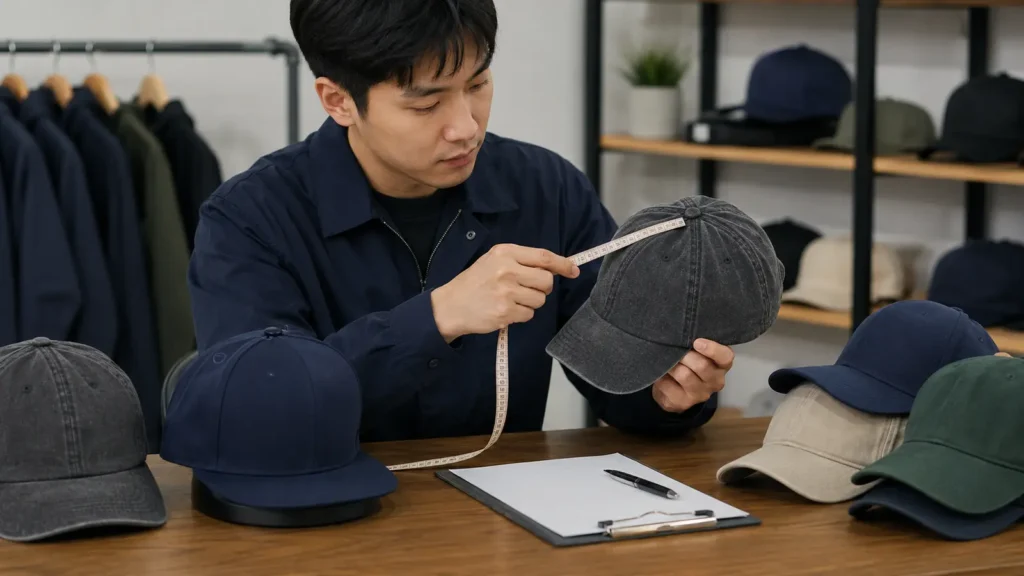
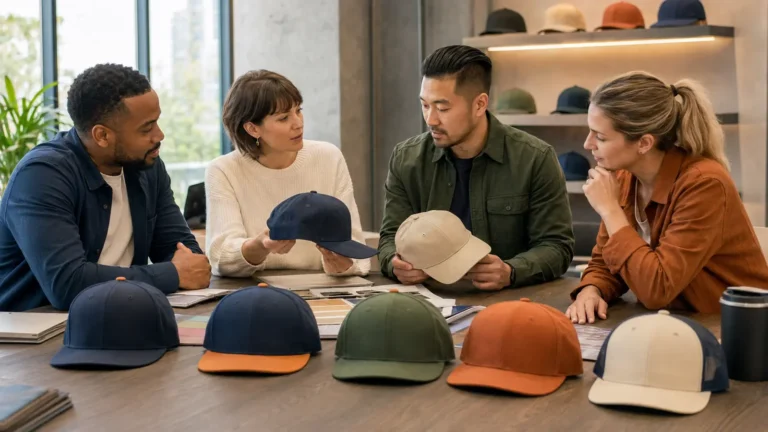
Digital mockups are useful for confirming layout, but they cannot prove fit, hand feel, brim curve, embroidery tension or wash character. A physical sample should be the primary approval reference for a custom bulk program.
Sample Approval Checklist
| Checkpoint | What to approve |
|---|---|
| Overall style | Correct snapback or dad-hat silhouette |
| Fit | Circumference range, crown depth, rear opening and comfort |
| Crown | Profile, firmness, symmetry and panel alignment |
| Brim | Curve, length, width, stitching and underside |
| Fabric | Composition, weight, color, texture and wash effect |
| Closure | Type, color, hardware, adjustment and attachment |
| Artwork | Size, position, thread or patch color and legibility |
| Sewing | Seam consistency, eyelets, sweatband and loose threads |
| Labels | Content, position, orientation and attachment |
| Packaging | Folding, inner support, bag, carton and assortment |
Bulk Inspection Priorities
For snapbacks, check that the crown remains symmetrical, front panels are not crushed, the flat or curved brim matches the reference, and plastic snaps connect securely.
For dad hats, check wash consistency within the approved range, brim curvature, buckle or slider finish, soft-crown behavior and embroidery puckering.
For both, inspect logo placement, color consistency, skipped stitches, seam alignment, sharp hardware edges, stains, packaging and carton protection.
What to Send a Supplier for an Accurate Quotation
A concise technical brief reduces assumptions and makes quotations easier to compare. Send:
- Style: snapback, dad hat or both.
- Reference: clear front, side, rear and interior images, or a tech pack.
- Quantity: total units and quantity per style and color.
- Audience: adult, youth or a defined size range.
- Crown: panel count, structured or unstructured, and profile.
- Brim: flat or curved, dimensions if controlled, and underside details.
- Material: composition, weight or reference swatch.
- Colors: shell, brim, closure, thread, patch and trim references.
- Closure: plastic snap, buckle strap, slider or other specified option.
- Artwork: vector file, finished dimensions, positions and technique.
- Branding: labels, hangtags, seam tape and packaging.
- Compliance needs: destination-market labeling or documented testing requirements.
- Timing: sample deadline, launch date and delivery destination.
If a detail is undecided, say so and request options. Do not let an undefined item become an invisible assumption.
Questions to Ask a Custom Hat Supplier
- Is the proposed crown structured or unstructured, and what is the finished profile?
- What head-circumference range does the sample fit comfortably?
- Is the quoted fabric a stock material or custom-developed option?
- How will washed-color variation be controlled?
- Will the same logo require different digitizing for snapbacks and dad hats?
- Does the center seam pass through the artwork?
- What closure colors and hardware finishes are available?
- Which physical sample becomes the approved production reference?
- How are crown shape and brim curve protected during packing?
- How are bulk color, embroidery and measurements inspected?
- Which labels and packaging details are included in the price?
- What information could change the MOQ, price or production schedule?
- How will repeat orders reference the approved fabric, color and construction?
Common Buying Mistakes
Treating Style Names as Specifications
“Snapback” does not confirm crown height, panel count, brim shape or fabric. “Dad hat” does not confirm wash, buckle finish or depth. Convert the name into an approved spec.
Reusing One Artwork File Without Adaptation
A logo digitized for a firm front panel may pucker or feel too dense on a soft dad hat. Approve separate embroidery settings where needed.
Approving Color Only on a Screen
Screens, fabrics, plastic snaps, threads and metal finishes reproduce color differently. Use physical references and approve the complete color combination.
Ignoring the Rear View
The closure strongly influences both function and brand perception. Rear embroidery, strap storage, buckle finish and opening shape deserve the same attention as the front.
Ordering Too Many Variations Too Early
Multiple styles, colors and logos can dilute the order quantity and complicate quality control. Start with a focused assortment when demand is uncertain.
Skipping Wear and Pack Tests
A cap can look correct on a table but feel too shallow or too tall. It can also arrive misshapen if packaging is not appropriate. Test both wearing and packing before scaling.
A Practical Decision Framework
Use this sequence to make the choice:
- Define the intended wearer and use case.
- Select the desired brand character: bold and structured or relaxed and understated.
- Choose the crown profile before finalizing logo scale.
- Confirm brim shape and closure type.
- Select fabric and finish based on appearance, comfort and care needs.
- Adapt the artwork to the cap construction.
- Review digital mockups.
- Approve a physical sample through fit, wear and packing checks.
- Define bulk tolerances and inspection points.
- Retain the approved specification for repeat orders.
Why Work With JIUMU on Custom Hat Programs?
Established in 2010 in Guangdong, China, JIUMU supplies custom hats, teamwear, uniforms, bags and branded merchandise for professional buyers in North America and Europe. The company supports OEM and ODM development, logo embroidery, patches, fabric sourcing, Pantone color matching, digital mockups, physical samples, private labels, hangtags, packaging customization, bulk production, quality control and export support.
The typical MOQ is 50 pieces, subject to the product structure and customization. That qualification matters: quantity, fabric, color count, decoration, labels and packaging can change what is practical.
For a snapback vs dad-hat program, JIUMU can help translate a visual concept into separate specifications and samples, then coordinate branding details across both shapes. Buyers can also review the broader custom hats collection or learn more about JIUMU.
Frequently Asked Questions
Final Recommendation
Choose a snapback when the project needs a structured silhouette, prominent front branding and a sports or streetwear direction. Choose a dad hat when it needs a soft low-profile fit, curved brim and understated lifestyle character. Choose both when the audience is broad enough to justify a coordinated two-style assortment.
The most important step is to stop treating either category name as a complete specification. Define the crown, panels, brim, fabric, closure, fit range, logo method, labels and packaging. Then approve the result on a physical sample before bulk production.
About JIUMU
JIUMU is a Guangdong-based B2B supplier of custom hats, teamwear, logo apparel, bags and branded merchandise, established in 2010. Contact: zhengdong@jiumugear.com · +86 18507502899.