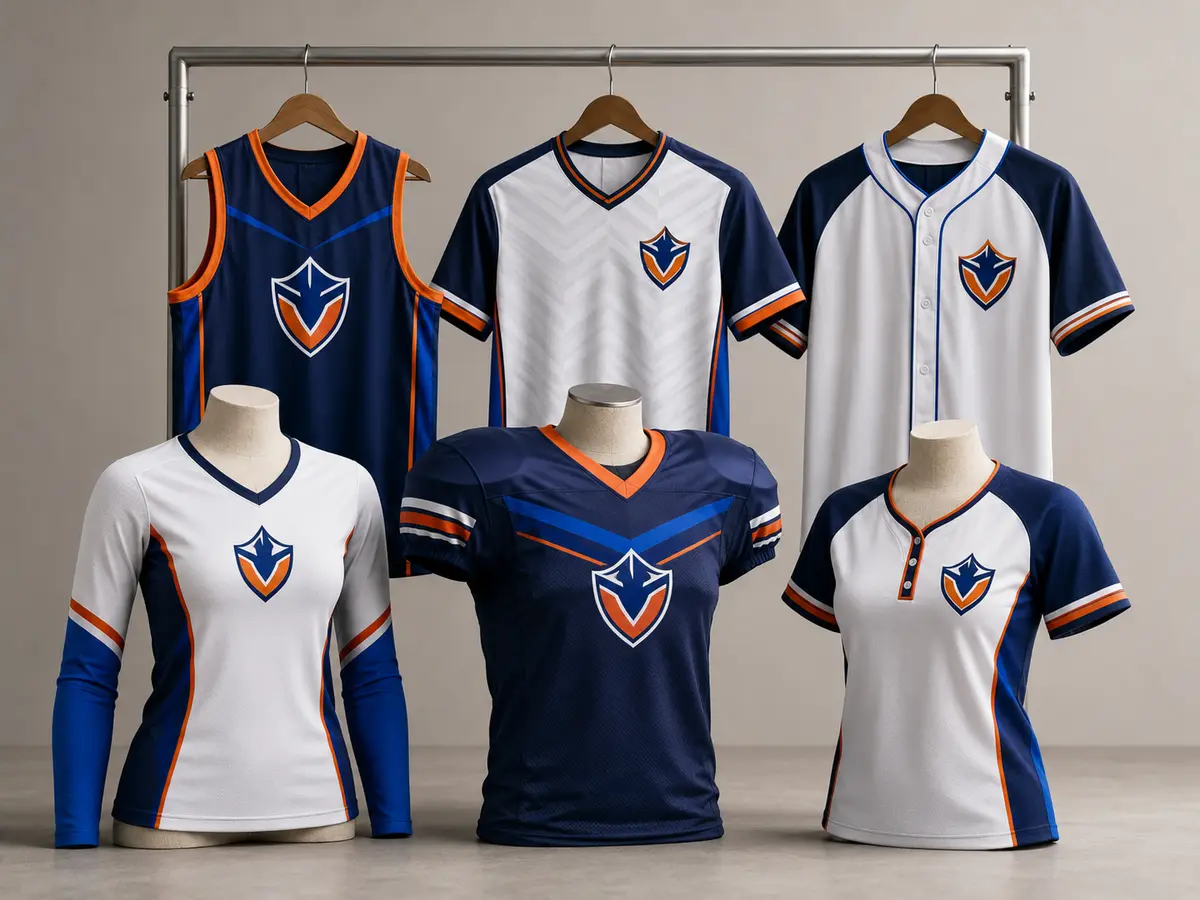
Best Custom High School Team Jerseys
High school jerseys must suit a specific sport, fit a changing student roster, display numbers clearly, tolerate repeated use and remain consistent when replacements are needed. Buyers may also need to coordinate colors across varsity, junior varsity, freshman teams and several sports.
That is why the “best” custom high school team jerseys are not one universal product. They are the jerseys that match the school’s competition rules, performance needs, budget, identity and repeat-order plan. Athletic directors, coaches, school districts, uniform dealers and booster organizations should compare measurable specifications rather than choosing from mockups alone.
This guide explains the key decisions: jersey type, fabric, fit, construction, decoration, rule review, cost drivers, sampling and quality control. It also provides a practical quotation brief for buyers sourcing a complete school program.
Quick Answer: The best custom high school team jerseys use a sport-appropriate fabric and cut, readable numbers, reinforced construction in stress areas, an approved school color system, and a documented size and player roster. Before production, approve a physical sample or a fully detailed pre-production sample, confirm the current rules for the sport and governing association, and save the final color, artwork, size and construction specifications for future reorders.
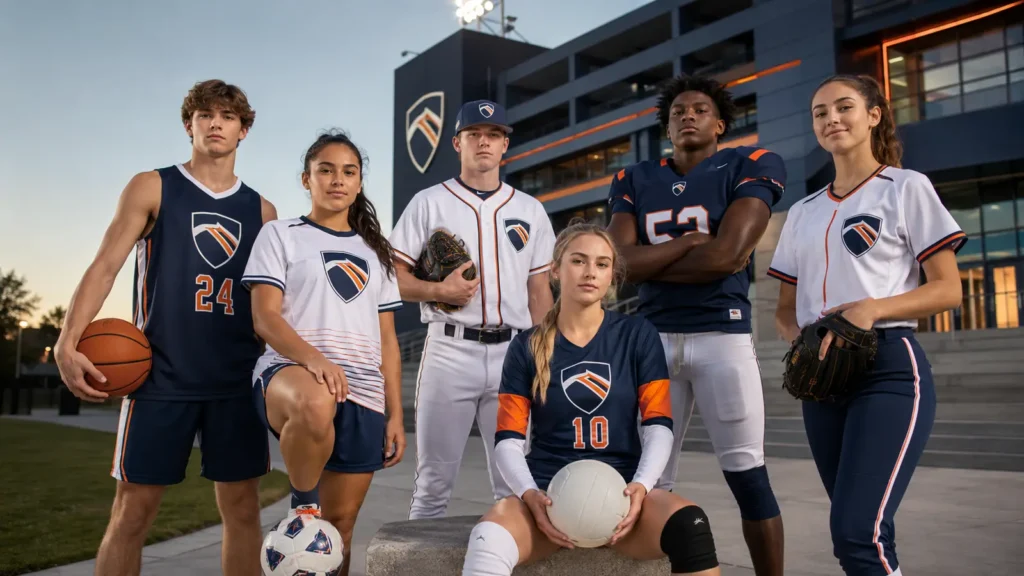
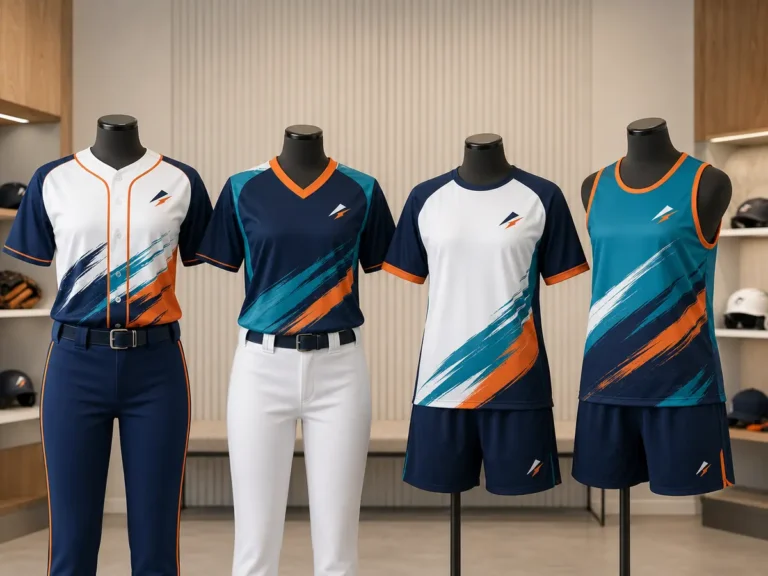
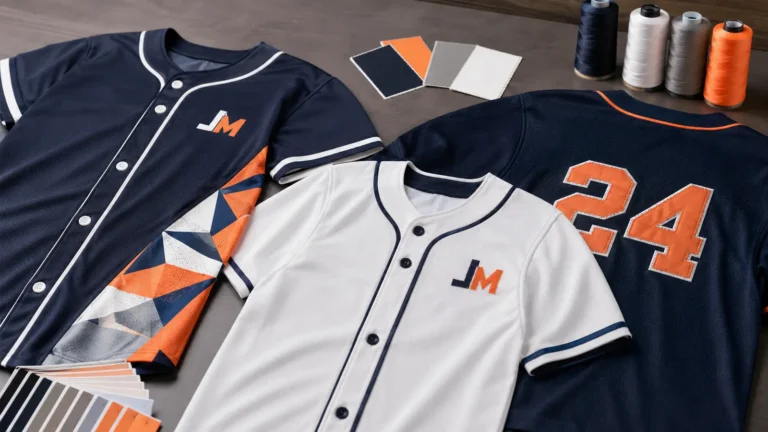
A coordinated jersey program can give different school sports one recognizable visual identity while preserving sport-specific construction.
Preparing a High School Jersey Program Quote
Provide each sport, governing rules, team level, jersey and matching garment list, school color references, logo files, player names and numbers, size breakdown, quantity, delivery destination, and season deadline. Approve representative sizes and preserve the final artwork, color, roster, and fabric specifications for replacements and future seasons.
Explore custom team jerseys and custom school team uniforms, then request a school jersey quotation with your roster and artwork.
What “Best” Means for a School Jersey Program
For a professional buyer, “best” should translate into purchasing criteria. A visually impressive design can still be a poor order if the jersey is too heavy, the player names crack after laundering, the number layout violates a competition rule, or the supplier cannot reproduce the same navy color next season.
Evaluate the product on six dimensions:
- Sport suitability: The fabric, sleeve, neckline, body length and stretch must work for the movements and equipment of the sport.
- Rule suitability: Number size, color contrast, logo placement, trim and home/away colors must follow the current rules adopted by the relevant association.
- Fit coverage: The size range and pattern should cover the actual student roster, including different body shapes and equipment requirements.
- Durability: Seams, hems, decoration and color must tolerate the expected practice, game and laundering schedule.
- Identity control: School colors, logos, fonts and numbering should be documented and repeatable across teams and seasons.
- Order control: The supplier should have a clear process for mockups, samples, roster verification, inspection, packaging and replacements.
Fast Decision Table
| Buyer priority | Specification to request | Evidence to review before bulk production |
|---|---|---|
| Lightweight performance | Fabric composition, knit type and weight in GSM | Physical fabric swatch and sample jersey |
| Breathability | Mesh structure or ventilation zones | Close-up swatch, sample and wear evaluation |
| Number visibility | Number height, stroke, color and contrast | Front-and-back artwork at production scale |
| Durable decoration | Decoration method and wash-care instructions | Decorated sample after a controlled wash test |
| Consistent school colors | Pantone reference plus approved fabric color | Lab dip, printed strike-off or production swatch |
| Reliable sizing | Finished-garment measurement chart | Size-set sample or representative core sizes |
| Easy team distribution | Individual player identification and packing plan | Approved roster and packing-label example |
| Future reorders | Saved style code, artwork, color and measurement records | Written reorder specification and revision number |
Choose the Jersey by Sport, Not by Appearance Alone
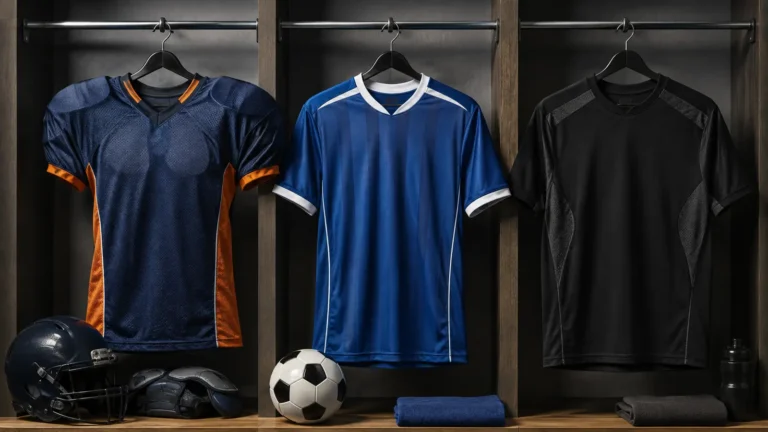
High school programs commonly need different jersey constructions under one school identity. The same colors and crest can be used throughout the athletics department, but a basketball jersey cannot simply be adapted into a football top by adding sleeves.
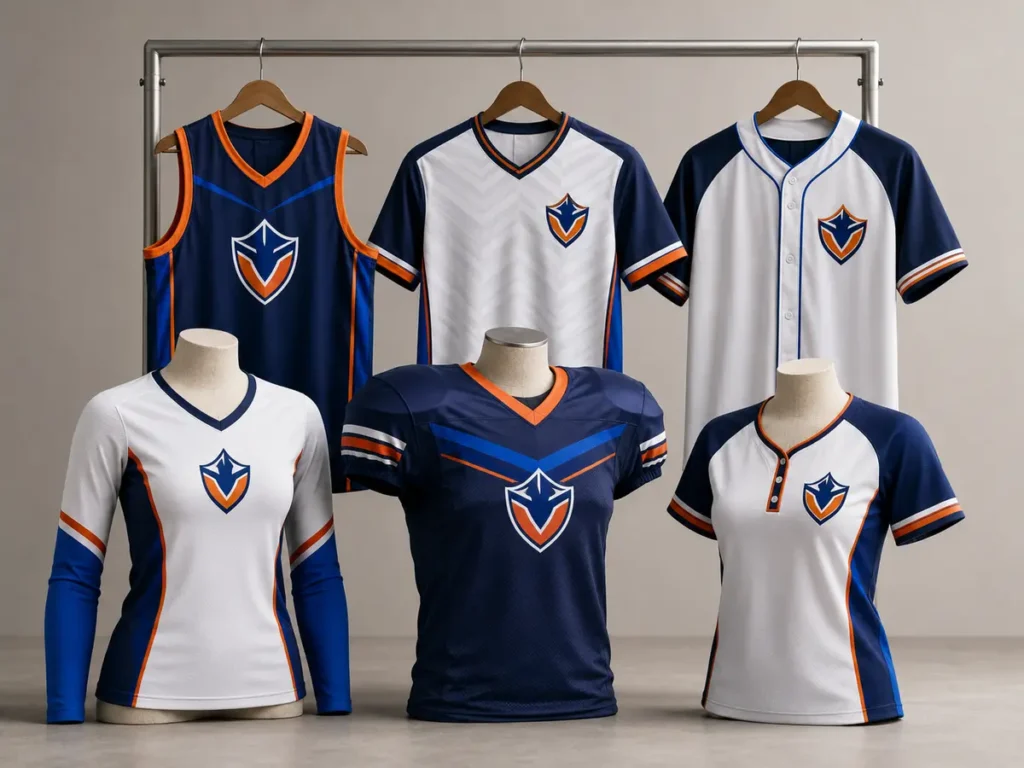
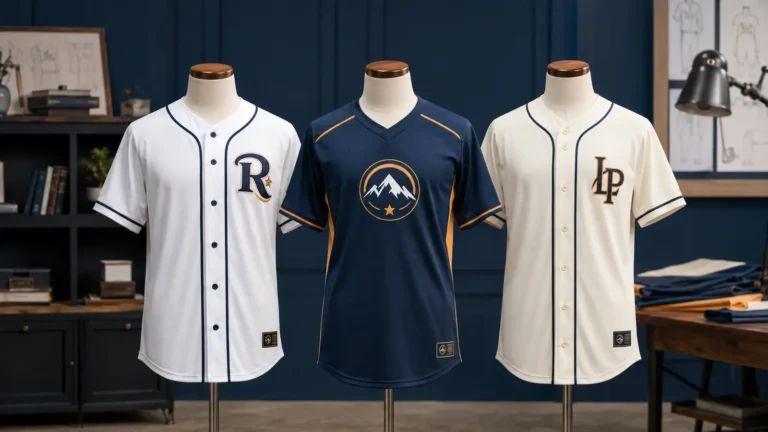
Sport-specific silhouettes can share colors and branding without sharing the same pattern or fabric.
Basketball Jerseys
Basketball jerseys normally need low-bulk arm openings, enough body length to stay secure during movement, and a fabric that manages heat in an indoor court environment. Reversible practice jerseys can be useful, but a game jersey should be designed around the association’s current requirements for torso color, numbers, trim and identifying marks.
The official NFHS basketball uniform guide illustrates how detailed these requirements can be, including torso color, number placement, legal number combinations and logo areas. Buyers should treat that guide as a design checkpoint, then confirm the current season’s rules with their state association before approving artwork. See the NFHS basketball uniform guidance.
Soccer Jerseys
Soccer jerseys typically use lightweight knit fabrics, short or long sleeves, and good underarm mobility. Goalkeeper jerseys require a distinct color plan, while field-player numbers must be legible from a distance. The NFHS soccer uniform guidance includes number and color requirements and is a useful reference for U.S. high school buyers.
Plan home, away and goalkeeper combinations together. A fashionable gradient or busy camouflage pattern may reduce number contrast, creating a design problem even if the artwork looks attractive on a screen.
Baseball and Softball Jerseys
Baseball and softball programs may choose button-front, two-button, V-neck or pullover styles. The buyer should define sleeve length, placket construction, shirt-tail length, piping, player-name format and whether the jersey will be tucked. Baseball and softball patterns may look similar, but do not assume that one unisex block will fit every roster well.
For a complete baseball program, coordinate jerseys with pants, caps, socks and belts. Buyers can also review custom baseball team uniform packages when planning a multi-item order.
Football Jerseys
Football jerseys must fit over protective equipment. The pattern needs sufficient chest, shoulder and armhole volume without leaving excess fabric that can be grabbed. Stretch panels, reinforced shoulders and sleeve construction should be evaluated on a player wearing the intended pads.
Color zones and number contrast are also rule-sensitive. NFHS provides a football jersey and pant rules resource. Because uniform rules can change by season, state and level, send the final scaled artwork to the school’s compliance contact before bulk production.
Volleyball Jerseys
Volleyball jerseys need shoulder mobility, a secure fit and a color system that accommodates the libero top. Too many colors or a low-contrast graphic can make it difficult to create a clearly contrasting libero jersey. NFHS publishes current volleyball rules resources and has emphasized jersey color planning in its volleyball points of emphasis.
Confirm Competition Rules Before Final Artwork
Uniform compliance is not a decorative afterthought. It affects torso colors, number dimensions, contrast, legal numbers, manufacturer marks, school logos, memorial patches, side inserts and home/away designation. The precise requirements differ by sport and may differ by the governing body or state association.
A safe workflow is:
- Identify the governing association and season.
- Obtain the current uniform rule document for that sport.
- Convert the relevant rules into an artwork checklist.
- Review the front, back, sleeves, neckline and side panels at production scale.
- Ask the authorized school or association contact to approve the design.
- Freeze the approved artwork before sampling and bulk production.
Do not rely on a previous season’s jersey or a generic supplier template as proof of compliance. A supplier can help translate a rule into production artwork, but the buyer should confirm what applies to the school.
Select Fabric by Performance, Hand Feel and Care
Most custom team jerseys use polyester-based performance knits because they can be lightweight, colorfast and suitable for several decoration methods. However, “100% polyester” does not describe how the fabric will feel or perform. Knit structure, yarn, finish, thickness and stretch all matter.
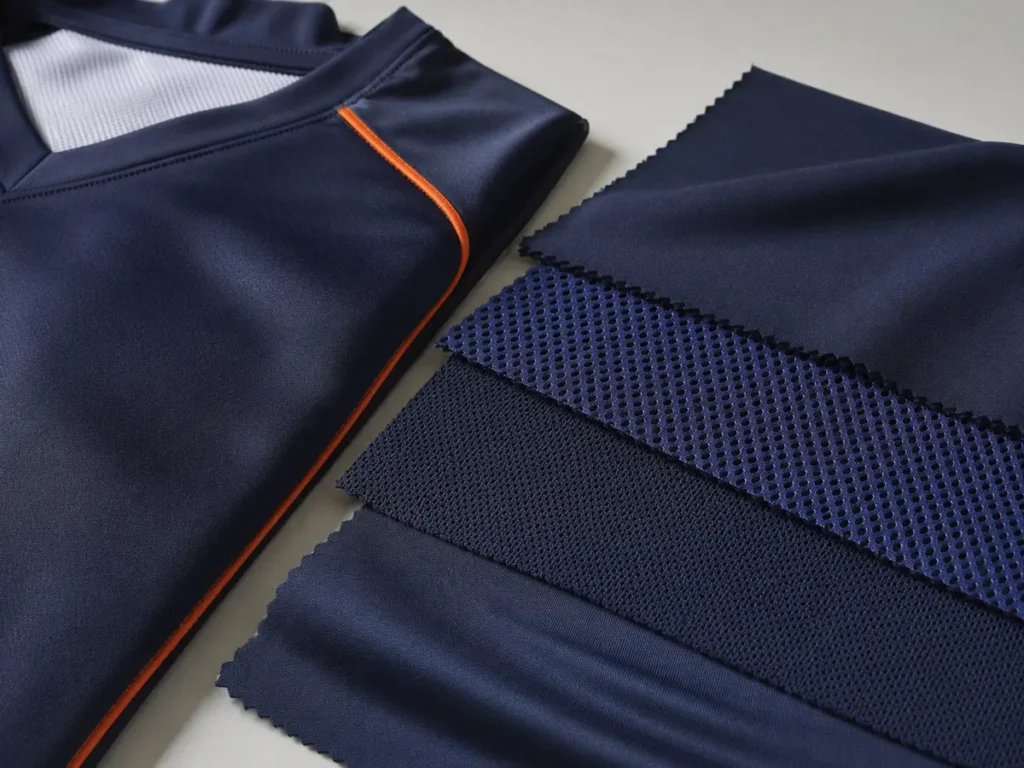
Fabric composition is only the starting point; knit structure and weight affect opacity, airflow, drape and decoration.
| Fabric option | Useful characteristics | Common school applications | Questions for the supplier |
|---|---|---|---|
| Polyester interlock | Smooth face, stable print surface, moderate structure | Soccer, basketball, volleyball, baseball | What is the GSM, opacity and snag resistance? |
| Birdseye knit | Small textured openings, athletic appearance | Basketball, soccer, practice tops | Is it used for the full body or ventilation panels? |
| Athletic mesh | High airflow, visible open structure | Football, hockey, reversible practice jerseys | Is a liner needed for opacity or comfort? |
| Polyester-spandex blend | Greater stretch and recovery | Fitted volleyball panels, football inserts | What are the stretch direction and recovery target? |
| Double knit | More body and abrasion tolerance | Baseball and structured team jerseys | Will the added weight suit the climate and season? |
Request These Fabric Details
Ask for fiber composition, knit type, weight in grams per square meter, usable width, stretch direction, color method and recommended care. If opacity matters, evaluate both light and dark colors under bright light. If the jersey will be sublimated, confirm that the fabric and panel construction are suitable for heat processing.
Do not accept unsupported descriptions such as “professional fabric” or “premium mesh” without a swatch or measurable specification. A 150 GSM interlock and a 200 GSM double knit can both be polyester, yet produce very different jerseys.
Include Correct Label Information
Buyers importing apparel should confirm destination-market labeling requirements. In the United States, the FTC says most textile products require fiber content, country of origin and responsible-business identification, while garment care instructions fall under the Care Labeling Rule. Review its apparel labeling guidance and Care Labeling Rule guide. In the EU, see the official textile label guidance. These are starting points, not legal advice.
Build a Size System Around the Actual Roster
High school athletes may span youth and adult sizes, and players in the same nominal size can prefer different fits. Football and hockey add protective equipment, while basketball and soccer require easier movement without excessive fabric. A reliable order starts with finished-garment measurements, not size labels alone.
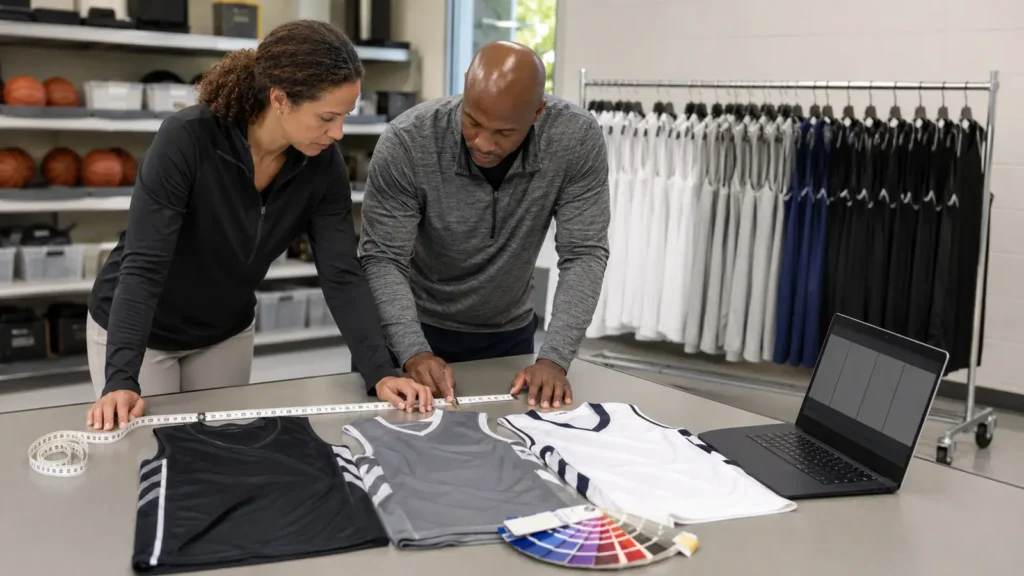
Measure sample garments and connect every player entry to the approved size chart before production.
Ask for a measurement chart that identifies:
- chest width measured flat;
- body length from the designated shoulder point;
- shoulder width where relevant;
- sleeve length and opening;
- bottom opening;
- tolerance for each measurement;
- whether measurements are garment dimensions or body dimensions;
- whether the style is youth, men’s, women’s or unisex;
- how football or hockey sizing accounts for pads.
Use Samples to Control Fit Risk
For a mixed roster, a size set is more reliable than asking players to select their usual retail size. If a full size run is impractical, review at least the smallest, middle and largest high-volume sizes. Test the intended uniform system: jersey with pads, jersey tucked into pants, or jersey layered over an undershirt.
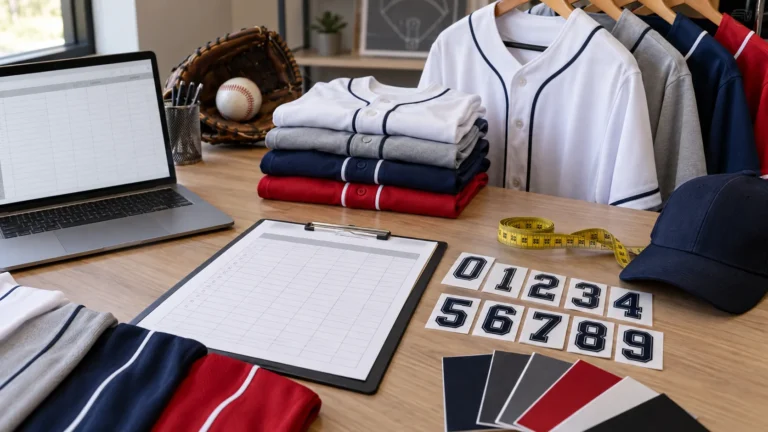
Create one locked roster with player name, displayed name, number, size, quantity, team level and special notes. Assign one person to approve that roster. Multiple email versions and handwritten changes are a common cause of duplicate numbers and spelling errors.
Allow spare blank or numbered jerseys when the program expects late enrollment, replacement needs or playoff roster changes. The correct spare strategy depends on the sport’s numbering rules and the school’s budget.
Compare Construction, Not Just Fabric
Two jerseys made from the same fabric can have very different service lives. Construction decisions determine how the garment handles pulling, repeated movement and laundering.
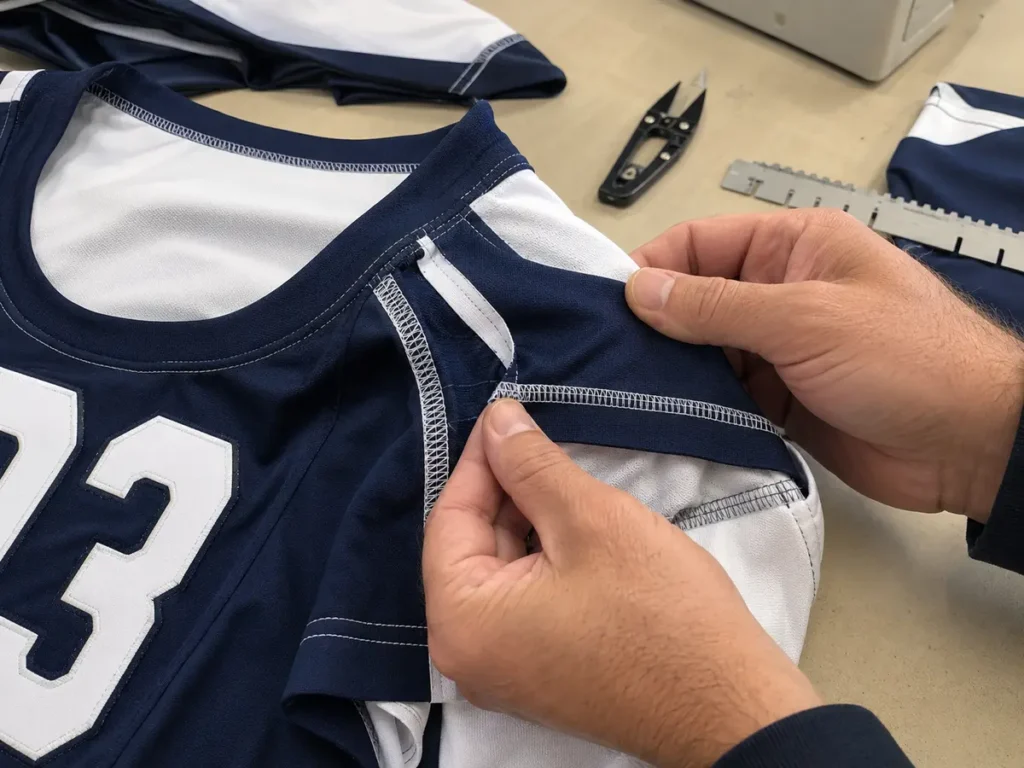
Seam type, reinforcement and clean decoration edges are visible quality indicators on a physical sample.
Review these areas:
- shoulder and side seams for balanced stitching and reinforcement;
- underarm joins for puckering or bulky seam intersections;
- neckline and armhole binding for even width and stretch recovery;
- plackets and buttons for alignment on baseball styles;
- hems for skipped stitches or twisting;
- mesh joins for secure stitching without tearing the open fabric;
- numbers and logos for clean edges, correct position and strong adhesion or stitching;
- label placement for comfort and compliance;
- left-to-right symmetry and consistent panel matching.
The strongest construction is not automatically the heaviest. A lightweight soccer jersey can be durable when the fabric, seam type and decoration are compatible. Conversely, a thick fabric with weak seams or poorly bonded transfers may fail early.
Choose a Decoration Method That Matches the Design
Decoration affects appearance, weight, flexibility, price, care and reorder consistency. It should be chosen after the design and use case are clear.
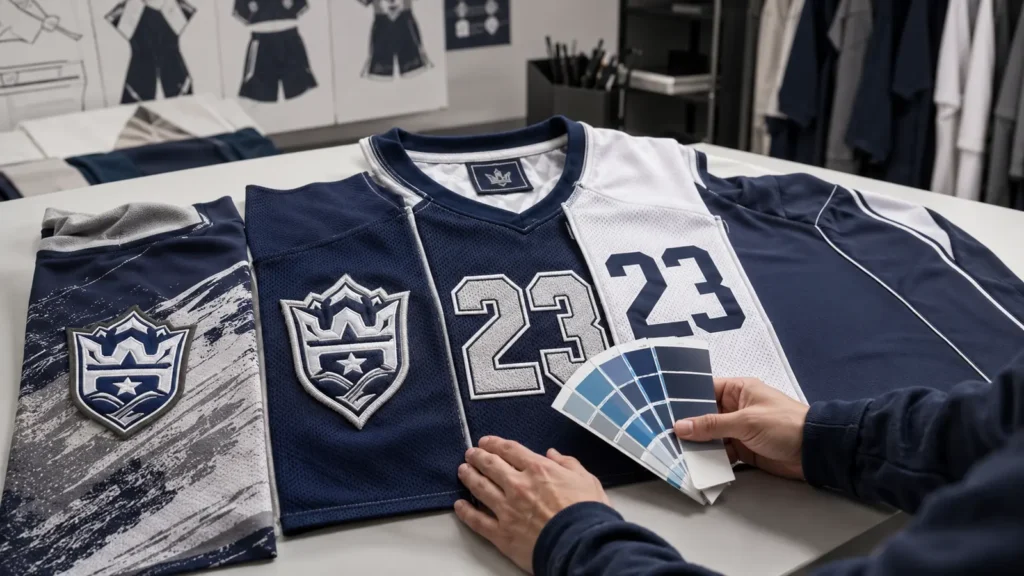
Different decoration methods create different texture, weight and design limits.
| Method | Best suited to | Main advantage | Buyer checkpoint |
|---|---|---|---|
| Dye sublimation | Polyester jerseys with full-color graphics | Artwork becomes part of the printed fabric surface | Approve a strike-off and check color on the actual fabric |
| Embroidery | Small crests, chest marks and selected details | Dimensional thread appearance | Check density, backing, weight and comfort |
| Tackle twill / appliqué | Traditional numbers and lettering | Structured layered look | Check edge stitching, layer thickness and flexibility |
| Heat transfer | Names, numbers and smaller runs | Clean surface and flexible personalization | Approve film type, application and care method |
| Screen printing | Suitable flat graphics and quantities | Efficient for defined-color artwork | Confirm ink, opacity, hand feel and curing |
| Woven or rubber/PVC patch | Branded badges and accent marks | Distinct material identity | Confirm size, edge method and attachment |
Sublimation is often suitable for gradients, repeated patterns and integrated names and numbers. Embroidery and tackle twill create a more dimensional appearance but add weight and cost. Heat transfer can support personalization, but the material and application process should be compatible with the fabric and laundering plan.
Ask the supplier to explain why a method is recommended for the specific jersey, not merely list every available technique.
Create One School Identity Across Multiple Teams
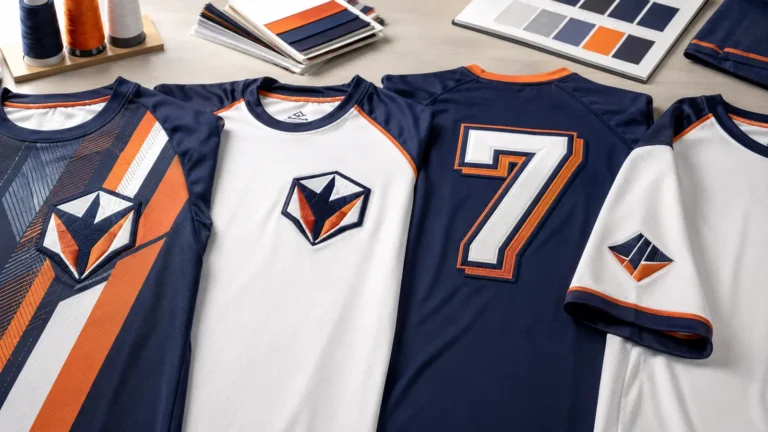
A district-wide or school-wide uniform program benefits from controlled design assets. Prepare a brand kit containing vector logos, approved crest variations, school colors, font or number style, minimum clear space and rules for mascot use. Then define which elements may change by sport.
A practical hierarchy is:
- Fixed: primary school colors, official crest, approved school name, core number style.
- Sport-specific: garment silhouette, fabric, trim width, number dimensions and permitted logo positions.
- Team-specific: varsity/JV identifier, player name, year, captain mark or approved commemorative patch.
- Order-specific: roster, sizes, quantities, packaging and delivery destination.
This prevents a soccer team’s navy from drifting toward purple while the basketball team receives a different navy. It also makes custom team uniforms easier to coordinate with custom team jackets, custom hoodies and custom team bags.
Understand the Main Cost Drivers
Bulk jersey cost is determined by the specification, not simply by the sport name. Request an itemized quotation or a clearly defined unit-price basis.
Common cost drivers include:
- total quantity and quantity per design;
- number of sports, styles and colorways;
- fabric type and weight;
- custom pattern development;
- sublimation coverage or number of print colors;
- embroidery stitch area, tackle twill layers or patch construction;
- unique player names and numbers;
- size range and very small or large sizes;
- private labels, hangtags and individual packaging;
- sample rounds and expedited changes;
- inspection requirements;
- freight method, carton volume, duties and destination charges;
- target delivery date and production schedule.
Compare total landed cost and the risk-control process, not unit price alone. Separate optional upgrades from mandatory specifications so stakeholders can see where budget changes affect the product.
Planning a school jersey program? Send JIUMU your sport list, team quantities, size range, logo files, school colors, decoration preference, packaging needs and target delivery date. Request a specification-based quotation through the JIUMU contact page.
Approve a Sample Before Bulk Production
A digital mockup confirms layout, but it cannot verify fabric hand feel, opacity, fit, seam quality or the real color after printing. For a new jersey program, use staged approval.
- Specification review: Confirm sport, style, fabric, measurements, colors, logos, names, numbers, labels and packaging.
- Artwork approval: Review front, back, sleeves and side views with dimensions for key graphics.
- Material approval: Approve swatches, color samples or a sublimation strike-off when needed.
- Physical sample: Check fit, construction, decoration, color and rule-sensitive elements.
- Revision record: List every correction in one controlled document.
- Pre-production approval: Confirm the corrected sample or final specification before bulk cutting.
If the school changes the crest, roster or color after approval, treat it as a formal revision. Ask the supplier to confirm the effect on cost and schedule before accepting the change.
Use a Bulk Quality-Control Checklist
Quality control should compare production against the approved sample and specification, not against a vague idea of “good quality.”
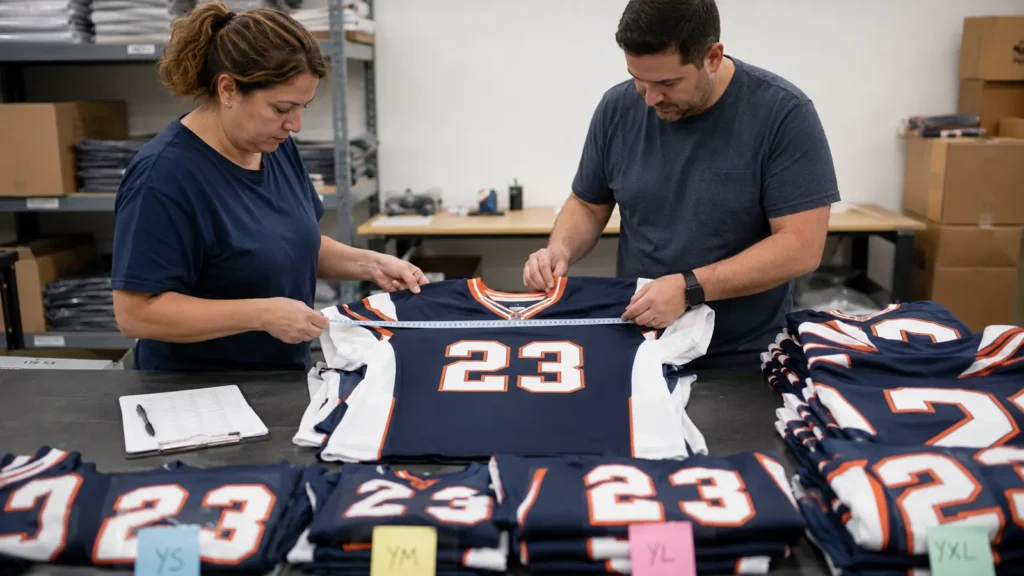
Bulk inspection should verify measurements, graphics, color, construction and roster accuracy against approved references.
Product Checks
- correct style, fabric and colorway;
- finished measurements within the agreed tolerance;
- correct front and back number dimensions;
- logo, number and name placement aligned with approved artwork;
- no visible dye migration, peeling, loose embroidery or untrimmed threads;
- even seams, hems, binding, piping and panel symmetry;
- clean garments without stains, holes or needle damage;
- labels and care information present as specified.
Roster and Packing Checks
- player name spelling matches the locked roster;
- player number and size match the same row;
- no accidental duplicate or missing entries;
- team level and colorway are correct;
- spare jerseys are identified;
- individual bags and carton marks follow the packing plan;
- carton quantities reconcile with the purchase order.
Sampling levels and inspection methods should be agreed according to the buyer’s risk tolerance and order size. At minimum, verify every personalized player entry against the final roster, even when physical garment measurements are checked by sampling.
Plan the Order Backward from the First Game
Do not use production time as the entire project schedule. A school order also needs time for stakeholder approval, artwork cleanup, sample shipping, fit testing, revisions, bulk production, inspection, international transport, customs clearance, internal distribution and contingency.
Build the calendar backward from the date uniforms must be in players’ hands, not the first game. Freeze the roster and artwork at defined milestones. If late players are expected, plan a controlled supplemental order rather than delaying the entire program.
For international sourcing, confirm the quoted Incoterm, shipping mode, destination, importer responsibility, estimated carton data and which charges are included. Transit estimates are not guarantees, so maintain a buffer appropriate to the season and route.
What to Send for an Accurate Quotation
A short inquiry such as “price for 100 jerseys” will produce assumptions rather than a dependable comparison. Send the same brief to each supplier:
| Quotation field | Information to provide |
|---|---|
| Buyer and destination | School, dealer or distributor name; country; postal code; delivery point |
| Sport and team level | Basketball varsity, soccer JV, baseball freshman, etc. |
| Quantity | Quantity by style, colorway and team |
| Size range | Youth/adult or men’s/women’s/unisex; expected size breakdown |
| Garment style | Sleeve, neckline, placket, fit and reference image |
| Fabric | Composition, knit, target weight or desired performance |
| Artwork | Vector logo, color references, front/back layout |
| Personalization | Player names, numbers, coach garments and spare jerseys |
| Decoration | Sublimation, embroidery, tackle twill, transfer, printing or supplier recommendation |
| Labels and packing | Care label, size label, private label, individual bags and player identification |
| Quality process | Sample requirement, tolerance and inspection expectations |
| Schedule | Sample deadline and required delivery date |
| Trade details | Quotation currency, Incoterm and freight requirement |
Ask the supplier to identify any assumption or exclusion. This makes quotations more comparable and reduces surprises after deposit or sample approval.
Questions to Ask a Custom Jersey Supplier
Use these questions during supplier evaluation:
- Which fabric and construction do you recommend for this sport, and why?
- Can you provide the fabric composition, knit type, GSM and color method?
- Can you work from our official association rules and scaled artwork?
- How do you manage youth, adult, women’s and equipment-fit size ranges?
- What sample stages are available, and what exactly does each sample approve?
- How are school colors matched and recorded for repeat orders?
- How do you verify personalized names, numbers and sizes?
- What measurement tolerances will apply to bulk production?
- Which decoration method is most durable for our design and laundering routine?
- What labels and care instructions can be supplied for our destination market?
- How are defects, shortages or roster discrepancies handled?
- What information will be retained to reproduce the jersey next season?
Strong answers should reference the actual specification. A supplier who recommends one fabric and decoration method for every sport may not be evaluating the program carefully enough.
Common Buying Mistakes
- Approving only a digital mockup: A mockup can hide fit, color and material problems; approve fabric and a physical sample.
- Using retail sizes: Size labels differ; use finished measurements and a try-on process.
- Designing before checking rules: Review the current association requirements before freezing artwork.
- Sending several roster versions: Keep one source of truth with a revision number and approval date.
- Comparing unlike quotations: Normalize names, labels, packing, freight and other inclusions first.
- Ignoring reorders: Record colors, patterns, artwork and measurements for future replacements.
- Overloading the design: Prioritize player identification, contrast and rule compliance.
Why JIUMU Is Relevant to School and Dealer Programs
JIUMU is a Guangdong-based B2B custom teamwear and logo-apparel supplier established in 2010. Its relevant capabilities include OEM and ODM development, embroidery, sublimation, screen printing, heat transfer, woven and rubber/PVC patches, fabric sourcing, Pantone color matching, private labels, packaging customization, digital mockups, physical samples, bulk quality control and export support.
The typical MOQ is 50 pieces, subject to the product structure and customization. That model can suit schools, school districts, uniform dealers, distributors and sports clubs that need a coordinated bulk program rather than one-off consumer jerseys.
Buyers can start with custom team jerseys and extend the same identity into headwear, outerwear, hoodies and bags. JIUMU should still be evaluated against the same checklist in this guide: sport suitability, documented specifications, samples, roster control, quality control and delivery planning.
Frequently Asked Questions
Final Recommendation
The best custom high school team jerseys are built from a controlled purchasing process. Start with the sport and current rules, then define fabric, fit, construction, decoration and school identity. Approve real materials and a physical sample, lock the roster, inspect bulk production and preserve the final specification for replacements.
This approach produces more than an attractive uniform. It gives the school a repeatable teamwear system that can serve different teams, seasons and purchasing stakeholders with fewer avoidable errors.
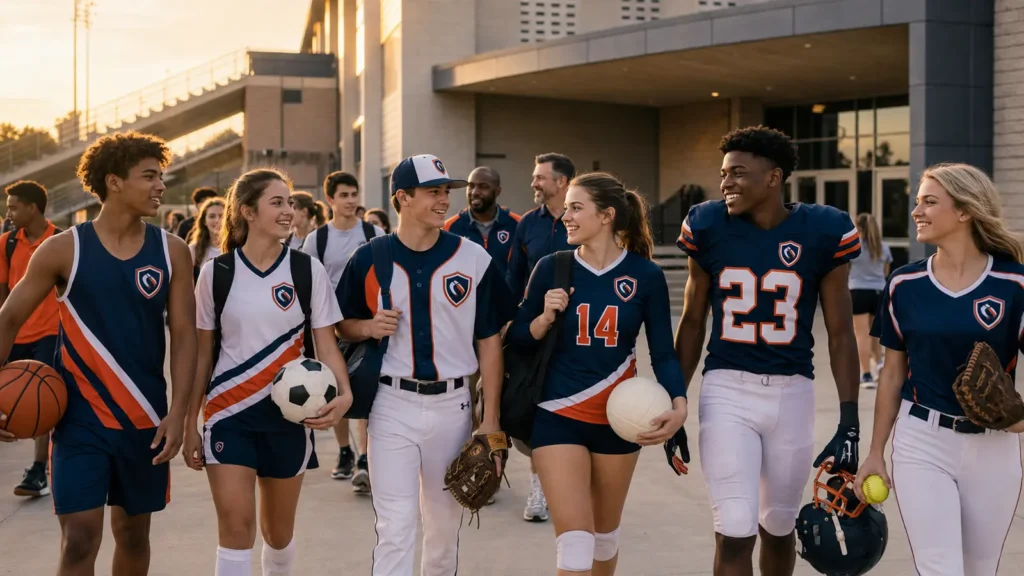
A controlled color and logo system helps different teams represent one school identity.
About JIUMU
JIUMU is a Guangdong-based B2B supplier of custom teamwear, logo apparel, uniforms, hats, bags and branded merchandise. Established in 2010, JIUMU supports OEM/ODM development, customization, samples, bulk quality control and export projects.