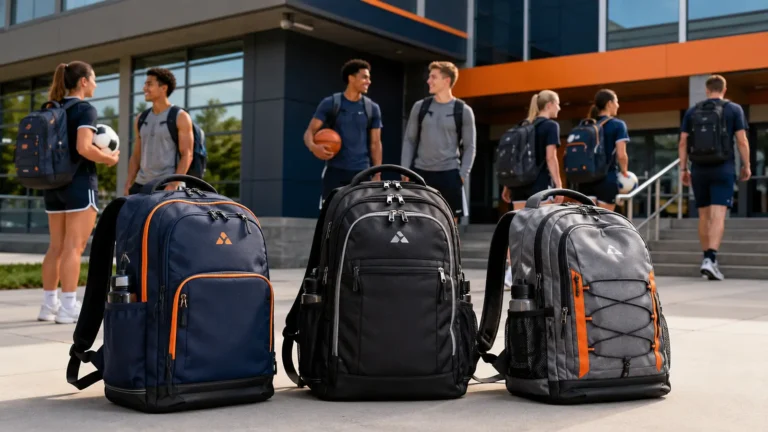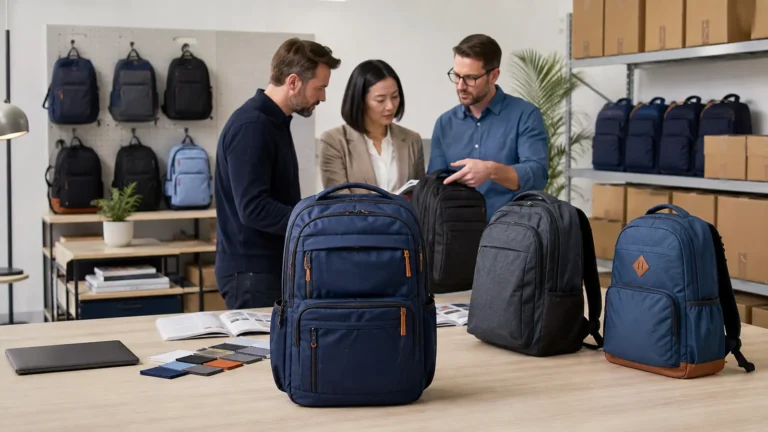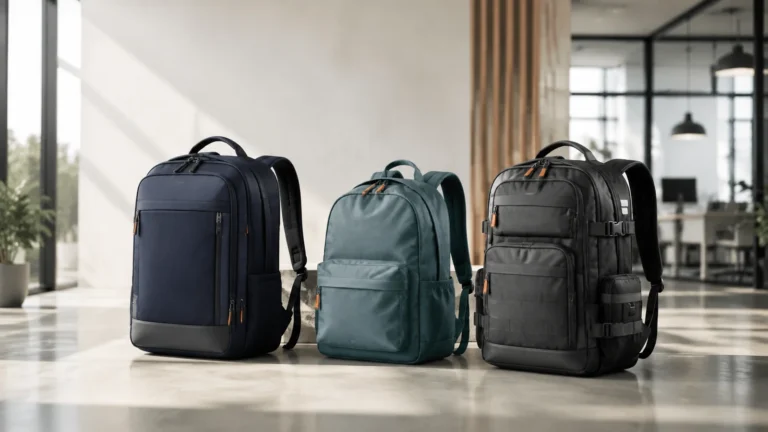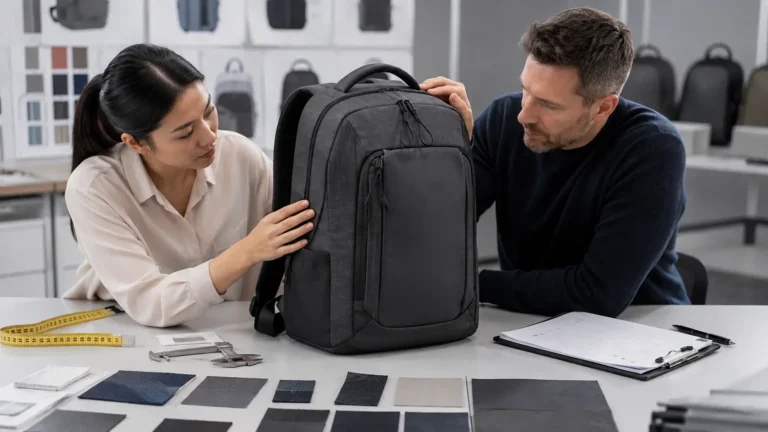
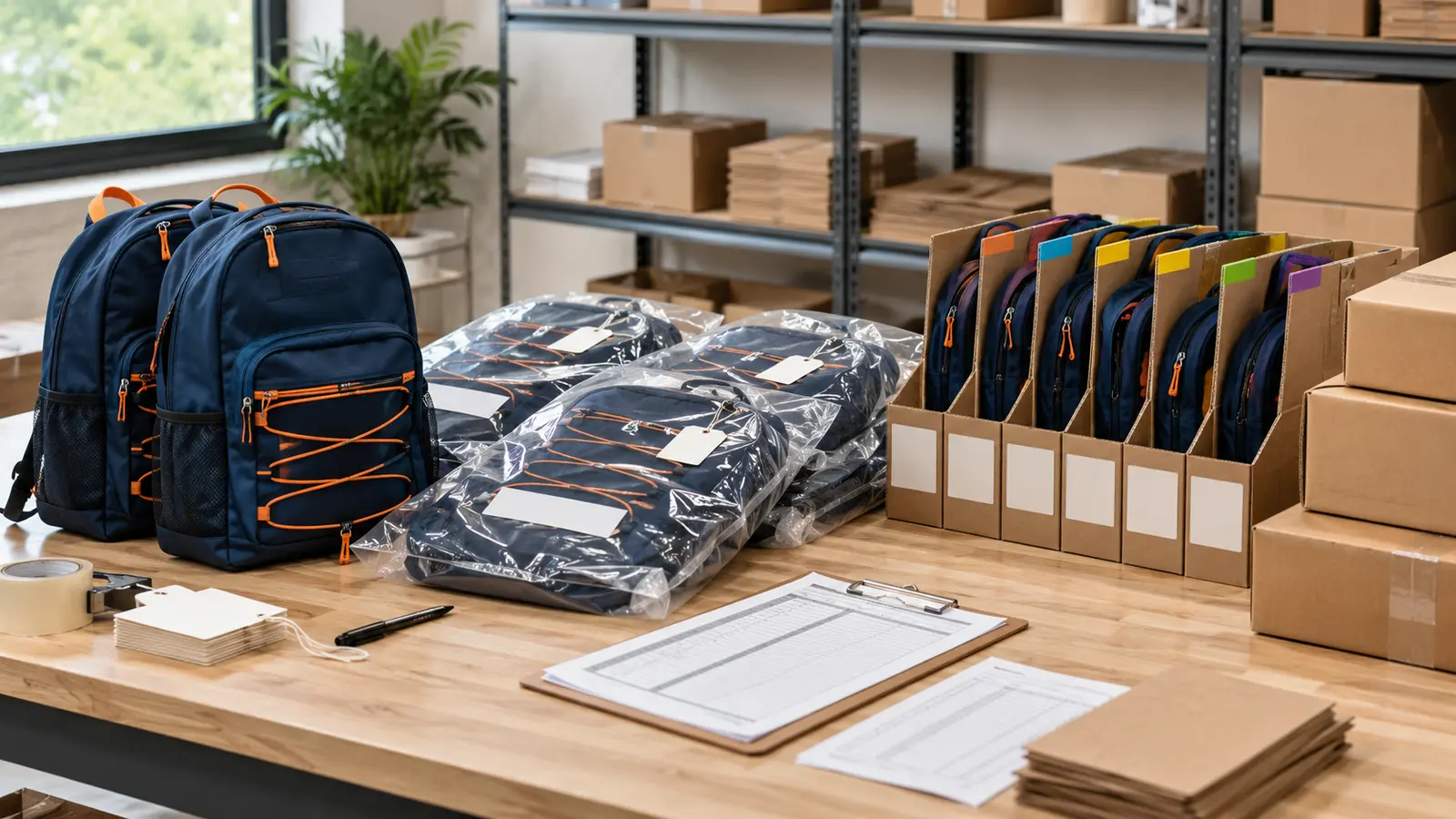
Custom Backpack Packaging for Retail and School Programs
Custom backpack packaging is more than choosing an individual bag. Retail brands need consistent labels and presentation. Schools may assign backpacks to a student, class, campus, or program. Promotional projects combine products into kits. Ecommerce buyers need identifiers, carton labels, and receiving data that match current platform rules.
A reliable packaging plan connects the physical backpack with the correct data. It defines how the bag is folded, protected, labeled, sorted, counted, packed into cartons, allocated to destinations, and checked before shipment. Without that specification, even correctly manufactured backpacks can arrive misshaped, mixed, unscannable, or difficult to distribute.
This guide helps professional buyers build a practical packaging specification before bulk production.
Quick Answer: What Packaging Options Are Available for Custom Backpacks?
Custom backpacks can be individually packed in clear or frosted bags, material-specific recyclable options, paper sleeves, or retail boxes. They can carry hangtags, care labels, woven brand labels, size stickers, SKU labels, retail barcodes, FNSKU labels, student identifiers, class codes, campus codes, or destination labels. Orders can also be sorted into student kits, classroom groups, team groups, event packs, or separate destination cartons.
The correct option depends on the backpack’s structure, target market, retail presentation, data privacy, warehouse rules, shipment method, and budget. Buyers should approve one physical pack-out sample, one label-data file, and one sample master carton before bulk packing begins.
Start With Four Packaging Layers
Treat packaging as four connected layers rather than one bag or box.
| Layer | Main purpose | Typical decisions | Failure if unspecified |
|---|---|---|---|
| Product and shape protection | Keep the backpack clean, dry enough for the planned route, and in an acceptable shape | Folding, stuffing, support, zipper position, strap arrangement, individual bag, moisture plan | Creases, crushed foam, bent panels, loose straps, dust or moisture exposure |
| Unit identification | Identify exactly what one sellable or distributable unit contains | SKU, GTIN/barcode, FNSKU, student code, hangtag, care label, location label | Wrong item, unscannable label, privacy exposure, warehouse rejection |
| Grouping and allocation | Put the correct units into classes, kits, teams, stores, campuses or destinations | Roster version, group code, kit contents, carton split, delivery quantities | Mixed classes, missing kits, incorrect destination quantities |
| Transport packaging | Protect and document units through handling and international delivery | Inner carton, master carton, quantity per carton, carton mark, packing list, moisture and compression control | Crushed bags, count differences, missing cartons, delayed receiving |
The Packaging Specification should define all four. A request such as “individual packing with labels” is not enough because it does not identify label ownership, data fields, placement, scan requirement, folding method, carton quantity, or delivery allocation.
Custom Backpack Packaging Options at a Glance
| Packaging option | Best suited to | Main advantages | Main limitations |
|---|---|---|---|
| Plain clear individual bag | Wholesale, schools, team programs, internal distribution | Low cost, visible product, simple counting and labeling | Plastic use; ventilation and warning requirements may apply by market or platform |
| Frosted or printed bag | Retail brands and ecommerce presentation | More branded appearance and privacy for contents | Printing MOQ, setup cost, reduced product visibility, material-claim control |
| Qualified recyclable bag | Programs with documented packaging goals | Can support a defined material strategy | Recyclability depends on material, construction and collection facilities; claims need evidence |
| Paper sleeve or belly band | Simple retail presentation for soft backpacks | Reduced plastic appearance and easy branding | Less moisture protection and limited containment of straps |
| Kraft paper bag | Store or event distribution | Printable and easy to carry | Adds volume and may not protect shape or moisture well |
| Individual retail box | Premium retail, gifts, subscription or presentation programs | Strong presentation and improved separation | Higher cost, packaging MOQ, storage and dimensional-weight exposure |
| Multi-item kit bag or box | School starter kits, promotional packs, event kits | Keeps backpack and accessories together | Requires component counting and kit-level SKU control |
| Bulk grouped packing | Large school or institutional delivery | Efficient carton use and lower packaging material | Less individual protection and more receiving labor |
The final choice should be tested with the actual backpack, not an empty generic package. Backpack thickness, foam, structural boards, straps, buckles, zipper pullers, decoration, and retail inserts change the minimum package size.
Individual Bags, Paper Options and Moisture Control
Can backpacks be individually packaged?
Yes. Individual packaging is common when units need to stay clean, receive separate labels, move through fulfillment, or be handed directly to students. The individual package should fully contain the backpack, straps, hangtags, and included accessories without forcing the product into a damaging fold.
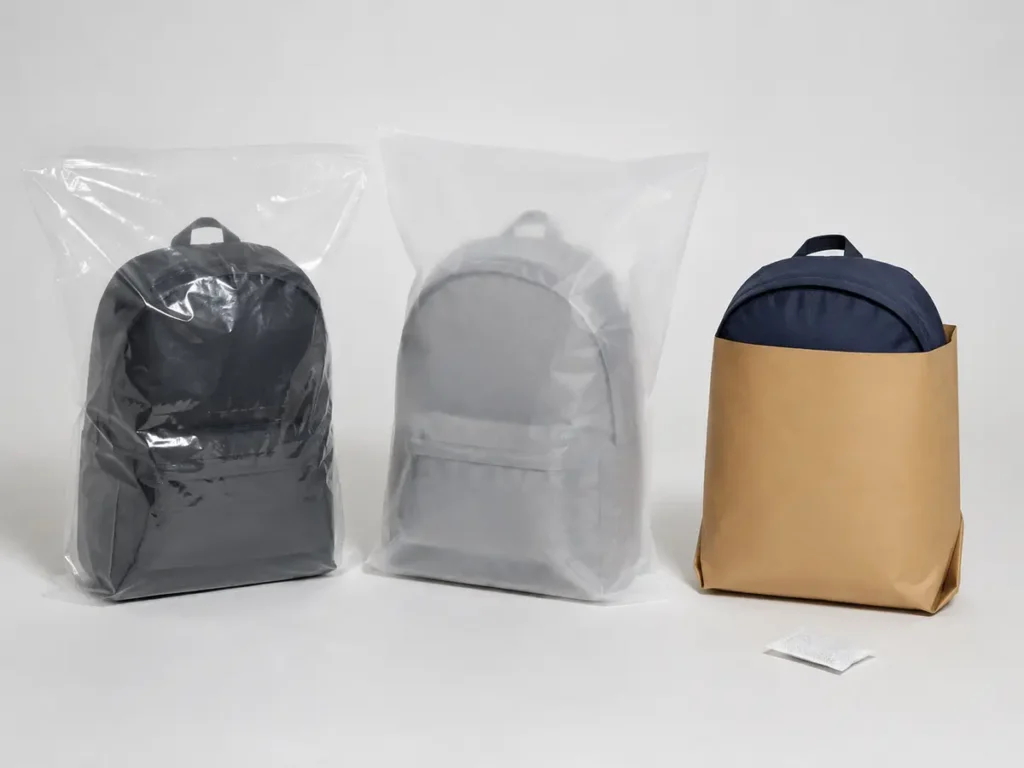
For a bag-style package, define:
- material and thickness;
- clear, frosted, colored, or printed appearance;
- opening and closure method;
- ventilation or warning requirements for the destination;
- package dimensions and tolerance;
- label position and surface compatibility;
- whether the backpack is folded, nested, or packed at full shape;
- moisture-control method;
- number of units per inner and master carton.
Do not assume a sealed bag makes the product waterproof. The individual bag can reduce dust and incidental moisture exposure, but punctures, imperfect seals, humidity trapped during packing, and carton damage remain possible.
Moisture prevention begins before the bag is sealed
Products and packaging should be clean and sufficiently dry before packing. A barrier bag or desiccant cannot correct a damp backpack. For long sea shipments or humid storage, the supplier and buyer should agree on product conditioning, bag closure, carton lining, desiccant type and quantity if used, container moisture precautions, and storage expectations.
Desiccants must be selected for the actual pack and route. They should be contained, kept away from children where relevant, and accompanied by required warnings or instructions. Do not add packets without defining their material, placement, count, and acceptance criteria.
Recyclable Packaging Claims Need Qualification
“Recyclable” is not a universal material description. A package may technically consist of a recyclable resin or paper but still be difficult to recycle because of inks, adhesives, laminates, mixed layers, labels, contamination, or limited local collection.
The U.S. Federal Trade Commission’s Green Guides state that environmental claims should be truthful, substantiated, and qualified when limitations matter. The FTC also distinguishes recycled content from recyclability. A package containing recycled material is not automatically recyclable, and a recyclable package does not necessarily contain recycled material. See the FTC environmental-claims guidance.
Before printing an environmental claim, confirm:
- exact material construction;
- post-consumer or pre-consumer recycled percentage, if claimed;
- documentary evidence and applicable chain-of-custody requirements;
- inks, closure, labels, laminates, and additives;
- intended selling markets and local collection availability;
- exact wording, symbols, and qualification approved by the brand’s compliance team.
A purchasing specification can say “mono-material PE bag, subject to local recycling availability” when supported. Avoid unqualified claims such as “100% eco-friendly,” “zero impact,” or “fully recyclable everywhere.”
Hangtags, Care Labels and Private-Label Elements
Retail and school projects may need more than one label. Each has a different purpose and durability requirement.
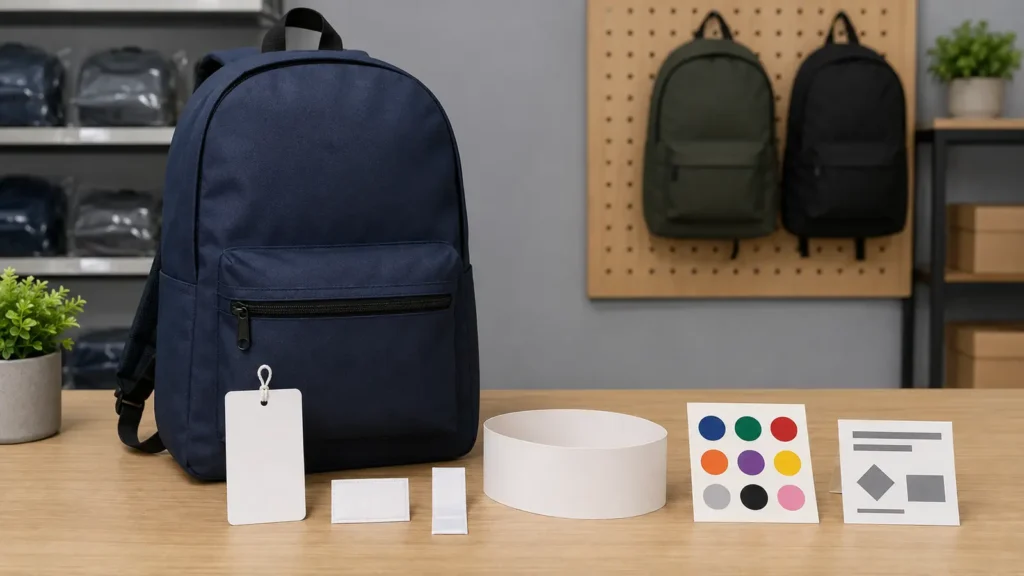
| Label element | Typical function | Key approval fields |
|---|---|---|
| Woven or printed brand label | Permanent brand identity | Artwork, size, fold type, material, colors, location and sewing method |
| Care or content label | Fiber, care, origin or other required information | Market-specific legal content, language, font size, material, location and version |
| Hangtag | Branding, story, features, price or campaign message | Size, stock, print, finish, hole, string, attachment point and artwork |
| Size or color sticker | Fast retail identification | Value list, color coding, adhesive, placement and removal behavior |
| SKU label | Internal item and variant control | SKU, description, color, size/capacity, pack level and label format |
| Retail barcode label | Point-of-sale or inventory scanning | GTIN owner, symbology, data, size, quiet zones, print quality and placement |
| Student or recipient label | Distribution to a named person or group | Minimum necessary identifier, privacy approval, attachment and removal plan |
| Warehouse label | Receiving or fulfillment | Platform-supplied file, shipment plan, unit/carton level and placement rule |
Labels that appear correct on screen can fail when printed too small, placed over a seam, curved around a package, covered by tape, or exposed to friction. Approve a physical print and perform scanning with the intended equipment where scanning is required.
SKU, GTIN, Barcode and FNSKU Are Not the Same Thing
A SKU is the buyer’s internal identifier. A GTIN is a standardized global trade-item identifier. A barcode is the machine-readable symbol that can encode a GTIN or other approved data. An FNSKU is an Amazon fulfillment identifier used under specific inventory and barcode conditions.
GS1 states that a GTIN uniquely identifies a trade item. The brand owner should obtain and manage legitimate identifiers and decide which product and packaging levels receive them. The factory should not invent GTINs or reuse a code across distinct sellable configurations. See GS1’s GTIN guidance.
Recommended Variant and Label Data Table
| Field | Example format | Owner | Validation |
|---|---|---|---|
| Product style | Backpack model code | Buyer | Matches purchase order and Tech Pack |
| Color | Approved color name and code | Buyer / supplier | Matches physical unit and BOM |
| Capacity or size | Defined variant | Buyer | Matches product and listing |
| Unit SKU | Unique internal code | Buyer | No duplicate variant assignment |
| GTIN / UPC / EAN | Authorized numeric value | Brand owner | Verified against product variant |
| FNSKU | Platform-exported value when required | Seller account owner | Matches current listing and shipment plan |
| Pack level | Single, set, inner carton or master carton | Buyer | Correct identifier for each level |
| Label filename | Controlled file name | Buyer | Version and checksum or approval recorded |
| Label placement | Drawing and measurement | Buyer / supplier | Visible, flat, uncovered and scannable |
| Quantity | Units for the variant | Buyer | Reconciles with PO and carton plan |
Do not send a screenshot of a barcode as the only instruction. Provide the original platform or barcode file, a human-readable variant map, print size, label stock, placement drawing, and written approval.
Amazon and Other Fulfillment-Center Requirements
Warehouse rules change by platform, marketplace, account configuration, product category, shipment method, and date. “FBA-ready” or “3PL-ready” is not a permanent specification.
Amazon’s U.S. FBA guidance states that prep and item-labeling services ended on January 1, 2026. Amazon also changed FBA barcode requirements as of March 31, 2026. Current Seller Central guidance distinguishes manufacturer barcodes and Amazon barcodes under applicable eligibility and account conditions. Therefore, a factory should not decide the barcode route from an old template. The seller should export the correct unit labels and shipment documents from the active account after the listing and shipment plan are confirmed. Review the current Amazon FBA barcode requirements and product packaging requirements.
For any fulfillment center, request:
- current receiving and prep manual;
- unit-label file and carton-label file;
- listing or SKU-to-variant map;
- package dimensions and weight limits;
- polybag, suffocation-warning, sealing, set-label, and barcode-placement rules where applicable;
- master-carton limits and pallet requirements;
- appointment, routing, advanced shipment notice, or shipment-plan data;
- prohibited packaging materials and damage standards;
- confirmation of who is responsible for changes after packing.
Run a print-and-scan trial before the complete order is labeled. Then scan random production units and cartons during final inspection.
Student Names, Classes and School Program Sorting
Schools often need distribution-ready backpacks. The factory can sort by class, grade, campus, house, team, teacher, program, or student identifier if the buyer supplies a controlled roster and clear privacy instructions.
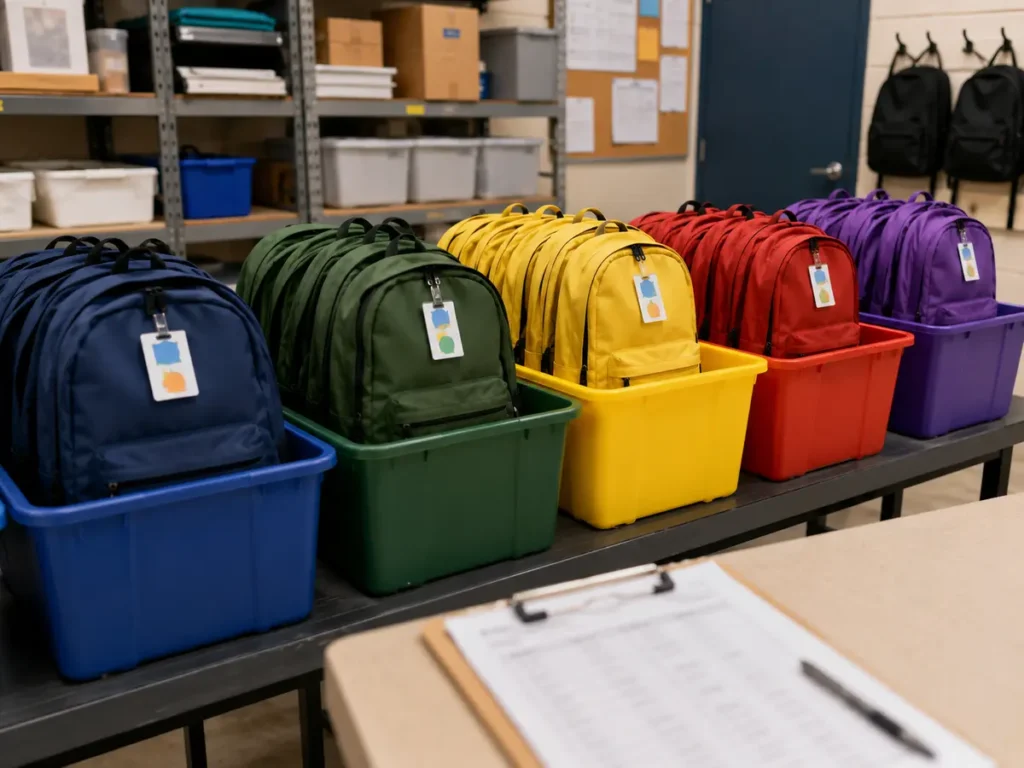
Can student labels be added?
Technically, yes. The more important question is whether the school is authorized to disclose the data and how it should be handled. In the United States, FERPA protects personally identifiable information from education records and places conditions on disclosure. Requirements differ by country, school policy, contract, and data type. The school or authorized buyer—not the factory—should determine what can be shared and obtain any required consent or agreement. See the U.S. Department of Education’s student privacy resources and third-party service provider guidance.
A data-minimization approach is safer and easier to control. Instead of sending full student records, use only what is necessary for distribution. A removable code such as C04-027 may be preferable to a visible full name when the school can map the code locally.
School Sorting File Fields
| Field | Required? | Guidance |
|---|---|---|
| Distribution ID | Yes | Unique, non-duplicated value; avoid unnecessary personal data |
| Display name | Optional | Use only when authorized and operationally necessary |
| School / campus code | For multi-site orders | Use controlled codes, not free text |
| Grade / class / teacher code | As needed | One approved naming convention |
| Backpack SKU / color | Yes | Must match the production variant table |
| Personalization artwork | If applicable | Link to approved file and spelling |
| Kit contents | For bundles | Use a controlled kit code |
| Carton group | Yes | Assigned after allocation is approved |
| Destination | For split delivery | Use destination ID and verified address file |
| Special note | Limited use | Avoid health, disability, financial, or other sensitive details |
Protect the file with access controls, a version number, an approval deadline, and a deletion or return policy. Do not circulate multiple uncontrolled spreadsheets through email and messaging apps. The supplier should report totals and exceptions without exposing unnecessary student details.
Can Orders Be Sorted by Class, Grade or Location?
Yes, but the order needs one authoritative Allocation File. It should reconcile from total purchase quantity down to every variant, group, carton, and destination.
A practical hierarchy is:
Purchase Order → Product SKU → Group Code → Recipient/Kit ID → Carton ID → Destination ID
The buyer should freeze the roster before packing. Late changes may require reopening cartons, replacing labels, recounting kits, updating packing lists, and changing freight documents. Establish a change cutoff and identify who pays for rework or reshipment after approval.
Use color-coded dividers for temporary visual control, but do not depend on color alone. Every group needs a written code, quantity, and carton reference. Color perception, lighting, and repeated colors across campuses can cause errors.
Class-Sorted Packing Workflow
- Validate the latest allocation file and total quantities.
- Print controlled group and recipient labels.
- Stage finished backpacks by SKU and color.
- Scan or double-check each unit against the group file.
- Add authorized student or group label.
- Place units into the assigned class or destination carton.
- Reconcile carton quantity and exceptions.
- Seal only after independent verification.
- Export the final carton-level packing list.
Kit and Multi-Item Packaging
A backpack may be one part of a school starter pack, employee welcome kit, team pack, event gift, or retail bundle. The kit can include a pencil case, bottle, cap, notebook, apparel, promotional item, or instruction insert.
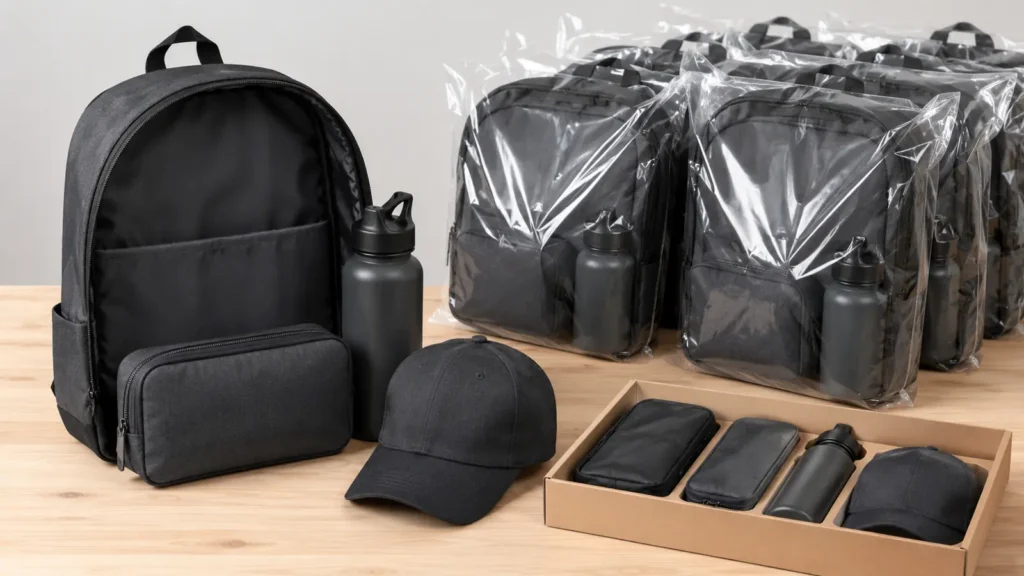
Define whether accessories are placed inside the backpack, attached outside, individually bagged, or packed in a separate tray or box. Check whether hard objects can mark fabric, damage coating, distort foam, or press against decoration during transport.
Kit Packing Record
| Kit code | Backpack SKU | Included components | Component quantities | Unit label | Total kits | Exception status |
|---|---|---|---|---|---|---|
The final inspection should open a defined sample of sealed kits and confirm every component, variant, label, and condition. Weighing can be an additional control when component weights are consistent, but it should not replace visual verification for similar-weight items.
Multi-Location Distribution
Orders can be packed for multiple schools, stores, campuses, warehouses, teams, or event locations. The buyer must decide whether the factory ships directly to each destination or sends one consolidated shipment for domestic redistribution.
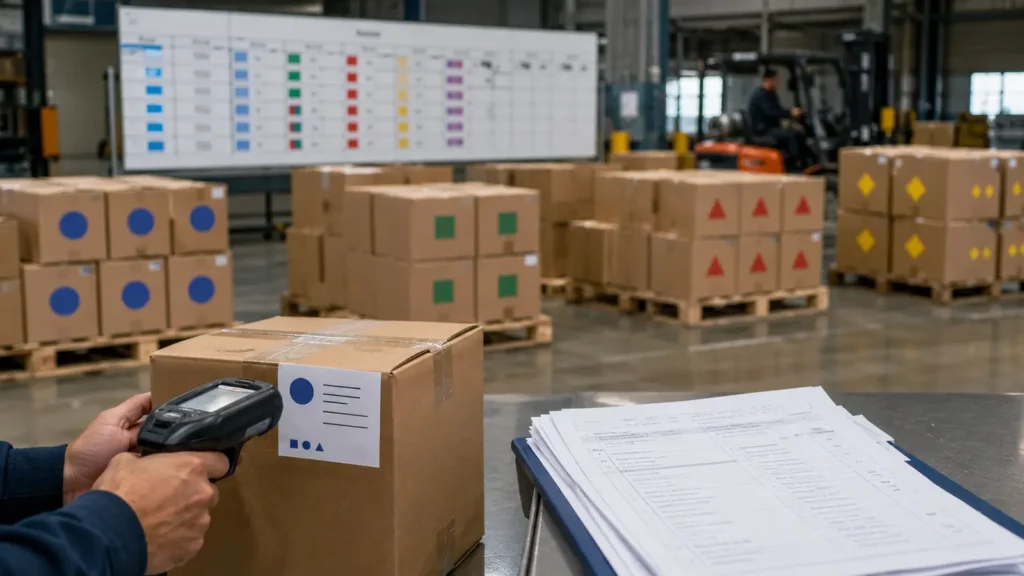
Factory-level split shipments can reduce receiving work, but they increase carton-label variants, documentation, freight quotations, customs or tax questions, small-shipment surcharges, and the risk of address errors. Consolidated shipping can be more efficient internationally but requires a capable destination warehouse to break down and forward the goods.
Multi-Location Allocation Table
| Destination ID | Verified address | Contact | Delivery rule | SKU quantities | Carton IDs | Shipping term | Status |
|---|---|---|---|---|---|---|---|
Confirm delivery addresses, receiving hours, appointment rules, liftgate or dock needs, phone numbers, and restricted-access conditions before booking. The Shipping Terms Guide can help buyers separate factory pricing from international and destination delivery responsibilities.
Outer Cartons, Carton Marks and Packing Lists
The master carton must suit the backpack structure, weight, route, handling, stacking, and storage period. Define board construction or performance, closure, reinforcement, maximum gross weight, internal arrangement, and carton quantity.
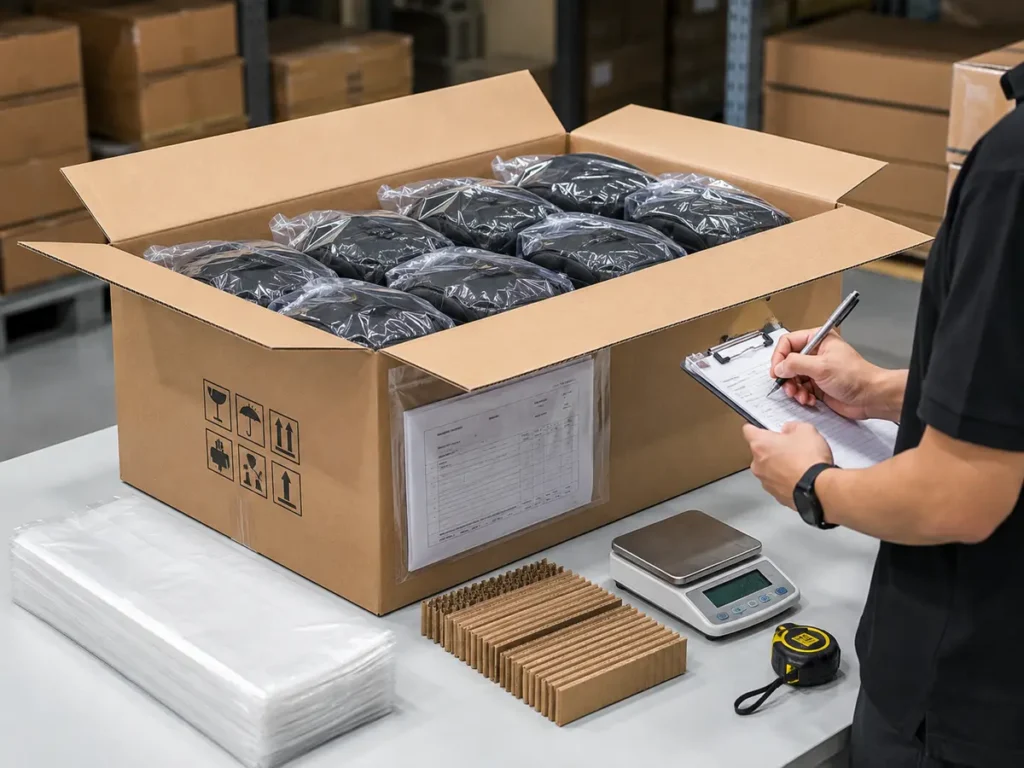
Recommended Carton Mark Fields
- buyer or approved consignee mark;
- purchase order number;
- style and SKU;
- color and size/capacity variant;
- destination or class code where applicable;
- carton number and total carton count;
- quantity in the carton;
- country-of-origin marking when required;
- gross weight, net weight and carton dimensions;
- handling marks approved for the route;
- platform or warehouse carton label where required.
Keep the human-readable carton mark consistent with the electronic Packing List. If sensitive recipient information is needed inside the carton, do not automatically print it on the exterior.
The Packing List should show one row per carton when the order is sorted. Include carton ID, destination, group, SKU, variant, quantity, net and gross weight, dimensions, and exception notes. This makes receiving and claims investigation more efficient.
Does Folding Affect Backpack Shape?
Yes. Folding can create creases, compress foam, bend structural boards, deform molded panels, mark coatings, or force hardware against the fabric. The risk depends on materials and construction.
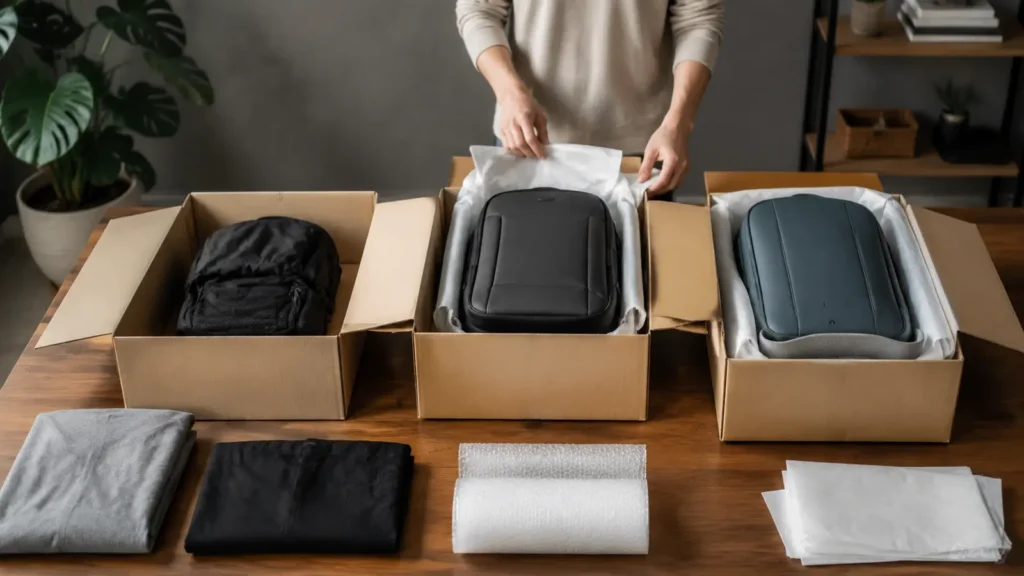
| Backpack type | Typical packing approach | Main risk | Approval test |
|---|---|---|---|
| Soft unstructured backpack | Controlled flattening or light fold with straps contained | Set-in creases, zipper stress, wrinkled decoration | Unpack after simulated storage and confirm recovery |
| Padded laptop backpack | Gentle nesting with limited compression | Crushed foam, distorted sleeve, pressure marks | Inspect padding recovery and compartment dimensions |
| Structured backpack | Maintain shape with tissue, insert, nesting frame or lower carton density | Bent board, collapsed front panel, corner dents | Check silhouette after storage and handling simulation |
| Molded or hard-panel backpack | Dedicated support or individual box | Cracks, dents, permanent deformation | Approve fitted pack and carton stacking plan |
Make a packed sample using final materials and keep it compressed for an agreed period. Unpack it, allow a defined recovery time, and inspect shape, foam, decoration, coating, zipper operation, and surface marks. Photograph the approved fold sequence so bulk packers follow the same method.
Packaging MOQ, Cost and Lead-Time Drivers
JIUMU backpack orders can commonly start from 20 pieces, but custom packaging components may have separate, higher minimums. Printed bags, woven labels, hangtags, retail boxes, molded supports, special stickers, and barcode rolls are purchased through different processes.
Packaging cost is affected by material, thickness, printing, number of packaging variants, label-data changes, sorting labor, kit contents, dividers, shape supports, carton specification, scan verification, destination count, rework, carton volume and shipping method.
Retail boxes and low carton quantities can increase dimensional weight. Ask for final carton dimensions, gross weight, carton count, and cubic volume before comparing transport options. Packaging savings should be evaluated against damage risk, distribution labor, and receiving errors—not unit material price alone.
Packaging Sample and Approval Process
1. Freeze the Packaging Specification
List every material, dimension, label, artwork file, data owner, placement, folding step, unit count, carton rule, destination and approval version.
2. Make a Representative Packed Sample
Use the actual backpack, inserts, labels and accessories. Photograph the product before packing, fold sequence, sealed unit, open carton, closed carton and marks.
3. Check Product Recovery
Leave the sample packed for an agreed time. Unpack it and inspect creases, foam recovery, coating, decoration, zipper paths and straps.
4. Validate Data and Scan Labels
Match each label to the SKU, recipient or group, carton and destination. Scan retail or warehouse labels with suitable equipment.
5. Approve One Sample Carton
Confirm quantity, arrangement, protection, gross weight, dimensions, carton mark, label position, sealing and Packing List entry.
6. Retain the Golden Pack-Out
Keep the approved unit package, label print, photographs, carton specification and versioned files as production references.
Final Packaging Quality-Control Checklist
| Check | Requirement | Result | Status |
|---|---|---|---|
| Backpack condition | Clean, dry, correct variant and approved workmanship | ||
| Fold and shape | Approved sequence; no damaging compression | ||
| Unit package | Correct material, dimensions, closure and warnings | ||
| Brand labels | Correct artwork, location and attachment | ||
| SKU / barcode | Correct variant, readable print and successful scan | ||
| Student / group label | Authorized fields, correct match and approved visibility | ||
| Kit contents | All components and quantities present | ||
| Group allocation | Correct class, campus, store or destination | ||
| Carton quantity | Matches packing specification and Packing List | ||
| Carton protection | Approved arrangement, moisture and compression controls | ||
| Carton mark | Correct PO, SKU, destination, count, weight and dimensions | ||
| Final reconciliation | Unit, group, carton and destination totals agree |
Record nonconformities by type and affected quantity. Reprint wrong labels, reopen and recount uncertain cartons, and update the final Packing List before shipment. Do not treat a handwritten carton correction as complete unless the electronic record is also updated.
What to Send for a Packaging Quotation
Send JIUMU:
- backpack style, dimensions, structure and finished sample status;
- total quantity and quantity by SKU, color or size;
- individual package material and presentation goal;
- label types, artwork, data files and placement drawings;
- retail barcode, FNSKU or warehouse requirements from the current account;
- student, class, team or destination allocation file with approved fields;
- kit bill of contents and insertion method;
- carton quantity, maximum weight and carton-mark format;
- number of destinations and verified addresses;
- target arrival date and requested shipping term;
- environmental claims and supporting evidence, if any;
- inspection, scan and reporting requirements.
Explore JIUMU’s Private Label Services, Custom Team Bags, and Manufacturing Capabilities when planning the product and packaging together.
Request a packaging proposal: Send the backpack specification, quantities, label files, sorting logic, pack-out method, destinations and required arrival date. JIUMU can identify missing data before preparing the final packaging quotation.
Why JIUMU Is Relevant
JIUMU supports OEM and ODM custom bag development, logo decoration, material sourcing, Pantone matching, woven labels, hangtags, packaging customization, physical samples, quality control and export support. This allows the backpack, branding, unit packaging, sorting file and master-carton specification to be reviewed as one project rather than disconnected purchases.
The final packaging method remains project-specific. Buyers should supply current platform requirements, authorized recipient data, environmental-claim evidence and destination instructions. JIUMU can then develop and approve a physical packaging sample before bulk packing.
Frequently Asked Questions
Final Recommendation
Build the packaging plan before bulk production, not after the backpacks are finished. Define the unit package, label hierarchy, privacy controls, group logic, kit contents, carton rules, destination split, inspection method and data version in one Packaging Specification.
Approve a physical unit pack and a complete sample carton. Scan identifiers, reconcile every quantity level, and test whether the backpack recovers after packing. This turns packaging from a last-minute material choice into a controlled retail, school-distribution and warehouse-delivery process.
Plan your backpack packaging with JIUMU: Email zhengdong@jiumugear.com, contact WhatsApp at +86 18507502899, or use the Contact Us page. Include product quantities, label files, sorting requirements, destinations and target delivery date.
About JIUMU
JIUMU supports OEM and ODM custom bags, teamwear, hats and branded merchandise for professional buyers. Established in 2010 in Guangdong, China.