Best Clear Backpacks for School and Campus Security
Clear backpacks are increasingly considered by schools, colleges, event operators, uniform dealers, and promotional buyers that want belongings to be easier to inspect. Yet the best clear backpack is not simply the most transparent model. For a successful school or campus program, the bag must match the written access policy, carry a realistic student load, remain comfortable, resist repeated flexing, and preserve visibility after decoration.
This guide explains how professional buyers can specify and source clear school backpacks for daily classes, campus events, athletics, and controlled-entry environments. It focuses on procurement decisions rather than retail rankings. Because bag rules differ among schools and venues—and can change—buyers should treat policy confirmation as the first specification step, not as a final compliance check.
Quick Answer: The best clear backpacks for school and campus security programs use genuinely transparent main panels, reinforced bound seams, a durable opaque base, comfortable adjustable straps, reliable zippers, and only limited decoration on opaque areas. Choose the dimensions and permitted features only after obtaining the current written policy from every school or venue that will use the bag. Approve a physical sample packed with a realistic load before authorizing bulk production.
Why the Clear-Backpack Purchasing Decision Matters
A clear backpack can support faster visual screening because its contents are visible without opening the main compartment. That practical benefit, however, does not make a bag an independent security system. It is one operational element within a broader school or venue safety process. Staff training, written rules, consistent communication, entry procedures, accommodations, and prohibited-item controls remain separate decisions.
The procurement risk comes from assuming that “clear” automatically means “approved.” Official policies demonstrate why that assumption is unsafe. Some civic venues permit clear plastic, vinyl, or PVC bags up to 12 × 6 × 12 inches. Delaware’s interscholastic athletics guidance, by contrast, describes a different maximum for a particular stadium. Birmingham’s Legion Field lists clear backpacks as non-approved even while allowing other clear bag formats. These examples are not universal specifications; they show that rules are venue-specific.
For a school district or distributor, a mismatch can create stranded inventory, denied entry, costly rework, or loss of trust. A well-managed order therefore begins with a policy matrix that records:
- The issuing school, district, college, stadium, or event operator
- Effective date and a link or copy of the written rule
- Permitted bag style, external dimensions, and material wording
- Whether backpacks, totes, drawstring bags, or only simple clear bags are allowed
- Restrictions on tint, patterns, pockets, hardware, and opaque trim
- Exceptions for medical, disability-related, childcare, or other necessary items
- Inspection procedures and responsibility for communicating changes
The buyer should obtain approval from the relevant policy owner when the design introduces features not explicitly addressed by the rule. A supplier can manufacture against an approved specification; it cannot determine whether a local authority will accept a particular bag.
Clear Backpack Decision Overview
| Buying criterion | Recommended procurement approach | Why it matters |
|---|---|---|
| Policy fit | Convert the current written rule into measurable product requirements | “Clear bag” may not mean “clear backpack,” and size limits vary |
| Visibility | Use untinted, optically clear main panels with controlled opaque coverage | Tint, large graphics, lining, or dense pockets can obstruct inspection |
| Capacity | Pack-test the sample with the school’s normal load | External dimensions alone do not show usable capacity |
| Comfort | Specify padded, adjustable straps and sensible load distribution | Clear film panels do not provide the structure of woven fabric by themselves |
| Durability | Reinforce the base, zipper curves, strap anchors, and bound seams | Film can crease or tear at concentrated stress points |
| Privacy | Provide guidance for personal and sensitive belongings | Visibility exposes contents to people beyond security staff |
| Decoration | Place marks on opaque trim or a limited approved zone | Large decoration can conflict with visibility requirements |
| Compliance | Confirm intended-age classification, destination-market requirements, and testing scope | A youth-oriented backpack may be treated as a children’s product in the United States |
| Repeat orders | Freeze approved materials, dimensions, colors, and tolerances | Transparent materials can vary in clarity, hand feel, and color between lots |
What Types of Clear Bags Work for Schools and Campuses?
The right format depends on where and how the bag will be used. Do not assume a daily school backpack and an event-entry clear bag are interchangeable.
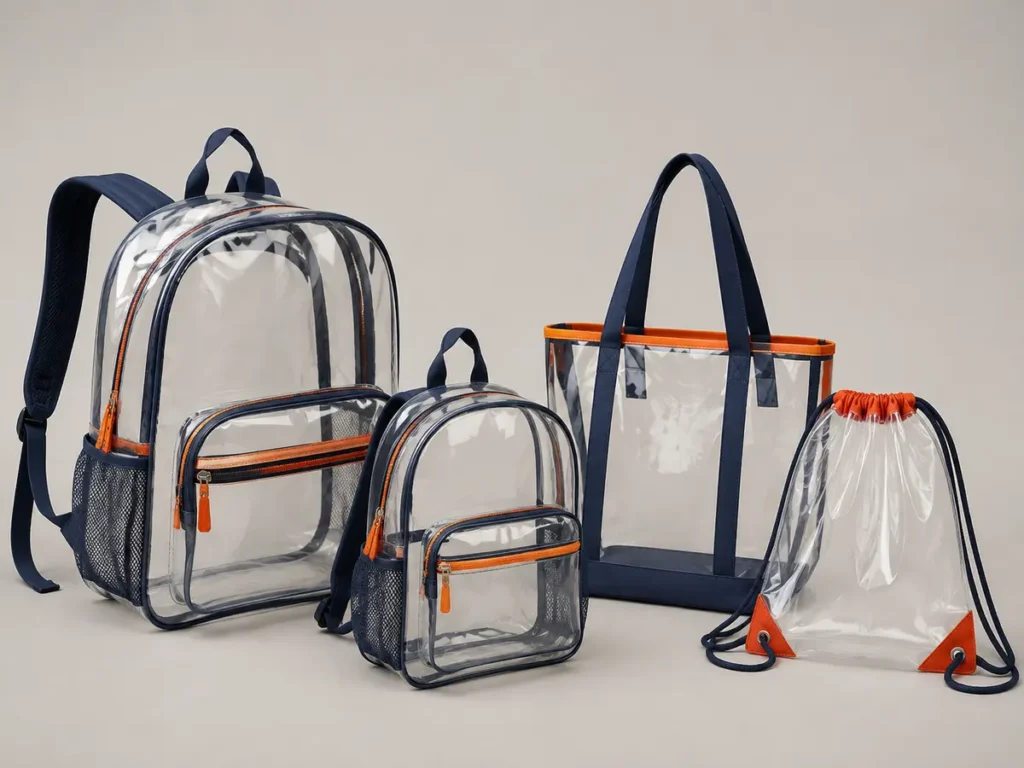
Full-Size Clear School Backpacks
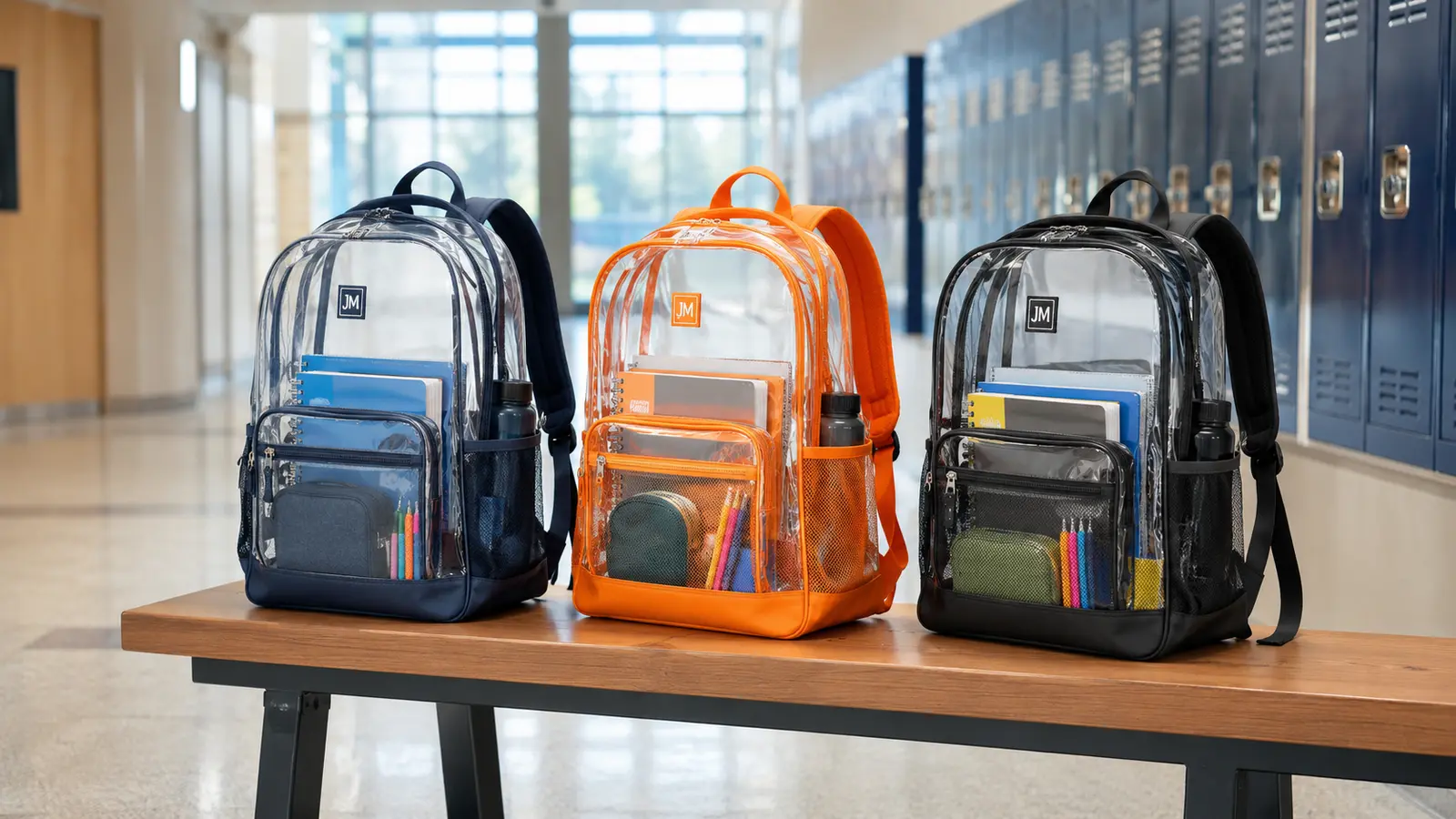
A full-size backpack is the most practical format for secondary schools, colleges, and programs requiring books, folders, a device, lunch, and a bottle. Common features include a main compartment, front pocket, side mesh pockets, padded shoulder straps, top handle, and an opaque reinforced base.
The benefit is familiarity: students carry and organize it like a conventional backpack. The tradeoff is complexity. Extra pockets, opaque panels, decorative zones, and thick reinforcement may reduce visible area. Buyers should ask the policy owner whether each feature is acceptable.
Compact Youth Clear Backpacks
Compact models reduce overall size and strap length for younger users. They should not simply be scaled-down adult bags. Folder dimensions, lunch containers, strap geometry, zipper pull size, and the intended age group all affect the design.
For the U.S. market, product classification matters. The Consumer Product Safety Commission explains that a backpack may be considered a children’s product when it is designed or intended primarily for children age 12 or younger; sizing, themes, and decoration can contribute to that determination. Buyers should obtain qualified compliance advice and define the required testing and documentation for the actual product and market.
Clear Laptop Backpacks
Laptop-oriented models add a device sleeve or an opaque padded divider. This improves device protection but can block a large part of the view. Confirm whether a sleeve is permitted and whether the device must remain visible during inspection. If full visibility is essential, a removable sleeve carried inside a simple clear compartment may be easier to review, subject to the local rule.
Clear Totes
Clear totes have a simple open form, fewer seams, and broad visible panels. They can suit campus events, libraries, staff kits, and stadium programs. They are generally less comfortable for heavy daily loads, provide less organization, and may not be accepted if the policy specifies another closure or size.
Clear Drawstring Bags
Drawstring bags are lightweight and cost-efficient for orientation kits, athletics, and events. Their limited structure makes them less suitable for laptops, sharp-edged binders, or all-day academic loads. Cord design, corner reinforcement, and opening security deserve careful review.
How to Translate a Security Policy into a Product Specification
Start with the rule and turn each phrase into an approval item. If a policy says a bag must be “clear,” determine whether that means colorless panels, no tint, no pattern, or a defined percentage of visible surface. If it lists external measurements, specify exactly how the finished bag will be measured—height, width, and depth—when empty and when normally packed.
Use a policy-to-product worksheet:
| Policy question | Specification field to approve | Evidence at sample stage |
|---|---|---|
| Is a backpack format permitted? | Product category and silhouette | Front, side, and packed photos |
| What is the maximum size? | Finished external H × W × D and tolerance | Measurement report on the sample |
| Must the entire bag be clear? | Maximum opaque trim, base, pocket, and strap coverage | Marked artwork and physical sample |
| Are tinted panels prohibited? | Colorless transparent film requirement | Material swatch under neutral light |
| Are multiple pockets allowed? | Pocket count, placement, and transparency | Open/closed sample review |
| Is hardware restricted? | Buckles, sliders, zipper pulls, and metal content | Bill of materials and sample |
| Are logos allowed? | Decoration method, size, and placement | Decorated pre-production sample |
| Are exceptions required? | Alternative process or companion pouch | Policy-owner operational plan |
Record the policy version used for approval. If a rule changes after the order, the buyer can identify which inventory and users are affected. For multi-campus programs, avoid averaging several policies into one design unless the most restrictive version is still usable for every location.
Size, Capacity, and Organization
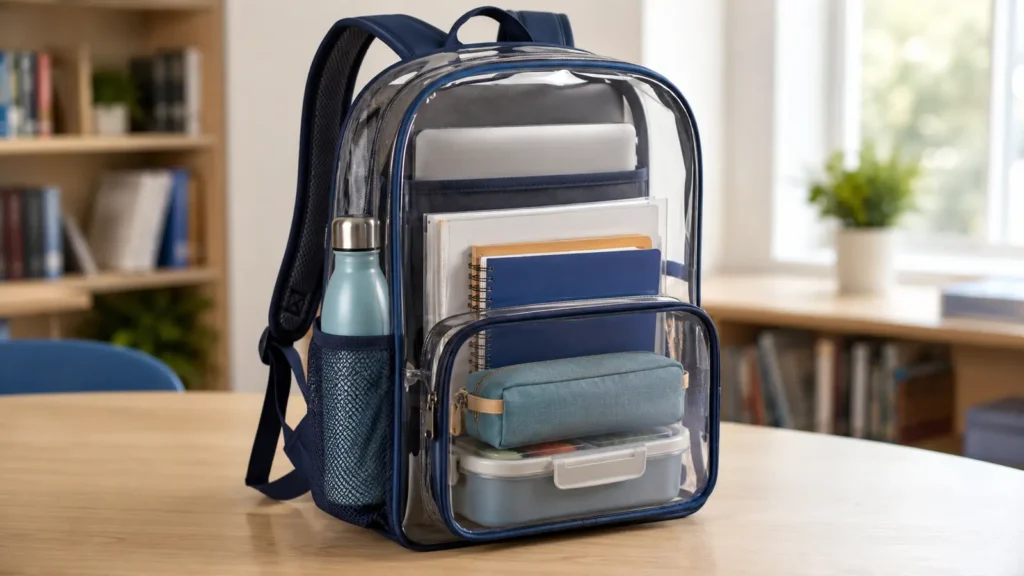
Capacity should follow an actual packing list. A bag may fit a policy envelope but fail to carry a binder or device once seam allowances, curved corners, internal sleeves, and material stiffness reduce usable space.
Ask each stakeholder group what students normally carry. A secondary-school load might include letter-size or A4 folders, a binder, notebooks, a school-issued laptop or tablet, charger, pencil case, lunch container, and bottle. A campus event bag may need only a phone, wallet, light layer, and small personal items. An athletics program may need clothing and a bottle but no rigid binder.
Practical Capacity Checklist
- Define the largest rigid item and its exact dimensions.
- Add the device sleeve thickness if one is approved.
- Confirm that the zipper opening is wide enough for the item—not merely that the compartment is tall enough.
- Load the physical sample with the expected contents.
- Check whether the packed bag remains within any depth limit.
- Evaluate whether contents can be visually reviewed without rearrangement.
- Test how the bag sits on the user and whether hard corners press through the clear panel.
Avoid publishing or ordering by an unverified liter capacity. Soft bags are measured inconsistently, and transparent film may bow when packed. External finished dimensions plus a photographed pack test give buyers more reliable evidence.
Materials: PVC, TPU, and Woven Components
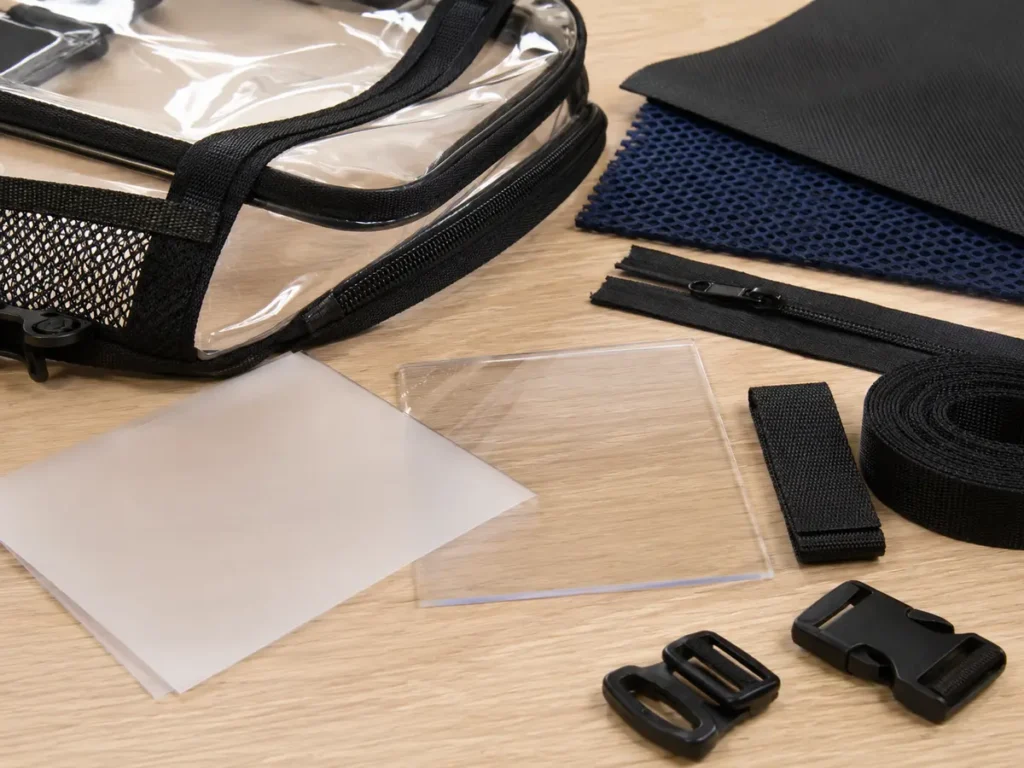
Most clear backpacks combine transparent film with woven reinforcement. Material selection affects clarity, flexibility, odor, cold-weather behavior, abrasion appearance, cost, and production technique.
Clear PVC Film
Flexible PVC is widely used for transparent bags because it can deliver clarity, structure, and economical production. The formulation and thickness strongly affect hand feel and performance. Buyers should not use “PVC” as a complete specification. Define the actual sample, film thickness or acceptable range, clarity standard, color/tint, low-temperature expectation, restricted-substance requirements, and destination market.
Phthalates are often discussed in connection with flexible PVC, but the applicable legal analysis depends on product classification, intended age, components, and jurisdiction. A generic “phthalate-free” request is not a substitute for a defined restricted-substance list, test method, laboratory scope, and pass criteria. Obtain compliance guidance for the actual program.
TPU Film
Thermoplastic polyurethane film can offer a softer hand and attractive clarity, depending on grade. It is commonly considered for buyers seeking a different feel or formulation approach. It can also raise material and processing costs. “TPU” does not guarantee a particular environmental, chemical, or durability outcome; the buyer still needs documented grade information and relevant testing.
Woven Polyester or Nylon Reinforcement
Opaque woven fabrics are used for the base, binding, straps, pocket borders, and back contact areas. These components carry stress and help prevent film edges from taking the full load. Specify fabric construction, color standard, coating if any, and abrasion expectations rather than relying only on a denier label.
Mesh, Webbing, Zippers, and Hardware
Spacer mesh can improve shoulder-strap comfort. Woven webbing stabilizes handles and adjustment points. Zipper chain, slider quality, pull size, and curved zipper geometry influence daily usability. Plastic hardware may help reduce metal content where required, but it must still be sized for the load. Side bottle pockets should be tall and elastic enough to retain the intended bottle.
Construction Details That Improve Durability
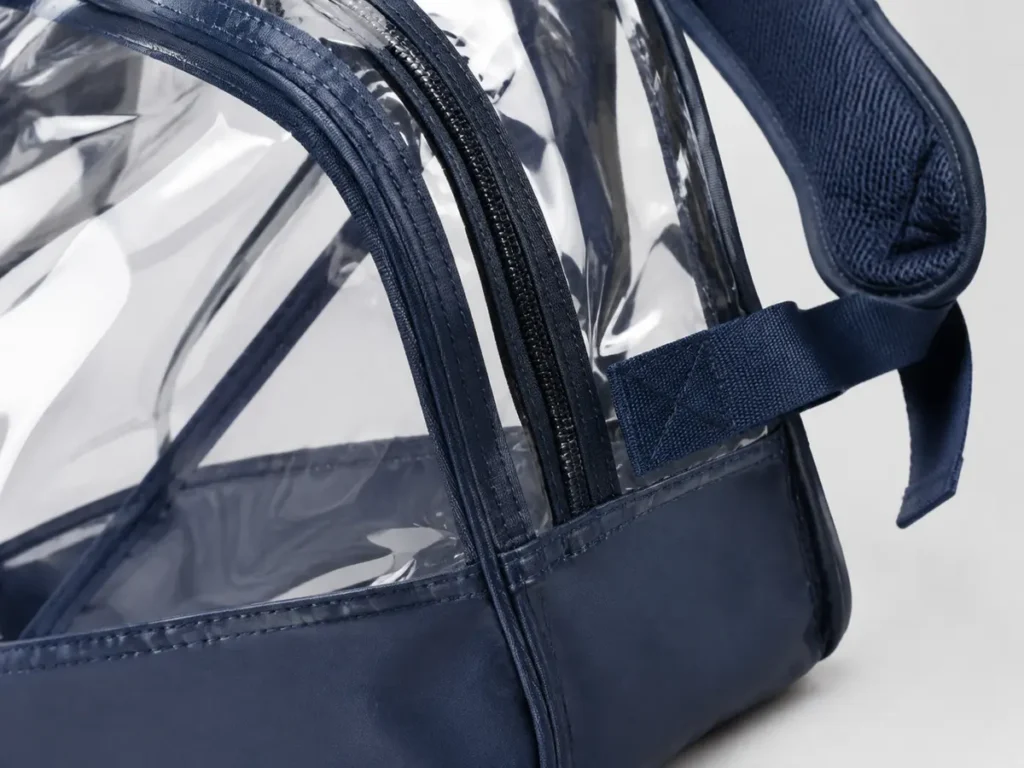
Clear film behaves differently from woven fabric. Needle holes do not recover, folds can whiten, and stress can concentrate at corners. Good construction distributes load into binding, webbing, and reinforced fabric zones.
Focus sample review on these areas:
- Strap anchors: Webbing should extend into a reinforced seam rather than terminate on an unsupported clear panel.
- Top handle: The handle should be secured to an opaque reinforcement or structural seam.
- Bottom panel: An opaque reinforced base helps resist abrasion and reduces stress from books and devices.
- Bound seams: Binding should fully capture the film edge without skipped stitches, puckering, or sharp exposed corners.
- Zipper ends: Start and stop points need reinforcement because users pull repeatedly in the same area.
- Curved openings: Smooth zipper geometry reduces jamming and local stress.
- Pocket corners: Rounded or reinforced corners are less likely to tear than sharp transitions.
- Stitch control: Stitch length must balance seam strength with the risk of perforating the film like a tear line.
Comfort and Student Usability
Transparency should not eliminate basic backpack ergonomics. Specify adjustable straps with enough range for the intended users and seasonal clothing. Padding should be broad enough to spread pressure without creating excessive opaque coverage. A lightweight bag is helpful, but weight claims should be measured on the approved sample.
During wear trials, check:
- Whether both straps remain comfortable with the expected packed load
- Whether the bag rides close enough to the back without sharp contents pressing through
- Whether strap tails can be managed without dragging
- Whether the top handle is comfortable for short carries
- Whether zipper pulls are easy to operate
- Whether bottle pockets retain the selected bottle while walking
- Whether clear panels become uncomfortably stiff in the expected climate
Privacy is also a usability issue. A transparent bag exposes medication, hygiene products, financial items, accessibility equipment, and personal information. Schools should provide clear guidance and an approved method for protecting sensitive items that does not undermine the written policy. The product should support that process only if the policy owner approves it.
Custom Clear Backpacks Without Blocking Visibility
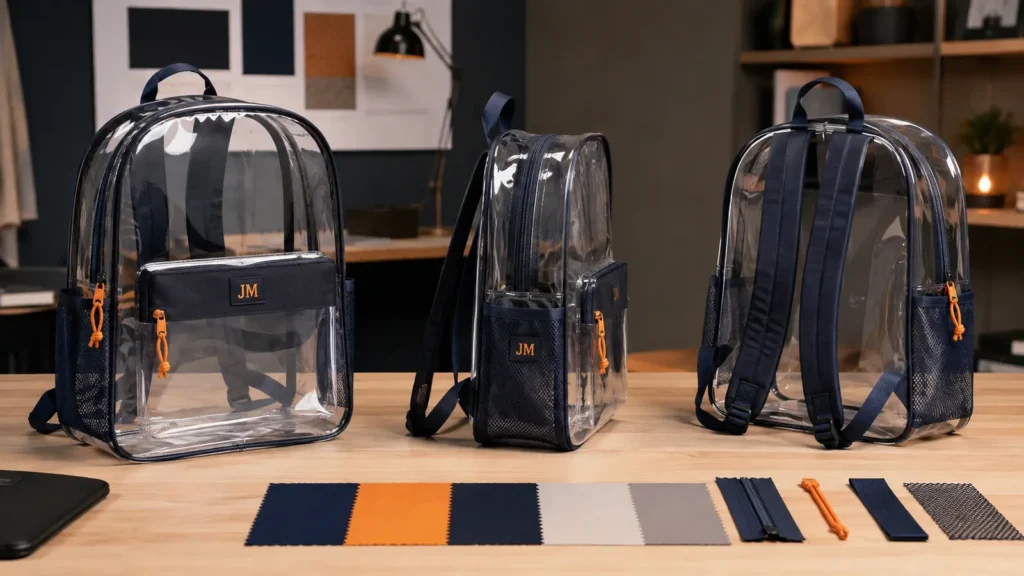
Schools and distributors often want colors, mascots, sponsor marks, student identifiers, or private labels. The safest design approach is to treat visibility as a fixed constraint and place branding on existing opaque areas.
Suitable options may include:
- Small embroidery on an opaque front-pocket border
- A compact woven label on a side seam
- A small rubber/PVC or leather-style patch on reinforced fabric
- Custom-colored binding, straps, webbing, and zipper tape
- Color-matched zipper pulls
- A private label inside an opaque seam area
- Customized packaging and carton marks
Large prints across the clear front panel, dense patterns, wide fabric appliqués, and oversized patches can reduce visible area. Even if technically attractive, they may conflict with a policy that prohibits obscuring decoration. Obtain written approval of the decoration layout before production.
Private-Label Specification Package
For an efficient quotation, send the supplier:
- Reference image or technical drawing
- Intended user and use case
- Applicable policy document or exact bag restrictions
- Finished dimensions and tolerance
- Expected packing list or capacity requirement
- Transparent material preference and required documentation
- Trim fabric, color references, and Pantone targets when needed
- Pocket layout, zipper configuration, and strap requirements
- Logo file, decoration method, maximum size, and placement
- Quantity by color or design
- Individual packaging, labels, carton marks, and barcode needs
- Destination country, delivery location, and required arrival date
- Sample quantity and approval process
- Testing or inspection requirements agreed with a qualified compliance adviser
Request a Clear Backpack Specification Review: Share your policy document, target dimensions, quantity, color, logo, packing list, destination, and required delivery date with JIUMU. We can review the product concept, prepare a quotation, and develop a sample for buyer approval. Explore custom team bags or contact JIUMU.
Cost Drivers in a Bulk Clear Backpack Order
Bulk price depends on the approved construction, not only order quantity. Important cost drivers include:
- Transparent film type, grade, thickness, and sourcing requirements
- Bag dimensions and total material consumption
- Number and complexity of compartments
- Opaque fabric, mesh, webbing, zipper, and hardware selections
- Padding and reinforced structural zones
- Decoration method, size, colors, and placements
- Custom labels, hangtags, barcodes, and packaging
- Sample rounds and testing scope
- Quantity per color or design rather than total quantity alone
- Quality inspection and destination logistics
- Delivery schedule and whether material must be specially developed
Consolidating colorways and using shared components can improve production efficiency. Removing reinforcement merely to lower the unit price may create a false economy if strap anchors, seams, or the base fail during normal use. Request a quote against a stable specification so suppliers are pricing the same product.
JIUMU’s typical MOQ is 50 pieces, subject to product structure and customization. Treat this as an initial planning reference; confirm the MOQ for the final clear backpack design and each color split.
Sample Approval and Quality-Control Checklist
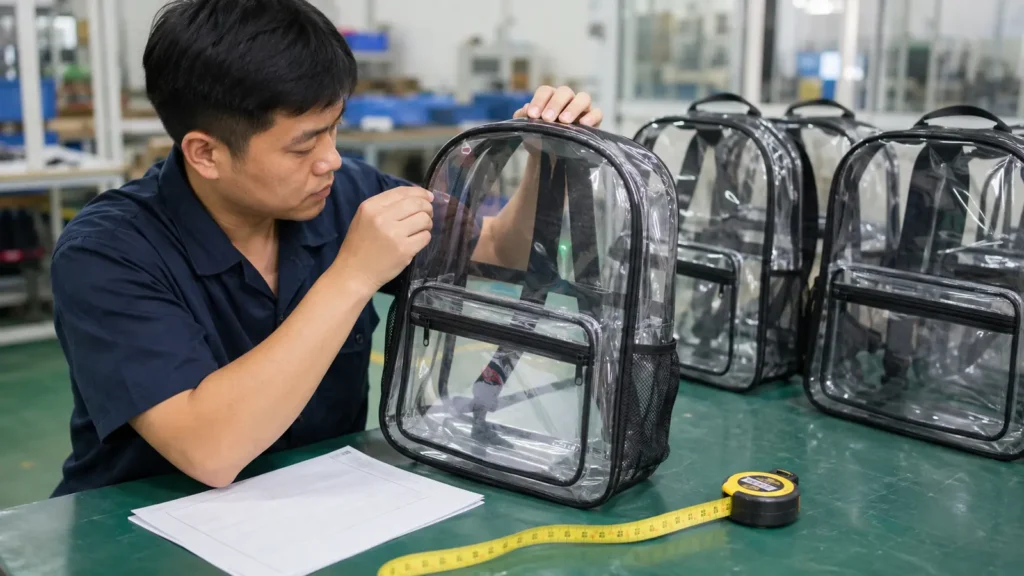
A digital mockup can confirm color placement and branding, but it cannot prove clarity, odor, stiffness, capacity, zipper behavior, or comfort. Approve a physical sample before bulk production.
Pre-Production Sample Review
| Inspection area | What to check | Approval record |
|---|---|---|
| Dimensions | Finished H × W × D using agreed method | Measured values and photos |
| Transparency | Tint, haze, distortion, scratches, and opaque coverage | Neutral-background photos and swatch approval |
| Capacity | Required contents fit and zipper closes normally | Packing list and packed photos |
| Construction | Binding, stitches, strap anchors, zipper ends, and base | Close-up images and comments |
| Comfort | Strap adjustment, padding, load position, and handle | Wear-trial notes |
| Decoration | Size, color, position, adhesion or stitch quality | Artwork version and signed sample |
| Components | Zippers, sliders, buckles, mesh, and webbing | Approved bill of materials |
| Packaging | Bag protection, labels, warnings, barcode, carton | Packing sample and marks |
| Documentation | Agreed material, test, inspection, and shipping records | Buyer compliance file |
Bulk Inspection Priorities
Bulk inspection should use the signed sample and final specification as references. Verify quantity and color breakdown, dimensions, panel clarity, scratches, contamination, seam consistency, zipper operation, strap symmetry, logo placement, packaging, and carton marks. Define sampling level and acceptance criteria before inspection; do not invent them after defects are found.
Transparent panels need extra handling care. Protective tissue or film may reduce abrasion in transit, but any protective layer must be clearly removable and should not create residue. Cartons should not compress bags so tightly that panels crease permanently.
A Practical Bulk-Ordering Process
1. Confirm the Policy
Collect the current written rules for every intended campus and event. Identify conflicts before designing the product.
2. Build the Specification
Define format, measurements, materials, capacity, construction, opaque coverage, colors, decoration, packaging, and documentation.
3. Request a Quotation and Feasibility Review
Send complete information to potential suppliers. Ask them to identify assumptions, component alternatives, MOQ, sample cost, and indicative production schedule.
4. Approve Materials and Artwork
Review transparent-film and trim swatches under neutral lighting. Lock the logo file, color references, location, and size.
5. Make and Pack-Test a Physical Sample
Use the actual intended contents. Measure the packed bag, wear it, inspect visibility, and ask the policy owner to review it when appropriate.
6. Freeze the Golden Sample
Record all approved changes and sign or otherwise identify the final reference sample. Do not authorize bulk production while major items remain “to be confirmed.”
7. Produce and Inspect
Use in-process checks for transparent panel handling, binding, strap anchors, and decoration. Complete a defined pre-shipment inspection.
8. Communicate the Rollout
Publish the approved bag type, dimensions, effective date, exceptions, and contact process. Remind users that possession of a clear bag does not override prohibited-item rules or inspection requirements.
Questions to Ask a Clear Backpack Supplier
- What transparent film options and thicknesses are available for this construction?
- Can you provide material identification and arrange the buyer-defined testing scope?
- How will strap and handle loads be transferred away from the clear panels?
- What opaque areas are structurally necessary?
- Can you meet the exact finished dimensions and tolerance after packing?
- How will clarity, tint, scratches, and panel contamination be inspected?
- What zipper, slider, webbing, mesh, and buckle options are available?
- Which decoration methods can stay within the approved opaque zones?
- Can you produce a fully decorated physical sample before bulk approval?
- How will panels be protected from scratching and creasing during shipment?
- What is the MOQ for the chosen design and each color split?
- What information is needed to confirm the production and delivery schedule?
- How will repeat-order materials and colors be controlled?
- What export and packaging documentation can be provided?
Common Buying Mistakes
Treating Every Clear-Bag Policy as the Same
This is the highest-risk mistake. A dimension or format accepted at one venue may be rejected at another. Always keep source documents and effective dates.
Choosing a Bag Only by Price
An inexpensive construction may omit base reinforcement, adequate binding, or secure strap anchors. Compare quotations against one written specification and approved sample.
Overdecorating the Transparent Surface
Large logos and patterns can defeat the product’s visibility purpose or violate a policy. Use trim colors and small approved marks.
Ignoring the Packed Depth
An empty bag may meet the size rule but exceed it once filled. Measure the sample under the agreed condition.
Relying Only on a Digital Mockup
Mockups cannot reveal material odor, stiffness, haze, zipper resistance, comfort, or real capacity. A physical sample is essential.
Making Unsupported Material Claims
Terms such as “non-toxic,” “eco-friendly,” “waterproof,” or “phthalate-free” require precise definitions and appropriate evidence. Use qualified claims linked to the exact component, test, standard, and product lot where applicable.
Forgetting Privacy and Exceptions
Transparent-bag programs can expose sensitive belongings. Policy owners should establish a respectful, accessible process for personal and medically necessary items.
Why Source Custom Clear Backpacks with JIUMU?
JIUMU is a Guangdong-based B2B supplier established in 2010, serving professional buyers in North America, the United Kingdom, Canada, and Europe. Its relevant capabilities include OEM/ODM development, fabric sourcing, Pantone color matching, embroidery, heat transfer, screen printing, woven and rubber/PVC patches, private labels, packaging customization, digital mockups, physical samples, bulk quality control, and export support.
For a clear backpack program, that capability set supports specification development, trim and component selection, limited branding, sample approval, and repeat-order documentation. JIUMU’s typical MOQ is 50 pieces, subject to the bag structure and customization. Buyers should share their policy, dimensions, materials, quantity, decoration, destination, documentation requirements, and target date for a project-specific assessment.
Frequently Asked Questions
Final Recommendation
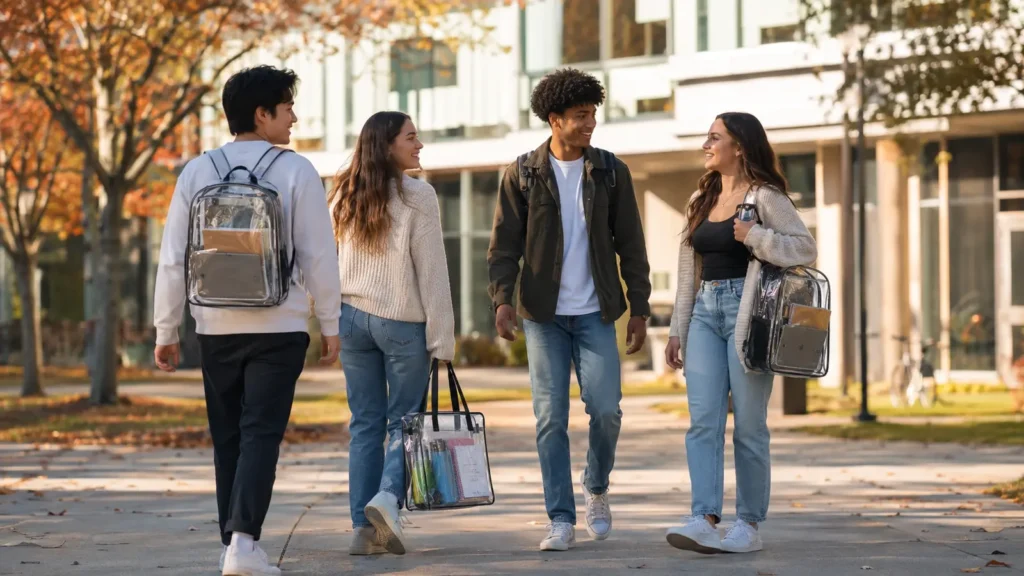
The best clear backpacks for school and campus security balance five requirements: written policy fit, unobstructed visibility, practical capacity, comfortable durable construction, and controlled customization. Start with the rule, not with a retail product photo. Translate that rule into measurable dimensions and allowed features, develop a physical sample, pack-test it, obtain stakeholder approval, and inspect bulk production against the signed reference.
Request a Custom Clear Backpack Quotation: Send JIUMU your policy document, reference image or tech pack, finished dimensions, quantity, colors, logo, capacity requirement, packaging, destination, compliance scope, and target delivery date. Email zhengdong@jiumugear.com, WhatsApp +86 18507502899, or use the JIUMU contact page.