Best Materials for Custom Team Jerseys: A B2B Buyer’s Guide
Choosing a jersey material is not simply a matter of selecting “polyester” from a supplier’s catalog. Fiber content is only the starting point. Fabric weight, knit structure, stretch, opacity, airflow, surface texture, decoration method, and care requirements all affect how a uniform looks, performs, and survives a season.
For schools, clubs, distributors, uniform dealers, and private-label brands, the material decision also affects sampling time, repeat-order consistency, landed cost, and customer complaints. A light soccer jersey and a structured baseball jersey can both be labeled 100% polyester, yet behave very differently in wear and production.
This guide explains the best materials for custom team jerseys, where each option works, which specifications to confirm, and how to approve fabric before a bulk order.
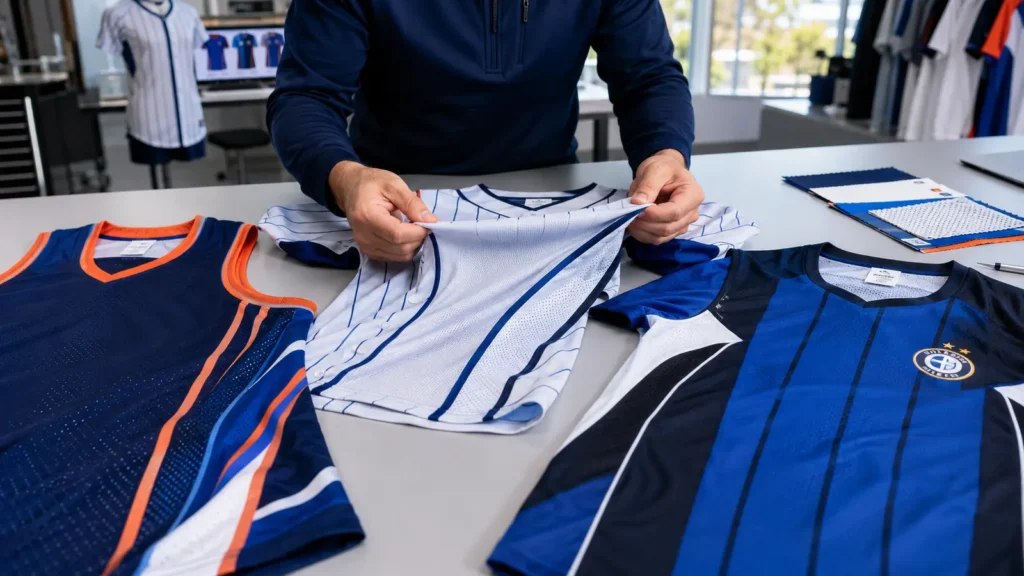
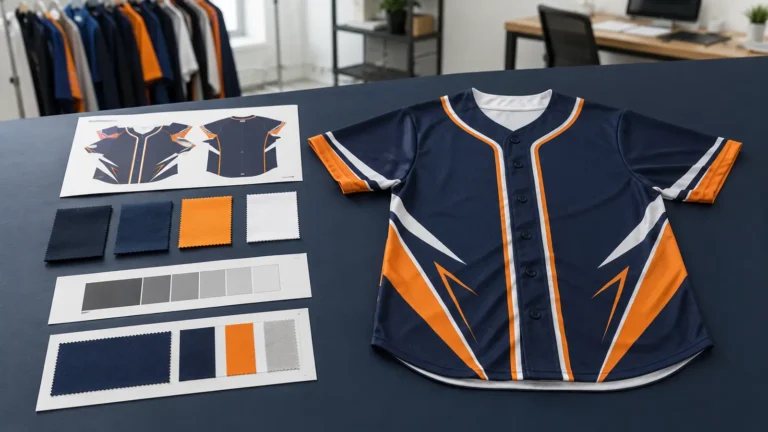
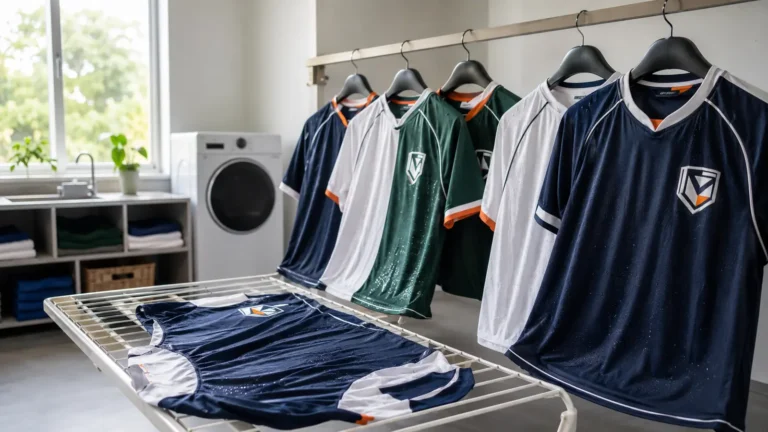
Custom team jersey materials reviewed in a professional apparel studio
Quick Answer
For most custom performance team jerseys, 100% polyester is the best all-around fiber because it is durable, quick-drying, dimensionally stable, and compatible with full-color sublimation. The exact fabric should still be selected by sport:
- Choose lightweight polyester interlock or birdseye mesh for soccer, basketball, volleyball, and warm-weather training.
- Choose medium- or heavyweight double-knit polyester for baseball, softball, and structured button-front jerseys.
- Choose polyester with a small elastane or spandex content when the pattern requires close fit, four-way stretch, or greater mobility.
- Use mesh as a full-body fabric only when transparency and snagging are controlled; otherwise place it in ventilation panels.
- Choose recycled polyester when verified recycled content is part of the brand brief, but approve performance and documentation rather than assuming it is automatically equivalent.
- Reserve cotton and cotton-rich blends mainly for retro jerseys, fanwear, training tops, and lifestyle merchandise rather than high-sweat competition use.
There is no universally best jersey fabric. The best specification is the one that balances the sport, climate, fit, decoration, wash routine, budget, and target retail position.
What to Request With a Jersey Fabric Sample
Ask the supplier to identify fiber composition, knit construction, finished weight, usable width, stretch direction, opacity, surface finish, color reference, decoration compatibility, and relevant test results. Review the actual fabric with the intended print, embroidery, patch, or twill application, then approve a production-intent garment sample before bulk manufacturing.
Compare custom team jersey options and printed versus stitched decoration methods, then request a jersey material quotation with your sport and performance requirements.
Why Jersey Material Selection Matters in Bulk Orders
Material affects player comfort, decoration, garment shape, repeat-order consistency, and claims. A fabric that feels acceptable in an air-conditioned sample room may become heavy, clingy, or transparent during play. Sublimation requires a suitable synthetic base, while heavy embroidery can distort a very light knit. Collar recovery, shoulder stability, and hem drape depend on construction as much as fiber.
A generic description such as “sports polyester” leaves too much room for variation. A repeatable specification should identify composition, knit, weight, color, finish, and an approved physical sample.
Professional buyers should therefore approve the material and the finished jersey as two connected but separate items. A fabric may pass inspection as a roll yet fail in the finished garment because the sewing, printing, trim, or pattern is unsuitable.
Jersey Material Comparison
| Material option | Main strengths | Main limitations | Best uses | Decoration compatibility |
|---|---|---|---|---|
| 100% polyester interlock | Smooth face, good print clarity, stable, versatile | Airflow depends on knit and finish | Soccer, volleyball, basketball, training jerseys | Sublimation, heat transfer, screen print, light embroidery |
| Polyester birdseye or micro mesh | Breathable appearance, lighter hand, fast drying | May be more transparent or prone to snagging | Basketball, practice wear, side and underarm panels | Sublimation, heat transfer, selected screen print |
| Polyester double knit | More body, opacity, abrasion resistance, structured drape | Heavier and warmer | Baseball, softball, hockey-inspired fashion jerseys | Embroidery, tackle twill, patches, screen print, sublimation where suitable |
| Polyester-spandex blend | Stretch, recovery, close athletic fit | Higher cost; heat and print processes need control | Compression-fit jerseys, cycling-inspired tops, fitted sleeves and panels | Sublimation on suitable fabric, heat transfer, light embroidery |
| Recycled polyester | Supports verified recycled-content sourcing goals | Documentation, color consistency, and availability must be checked | Clubs, schools, and brands with a defined material policy | Usually similar to comparable virgin-polyester constructions after approval |
| Cotton-polyester blend | Softer casual hand, familiar lifestyle look | Absorbs more moisture than polyester-rich performance fabrics; limited sublimation options | Retro jerseys, fanwear, staff tops, promotional apparel | Screen print, embroidery, heat transfer |
| Nylon or nylon blends | Smooth hand, toughness, stretch potential | Dyeing, heat sensitivity, and decoration need specific development | Specialty performance panels and selected premium designs | Heat transfer and print systems approved for nylon; embroidery with stabilization |
The table compares broad material families. It does not replace a fabric specification. Two 150 GSM polyester fabrics can differ in yarn, knit density, finish, stretch, opacity, and color response.
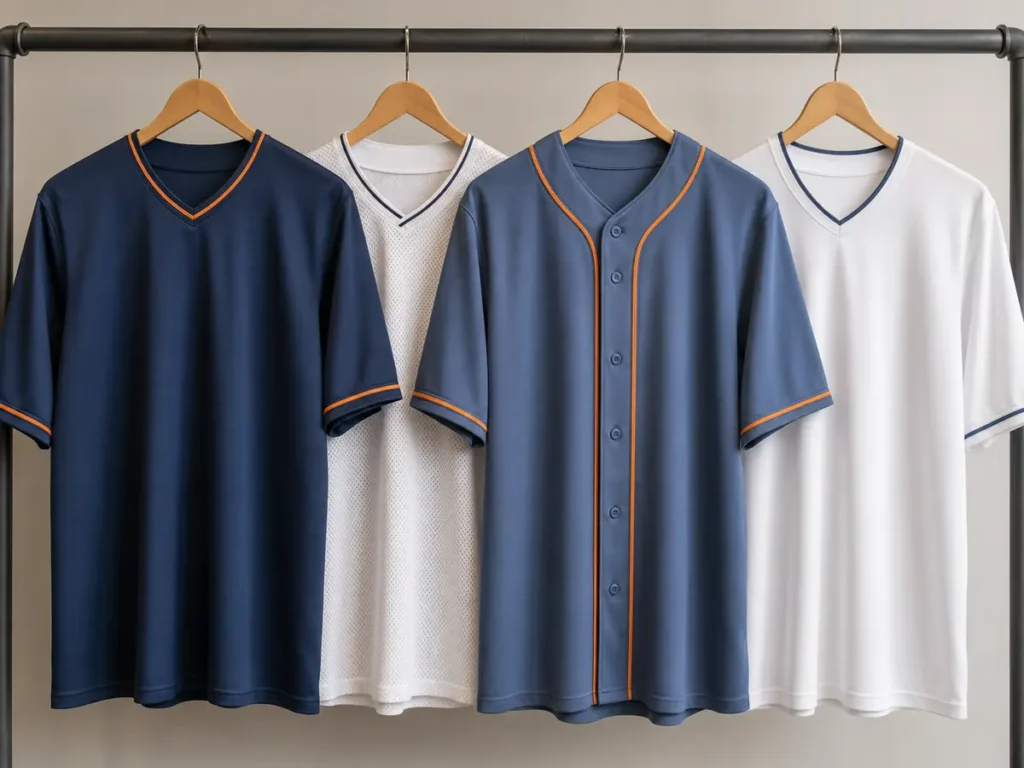
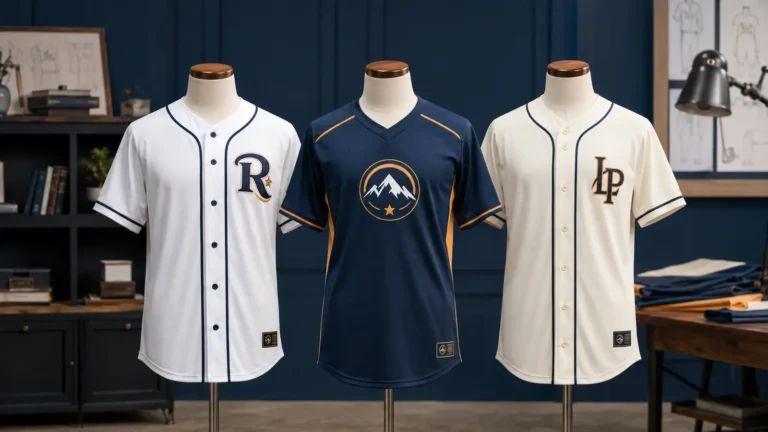
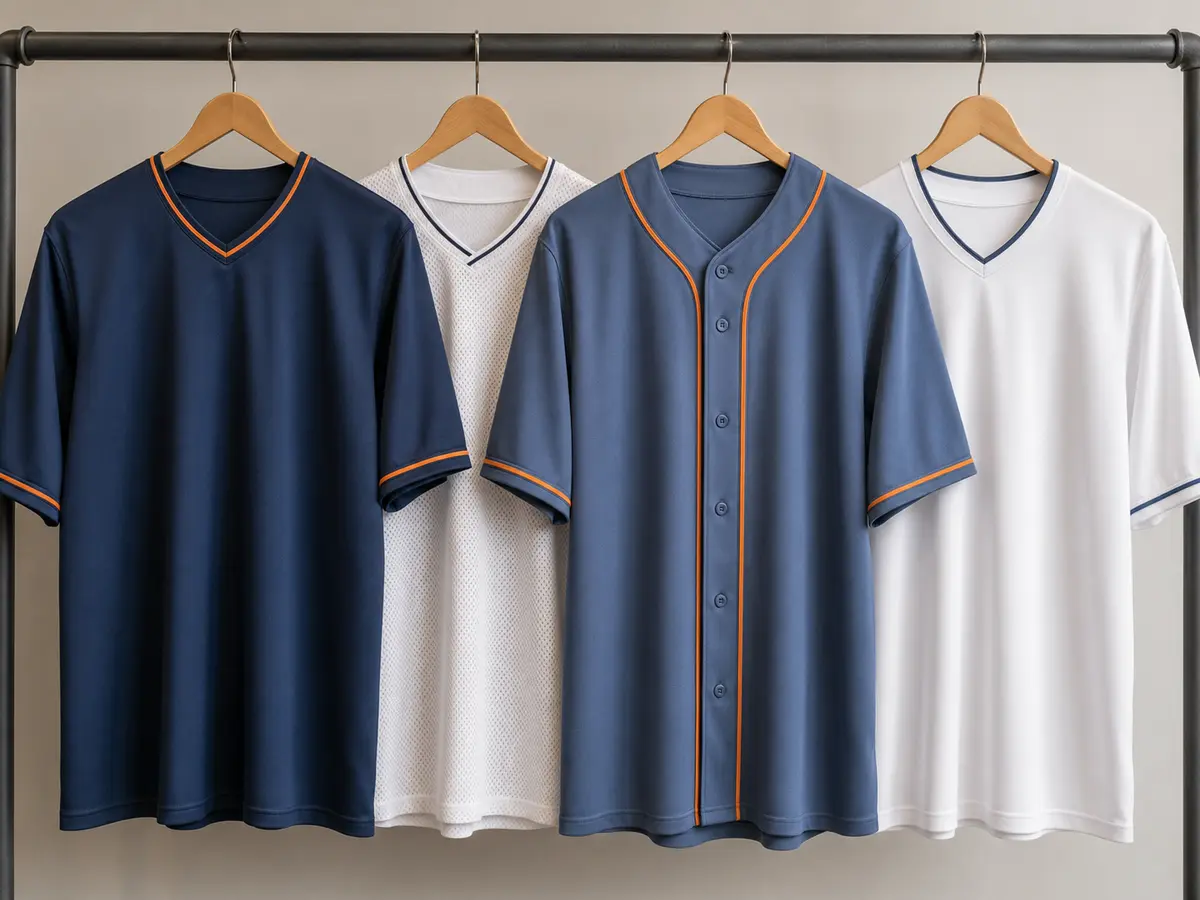
Four custom jersey constructions displayed on one garment rail
Fiber Content and Fabric Construction Are Not the Same
Buyers often request “100% polyester” and assume they have defined the material. In reality, fiber content tells you what the yarn is made from; construction tells you how the yarn becomes fabric.
Interlock has a smooth, relatively stable surface suited to clear graphics and controlled drape. Birdseye and micro mesh use openings or textured structures; hole size and density affect airflow and transparency. Double knit generally provides more body for baseball and similar jerseys. Piqué offers a raised texture, while single jersey knit is lighter and more flexible but usually less structured.
When comparing quotations, confirm both composition and construction. If one supplier quotes 140 GSM interlock and another quotes 180 GSM double knit, the prices are not based on equivalent products.
The Best Material Options for Custom Team Jerseys
1. 100% Polyester Interlock: The Most Versatile Choice
Polyester interlock is the safest starting point for many programs. It can provide a smooth print surface, reliable color, moderate stretch, and a clean silhouette. Polyester is strong, durable, crease-resistant, and quick to dry, according to Textile Exchange’s overview of synthetic fibers.
For sublimated jerseys, a white or light-colored polyester base allows the graphic to be transferred into the fabric rather than placed as a thick layer on top. This works well for gradients, all-over patterns, sponsor graphics, and individually personalized names and numbers.
However, “interlock” does not guarantee breathability or quality. Ask for the GSM, knit density, stretch direction, opacity, and finish. A dense interlock can feel warm; an overly light interlock can become transparent when stretched.
Best for: soccer, volleyball, basketball, esports, training jerseys, and multi-sport school programs.
2. Polyester Mesh: Best Used with a Clear Ventilation Plan
Mesh performance depends on the size and distribution of openings, garment fit, and layering. Large holes may ventilate well but show an undershirt or skin; fine micro mesh looks more polished but can provide less airflow.
Mesh works especially well in side panels, underarms, upper back sections, or reversible basketball jerseys. Strategic placement can improve ventilation while the main fabric maintains opacity and supports graphics.
Before approving mesh, stretch it over a contrasting background, inspect snag resistance, and test the exact decoration. Fine lines and small sponsor marks may look less crisp on an open structure.
Best for: basketball, training, warm-climate use, reversible jerseys, and ventilation panels.
3. Double-Knit Polyester: Best for Structure and Durability
Baseball and softball jerseys often need more body than lightweight field-sport tops. A denser double knit supports button plackets, piping, embroidery, patches, and tackle-twill numbers. It also tends to be more opaque and less clingy.
The tradeoff is weight and heat. A hot-climate club may prefer a medium-weight body with lighter mesh underarms. Distributors can offer approved standard and lightweight options for different regions.
Best for: baseball, softball, hockey-style fashion jerseys, premium fan jerseys, and applications using stitched decoration.
4. Polyester-Spandex: Best for Stretch and Athletic Fit
A polyester-spandex blend is useful when the garment is intended to sit closer to the body or when panels need more recovery. It can improve movement in fitted sleeves, shoulder inserts, side panels, and cycling-inspired silhouettes.
More stretch is not always better. It can make a jersey cling, distort logos, or create inconsistent measurements. Specify stretch direction and recovery, then evaluate the printed garment before and after laundering.
Best for: close-fit soccer tops, performance sleeves, fitted women’s cuts, specialty training garments, and mobility panels.
5. Recycled Polyester: Best When Documentation Is Part of the Specification
Recycled polyester can be made from mechanically or chemically recycled polyester feedstock. Textile Exchange notes that inputs and processes vary; its polyester resource provides sourcing context.
Treat a recycled claim as a documentation requirement. Confirm available evidence, color and construction availability, minimums, shade, hand feel, print response, pilling, and wash behavior.
Best for: brands, clubs, and schools with a defined and verifiable responsible-material policy.
6. Cotton and Cotton-Poly Blends: Best for Lifestyle and Retro Programs
Cotton provides a familiar soft hand. A cotton-poly blend can improve shape retention and drying while keeping a casual feel. Cotton absorbs moisture, becomes heavier when wet, and does not support standard polyester sublimation in the same way.
Cotton-rich fabrics are therefore more suitable for heritage baseball concepts, fan merchandise, coach tops, school spiritwear, and off-field collections.
Best for: retro team jerseys, fanwear, promotional tops, and lifestyle extensions.
Which Jersey Material Is Best by Sport?
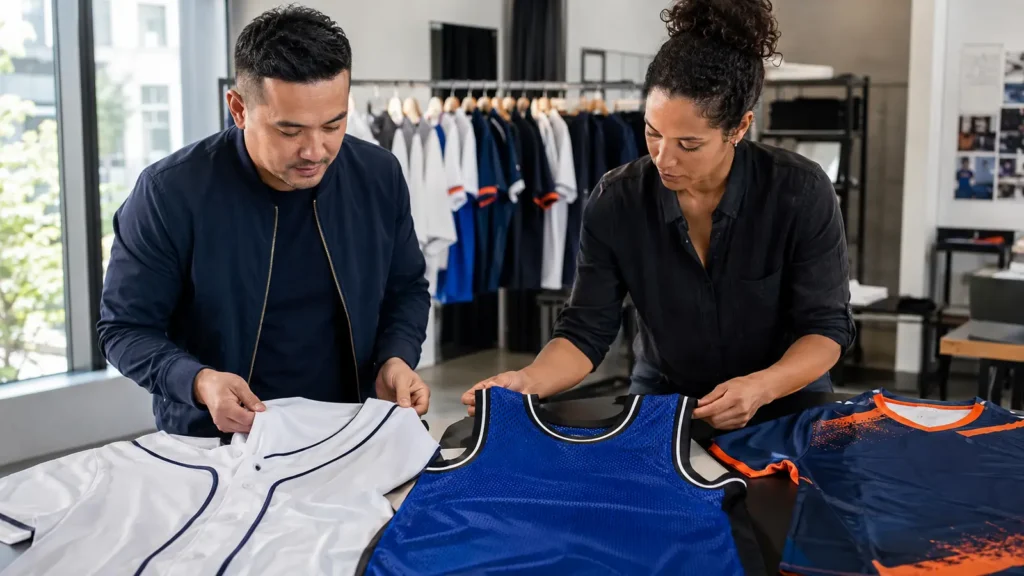
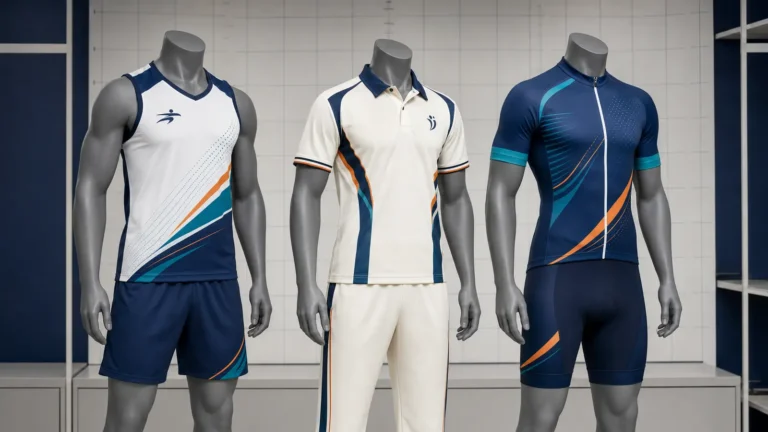
A teamwear buyer compares baseball, basketball, and soccer jersey materials
| Sport or program | Recommended starting material | Useful configuration | Main approval concern |
|---|---|---|---|
| Baseball and softball | Medium-weight polyester double knit | Mesh underarm panels; rib or self-fabric collar; reinforced placket | Heat, embroidery support, piping alignment, opacity |
| Soccer | Lightweight polyester interlock | Mesh back or side panels; optional stretch inserts | Airflow, snagging, wet opacity, print clarity |
| Basketball | Lightweight interlock or micro mesh | Reversible construction or mesh side panels | Transparency, armhole recovery, decoration on open knit |
| American football | Durable polyester knit with stretch panels as needed | Reinforced shoulders; panel-specific weights | Abrasion, seam strength, pad fit, number durability |
| Hockey | Structured polyester knit plus ventilating panels | Reinforced elbows or shoulders depending on level | Snagging, sleeve length, patch weight, colorfastness |
| Volleyball | Lightweight interlock or polyester-spandex | Fitted women’s and unisex patterns; breathable back | Recovery, body mapping, print distortion |
| Esports | Smooth lightweight polyester interlock | Zipped neck, polo collar, or V-neck | Comfort for long wear, sponsor-mark clarity, hand feel |
| School multi-sport | Versatile polyester interlock | Standardized color library and shared trims | Repeat-order consistency and size continuity |
| Fan and merchandise | Double knit, cotton-poly, or polyester interlock | Retail fit, woven labels, premium decoration | Hand feel, retail appearance, care communication |
The recommendation should also reflect the playing environment. Indoor leagues may prioritize soft hand and visual finish; outdoor summer programs may prioritize low weight and ventilation; contact sports need stronger fabrics and seams.
How to Specify Jersey Fabric Correctly
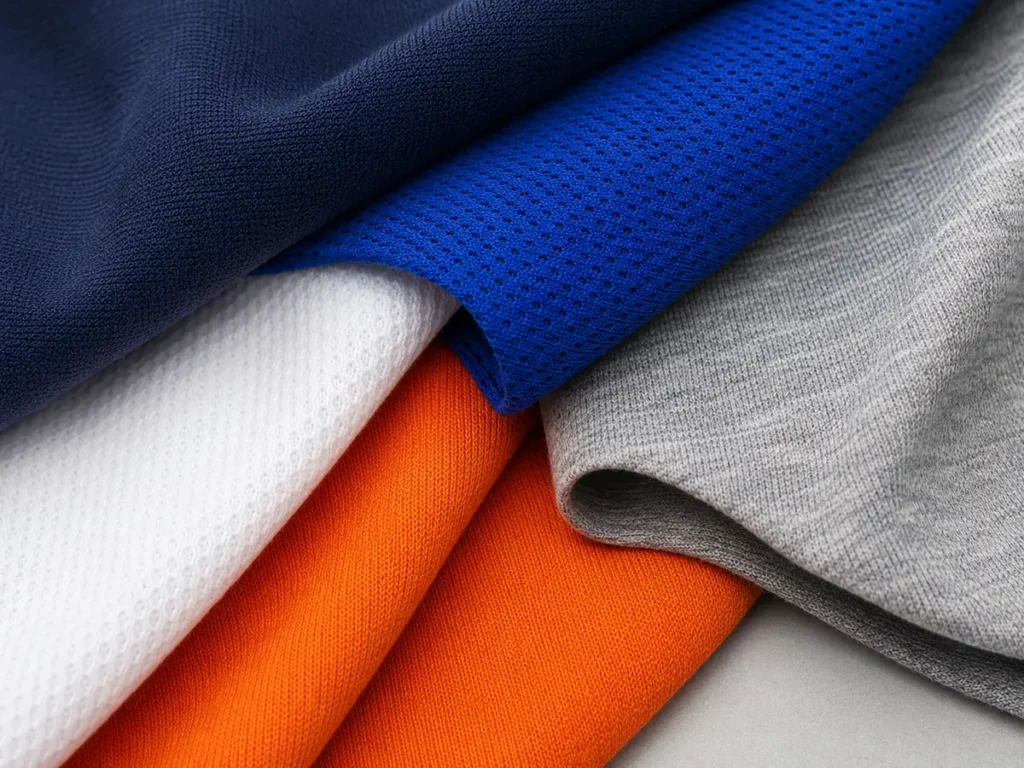
Macro view of polyester interlock, mesh, double knit, stretch knit, and cotton-blend jersey fabrics
A usable purchasing specification should go beyond a fabric name.
Composition
State the percentage of each fiber, such as 100% polyester or 92% polyester/8% elastane. If recycled content is claimed, identify how it will be verified and shown on labels or supporting documents.
Fabric Weight
Weight is commonly expressed in grams per square meter (GSM). It helps compare options but does not independently determine durability or opacity. Define an agreed measurement method and tolerance.
Knit Structure
Specify interlock, birdseye, micro mesh, double knit, single jersey, or another approved construction. Include a physical swatch because naming conventions differ between mills and markets.
Stretch and Recovery
Define two-way or four-way stretch, direction, and acceptable recovery. Assess the finished printed fabric when heat processing is involved.
Opacity
Check white and light colors over skin-tone and dark backgrounds, both relaxed and stretched. Basketball armholes, fitted soccer jerseys, and mesh panels deserve special attention.
Moisture Management and Finish
For “moisture-wicking,” “antimicrobial,” or “UV-protective” claims, define a recognized test, required result, wash durability, and responsible testing party.
Color
Pantone references are useful targets, but the final approval should be based on a material-specific lab dip, strike-off, or sample viewed under agreed lighting. The same color may appear different on mesh, rib, sublimated interlock, embroidery thread, and piping.
Hand Feel and Surface
Confirm whether the target is smooth, matte, brushed, cool-touch, firm, or soft. Surface texture affects print sharpness, snagging, perceived value, and how the jersey photographs online.
Match the Material to the Decoration Method
Sublimation
Sublimation is usually the most flexible option for full-color polyester jerseys. It supports gradients, all-over graphics, multiple sponsor marks, and individualized names and numbers without adding a heavy surface layer. The fabric must be suitable for the transfer temperature, and the supplier should control color migration, white creasing, and print alignment.
Embroidery
Embroidery gives logos and badges a dimensional stitched appearance. Dense embroidery can pull or ripple a lightweight knit, so backing, stitch count, needle, and placement must be developed together. A structured double knit generally supports heavier embroidery better than ultra-light mesh.
Tackle Twill and Appliqué
Layered fabric letters and numbers create a traditional baseball, football, or hockey look. They add weight and stiffness. The body fabric and seam construction should support the application, especially on youth sizes.
Heat Transfer
Heat transfer works for names, numbers, sponsor logos, and short runs. Adhesive, film type, temperature, pressure, and dwell time must match the base fabric. Stretch garments require a compatible transfer, and dark polyester may need migration-resistant materials.
Screen Printing
Screen printing can be efficient for repeated designs and suitable quantities. Open mesh, stretch, heavy ink coverage, and highly detailed art require special development. Approve the printed garment after laundering, not only a fresh print.
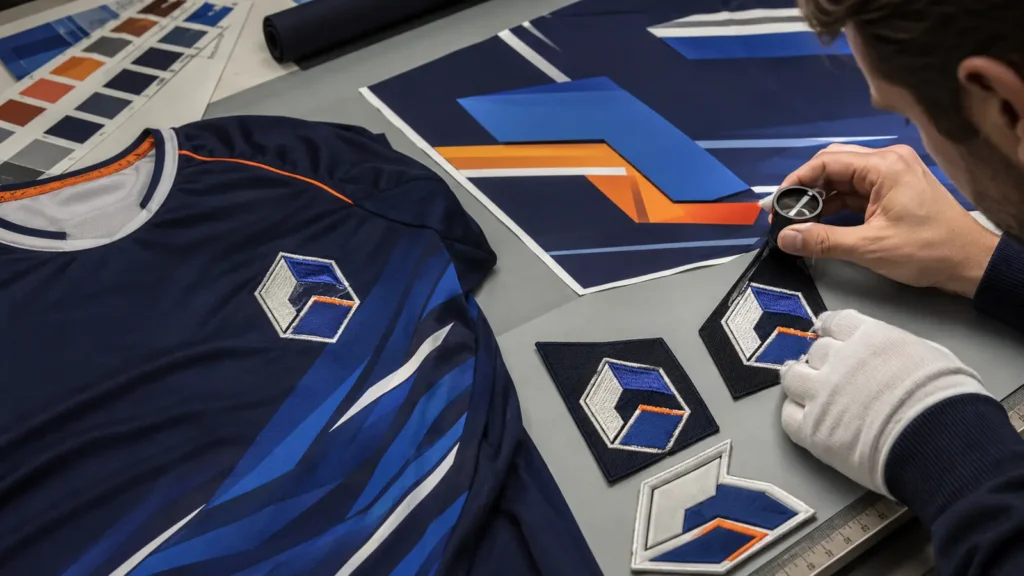
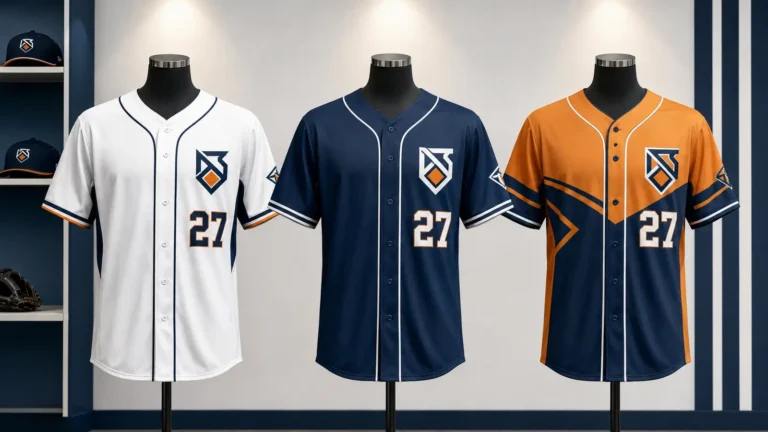
Designer inspects sublimation, embroidery, woven patch, and tackle-twill options
Planning a custom teamwear order? Send JIUMU your sport, quantity, size range, target fabric weight, colors, artwork, decoration method, packaging needs, and required delivery date. A digital mockup and physical sample can then be developed around one controlled specification.
Construction Details That Improve Jersey Durability
The best fabric can still produce a weak jersey if the construction is unsuitable.
High-stress areas should use an appropriate seam type and sufficient seam allowance. Shoulder seams, armholes, side seams, and panel junctions should lie flat without skipped stitches, puckering, or exposed raw edges. Contact-sport jerseys may need reinforcement based on the actual wear zone.
Collars and cuffs require reliable recovery. Rib knit should be matched for color, stretch, and wash behavior. Button-front baseball jerseys need a stable placket that remains straight after decoration and laundering. Mesh panels should transition cleanly into solid fabric without creating a weak seam intersection.
Decoration must also be assessed as part of construction. Check whether embroidery backing scratches the skin, whether appliqué corners lift, whether heat transfers bridge over mesh holes, and whether sublimated patterns align across front openings and panels.
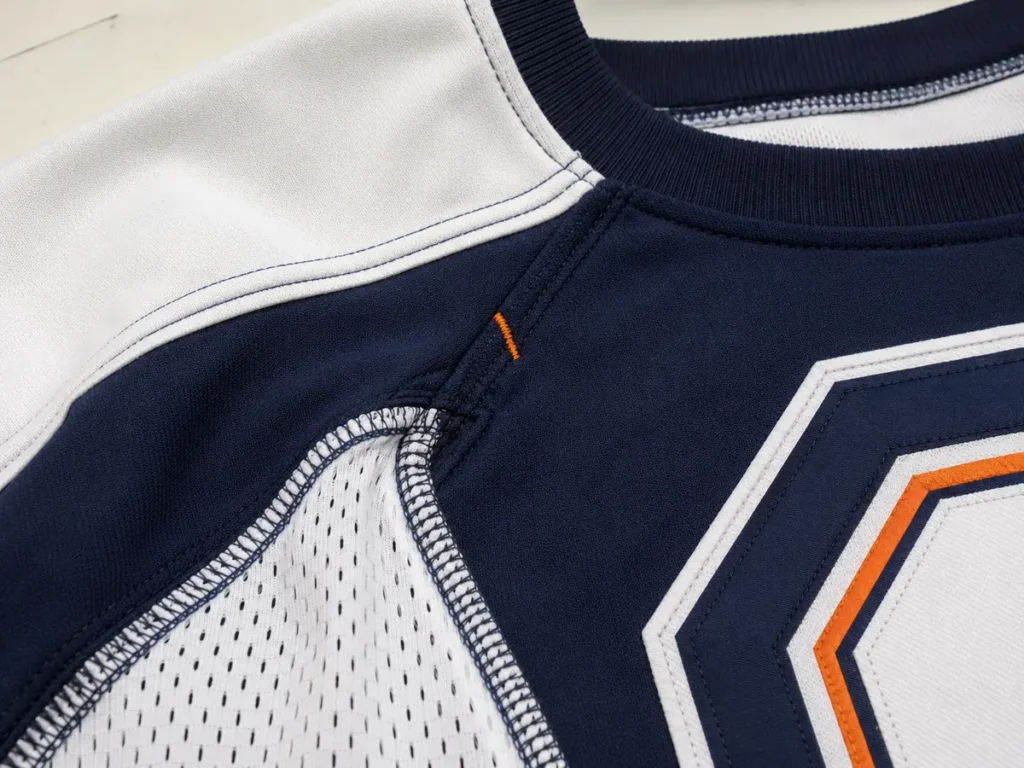
Close-up of reinforced seams, mesh panel, rib collar, and stitched jersey decoration
Quality-Control Tests Buyers Should Request
Testing should reflect the risk and order value. A school reorder may need practical wash and measurement checks; a private-label retail program may require formal third-party testing to a defined protocol.
Useful evaluation areas include:
- Fiber composition: confirm labeled material, especially blends and recycled claims.
- Dimensional change: measure before and after agreed laundering. AATCC TM135 addresses dimensional change in fabrics after home laundering.
- Colorfastness to laundering: assess shade change and staining. ISO 105-C06 covers resistance to laundering procedures.
- Colorfastness to rubbing: important for dark colors and prints. ISO 105-X12 covers dry and wet rubbing.
- Perspiration colorfastness: AATCC lists relevant methods in its standards catalog.
- Abrasion: useful where fabric rubs against pads, bags, benches, or playing surfaces. ISO 12947-2 specifies a Martindale procedure for determining specimen breakdown.
- Pilling and snagging: especially important for mesh, brushed surfaces, and contact sports.
- Seam strength and seam slippage: confirm that the construction withstands realistic movement.
- Stretch and recovery: measure after extension, heat processing, and laundering.
- Decoration durability: inspect cracking, lifting, migration, puckering, and loose threads after washing.
Do not ask only whether a fabric “passes.” Define the method, sample condition, test cycles, required grade or tolerance, and whether the result applies to the exact bulk material.
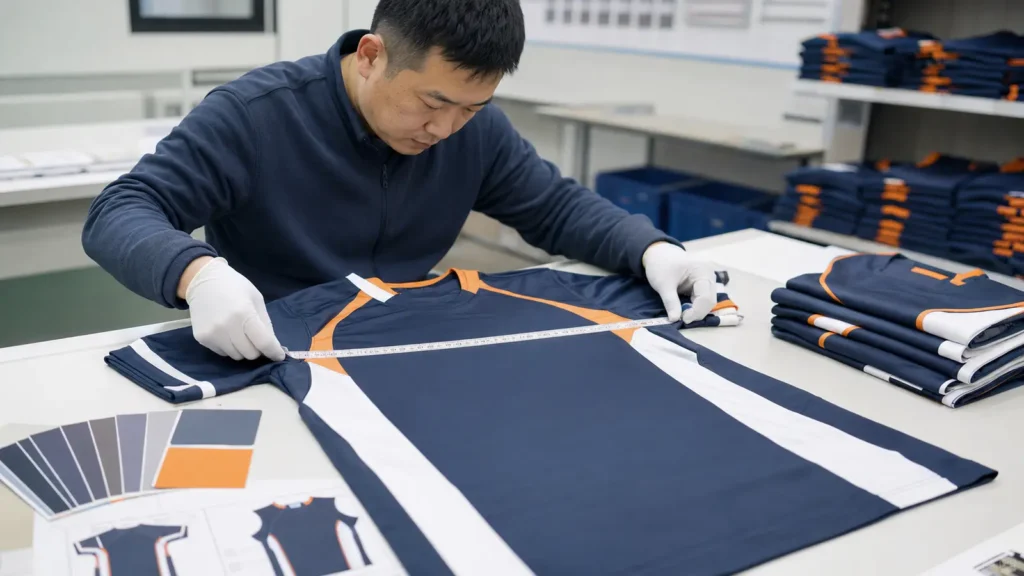
Quality inspector measures and checks a finished custom team jersey
Sample Approval and Bulk-Order Control
A disciplined approval process reduces arguments later.
- Approve a fabric swatch. Confirm composition, construction, GSM, stretch, opacity, hand feel, and color.
- Approve a decoration strike-off. Check actual artwork, colors, small details, and adhesion or stitch quality on the chosen fabric.
- Approve a size-set or pre-production sample. Review fit, measurements, panel shape, collar, seam quality, print placement, labels, and packaging.
- Record the approved standard. Keep the signed physical sample, swatch code, color references, measurement chart, artwork version, and packaging specification.
- Inspect production. Compare bulk units with the approved sample and defined tolerances. Use random checks across colors and sizes rather than inspecting only one convenient piece.
- Retain reference units. A sealed production reference helps manage reorders and investigate future claims.
Photography is useful for communication, but it is not a complete color or material standard. Lighting, cameras, and screens can shift appearance. Critical approvals should include physical material wherever possible.
Labeling and Buyer Compliance Considerations
Destination-market requirements should be reviewed before bulk production.
In the United States, the Federal Trade Commission states that manufacturers and importers of textile wearing apparel generally must provide care instructions under the Care Labeling Rule.
In the European Union, products made up of at least 80% textile fibers by weight generally require firmly attached fiber-composition labels. Buyers should confirm the full requirements and destination-language rules in the official EU textile-label guidance.
If harmful-substance certification is required, confirm scope and validity. OEKO-TEX STANDARD 100 applies to textiles tested for harmful substances, but a finished jersey is not automatically certified because a similar fabric is available.
This guide is commercial sourcing information, not legal advice. Importers and brand owners remain responsible for confirming the rules that apply to the final product and market.
What Drives the Cost of Jersey Materials?
Fiber name alone does not determine price. Key cost drivers include:
- Fabric weight and yarn specification
- Knit density and complexity
- Elastane content
- Recycled-content documentation
- Special finishes and required testing
- Custom-dyed fabric versus stock colors
- Minimum fabric quantity by color
- Number of body and mesh materials in one style
- Decoration type, coverage, and stitch count
- Individually personalized names and numbers
- Pattern complexity and size range
- Private labels, hangtags, individual bags, and cartons
- Inspection requirements and retained samples
A cheaper fabric can raise the finished cost if it requires extra lining, causes print rejects, or produces customer complaints. Compare complete approved jerseys, not only price per meter or price per piece.
Information to Send for an Accurate Quotation
Provide as much of the following as possible:
- Sport and intended level of play
- Buyer type: school, club, distributor, brand, or promotional program
- Estimated quantity by style and color
- Youth and adult size range
- Preferred fit: relaxed, standard, athletic, or compression
- Reference image or tech pack
- Fabric preference, target GSM, and performance priorities
- Main color and trim colors, with Pantone targets if available
- Logo files and decoration method
- Player names, numbers, and roster format
- Label, hangtag, and packaging requirements
- Required testing or documentation
- Destination country and delivery location
- Target delivery date
- Reorder expectations
If the buyer does not yet know the fabric, define the use case rather than guessing a technical answer. A supplier can propose two or three controlled options for sampling.
Questions to Ask a Custom Jersey Supplier
- What are the exact fiber composition, knit structure, and GSM?
- Is the quoted fabric a stocked material or a custom development?
- What color and quantity minimums apply?
- Can the supplier provide swatches before the garment sample?
- Which decoration methods are validated for this fabric?
- How will white creasing, dye migration, or print misalignment be controlled?
- What measurement, color, and workmanship tolerances will apply?
- Which test methods and acceptance criteria can be arranged?
- How are size sets and pre-production samples approved?
- How will bulk fabric be matched to the approved swatch?
- What records support repeat orders and material claims?
- How are defects, shortages, labels, and packaging handled?
Clear answers are more useful than broad claims such as “premium fabric” or “professional quality.”
Common Jersey Material Buying Mistakes
Choosing by GSM alone. Weight cannot describe knit quality, stretch, opacity, or finishing.
Approving color on a screen only. Digital displays are not reliable physical color standards.
Using one fabric for every sport. A universal fabric may simplify purchasing but compromise heat management, structure, or decoration.
Ignoring light-color transparency. White and pastel samples should be inspected both relaxed and stretched.
Adding heavy embroidery to ultralight fabric. The result may pucker or sag even if both components are individually acceptable.
Accepting unqualified performance claims. “Wicking,” “antimicrobial,” “UV,” and “eco-friendly” need defined evidence.
Skipping a wash test. Fit, shade, seam appearance, labels, and decoration should be reviewed after care, not only when new.
Changing material after sample approval. Any substitution should trigger renewed approval of the affected color, print, fit, and performance.
Failing to plan reorders. Keep fabric codes, swatches, artwork versions, and reference garments; still allow for reasonable lot-to-lot variation.
Why Buyers Work with JIUMU
JIUMU supports B2B custom teamwear programs for schools, teams, clubs, distributors, uniform dealers, promotional buyers, retailers, and private-label brands in North America and Europe.
The available development scope includes OEM and ODM support, fabric sourcing, Pantone color matching, digital mockups, physical samples, and bulk production coordination. Decoration options include sublimation, embroidery, screen printing, heat transfer, and woven, rubber/PVC, or leather-style patches. Private labels, neck labels, woven labels, hangtags, and packaging can be integrated into the specification.
The typical MOQ is 50 pieces, subject to the jersey construction and customization. Buyers can also combine jerseys with coordinated products through custom team uniforms, custom team jerseys, or a baseball team uniform package.
JIUMU’s role is to help turn a visual idea into a controlled order specification. The material recommendation should be confirmed through sampling rather than treated as a one-size-fits-all promise.
Frequently Asked Questions
Final Recommendation
The best materials for custom team jerseys are selected by matching the fabric to the real use case.
Start with polyester interlock for versatile performance jerseys, mesh for controlled ventilation, double knit for structured and stitched styles, and polyester-spandex where stretch is genuinely needed. Consider recycled polyester when verified content is part of the procurement brief. Use cotton-rich materials mainly for casual, retro, and merchandise programs.
Then turn the choice into a measurable specification: composition, construction, GSM, stretch, opacity, color, finish, decoration, care, test requirements, and approved physical sample. That process does more to protect quality than choosing a material by name or price alone.

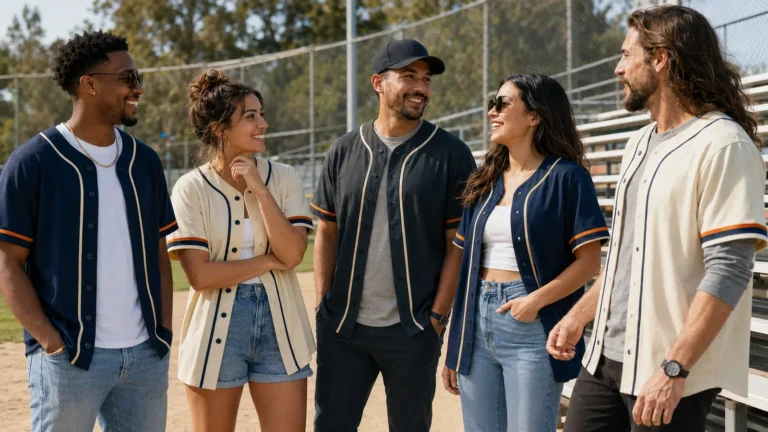
Diverse club athletes wearing coordinated custom performance jerseys
About JIUMU
JIUMU supports B2B custom teamwear, logo apparel, hats, uniforms, bags, and branded merchandise programs for schools, clubs, distributors, uniform dealers, promotional buyers, retailers, and private-label brands.