How to Frame, Hang and Display Sports Jerseys
A sports jersey can represent a championship, a graduating class, a first professional contract, a fundraiser or a long-running team tradition. Displaying it well is not simply a decorating task. The method must suit the jersey’s value, condition, construction and future use. A signed game-worn jersey needs a different solution from a current-season uniform that a school plans to rotate every year.
This guide explains how to display sports jerseys using shadow boxes, open hangers, rails, display cases and mannequins. It also covers frame planning, fabric support, wall installation, lighting, maintenance and multi-jersey display programs for schools, clubs, academies, retailers and corporate spaces.
The advice is practical rather than prescriptive. If a jersey is historically important, fragile, badly stained, mould-affected or already attached to questionable materials, consult a qualified textile conservator before cleaning, mounting or framing it.
Quick Answer: For a valuable, signed or long-term display jersey, use a deep shadow box with stable backing, a spacer that prevents the fabric from touching the glazing, and a reversible support method such as carefully placed stitches. Keep the display away from direct sunlight, heat and damp. For a low-risk decorative jersey that may be worn again, use a broad padded hanger or a removable display rail. Always match the wall hardware to the combined weight of the frame and its contents.
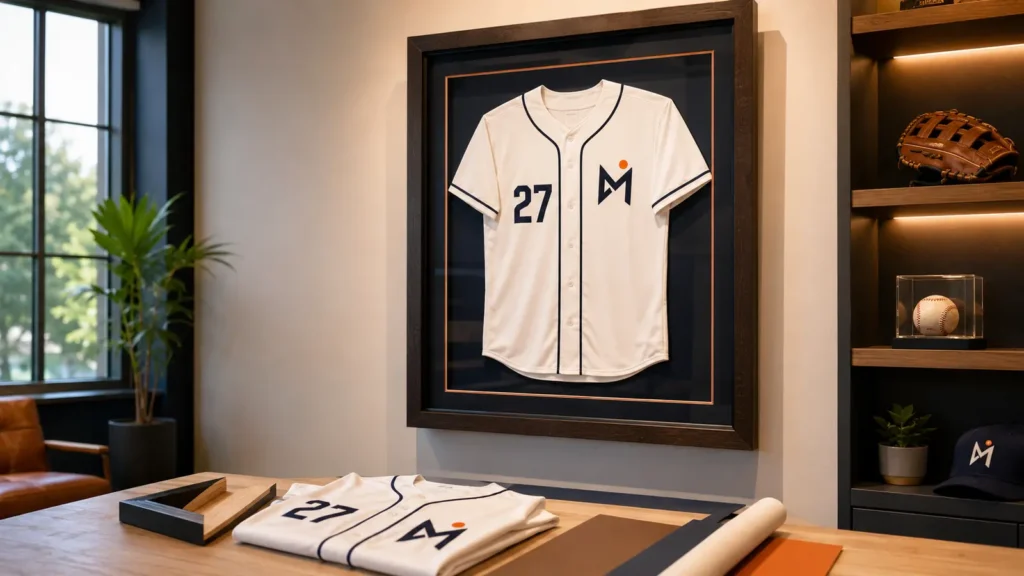
A fictional baseball jersey displayed in a professional shadow box in a modern sports room.
A shadow box protects a jersey from handling and dust while giving the display a finished, permanent appearance.
Why the Display Method Matters
Fabric is flexible, so gravity can change its shape. A narrow hanger can concentrate stress at two points on the shoulders. Pins, staples and tacks can puncture yarns or create rust stains. Adhesive can migrate into fabric, become brittle or leave a residue that is difficult to remove. Glazing placed directly against raised numbers, embroidery or patches can flatten the surface and trap condensation against the textile.
Light is another concern. The Canadian Conservation Institute explains that visible and ultraviolet radiation can fade dyes and weaken fibres, and that light damage is cumulative and irreversible. A jersey does not become safe simply because the room feels dim; both intensity and exposure time matter. This is why display location, glazing and lighting control belong in the plan from the beginning, not after the frame is complete.
For organizations, the display method also affects consistency. One attractive frame may be easy to improvise. A corridor containing 20 jerseys requires standard dimensions, repeatable colors, aligned hanging points, a labeling system and a plan for future additions. Schools and clubs should therefore treat a jersey wall as a small environmental-branding project.
Compare the Main Sports Jersey Display Methods
There is no universal best method. Choose according to preservation need, access frequency, available wall space, budget and the story you want the jersey to tell.
| Display method | Protection level | Can the jersey be removed easily? | Best use | Main limitation |
|---|---|---|---|---|
| Deep shadow-box frame | High when correctly specified | Moderate; depends on mounting | Signed, game-worn, commemorative or permanent displays | Heavier, deeper and more expensive than open display |
| Padded hanger on wall hook | Low | Yes | Current uniforms, retail presentation, rotating displays | Exposed to dust, handling and light |
| Horizontal rail or peg system | Low to moderate | Yes | Team rooms, showrooms and seasonal installations | Needs careful support and consistent spacing |
| Enclosed freestanding case | High | Moderate | Valuable jersey with equipment or memorabilia | Requires floor space and access control |
| Torso mannequin or dress form | Moderate | Yes | Showing the jersey’s three-dimensional fit | Takes more depth and may strain an incorrectly sized garment |
| Folded shelf or tabletop case | Moderate | Yes | Limited space, retail stories or fabric-detail focus | Does not show the complete front and back |
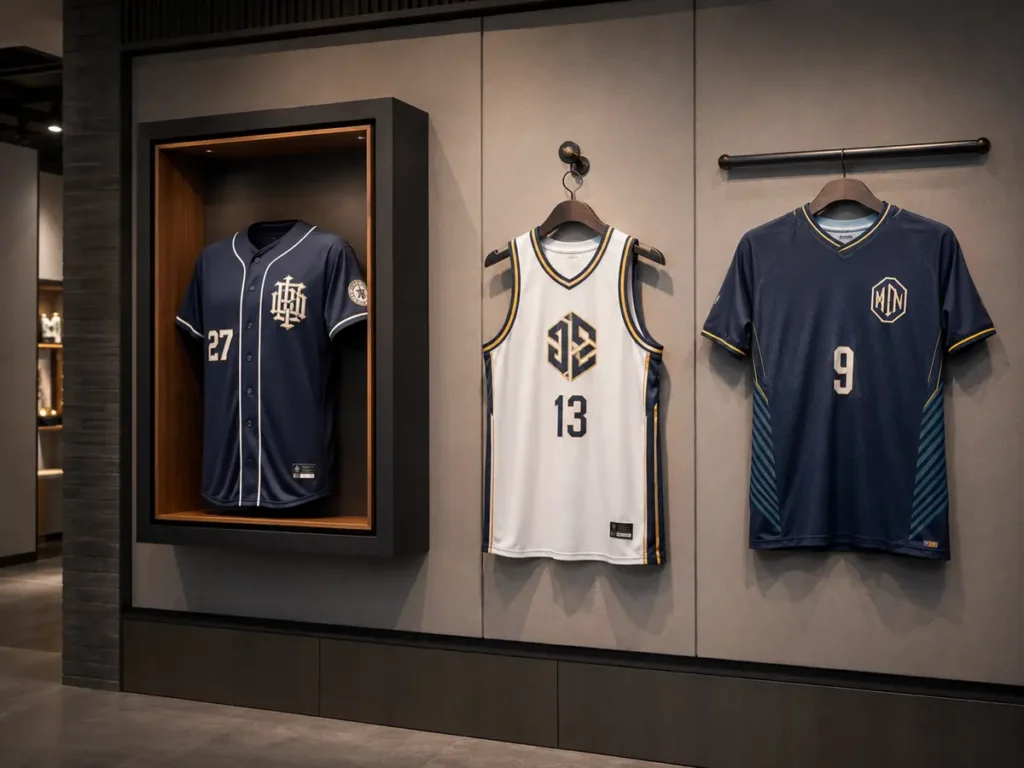
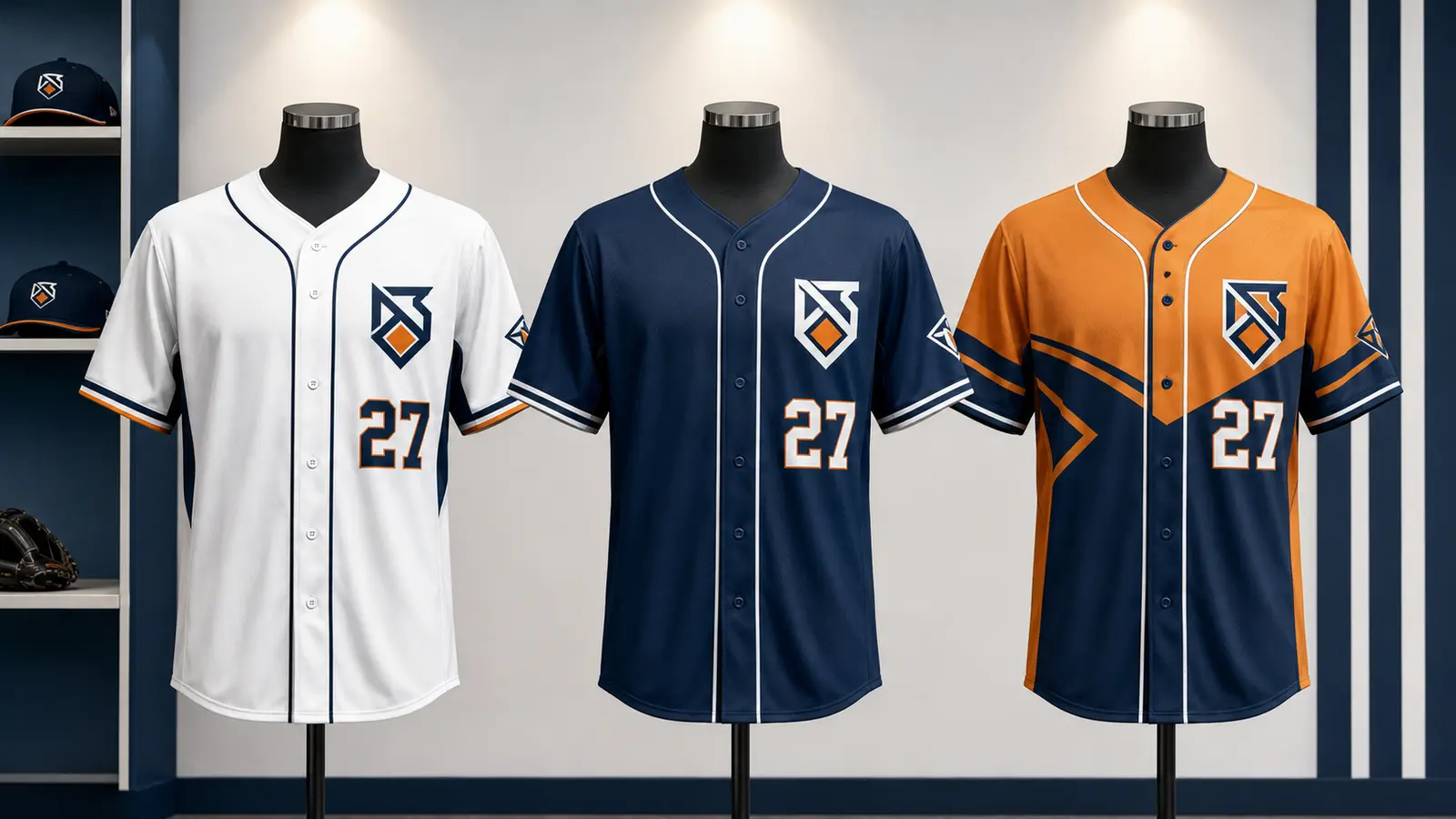
Three fictional sports jerseys shown in a shadow box, on a padded hanger and on a display rail.
A frame, padded hanger and rail solve different access and protection needs.
Choose a Shadow Box for Long-Term Protection
A shadow box provides clearance for backing, spacers and glazing. It suits signed, game-worn, commemorative and long-term displays because the enclosure reduces dust and touching while the backing distributes support. It can also hold a photograph, ticket or plaque, although a restrained layout is usually clearer.
Use a Padded Hanger for Flexible, Rotating Displays
For a current, replaceable garment, use a wide, smooth, padded hanger that supports the shoulder line. This flexible method works in locker rooms, showrooms and pop-ups, but leaves the jersey exposed to dust, contact and light. Avoid thin wire or narrow plastic hangers.
Use a Rail or Peg System for a Coordinated Series
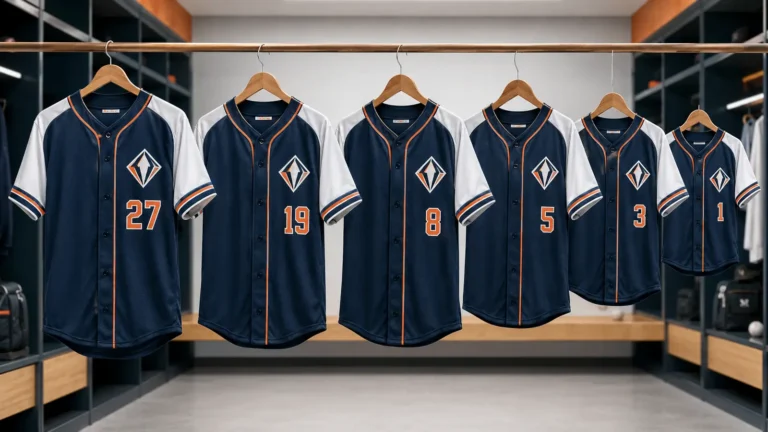
A rail creates rhythm across a long wall and simplifies replacement, making it useful for schools or academies that update uniforms each season. Specify the rail, fixings and spacing as one system, and keep garments clear of doors, benches and high-traffic corners.
Use a Mannequin When Fit Is Part of the Story
A smooth torso form communicates fit in an exhibit or retail setting. It must be smaller than the jersey; never force a small or brittle garment over a large form.
Decide Whether the Jersey Is Decorative or Collectible
Before buying a frame, classify the object. A decorative jersey is replaceable and may return to use. A collectible jersey is signed, game-worn, rare or institutionally significant. A historically important textile may justify professional conservation.
Ask these questions:
- Is the jersey expected to be worn again?
- Is the signature or surface decoration sensitive to rubbing?
- Are there tears, weak shoulder seams, flaking numbers or lifting patches?
- Is there visible mould, insect damage, strong odor or staining?
- Is the display permanent or rotating, and can the jersey be replaced?
- Who can touch, remove or clean it?
If the garment has tears, powdering or flaking decoration, mould, insect damage, unstable dyes or old adhesive, stop and obtain specialist advice. The Canadian Conservation Institute specifically recommends professional assessment for damaged textiles before framing.
How to Plan the Frame Size and Jersey Layout
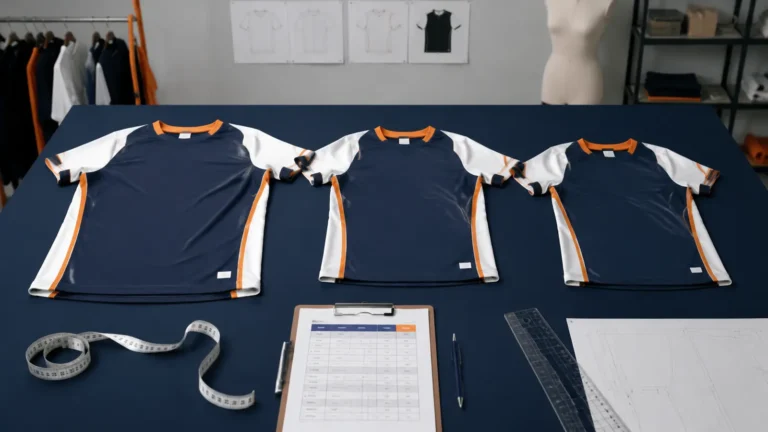
Measure the jersey in the exact pose you want to display. Do not rely only on the labeled garment size, because two jerseys marked “L” can differ in body length, sleeve construction and width.
Lay the clean jersey on a large, smooth surface. Arrange it front-facing, back-facing or with a controlled fold that reveals the name and number. Measure:
- The maximum width, including the chosen sleeve position.
- The total height from the highest collar point to the lowest hem.
- The thickness of raised embroidery, patches, buttons or folded fabric.
- The space required for photographs, plaques or accessories.
- A visual border between the jersey and the frame edge.
Add room for the mat, spacer and frame rabbet. The internal depth must prevent the glazing from pressing on any part of the jersey. A spacer is not merely decorative; it protects raised details and helps maintain physical separation.
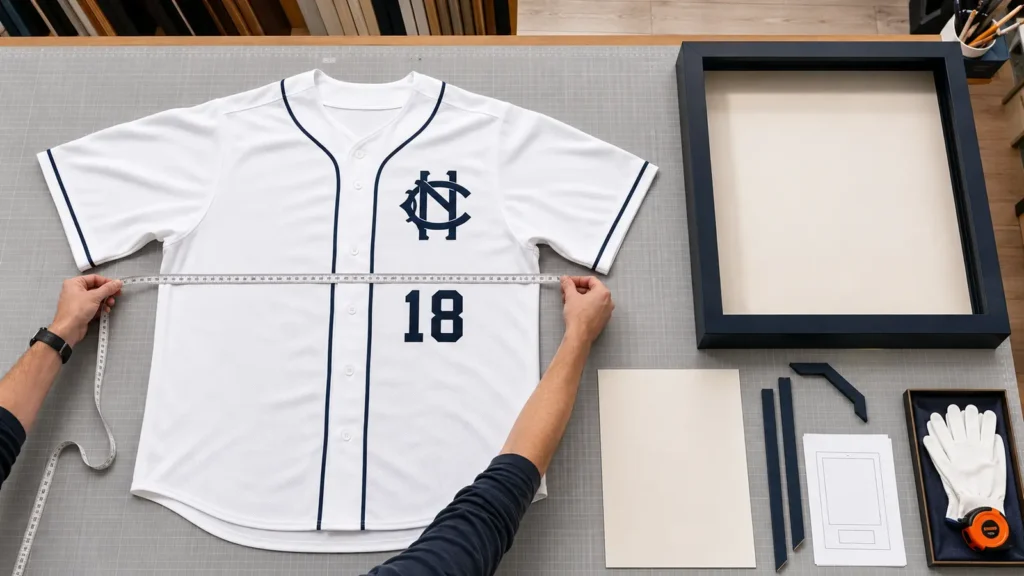
A fictional baseball jersey being measured beside a deep frame and backing materials.
Measure the jersey in its final pose before ordering the frame or cutting the support board.
Front, Back or Folded Display?
Display the front when the team mark, crest, sponsor layout or button construction carries the story. Display the back when the player name, number or signature is the main feature. If both sides are important, consider:
- two matching jerseys, one front-facing and one back-facing;
- a double-sided freestanding case;
- a frame with a photograph of the hidden side;
- a reversible mount that allows occasional rotation by a professional;
- a controlled sleeve or body fold that reveals selected elements without creating hard creases.
For team heritage installations, using two purpose-made commemorative jerseys can be safer and visually clearer than forcing a single valuable jersey to show both sides.
Select Materials That Will Not Work Against the Fabric
For a long-term display, the jersey should be separated from unstable surfaces. Conservation-oriented framing typically uses stable boards, prewashed support fabric, inert padding where appropriate, spacers, suitable glazing and a protective backing.
| Component | Practical specification | Avoid |
|---|---|---|
| Support board | Acid-free matboard, stable corrugated plastic board or another conservation-suitable rigid support | Ordinary cardboard, acidic board, unknown recycled board |
| Cover fabric | Prewashed, colorfast cotton or another stable fabric with a smooth surface | Unwashed fabric, loose glitter, unstable dye, rough weave |
| Padding | Thin needle-felted polyester batting where shaping is needed | Thick foam that changes the silhouette or off-gasses |
| Attachment | Sparse, reversible support stitches placed in strong structural areas | Glue, spray adhesive, pressure-sensitive tape on the jersey, staples, tacks |
| Spacer | Acid-free mat or stable plastic spacer that keeps glazing away from the textile | Direct glazing contact |
| Glazing | Glass or acrylic selected for weight, breakage risk, scratch resistance and UV-filtering need | Unprotected open frame for a valuable jersey |
| Backing | Stable board plus a sealed or dust-resistant rear assembly | Open back exposed to dust and impacts |
The Canadian Conservation Institute advises that materials in contact with textiles should be acid-free, chemically stable and waterfast. It also lists adhesive tape, adhesive-coated boards, staples, tacks and nails as unsuitable for direct contact with textile artifacts.
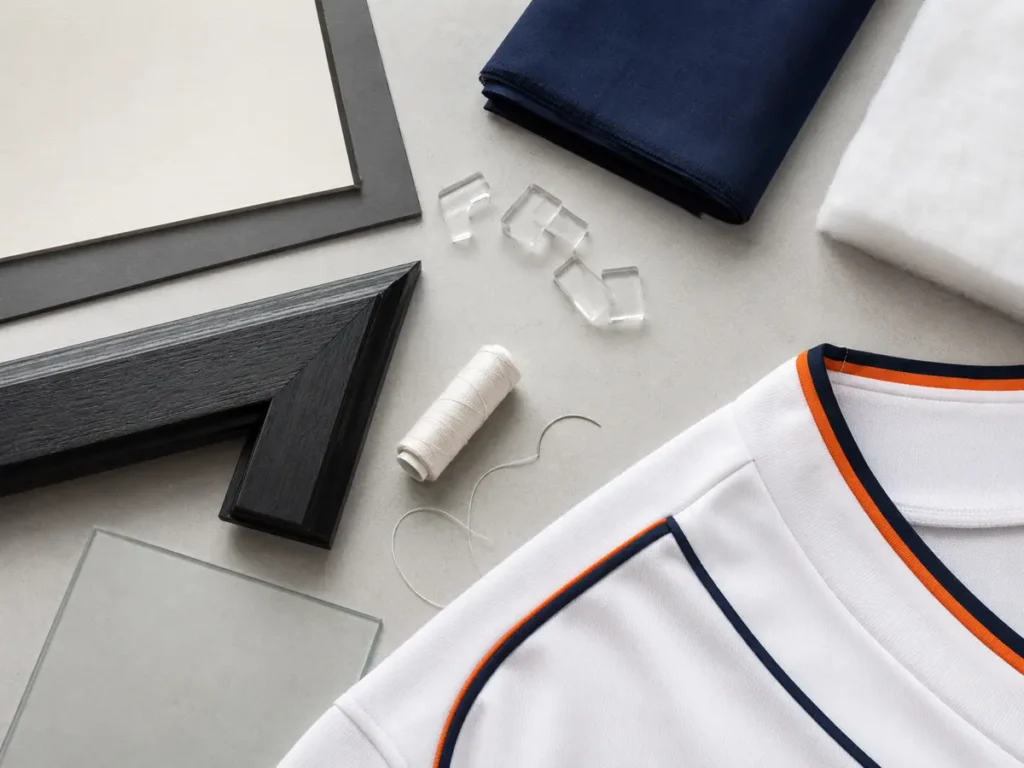
Stable framing boards, fabric, batting, spacers, glazing and stitching materials arranged beside a jersey.
Specify the entire material stack, not just the visible frame moulding.
Glass or Acrylic Glazing?
Glass generally resists scratching but is heavier and breakable. Acrylic is lighter and more impact-resistant but scratches more easily and can build static charge. UV-filtering glazing reduces part of the exposure; it does not remove the need to control ambient light. Verify cleaning requirements before standardizing a large project.
Why a Spacer Is Essential
A spacer protects raised numbers, embroidery, patches and texture from pressure. Size it for the highest point of the arranged garment, including buttons and folds.
How to Mount a Jersey in a Shadow Box
The goal is even support with minimal intervention. The method should hold the jersey’s shape without pulling, puncturing visible areas or making future removal unnecessarily destructive.
Step 1: Document the Condition
Photograph the front, back, signatures and existing damage. Record dimensions and orientation. Keep any inventory number off the visible garment.
Step 2: Clean Only Within the Jersey’s Limits
Do not automatically wash a signed or decorated jersey. Water, detergent or solvent can affect ink, adhesive, transfers and dye. If in doubt, consult a textile conservator.
Step 3: Prepare the Covered Support
Cut a rigid stable board to fit the frame. Add a thin layer of polyester batting only if slight shaping is needed, then cover it with prewashed, colorfast fabric. Pull the cover smooth and secure it on the reverse of the board so that no adhesive touches the jersey.
Step 4: Arrange Without Hard Creases
Place the jersey on the support. Align the collar, placket, center line, number and hem. Fold sleeves gently if necessary, using broad curves rather than sharp creases. Step back and check the silhouette from the normal viewing distance.
Step 5: Add Sparse, Reversible Support
Use a small number of carefully placed stitches or fabric ties in strong construction areas such as seam allowances. Support the shoulders, side seams and lower body so the entire weight does not hang from the collar. Stitches should be loose enough to avoid puckering and positioned so they can be removed later.
Do not pin through visible fabric, staple the garment, or glue it to the backing. If the jersey is heavy, fragile or complex, have a conservator or experienced textile framer design the mount.
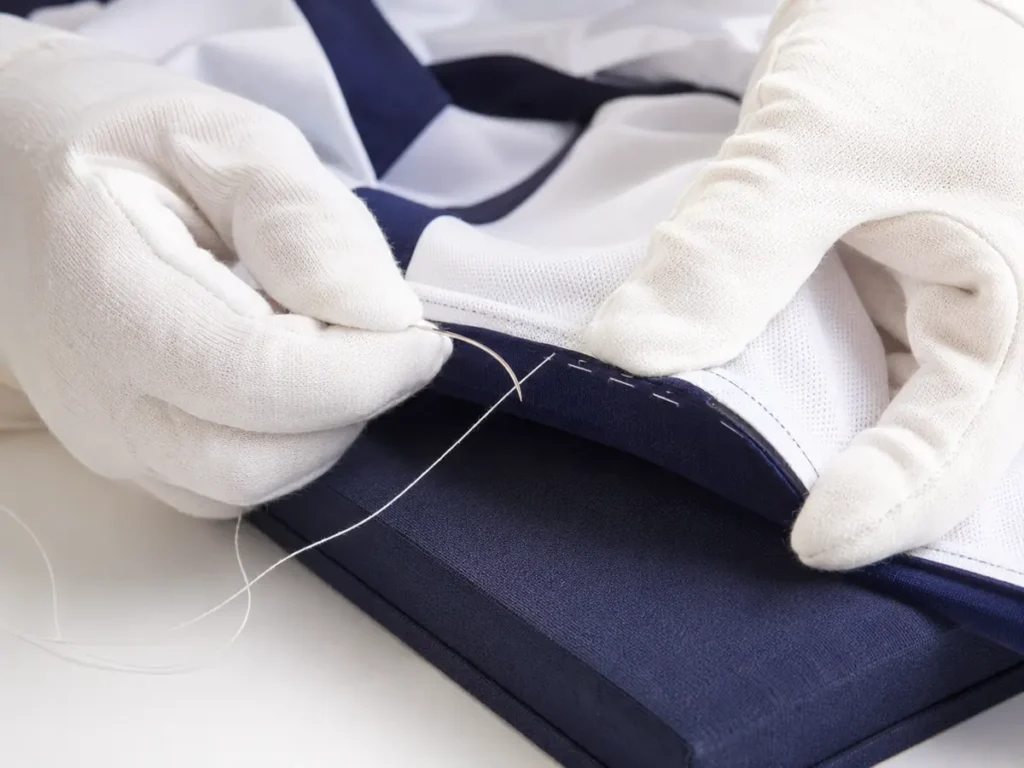
A professional framer making discreet support stitches at a jersey seam on a padded backing.
Distributed, removable support is preferable to permanent adhesive or concentrated pressure.
Step 6: Verify Clearance and Close the Frame
Install the spacer and glazing and inspect from the side. Add a stable backing and dust-resistant rear seal. Nothing should touch the glazing or project into the display cavity.
Step 7: Record the Final Assembly
Record the jersey, frame dimensions, materials, mounting method and date for future inspection or relocation.
Add Memorabilia Without Overcrowding the Jersey
A shadow box can include a photograph, ticket, medal, cap, ball or plaque, but every extra object changes weight, depth and visual balance. It can also create a new material-compatibility question.
Start with the jersey as the primary object. Group smaller elements in a separate zone rather than scattering them over the garment. Mount each object independently; do not let a ball, metal medal or rough-edged ticket rest against the textile. Use replica items when the original object would add excessive weight or preservation risk.
For an honors wall, establish a repeatable template:
- same outer frame color;
- same backing color;
- consistent jersey scale;
- standardized plaque position;
- fixed spacing around photographs;
- one type hierarchy for names, season and achievement;
- a reserved area for future entries.
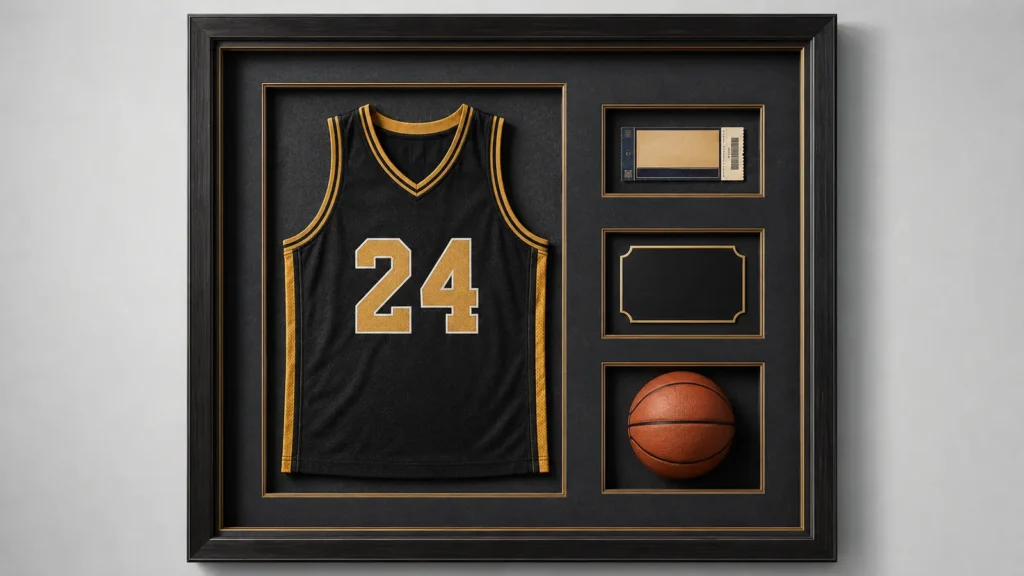
A fictional basketball jersey presented with a neutral ticket, plaque and ball in a deep shadow box.
Separate supporting memorabilia from the garment and keep the hierarchy simple.
How to Hang a Framed Sports Jersey Safely
A large shadow box can be much heavier than it appears. Its weight includes the moulding, glazing, backing, jersey, accessories and internal mounting materials. Weigh the finished assembly rather than estimating from the empty frame.
Choose the Wall Location First
Avoid:
- direct sunlight at any time of day;
- walls next to heating vents, radiators or fireplaces;
- damp exterior walls or areas with condensation;
- locations directly below plumbing;
- narrow paths where bags, equipment or doors can strike the frame;
- positions within easy reach in unsupervised public areas;
- a spotlight fixed directly to the frame.
The CCI recommends observing where sunlight falls throughout the day and avoiding heat sources and cold, damp walls. These are sensible principles for both collectible and decorative jerseys.
Match Hardware to the Wall and the Finished Weight
Identify the wall type: wood stud, masonry, solid concrete, metal stud, hollow drywall or another system. Use hardware designed for that substrate and rated by its manufacturer for the installed configuration. When possible, distribute the load across two points or use an appropriate cleat system. Do not assume a small picture hook or generic adhesive strip is suitable for a deep, glazed frame.
In schools, clubs and commercial facilities, involve the facility manager or a qualified installer. Check for electrical cables, plumbing and building restrictions before drilling. In seismic areas or spaces where the public may pull on a frame, add security fixings or anti-lift hardware.
Establish a Consistent Viewing Height
For one frame, align the visual center near the normal eye line of the intended audience while allowing for furniture and accessibility. For a series, align frame centers or top edges consistently. On a long corridor wall, use a laser level and a measured template so spacing remains uniform.
After installation:
- Confirm the frame is level.
- Check that it cannot slide sideways or lift accidentally.
- Inspect the wall for flexing or damaged anchors.
- Verify that doors and equipment cannot strike the glazing.
- Record the hardware and weight for future relocation.
Control Light, Heat, Dust and Humidity
No frame makes a textile immune to its environment. Light exposure accumulates, and UV-filtering glazing is only part of the solution. Use blinds, shades or layout changes to eliminate direct sun. Select low-heat lighting, keep fixtures at a distance and turn display lighting off when the area is closed.
Avoid rapid changes in temperature and humidity. Do not hang jerseys over radiators, under air-conditioning discharge, against persistently damp walls or near showers, pools and kitchens. For a valuable collection, environmental monitoring and a rotation schedule are more reliable than relying on visual inspection alone.
The U.S. National Park Service recommends periodic rotation for fragile textiles in museum exhibitions. A household or team display is not automatically a museum collection, but the principle is useful: an irreplaceable jersey does not have to remain exposed every day of every year. A high-quality replica can carry the visual story while the original rests in protected storage.
Build a Multi-Jersey Display for a Team, School or Brand
Design the system before producing frames. Inventory sport, size, orientation, condition, color, season and accompanying objects, then group them into a hierarchy.
Create a Display Standard
Define:
- standard outer frame sizes;
- approved frame and backing colors;
- front- or back-facing orientation rules;
- plaque dimensions and content;
- image aspect ratio;
- spacing between frames;
- lighting type and operating hours;
- installation hardware;
- inspection frequency;
- who can approve changes.
Allow different internal mounts for sleeveless, short-sleeve, button-front and padded garments even when the outer frames match.
Plan for Future Seasons
Reserve wall space and source files for annual additions. Use documented color references. For commemorative or duplicate jerseys, give the supplier the visible orientation, frame opening and logo placement so names, numbers and split-front graphics remain centered after folding.
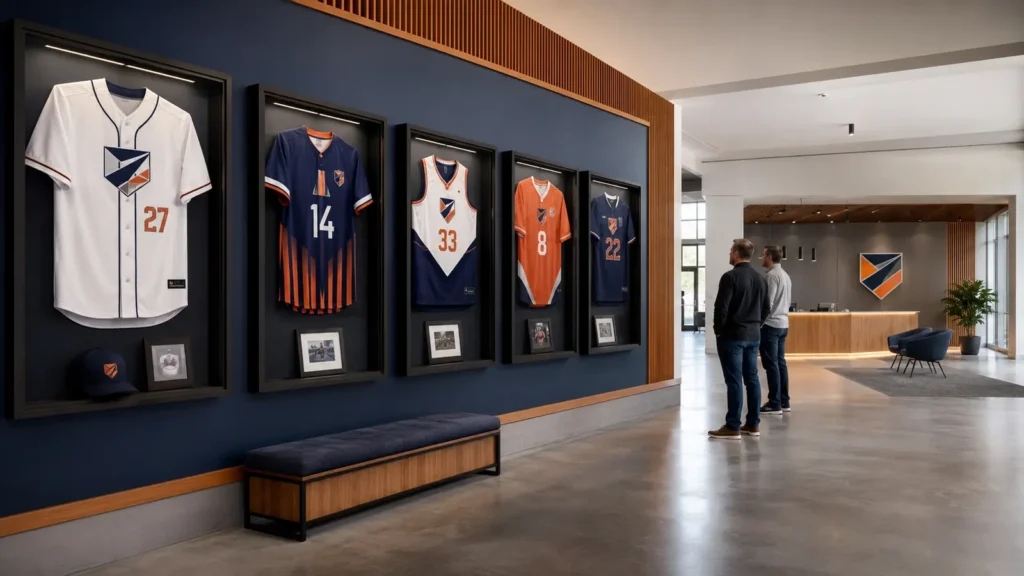
A coordinated series of fictional jerseys displayed in a modern athletic facility corridor.
Schools and clubs benefit from standard frame finishes, spacing and a plan for future additions.
Translate Jersey Design Features Into Display Decisions
Apparel specifications influence the frame. Sublimation lies relatively flat; embroidery and tackle twill add relief and weight; heat-transfer graphics should not be sharply folded or pressed against glazing; buttons and patches require more clearance; mesh needs distributed support. Signature locations should be confirmed before choosing folds or attachment points.
This is also a procurement decision. A presentation jersey can use display-facing logo placement, consistent number scale and a cut that suits the frame. The wearable uniform and display copy do not always need identical construction.
Quality-Control Checklist Before Installation
Inspect the frame on a clean, padded surface.
- Jersey identity, orientation and number match the approved plan.
- No new stain, snag, crease or puncture is visible.
- Collar, shoulder line, center and hem are aligned.
- Support points distribute weight without puckering.
- No adhesive, tape, staple or tack touches the garment.
- Glazing does not touch fabric, embroidery, numbers or accessories.
- Frame corners are tight and the glazing is clean inside.
- Backing is secure and the rear seal is intact.
- Hanging hardware is centered, tight and rated for the assembly.
- Finished weight is recorded.
- Wall location has been checked for sun, heat, damp and impact risk.
- Installation height and spacing match the display standard.
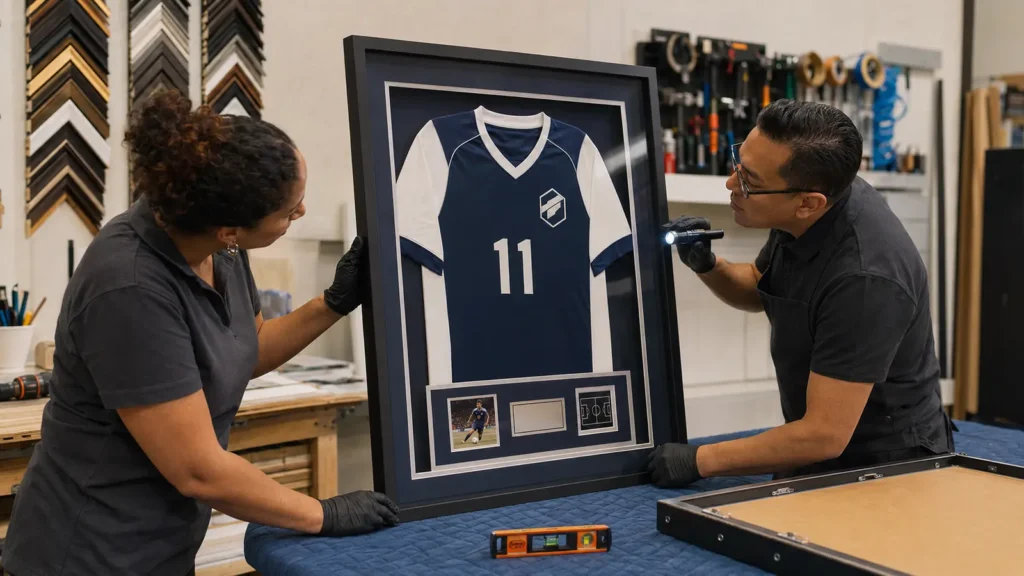
Two framing professionals inspecting a completed fictional jersey shadow box before installation.
Final inspection should cover the garment, internal clearance, backing and hanging hardware.
Ongoing Inspection and Cleaning
Dust the outside with a clean, soft cloth appropriate for the glazing. Never spray cleaner directly onto the frame. Inspect periodically and after building work, a leak, impact or relocation. Look for:
- jersey slippage or sagging;
- loose thread supports;
- fabric touching the glazing;
- condensation, haze or tide marks;
- insects, webbing or debris inside;
- fading compared with protected areas;
- lifting numbers, patches or signatures;
- loose frame joints or wall hardware;
- dust entering from the back.
If the jersey moves, do not shake the frame. Lay it flat securely and have the mount assessed.
Common Jersey Display Mistakes
Avoid these recurring errors:
- applying double-sided tape, hot glue or spray adhesive to the garment;
- pinning, stapling or tacking through visible fabric;
- allowing glazing to press against fabric or decoration;
- enclosing a damp, dirty or mould-affected jersey;
- relying on UV-filtering glazing while placing the frame in direct sun;
- selecting wall fixings before weighing the finished frame;
- overcrowding the layout with photographs, balls and plaques;
- treating a replaceable retail sample like a signed or historic uniform.
Start with significance and condition, then choose the least invasive method that meets the display goal.
What to Send When Requesting a Jersey Display or Commemorative Jersey Quote
For a frame shop or exhibit fabricator, send:
- clear front and back photographs;
- jersey width, height and thickness in the planned pose;
- condition notes and signature locations;
- preferred orientation;
- list and dimensions of accompanying objects;
- desired outer frame size, color and depth;
- wall type and installation location;
- number of matching displays;
- preservation expectation;
- target completion date and delivery location.
For custom commemorative or duplicate jerseys, send JIUMU:
- sport and jersey style;
- quantity and size breakdown;
- front- or back-facing display orientation;
- logo artwork and Pantone references;
- player names and numbers;
- decoration method preference;
- fabric and weight requirements;
- private label, hangtag and packaging needs;
- reference photos or a technical pack;
- target delivery date and destination.
Planning a team heritage wall? Share the sport, display quantity, jersey orientation, colors, logo files, names and numbers with JIUMU. We can help develop coordinated custom jerseys or presentation copies for schools, clubs, academies, distributors and branded teamwear programs. Request a custom quotation.
How JIUMU Supports Display-Ready Teamwear Programs
JIUMU is a Guangdong-based B2B supplier of custom teamwear, logo apparel, hats, uniforms, bags and branded merchandise. Established in 2010, the company supports buyers in the United States, Canada, the United Kingdom and Europe.
For jersey programs, relevant capabilities include OEM and ODM development, sublimation, embroidery, screen printing, heat transfer, patch options, fabric sourcing, Pantone color matching, player personalization, private labels, packaging customization, digital mockups, physical samples and bulk-production quality control. The typical MOQ is 50 pieces, subject to the product structure and customization.
JIUMU does not need to be the frame fabricator to improve the display outcome. A buyer can specify whether the jersey will be framed front-facing or back-facing, request a presentation copy, coordinate number scale and logo position, and maintain consistent colors across future seasons. Explore custom team jerseys, custom team uniforms and baseball team uniform packages.
Questions to Ask a Framer, Installer or Apparel Supplier
| Partner | Questions to confirm |
|---|---|
| Framer | What touches the jersey? Is the mount reversible? How is weight distributed? What creates glazing clearance? Can the frame be reopened safely? |
| Installer | What is the wall construction? Which fixings suit the finished weight? Are security or seismic restraints required? How will a series be aligned? |
| Jersey supplier | Can logo, name and number placement suit the frame opening? Are front and back presentation copies available? How will repeat-order color and scale be controlled? Can a sample be approved? |
Frequently Asked Questions
Final Recommendation
Choose the least invasive display method that meets the visual goal. Use an open padded hanger for a replaceable jersey that must remain accessible. Use a coordinated rail for rotating school, club or showroom collections. Use a professionally specified shadow box for signed, significant or long-term displays.
Whatever method you choose, support the garment evenly, keep unstable materials and adhesive away from the fabric, prevent contact with glazing, control light and moisture, and install the finished display for its actual weight and wall type. For large team displays, document the standard so that future jerseys match.
If your project requires coordinated custom jerseys, duplicate presentation pieces or a complete teamwear program, send JIUMU your quantity, sport, colors, logo artwork, names, numbers, display orientation, packaging needs and target delivery date. Contact JIUMU for a custom quotation or email zhengdong@jiumugear.com.
Sources and Further Reading
- Canadian Conservation Institute: Conservation Framing of Embroideries and Other Flat Textiles
- Canadian Conservation Institute: Textiles and the Environment
- Canadian Conservation Institute: Basic Care of Textiles
- U.S. National Park Service Museum Handbook, Appendix K: Curatorial Care of Textile Objects
About JIUMU
Established in 2010 in Guangdong, JIUMU supplies custom teamwear, logo apparel, hats, uniforms, bags and branded merchandise for B2B buyers in North America, the United Kingdom and Europe.