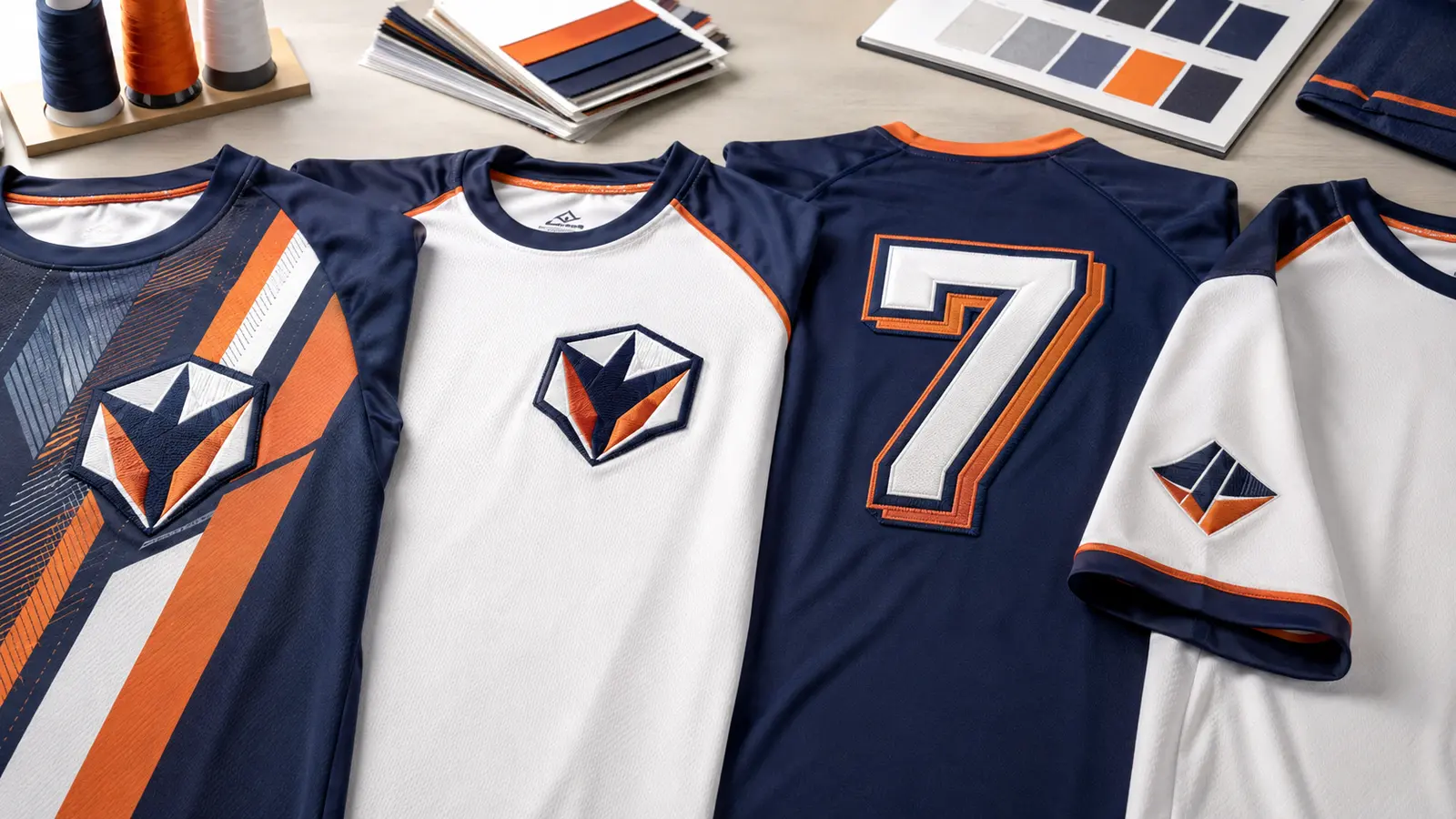
How to Design Custom Team Jerseys with Names, Numbers and Logos
Custom team jersey design is more than placing a logo on a shirt. The system must make the team recognizable, identify every player, reproduce across sizes, and translate from a digital mockup into a consistent bulk order.
This guide explains how to design custom team jerseys with names, numbers and logos—from the first design brief to sample approval and final quality control. It also shows how layout, type, color, fabric, decoration method, sizing, and roster management affect the finished result.
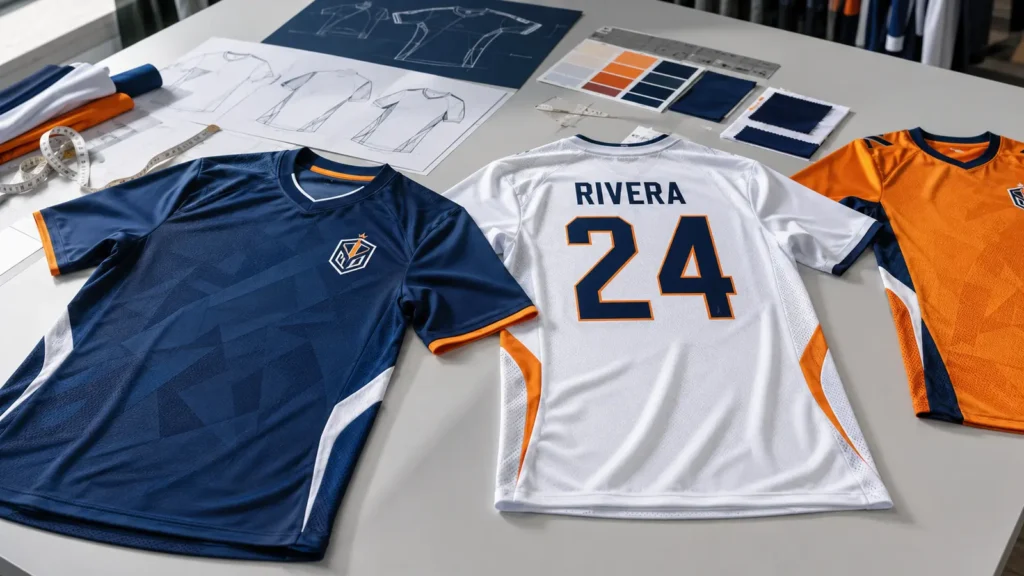
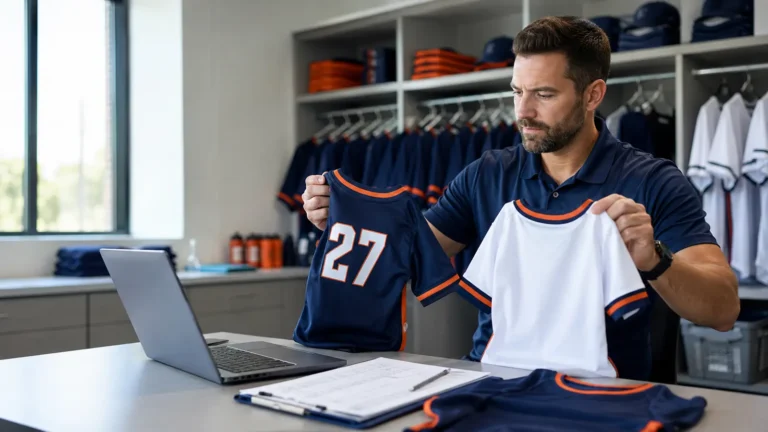
A coordinated jersey program starts with one specification covering design, materials, decoration, player data, sizes, and approval rules.
Quick Answer
To design custom team jerseys effectively, begin with a clear hierarchy: team identity first, player identification second, and supporting marks third. Select one primary logo, a legible number style, a readable player-name font, and a controlled color palette. Define the exact position, size, color, and decoration method for every element on the front, back, sleeves, and collar. Then approve a complete mockup, roster spreadsheet, color references, size breakdown, and physical sample before bulk production.
The strongest designs usually use fewer elements with more discipline. A clear crest, high-contrast numbers, consistent name spacing, and repeatable placement are more valuable than adding graphics to every available area.
Start with a Complete Team Jersey Design Brief
Before choosing fonts or colors, define the order. A manufacturer can build a more accurate quotation and mockup when the brief separates confirmed requirements from optional ideas.
At minimum, the brief should state:
- Sport and level of play
- Men’s, women’s, unisex, youth, or mixed sizing
- Jersey silhouette, sleeve length, collar, and fit
- Home, away, alternate, goalkeeper, or staff versions
- Preferred fabric weight and ventilation requirements
- Team colors and color references
- Primary and secondary logos
- Sponsor marks and any placement restrictions
- Player names and numbers
- Quantity by style, color, and size
- Required private labels, hangtags, and packaging
- Target delivery date and shipping destination
- Reference images or an existing jersey to match
If a school, league, or governing organization has its own uniform rules, include those requirements in the brief rather than relying on the supplier to infer them. The same applies to sponsor agreements, retail labeling, and reseller packaging.
Separate the brief into fixed requirements, preferences, and items open to supplier recommendation. This prevents unnecessary redesign and supports practical material and production advice.
Build a Clear Visual Hierarchy
Every jersey element should have a defined role. When all elements are equally large or equally bright, the design loses hierarchy and becomes harder to read.
| Priority | Element | Main purpose | Typical design approach |
|---|---|---|---|
| 1 | Team identity | Recognition | Primary crest, wordmark, or controlled team graphic |
| 2 | Player number | Identification at distance | Large, high-contrast, consistent front and back number system |
| 3 | Player name | Individual identification | Legible uppercase or title-case lettering with controlled spacing |
| 4 | Sponsor or partner | Commercial visibility | Secondary scale and clearly separated placement |
| 5 | Supporting details | Brand finish | Sleeve mark, collar detail, pattern, label, or commemorative symbol |
The exact order may change. A retail streetwear jersey may emphasize the wordmark, while a competition jersey may make the number more dominant. The important point is to decide the hierarchy before arranging the artwork.
A restrained design is easier to reproduce, inspect, reorder, and adapt for youth sizes. Avoid oversized graphics behind numbers, competing chest logos, heavy patterns beneath lettering, unnecessary outlines, and too many typefaces.
Plan the Front, Back, Sleeves, and Collar as One System
Do not design each garment zone independently. The front and back must look related, while the sleeves and collar should support the main composition.
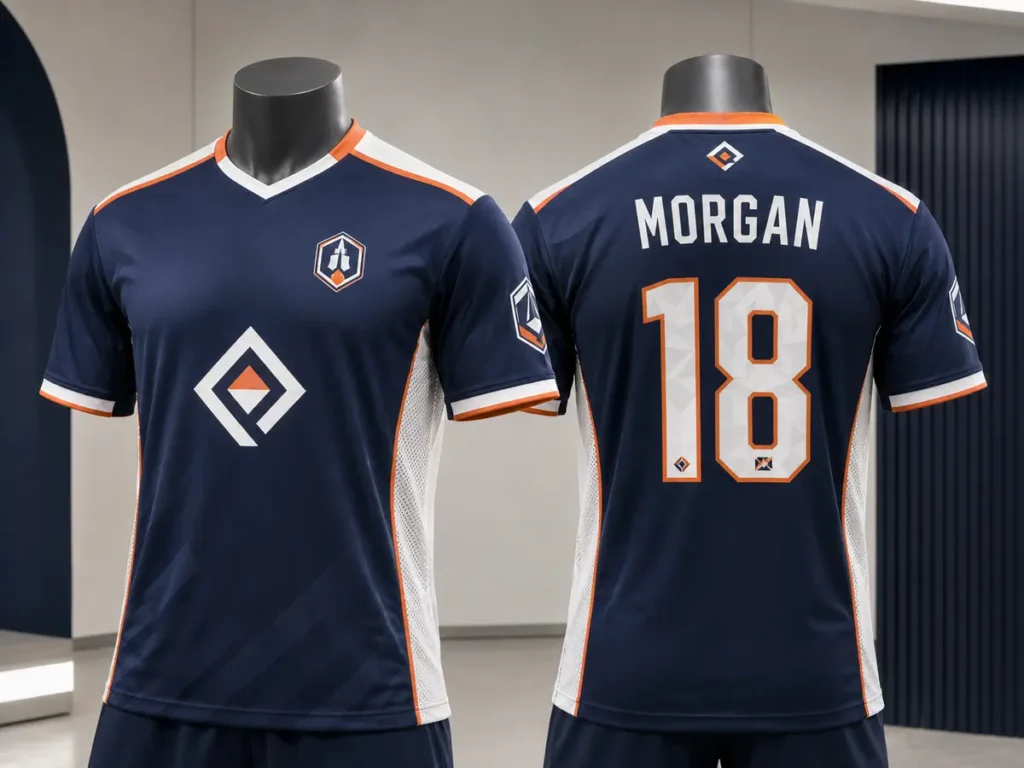
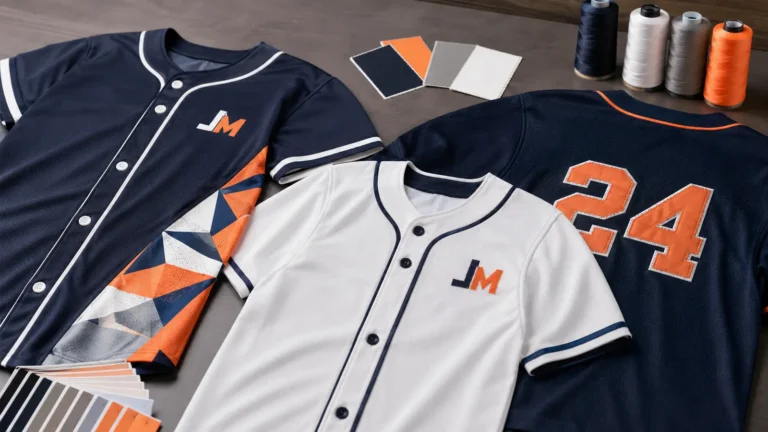
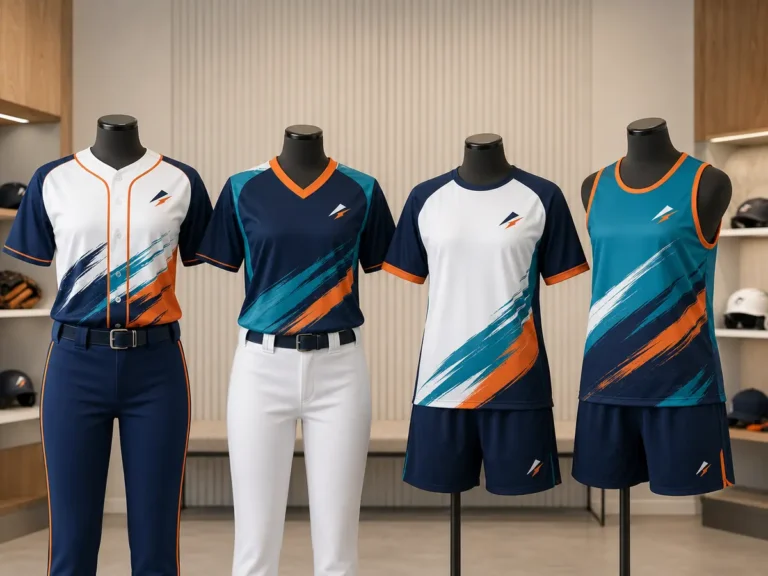
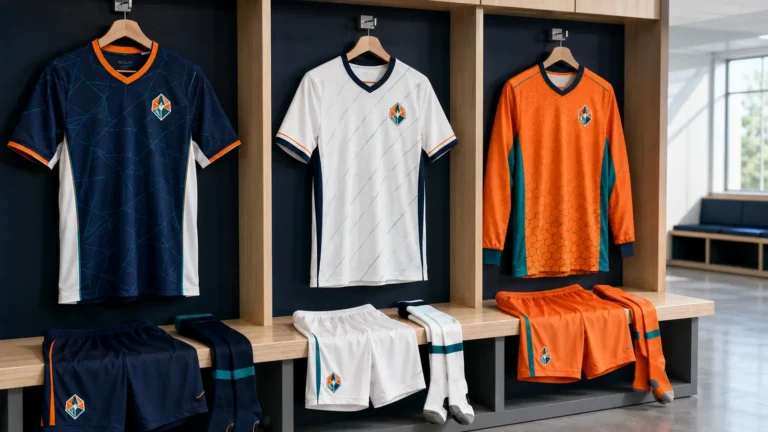
Front and back layouts should be approved together so that the complete jersey maintains one hierarchy.
Prepare Your Jersey Design Brief
For an accurate team quotation, send the sport, roster quantity, size range, player names and numbers, logo files, Pantone references, preferred fabric, decoration method and required delivery date. Review custom team jersey options before submitting the brief.
Front Placement
The front commonly includes some combination of:
- Team crest on the left or right chest
- Small player number on the opposite chest or center
- Team wordmark across the chest
- Sponsor below the chest or in a designated center zone
- Subtle background graphic or side panel
Avoid placing important details directly across a placket, zipper, heavy seam, mesh transition, or sharply curved panel unless the decoration method supports it.
Back Placement
The back typically gives priority to:
- Player surname or approved display name
- Large player number
- Small upper-back team or sponsor mark
- Lower-back partner mark, when permitted
The player name should not be squeezed between the collar and an oversized number. Long names require an agreed rule: reduce the font size within a defined limit, use a condensed font, or create a wider arc. Do not make unplanned decisions one jersey at a time during production.
Sleeve and Collar Placement
Sleeves can carry a conference mark, sponsor, anniversary patch, or small team graphic. Collar zones may include a back-neck identity or contrast insert. Because these areas are small and curved, test fine lettering and complex emblems at actual production size.
How to Design Player Names That Stay Readable
Player names need a consistent font, letter height, spacing rule, and maximum width. The roster may include three-letter names and names with more than twelve characters, so the system must handle both.
Choose the Right Name Font
A good jersey-name font is:
- Legible in uppercase at a distance
- Available in all required letters and punctuation
- Strong enough for the chosen decoration method
- Narrow enough to handle long surnames
- Visually related to the number font
- Free from fragile serifs or thin interior details
Condensed athletic sans-serif fonts are popular because they conserve width. However, the font should still have clear differences between characters such as I, J, L, O, Q, 0, 1, and 7.
Define a Long-Name Rule
Agree on a production rule before submitting the roster. For example:
- Standard names use one letter height.
- Names over a defined width use a slightly condensed setting.
- Font height may reduce only to an approved minimum.
- Hyphens and apostrophes remain unless the buyer approves removal.
- Double surnames follow the spelling supplied in the roster.
The purpose is consistency. Without a rule, one long name may appear much smaller than every other name, or letters may be crowded at the shoulder seams.
Check Spelling as Structured Data
Treat player names as production data, not informal email text. Copy them from an approved spreadsheet. Avoid sending names across chat messages, annotated screenshots, handwritten lists, and separate email threads.
Use one row per jersey and lock the final version after approval. If a player uses an accent mark, apostrophe, hyphen, suffix, or preferred display name, confirm that the selected font and production process support it.
How to Choose and Format Player Numbers
Numbers perform the most important identification function. They must remain clear under motion, at distance, and against every jersey colorway.
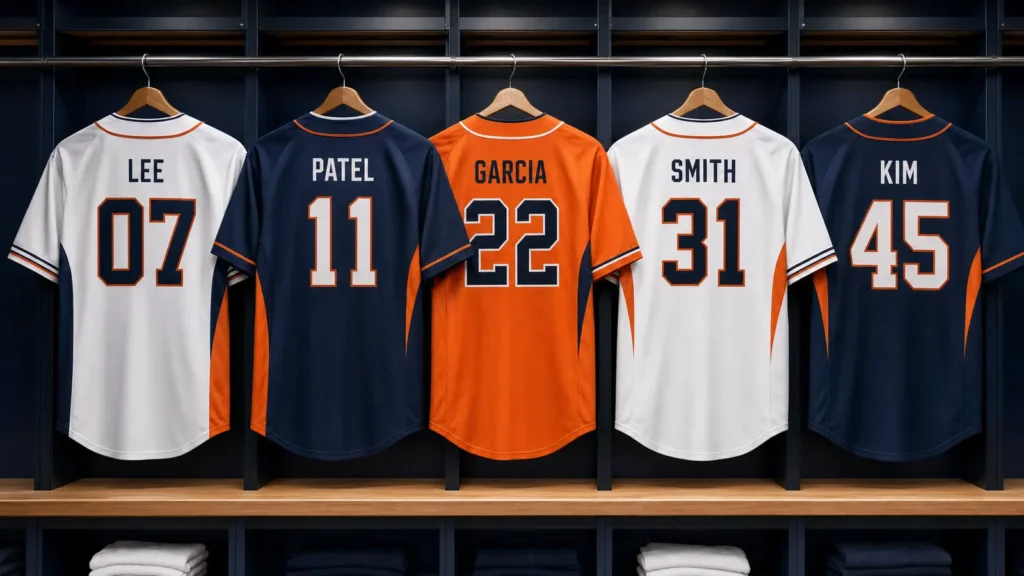
A roster should use one number system with consistent proportions, outlines, spacing, and vertical position.
Prioritize Contrast
Contrast is not only a choice between light and dark. It also depends on:
- The pattern beneath the number
- Outline width
- Viewing distance
- Fabric sheen
- Lighting conditions
- Whether colors are adjacent in value
A white number with a dark outline on navy is usually clearer than two medium-value colors placed together. For sublimated designs, create a clean or quieter zone behind the number if the main jersey pattern is busy.
Use Outlines Purposefully
One outline can separate the number from the body color. A second outline may strengthen a team color story, but multiple outlines add production complexity and can reduce the open space inside narrow numbers.
Test characters with enclosed counters—such as 0, 6, 8, and 9—and narrow shapes such as 1. The outline should not close small interior spaces.
Confirm Number Rules
The roster file should treat numbers as text, not calculations. This preserves leading zeroes such as 07. It also prevents spreadsheet software from converting data unexpectedly.
Confirm:
- Whether 0 and 00 are allowed
- Whether leading zeroes are required
- Whether duplicate numbers are acceptable
- Which number appears on each jersey version
- Whether front and back numbers use the same style
- Whether shorts, pants, or bags also carry the number
For a preproduction readability test, print the artwork near actual size or review the sample from several meters away. Ask someone who did not design it to identify the number quickly.
Design an Original Team Logo for Real Production
A team logo must work as both an identity and a manufacturable graphic. The best starting file is vector artwork with clean paths and defined colors.
Prepare the Logo File Correctly
Supply:
- AI, EPS, SVG, or editable PDF vector artwork when available
- A transparent high-resolution PNG for visual reference
- Full-color, one-color, light- and dark-background versions
- Approved colors, minimum-size rules, and the identified master file
Do not rely on a screenshot or photo of an old jersey as the only artwork source; it may contain blurred edges, compressed colors, or distorted proportions.
Simplify for Small Embroidery
Embroidery has physical thread width and stitch-density limitations. Tiny text, narrow gaps, thin outlines, and complex gradients may need to be simplified. The supplier should provide an embroidery proof or stitched sample rather than treating a flat digital logo as final approval.
Sublimation can reproduce more color and detail, but it does not correct weak artwork. Fine lines may still disappear against a textured background, and color transitions should be reviewed on the actual fabric.
Avoid Unlicensed Marks
Buyers should confirm they have the right to reproduce every team, sponsor, school, league, or partner mark supplied for production. If the project needs a new identity, commission original artwork rather than imitating a professional club or apparel brand.
Choose Colors That Can Be Managed Across the Order
Begin with a small system:
- One primary team color
- One secondary team color
- One light neutral
- One optional accent
Additional colors can be used, but each one increases the number of relationships that must remain consistent across jerseys, shorts, jackets, caps, bags, and reorders.
Define Color References
Screen colors are not enough. Displays, file profiles, print processes, fabrics, thread, and lighting can make the same digital value appear different.
For a bulk order, provide:
- Pantone or another agreed physical color reference where appropriate
- Digital values as supporting references
- Thread and fabric swatches where relevant
- A print strike-off or physical sample for sublimation
- An approved master sample for future reorders
Color matching should be treated as a tolerance and approval process. Different materials and decoration methods may not look identical because they reflect light differently.
Match the Fabric and Construction to the Use Case
The design should respond to the jersey’s performance and commercial purpose. A lightweight competition jersey, a school spirit top, and a retail fan jersey do not require the same fabric or construction.
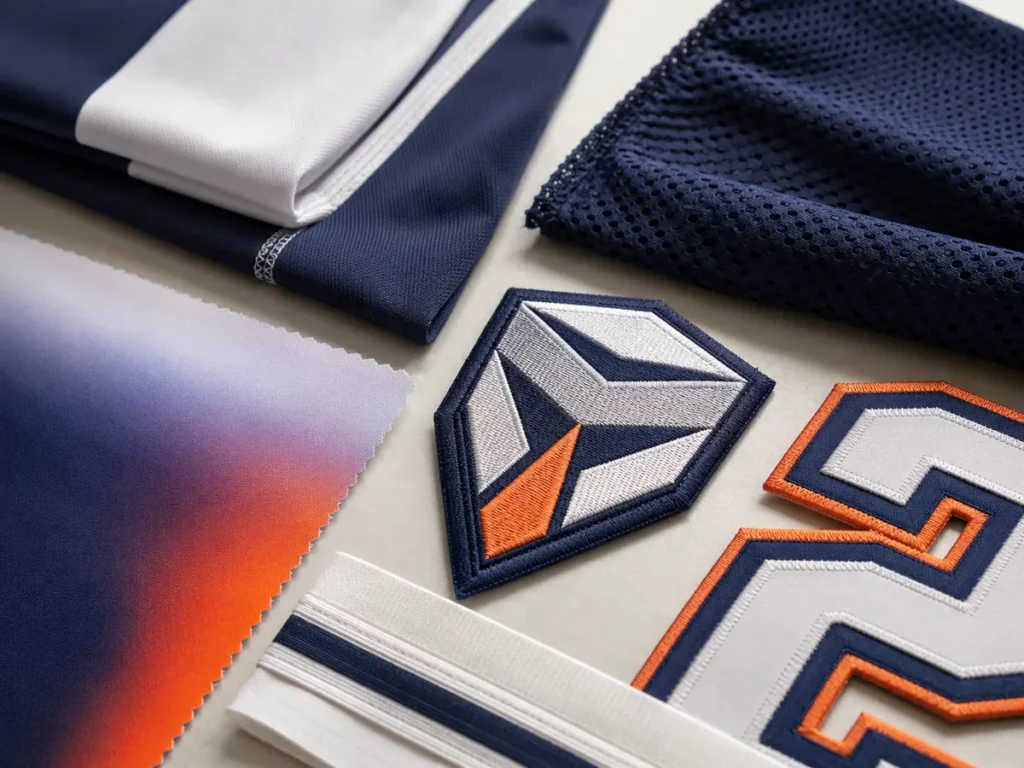
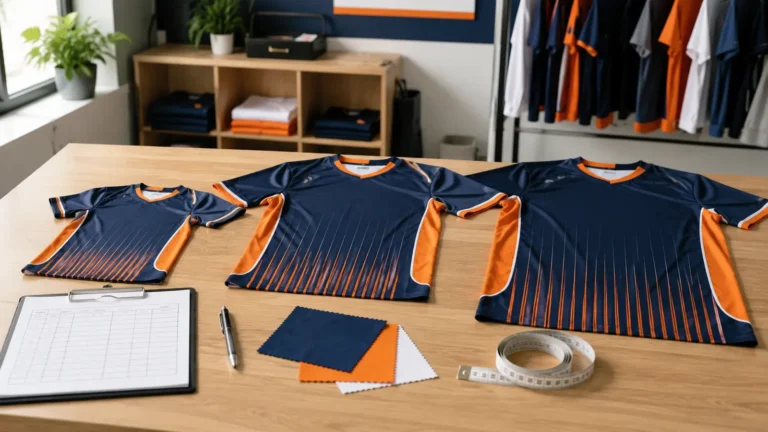
Fabric texture and decoration thickness influence comfort, appearance, price, and artwork detail.
| Specification | Why it matters | Buyer decision |
|---|---|---|
| Fabric weight | Affects hand feel, opacity, drape, and heat retention | Request actual fabric samples and state the intended activity |
| Knit structure | Influences stretch, breathability, snag behavior, and print appearance | Compare interlock, mesh, and other offered structures |
| Ventilation panels | Can improve airflow but add seams and color-matching requirements | Define panel locations and whether mesh is tonal or contrasting |
| Collar and cuffs | Change appearance and comfort; may use separate materials | Approve rib, self-fabric, binding, or insert construction |
| Seam type | Influences inside comfort and durability | Review key stress points and finishing on the sample |
| Fit block | Determines ease, layering, and grade between sizes | Approve the intended men’s, women’s, unisex, or youth block |
Account for Garment Stretch
Names, numbers, and logos may distort when a fitted jersey stretches. A fitting sample helps confirm whether the artwork remains balanced.
Design Across the Size Range
Do not scale every element proportionally. A crest may remain one size across most adult garments, while numbers may use multiple size groups. Youth jerseys may need smaller sponsor marks and narrower name settings. Record placement measurements for each size group so production and inspection teams share the same reference.
Select the Right Decoration Method
The decoration method affects artwork freedom, texture, weight, durability expectations, MOQ, sample process, and cost.
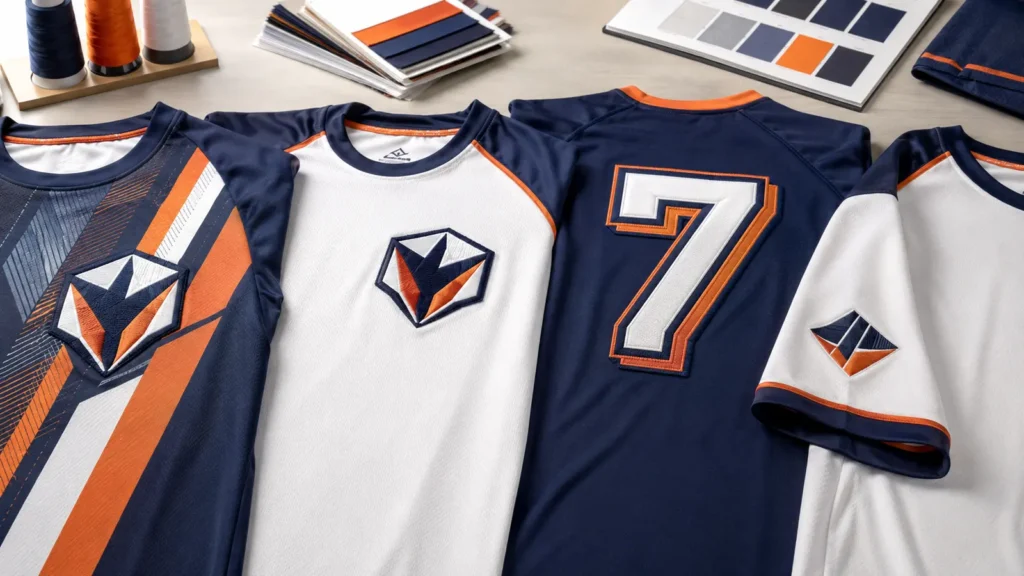
Decoration methods should be selected according to artwork, fabric, order volume, budget, and intended use.
| Method | Best suited to | Visual and production considerations |
|---|---|---|
| Sublimation | Full-coverage color, gradients, repeated patterns, names and numbers on suitable polyester | Smooth hand feel; artwork and color require fabric-specific sampling |
| Embroidery | Chest crests, small identity marks, premium texture | Adds stitch density and weight; fine details may need simplification |
| Tackle twill or appliqué | Traditional numbers, letters, and bold team graphics | Dimensional appearance; added layers, stitching, and labor |
| Heat transfer | Player names, numbers, sleeve marks, short runs, or specific effects | Film, adhesive, fabric, pressure, and temperature must be compatible |
| Screen printing | Bold flat-color graphics and suitable order quantities | Setup depends on color count and artwork; placement across seams needs care |
Mixed techniques can create a stronger result, such as sublimated body graphics with an embroidered crest. They also add approval points. Each technique should be identified separately in the quotation and mockup.
Check Construction Before Approving the Design
Graphics are only one part of the jersey. Review the underlying garment because poor seam placement or weak finishing can undermine an otherwise strong design.
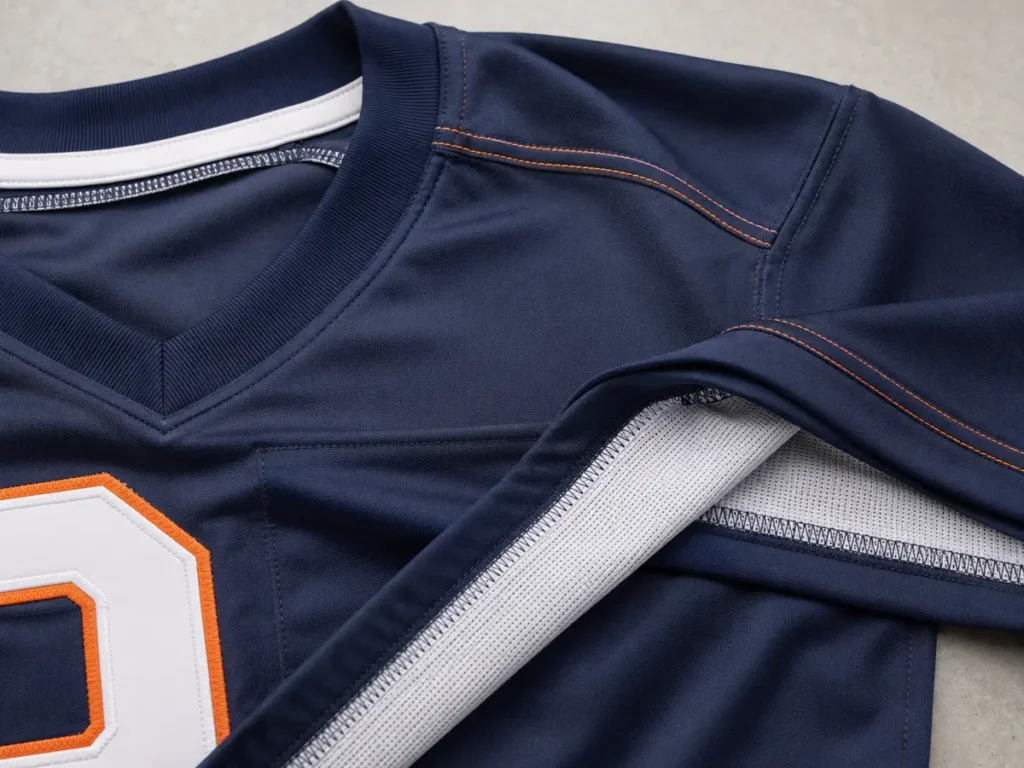
Construction review should cover seam shape, inside finishing, panels, collar, hems, and the interaction between stitching and decoration.
Key points include:
- Collar symmetry and recovery
- Shoulder and armhole seam alignment
- Sleeve length and opening consistency
- Side-panel alignment
- Hem shape and stitch consistency
- Inside seam comfort
- Reinforcement at stress points
- Decoration edges, corners, and stitch coverage
- Clean trimming of loose threads
- Label position and comfort
If the jersey uses stripes, piping, gradients, or geometric panels, define which seams should align. Perfect alignment may not be practical at every seam, so identify the visible priority areas during sample approval.
Understand the Main Cost Drivers
Custom jersey pricing reflects the complete specification. Major drivers include:
- Order quantity and size breakdown
- Number of jersey styles or colorways
- Fabric, pattern, panels, and construction complexity
- Decoration method, artwork coverage, and personalization
- Embroidery stitch count or appliqué layers
- Labels, hangtags, packaging, and samples
- Shipping method, destination, and delivery target
Buyers can control cost by simplifying the number of versions, standardizing one collar and fabric, reducing the number of decoration processes, and consolidating roster data before production.
Approve a Sample Before Bulk Production
A digital mockup confirms layout intent, but it cannot fully show fabric weight, stretch, hand feel, print color, embroidery texture, collar structure, fit, or actual placement on the body.
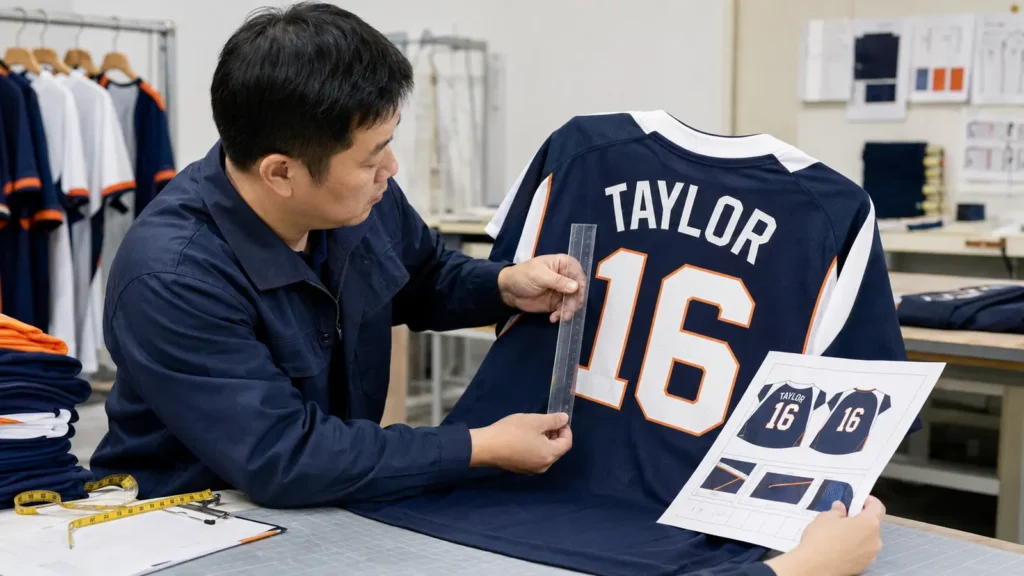
Sample approval should compare the physical jersey with the confirmed artwork, placement measurements, colors, construction, and roster rules.
Digital Mockup Approval
Check:
- Front, back, and both sleeves
- Logo versions and orientation
- Name and number font
- Color codes
- Sponsor position
- Pattern scale and direction
- Collar and cuff colors
- Seam and panel boundaries
- Label and packaging notes
Mark approval with a version number and date. Comments such as “make it a little bigger” should be replaced with dimensions or a precise reference.
Physical Sample Approval
Evaluate the sample in real lighting and, when practical, on a person from the intended size group. Confirm:
- Fabric and opacity
- Fit, length, and movement
- Collar, color, logo clarity, and number readability
- Player-name spacing and decoration quality
- Seams, labels, care instructions, and packaging
Record accepted differences and required corrections. The final approved sample should become the reference for bulk inspection and future reorders.
Build a Clean Roster and Size Spreadsheet
Roster errors are among the most preventable risks in personalized teamwear. One controlled spreadsheet should contain the full production data.
Recommended columns:
| Order ID | Jersey version | Player display name | Number | Size | Fit | Sleeve | Quantity | Special note |
|---|---|---|---|---|---|---|---|---|
| JT-001 | Home | RIVERA | 24 | Adult L | Unisex | Short | 1 | Captain |
| JT-002 | Away | PATEL | 11 | Adult M | Women’s | Short | 1 | — |
| JT-003 | Home | LEE | 07 | Youth XL | Youth | Short | 1 | Keep leading zero |
Use data validation where possible:
- One approved list of sizes
- One approved list of jersey versions
- A text format for number fields
- A duplicate-number check
- Required cells for every personalized jersey
- A total quantity check against the purchase order
After approval, export a locked PDF copy for visual review while retaining the editable spreadsheet as the production source. Any later change should receive a revision number and written confirmation.
Quality-Control Checklist for Bulk Custom Jerseys
Bulk inspection should compare finished pieces with the approved sample and roster, not with memory or informal messages.
Design and Personalization
- Correct team, sponsor, and jersey-version artwork
- Correct player name and number, including leading zeroes
- Consistent font, outline, color, pattern, and orientation
- Placement within the approved tolerance
Garment and Construction
- Correct size label and fit block
- Measurements within the agreed tolerance
- Fabrics and trims match the specification
- Collar, sleeves, panels, and hem are symmetrical
- Seams and decoration are clean and secure
Packing and Order Control
- Each jersey matches the roster
- Individual bag label matches the garment
- Carton quantities match the packing list
- Spares, shipping marks, and documents are correctly identified
Use a clear sampling plan appropriate to the order and risk level. Personalized pieces deserve special attention because one incorrect name or number cannot simply be reassigned to another player.
Questions to Ask a Custom Jersey Supplier
Before placing a bulk order, ask:
- Which fabric and decoration method do you recommend for our sport and artwork?
- What artwork file formats are required?
- How are long player names handled?
- How are leading zeroes and duplicate numbers controlled?
- Can you provide a size chart for the exact fit block?
- Which garment measurements have production tolerances?
- How are colors approved for fabric, print, thread, and trims?
- What is included in the digital mockup and physical sample process?
- How are logo and number placements measured?
- Can labels, hangtags, individual bags, and carton marks be customized?
- How are roster changes and repeat-order references managed?
- What is the MOQ, and what information is needed to estimate production and shipping time?
The quality of the answers is often as important as the quoted price. Clear questions reveal whether the supplier has a repeatable process for personalized orders.
Common Custom Jersey Design Mistakes
Designing Only on a Large Flat Template
A design that looks balanced on an adult large may fail on youth or women’s sizes. Review size grading and placement groups.
Using Low-Resolution Logos
Small raster files create blurred edges and slow the artwork process. Supply vector masters whenever possible.
Choosing Style Over Readability
Thin, distorted, or heavily decorative fonts can make names and numbers difficult to read. Test at distance and at actual size.
Ignoring the Decoration Method
Artwork designed for sublimation may not translate directly to embroidery or appliqué. Select the process early.
Approving Colors Only on Screen
Digital appearance varies. Use physical swatches, print samples, thread references, and an approved garment sample.
Sending Roster Information in Multiple Places
Scattered updates increase the risk of conflicting data. Maintain one version-controlled spreadsheet.
Adding Too Many Versions
Home, away, alternate, goalkeeper, staff, youth, and fan versions can multiply artwork and order-control risk. Standardize shared components where practical.
What to Send for an Accurate Custom Jersey Quotation
Send the following in one inquiry package:
- Sport and jersey type
- Total quantity and estimated size breakdown
- Target markets and intended use
- Reference images or a tech pack
- Vector logo and sponsor files
- Color references
- Front, back, and sleeve placement requirements
- Preferred decoration methods, if known
- Preliminary roster or personalization count
- Fabric, fit, and performance preferences
- Label, hangtag, and packaging requirements
- Delivery destination and target date
If some decisions are open, label them clearly and ask for options. A supplier can then compare alternatives rather than making hidden assumptions.
Planning a school, club, league, distributor, or private-label jersey order? Share your reference image, logo files, expected quantity, size range, colors, personalization requirements, packaging needs, destination, and target delivery date with JIUMU. Explore custom team jerseys or contact JIUMU for a specification-based quotation.
Why Buyers Work with JIUMU
JIUMU supports B2B custom teamwear and logo-apparel projects for buyers in the United States, Canada, the United Kingdom, and Europe. The company was established in 2010 in Guangdong, China, and works with schools, sports teams, clubs, academies, distributors, uniform dealers, promotional buyers, retailers, and private-label brands.
Relevant capabilities include:
- OEM and ODM product development
- Sublimation printing
- Logo embroidery
- Screen printing and heat transfer
- Woven, rubber/PVC, and leather-style patches
- Fabric sourcing and Pantone color matching
- Private labels, neck labels, woven labels, and hangtags
- Packaging customization
- Digital mockups and physical samples
- Bulk production, quality control, and export support
The typical MOQ is 50 pieces, subject to product structure and customization. Buyers can also coordinate jerseys with custom team uniforms, custom team jackets, custom hoodies, custom team bags, and baseball team uniform packages.
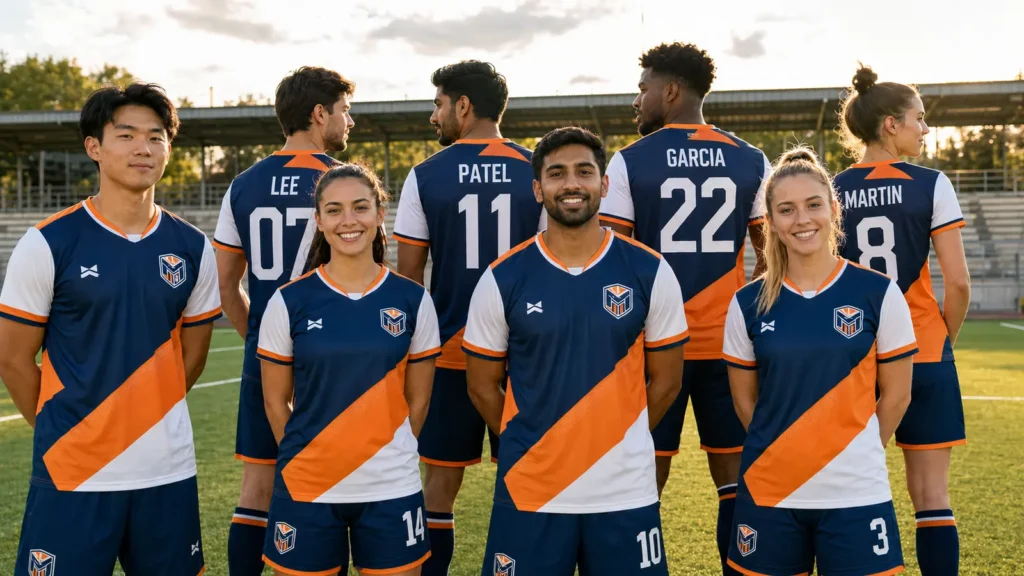
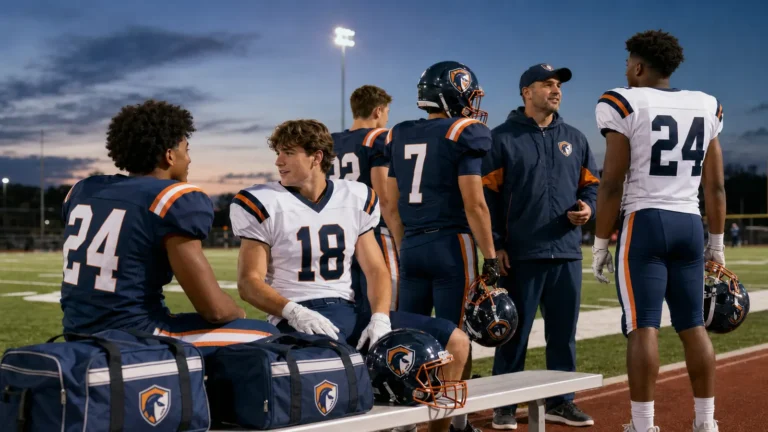
A controlled jersey system creates consistent team identity across different players, sizes, and viewing angles.
Frequently Asked Questions
Final Recommendation
The most effective way to design custom team jerseys with names, numbers and logos is to treat the project as a system. Define the visual hierarchy, use readable type, control colors, match artwork to the fabric and decoration process, specify placement measurements, and manage every personalized jersey through one approved roster.
Then verify the design twice: first as a complete digital specification and again as a physical sample. This approach protects team identity, reduces production ambiguity, and creates a reliable foundation for bulk delivery and future reorders.
About JIUMU
JIUMU is a B2B supplier of custom teamwear, logo apparel, hats, uniforms, bags, and branded merchandise for buyers in North America and Europe. Capabilities include OEM/ODM development, multiple logo methods, fabric sourcing, private labeling, packaging customization, sampling, quality control, and export support.