Baseball Jersey Size Chart and Fit Guide for Youth and Adult Teams
Ordering custom baseball jerseys for a full roster is different from buying one retail shirt. A team order must fit players of different ages, body shapes, positions, and layering preferences while keeping names, numbers, colors, and repeat orders consistent. One inaccurate size list can create replacements, missed games, extra freight, and a team photo in which half the jerseys look tight and the other half look oversized.
This guide gives team managers, schools, clubs, uniform dealers, and private-label buyers a practical way to build an accurate size roster. It includes reference youth and adult chest ranges, measurement instructions, fit choices, sample-approval steps, and a bulk-order quality-control checklist.
The most important rule is simple: use body measurements to select a starting size, then approve the supplier’s finished-garment specification and physical sample before bulk production. Size labels are not universal. A Youth Large from one program may not match another supplier’s Youth Large, and an Adult Small may overlap a youth chest range while having different shoulder width, body length, and armhole proportions.
Quick Answer: How Do You Choose the Right Baseball Jersey Size?
Measure the player’s chest around the fullest part, with the tape horizontal and the player standing naturally. Compare that body measurement with the jersey supplier’s body-size chart. If the player is between sizes, choose according to the required fit: the smaller size for a closer athletic fit or the larger size for more room, layering, or youth growth.
For a custom team order, do not approve sizes from age, height, or a familiar T-shirt label alone. Confirm five items:
- whether the chart shows body measurements or finished-garment measurements;
- the target fit—athletic, regular, or relaxed;
- whether players will wear a compression top or thicker base layer underneath;
- the approved sample’s chest width, body length, shoulder, sleeve, and armhole;
- the final player-by-player roster with youth and adult size prefixes.
Why Baseball Jersey Fit Matters in a Bulk Team Order
A baseball jersey must look consistent and allow throwing, batting, fielding, and warm-up movement. It can match the player’s chest yet still feel wrong if the shoulders are narrow, the armhole is high, or the body is too short.
Fit also affects customization. Large front lettering, tackle twill numbers, sponsor marks, sleeve patches, and player names must sit correctly on every size. If the smallest youth pattern does not have enough usable decoration area, artwork may need proportional scaling. If a relaxed adult pattern is too long, the back number and name arch may appear lower than intended.
Accurate sizing reduces replacements, supports consistent presentation and personalization, and makes repeat orders and roster packing easier. It therefore belongs at the beginning of the order, before artwork and production files are locked.
Reference Baseball Jersey Size Chart
The following charts are a starting reference for body chest measurements, not a universal JIUMU production specification. They follow the chest bands shown in the official Rawlings jersey sizing guidance, which instructs players to measure under the arms across the back and chest. Nike’s official MLB jersey guide likewise states that its chart values are body measurements and separates body sizing from the finished jersey itself.
Always compare the roster against the size chart supplied for the exact style being ordered.
Youth Baseball Jersey Size Chart
| Youth size | Reference body chest | Metric chest | Procurement note |
|---|---|---|---|
| Youth XS | 22–24 in | 56–61 cm | Use actual measurements; do not assign by age alone |
| Youth S | 26–28 in | 66–71 cm | Confirm body length for shorter players |
| Youth M | 30–32 in | 76–81 cm | Common transition range; check shoulder comfort |
| Youth L | 34–36 in | 86–91 cm | May overlap Adult S chest range but not adult proportions |
| Youth XL | 38–40 in | 97–102 cm | Compare youth and adult samples for taller players |
| Youth 2XL | 42–44 in | 107–112 cm | Availability depends on the supplier’s pattern range |
Adult Baseball Jersey Size Chart
| Adult size | Reference body chest | Metric chest | Procurement note |
|---|---|---|---|
| Adult S | 34–36 in | 86–91 cm | Confirm shoulder and body length against Youth L |
| Adult M | 38–40 in | 97–102 cm | Suitable starting point only; fit choice still matters |
| Adult L | 42–44 in | 107–112 cm | Check range of motion with arms raised |
| Adult XL | 46–48 in | 117–122 cm | Confirm finished chest and hem circumference |
| Adult 2XL | 50–52 in | 127–132 cm | Review artwork scale and placement on the approved sample |
| Adult 3XL | 54–56 in | 137–142 cm | Confirm fabric yield, surcharge, and availability |
Do not copy these ranges blindly into a purchase order. The official Nike MLB jersey chart separates authentic and replica constructions, showing how product type and silhouette can change size mapping within one brand.
Why Youth and Adult Sizes Can Overlap
Youth L and Adult S may show similar chest ranges, but their patterns use different proportions. The adult pattern commonly has more body length, broader shoulders, and larger armholes. For older youth players, provide Youth L/XL and Adult S/M samples and decide from shoulder movement, hem position, and overall appearance—not chest alone.
How to Measure a Player for a Baseball Jersey
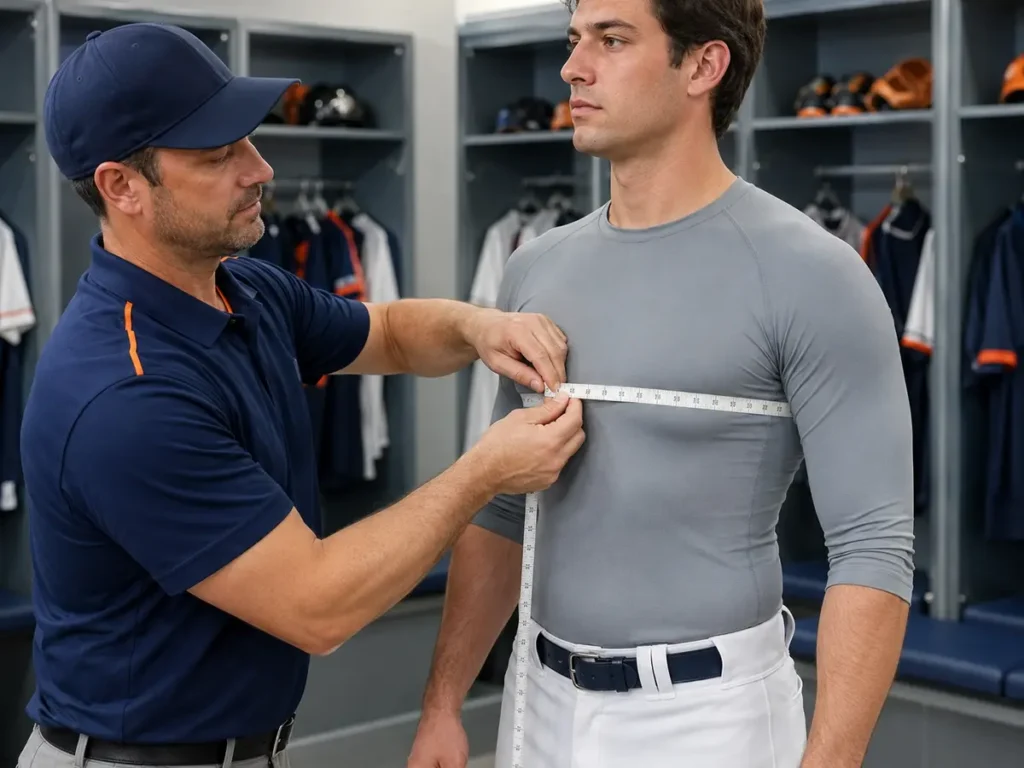
Use a flexible apparel tape and record measurements over the clothing normally worn under the jersey. Keep the tape flat and level without pulling it tight. If possible, have one trained person measure the whole team so the method stays consistent.
1. Measure the Chest
Ask the player to stand upright with arms relaxed. Wrap the tape around the fullest part of the chest, under the arms and across the shoulder blades. Keep it horizontal all the way around.
Rawlings advises measuring under the arms across the back muscles and chest and reading the measurement while the player takes a deep breath. Nike’s guidance says to measure around the fullest part of the chest while keeping the tape horizontal. Either method reinforces the same principle: do not measure only the front of the body or a favorite shirt.
Record the result to the nearest half inch or centimeter. Do not subtract from the measurement to create a tighter fit.
2. Measure Body Length
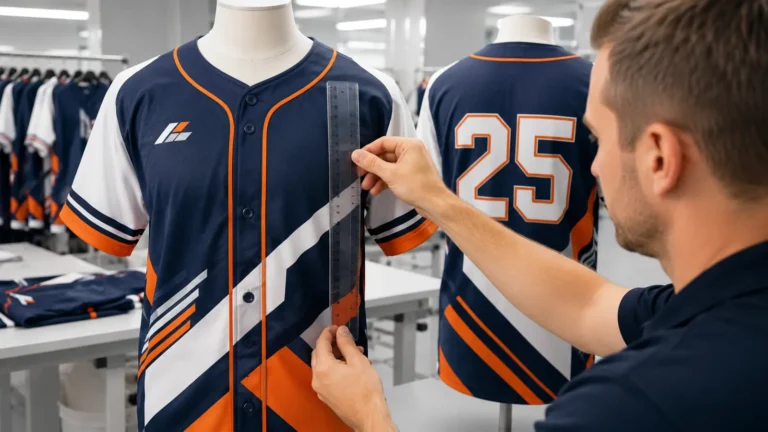
Measure from the high shoulder point near the neck to the desired hem. For a tucked jersey, check that it remains inside the pants during a batting stance and overhead reach. For an untucked jersey, make sure the curved hem is not too long for shorter players.
3. Check Shoulder Width
Measure across the upper back from shoulder point to shoulder point. A seam too far inside can restrict throwing; one too far down the arm can look oversized even when the chest is correct.
4. Check Sleeve and Armhole Comfort
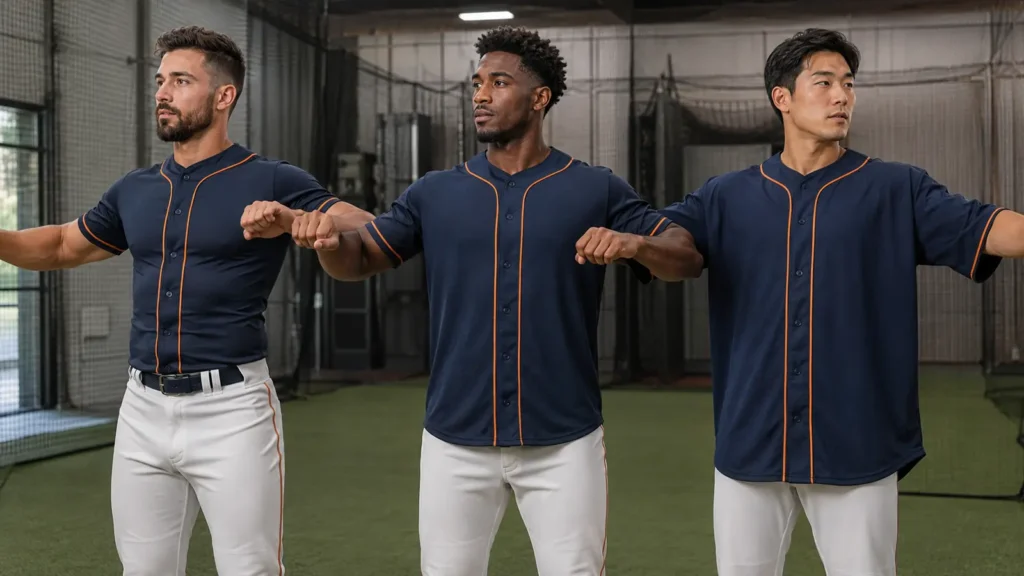
Measure sleeve length from the shoulder point to the intended sleeve edge. Then ask the player to raise both arms, rotate the torso, and simulate a throwing or batting position in the sample jersey.
A high armhole can pinch a broad-shouldered player, while an oversized armhole can expose the base layer and make the body look loose.
5. Record Height and Preferred Fit
Use height as a secondary check for players who may need extra body length; players of the same height can still need different sizes.
Add a preferred-fit field to the roster:
- Athletic / close
- Regular / standard
- Relaxed / roomy
- Between sizes
- Requires coach or supplier review
This prevents the coordinator from guessing what “I usually wear Medium” means.
Body Measurements vs Finished-Garment Measurements
Confusing these two systems is one of the most common causes of incorrect team sizing.
Body measurements describe the player. A 40-inch chest is the circumference around the body.
Finished-garment measurements describe the jersey laid flat or measured around the completed product. A supplier may list “half chest,” which is the distance from one underarm point to the other on a flat jersey. A 22-inch half chest equals approximately 44 inches around the garment before considering fabric behavior or measurement tolerance.
| Measurement | What it describes | How it is taken | Typical use |
|---|---|---|---|
| Body chest | Player’s torso | Around the fullest chest | Select a starting size |
| Half chest / pit to pit | Finished jersey | Flat, underarm to underarm | Approve garment width |
| Body length | Finished jersey | High shoulder point to hem | Confirm tuck or untucked coverage |
| Shoulder width | Finished jersey | Shoulder seam to shoulder seam | Check upper-body proportion |
| Sleeve length | Finished jersey | Shoulder seam to sleeve edge | Check coverage and movement |
| Hem width | Finished jersey | Flat across bottom opening | Check taper or relaxed silhouette |
Before approving production, ask the supplier to state exactly how every garment measurement is taken. Use the same method for the pre-production sample and bulk inspection.
Choose the Right Fit: Athletic, Regular, or Relaxed
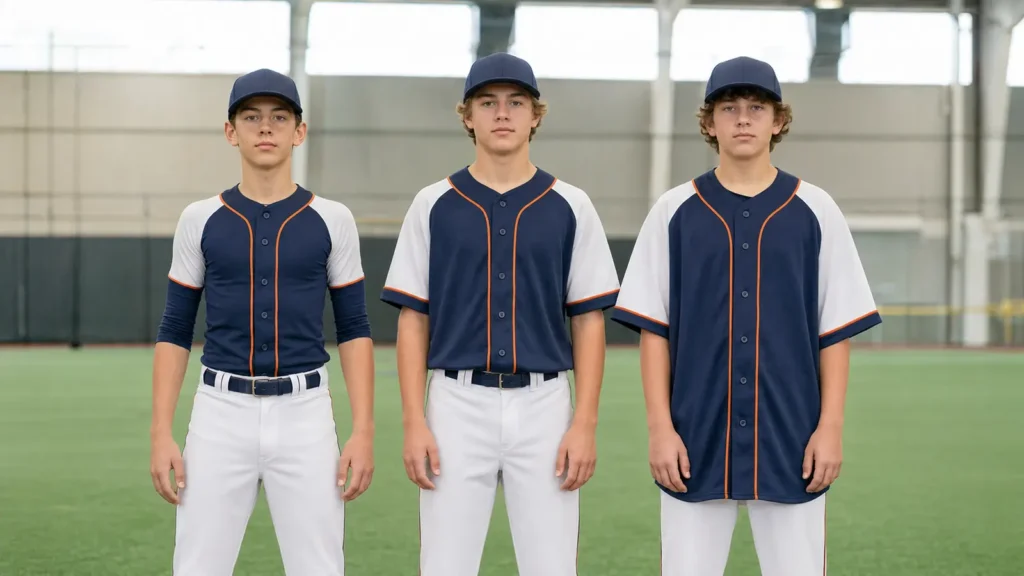
The size label and the fit are separate decisions. A size chart maps a body to a starting size; the pattern determines how the jersey sits on that body.
Athletic Fit
An athletic fit sits closer through the chest and body with less excess fabric. It can create a sharp game-day appearance and reduce loose material, but it must still permit full shoulder rotation. It is usually better suited to stretch or performance fabric and accurate body measurements.
Choose it when the team wants:
- a modern, close silhouette;
- jerseys worn over a thin compression layer;
- controlled fabric movement;
- a clearly defined shoulder line.
Avoid assigning athletic fit from age or weight. Test it on broad shoulders, catchers, and players who prefer layering.
Regular Team Fit
A regular fit offers moderate room without looking oversized. It is the safest starting point for mixed rosters, schools, youth leagues, and distributor programs because it balances movement, layering, and consistent presentation.
Choose it when:
- one pattern must serve many body shapes;
- players wear a light base layer;
- repeat orders are likely;
- the buyer wants a familiar team-uniform silhouette.
Relaxed Fit
A relaxed fit provides more room through the chest, waist, and armhole. It may suit recreational adult leagues, players who layer, or programs that deliberately prefer a looser traditional look.
Too much room can affect number position, front-placket alignment, and the untucked hem. Approve the full size set rather than simply increasing every player by one size.
A Practical Fit-Allowance Discussion
To translate a body measurement into a finished jersey, the pattern needs wearing ease. There is no universal baseball-jersey ease standard. As a non-binding planning discussion, a buyer may start by asking the supplier to compare:
| Desired fit | Starting discussion for total chest ease | Validation required |
|---|---|---|
| Athletic / close | About 2–4 in (5–10 cm) | Confirm stretch, armhole, and full batting motion |
| Regular / standard | About 4–6 in (10–15 cm) | Confirm layering and consistent silhouette |
| Relaxed / roomy | About 6–8 in (15–20 cm) | Confirm hem, artwork position, and excess fabric |
These are not final specifications. Fabric stretch, pattern shape, player build, and wearing method can change the required allowance; the physical sample is the decision point.
Youth Team Sizing: Growth Without Oversizing
Ordering every youth jersey one or two sizes larger creates dropped shoulders, long sleeves, low back numbers, and excess body length without guaranteeing next-season fit.
Use a controlled approach:
- measure every player close to the roster lock date;
- identify only players who are genuinely between sizes;
- compare the next size in a physical sample;
- confirm that shoulder seams and armholes remain functional;
- keep a small quantity of blank spare jerseys when the program expects additions or replacements.
Official youth charts also illustrate why age is not enough. Nike’s kids’ team-apparel guidance includes age, height, chest, waist, and hip because children within the same age range do not share one body shape. For a custom baseball jersey, chest and sample fit should carry more weight than the birthday on the roster.
Adult Team Sizing: Body Shape and Layering
Adult recreational and corporate teams often have a wide range of body shapes, so chest alone may understate waist, hem, shoulder, and wearing-style needs.
For adults:
- record chest and, when relevant, waist or midsection circumference;
- confirm whether the jersey will be tucked;
- test the sample over the intended base layer;
- check seated and batting positions, not only standing posture;
- offer extended sizes only after confirming the supplier’s available grading;
- do not assume that a unisex or men’s cut will satisfy every roster.
If the team includes women who prefer a shaped cut, build a separate size group and approve that pattern independently. Do not convert sizes by changing labels on the same adult pattern.
How Fabric and Construction Change the Fit
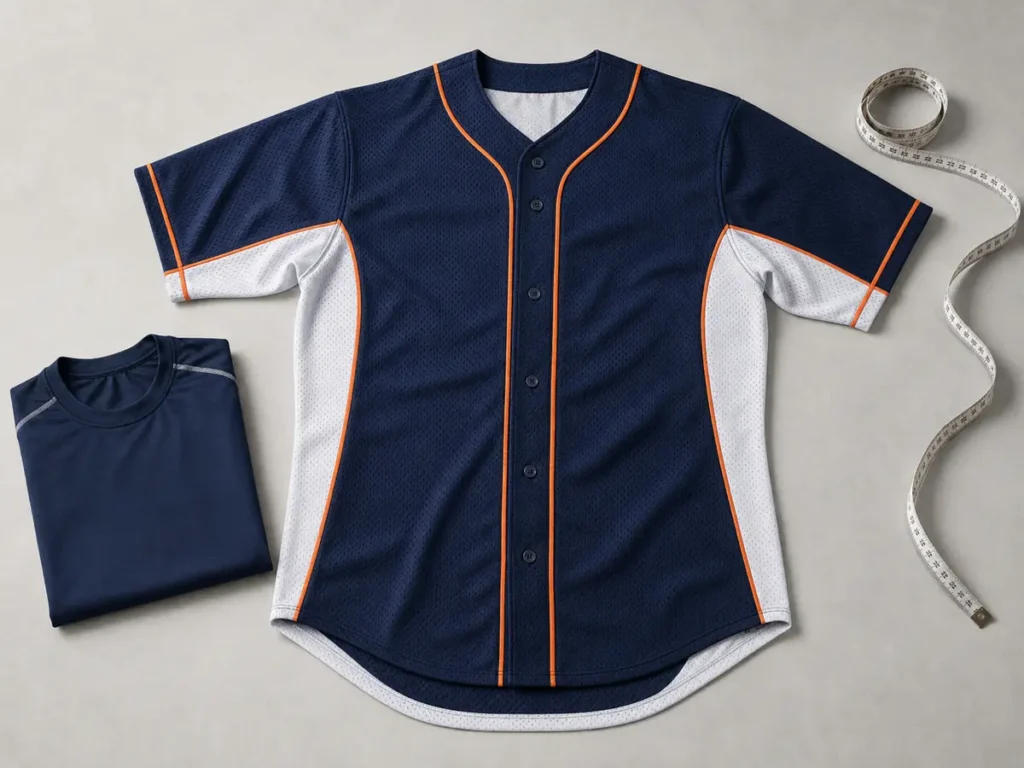
The same dimensions can feel different in two fabrics. Lightweight stretch knit may support a closer pattern, while stable double knit may require more ease. Mesh, embroidery, and stitched appliqué also change stretch, weight, and drape.
Review these specifications:
- fabric composition and weight;
- mechanical or elastane stretch;
- stretch direction and recovery;
- mesh placement;
- shoulder and side-panel construction;
- placket reinforcement;
- hem shape;
- seam type and seam allowance;
- expected dimensional tolerance;
- care method and shrinkage expectations.
Do not use an approved sample in one fabric to authorize production in another fabric without rechecking dimensions and movement.
How Decoration Methods Affect Size Planning
Customization should be planned across the complete size range. Sublimation integrates complex graphics into printed fabric. Embroidery adds texture and localized weight, while tackle twill creates a dimensional traditional look and may require more decoration area.
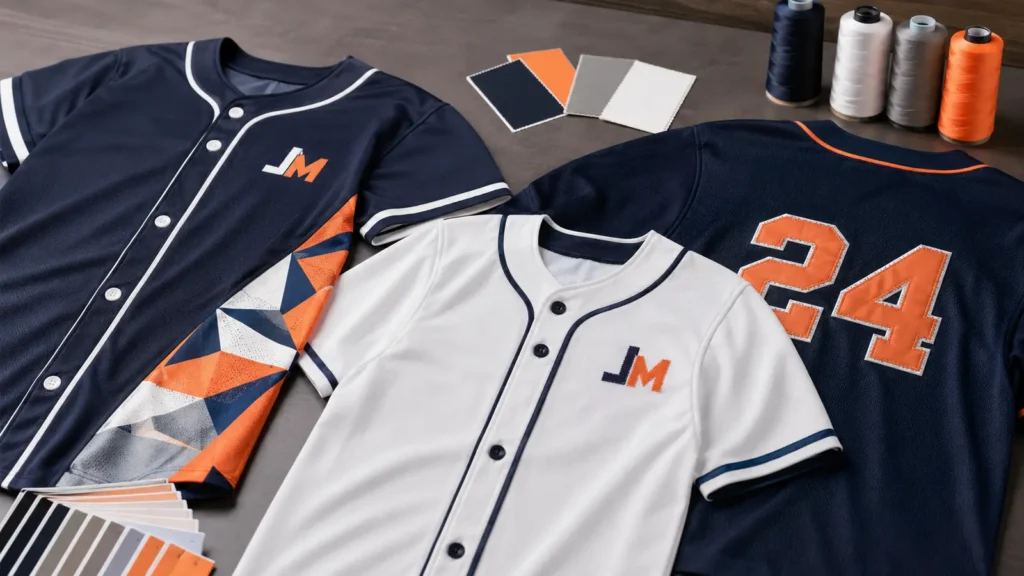
For Youth XS through Adult 3XL, confirm:
- minimum and maximum logo width;
- front artwork clearance from the placket and buttons;
- back-name and number proportions;
- sleeve patch size on youth sleeves;
- whether artwork scales proportionally or remains one size;
- how player names with different character counts will be handled;
- whether the decoration changes fabric drape;
- placement tolerances for the bulk order.
Planning a mixed youth and adult roster? Send JIUMU your size range, quantity, jersey style, logo files, colors, player names and numbers, fit preference, and target delivery date. Start with the custom baseball jerseys page or request a size-set sample through Contact JIUMU.
Build a Reliable Team Size Roster
A clean roster prevents size and personalization errors. Use one row per player and one controlled set of size labels.
| Required field | Example format | Why it matters |
|---|---|---|
| Roster ID | 001, 002, 003 | Keeps players traceable if names repeat |
| Player name | Jordan Lee | Links size, name, number, and package |
| Display name | LEE | Confirms exact decoration spelling |
| Player number | 24 | Prevents duplicate or missing allocations |
| Size group | Youth / Adult | Avoids confusing Youth L with Adult L |
| Size | YL / AS / A2XL | Uses unambiguous prefixes |
| Body chest | 35 in / 89 cm | Supports size verification |
| Preferred fit | Regular | Explains borderline choices |
| Sample tried | YL and AS | Records the decision basis |
| Approval status | Approved | Prevents draft rows entering production |
Freeze the roster before bulk production. If a late change is unavoidable, issue a revised file with a new version date and highlight only the changed rows. Do not send corrections across several chat messages without a consolidated final roster.
Sample Approval Process for Youth and Adult Teams
The best sizing workflow separates design approval from fit approval.
Step 1: Confirm the Base Style
Confirm the jersey construction, fabric, sleeve, collar, hem, placket, and whether it will be tucked.
Step 2: Review the Supplier’s Measurement Chart
Ask whether the chart contains body ranges, finished measurements, or both. Confirm the measurement method and tolerance. Compare it with a jersey your team already likes, but do not assume the old size labels transfer.
Step 3: Order a Size Set or Key Sizes
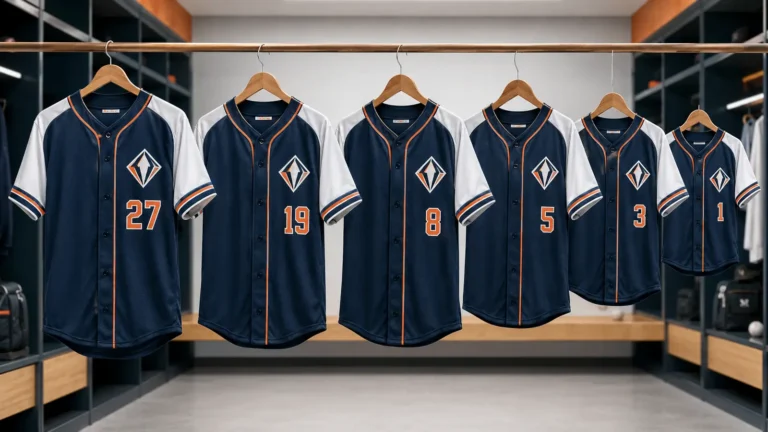
For a mixed roster, prioritize sizes around likely transitions: Youth M, Youth L, Youth XL, Adult S, Adult M, and the larger adult sizes represented on the team. If budget limits the sample set, choose the most common size and every critical boundary.
Step 4: Run a Structured Fitting
Players should wear the intended base layer and perform:
- overhead arm raise;
- cross-body reach;
- throwing motion;
- batting stance and rotation;
- seated position;
- tuck and untuck check.
Record the result immediately. Photos may help internal approval, provided the team has permission to capture and share them.
Step 5: Approve Finished Measurements
Measure the sample flat using the supplier’s method. Record half chest, body length, shoulder width, sleeve length, and hem width. These values—not only the sample’s label—become the approved reference.
Step 6: Approve Artwork on Small and Large Sizes
Check at least one youth size and one large adult size. Make sure the mark remains legible on the small garment and does not look undersized on the large garment.
Step 7: Lock the Roster and Production File
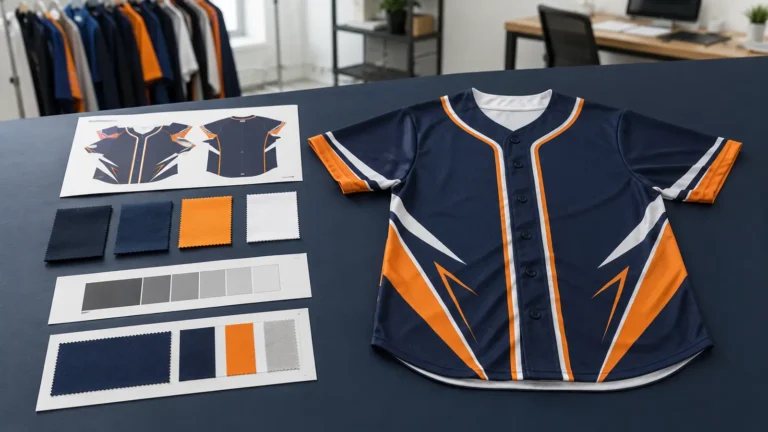
Final approval should include the style code, color references, fabric, size table, roster, artwork, placement, packaging, quantity, and delivery terms.
Bulk Quality Control for Jersey Size Consistency
Size approval is not complete until the bulk order is checked against the approved specification.
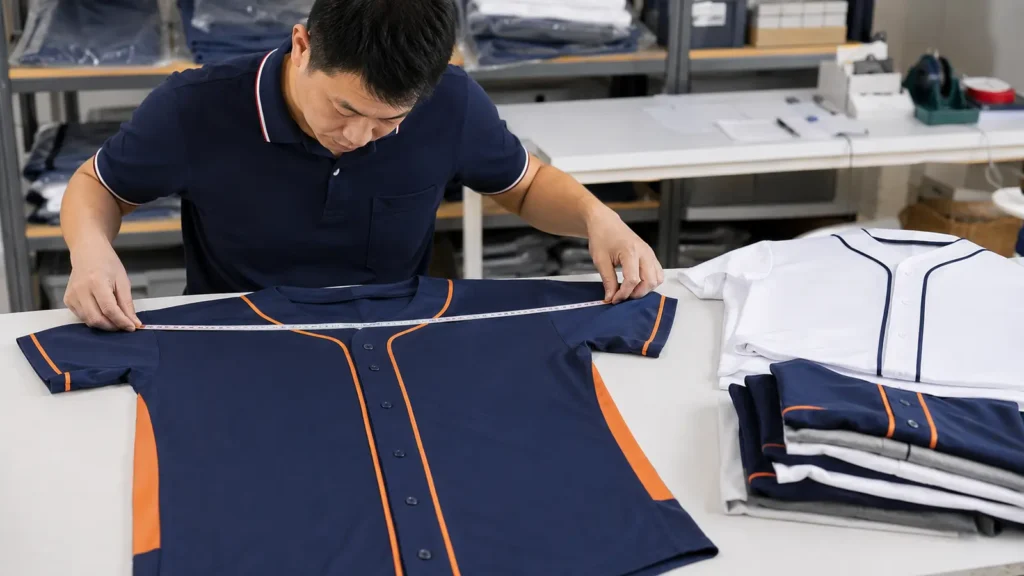
Use a quality-control checklist that covers:
- correct youth and adult size labels;
- finished half chest and body length;
- shoulder and sleeve measurements;
- measurement tolerance;
- left-to-right symmetry;
- placket alignment and button spacing;
- seam quality at stress points;
- consistent fabric and color by size;
- logo, name, and number placement;
- correct spelling and player-number allocation;
- quantity by size;
- packaging label and roster ID;
- carton assortment and shipping marks.
Measure garments on a flat, stable surface without stretching the fabric. If a result is outside the agreed tolerance, separate the affected item and inspect additional pieces from that size and production batch. Keep the approved sample and signed measurement chart available for comparison.
Common Baseball Jersey Sizing Mistakes
Using age as the size
Age can support a general youth category, but it cannot replace chest, height, and sample fit.
Writing “L” without Youth or Adult
Use YL and AL, or write Youth L and Adult L in full. Ambiguous labels can cause costly personalization errors.
Measuring a favorite shirt without identifying the method
A flat shirt measurement can help, but it is a finished-garment measurement. Record whether it is half chest, body length, or another dimension.
Adding one size for every youth player
Growth allowance must be assessed individually. Oversizing the entire roster weakens present fit and decoration placement.
Approving only one middle size
Grading issues can appear at Youth XS or Adult 3XL even when Adult M is correct. Review boundary sizes.
Changing fabric after sample approval
Different stretch, weight, and recovery can alter comfort and drape. Revalidate the sample when a material changes.
Ignoring the base layer
A jersey fitted over bare skin may feel tight over a compression top or cold-weather layer. Fit players in the intended game configuration.
Sending roster corrections in multiple files
Maintain one version-controlled final sheet. Every player row should connect size, name, number, and packaging.
What to Send a Supplier for an Accurate Quotation
For an accurate custom baseball jersey quotation, send:
- buyer type and destination country;
- youth and adult quantities by size;
- jersey style and fit preference;
- reference image or tech pack;
- fabric preference and approximate weight, if known;
- logo files and color references;
- decoration method;
- player names and numbers;
- individual or bulk packaging requirements;
- sample requirement;
- target delivery date;
- any required testing or documentation to discuss before ordering.
If the size breakdown is not ready, provide the expected range and total quantity. Material use, extended-size charges, roster handling, and packaging can be confirmed later.
Why JIUMU Is Relevant for Custom Baseball Team Orders
Established in 2010 in Guangdong, China, JIUMU provides B2B custom teamwear and logo apparel for schools, baseball and softball teams, sports clubs, distributors, promotional product companies, and private-label brands in North America and Europe.
JIUMU supports OEM and ODM product development, sublimation, embroidery, screen printing, heat transfer, custom fabric sourcing, Pantone color matching, labels, hangtags, custom packaging, digital mockups, physical samples, bulk production, quality control, and export support. A typical MOQ is 50 pieces, subject to the jersey structure and customization requirements.
For a baseball program, JIUMU can coordinate jerseys with baseball team uniform packages, including pants, caps, socks, bags, jackets, and hoodies. One coordinated specification helps buyers manage color, logo application, roster packing, and repeat orders across product categories.
Learn more about the company on About JIUMU.
Frequently Asked Questions
Final Recommendation
The safest baseball jersey size plan uses three layers of evidence: accurate player body measurements, a style-specific supplier chart, and a physically approved sample. Use chest size to choose the starting label, then confirm shoulder movement, body length, layering, and finished-garment dimensions. Record every choice in one version-controlled roster with clear Youth and Adult prefixes.
This process takes more discipline than collecting familiar T-shirt sizes, but it reduces replacements and gives the team a more consistent result across youth, adult, and extended sizes.
Request a custom quotation: Share your roster quantity, youth and adult size range, jersey style, colors, logo files, player names and numbers, packaging requirements, and target delivery date with JIUMU. Contact zhengdong@jiumugear.com or WhatsApp/phone +86 18507502899, or use the JIUMU contact page.
Editorial Sources
- Rawlings Sizing Chart – Jerseys
- Nike MLB Jerseys Size and Fit Guide
- Nike Kids’ MLB, NBA and NFL Clothing Size Chart
Editorial note: The reference charts in this guide are for preliminary planning. Final sizing must follow the approved specification for the exact custom jersey style, fabric, pattern, and fit.
About the Author
JIUMU Teamwear Sourcing Team prepares practical buying guidance for custom uniforms, logo apparel, and bulk team orders. This article was developed from official manufacturer sizing references and JIUMU’s custom teamwear order-planning workflow. Final sizing requires style-specific sample approval.