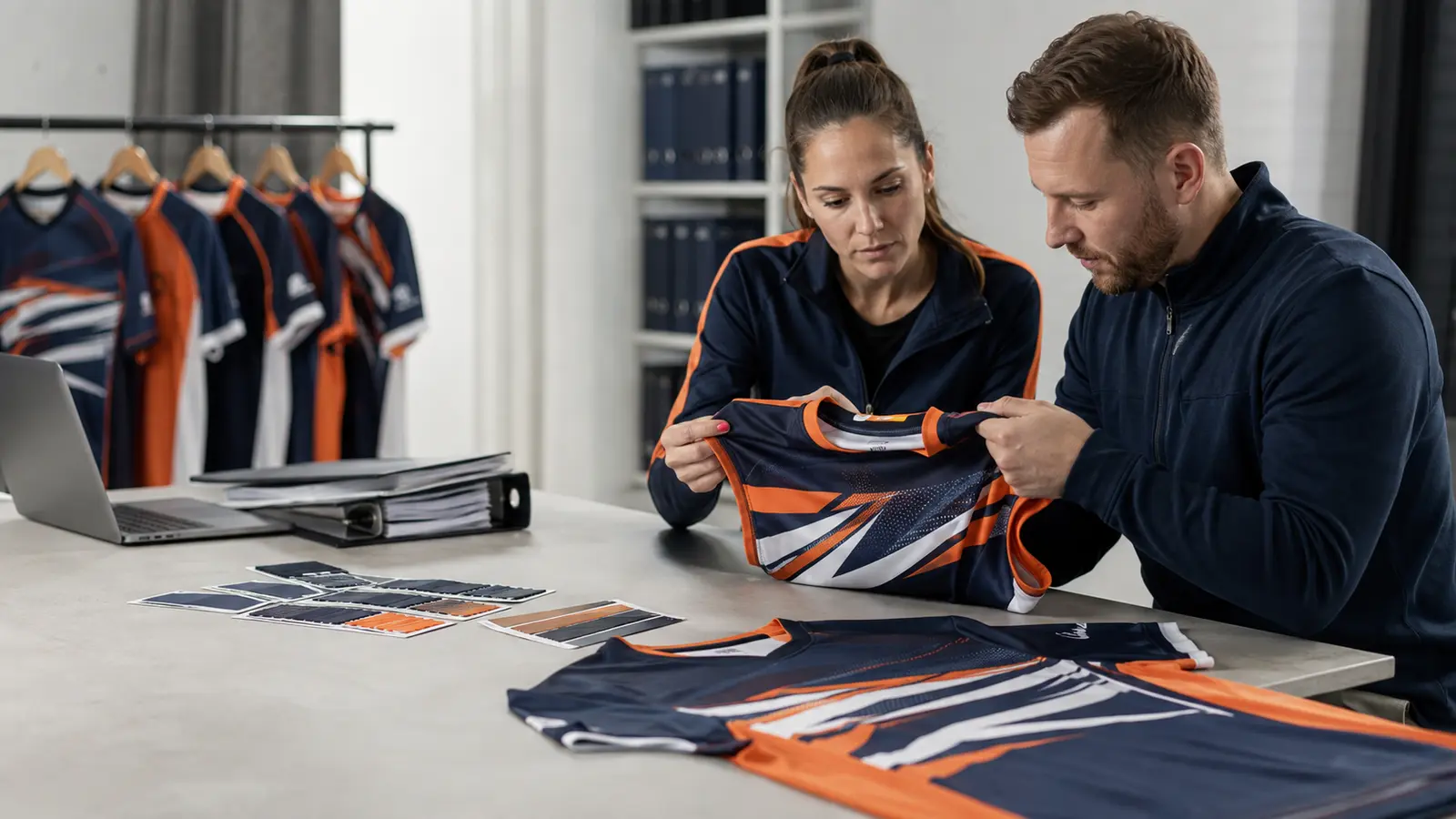
How to Reorder Team Uniforms Without Color Differences
Reordering team uniforms sounds simple: send the old order number and ask for the same jerseys again. In practice, “same” must be translated into controlled production references. The original color may have been produced on a specific polyester construction, with a particular printer profile, ink system, transfer paper, temperature, pressure and approved physical sample. The fit may depend on an archived pattern and size-chart revision. Logo size and placement may vary by garment size. Player names and numbers may come from a final roster version that is different from the first spreadsheet the buyer submitted.
A reliable repeat order therefore begins with record recovery, not with a photo of an old jersey. The supplier and buyer should identify the approved standard, check whether the same material and production route remain available, agree on color and dimensional tolerances, approve a current swatch or first piece when necessary, and inspect the reorder against both the archived reference and the newly approved production standard.
Quick Answer
Can team uniform reorders match exactly? A supplier can reproduce the approved design, fit and color target closely when the original files, material reference, paper pattern, size chart, production settings and Golden Sample are available. Absolute identity across separate textile or print batches should not be guaranteed. The correct goal is a documented match within buyer-approved color, measurement and placement tolerances.
Why do fabric batches differ? Fiber, yarn, knitting or weaving, finishing, whiteness, texture, dye absorption and surface sheen can vary between lots. In sublimation, the fabric and the transfer process jointly determine the visible result. Even if the artwork values remain unchanged, a different base fabric or production setup may alter the final appearance.
What is needed for a reorder? Send the original purchase order, style code, approved artwork revision, final roster, size chart, fit name, fabric and trim references, color targets, logo dimensions and positions, packaging specification, photos and required delivery date. The physical Golden Sample or retained swatch is especially valuable.
“Same Design” Is Not a Complete Reorder Specification
A design file mainly describes visible graphics. It may not define the material, garment construction, measurement method, print profile, production conditions, trim or accepted variance. A repeat-order file should connect all of those elements.
| Consistency layer | What should be preserved | What can go wrong if missing |
|---|---|---|
| Order identity | Purchase order, style code, season and buyer account | Wrong historical order retrieved |
| Artwork | Final vector/raster production file and revision | Old logo, wrong sponsor or outdated colors used |
| Personalization | Approved roster with names, numbers, sizes and fit | Spelling, duplicate-number or size errors |
| Color | Physical standard, color target, approved swatch and evaluation condition | Screen-based or subjective matching |
| Fabric | Composition, construction, weight, finish, supplier and lot reference | Different whiteness, texture, stretch or sheen |
| Printing or decoration | Method, profiles, consumables, heat settings and placement | Color, hand feel or location changes |
| Pattern and sizing | Paper pattern, graded nest, size chart revision and measurement method | Fit drift or incorrect grading |
| Trims and packing | Collar, rib, labels, thread, bags and carton ratios | Visibly inconsistent finished product |
| Approval evidence | Golden Sample, strike-off, first piece and accepted deviations | No objective reference for QC |
The supplier should not merely search for a file with the same team name. The buyer may have ordered several seasons, colorways or sponsor versions. Every repeat order needs an exact source record.
Start With the Original Order Number and Version
The original purchase order is the fastest route into the production archive. It should connect to the quotation, artwork, sample approvals, roster, material information, production release and inspection report.
However, the order number alone is not enough if the project changed during approval. The original art file may have been revised several times. A sponsor may have moved. The neck label may have changed. The final roster may not match the spreadsheet attached to the first inquiry.
Use a reorder header containing:
- Original purchase order and invoice reference
- Team, club, school or program name
- Product and internal style code
- Original production season and ship date
- Final artwork revision
- Final roster revision
- Size-chart revision and named fit
- Golden Sample or retained-swatch ID
- Reorder quantity and size assortment
- Requested changes, explicitly separated from unchanged details
- Must-arrive date and destination
If the buyer intentionally changes one element, such as a sponsor logo, record the new revision without silently replacing the historic file. This preserves an audit trail and prevents the change from contaminating future reorders for another team division.
Keep the Golden Sample as the Physical Standard
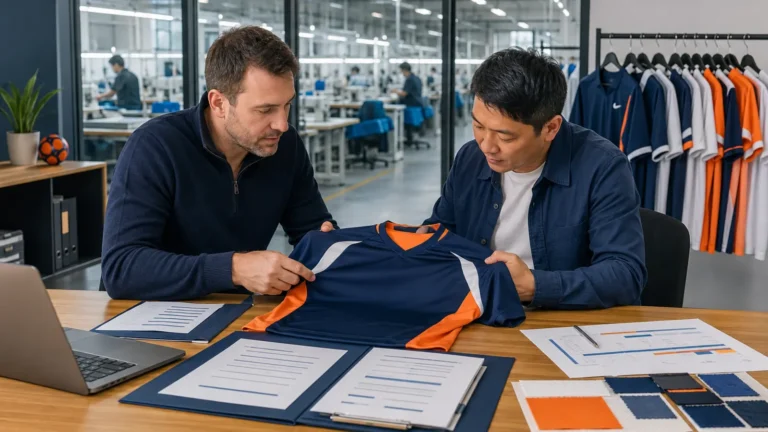
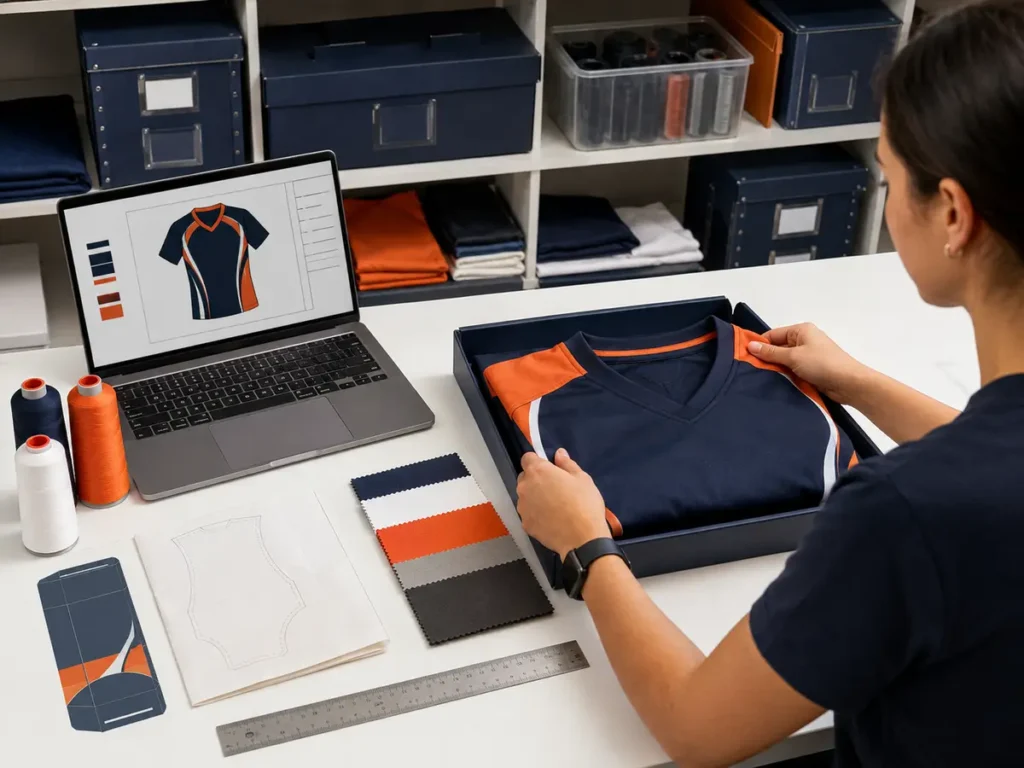
A Golden Sample is the approved physical item used as a benchmark for later production and inspection. For team uniforms, it can preserve information that a digital file cannot fully express:
- Fabric surface, weight, stretch and opacity
- Printed color on the real substrate
- Collar, rib, binding and seam construction
- Logo scale and physical placement
- Garment balance and fit
- Label and packaging details
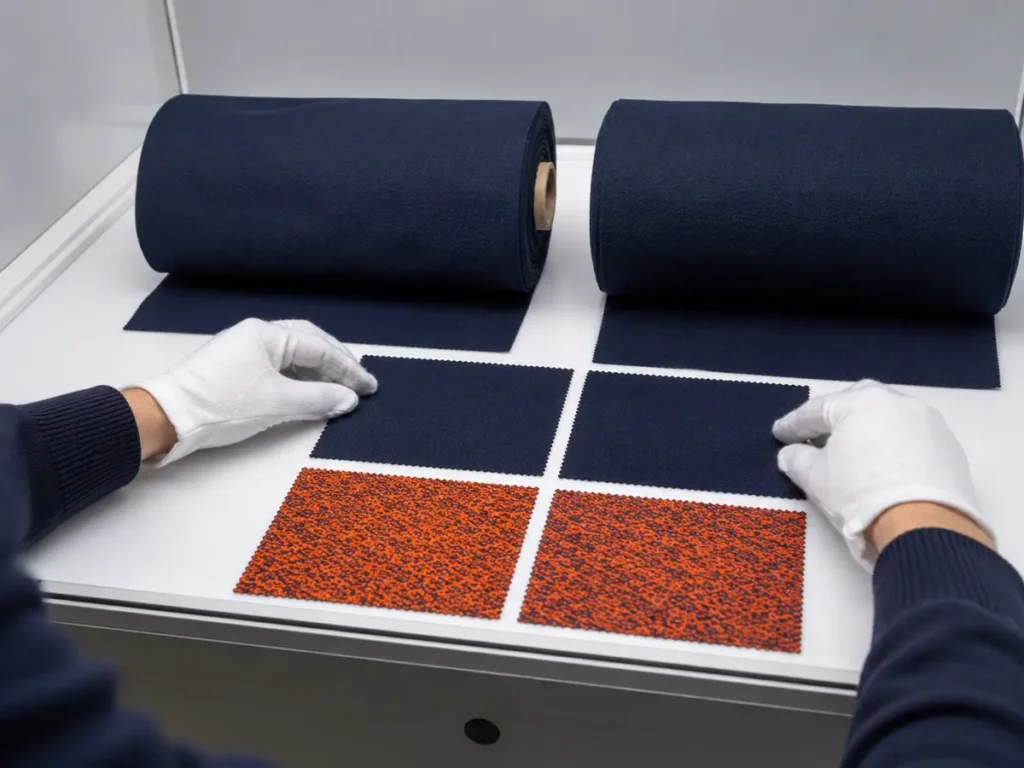
The buyer and factory should agree which item has Golden Sample status. A random piece from the first bulk order is helpful but may not carry the same formal approval history. Label the sample with the order, style, colorway, size, revision and approval date. Store it away from excessive light, moisture, dust, heat and handling.
Physical standards can also change over time. AATCC notes that textile evaluation scales require controlled storage and periodic checking because exposure and handling can affect reference materials. The same practical principle applies to retained jersey and fabric references: protect them and record their condition rather than assuming they remain unchanged indefinitely. (AATCC reference-scale care)
Record Pantone Targets, Materials and Production Parameters
Pantone provides a shared color language, but a Pantone designation is a target, not a guarantee that every fabric and process will render the target identically. Pantone explicitly notes that color appearance can change with the material and that some colors may not be achievable on certain substrates. (Pantone Color Systems)
For a repeat order, connect the color target to the actual production system.
Physical Color Reference
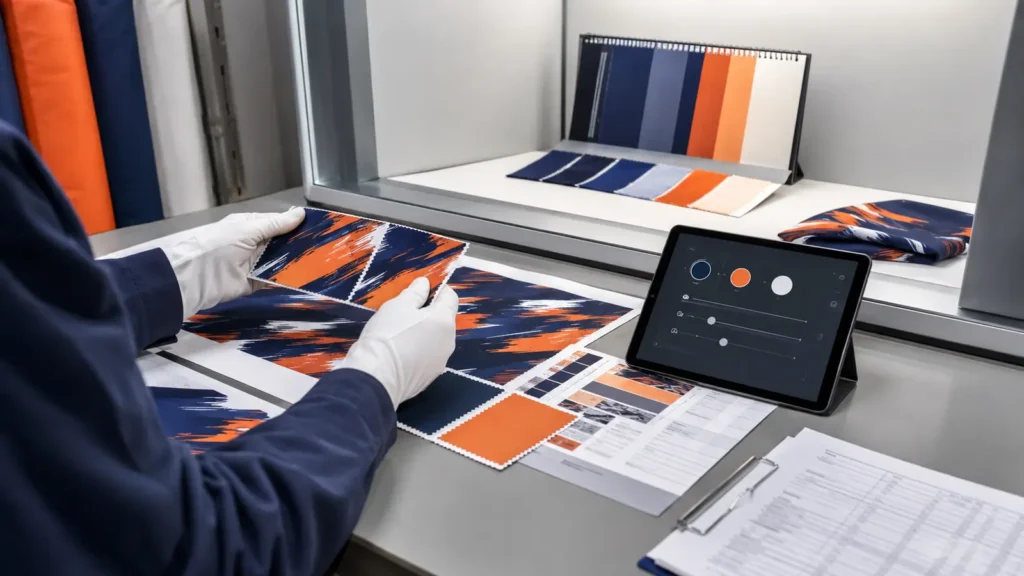
Record the physical guide or textile swatch used, its condition and the agreed viewing environment. Do not rely only on RGB, HEX, CMYK or a screenshot. Pantone’s textile guidance recommends providing a physical swatch standard to production partners for textile dyeing decisions. (Pantone digital and physical color workflow)
Fabric Specification
Record more than “100% polyester.” Include the relevant construction, weight, stretch, surface, finish, whiteness and supplier reference. Two polyester fabrics can interact differently with the same print file because their structures and optical properties differ.
Printing or Heat-Transfer Parameters
For sublimation, the production record may include the printer and ink system, profile, transfer paper, temperature, dwell time, pressure, fabric orientation and other process controls appropriate to the supplier’s workflow. These are operational references, not universal values. Copying a temperature from a different material or machine is not a reliable control.
Decoration and Trim References
Embroidery thread, heat-transfer film, screen-print ink, patches, rib, binding, buttons, zippers and labels can each introduce a second color or texture standard. Record the vendor code and approved physical appearance where relevant.
Send JIUMU the original order number, approved design, final roster, size assortment, Golden Sample reference and requested delivery date. We will review what can be reproduced, what must be reconfirmed and whether a current swatch or first piece is needed. Request a Reorder Review.
Preserve the Original Pattern and Size Chart
Color is only one part of repeat-order consistency. Players immediately notice when a new Large is longer, narrower or tighter than the original Large.
Preserve:
- Base paper pattern and style code
- Graded pattern or size nest
- Size chart revision
- Measurement-point diagrams
- Measurement method, including how the garment is laid and tensioned
- Named fit: relaxed, athletic, compression, men’s, women’s, youth or unisex
- Fabric stretch and recovery assumptions
- Approved sample measurements
- Bulk-production measurement tolerance
Garment measurements and body measurements must remain separate. If the old chart recorded body recommendations while the factory uses finished-garment measurements, the reorder comparison will be misleading.
The Same Pattern on a Different Fabric May Not Fit the Same
A paper pattern controls cut geometry. The finished fit also depends on stretch, recovery, shrinkage or heat response, seam construction and finishing. If the original fabric is unavailable, the supplier should assess the substitute before releasing the reorder.
ISO 5077 specifies a method for determining dimensional change in textile articles under defined washing and drying procedures. This does not create a universal jersey shrinkage limit, but it shows why dimensional behavior must be tested under an agreed method rather than inferred from fiber content alone. (ISO 5077:2007)
Record Logo Size and Position by Garment Size
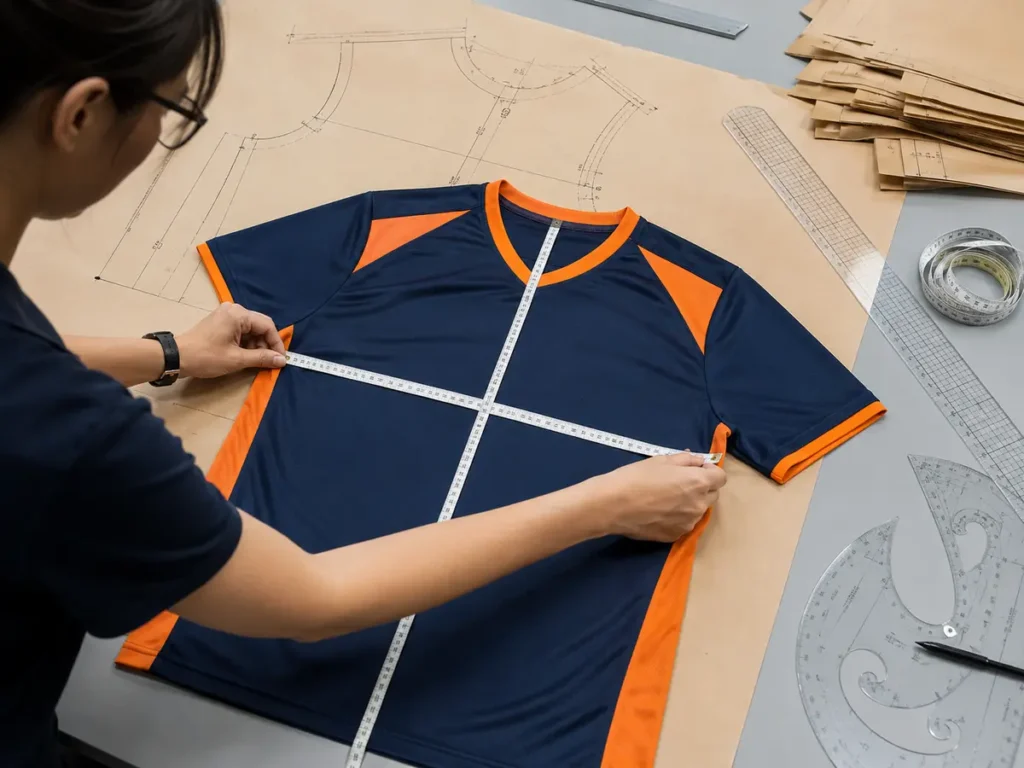
Logo position is not always a single coordinate copied across every size. A chest logo centered on an Adult XL may look too low or too wide on Youth XS. Player names and numbers may need scaling to avoid collars, seams, armholes or side panels.
The repeat-order specification should define:
- Logo artwork revision
- Finished logo width and height
- Reference measurement point
- Horizontal and vertical position
- Alignment rule, such as centered to body or aligned to a panel
- Size-dependent scaling rule
- Minimum distance from seam, collar, placket or armhole
- Sponsor hierarchy
- Decoration method
- Permitted placement and size tolerance
Use a measurement diagram rather than a vague instruction such as “same position as before.” The diagram becomes especially important if the original production team, supplier or software changes.
Why Fabric, Dye and Print Batches Naturally Vary
Separate manufacturing runs are not one continuous physical batch. Material and process inputs can change within controlled limits.
| Variation source | Possible visible or dimensional effect | Reorder control |
|---|---|---|
| Fiber or yarn lot | Surface reflectance, hand feel or dye response | Confirm material source and inspect current lot |
| Knitting or weaving | Texture, weight, stretch and opacity | Compare construction and test measurements |
| Fabric finishing | Whiteness, sheen, shrinkage or heat response | Approve current material swatch |
| Dye lot | Shade, depth or undertone difference | Compare lots under agreed lighting |
| Sublimation ink or profile | Hue, saturation and tonal balance | Restore verified workflow and print a current strike-off |
| Transfer conditions | Color development, sharpness or migration | Control equipment-specific time, temperature and pressure |
| Screen print or heat transfer | Color, thickness, gloss or edge definition | Preserve material code and approve current sample |
| Sewing and pressing | Measurements, shape or surface marks | Measure first piece and bulk samples |
The objective is not to deny variation but to detect and control it before the full reorder is completed.
Why an Old Jersey Photo Is Not Enough
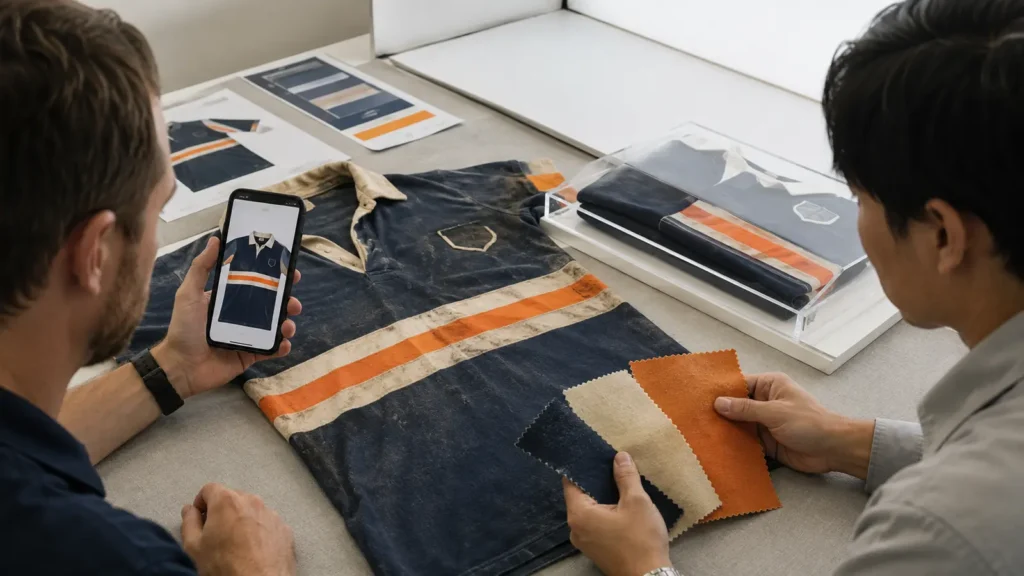
A photo is valuable for finding the correct style and identifying missing records. It is a weak final color standard.
The captured result depends on:
- Camera white balance, exposure and image processing
- Room lighting and reflections
- Phone or monitor calibration
- File compression and social-media processing
- Background colors
- Fabric angle, texture and sheen
- Wear, washing and sunlight exposure
A two-year-old game jersey may also have faded, abraded, stretched or shrunk. If the factory matches the worn piece visually, it may reproduce the aged state rather than the approved original standard.
Use Photos as Supporting Evidence
Ask the buyer to photograph front, back, labels, logo placement and construction. Include a neutral background and physical reference if available. Use the photos to locate the original record and understand current field appearance. Then base production approval on the archived artwork, material specification, physical standard and current sample.
Can One Jersey Match a Two-Year-Old Batch?
It may be possible to produce a close replacement, but the feasibility and commercial route require review.
Ask:
- Does the original production file still exist?
- Is the same fabric construction available?
- Is there a protected Golden Sample or retained swatch?
- Has the supplier, printer, ink system, paper or decoration material changed?
- Is the old jersey worn or washed?
- Is one-piece production technically and economically feasible?
- Would a small visible difference be acceptable beside the aged jerseys?
JIUMU’s typical MOQ is 50 pieces, subject to product structure and customization. A one-piece or very small repeat order therefore requires case-by-case confirmation. The original bulk unit price should not be assumed, because setup, handling, inspection and shipping are distributed differently.
If the replacement must appear beside two-year-old uniforms, compare the new proposal with both the protected original standard and a representative worn jersey. The buyer can then decide whether to reproduce the original target, accept a practical compromise or replace a larger group together for closer within-batch consistency.
Reapprove a Swatch, First Piece or Full Sample
The approval level should match the degree of change and commercial risk.
| Current reorder condition | Recommended approval | What it confirms |
|---|---|---|
| Same verified material and process, recent original order | Document review plus current first-piece check | Artwork, placement and measurements |
| New fabric lot | Physical fabric or printed swatch | Color, texture, whiteness and print response |
| New print profile, machine or consumable | Printed strike-off plus first piece | Color development and graphic result |
| Original fabric unavailable | Substitute material sample and finished garment | Appearance, fit, hand feel and dimensions |
| Major paper-pattern or fit uncertainty | Physical size sample | Construction and measurements |
| Two-year-old or poorly documented order | Full pre-production sample | Complete current production standard |
Digital approval may be sufficient for spelling or layout confirmation. It cannot fully approve fabric hand, surface sheen, exact printed color or finished measurements.
Approve the Current Standard, Not Just “Looks Good”
The approval record should identify:
- Order and style
- Artwork and roster revision
- Material and colorway
- Sample or swatch ID
- Lighting or evaluation condition
- Measurements checked
- Accepted deviations
- Approver, date and decision
- Status: approved, approved with condition or revise and resubmit
Define Reasonable Color and Size Tolerances
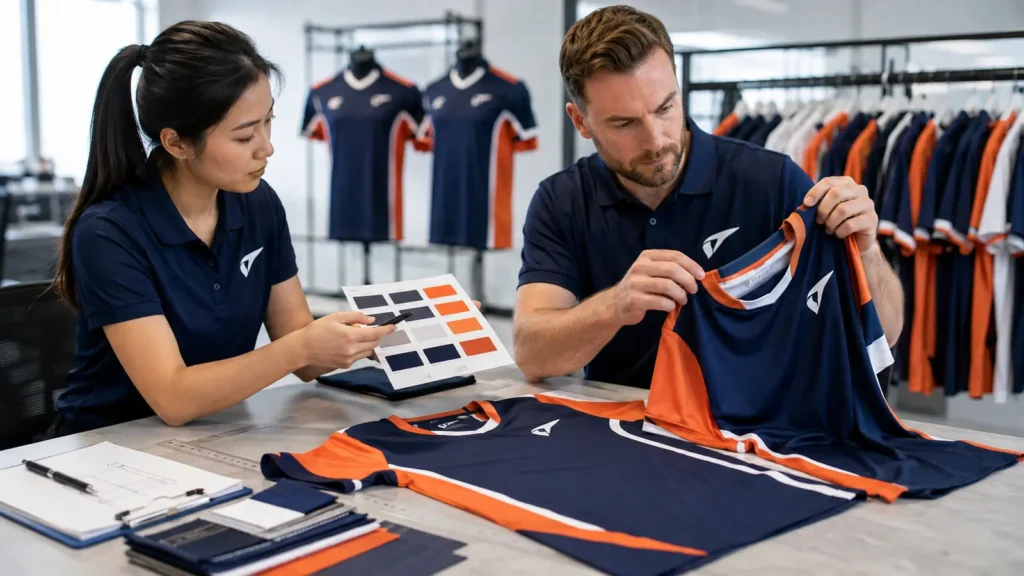
“No color difference” and “same size” are intentions. QC needs measurable or clearly observable acceptance rules.
Color Tolerance
Color tolerance can combine a visual comparison under agreed lighting with an instrumental method when suitable equipment and procedures are available. ISO 105-J03 describes calculating color difference between specimens of the same textile material measured under the same conditions and permits a maximum tolerance appropriate to the required closeness of match. It does not impose one universal limit for every jersey and application. (ISO 105-J03:2009)
The buyer and supplier should agree:
- Physical reference
- Material being compared
- Lighting and viewing geometry
- Visual decision owner
- Instrumental method, if used
- Maximum accepted difference
- Action for borderline or failed results
Do not copy a Delta E value from an unrelated brand or material without checking whether the method, instrument settings and end use match.
Garment Measurement Tolerance
Define tolerances by point of measurement, not as one percentage for the whole garment. Chest width, body length, shoulder, sleeve, waist, inseam and opening can have different construction behavior and commercial importance.
Record:
- Measurement code and diagram
- Nominal finished measurement for each size
- Plus/minus tolerance
- Garment preparation and relaxation condition
- Measuring tool and method
- Sample size and disposition rule
Logo and Placement Tolerance
Separate artwork size tolerance from placement tolerance. A correctly sized logo can still be positioned incorrectly. Define the reference origin, allowable movement and any symmetry or seam-distance requirement.
Repeat-Order Pre-Production Workflow
Step 1: Submit the Original Record
Send the order ID, style, artwork, Golden Sample reference, roster and requested quantity. List every intentional change.
Step 2: Perform an Availability Review
The supplier checks fabric, trims, decoration materials, pattern and production files. Any unavailable input is flagged before quotation approval.
Step 3: Classify the Reorder
Use one of three statuses:
- Direct controlled repeat: same verified specification and current references available.
- Repeat with reapproval: same design, but current material or production lot must be approved.
- Redevelopment: original records are incomplete or a material, pattern or process has materially changed.
Step 4: Approve Current References
Approve the required color swatch, print strike-off, first piece or full sample. Connect the approval to the production order.
Step 5: Lock the New Roster and Size Assortment
Do not reuse the old roster without marking returning, new and removed players. Check spelling, numbers, youth/adult range, fit and top/bottom sizes.
Step 6: Release and Inspect Production
The reorder uses the newly approved reference for production control while the archive remains the historical comparison.
Repeat-Order Quality-Control Checklist
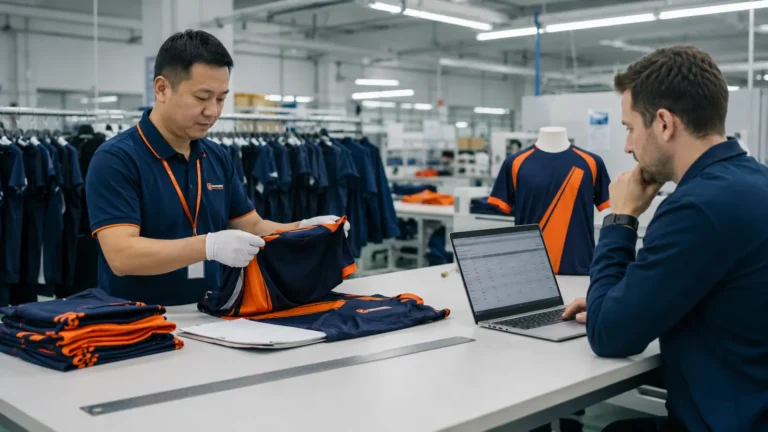
Inspect the reorder for:
- Correct purchase order, style and colorway
- Approved artwork and roster revision
- Fabric composition, construction and surface
- Color against current approval and archived reference
- Logo dimensions and position
- Player names, numbers and special marks
- Pattern and fit identity
- Measurements by size and measurement point
- Collar, rib, binding, panels and seam construction
- Print sharpness, registration and coverage
- Embroidery, transfer, patch or screen-print quality where applicable
- Labels, packing and carton ratios
- Quantity by player, size and set
- Any accepted deviations documented before shipment
The Quality Control process should treat the Golden Sample as one reference and the approved reorder first piece as the current-batch production standard.
What Buyers Should Send for a Reorder Quotation
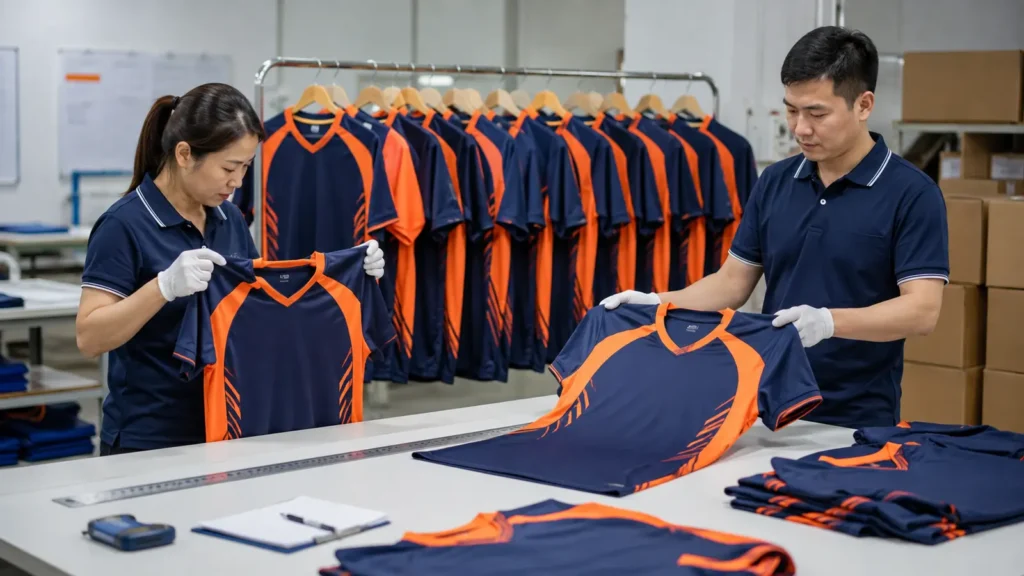
Provide:
- Original order or invoice number
- Team, organization and contact
- Product style and colorway
- Reorder quantity
- Size assortment
- Updated roster
- Final artwork files, if available
- Photos of the old garments for identification
- Golden Sample or retained-swatch information
- Requested changes
- Destination and must-arrive date
- Packaging or player-sorting requirements
- Whether a swatch, first piece or full sample is required
- Any written tolerance or side-by-side matching requirement
If the original supplier is no longer available, say so. A new supplier may need to redevelop the product from the physical garment and available files rather than claim it is a simple repeat order.
Questions to Ask the Factory
- Can you retrieve the final approved order and artwork revision?
- Is the original fabric construction still available?
- Do you hold the Golden Sample, swatch or production references?
- Have any print, ink, paper, heat-transfer or decoration inputs changed?
- Is the original paper pattern and size chart revision available?
- Which logo placement rules are size-specific?
- What current sample or swatch must be reapproved?
- How will color be evaluated?
- What dimensional and placement tolerances will be used?
- What MOQ, setup and lead-time conditions apply to the reorder?
- How will the first piece and bulk production be inspected?
- Which records will be saved for the next season?
Common Reorder Mistakes
Sending Only a Photo
A photo cannot reliably define exact color, fabric construction, measurements or production parameters.
Using the First Artwork Instead of the Final Approved Version
The final production file may contain later sponsor, logo, number or layout corrections.
Calling a Substitute Fabric “the Same”
Even identical fiber content does not prove identical weight, stretch, surface, whiteness or print response.
Ignoring Fit and Size-Chart Revisions
A new Large can differ even if the printed design matches. Preserve pattern and measurement controls.
Comparing Only With a Worn Jersey
Use the worn garment to understand current field appearance, but keep the protected production standard separate.
Approving Color on a Screen
Screens are helpful for layout but do not replace a physical textile approval under controlled viewing conditions. For more detail, use the Sublimation Color Guide.
Leaving Tolerance Undefined
If no acceptance rule exists, buyer and supplier may disagree even when the deviation is small. Set the evaluation method and disposition before production.
How JIUMU Supports Repeat Team Uniform Orders
JIUMU supports custom teamwear development for schools, clubs, leagues, distributors and apparel buyers. Relevant capabilities include digital mockups, physical samples, sublimation printing, screen printing, heat transfer, embroidery, fabric sourcing, Pantone color matching, private labels, packaging customization and bulk-production quality control.
For a reorder, JIUMU first needs the original project reference and current requirements. The review connects the design, material, color, pattern, size chart, roster and approval records. When an input has changed, the appropriate current swatch or sample can be identified before bulk production.
Explore Custom Team Uniforms for coordinated jerseys and related teamwear. Review MOQ & Lead Time and confirm the current requirement for the specific product, quantity and degree of redevelopment.
Frequently Asked Questions
Final Recommendation
The most dependable reorder is designed during the first order. Save the order ID, final artwork and roster, physical color reference, fabric specification, production method, paper pattern, size chart, logo-position diagram, Golden Sample and accepted tolerances.
Before every new season or replenishment run, verify that those inputs are still available. If anything has changed, approve the relevant current swatch, first piece or sample. Inspect the bulk reorder against the current approval while retaining the original archive for traceability.
This approach cannot eliminate the physical reality of separate production batches, but it turns vague expectations into a controlled, auditable process—and gives the buyer a clear decision point before the full order is made.
Send the original order number, approved design, current roster, size assortment, Golden Sample reference, quantity and target delivery date. JIUMU will review record availability, current materials, approval requirements and the suitable production route. Contact JIUMU.
About the JIUMU Team
JIUMU provides OEM and ODM custom teamwear, color coordination, physical sampling, jersey personalization, repeat-order planning, quality control and export support for schools, clubs, leagues, distributors and apparel buyers.