How to Handle Late Player Additions and Replacement Jerseys
Late player additions are normal in school teams, clubs, recreational leagues and tournament programs. A player joins after the roster closes. A number must change. A jersey is lost, damaged or ordered in the wrong size. The operational problem is not simply whether a supplier can make another garment. It is whether the change can be made at the current production stage without disrupting approved artwork, material allocation, personalization records, quality control or the required delivery date.
The safest approach is to treat every late request as a controlled change. First identify the exact order and approved roster version. Then confirm the production stage, the new player’s details, the quantity, the required date and the acceptable matching standard. Only after that review should the supplier confirm whether the item can join the current batch, move to a separate replacement order or be filled from planned spare stock.
Quick Answer
Can a player be added after production starts? Sometimes, but not automatically. If artwork, material and personalization have not been locked, the supplier may be able to add the player to the original batch. Once printing, cutting or sewing has started, the extra jersey may require a separate work order, a different ship date and additional cost. After shipment, it is a replacement or repeat order.
Can a team reorder one jersey? It depends on the product method, available material, saved production files and the supplier’s minimum economic batch. A single fully customized jersey may be technically possible but disproportionately expensive because setup, handling, quality control and international freight are concentrated into one piece. Confirm feasibility and total landed cost rather than assuming the original unit price applies.
Will a replacement match exactly? It can be managed toward the approved standard, but an absolute visual match should not be promised across different material, ink, dye, transfer or production batches. Keep the approved sample, fabric reference, artwork, color target and production settings, then approve any material substitution or visible variance before production.
Why the Production Stage Changes the Answer
A custom jersey order moves through several commitment points. Before those points, a spreadsheet change may still be only administrative. After them, the same request can require new artwork, new printed panels, recutting, re-sewing, repacking and another inspection.
| Order stage | What may still be flexible | Main risk | Recommended action |
|---|---|---|---|
| Quotation or draft roster | Quantity, sizes, names and numbers | Price or lead-time change | Update the master roster and quotation |
| Artwork approved, production not released | Some personalization may still change | Approval records become inconsistent | Issue a revised proof and new roster version |
| Material allocated or printing queued | Addition may depend on spare material and layout capacity | Material shortage or schedule disruption | Ask for a written feasibility review |
| Printing or cutting in progress | Original pieces may already be irreversible | Reprint, recut and separate handling | Create a controlled change order |
| Sewing, finishing or packing | Only some replacement paths remain | Mixed packing, missed QC or split shipment | Use a separate line item and inspection record |
| Original order shipped | Cannot join the original production batch | Higher small-order and freight cost | Process as a repeat or replacement order |
The practical rule is simple: do not promise the player until the supplier confirms the current stage in writing. A coach may see “production” as one continuous period, but the supplier may have already committed fabric, printed the player’s panels or packed the team by roster line.
Before Production Starts: Revise the Controlled Roster
This is the least disruptive point to add a player. Even here, do not send a name and number through an isolated chat message. Update the single master roster used for the order and assign a new version number.
The new line should include:
- Order or project ID
- Player ID or unique line ID
- Display name exactly as it should appear
- Player number stored as text, including any leading zero
- Youth or adult range
- Jersey size and, when applicable, bottom size
- Fit category, such as unisex, men’s, women’s or youth
- Captain mark, sponsor variation or other exception
- Quantity
- Required delivery date
- Reason for the change
The buyer should resend the complete updated roster, not only the added row. The supplier should compare the revision against the previously approved version, highlight the new or changed line and return a proof or change summary. The team then approves that specific version.
This process complements the full Roster Checklist. The roster remains the single source of truth; the late-addition request documents why and when the source changed.
After Artwork Approval but Before Production Release
An artwork-approved order is not necessarily physically in production. If the supplier has not released printing, cutting or decoration, a late player may still be added with limited disruption. However, approval control still matters.
The supplier should check whether the change affects:
- The personalized back layout or sleeve details
- Name and number scaling for the player’s size
- Print nesting or material consumption
- Total quantity and price tier
- Packing ratios and carton marks
- The production release date
- The promised factory-completion date
The buyer should receive an updated visual proof when the name, number, sponsor or special mark changes. “Same as the other players” is not an adequate approval instruction. The new jersey still needs a defined size, exact display name, exact number and confirmed design version.
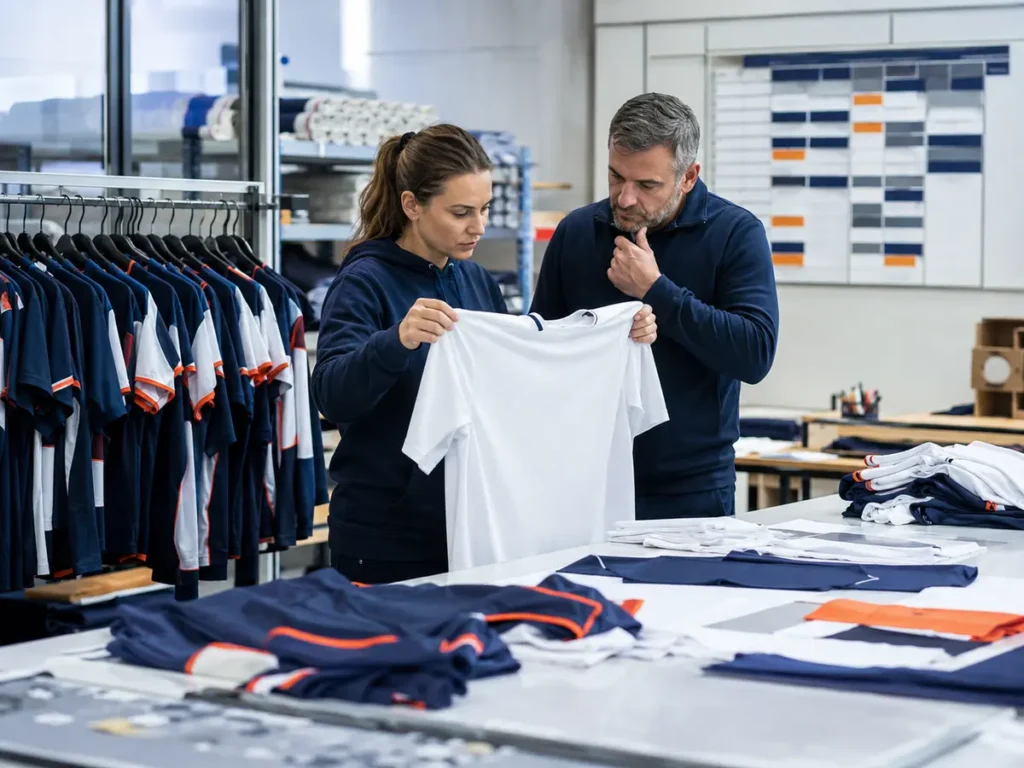
During Printing, Cutting or Sewing: Use a Change Order
Once production has started, an addition may no longer follow the same workflow as the original roster. For a sublimated jersey, the player’s name and number may be integrated into printed panels. If those panels have already been printed and cut, changing the number is not a minor finishing operation; the affected panels may need to be printed and cut again.
For heat-transfer names and numbers, a finished blank jersey might still accept personalization later, provided the fabric, decoration method and application area are suitable. For screen printing, embroidery, tackle-twill-style decoration or sewn patches, the supplier must assess setup, placement and whether the garment has reached a stage where the work can still be performed correctly.
The change order should record:
- Original purchase order and roster version
- Requested change and reason
- Current production stage
- Parts or operations that must be repeated
- Additional charge
- Effect on completion or shipping date
- Whether the original batch will wait or ship separately
- Revised proof or production reference
- Buyer approval date and approver
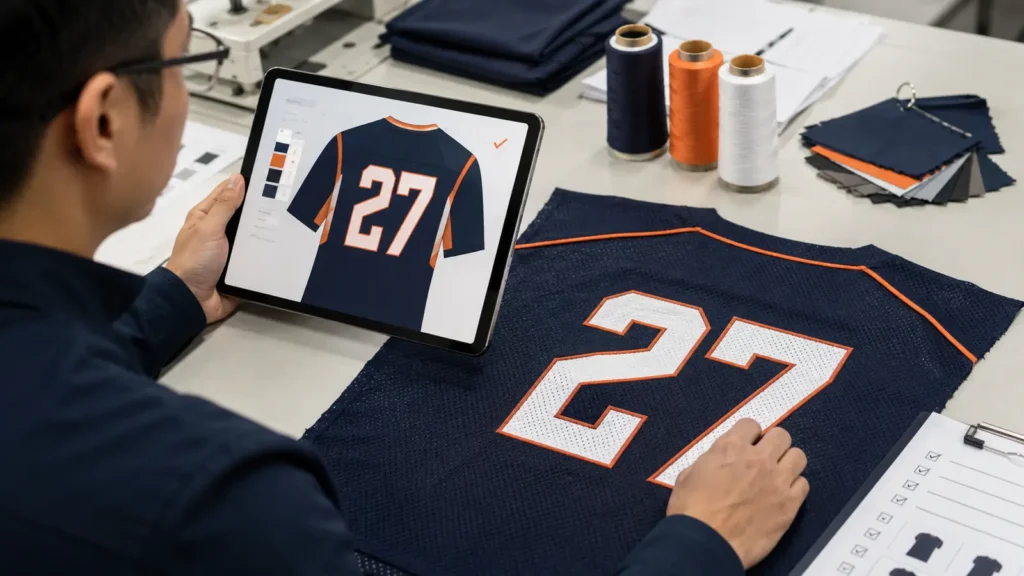
Should the Original Order Wait?
Usually, delaying an entire team order for one late player creates more risk than shipping the completed batch on time. A split shipment may be the better operational choice when the season date is close. The buyer should compare:
- Cost of a second shipment
- Consequence of delaying the full order
- Player’s first required game date
- Availability of a temporary practice jersey
- Customs and delivery uncertainty
- Whether the replacement can travel with another planned order
There is no universal answer. The important point is to decide deliberately and record which items belong in each shipment.
Send JIUMU the order number, current roster version, exact player details, requested quantity and must-arrive date. We will review the production stage and confirm the feasible route before you promise a delivery date to the player. Request a Change Review.
After Shipment: Treat It as a Replacement or Repeat Order
After the original goods have shipped, the extra item is no longer part of the first batch. It needs its own order reference even if every visible specification is intended to remain the same.
Classify the request before quoting:
| Request type | Example | Responsibility question | Production reference needed |
|---|---|---|---|
| Late addition | New player joins after shipment | New purchase | Approved team design plus new roster line |
| Buyer data correction | Wrong name supplied in approved roster | Buyer-funded remake in most cases | Original approval and corrected proof |
| Supplier production error | Product differs from approved file | Confirm corrective-action responsibility | Inspection evidence and approved reference |
| Size replacement | Approved size does not fit the player | New purchase unless a production defect exists | Same design, new size and fit confirmation |
| Damage or loss | Jersey damaged in use or lost | New purchase | Original design and replacement details |
| Warranty or quality claim | Seam, print or construction issue | Assess evidence and agreed terms | Photos, order ID, care history and defect location |
This classification prevents a replacement purchase from being confused with a quality claim. It also tells the supplier which evidence and approval path are required.
Can You Reorder Only One Jersey?
Technically possible does not always mean commercially practical. A one-piece replacement can require many of the same controlled actions as a larger order: retrieving artwork, confirming material, preparing print or decoration, cutting, sewing, quality inspection, packing and export documentation.
JIUMU’s typical MOQ is 50 pieces, subject to product structure and customization. A smaller replacement quantity therefore requires case-by-case confirmation. Possible paths include:
- Producing the piece with another compatible production run
- Using approved retained or available material
- Personalizing a planned blank spare
- Combining several seasonal replacements into one order
- Moving to the next scheduled team or club order
- Quoting a special small-batch setup when feasible
Do not calculate a one-piece replacement by dividing the original total by the original quantity. The original order distributed setup and handling across many units. A replacement concentrates those costs and may require separate international transport.
UPS explains that package charges can be based on dimensional weight when package volume is high relative to actual weight. Carrier rules and rates vary, but the general procurement lesson is stable: ask for the replacement jersey price and the shipping method, billable weight, destination charges and expected transit window before approving the order. (UPS package dimensions and weight guide)
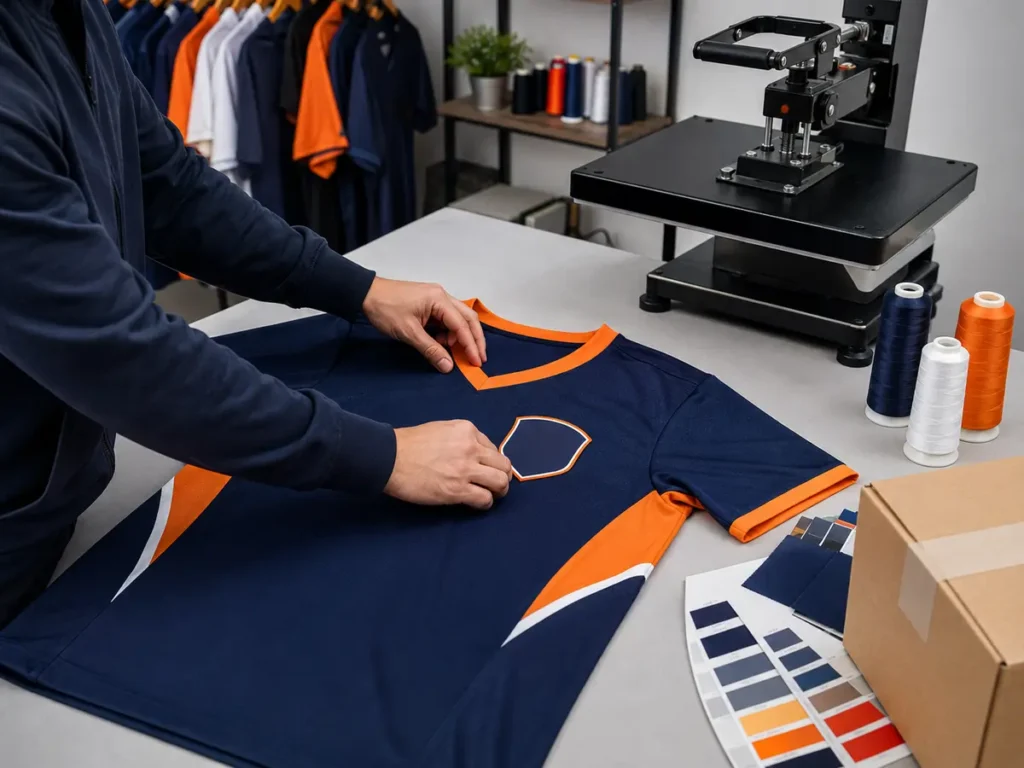
Why a Replacement May Not Look Identical
The goal should be controlled consistency against the approved reference, not an unsupported promise of perfect identity under every condition.
Potential differences include:
- A new fabric lot with slightly different whiteness, texture, stretch or sheen
- A substitute fabric when the original construction is unavailable
- Different ink, transfer paper or decoration consumables
- Updated printer profiles, temperature, time or pressure settings
- Different thread or trim lot
- Panel placement or sewing tolerance
- Wear, laundering or sunlight exposure on the original jersey
- Viewing the pieces under different light sources
Pantone describes its systems as a common color language for brands and manufacturers, but a color target still has to be translated into a specific textile, ink and production process. (Pantone Color Systems) AATCC also highlights the effect of lighting and the value of consistent viewing conditions in textile color evaluation. (AATCC color-evaluation guidance)
Compare New, Approved and Worn References Separately
A useful evaluation uses three references:
- Approved production reference: the Golden Sample, approved strike-off or retained swatch.
- New replacement: the item being evaluated under the agreed lighting.
- Player’s worn jersey: useful for understanding field appearance, but not the sole production standard because wear and washing may have changed it.
If the team asks the supplier to match a worn jersey instead of the approved production reference, the instruction should be explicit. Otherwise, the supplier may reproduce the original standard while the buyer expects the aged appearance.
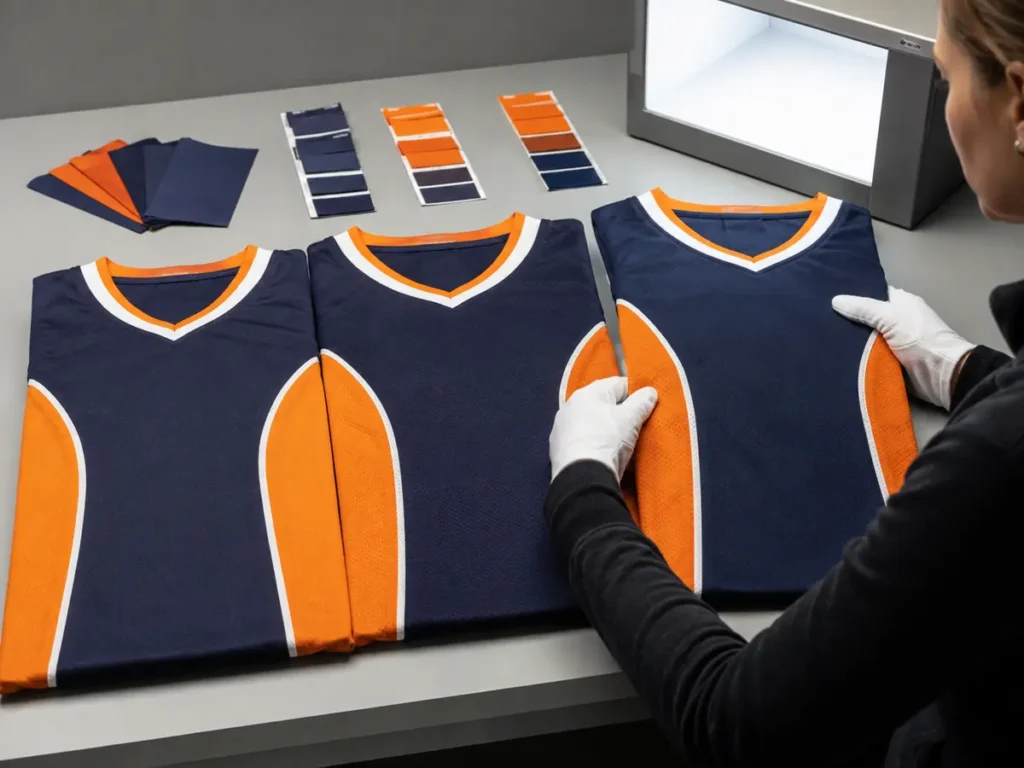
Define an Approval Rule Before Production
For a visible replacement, agree on one of these outcomes:
- Proceed using the stored original specification
- Approve the closest available current material
- Approve a photographed or physical pre-production comparison
- Replace multiple jerseys together to improve within-batch consistency
- Reject the substitute and wait for a closer material option
Color tolerances should be agreed for the actual product and use case. ISO 105 includes methods for evaluating textile color change, and AATCC publishes textile color-evaluation procedures; these standards show why “looks the same on my screen” is not a complete production criterion. They do not create a universal jersey replacement tolerance without an agreed specification. (ISO 105-A01 overview, AATCC standards)
Should Teams Order Spare Jerseys?
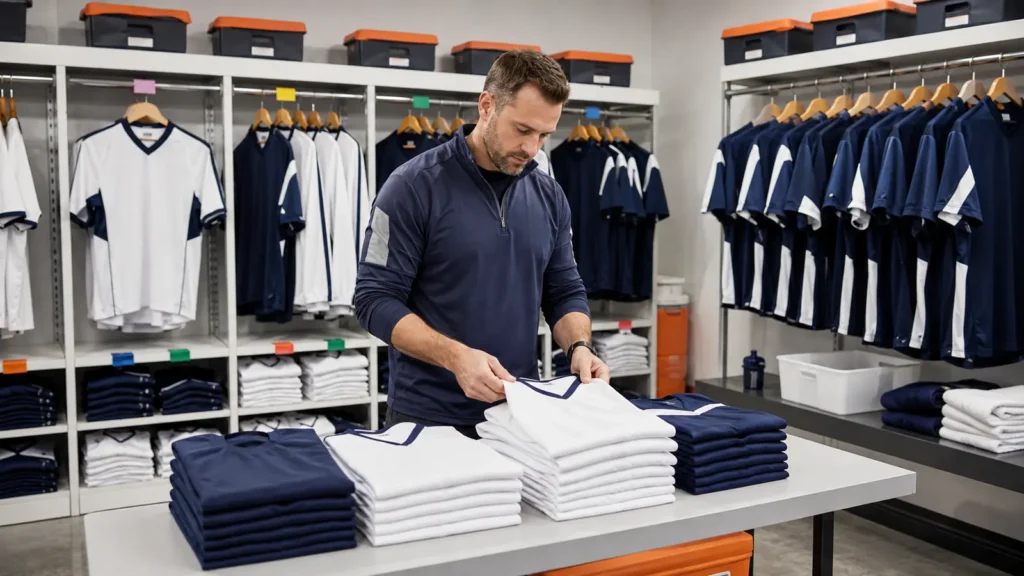
For active leagues, a modest spare strategy is usually more reliable than treating every late request as an emergency. The reserve does not need to be large. It needs to reflect the roster, sport, replacement frequency, uniform method and ability to personalize later.
Three spare strategies are common:
| Spare strategy | Best for | Advantage | Limitation |
|---|---|---|---|
| Fully personalized spares | Stable emergency numbers or designated alternates | Ready to issue immediately | Name and number may not fit the actual new player |
| Blank finished jerseys | Heat-applied or otherwise post-personalized details | Faster late personalization | Not suitable for every decoration method or design |
| Unprinted material or cut components | Programs with repeat production support | Preserves some material continuity | Still requires production setup and may age in storage |
| Planned reorder window | Clubs expecting several changes | Consolidates small replacements | Player may wait until the next window |
Full Sublimation Changes the Spare Strategy
In full sublimation, graphics, names and numbers may be printed as part of the panel design before sewing. A generic finished “blank” may not accept the same integrated result later. The team can instead consider:
- A no-name spare using a defined reserve number
- A generic player version without personalized back name
- Retaining compatible fabric or planned extra printed blanks, if feasible
- Scheduling a small consolidated reorder window
The supplier should confirm the strategy during initial development. Do not buy blank stock first and assume it can reproduce an integrated sublimated design later.
Which Sizes Should Be Held?
There is no universal list of “common” sizes for every team. Youth leagues, adult recreational clubs, women’s teams and mixed programs have different distributions. Use actual roster data.
A practical method is:
- Separate youth, adult and gender-specific fits.
- Count each approved size in the current roster.
- Identify the central sizes that cover the largest share.
- Review prior season additions and replacements.
- Add sport-specific risk, such as goalkeeper fit or protective-equipment allowance.
- Decide whether one flexible fit can serve temporarily.
- Record the reserve quantity and who may authorize release.
For example, if an adult club’s roster is concentrated in M, L and XL, the spare plan may focus there. That does not mean the same distribution is suitable for a youth baseball program or women’s volleyball team. Avoid age-only size assumptions and keep youth and adult ranges explicit.
Preserve the Complete Repeat-Order Record
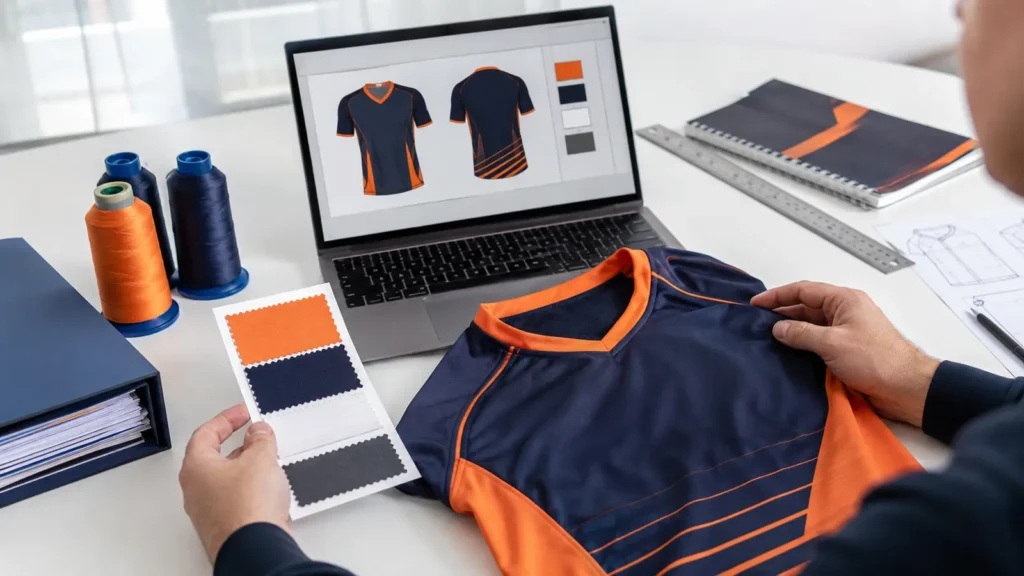
A design screenshot is not enough to reproduce a jersey. For replacement and repeat-order consistency, preserve:
- Purchase order and style code
- Final approved artwork file and revision
- Master roster and approval date
- Size chart revision and fit name
- Fabric composition, construction, weight or supplier reference where applicable
- Fabric lot or retained swatch when available
- Color targets and approved physical color reference
- Decoration method and placement dimensions
- Name and number fonts, outlines and scaling rules
- Labels, trims, packaging and carton requirements
- Approved physical sample or Golden Sample
- Production photos and inspection record
- Any accepted deviations or substitutions
The buyer and supplier should each retain the approved records appropriate to their role. File names should include the team, style and revision rather than terms such as “final-new-latest.” For broader controls, use the Repeat Order Consistency guide alongside this replacement workflow.
Build a Season Replenishment Plan
The best time to plan replacements is before the first match. Add a short replenishment policy to the original team order.
Set Three Dates
- Initial roster lock: the last date for changes intended for the main batch.
- First replenishment window: a planned date after registration closes or the season begins.
- Final replacement window: the last economical point for end-of-season or tournament needs.
Assign One Decision Owner
One coach, equipment manager or club administrator should collect all requests. Players and parents should not send independent instructions directly to the supplier. The owner checks spelling, number availability, size and payment before sending one controlled file.
Use a Replacement Log
Record the request ID, player, reason, original order, requested specification, approval status, production route, cost, ship date and receipt result. This creates evidence for future spare planning and prevents the same player from being ordered twice.
Consolidate Where the Deadline Allows
Several small requests may be more economical together than separately. Consolidation can reduce repeated setup and shipping, but it must not endanger a player’s required date. Use a regular review cadence—such as after tryouts, at the end of registration and before tournaments—rather than waiting for an emergency.
Replacement Jersey Quality-Control Checklist
Before approving or distributing the new jersey, verify:
- Correct order and replacement request ID
- Correct style, sport and fit
- Youth or adult range
- Correct garment size
- Exact display name spelling
- Exact player number
- Number uniqueness under the team’s rules
- Logo, sponsor and special-mark version
- Decoration method and placement
- Visual color against the approved reference under agreed lighting
- Fabric hand, stretch, texture and opacity
- Chest, length, shoulder or relevant garment measurements
- Seam construction and finishing
- Stains, print defects, skipped stitches or heat marks
- Labels and packaging
- Player-specific bag or roster line
- Quantity received
- Photos and disposition for any variance
If the replacement is a corrective remake, connect the inspection result to the original claim and corrective action. If it is a new purchase, record it as a new approved line without implying the original item was defective.
What Buyers Should Send for a Replacement Quotation
Send a compact, complete request:
- Original order number
- Team or club name
- Replacement reason
- Product and style reference
- Quantity
- Player ID
- Display name
- Number
- Size range, size and fit
- Photos of the original jersey, front and back
- Photo of the care label when relevant
- Original design or approval file if available
- Must-arrive date and destination
- Whether split shipping is acceptable
- Whether a visible shade difference requires pre-approval
For active production, also send the current roster version and ask whether the order has reached printing, cutting, sewing, finishing or packing. For a post-shipment replacement, ask whether original material remains available and whether the supplier needs the approved sample returned or photographed.
Questions to Ask the Supplier
- Has the original order passed the roster and artwork lock point?
- Which production operation has started?
- Can the item join the current batch without delaying it?
- If not, what is the separate production route?
- Is the original fabric, trim and decoration specification available?
- What MOQ or small-batch charge applies?
- Does the quotation include setup, packing and shipping?
- Can the item ship with another order?
- What matching reference will production use?
- What variance requires buyer approval?
- Will a proof, photograph, swatch or physical sample be supplied?
- What is the revised factory-completion and estimated delivery window?
Common Mistakes to Avoid
Sending Changes Through Several Channels
When a coach emails, a player sends a message and an administrator updates a spreadsheet, the supplier may receive conflicting instructions. Use one owner, one file and one version.
Assuming “Not Shipped” Means “Easy to Change”
The jersey may already be printed, cut or packed. Ask for the production stage, not only the shipment status.
Expecting the Original Bulk Unit Price
Small replacement work carries concentrated setup and handling. Compare the full replacement cost and shipping route.
Matching a Worn Jersey Without Saying So
The approved production reference and a season-worn garment may no longer look identical. Specify which one is the target.
Holding the Wrong Spare Sizes
Generic assumptions create dead stock. Use roster and replacement history, separated by fit range.
Treating Every Blank Jersey as Later-Personalizable
Decoration method matters. Full-sublimation names and numbers may be integrated before sewing, while some heat-applied details can be added to a suitable finished blank.
How JIUMU Supports Controlled Jersey Replacements
JIUMU provides custom team jersey development for schools, clubs, leagues, distributors and uniform buyers. Available capabilities include digital mockups, physical samples, sublimation printing, heat transfer, screen printing, embroidery, fabric sourcing, Pantone color matching, labels, packaging and bulk-order quality control.
For a late addition or replacement, the practical first step is record retrieval and feasibility review. JIUMU needs the original order reference, approved design, player details, quantity and deadline. The team can then assess the current production stage, available materials, appropriate decoration route, small-batch implications and inspection requirements.
Explore Custom Team Jerseys for available product and personalization options. For order-size planning, consult MOQ & Lead Time and confirm the actual requirement for the replacement style before committing to a player.
Frequently Asked Questions
Final Recommendation
Late player additions do not need to become emergencies. Establish a roster lock, document the production stage, control every change through one owner and preserve the complete production reference. When the deadline allows, consolidate replacements. When it does not, compare the cost of a separate shipment with the operational cost of leaving a player without a uniform.
Most importantly, design the spare and replenishment policy around the actual jersey construction. A blank heat-personalized garment, an integrated full-sublimation jersey and a sewn-decoration uniform do not have the same replacement path.
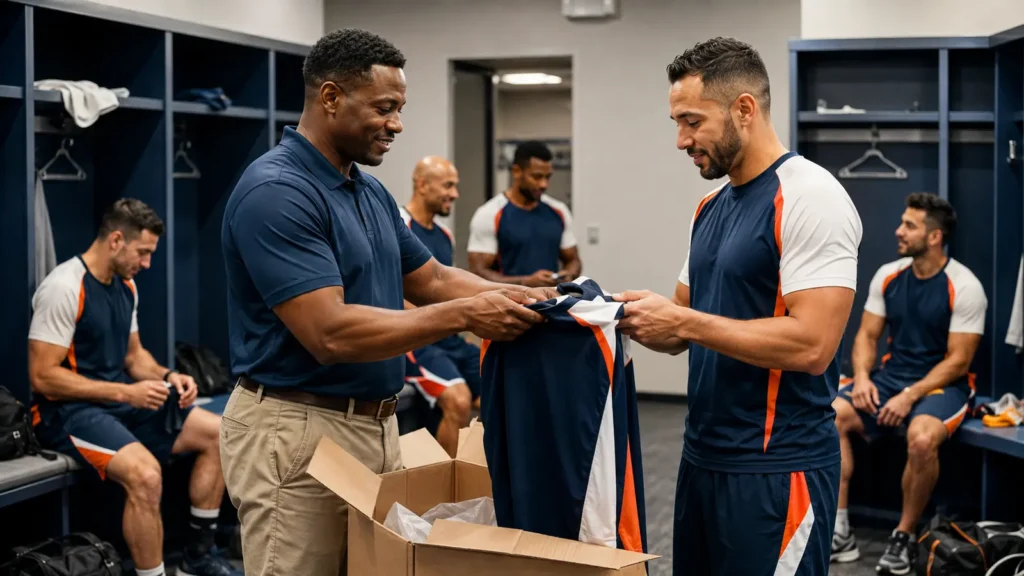
Send the original order number, approved design, current roster version, exact player name, number, size, quantity, destination and must-arrive date. JIUMU will review the production stage, matching references and feasible order route before confirming price and timing. contact JIUMU online.
About the JIUMU Team
JIUMU provides OEM and ODM custom teamwear, jersey personalization, physical sampling, material and color coordination, quality control and export support for schools, clubs, leagues, distributors and apparel buyers.