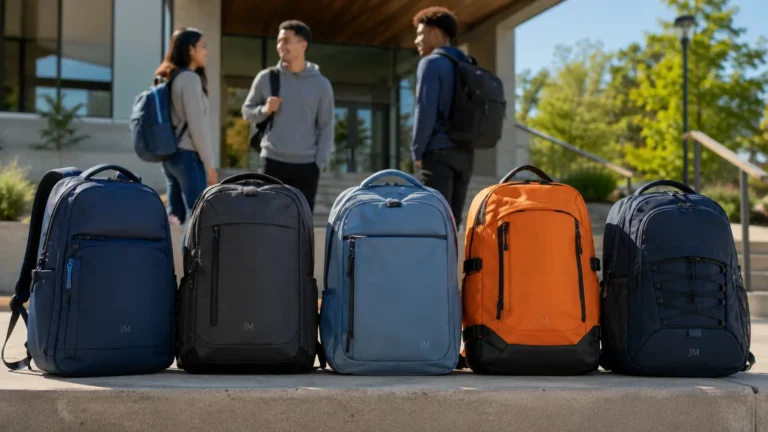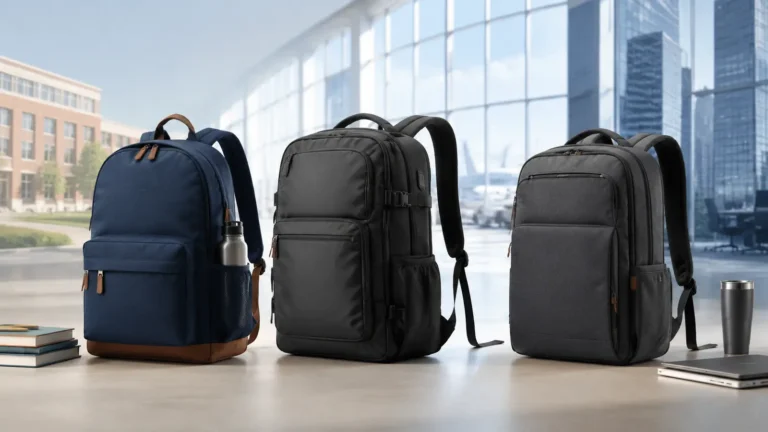
Where to Buy School Backpacks: Retail vs Bulk Ordering
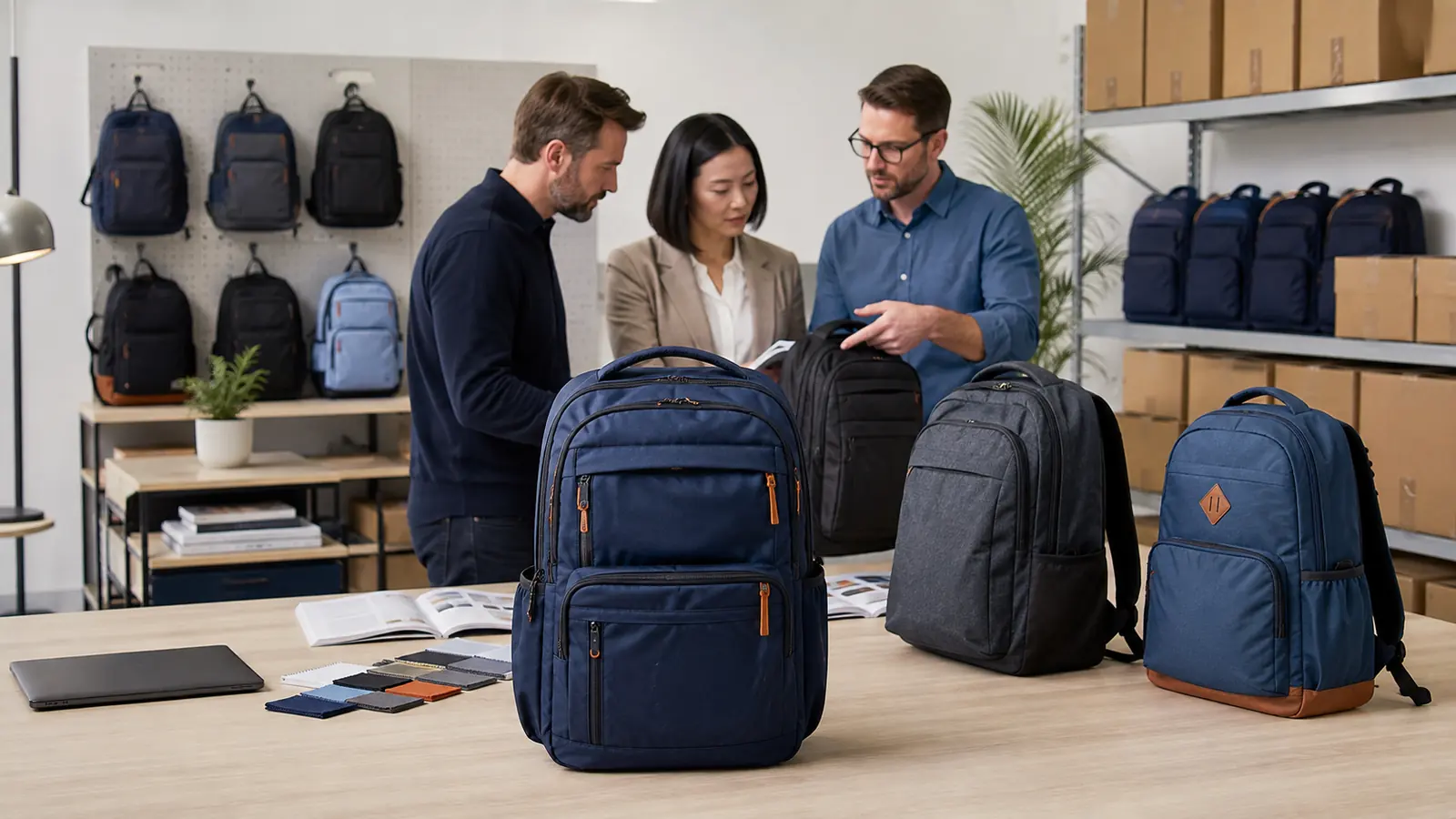
Buying school backpacks is a very different task when you need 300 coordinated bags instead of one bag for one student. A retail store is built for immediate selection and single-unit convenience. A bulk supplier is built for specification control, customization, repeat orders, packaging, and delivery planning. The right channel depends less on which price looks lowest on a screen and more on quantity, deadline, branding, quality expectations, and who will carry the inventory risk.
This guide explains where to buy school backpacks for school programs, clubs, distributors, promotions, and private-label collections. It also provides a framework for comparing retail and bulk quotations on an equivalent basis.
Quick Answer: Buy at retail when you need a few backpacks immediately, want to inspect finished options, and do not require matching colors, logos, custom packaging, or reliable reorders. Consider bulk ordering when you need a coordinated program—typically dozens or hundreds of units—with an approved specification, decoration, packaging, quality-control plan, and scheduled delivery. For JIUMU projects, the typical MOQ is 50 pieces, subject to the bag structure and customization.
The Real Choice Is Convenience Versus Control
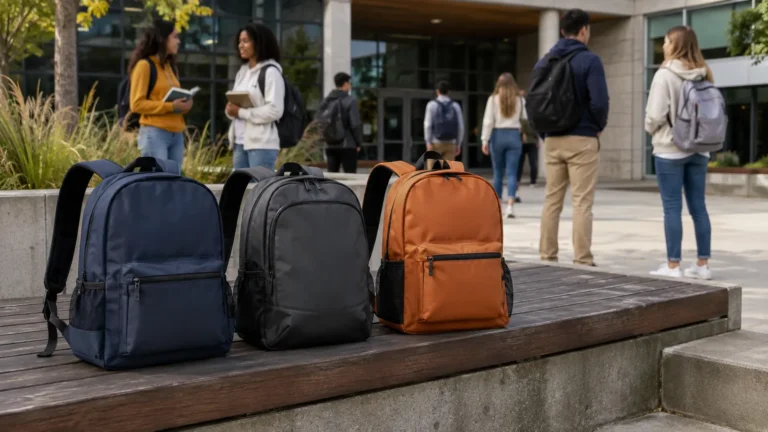
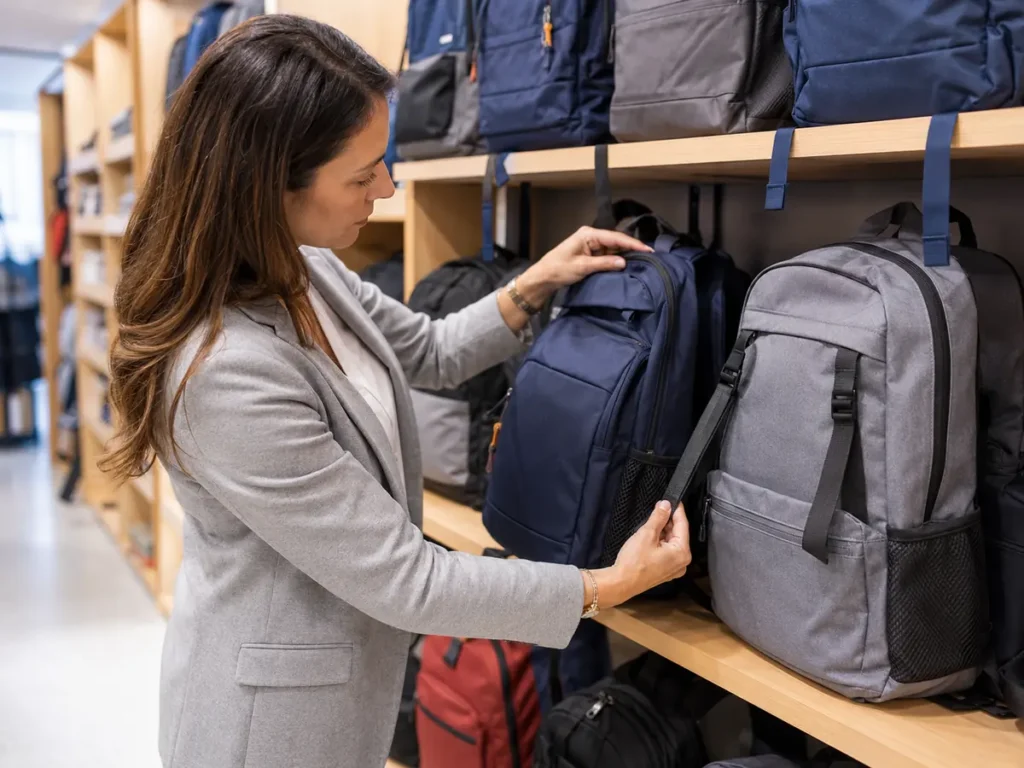
Retail offers convenience. The product already exists, the price is visible, and the buyer can often leave with it the same day. This is valuable for replacements, emergency purchases, teacher samples, or a small group whose members can choose different styles.
Bulk sourcing offers control. Buyers can define the dimensions, capacity target, fabric, colors, compartment layout, logo method, labels, packaging, and inspection criteria. That control requires decisions earlier in the process. It also requires an approved sample or documented reference so the supplier and buyer share the same definition of acceptable.
Neither channel is automatically cheaper. A discounted retail bag may be economical for ten units. The same bag may become costly or unavailable when a program needs 500 matching units and replacements next term. Conversely, a custom order may carry sample, decoration, freight, duty, and project-management costs that make little sense for a five-piece need.
Retail vs Bulk School Backpack Ordering at a Glance
| Decision factor | Retail purchase | Bulk order from a supplier |
|---|---|---|
| Best-fit quantity | One to a small group | Coordinated programs, usually dozens or more |
| Speed | Immediate if stock is available | Requires specification, sampling, production, QC, and transit planning |
| Product choice | Limited to finished inventory | Existing styles, modified styles, OEM, or ODM depending on the supplier |
| Branding | Usually none or added after purchase | Logo, color, trims, labels, hangtags, and packaging can be planned together |
| Consistency | May vary by store, batch, or restock | Approved sample and order specification can establish one standard |
| Unit economics | Simple shelf price; discounts vary | Quotation depends on quantity, material, construction, decoration, packaging, and trade terms |
| Inspection | Buyer can inspect each item before purchase | Pre-production approval and bulk inspection should be defined |
| Reorders | Dependent on retail inventory | More predictable when files, materials, colors, and approved samples are documented |
| Buyer workload | Low | Higher at the beginning, then more repeatable |
| Main risk | Stockouts and mismatched replacements | Poor specification, late approval, or an unrealistic delivery plan |
The table is a starting point, not a universal rule. A domestic wholesaler may offer ready stock with a short lead time. A retailer may accept a small corporate order. A manufacturer or sourcing partner may offer a stock bag with logo decoration rather than full custom development. Ask what is actually included instead of relying on the seller category alone.
Where Can You Buy School Backpacks?
Local and national retail stores
Department stores, sporting-goods shops, office-supply stores, and school-uniform retailers are practical when physical inspection matters and the quantity is small. Buyers can check zipper operation, strap comfort, apparent size, and color in person. Returns are usually clearer than with an international custom order.
The limitation is program control. Shelf inventory changes. Even when a store shows enough units, products can come from more than one production batch. A buyer who adds decoration through a separate local printer must also confirm that the bag fabric and coatings are suitable for the proposed process.
Online marketplaces and ecommerce retailers
Online retail expands the selection and makes price comparison fast. It suits individual purchases and small, nonuniform group orders. However, product photos do not establish fabric weight, seam construction, zipper specification, usable capacity, or color tolerance. Marketplace listings may also change seller or version while retaining a similar page presentation.
For a business purchase, preserve the exact SKU, seller, invoice, product description, and return terms. Order a physical unit before committing decoration labor to a large number of retail bags.
Domestic promotional-product distributors
Promotional distributors can bridge retail convenience and custom branding. Many offer stock bags, established decoration services, and domestic account support. This can be effective for events, staff gifts, and school campaigns with moderate quantities and short schedules.
Compare the available imprint area, color choices, bag specification, decoration method, proof process, freight, setup charges, and replacement policy. A stock promotional backpack may prioritize branding area and cost over the load distribution or compartment structure needed for daily school use.
Uniform dealers and school-supply specialists
Specialists often understand purchasing cycles, roster changes, school colors, and repeat orders. They may bundle backpacks with uniforms or other merchandise and can simplify local distribution. The tradeoff is that buyers may have fewer construction choices than in a direct custom program.
Direct manufacturers and B2B sourcing partners
This route is appropriate when the backpack is a defined product rather than a generic giveaway. The buyer can specify dimensions, materials, pockets, reinforcement, colors, decoration, labels, and packaging. A capable partner should translate the brief into a quotation, mockup, sample, and bulk approval process.
Direct sourcing creates more responsibility for the buyer. Product classification, applicable safety obligations, labeling, import documentation, duties, and local market requirements must be assigned. For the United States, a product primarily intended for children 12 or younger may be treated as a children’s product; the CPSC explains that classification drives testing and certification obligations. Buyers should obtain product-specific compliance advice rather than assuming every school backpack is classified identically.
When Retail Buying Is the Better Decision
Choose retail when the operational value of speed and flexibility is greater than the value of customization.
Retail is usually sensible for emergency replacements, a classroom pilot, staff evaluation, a very small club, or students who are meant to choose their own bags. It also helps a buyer learn what size and layout users prefer before writing a bulk specification.
Retail buying works best when all five statements are true:
- The quantity is small.
- Immediate availability matters.
- Exact visual consistency is not required.
- A future reorder can use a different style if necessary.
- Branding and custom packaging are unnecessary or can be added locally without damaging the bag.
Do not confuse retail availability with repeat-order security. If a specific color or style must remain available for several years, ask the retailer or brand whether the SKU is seasonal, whether substitutions are permitted, and whether commercial quantities can be reserved.
When Bulk Ordering Creates More Value
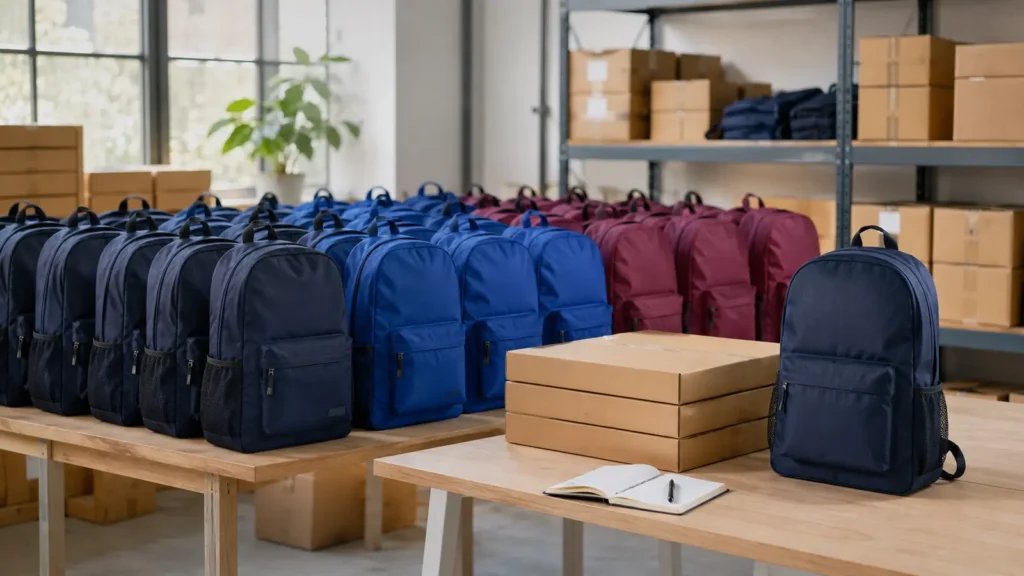
Bulk ordering becomes attractive when a backpack must serve a program, brand, or repeated use case. Examples include school admissions kits, district initiatives, sports academies, fundraising merchandise, uniform-dealer assortments, promotional campaigns, and private-label retail collections.
The advantage is not merely a lower unit price. A bulk project can align the bag with a defined load, age group, visual identity, distribution method, and replenishment plan. A school may need name identification and grade-level colors. A sports academy may want a shoe compartment and matching team apparel. A distributor may need private labels, barcodes, carton markings, and consistent reorder files.
Bulk sourcing is a better fit when several of these conditions apply:
- You need 50 or more coordinated units.
- The same color and logo placement must appear across the order.
- Users need a specific size, pocket layout, laptop sleeve, bottle pockets, or team-equipment function.
- The buyer wants labels, hangtags, retail packaging, or carton marks.
- A physical sample must be approved before production.
- The product will be reordered and specifications should be retained.
- The landed cost and delivery date can be planned rather than guessed.
Translate Backpack Features Into Procurement Decisions
Features only matter when they support a use case. “More pockets” is not a useful specification by itself. Each pocket adds material, labor, weight, and another potential failure point. Define what must fit, how often it is accessed, and whether organization improves the user’s routine.
| User need | Useful specification direction | Procurement question |
|---|---|---|
| Elementary school program | Smaller body dimensions, low empty weight, simple opening, visible name area | Is the size appropriate for the intended age group and daily load? |
| Secondary school | Main compartment plus device/document organization | What device dimensions and folder sizes must fit? |
| Sports academy | Separate wet, shoe, or equipment zone where needed | Can the compartment be cleaned and ventilated appropriately? |
| Staff or faculty issue | Restrained branding, device protection, document organization | Does the design need to work in both school and commuter settings? |
| Promotional event | Simple construction, clear decoration area, efficient packing | Is daily school performance expected, or is this a short-term giveaway? |
| Private-label retail | Defined assortment, labels, barcode/packaging, repeatable color standards | What information must remain consistent across reorders and sales channels? |
Avoid specifying a liter capacity without explaining how it was measured. Advertised capacity can vary with shape, pocket inclusion, and method. Provide finished dimensions and a packing list for critical items. For device sleeves, specify the device’s actual width, height, and thickness rather than only the diagonal screen size.
Materials: Compare the Whole Construction, Not One Fabric Number
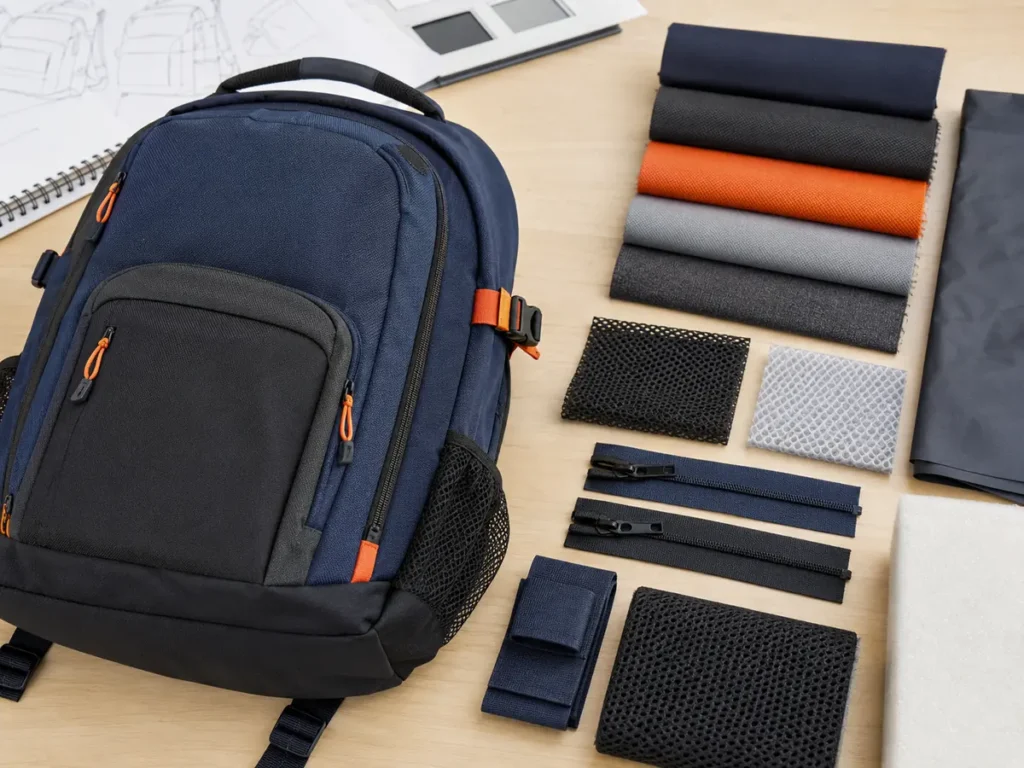
Polyester and nylon are common backpack shell families, but fiber name alone does not predict service life. Fabric construction, yarn size, density, coating, finish, abrasion exposure, seam design, and workmanship all affect performance. A heavier-looking fabric is not automatically better if the seam allowance, zipper, or strap attachment is weak.
For a clear quotation, define or ask the supplier to recommend:
- Shell fabric family, construction, weight or denier convention, and finish.
- Lining material and color.
- Mesh type for bottle pockets or ventilation panels.
- Padding material and thickness where it matters.
- Webbing width and hand feel.
- Zipper type, size, puller, and opening direction.
- Binding tape and seam-finishing method.
- Bottom-panel reinforcement or alternate material.
- Required color reference and acceptable tolerance.
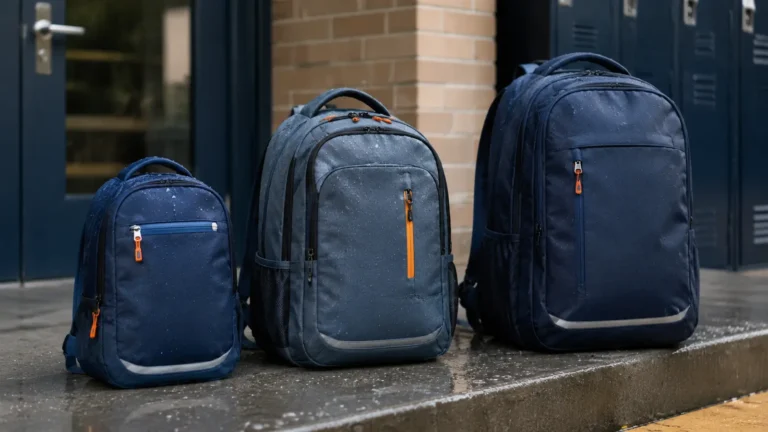
Use “water-resistant” only when the material and construction have been defined and, if necessary, tested to an agreed method. A coated shell does not make the finished bag waterproof: needle holes, zippers, seams, and openings can admit water. Do not allow a visual sample to substitute for a measurable requirement when performance is commercially important.
Size, Capacity, Fit, and Load Planning
A school backpack should be planned around the intended user and contents. Begin with a representative packing list: folders, books, lunch container, bottle, device, charger, sports clothing, and any special equipment. Then evaluate body dimensions, opening, pocket access, and empty weight.
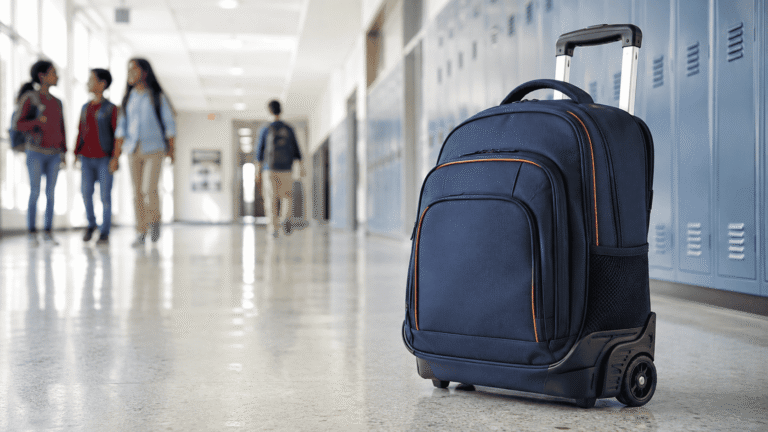
Fit claims should be treated carefully because student body sizes vary. Adjustable shoulder straps expand the fit range, but the bag body can still be too long or wide for smaller users. For a district-wide program, consider more than one size when age groups differ substantially. A single promotional size is simpler to procure but may not be equally appropriate for every user.
Ask for a filled-sample evaluation, not only a flat measurement. Load the sample with realistic contents. Check whether the base remains stable, the zippers close without excessive stress, bottle pockets retain common bottles, and straps can be adjusted without slipping. Comfort is influenced by load and use behavior, so avoid making medical or ergonomic guarantees from appearance alone.
Construction Details That Affect Durability
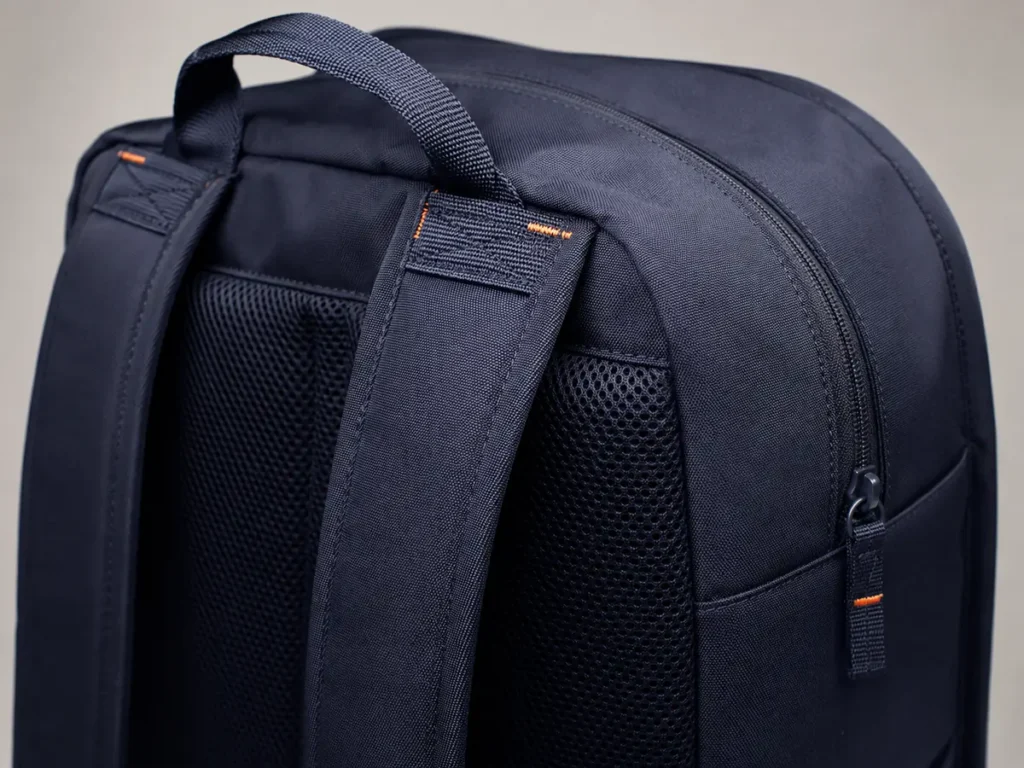
The most important durability details often sit at load-transfer points: shoulder strap attachments, top handle, base corners, zipper ends, and pocket openings. A buyer should review how forces move through the bag rather than asking only whether stitching is “strong.”
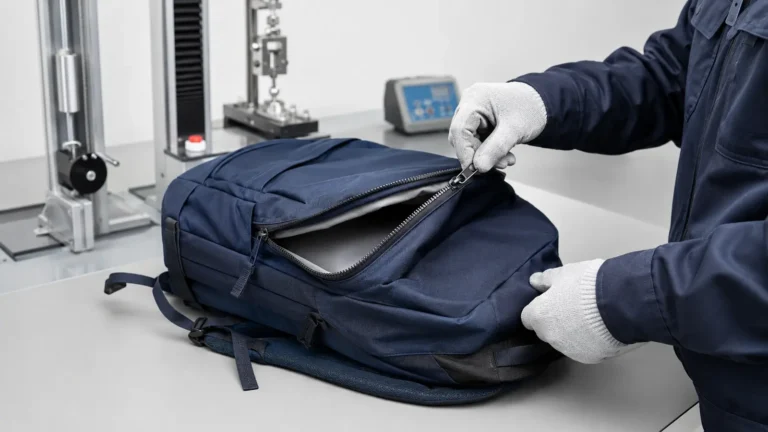
Useful sample checks include seam allowance consistency, reinforcement at defined stress points, stitch security, edge binding, zipper alignment, strap symmetry, webbing capture, and absence of sharp or loose components. The approved sample should document which reinforcements are required and where they occur.
A product can look correct in a mockup while being difficult to manufacture consistently. Decorative seams, complex pocket shapes, very thick material stacks, and small logo details may need adjustment. Resolve these issues during sampling, before cutting bulk material.
Custom Logos, Colors, Labels, and Packaging
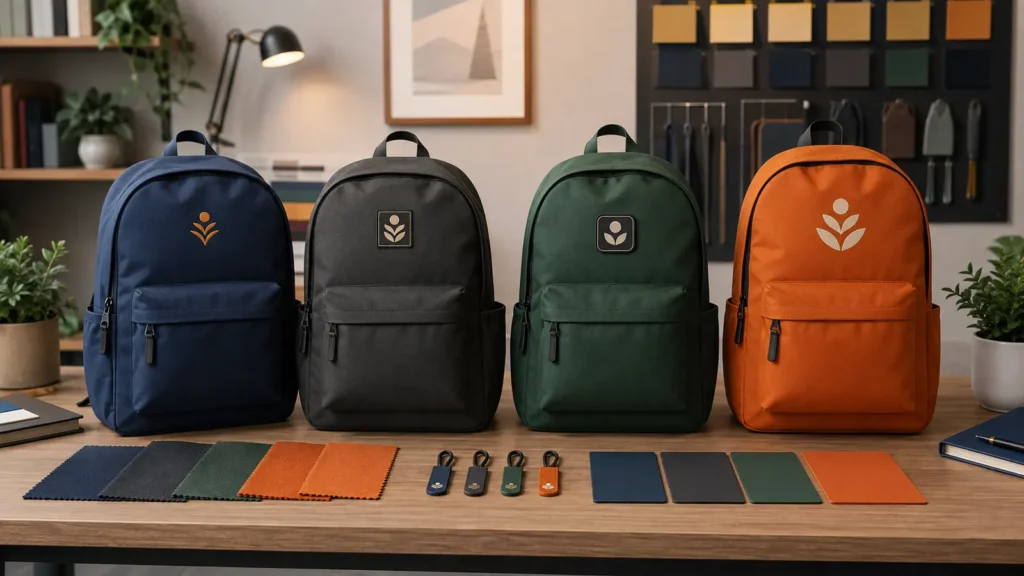
Bulk orders can coordinate product design and brand presentation. JIUMU capabilities include embroidery, screen printing, heat transfer, woven and rubber/PVC patches, leather-style patches, private labels, hangtags, packaging customization, fabric sourcing, and Pantone color matching.
Choose decoration by artwork, fabric, expected use, surface location, hand feel, and budget. Embroidery creates texture but can distort lightweight panels or conflict with internal pockets. Heat transfer can reproduce fine color detail, but adhesion depends on the fabric surface and process. Patches add dimension and can be developed separately, while screen printing can suit larger simple graphics on compatible panels.
Send vector artwork when possible. Define finished logo width and height, location measured from stable seams, color references, and whether the buyer or supplier may simplify small details. Approve an actual decoration sample when color, edge quality, or texture is important.
Packaging also belongs in the original specification. Decide whether each bag is folded, filled, tagged, individually packed, barcoded, or bundled by classroom, color, or size. Efficient distribution can justify packaging changes even when they add a small unit cost.
Planning a coordinated school backpack order? Send JIUMU your target quantity, user age group, dimensions or reference style, compartments, fabric preference, colors, logo artwork, packaging, destination, and required delivery date. JIUMU can assess a stock-style, modified, OEM, or ODM route and confirm whether the typical 50-piece MOQ applies. Request a custom quotation.
Understand Price: Unit Cost Is Only One Line
Retail comparison is easy because the shelf price is visible. Bulk comparison requires a common basis. Two quotations can show different unit prices because one includes decoration, individual packing, inspection, or delivery while the other stops at an earlier trade point.
Build a landed-cost worksheet with these categories:
| Cost category | Questions to normalize |
|---|---|
| Product | Are dimensions, fabric, lining, pockets, padding, zippers, and reinforcement identical? |
| Development | Are mockups, sample charges, revisions, and sample freight included? |
| Decoration | Does pricing include setup, each logo position, thread/color count, and special patches? |
| Packaging | Is individual packing, labeling, barcode work, carton marking, or sorting included? |
| Quality | What inspections or tests are included, and who pays for additional requirements? |
| Logistics | What Incoterm or delivery basis is quoted? Are freight, duty, tax, brokerage, and local delivery included? |
| Risk | What happens if approval is late, materials change, or a shipment fails the agreed inspection? |
Major cost drivers include order quantity, number of sizes or colors, custom-dyed material minimums, pocket count, lining, padding, hardware, decoration complexity, label and packaging requirements, testing, inspection, and shipping method. Ask for optional pricing where a feature is uncertain. This lets the buyer compare a base specification with upgrades without restarting the project.
Sampling: Turn an Idea Into an Approval Standard
Sampling is the control point between concept and bulk production. A digital mockup can confirm graphic placement and color intent, but it cannot confirm dimensions, fabric hand, pocket function, zipper operation, strap comfort, or sewing quality.
Use a written approval sheet. Record sample version, date, dimensions, materials, component colors, logo size and location, labels, packaging, approved exceptions, and required corrections. Photographs are useful, but retain the physical approved sample when practical.
Do not write “same as sample” if the sample contains an error that should not be repeated. Mark the exception explicitly. When changes are substantial, request a revised sample or a controlled pre-production confirmation before bulk work begins.
Quality Control for a Bulk Backpack Order
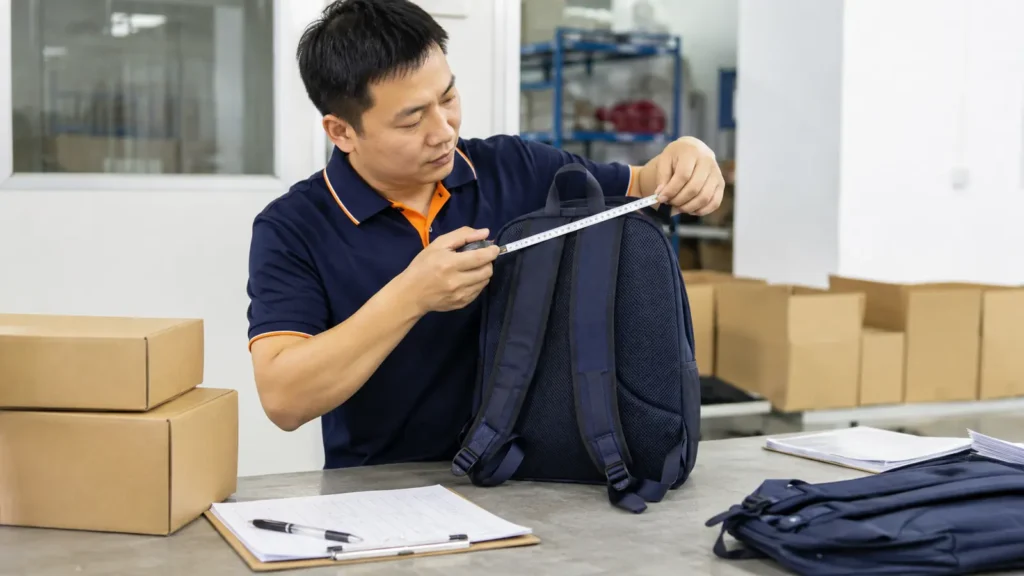
Quality control should follow the approved specification and sample. It should not depend on a general impression that the bags “look good.” Define checkpoints and defect categories before inspection.
A practical checklist can cover:
- Correct style, color assortment, size assortment, and quantity.
- Finished dimensions measured at agreed points and tolerances.
- Shell, lining, mesh, padding, webbing, zipper, and trims against the approved references.
- Logo size, position, orientation, color, and workmanship.
- Pocket count, internal organization, closures, and accessory placement.
- Seam appearance, skipped stitches, loose threads, reinforcement, binding, and symmetry.
- Zipper operation, strap adjustment, handle attachment, and basic functional checks.
- Cleanliness, odor concerns, stains, sharp points, and foreign objects.
- Labels, hangtags, barcodes, individual packing, carton assortment, and shipping marks.
- Applicable testing and documentation identified by the buyer for the destination and product classification.
Inspection level, sampling method, acceptance criteria, and responsibility for rework should be agreed in the purchase documents. If laboratory testing is required, identify the test method, responsible party, laboratory qualification, sample selection, and timing before production. Testing after the shipment deadline leaves little room for correction.
Compliance Is Product- and Market-Specific
School use does not automatically create one universal compliance category. Intended age, design, marketing, materials, destination, and applicable rules all matter. In the United States, the CPSC states that children’s products are those designed or intended primarily for children 12 or younger; covered children’s products may require third-party testing and a Children’s Product Certificate. The CPSC also provides guidance on tracking labels for children’s products.
For the European Union, the General Product Safety Regulation applies a broad safety framework to consumer products. Economic operators should determine their own responsibilities, traceability information, warnings, technical documentation, and online sales information where applicable. Requirements can differ between consumer retail, promotional distribution, and institutional procurement, and additional national or chemical rules may apply.
This guide is procurement information, not legal advice. The importer, brand owner, or responsible economic operator should confirm the exact classification and requirements with qualified compliance professionals and current official sources. A supplier can provide requested materials and documents, but the buyer should not outsource its legal responsibility through a vague request such as “must pass all tests.”
A Step-by-Step Bulk Ordering Process
1. Define users and use case
State the age group, region, distribution channel, daily contents, and expected use. Separate essential requirements from preferences.
2. Build the specification
Provide dimensions, compartments, materials, colors, artwork, labels, packaging, quantity by version, and destination. Reference photos are helpful, but identify which features should be copied conceptually and which must remain original.
3. Request a structured quotation
Ask the supplier to state assumptions, MOQ, sample cost, production basis, packaging, trade term, quote validity, and exclusions. Request option prices for unresolved features.
4. Approve artwork and sample
Check measurements and function with realistic contents. Record every correction and retain a signed or dated approval record.
5. Confirm the purchase order
The purchase order should reference the final specification, approved sample, quantity breakdown, price basis, packaging, inspection, documentation, delivery milestone, and agreed remedy process.
6. Monitor materials and production
Confirm critical color or trim approvals before bulk assembly where possible. Avoid late cosmetic changes that create material waste or schedule risk.
7. Inspect and release
Inspect against the defined standard, review packaging and carton assortment, and resolve material issues before shipment release.
8. Preserve reorder records
Keep artwork, color references, bill-of-material details available to you, packaging files, inspection findings, and approved sample information. Note that materials can be discontinued, so reconfirm critical components for every reorder.
What to Send for an Accurate Backpack Quotation
The fastest useful quotation begins with a complete brief. Send:
- Buyer company, destination country, and intended sales or distribution channel.
- Student age group and primary use case.
- Target order quantity and breakdown by color, size, or design.
- Finished dimensions or a physical/reference product with required changes.
- Compartment and feature list, including device dimensions if applicable.
- Preferred shell, lining, mesh, padding, zipper, and webbing direction.
- Pantone or other controlled color references when available.
- Vector logo artwork, decoration method preference, size, and placement.
- Label, hangtag, barcode, polybag, bundle, and carton requirements.
- Required tests, documentation, inspection criteria, and destination rules identified by the buyer.
- Target delivery date and whether it is fixed or flexible.
- Delivery address or port and requested trade term.
If you do not know every material, describe the performance target and target price position. A supplier can propose options, but it should state what each option changes.
Questions to Ask a School Backpack Supplier
- Is this style ready-made, modified from an existing platform, or fully custom?
- What MOQ applies to the style, each color, and each logo version?
- Which materials or colors require separate minimums?
- What dimensions and tolerances will appear in the specification?
- What sample stages are available, and what does each stage confirm?
- Which logo methods suit the selected panel and fabric?
- How will critical colors be approved and controlled?
- What quality checks are standard, and which require a separate arrangement?
- What compliance information can be supplied, and what must the buyer specify or commission?
- How are individual bags and cartons packed and marked?
- Which trade term, production milestone, and transit assumption support the delivery estimate?
- How are approved specifications retained for reorders, and what must be reconfirmed?
Clear answers matter more than a polished catalog. A supplier that identifies limitations early can be easier to manage than one that accepts every request without qualification.
Common Buying Mistakes
Comparing shelf price with a delivered custom price
Normalize product, decoration, packaging, tax, duty, freight, and service scope. Otherwise the lower-looking offer may simply exclude more.
Selecting by appearance alone
Photos do not reveal internal seam construction, padding, usable volume, or material consistency. Use samples and specifications.
Ordering one universal size without testing users
Age ranges and body sizes vary. Evaluate representative users and realistic loads, and consider multiple sizes where justified.
Approving only a digital mockup
A mockup approves layout intent, not physical function. Use a physical sample for a custom bulk project.
Using vague performance words
“Durable,” “heavy duty,” and “waterproof” are not complete requirements. Translate them into material, construction, test, and acceptance criteria.
Changing artwork or materials after approval
Late changes can affect cost, material availability, appearance, and delivery. Lock the decision process and identify authorized approvers.
Ignoring distribution
A well-made backpack can still create operational problems if bags are not sorted, labeled, barcoded, or packed for the receiving plan.
Treating compliance as a supplier slogan
Requirements depend on the product and destination. Identify the rules and evidence needed for the actual program; do not accept an unrelated certificate as universal proof.
Why Consider JIUMU for Bulk School Backpack Projects?

JIUMU is a Guangdong-based B2B supplier established in 2010, serving buyers in the United States, Canada, the United Kingdom, and Europe. The company supports OEM and ODM development for custom teamwear, uniforms, hats, bags, and branded merchandise.
For school backpack projects, relevant capabilities include fabric sourcing, Pantone color matching, embroidery, screen printing, heat transfer, woven and rubber/PVC patches, leather-style patches, private labels, hangtags, packaging customization, digital mockups, physical samples, bulk production, quality control, and export support. The typical MOQ is 50 pieces, subject to product structure and customization.
This makes JIUMU most relevant when a buyer needs more than off-the-shelf inventory: coordinated colors, a defined bag structure, branded decoration, packaging, and a documented route from concept to repeat order. Explore custom team bags or review JIUMU’s company background.
Frequently Asked Questions
Final Recommendation
Buy school backpacks at retail when quantity is small, speed matters, and matching specifications or future reorders are not essential. Choose bulk sourcing when the order must operate as a coordinated program with defined size, materials, construction, colors, branding, packaging, quality control, and delivery planning.
Start with users and contents, compare the complete landed scope, approve a physical sample, and make the quality standard inspectable.
Request a JIUMU school backpack quotation: Send your quantity, destination, age group, target dimensions, required compartments, material direction, colors, logo file, packaging, testing or documentation needs, and target delivery date. Email zhengdong@jiumugear.com, WhatsApp +86 18507502899, or use the contact form.