Best Rolling Backpacks for School: Pros, Cons and Buying Tips
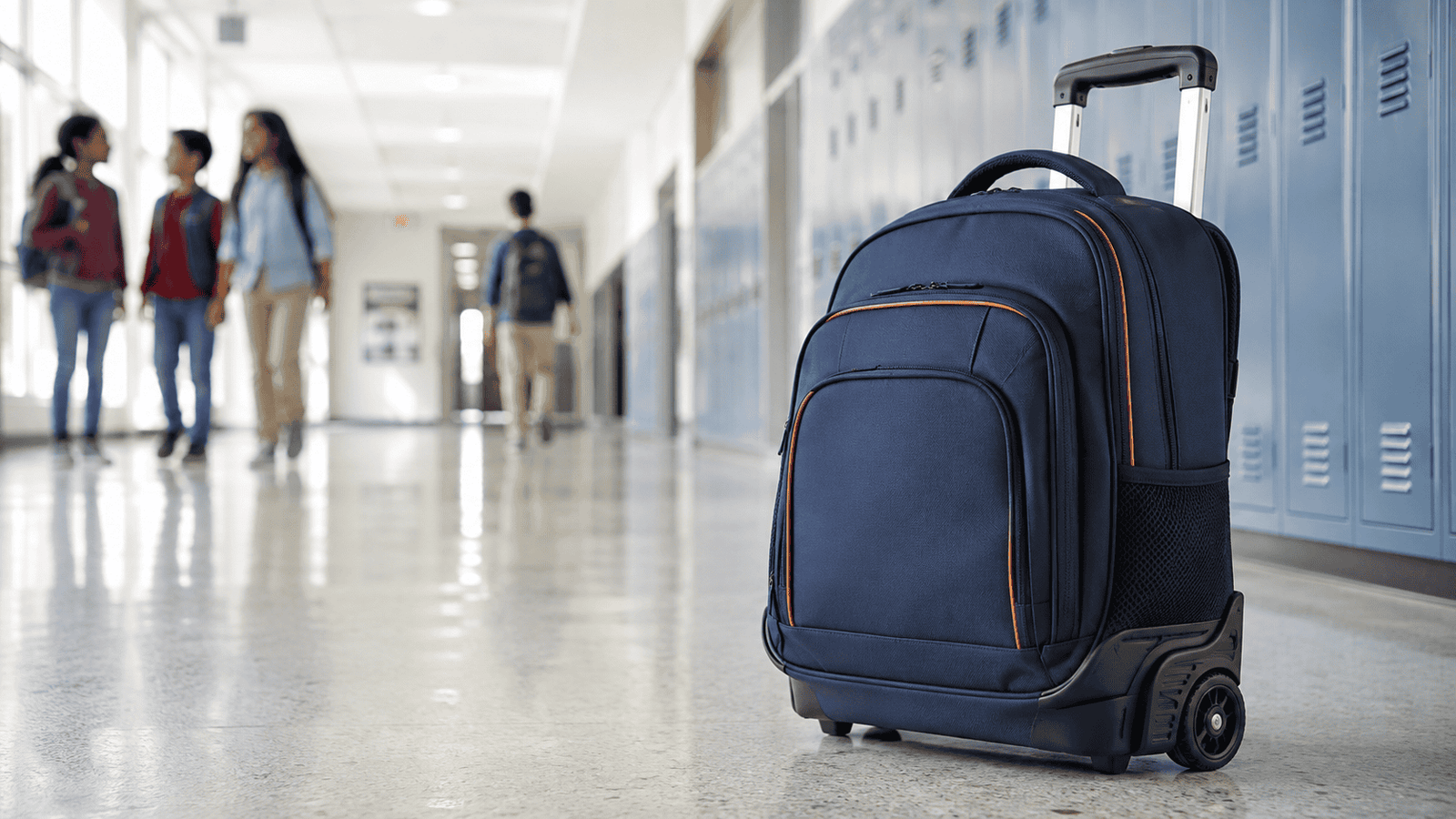
Rolling backpacks can be a practical school-bag option when students carry books, devices, lunch, and supplies across long, level routes. They move most of the load onto wheels while still providing backpack straps for short carries. However, they are not automatically the best choice for every school. Stairs, crowded corridors, snow, rough pavement, locker dimensions, and school rules can turn a useful trolley bag into an awkward obstacle.
For schools, distributors, uniform dealers, and private-label buyers, the correct purchasing question is not simply, “Which rolling backpack looks best?” It is: “Which construction, size, wheel system, and carrying mode fit the students and the actual campus?” This guide explains the pros and cons of rolling school backpacks, compares common designs, and provides a specification and sample-testing process for bulk orders.
Quick Answer: The best rolling backpacks for school are lightweight before loading, stable when pulled, easy to steer on the intended surfaces, compact enough for the school’s lockers, and strong at the wheel housing, bottom panel, telescopic handle, and carry points. Choose a rolling bag only after confirming that the school allows it and that the daily route is mostly level and uncongested. A convertible design with usable shoulder straps is valuable when a student must negotiate a few steps, board transportation, or move through an area where rolling is unsuitable.
Are Rolling Backpacks Good for School?
Yes—under the right conditions. A rolling backpack can reduce the time a student carries a load directly on the shoulders. That can be useful for a long hallway, a large campus, or a student who has been advised to avoid carrying a conventional backpack. The American Academy of Pediatrics advises families to consider a handled or rolling backpack if the school allows it, while also recommending lighter loads and sensible packing. The Pediatric Orthopaedic Society of North America notes that rolling models may cause less strain but can be difficult on stairs and in crowded halls.
Those two ideas belong together. Wheels solve one problem—continuous carrying—but introduce others: added product weight, a wider turning path, potential trip exposure, wheel noise, dirty wheel contact, and the need to lift the bag occasionally. A buyer should therefore treat a rolling school backpack as a route-dependent product, not a universal replacement for a two-strap backpack.
A simple suitability test
Before selecting a product, review the student journey from door to desk:
- Does the school permit wheeled bags?
- Are entrances, corridors, and classroom routes mostly level?
- Are stairs unavoidable, and if so, how many?
- Are corridors or buses crowded at changeover times?
- Will the bag fit under a desk, in a cubby, or inside the assigned locker?
- Is the outdoor route smooth, or does it include gravel, curbs, snow, or standing water?
- Can the student control, park, and lift the loaded bag when necessary?
If several answers are unfavorable, a lighter conventional backpack, a second set of books, or a reduced daily load may be a better solution.
Rolling Backpack Pros and Cons at a Glance
| Factor | Potential advantage | Possible drawback | Procurement implication |
|---|---|---|---|
| Load handling | Most travel occurs on wheels rather than shoulders | Bag still needs lifting at stairs, curbs, buses, and storage points | Test both rolling and lifting with the expected load |
| Capacity | Structured base can support books and devices | Extra space encourages overpacking | Define a realistic capacity and internal organization |
| Stability | Wide base can stand while parked | Narrow wheel track or poor load balance can tip | Test loaded tilt angle, parking stability, and turns |
| Durability | Reinforced base protects high-wear areas | Wheels, axles, and handle add failure points | Specify cycle tests and inspect replaceable components |
| School movement | Useful on long, smooth, level routes | Can obstruct crowded halls or create a trip hazard | Confirm school policy and route suitability first |
| Weather | Coated base helps with damp floors | Small wheels perform poorly in snow, gravel, or deep puddles | Match wheel diameter and clearance to local conditions |
| Conversion | Shoulder straps provide a backup carry mode | Wheel housing can press against the back | Require wheel covers or a comfortable protected back panel |
| Storage | Telescopic handle retracts | Rigid base may not compress into small lockers | Obtain exact locker and cubby measurements |
Which Students and School Environments Benefit Most?
Rolling backpacks are most convincing where the physical route supports them. A middle-school or high-school student moving between distant rooms on one accessible floor may benefit more than a younger child navigating short, crowded corridors. Students who routinely move a laptop, several books, and organized project materials may value the structured capacity. Schools ordering bags for a specific program should assess that program’s actual timetable and rooms rather than relying only on age labels.
They can also be appropriate for students with temporary or continuing mobility needs, but the decision should be individualized with the family, school, and relevant health professional. A product description should not make medical claims. Procurement teams can support accessibility by offering multiple carrying formats and collecting feedback from users.
Rolling models are less suitable when daily movement includes many stairs, narrow aisles, frequent bus boarding, rough unpaved routes, or heavy snow. They may also be a poor fit where bags must hang from a small hook or compress into a narrow locker.
Types of Rolling School Backpacks
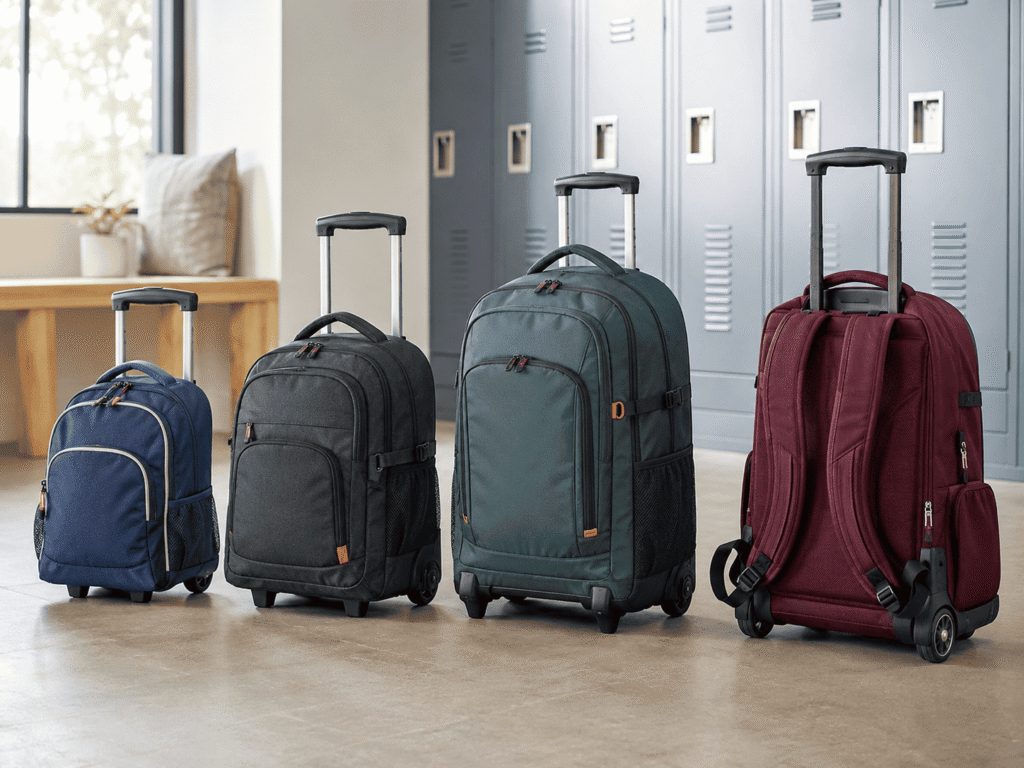
Compact two-wheel backpack
This format targets elementary or light-load use. It normally has one main compartment, a front organizer, bottle pockets, a two-stage handle, and two rear wheels. Its smaller footprint helps with storage, but a short wheelbase may be less stable when the top compartment is overloaded. Buyers should prioritize low empty weight, smooth zipper paths, and a handle height suitable for the intended users.
Standard student rolling backpack
The standard model balances book capacity, organization, and manageable size. It may include two or three main sections, a padded device sleeve, a molded or coated base, and stowable shoulder straps. For school programs and distributors, this is often the most adaptable starting point because colors, organizer layouts, labels, and logo positions can be customized without fundamentally changing the chassis.
Large-capacity laptop rolling backpack
This version adds a structured device compartment, more depth, and sometimes larger wheels. The extra capacity can serve older students, but it also increases empty weight and the temptation to fill unused space. The loaded center of gravity matters: a heavy laptop placed far from the handle side can make the bag feel unstable or pull unevenly.
Convertible rolling backpack
A convertible model provides functional shoulder straps, not merely decorative webbing. It is useful when rolling is possible for most—but not all—of a route. The design must isolate the student’s clothing from dirty wheels and keep the wheel housing from pressing uncomfortably into the back. A zip cover, molded guard, or fold-away panel can help, provided it is easy enough that students will actually use it.
Stair-climbing wheel configurations
Some products use multi-wheel clusters intended to move over steps. Buyers should be cautious with broad “stair-climbing” claims. Performance depends on stair geometry, load, user height, pulling angle, and product construction. A school sample should be tested on the actual stairs under controlled supervision. Even when the wheels traverse steps, the pulling motion and bag impact may remain unsuitable for a child or for crowded traffic.
Size, Capacity, and Fit: Start With the School, Not the Catalog
Capacity in liters is useful but incomplete. Two bags with the same nominal capacity can differ in external depth, rigid-base size, and storage efficiency. Begin with the largest required objects and the smallest storage opening.
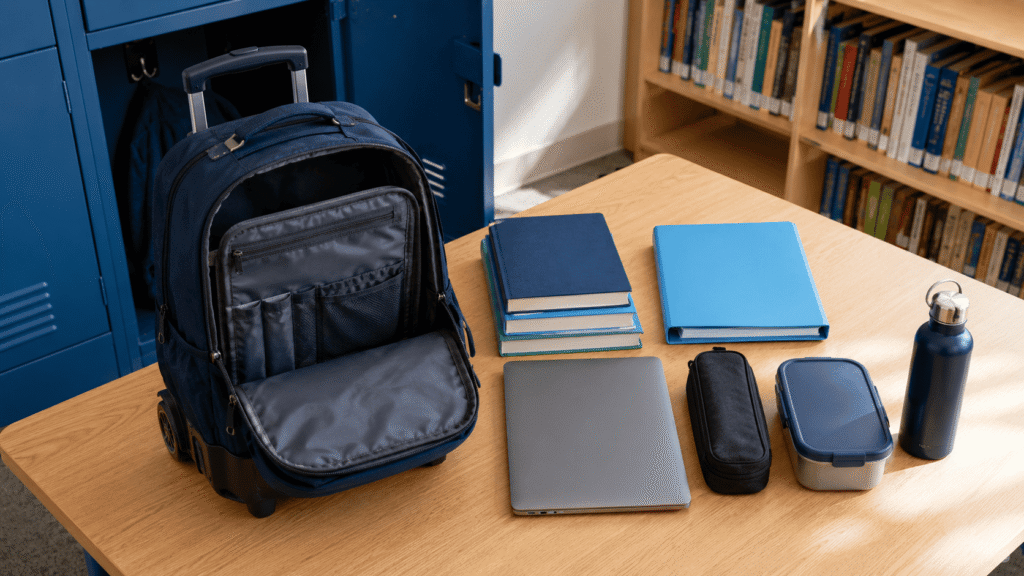
Record the dimensions of the biggest textbook or binder, the actual laptop with its protective case, lunch container, water bottle, and any program-specific equipment. Then measure locker or cubby height, width, depth, door opening, shelf position, and hook clearance. Allow space for zipper bulges and side pockets. Do not assume the telescopic tubes can enter a locker if the handle grip or molded base is wider than the body.
| Buyer group | Typical planning priority | Features to evaluate | Avoid |
|---|---|---|---|
| Elementary programs | Low empty weight and simple control | Short handle setting, easy zippers, stable base, name label | Oversized body and too many compartments |
| Middle schools | Books, binder, lunch, and device organization | Separate device sleeve, smooth wheels, compact depth | A top-heavy shape that tips in turns |
| High schools | Device protection and changing class loads | Reinforced sleeve, organized cables, taller handle | Travel-luggage bulk that blocks aisles |
| Distributors | Broad fit and low return risk | Clear dimensions, consistent QC, spare-part policy | Unverified universal age claims |
| School merchandise programs | Branding and repeatability | Standardized color, logo zone, reorder records | Decoration that interferes with pockets |
Handle height and pulling posture
An extended handle should let the user pull without leaning sharply sideways or backward. Because student heights vary, two or more positive-locking positions are usually more useful than a single extension. Check wobble at each position. Some movement is normal in telescopic systems, but excessive lateral play can feel unstable and may worsen with use.
Empty weight matters
Wheels, base plates, axles, guards, and handle tubes add mass before a book is packed. Compare the product’s empty weight as part of the specification. Do not treat wheels as permission to increase the total load: the bag will still be lifted into vehicles, over curbs, or into storage.
Wheel, Base, and Handle Specifications
The rolling system is the product’s defining structure. Cosmetic fabric cannot compensate for weak wheel attachment or a handle that jams.
Wheels
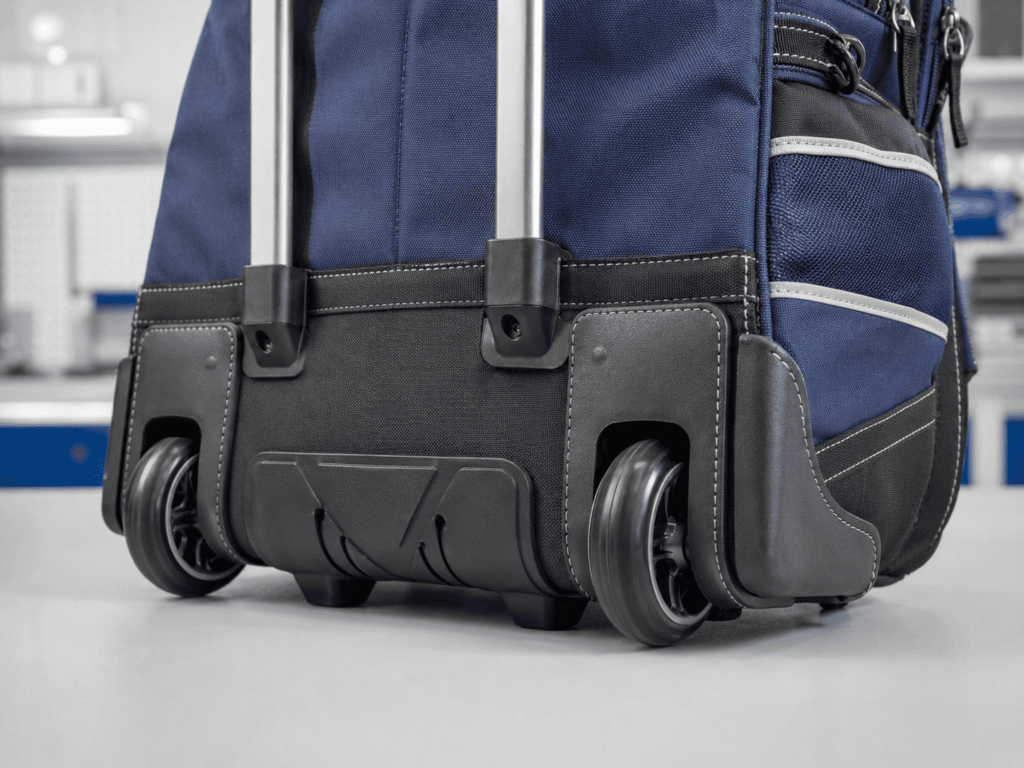
Larger wheels generally cross seams and small surface irregularities more easily than very small wheels, but they increase base size. Look for consistent rotation, minimal side-to-side play, adequate clearance from fabric, and a housing that protects the wheel without trapping excessive debris. Wheel material, bearing or bushing design, axle construction, and attachment method should be documented for repeat orders.
Wheel track and stability
The distance between the left and right contact points affects stability. A bag with a high center of gravity and narrow track may tip when turning or when a side bottle pocket is loaded. Test straight pulling, slow and fast turns, sloped surfaces, door thresholds, and sudden stops with a representative load.
Bottom panel
The base receives curb impacts, damp-floor exposure, abrasion, and the concentrated load around wheel and foot mounts. Useful details include abrasion-resistant fabric or molded protection, reinforced corners, drainage-aware construction, and feet that keep textile panels off the floor when parked.
Telescopic handle
Inspect the grip, release button, locking pins, internal tubes, mounting plate, and attachment to the chassis. The handle should extend and retract without catching the lining. It should remain locked during pulling, yet release with an accessible control. Conduct repeated extension cycles during sampling and after a loaded rolling test.
Materials and Construction Details
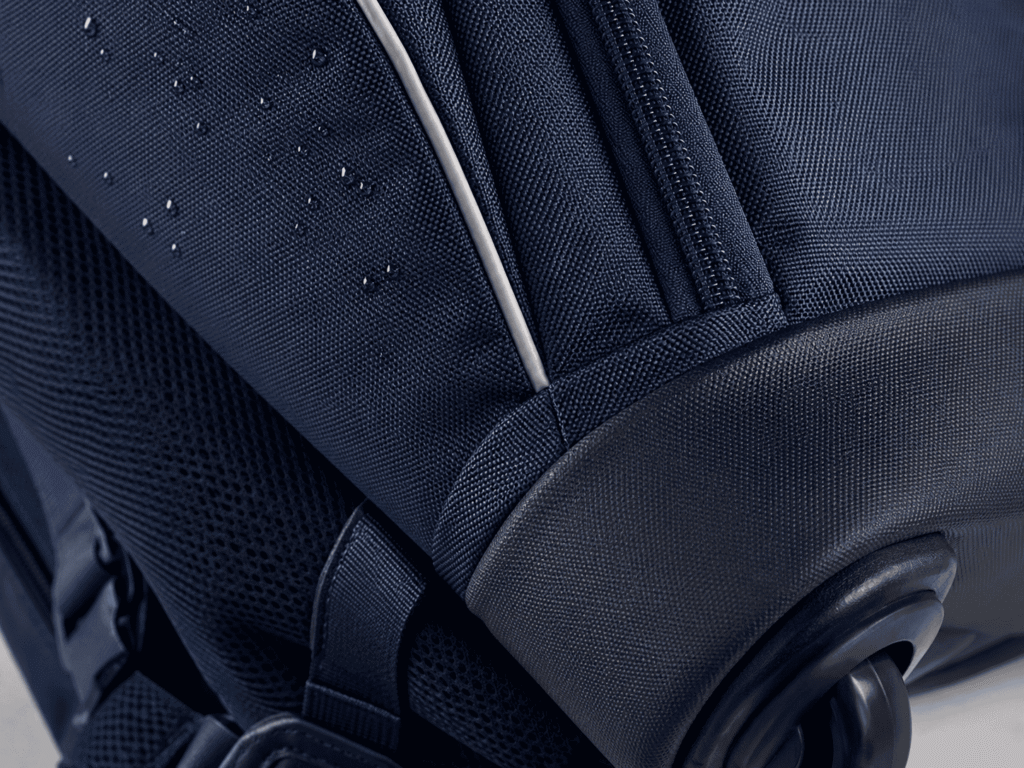
Common shell materials include woven polyester and nylon in different yarn sizes, weaves, coatings, and finishes. A material name alone does not establish durability. Buyers should specify fabric weight or construction, color standard, coating expectation, abrasion target where relevant, and restricted-substance requirements for the destination market.
High-contact zones deserve special attention: lower corners, wheel openings, the handle tunnel, the top carry handle, zipper ends, shoulder-strap anchors, and bottle-pocket edges. Bartacks or reinforcement patches may be appropriate at load points. Seam allowance, stitch density, thread selection, and binding quality should be confirmed on the approved sample.
“Water-resistant” should be defined. A coated shell may resist light splashes while zippers and seams still admit water. If a buyer needs a specific performance level, agree on a test method and acceptance criteria instead of relying on marketing wording.
From Feature List to Procurement Decision
Product features become valuable only when they answer a real operating need. Use this translation:
- Large wheels are justified by thresholds or uneven paving, but must still fit storage constraints.
- Multiple handle positions matter when one SKU serves a broad height range.
- Convertible straps matter where short carries are unavoidable, but require a wheel-cover solution.
- A padded laptop sleeve matters only if its usable dimensions and drop protection fit the devices issued.
- Many compartments help structured programs, but add material, sewing operations, cost, and empty weight.
- Reflective accents can improve visibility in low light, but placement and claimed performance should be specified.
- Replaceable wheels may support serviceability, but spare-part availability and replacement instructions must be planned.
This prevents a common sourcing mistake: selecting the model with the longest feature list rather than the one with the fewest operational conflicts.
Custom Rolling Backpacks for Schools and Private Labels
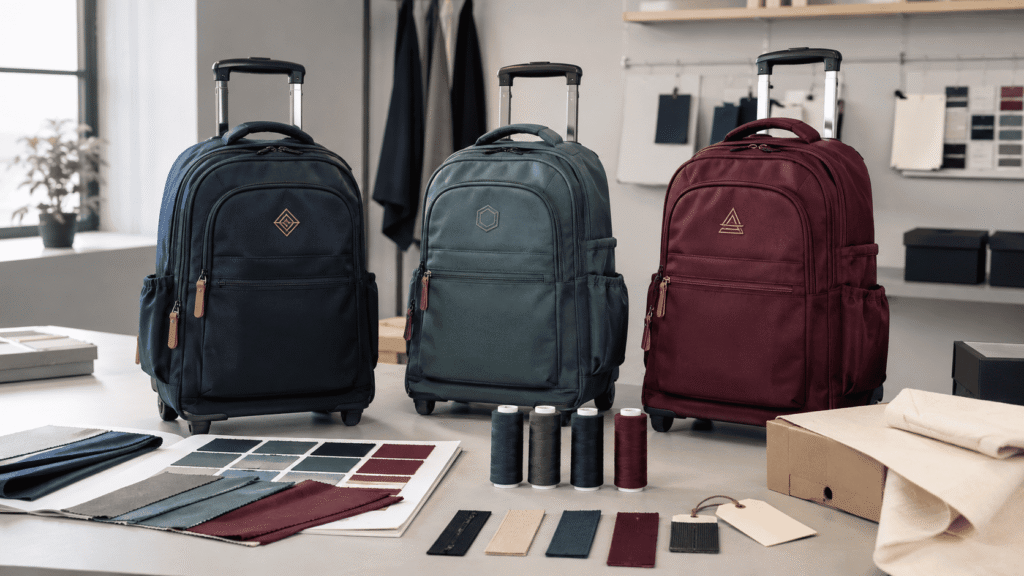
Customization can cover body color, contrast piping, zipper pulls, lining, embroidery, screen printing, heat transfer, woven patches, rubber/PVC patches, private labels, hangtags, and packaging. The decoration method should match the artwork, order quantity, abrasion exposure, and target appearance.
Embroidery gives a dimensional institutional look but adds stitches and backing to the panel. Heat transfer can reproduce detailed graphics but requires compatible fabric and controlled application. Patches can support a merchandise aesthetic and keep complex artwork consistent. Whatever method is used, the logo should not obstruct zipper paths, bend across a heavily curved panel, or weaken a structural seam.
Color approval should use a physical swatch or production material, not only a screen image. Pantone references can guide matching, but fabric texture, coating, and lighting affect the result. Private-label buyers should also approve label content, placement, legal information, barcode data, carton marks, and packaging before production.
Planning a school, distributor, or private-label program? Send JIUMU your target quantity, student age group, required dimensions, daily load, campus conditions, colors, logo file, packaging, destination, and target delivery date. JIUMU can review the concept and prepare a custom quotation subject to structure and customization. Request a custom rolling backpack quotation.
What Determines the Cost of a Rolling Backpack?
The chassis is usually a major cost driver. Wheel diameter and material, axle design, molded components, telescopic handle quality, tube thickness, and mounting reinforcement affect both price and durability. Fabric construction, number of compartments, zipper specification, lining, padding, device protection, decoration, labels, packaging, testing, order quantity, and shipping volume also matter.
A rolling backpack can occupy more carton volume than a soft backpack because its base and handle components do not compress fully. Ask for packed dimensions, units per carton, gross weight, and carton size before comparing landed cost. A lower unit price can be offset by inefficient packing, higher defect exposure, or a short service life.
Avoid requesting a price from only a photograph. A meaningful quotation needs a specification baseline. At minimum, provide target dimensions, expected load, materials or performance priorities, compartments, wheel and handle preferences, logo method, quantity by color, packaging, destination, and schedule.
Sample Approval and Quality-Control Checklist
Sample review should reproduce actual use, not only confirm appearance. Pack the sample with the intended books, device, lunch, bottle, and supplies. Weigh the complete load and record it. Then follow the actual route or a controlled equivalent.
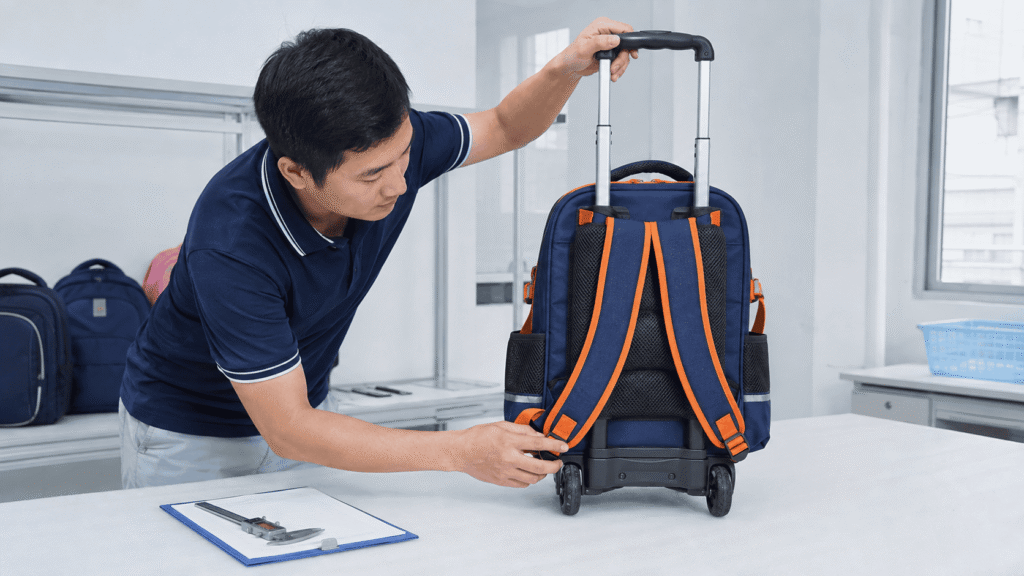
Functional sample tests
- Extend and retract the handle repeatedly at every lock position.
- Roll straight on smooth flooring and check whether the bag tracks to one side.
- Turn both directions with a balanced load and with a loaded side pocket.
- Cross door thresholds, floor seams, curb transitions, and the intended outdoor surface.
- Park the bag upright and test stability with normal classroom access.
- Lift it using the top handle and shoulder straps, where supplied.
- Check whether wheels or guards contact clothing during backpack carry.
- Open every zipper with the bag full and confirm fabric does not catch.
- Inspect wheel mounts, base, seams, handle tunnel, and anchor points after testing.
- Verify locker, cubby, desk, and transportation fit with actual measurements.
Production inspection points
Confirm approved color, external dimensions, empty weight, logo placement, zipper operation, handle locking, wheel rotation, alignment, base attachment, carry-handle strength, shoulder-strap symmetry, seam finish, lining cleanliness, label content, packing, carton marks, and quantity. Define defect classifications and inspection sampling with the supplier before production rather than after goods are ready.
For repeat orders, retain an approved reference sample and a specification record. Component substitutions should require buyer approval when they could change appearance or performance.
Bulk-Order Planning Process
1. Audit users and routes
Define grade range, approximate user heights, typical daily load, storage dimensions, school rules, terrain, stairs, corridor density, transport mode, and climate. Separate must-have requirements from preferences.
2. Build the product specification
Confirm body dimensions, target empty weight, compartments, device sleeve, fabric, lining, padding, wheel system, base protection, handle positions, shoulder straps, wheel cover, colors, logo, labels, and packaging.
3. Review a digital mockup
Use the mockup to confirm color blocking, panel lines, artwork size, and placement. It is not a substitute for a physical sample because it cannot demonstrate wheel, handle, or fit performance.
4. Approve a physical sample
Test it with the intended load and route. Record requested revisions in a consolidated document with photographs and measurements. Approve the final sample and specification together.
5. Confirm production controls
Agree on critical components, in-process checks, final inspection criteria, packaging, carton labels, delivery terms, and communication milestones.
6. Plan distribution and feedback
Provide safe-use instructions, encourage students to keep the bag close and avoid blocking traffic, and collect feedback on wheel noise, handling, storage, and wear. That information improves a repeat order.
Questions to Ask a Rolling Backpack Supplier
- What are the exact external and internal dimensions, empty weight, and usable device-sleeve dimensions?
- What materials and construction are used for the shell, base, wheel housing, axle, wheels, and handle tubes?
- How many handle positions are available, and what are their heights from the floor?
- Which high-stress points are reinforced?
- Can the shoulder straps be stowed, and how are wheels covered during backpack carry?
- Which components can be customized without a new structure or mold?
- Can wheels or handles be replaced, and are spare parts available?
- What sample types, charges, and revision steps apply?
- Which tests can be agreed for rolling cycles, handle cycles, seams, colorfastness, or restricted substances?
- How will bulk production be compared with the approved sample?
- What are the MOQ, packed carton dimensions, production schedule, and delivery terms?
- How are private labels, packaging copy, barcode data, and carton marks verified?
Common Buying Mistakes
Buying before checking school policy
A technically sound product is useless if wheeled bags are prohibited. Obtain current approval from the relevant school or district rather than relying on a general assumption.
Choosing by capacity alone
The largest bag is rarely the safest operational choice. Excess capacity increases bulk and encourages unnecessary packing. Fit the required items with disciplined organization and a margin—not a travel-luggage volume.
Ignoring the empty weight
Students must still lift the bag. Compare total loaded weight and every lifting point, not just the reduced shoulder-carry time.
Testing only on a showroom floor
Smooth tile hides problems that appear at door thresholds, pavement joints, ramps, turns, or locker doors. Simulate real use.
Treating the wheel system as a commodity
Small differences in alignment, clearance, housing reinforcement, and handle mounting can define the user experience. Put these elements in the specification.
Approving artwork without a physical sample
Digital color and logo scale can change on textured fabric and curved panels. Approve the decorated physical sample when brand consistency matters.
Why Work With JIUMU on Custom School Bags?
JIUMU is a Guangdong-based B2B supplier established in 2010, serving buyers in North America, the United Kingdom, Canada, and Europe. Its scope includes OEM and ODM development, logo decoration, fabric sourcing, Pantone color matching, private labels, packaging customization, digital mockups, physical samples, quality control, and export support.
For rolling backpack projects, the useful starting point is a clear operational brief. JIUMU can help translate the desired user, route, size, component, branding, and packaging requirements into a sample and bulk-order discussion. The typical MOQ is 50 pieces, subject to product structure and customization. Buyers should confirm the applicable MOQ, sample plan, component options, tests, and delivery schedule for the specific project.
Explore JIUMU’s broader custom team bags capability or review the company’s background and customization services.
Frequently Asked Questions
Final Recommendation
The best rolling backpack for school is the one that fits the school—not the one with the most liters or the largest wheels. Confirm permission and route conditions first. Then specify manageable size and empty weight, stable wheels, a reinforced base, a reliable multi-position handle, appropriate organization, and a practical carry backup. Test the decorated physical sample with the expected load across the real environment before approving bulk production.
About JIUMU
JIUMU is a Guangdong-based B2B custom bags and teamwear supplier established in 2010, supporting OEM/ODM, sampling, decoration, private labels, packaging and export orders.