Best Backpacks for Elementary School Students: A B2B Buying Guide
Choosing the best backpacks for elementary school students is not a matter of selecting the brightest color or the largest compartment. For schools, distributors, uniform dealers, promotional companies, and private-label brands, the decision connects child fit, daily function, material performance, branding, quality control, and reorder consistency.
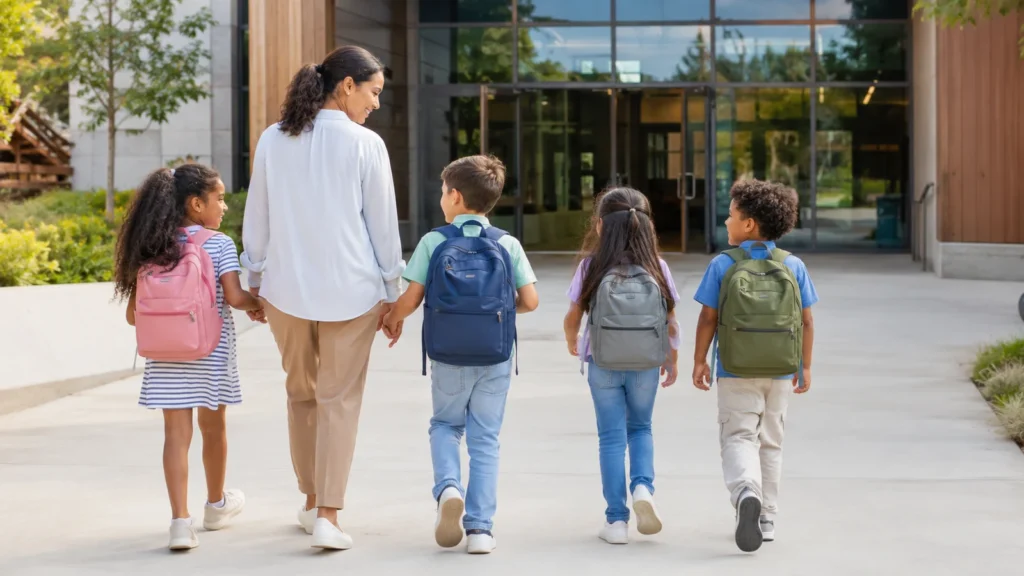
Elementary students cover a wide physical and developmental range. A compact bag that works for a kindergarten student may be too small for a fourth- or fifth-grade timetable. Conversely, an oversized backpack can encourage unnecessary packing and may sit too low on a younger child’s back. A sound buying program therefore starts with student use, required contents, and body fit—not a generic age label.
This guide explains how professional buyers can define an elementary school backpack specification, compare practical constructions, plan customization, approve samples, and prepare a bulk order.
Quick Answer: The best elementary school backpacks are appropriately scaled to the intended grade group, light before packing, fitted with two adjustable padded straps, organized so heavier items can sit close to the back, and constructed with reinforced high-stress seams and child-manageable zippers. For a program spanning early and upper elementary grades, use at least two size tiers. Confirm dimensions with fit samples, define materials and components in writing, and inspect production against an approved reference sample.
Why the Backpack Decision Matters
A backpack becomes part of a student’s daily routine. It moves between home, buses, classrooms, playground edges, and after-school activities. It may be opened many times, placed on rough floors, pulled by its top handle, and carried in rain or snow. The buyer must translate that routine into observable requirements.
For a school, the product may need to fit standard folders, a lunch container, a reading book, and a refillable bottle without becoming unnecessarily large. A distributor needs a design that can serve several accounts while supporting logo changes and repeat orders. A retailer needs clear size communication and packaging. A uniform dealer may need color coordination with apparel and predictable replenishment.
The American Academy of Pediatrics’ HealthyChildren guidance says backpacks should not exceed 15% of a child’s body weight, should be worn with both shoulder straps, and should sit close to the body in the middle of the back. It also recommends waist or chest straps where appropriate. This is use guidance, not a universal product certification, but it has practical implications: control the empty weight, avoid excessive capacity, use adjustable paired straps, and make the internal layout easy to balance.
The American Academy of Orthopaedic Surgeons similarly recommends placing heavier items low and toward the center of the backpack. A buyer can support that behavior with a stable back panel and a folder or book sleeve against the wearer’s back.
Elementary Backpack Decision Overview
| Procurement question | Better specification direction | Why it matters |
|---|---|---|
| Who will use the bag? | Define grade band and representative torso range | “Elementary” is too broad for one assumed fit |
| What must it carry? | List the largest folder, lunch format, bottle, clothing, and device | Contents determine dimensions and layout |
| How is it transported? | Map walking, bus, car, cubby, locker, and after-school use | Transport changes visibility, handle, and abrasion needs |
| How will it be branded? | Confirm method, size, location, and color count | Branding affects panel construction, cost, and sampling |
| What should be tested? | Set component, seam, zipper, load, and appearance checks | “Durable” alone is not inspectable |
| How will reorders work? | Lock color, material, trim, and artwork references | Repeat-order consistency matters |
Which Backpack Types Work Best?
Compact early-elementary backpack
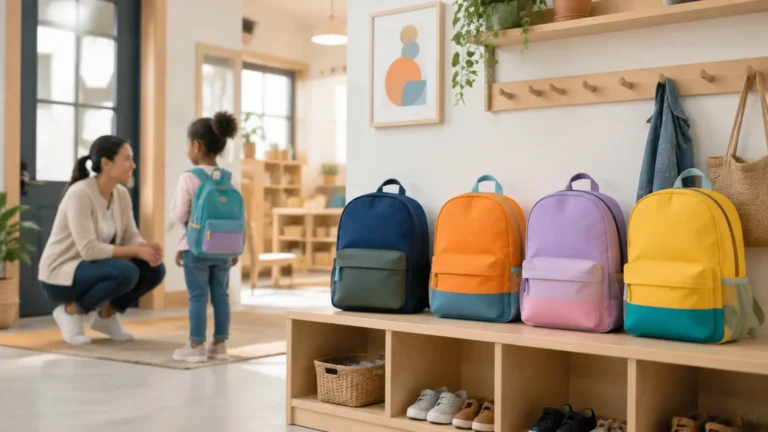
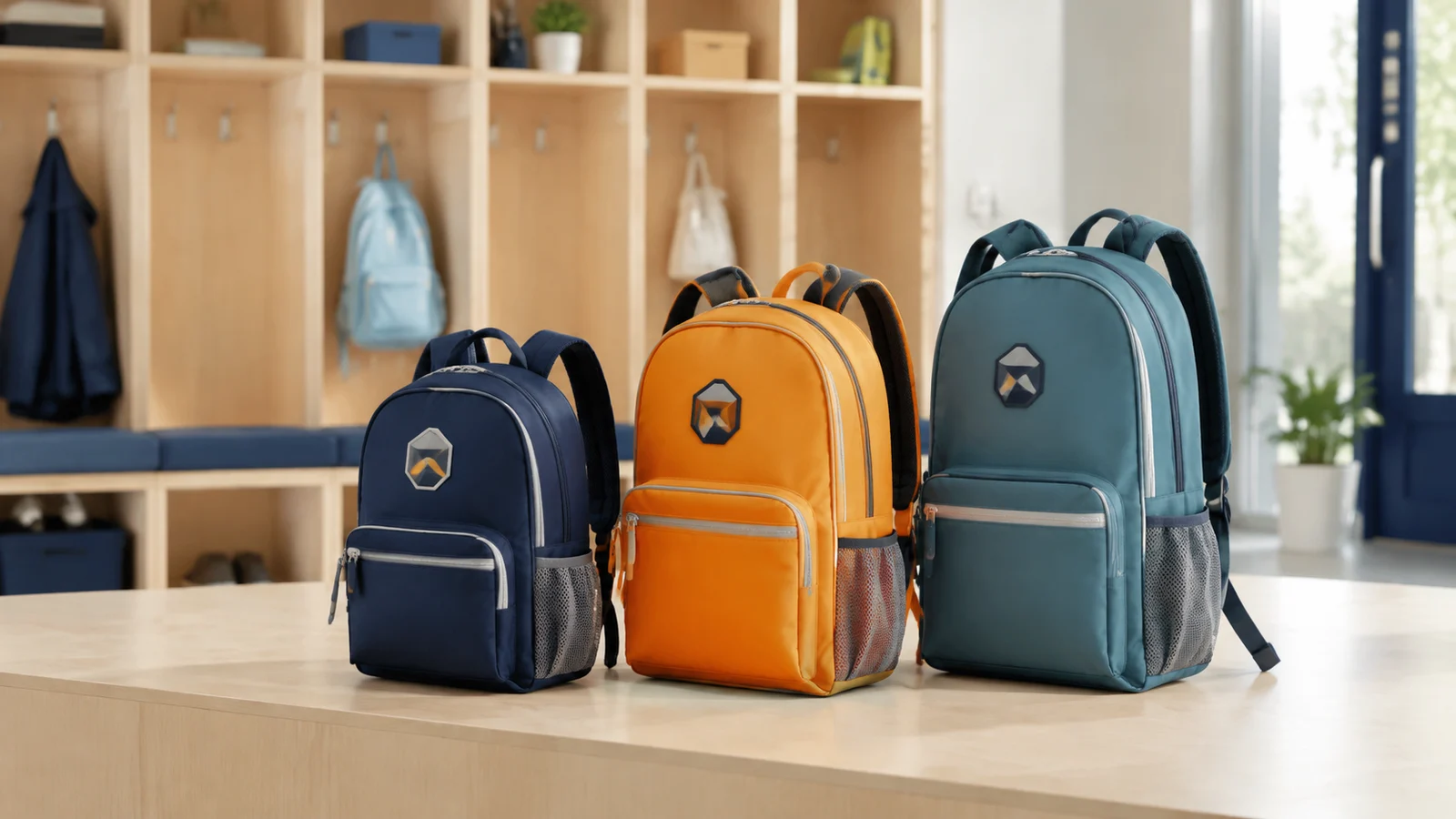
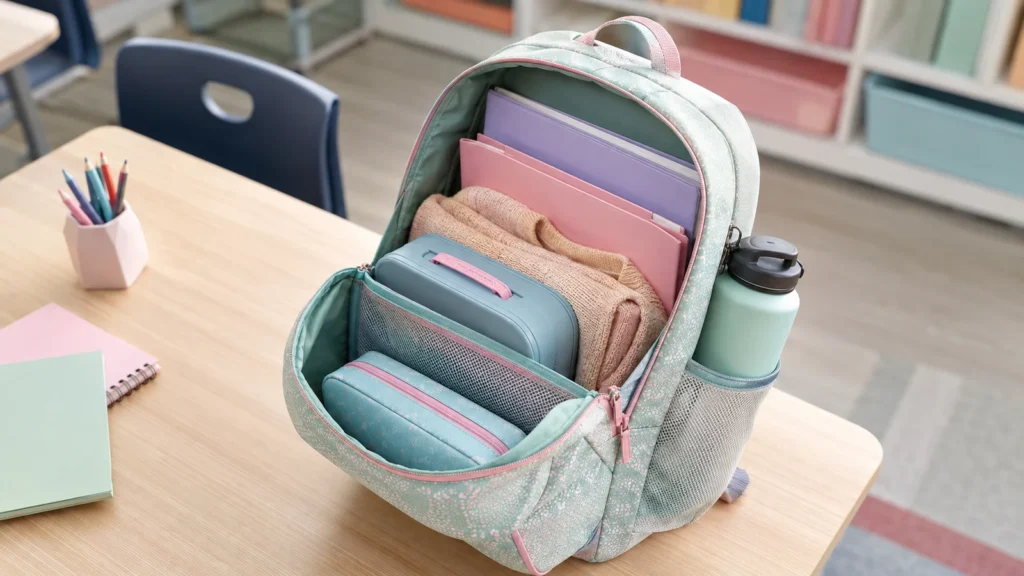
A compact model suits kindergarten through early grades when students carry a few thin folders, a small lunch, and personal items. It should accept the school’s required folder format without bending corners. A front pocket can hold supplies, while side bottle pockets keep liquids out of the main compartment.
The key is restraint. A very deep bag may look attractive online but can project too far from a small torso when loaded. Ask for external height, width, and depth plus usable internal dimensions; nominal liter capacity does not prove that a folder will fit.
Standard elementary backpack
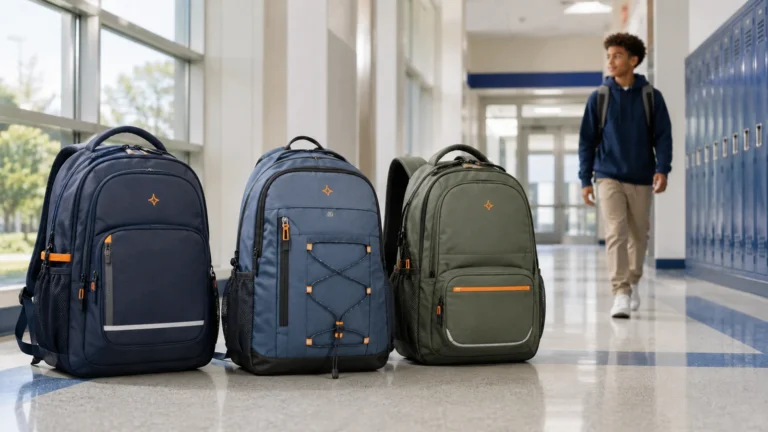
A standard model serves many middle and upper elementary students. It typically needs room for folders, notebooks, a lunch container, and a light layer. Two clear main zones can be easier for a child to understand and easier for the buyer to inspect than many tiny pockets.
Structured school-uniform backpack
Some schools prefer a structured silhouette and restrained palette. Reinforcement or light foam can help retain shape, improve logo presentation, and protect contents. The tradeoff is added weight and cost. Specify where structure is required instead of adding foam everywhere.
Activity or field-trip backpack
A lightweight activity bag may suit field trips, clubs, or welcome kits, but it is not automatically an all-day academic backpack. If it lacks a stable back panel, padded straps, or folder-sized space, describe the narrower use case accurately.
Rolling backpack
Rolling bags may help in selected circumstances, but buyers should confirm school rules and building conditions. Wheels, frames, and handles add weight and consume internal space. Stairs, crowded corridors, and cubbies can make the format less practical. Treat it as a separate program, not a universal upgrade.
How Should Buyers Choose Size, Capacity, and Fit?
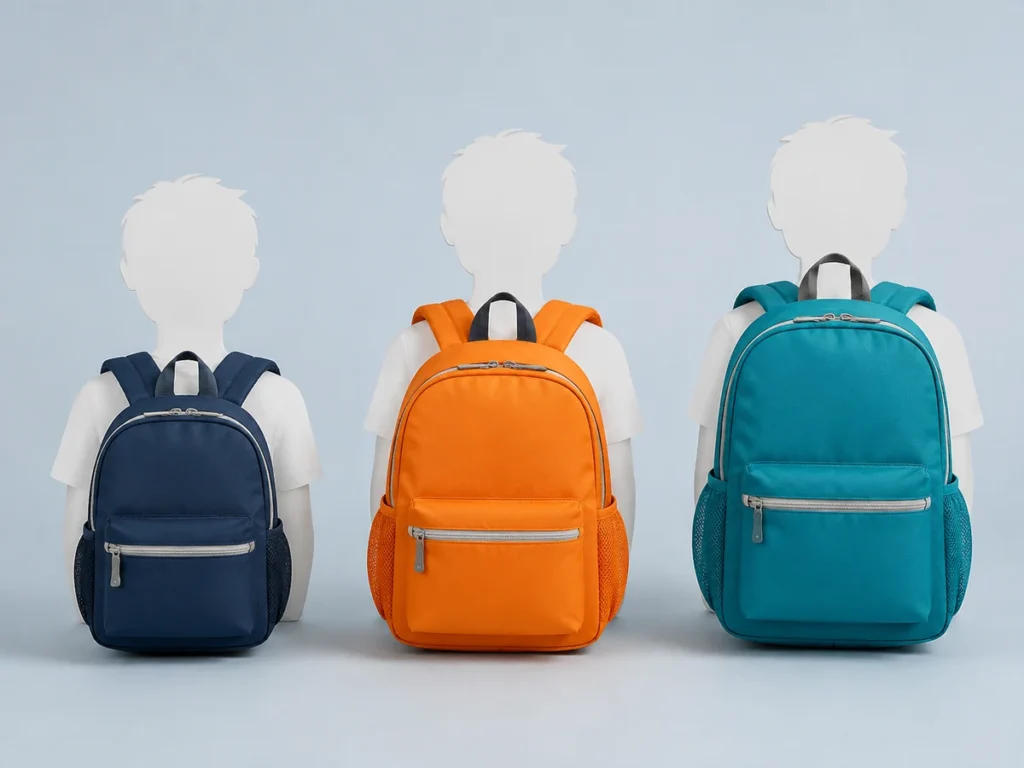
Do not assign a backpack solely by age. Children of the same grade can differ considerably in height and build. Build a size recommendation from representative students or torso forms, required contents, and the school calendar.
The pack should sit close to the body and around the middle of the back. HealthyChildren advises that the bottom rest in the curve of the lower back and not hang more than four inches below the waistline. In procurement terms, the adjustment range must allow intended users to reach a stable position without leaving unmanaged strap tails.
Suggested planning tiers—not universal standards
| Program tier | Starting external height range | Typical use | Buyer validation |
|---|---|---|---|
| Compact | about 14–15 in / 36–38 cm | Early grades, light daily load | Test required folder and smallest representative wearer |
| Standard | about 15–17 in / 38–43 cm | Broad elementary use | Test packed fit across representative grade band |
| Large elementary | about 17–18 in / 43–46 cm | Older students or larger contents | Confirm bag does not extend too low |
These are planning assumptions, not medical recommendations or mandatory standards. Usable capacity changes with pattern shape, padding, pocket construction, and zipper opening. A sample fit session is more reliable than a catalog dimension.
Measure contents before specifying liters
Create a packing list and measure the largest item. Include actual folder or binder dimensions, lunch container orientation, water bottle diameter, winter layer, and any school-issued device. Add reasonable access clearance. Do not increase every dimension “for safety”; unused volume invites more loading and changes the silhouette.
Make adjustment child-manageable
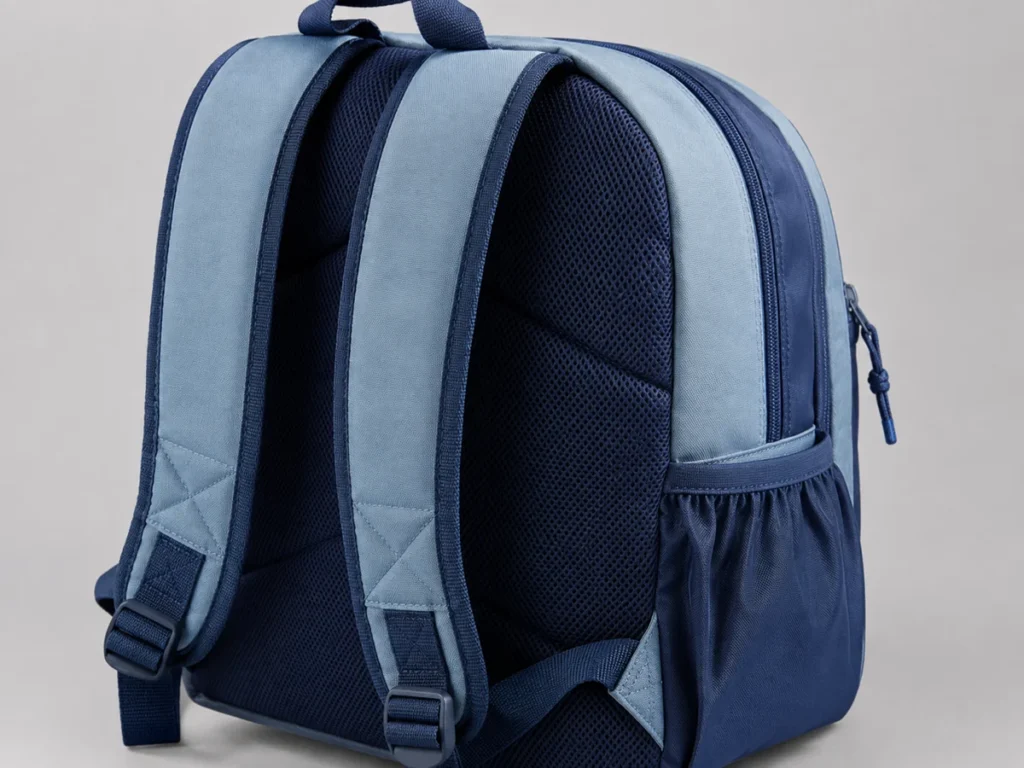
Strap adjusters should hold position yet remain manageable. Paired padded shoulder straps are the baseline. A sternum strap can stabilize a load, especially for walking programs, but its height and buckle operation must suit the target group. Loose strap ends can be controlled with elastic keepers.
Which Materials Make Sense?
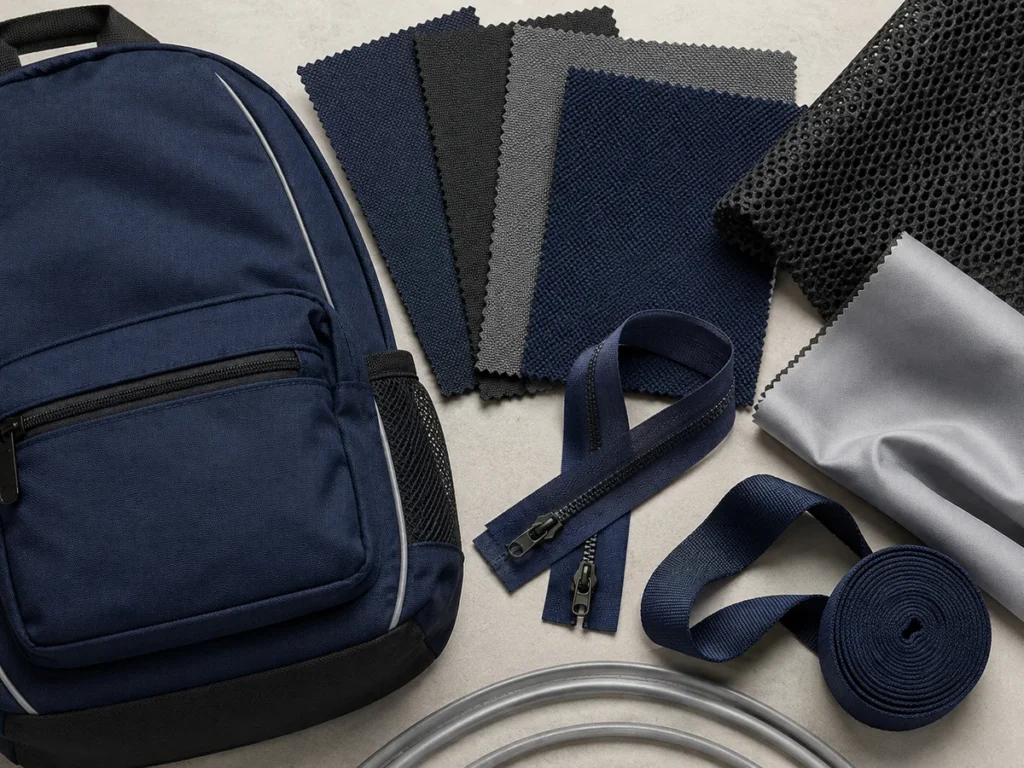
Fabric choice should be made through measurable specifications and approved samples. “Polyester” describes a fiber family, not one performance level. Yarn, weave, coating, finish, backing, and fabric weight all affect the result.
Polyester woven shell
Polyester supports color development, printing, and a range of price points. Buyers can specify a woven construction and verify hand feel, abrasion expectations, coating, and color against a sample. Denier may describe yarn size but should not be treated as a durability score by itself.
Nylon woven shell
Nylon may suit programs seeking a particular hand feel or abrasion profile, but construction and finish remain decisive. Compare submitted materials under the intended test method and commercial conditions.
Lining, mesh, and padding
A light-colored lining can make contents easier to see. It should be attached neatly and avoid loose fabric near zippers. Spacer mesh can provide a comfortable contact surface. Foam thickness and density should be judged together: very soft foam may collapse quickly, while an overly rigid back can be uncomfortable.
Zippers, webbing, buckles, and elastic
Zipper size, tape, slider, puller, and opening geometry affect use. Easy-to-grip pullers can help, but avoid sharp edges or detachable decorations. Webbing should feed correctly through adjusters and resist slipping. Bottle-pocket elastic must recover after repeated stretching.
Water resistance is not waterproofing
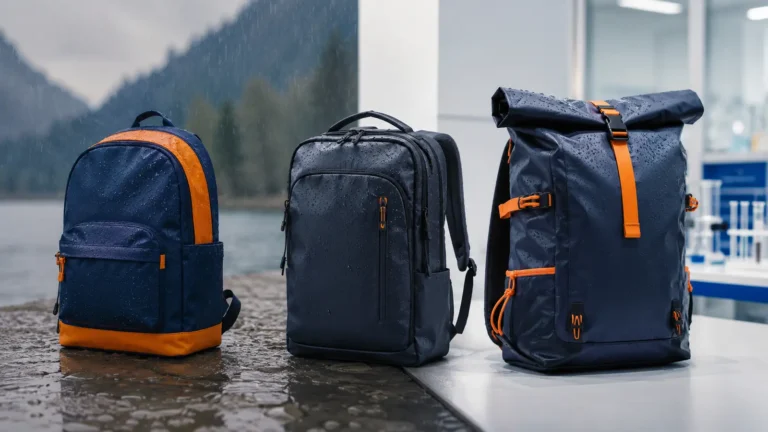
A coated shell and covered zipper geometry may resist light exposure, but seams and openings remain pathways for water. Do not market a backpack as “waterproof” without defined construction and testing. State the method and result if a water claim is necessary.
Construction Details That Predict Daily Performance
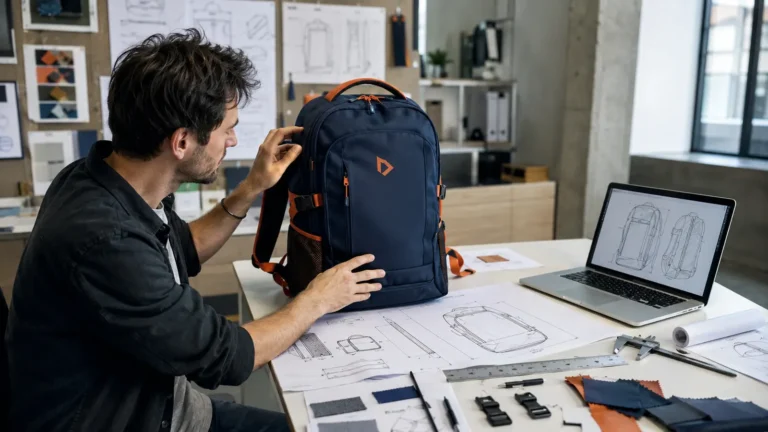
The highest-value decisions are often invisible in a front-view photo. Ask the supplier to document stress areas and show inside construction during sample approval.
Reinforce attachment points
Shoulder straps, the top handle, and lower anchors take repeated pulling loads. Reinforcement may include extra layers, box stitching, bartacks, or a designed seam pathway. The method depends on the material stack. Approve the construction and evaluate it under a defined load protocol.
Stabilize the back panel
A stable panel keeps folders closer to the body and reduces hard edges pressing directly into the wearer. It need not be heavy. Lining, foam, quilting, and an internal sleeve can provide balanced shape.
Design openings for real hands
A long, smooth zipper path is often easier than a tight opening with deep corners. Check whether a child can see and retrieve contents without forcing the slider. Use secure pullers that are easy to grasp.
Protect the base
The base meets floors and outdoor surfaces. A slightly heavier or coated panel, reinforced corner geometry, and clean seam allowance can improve serviceability. Avoid promising a leakproof base unless it is designed and tested that way.
Control small components
Review detachable trims, sharp points, decorative hardware, and cord loops. Regulatory scope depends on product, market, age grading, materials, and claims. Buyers importing to the US, Canada, UK, or EU should obtain market-specific compliance advice and define applicable testing before production.
Translate Features Into Procurement Requirements
| Marketing phrase | Inspectable buyer requirement |
|---|---|
| Lightweight | Maximum approved empty sample weight by size |
| Durable | Defined materials plus agreed seam, zipper, and load checks |
| Comfortable | Strap width, padding, adjustment range, back panel, and fit trial |
| Water-resistant | Exact finish and agreed test method/result |
| Easy to organize | Named compartments sized around the packing list |
| Reflective | Material type, placement, color, width, and visual check |
| Kid-friendly | Opening force, puller size, buckle use, and loose-cord review |
| Eco-friendly | Specific verified material claim and accurate labeling |
This translation prevents ambiguity. It gives suppliers a basis for quotation and inspectors observable criteria.
Customization and Private Label
Embroidery
Embroidery creates a dimensional appearance for simple crests and initials, but dense stitching can stiffen or distort a lightweight front panel. Confirm stitch coverage, backing, thread colors, and the reverse-side appearance.
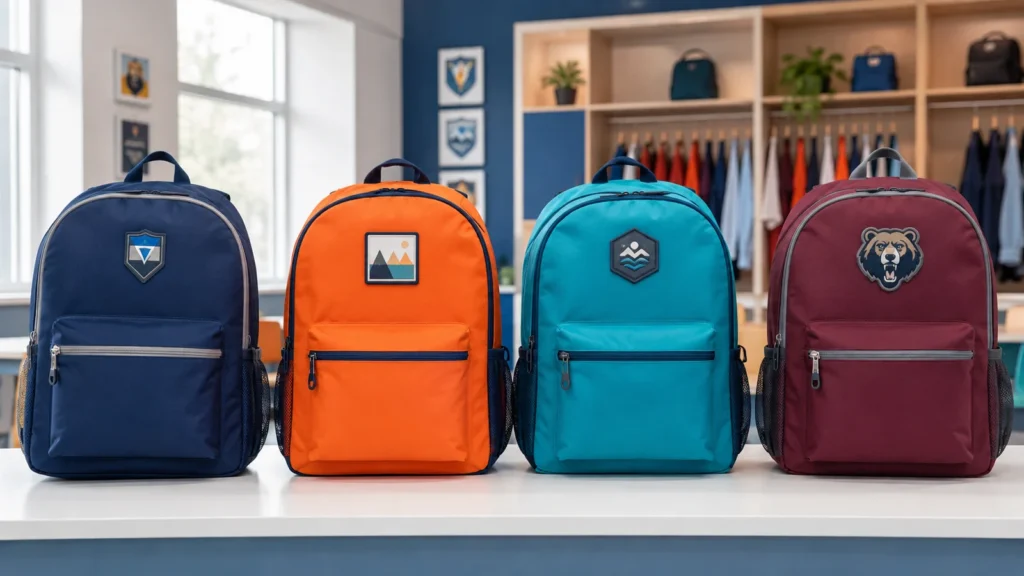
Woven and molded patches
Woven patches reproduce fine lines; approve edge finish, attachment stitching, and background color. Rubber or PVC-style patches can create precise color zones, but buyers must confirm thickness, flexibility, attachment, artwork minimums, and applicable material requirements.
Heat transfer and screen printing
Heat transfer supports detailed graphics, while screen printing can be efficient for suitable artwork and volume. Fabric coating and heat sensitivity must be evaluated. Ask for adhesion and appearance checks on production-equivalent fabric.
Labels and packaging
Private-label programs may include woven labels, hangtags, barcodes, individual packing, and carton marks. Country-of-origin and other obligations depend on destination and product composition. The FTC Textile Fiber Rule covers specified textile products in the United States; buyers should determine whether and how their backpack is covered instead of copying an apparel label template.
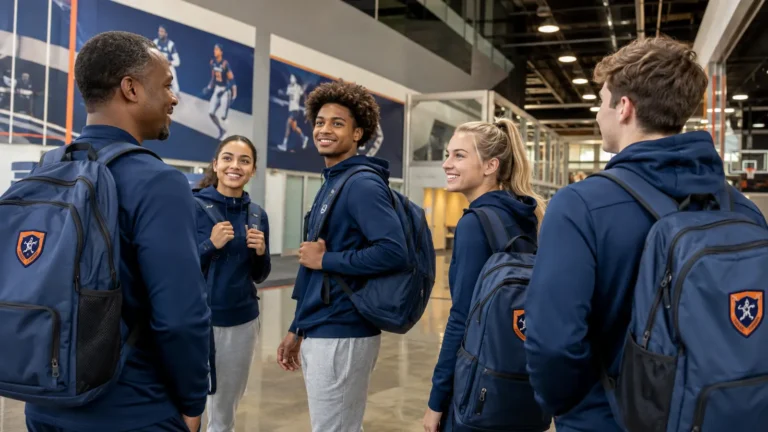
Send JIUMU the target grade band, quantity by color, contents, dimensions, artwork, decoration, packaging, destination, and target date. A complete brief enables a more relevant proposal. Explore custom team bags or contact JIUMU.
What Drives the Cost?
Cost comes from the specification, not simply the number of compartments. Major drivers include shell and lining, coatings, padding, reinforcement, zipper and buckle grades, reflective details, number of pattern pieces, decoration method and size, colorways, size tiers, private labels, packaging, testing, inspection, quantity, and shipment plan.
A simplified bag is not necessarily inferior. Removing decorative seams or redundant pockets may reduce weight, failure points, and sewing time. Spend budget on fit, core materials, stress reinforcement, access, and quality control before novelty features.
JIUMU’s typical MOQ is 50 pieces, subject to product structure and customization. Confirm whether the minimum applies per design, color, size, or total program because development and decoration setup can change the workable quantity.
Quality-Control Checklist
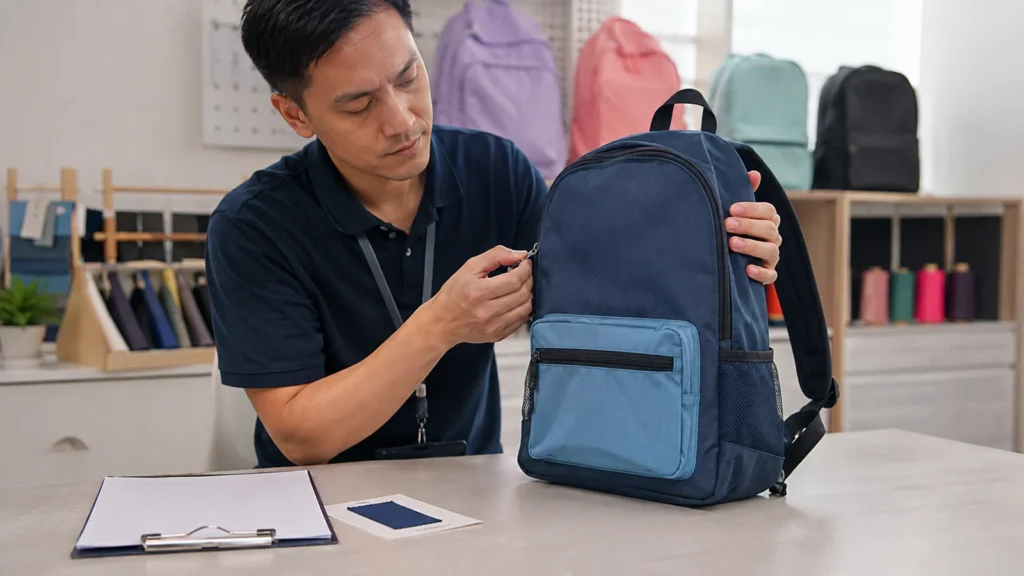
Quality control begins before bulk production. The approved sample, artwork, color references, bill of materials, measurement table, and packaging instructions should form one controlled reference set.
Sample-stage checks
- Pack the sample with actual school contents.
- Fit it on representative users or suitable forms using school procedures.
- Record empty weight and finished dimensions.
- Open and close every zipper repeatedly; check corners and slider access.
- Adjust straps across the full intended range.
- Inspect strap anchors, handle attachment, base corners, binding, and seams.
- Stretch bottle pockets with the intended bottle diameter.
- Review artwork size, location, color, and panel distortion.
- Confirm labels and packaging against destination requirements.
- Define which sample becomes the signed approval reference.
Production inspection points
| Area | What to verify |
|---|---|
| Appearance | Correct silhouette and color; clean surface |
| Measurements | Finished dimensions and tolerances by size |
| Components | Correct shell, lining, zipper, webbing, buckle, elastic, and trim |
| Sewing | Seam security, stitch consistency, reinforcement, thread control |
| Function | Smooth zippers, secure adjusters, usable pockets, stable handle |
| Branding | Artwork, placement, orientation, dimensions, colors, attachment |
| Packing | Correct labels, quantities, protection, and carton marks |
| Records | Inspection tied to order, colorway, size, and sample reference |
If testing is required, name the method, sample count, laboratory or inspection party, timing, and acceptance criterion. “Pass standard test” is insufficient because methods evaluate different risks.
A Practical Bulk-Order Process
1. Define the user and the day
Identify grade bands, representative student sizes, school schedule, transport, climate, cubby or locker dimensions, and daily contents.
2. Build the requirement sheet
List external and usable dimensions, target empty weight, compartments, strap range, padding, shell, lining, components, decoration, labels, packaging, destination, and required checks.
3. Request a construction proposal
Share reference images as direction, not an instruction to copy protected branding. Ask the supplier to flag conflicts between size, capacity, material, cost, and timing.
4. Approve artwork and color
Use vector artwork where possible. Define Pantone or another controlled color reference while acknowledging that thread, fabric, print, and molded patches reproduce color differently.
5. Review a physical sample
Do not approve from photographs alone when fit, hand feel, zipper operation, or capacity matters. Record changes in one consolidated revision document.
6. Lock production references
Approve the final sample, measurement table, bill of materials, artwork, color references, packaging, and inspection plan. Control later changes formally.
7. Inspect and retain records
Check production against approved references and retain order-specific records for reorders. Photograph important details and label retained samples.
What to Send for a Quotation
A useful RFQ should contain:
- buyer type and project purpose;
- destination country and delivery location;
- target grade band or fit information;
- quantity by size, color, and artwork;
- required external and internal dimensions;
- packing list or capacity requirement;
- material, padding, and component preferences;
- logo artwork, method, dimensions, and placement;
- private label, hangtag, barcode, and packaging needs;
- compliance or testing requirements identified for the market;
- target delivery date and shipping expectations;
- reference images or an existing sample;
- target price range, when commercially appropriate.
When a field is unknown, label it open for supplier recommendation. That produces a better conversation than filling the brief with arbitrary numbers.
Questions to Ask a Supplier
- Which dimensions and construction suit our grade band and packing list?
- Can you provide two size tiers using a coordinated design?
- What are the exact shell, lining, foam, mesh, zipper, webbing, and buckle specifications?
- How are straps, handles, and lower anchors reinforced?
- How will finished dimensions and empty weight be controlled?
- Which decoration method suits our artwork and selected panel?
- What will the sample show, and which items need separate approval?
- What is the MOQ by design, color, size, and logo?
- Which tests or inspections can be arranged for our market?
- How are color, components, and artwork controlled for reorders?
- What packaging and carton information do you need?
- Which choices have the largest effect on price and timing?
Common Buying Mistakes
Buying one oversized model for every grade
One SKU is simple administratively but may fit the youngest students poorly. Consider compact and standard tiers for a broad elementary population.
Selecting by liters alone
Capacity figures do not reveal opening size, usable geometry, padding volume, or folder fit. Approve dimensions and pack a sample.
Specifying “waterproof” without a method
Coated fabric does not make every seam and zipper waterproof. Use qualified claims supported by a defined result.
Adding too many pockets
Extra pockets increase material, operations, weight, inspection points, and confusion. Every compartment should have a purpose.
Approving a logo without the actual fabric
Decoration can pucker, sink into texture, shift color, or distort a panel. Approve the method on production-equivalent material.
Treating the first sample as the specification
Record all revisions. A sample without matching measurement, material, artwork, and packing records is difficult to reproduce.
Ignoring destination-market obligations
Children’s products, textile content, labels, chemical requirements, and packaging can be regulated differently. Buyers and importers should identify applicable rules with qualified support before production.
Why JIUMU Is Relevant
JIUMU is a Guangdong, China–based B2B supplier established in 2010. It supports custom teamwear, logo apparel, uniforms, bags, and branded merchandise for buyers in the United States, Canada, the United Kingdom, and Europe.
Relevant capabilities include OEM and ODM development, fabric sourcing, Pantone color matching, embroidery, printing, woven and rubber/PVC-style patches, private labels, hangtags, packaging customization, digital mockups, physical samples, bulk-production quality control, and export support. The typical MOQ is 50 pieces, subject to structure and customization.
These capabilities do not replace a precise buyer brief. They provide a framework for turning a defined school or private-label concept into samples and a controlled bulk specification.
Frequently Asked Questions
Final Recommendation
The best backpacks for elementary school students are defined by a controlled match between child group, contents, fit, empty weight, access, materials, stress-point construction, branding, and quality plan.
For broad programs, begin with two coordinated size tiers. Pack and fit samples. Convert marketing phrases into inspectable requirements, then lock the final sample and supporting documents before production. This gives schools, distributors, and private-label brands a dependable basis for use and reorders.
Request a Custom Backpack Quotation: Send JIUMU your grade bands, size or capacity, quantity by color, logo artwork, decoration, labels, packaging, destination, required checks, and target date. Email zhengdong@jiumugear.com, WhatsApp +86 18507502899, or use the JIUMU contact page.