Best Custom Team Jerseys: Complete Buying Guide
Ordering custom team jerseys is not simply a matter of choosing a color and adding a logo. A successful bulk order connects the sport, garment pattern, fabric, decoration, roster data, labeling, packaging, budget, and delivery schedule. If one element is vague, the finished jerseys may look attractive in a mockup but create problems in use.
This guide is for schools, sports clubs, academies, uniform dealers, distributors, promotional buyers, and private-label brands sourcing custom team jerseys in bulk. It explains how to turn a visual idea into a controlled production specification—and how to compare suppliers on more than price.
Quick Answer: The best custom team jerseys are the ones specified for the actual sport and buying program. Start with the required fit and range of motion, choose a fabric by weight and construction rather than by fiber name alone, match the decoration method to the artwork and expected use, approve a size set and pre-production sample, and confirm the bulk quality-control standard before production. For repeat programs, color consistency, roster accuracy, replacement-order capability, labeling, and packaging can be as important as the first unit price.
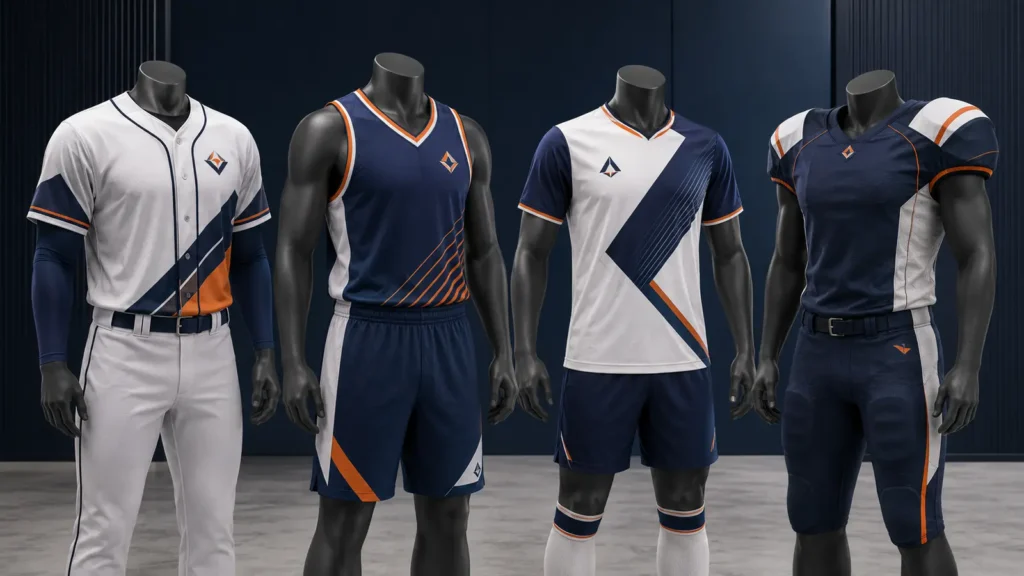
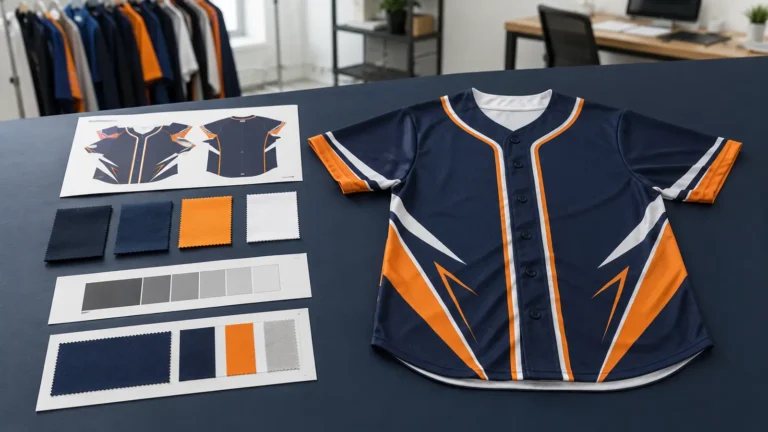
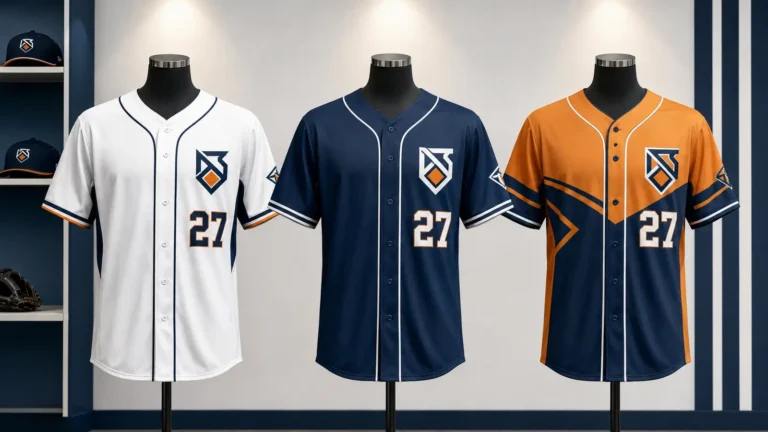
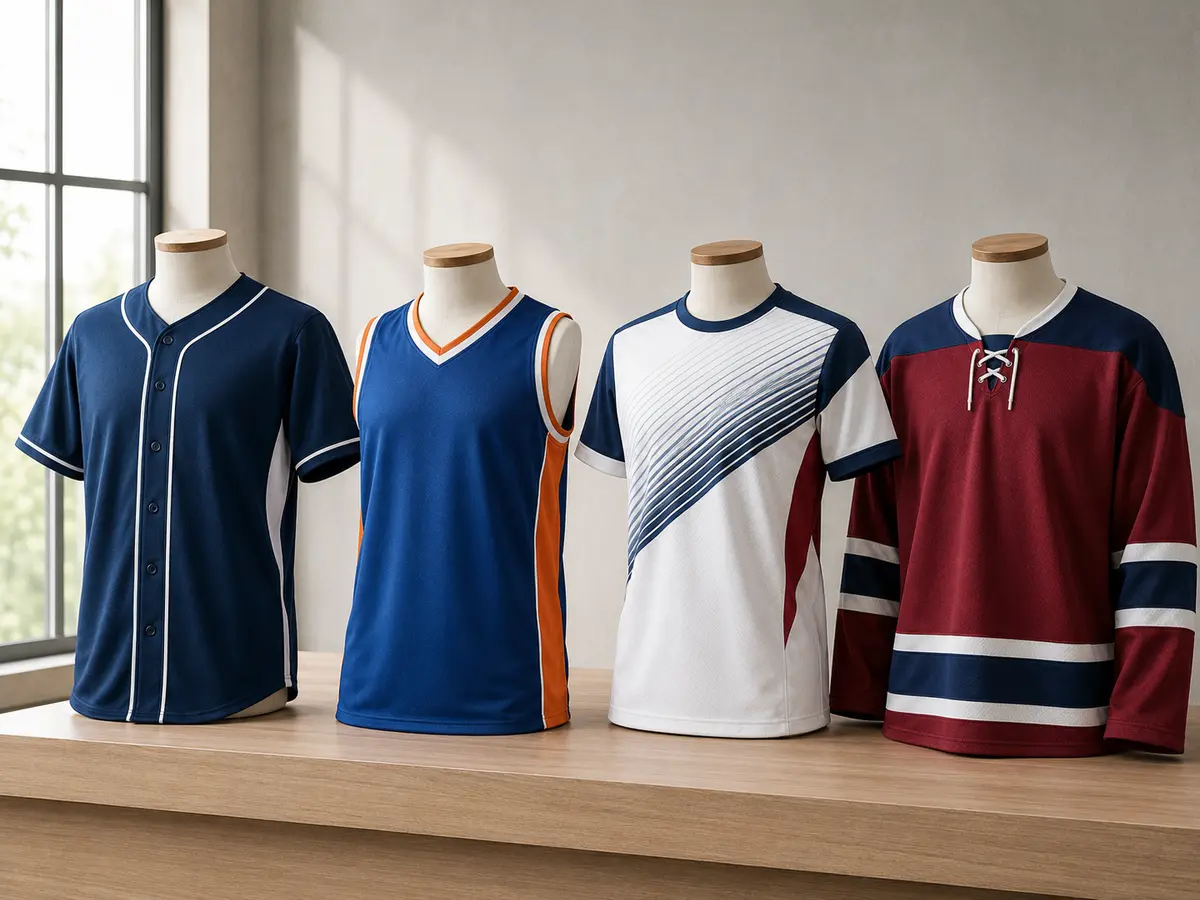
A coordinated custom teamwear system can use one visual identity across different sports while preserving sport-specific construction.
Why the Jersey Buying Decision Matters
A team jersey performs several jobs at once. It identifies the team, supports movement, carries player and sponsor information, and often represents a school, club, company, or retail brand. For a buyer, it is also a repeatable product system. New players join, sizes change, sponsors are updated, and replacement pieces may be needed after the main delivery.
The lowest quotation is not automatically the lowest total cost. An inexpensive jersey can become costly if:
- the fabric is too heavy for the climate;
- the cut restricts the player’s movement;
- the printed colors shift between production runs;
- names or numbers are assigned to the wrong sizes;
- the decoration cracks, peels, puckers, or feels too heavy;
- youth and adult sizes are graded inconsistently;
- labels do not match the destination market;
- replacement orders cannot reproduce the original design;
- or the cartons arrive without useful team, size, or player sorting.
The goal is to remove ambiguity from features that affect use, appearance, compliance, and repeatability.
Custom Team Jersey Decision Overview
Use this table to establish the product direction before discussing artwork details.
| Buying factor | Questions to answer | Procurement implication |
|---|---|---|
| Sport and level | Which sport, age group, competition level, and season? | Determines silhouette, range of motion, reinforcement, and rule checks |
| Climate and venue | Indoor or outdoor? Hot, cold, wet, or mixed conditions? | Influences fabric weight, ventilation, layering, and drying performance |
| Fit | Compression, athletic, regular, relaxed, or over-equipment? | Changes the base pattern, size chart, and sample requirement |
| Artwork | Solid colors, gradient, all-over graphics, small crest, sponsor marks? | Determines whether sublimation, embroidery, twill, transfer, or screen printing is appropriate |
| Order structure | One roster, multiple teams, mixed youth/adult, or dealer inventory? | Affects size breakdowns, name-number control, packing, and reorder planning |
| Brand program | One-time event or repeat seasonal program? | Repeat programs need archived colors, artwork, patterns, labels, and approval records |
| Target market | United States, Canada, United Kingdom, or EU? | Influences textile, origin, care, language, and responsible-party labeling requirements |
| Budget | Target unit cost or landed budget? | Requires clear separation of product, decoration, sample, packaging, freight, duty, and tax |
| Delivery date | Match date, launch date, school term, or retail campaign? | Determines the latest safe date for artwork, sample, roster, production, and shipping approval |
Choose the Jersey Type by Sport and Use
“Custom jersey” is a broad product category. Different sports require different pattern blocks, openings, sleeve shapes, body lengths, and reinforcement.
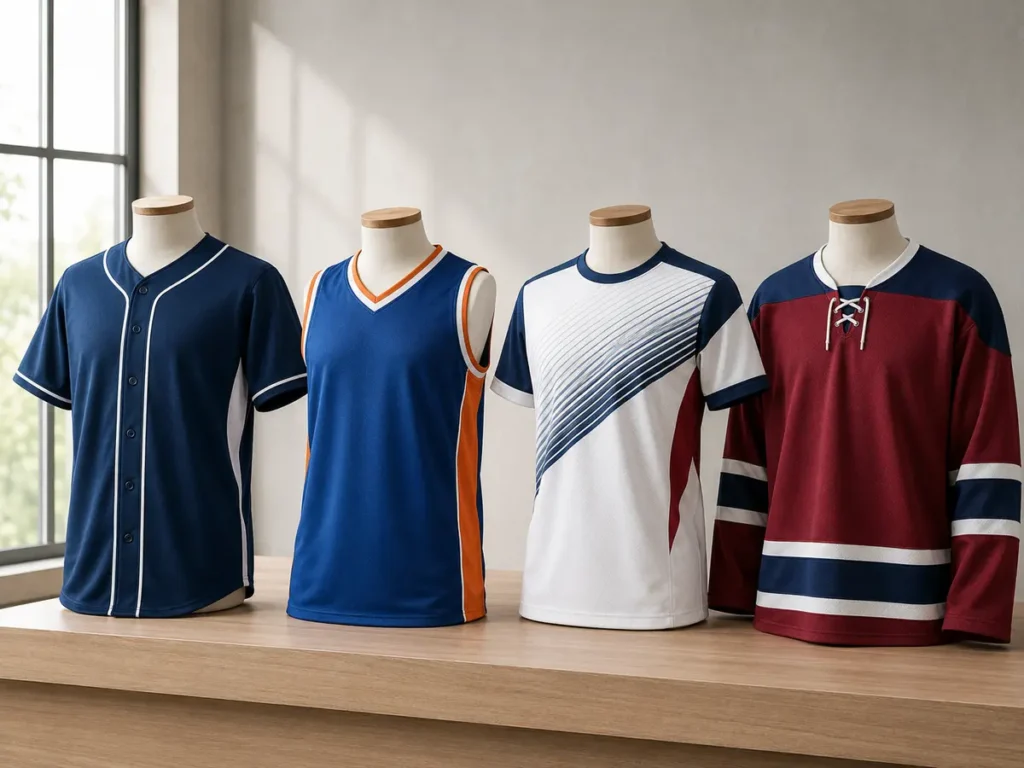
The sport should determine the base jersey architecture before colors and graphics are finalized.
Baseball and Softball Jerseys
Baseball jerseys commonly use a full-button, two-button, or pullover construction. Buyers may choose set-in or raglan sleeves, straight or rounded hems, and optional piping at the placket, neck, sleeve, or side seam. The pattern needs enough room for throwing and batting without creating excessive fabric around the torso.
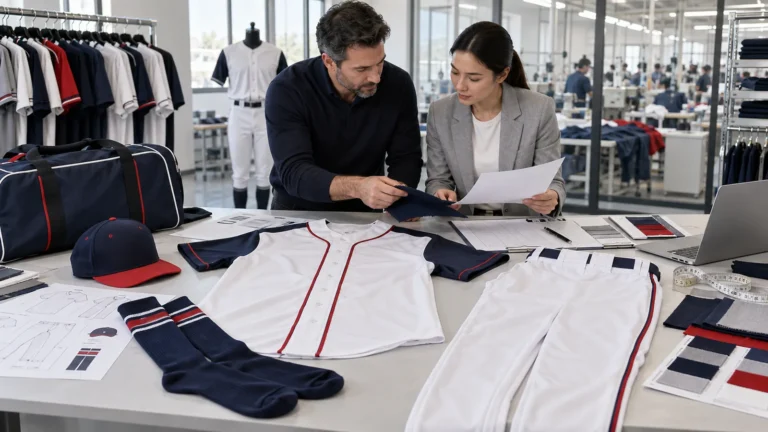
Embroidery and tackle-twill style decoration can add dimension but also add weight and labor. Sublimation supports lightweight all-over graphics, gradients, pinstripes, and complex sponsor layouts. For coordinated pants, caps, socks, jackets, or bags, create one approved color and artwork system.
Basketball Jerseys
Basketball jerseys require clean armholes, a stable neckline, and enough body length to stay comfortable during repeated overhead movement. The cut may be athletic or relaxed, but the buyer should define whether the jersey will be tucked in, worn loose, or paired with a specific short pattern.
Breathable mesh is familiar, while smooth interlock fabrics often provide a cleaner sublimation surface. Reversible jerseys can support training or budget programs but require attention to weight, opacity, seam finishing, and number visibility on both sides.
Soccer Jerseys
Soccer jerseys are commonly short-sleeve crew-neck or V-neck styles with a relatively streamlined fit. Lightweight polyester knits, ventilated side panels, raglan sleeves, and sublimation are widely used. The specification should define the chest crest, player number, player name, sponsor positions, sleeve marks, and any competition-specific restrictions.
Do not assume that one fit is correct for every club. Youth academies, school teams, adult recreational clubs, and performance programs may need different body lengths and ease. A fit sample is more reliable than choosing sizes from age alone.
American Football Jerseys
American football jerseys may be designed for pads or for non-contact training and fanwear. These are different products. A competition jersey worn over shoulder pads needs the correct chest and shoulder volume, stretch zones, sleeve shape, and reinforcement. A fan jersey may prioritize comfort and appearance instead.
Tell the supplier exactly how the garment will be worn. If pads are involved, provide equipment dimensions or approve the jersey on the intended equipment. Standard casual-apparel sizing is not a safe substitute.
Ice Hockey and Lacrosse Jerseys
Hockey jerseys typically have a generous body, long sleeves, and enough room for protective equipment. Buyers should specify cuff construction, neck shape, side panels, ventilation, and whether the bottom hem is straight or shaped. Lacrosse jerseys vary by program and may be closer to sleeveless, short-sleeve, or reversible performance tops.
For both sports, confirm how large numbers, names, sleeve graphics, and sponsor elements interact with seams. Large decorated areas should not be split by construction lines unless the artwork is prepared for that placement. Volleyball, esports, training, and fan jerseys also need their own fit and use-case specification rather than a generic T-shirt pattern.
Build a Technical Specification Before Requesting Final Prices
A reference image communicates direction, but it is not a production specification. Two suppliers can quote visually similar jerseys while using different fabric weights, patterns, seam types, decoration, labels, and packing standards.
At minimum, the specification should state:
- sport and end use;
- youth, adult, women’s, unisex, or custom pattern;
- jersey silhouette and fit;
- fabric composition, knit structure, weight, color, and stretch requirement;
- collar, sleeve, cuff, placket, hem, and side-panel construction;
- logo, name, number, and sponsor decoration method;
- artwork dimensions and placement;
- size range and roster breakdown;
- label and hangtag requirements;
- individual or team packing method;
- destination country;
- sample and bulk approval process;
- and target delivery date.
If a supplier proposes an alternative, ask for the change in writing.
How to Select Jersey Fabric
“100% polyester” is not enough information. Polyester can be knitted into many structures with different weights, stretch, hand feel, opacity, airflow, snag resistance, and print behavior.
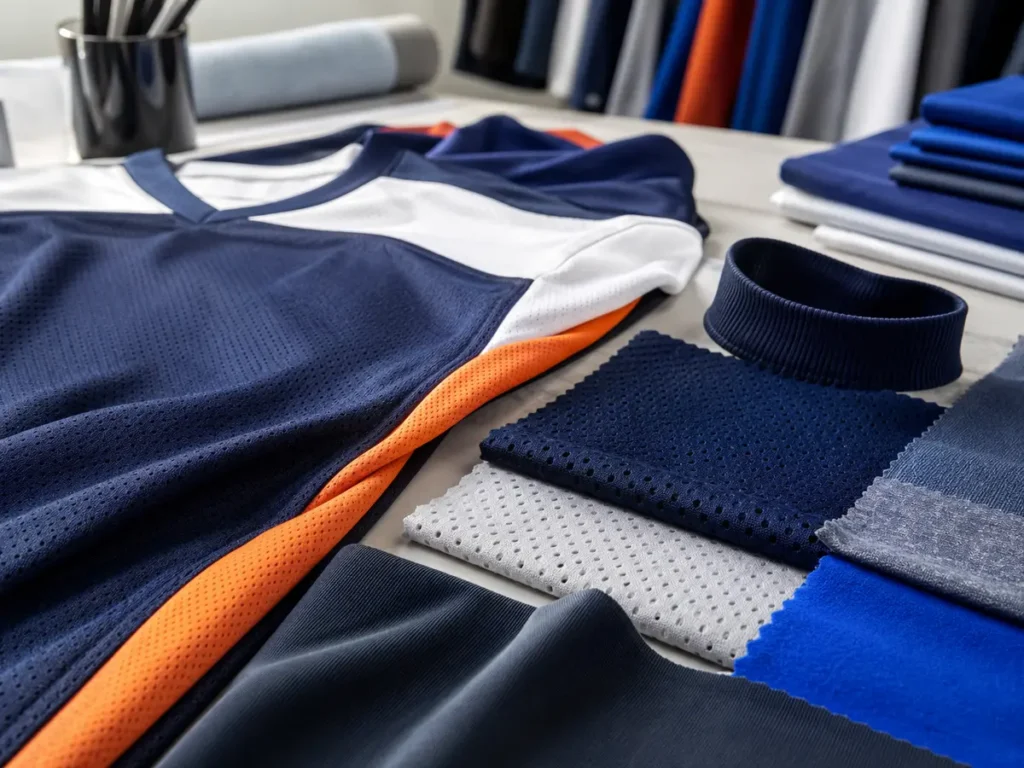
Fabric comparison should include knit structure, weight, stretch, opacity, hand feel, and decoration compatibility.
| Fabric option | Typical characteristics | Good applications | Buyer checks |
|---|---|---|---|
| Polyester interlock | Smooth face, stable print surface, balanced drape | Sublimated soccer, basketball, baseball, and esports jerseys | Weight, stretch, opacity, snagging, print sharpness |
| Birdseye or mini-mesh | Small visible texture and airflow | Training tops and multi-sport jerseys | Hole size, transparency, print definition, hand feel |
| Open mesh | High ventilation and classic athletic appearance | Basketball panels, football zones, reversible styles | Opacity, seam stability, number clarity |
| Stretch polyester | Added mechanical or elastane-assisted stretch | Side panels, fitted cuts, high-mobility zones | Stretch direction, recovery, color match, wash behavior |
| Piqué or textured knit | More structured surface and retail appearance | Polo-inspired teamwear and some esports styles | Surface texture, logo quality, snag resistance |
| Brushed or heavier knit | Warmer, denser, more substantial feel | Cold-weather training or fanwear | Drying time, weight, layering, decoration feel |
Fabric weight is usually expressed in grams per square meter, but weight alone does not predict performance. A lighter dense knit may be opaque while a heavier open mesh may still reveal an underlayer. Ask for a physical swatch when opacity, touch, stretch, or color is important. Record every fabric zone so reorders use the same construction.
Size, Fit, and Roster Planning
Sizing errors are among the most expensive custom-order mistakes because personalized jerseys may be difficult to reassign. Do not rely only on “S, M, L” labels. Compare finished garment measurements.
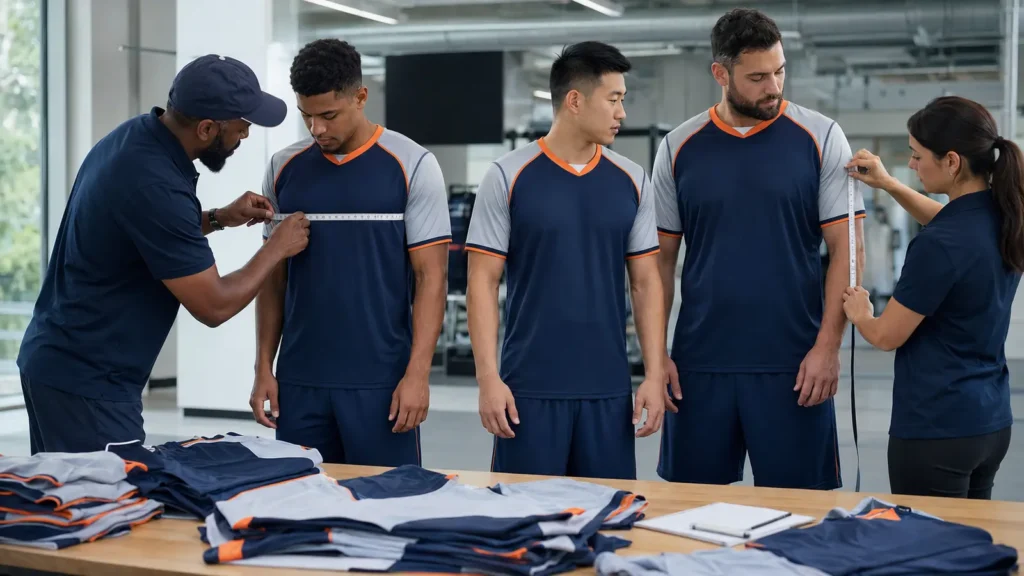
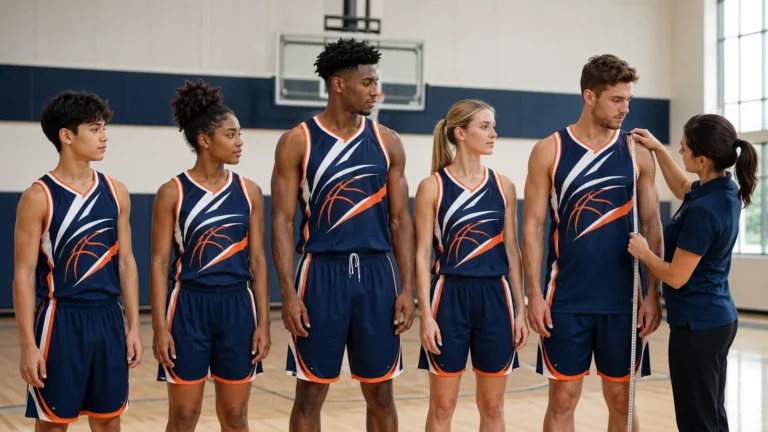
Fit approval is stronger when buyers compare finished garment measurements and test movement on representative players.
Use Finished Garment Measurements
Request a size chart showing at least chest width, body length, shoulder or sleeve measurements where relevant, and the measurement tolerance. Confirm whether chest is measured flat from armpit to armpit or as a full circumference. These are not interchangeable.
Compare the proposed chart with a jersey the team already likes. Measure that garment using the supplier’s method. This creates a practical reference and reduces interpretation.
Approve Representative Fit Samples
For a mixed roster, test representative sizes rather than one middle size. Include youth, core adult, extended, women’s, unisex, or over-equipment samples as the program requires.
Players should test reaching, throwing, swinging, skating posture, overhead movement, and any movement specific to the sport. Check neck comfort, armhole opening, sleeve position, body length, and whether the garment twists during movement.
Freeze the Roster with a Control File
Maintain one master roster containing:
- team or squad;
- player name exactly as it should appear;
- number;
- garment size;
- jersey style or color;
- quantity;
- special notes;
- and approval status.
Avoid sending changes across multiple chat messages, screenshots, and spreadsheet versions. Assign a revision number and a roster-freeze date. After freezing, any change should be acknowledged in writing because it may affect production and delivery.
Construction Details That Affect Durability
Durability is not a single material claim. It is the result of fabric selection, pattern stress, seam type, stitch density, reinforcement, decoration, and care.
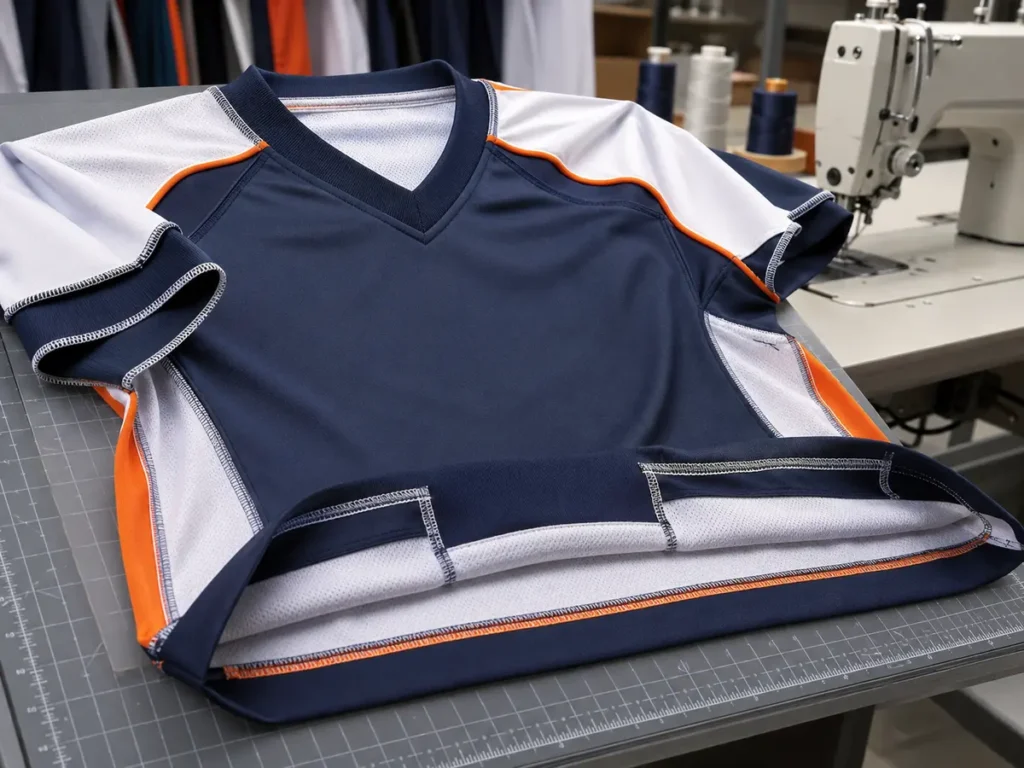
Inspect the inside as well as the outside: seam security and stress-point construction influence long-term performance.
Check these areas during sampling:
- Neckline: The rib or binding should lie flat and recover after stretching.
- Armholes and shoulders: Seams should remain smooth through movement and should not feel bulky.
- Side panels: Panel joins should align, particularly when graphics cross the seam.
- Placket and buttons: Baseball plackets should stay flat; button spacing and attachment should be consistent.
- Cuffs and hems: Stitching should be even, with no tunneling, twisting, or skipped stitches.
- Stress points: Bar tacks or reinforcement may be appropriate at openings and high-load joins.
- Seam allowance: The interior should be secure without excessive loose threads or exposed raw edges.
Define the workmanship standard in plain language. “Good quality” is subjective; “no open seams, skipped stitches, obvious puckering, or unsecured thread ends” is inspectable.
Choose the Right Customization Method
Decoration should be selected after considering artwork complexity, quantity, fabric, use, budget, and desired hand feel.
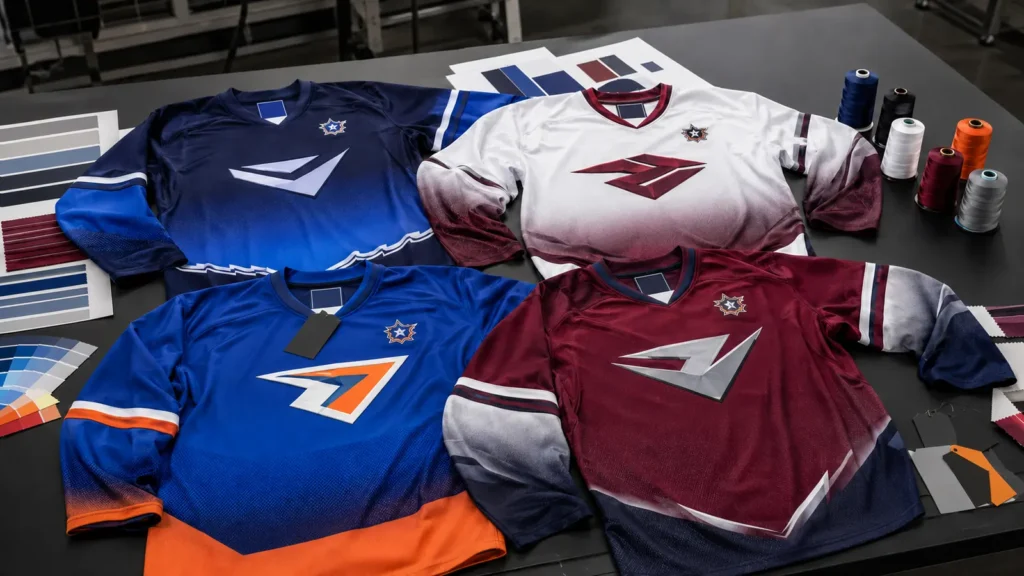
Different decoration methods can be combined, but each method changes weight, texture, cost, minimums, and artwork preparation.
| Method | Main advantages | Limitations to manage | Best fit |
|---|---|---|---|
| Sublimation | All-over color, gradients, integrated names and numbers, lightweight feel | Usually suited to polyester and lighter base colors; color must be approved on the actual fabric | Complex graphics, individualized rosters, performance jerseys |
| Embroidery | Dimensional, durable-looking crest or small logo | Adds weight and backing; very fine detail may need simplification | Small chest crests, premium marks, staff apparel |
| Tackle-twill style appliqué | Classic layered athletic appearance | More labor, weight, edge stitching, and placement control | Baseball, hockey, heritage programs |
| Heat transfer | Flexible for names, numbers, sponsor marks, and smaller runs | Film type, press settings, fabric compatibility, and care affect performance | Sponsor logos, roster personalization, training products |
| Screen printing | Efficient for suitable quantities and relatively simple artwork | Each color and placement adds setup; not ideal for every performance fabric | Training jerseys, fanwear, simple graphics |
| Woven or rubber/PVC patch | Distinct branded finish with controlled edge shape | Adds a separate component, attachment process, and minimum quantity | Private-label or merchandise programs |
Request an artwork proof showing front, back, and sleeve views with dimensions. Color shown on a monitor is not a physical standard. For critical programs, approve printed fabric, embroidery thread, patch, and appliqué materials under suitable lighting before bulk production.
Plan Private Labels and Packaging Early
Private labels are not a last-minute detail. Confirm brand name treatment, size label, fiber content, care instructions, country of origin, responsible business identity where applicable, hangtag, barcode, polybag warning or ventilation requirements, and carton marks before production.
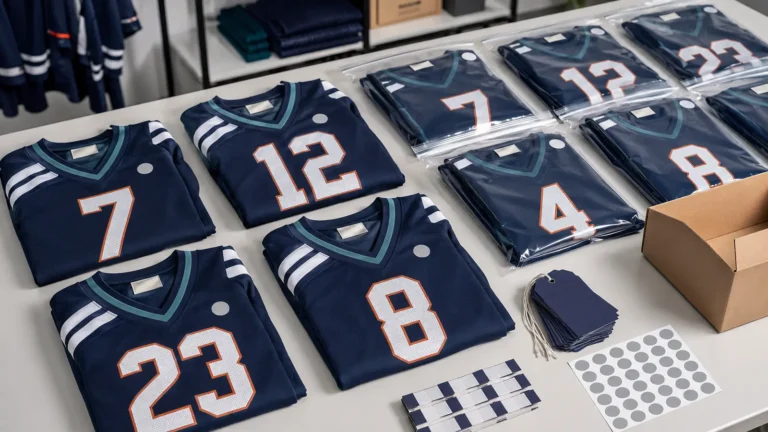
For team distribution, individual bags can be marked by player, number, size, or team. For wholesale programs, use SKU, size, color, and barcode logic that matches the buyer’s receiving system. The most attractive package is not always the most useful package.
Textile Labeling and Market Requirements
Buyers should confirm current legal and customer-specific requirements with qualified advisors for the destination market. A supplier can prepare labels to an approved specification, but the importer or seller should understand its own obligations.
For the United States, the Federal Trade Commission explains that most covered textile and wool products require labels identifying fiber content, country of origin, and the manufacturer or another responsible business; the FTC Care Labeling Rule also requires care instructions for covered apparel. Review the current FTC apparel labeling guidance and care-label guidance when preparing a U.S. program.
For the European Union, textile products marketed in the EU generally need a firmly attached label or marking showing fiber composition. The EU guidance notes that this applies to products made up of at least 80% textile fibers by weight. Confirm the current requirements, language presentation, and member-state obligations through the Your Europe textile label guidance and applicable professional advice.
Competition rules are separate. Leagues and schools may control number sizes, contrast, sponsor positions, player-name placement, or colors. Obtain the current rules from the relevant governing organization.
What Drives the Cost of Custom Team Jerseys?
Accurate comparisons require equivalent specifications. A price can change because of:
- fabric type, weight, color, and sourcing;
- custom pattern development;
- youth and adult size range;
- number of fabric panels and seam complexity;
- collar, cuff, placket, piping, and button construction;
- decoration method, size, and number of placements;
- individual names and numbers;
- private labels, hangtags, barcodes, and special packaging;
- quantity by style and color;
- sample type and shipping;
- inspection requirements;
- and freight, duty, tax, and delivery terms.
Ask suppliers to state what the quotation includes. If one price includes individual player packing and another uses bulk packing, the unit prices are not directly comparable.
The typical MOQ for JIUMU custom programs is 50 pieces, subject to product structure and customization. A mixed roster can often share one base design, but buyers should confirm how quantities are counted across colors, styles, youth/adult patterns, and decoration variations.
Planning a team, school, club, distributor, or private-label jersey program? Send JIUMU your sport, quantity, size range, reference images or tech pack, logo files, color requirements, packaging needs, destination, and target delivery date. Request a custom quotation.
Quality-Control Checklist for Bulk Jerseys
Quality control should compare bulk production with approved standards, not with memory.
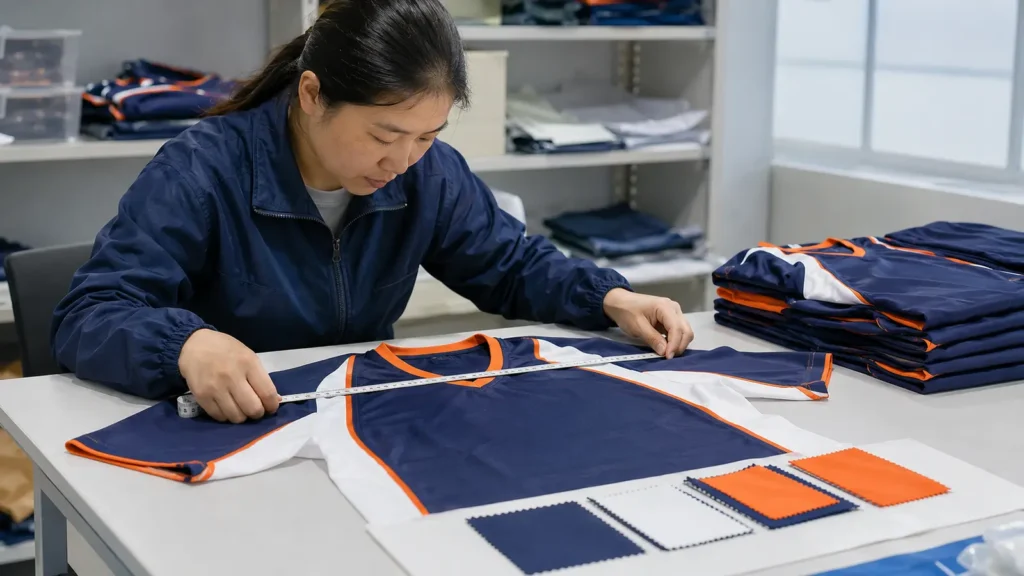
Bulk inspection should compare measurements, colors, construction, decoration, roster data, and packing with approved references.
Before production, approve:
- artwork and placement dimensions;
- physical color or printed-fabric standard;
- fabric and trim;
- size chart and measurement method;
- fit or size-set samples;
- decoration sample;
- labels, hangtags, and packaging;
- pre-production sample;
- roster control file;
- workmanship and tolerance criteria.
During or after production, inspect:
- style, color, and quantity by size;
- finished garment measurements against tolerances;
- fabric defects, shade variation, stains, and damage;
- seam security, skipped stitches, puckering, and thread trimming;
- collar, sleeve, placket, hem, and panel alignment;
- logo, number, name, and sponsor position;
- spelling and roster assignment;
- decoration adhesion, edge quality, and surface appearance;
- label content and placement;
- individual packing identification;
- carton quantity, assortment, marks, and condition.
For complex rosters, use a two-way check: verify each physical jersey against the roster and reconcile the completed roster back to the packed quantities. This helps detect duplicates and omissions.
A Practical Bulk-Order Process
1. Send the Brief
Provide the sport, quantity, size range, quality target, artwork direction, destination, and delivery deadline.
2. Confirm the Specification and Quotation
Review fabric, pattern, decoration, labels, packaging, samples, bulk terms, and delivery basis.
3. Approve Digital Artwork
Check colors, layouts, dimensions, sponsor positions, name-number styling, sleeve details, and seam interaction. Confirm that the buyer owns or licenses the artwork.
4. Approve Materials and Samples
Depending on risk, approve swatches, strike-offs, decoration, fit, size-set, or pre-production samples. Document revisions.
5. Freeze the Roster
Submit one controlled file and confirm spelling, numbers, sizes, quantities, and variants.
6. Confirm Bulk Production and QC
Agree on standards, tolerances, inspection stage, reporting, and treatment of nonconforming units.
7. Approve Packing and Shipment
Confirm individual identification, carton assortments, marks, documents, address, and responsible contact.
What to Send for an Accurate Quotation
Prepare the following information:
- buyer/company name and market;
- sport and intended use;
- total quantity and number of teams;
- approximate size breakdown;
- youth, adult, women’s, unisex, or custom fit;
- preferred jersey style;
- preferred fabric or performance target;
- vector logo files where available;
- names, numbers, sponsors, and placement list;
- Pantone or other color references;
- decoration preference, if known;
- label, hangtag, barcode, and packaging needs;
- destination postal code and country;
- required delivery date;
- reference image, mockup, or tech pack;
- and whether future reorders are expected.
If details are unknown, a useful supplier will identify the decisions that materially affect price.
Questions to Ask a Custom Jersey Supplier
- Which base pattern do you recommend for this sport and why?
- What is the exact fabric composition, knit structure, weight, stretch, and color?
- Can you provide a swatch, fit sample, size set, or pre-production sample?
- What finished garment measurements and tolerances will control bulk production?
- Which decoration method suits this artwork and expected use?
- How will sublimated, embroidered, transferred, or appliquéd colors be approved?
- How are personalized names, numbers, and sizes checked?
- What labels are included, and who confirms market-specific content?
- How are individual jerseys identified and packed?
- What is the MOQ for this exact structure and customization?
- What changes may affect the quoted price or production schedule?
- How will artwork, patterns, color standards, and order records be retained for reorders?
- What quality checks are performed before shipment?
- What shipping terms and delivery assumptions are included?
Common Buying Mistakes
Choosing by Mockup Alone
A digital mockup cannot show fabric weight, opacity, stretch, collar recovery, print hand feel, seam quality, or fit. Use it for artwork approval, not total product approval.
Comparing Non-Equivalent Quotes
One supplier may include sublimated names, custom labels, and individual packing while another excludes them. Normalize the specifications before choosing.
Skipping the Size Set
A single medium sample does not prove the full size range. Grading issues often appear at the smallest and largest sizes.
Approving Colors Only on Screen
Screens vary. Approve physical fabric, a printed strike-off, thread, or patch material when color is critical.
Sending the Roster in Multiple Formats
Scattered changes create avoidable personalization errors. Use one version-controlled spreadsheet and freeze it before production.
Ignoring Reorders
Ask how patterns, fabric references, color files, artwork, labels, and size specifications will be archived. A repeat program needs repeatable inputs.
Leaving Labels and Packing Until the End
Late changes can delay production or require rework. Treat labels, hangtags, barcodes, and team sorting as part of the initial specification.
Scheduling to the Event Date
The target delivery date should be earlier than the first match, tournament, school launch, or retail campaign. Allow time to receive, count, distribute, and resolve any discrepancy.
Why Buyers Work with JIUMU
JIUMU has supplied custom apparel and merchandise programs since 2010 from Guangdong, China. The company focuses on B2B custom teamwear, logo apparel, hats, uniforms, bags, and branded merchandise for buyers in the United States, Canada, the United Kingdom, and Europe.
Relevant capabilities include:
- OEM and ODM product development;
- sublimation, embroidery, screen printing, and heat transfer;
- woven, rubber/PVC, and leather-style patch options;
- fabric sourcing and Pantone color matching;
- private labels, neck labels, woven labels, and hangtags;
- customized packaging;
- digital mockups and physical samples;
- bulk production quality control;
- and export support.
The typical MOQ is 50 pieces, subject to the jersey structure and customization. JIUMU can also support coordinated programs that connect custom team jerseys with custom team uniforms, baseball team uniform packages, custom baseball caps, custom team jackets, custom hoodies, and custom team bags.
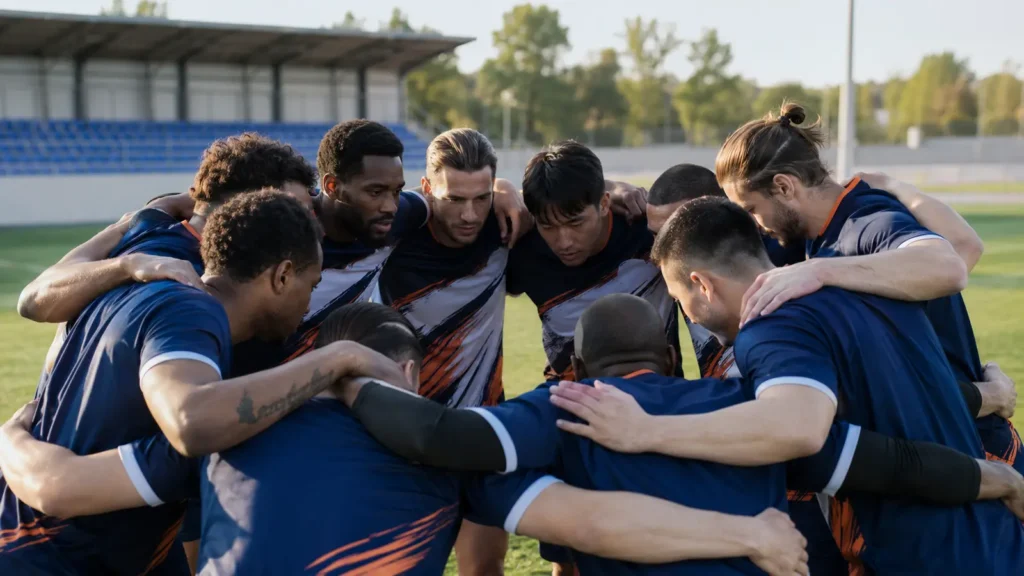
A controlled jersey specification creates a consistent identity across the roster and supports future replacement orders.
Frequently Asked Questions
Final Recommendation
The best custom team jersey order begins with a clear use case and ends with documented approval standards. Define the sport, fit, fabric, construction, decoration, roster, labels, packaging, quality checks, and delivery plan before releasing bulk production. Compare suppliers on specification clarity, sampling, control of personalized data, repeat-order support, and communication—not only on the headline unit price.
JIUMU supports B2B teamwear programs for schools, clubs, academies, distributors, uniform dealers, promotional buyers, and private-label brands. To receive a more accurate proposal, send your reference image or tech pack, sport, quantity, size range, logo files, colors, personalization list, packaging requirements, destination, and target delivery date.
About JIUMU
JIUMU provides B2B custom teamwear, logo apparel, hats, uniforms, bags, and branded merchandise programs for buyers in North America and Europe.