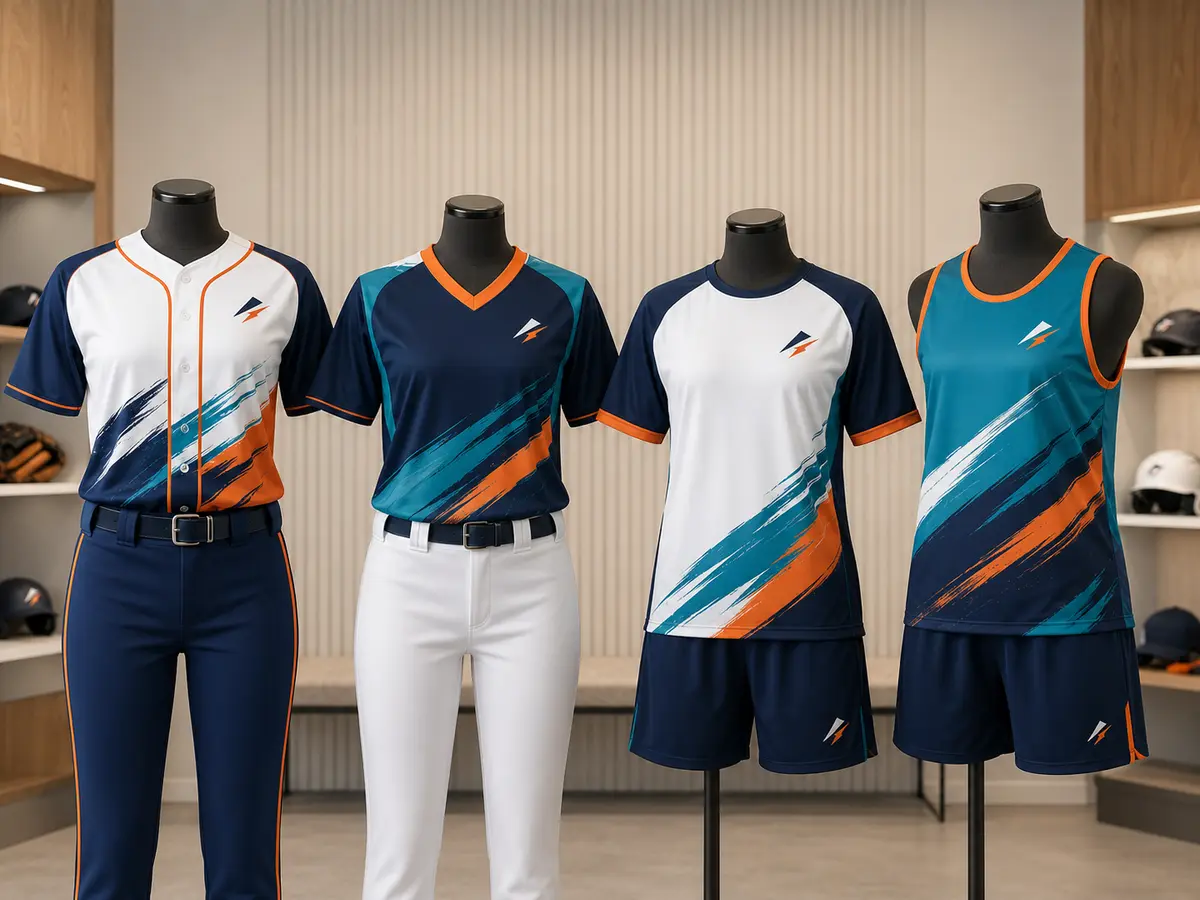
Best Custom Softball Jerseys for Teams and Leagues
The best custom softball jerseys are not simply the designs that look strongest in a digital mockup. For a team, school, club, or league, the better choice is the jersey system that fits the competition level, climate, roster, budget, decoration needs, and reorder plan.
That makes buying a team set different from buying a single retail jersey. A procurement lead must control fabric, fit, colors, player data, artwork placement, production approval, packing, and future replacements. A league ordering for several teams must also keep those variables consistent across multiple rosters.
This guide explains how to compare custom softball jerseys by observable specifications. It covers game and training applications, fabric choices, decoration methods, women’s and youth fit, construction, league requirements, cost drivers, sampling, quality control, and the information a supplier needs to prepare an accurate quotation.
Quick Answer: For most teams that need complex graphics, individual names and numbers, and consistent color coverage, a well-specified sublimated polyester jersey is a practical starting point. It is not automatically the best option for every program. Simple heritage designs may benefit from embroidery or appliqué details, training jerseys may prioritize economical fabric and minimal decoration, and leagues need a controlled size, artwork, roster, and reorder system. The best custom softball jersey is the one approved against the team’s current rule book, wear conditions, fit needs, decoration plan, and sample standard.
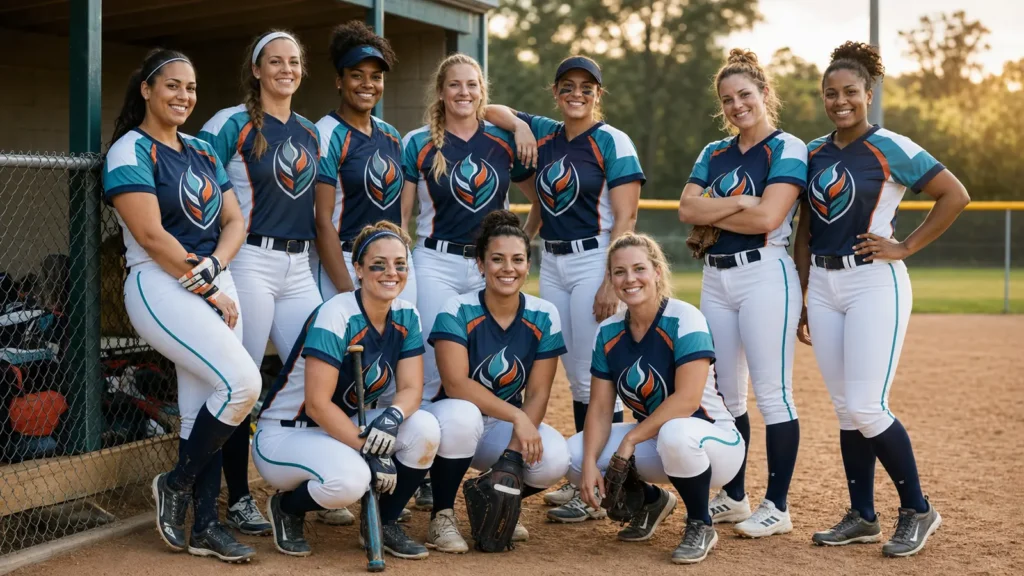
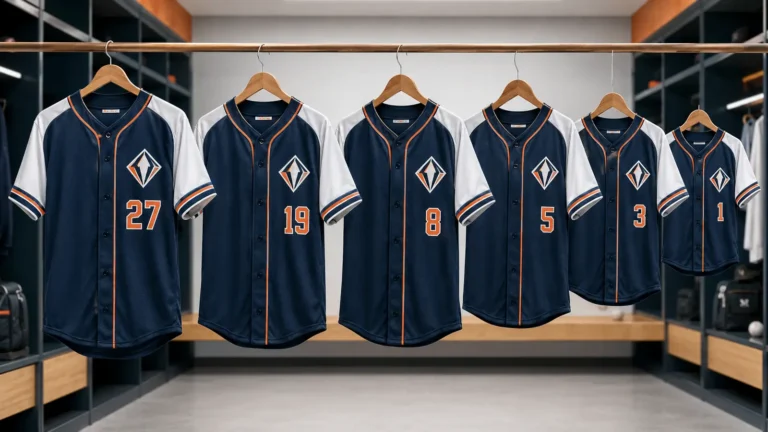
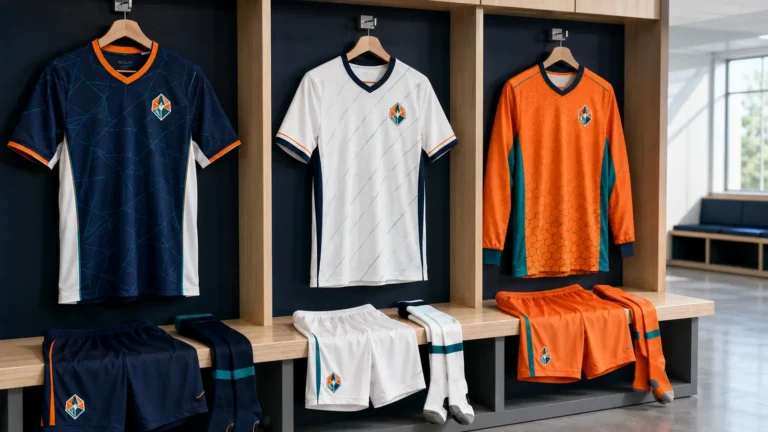
A coordinated jersey system gives teams a unified game-day identity while leaving room for player-level personalization.
What Does “Best” Mean for a Softball Team or League?
“Best” should be defined before artwork begins. Otherwise, buyers tend to compare suppliers by mockup style or unit price while leaving more important variables unspecified.
For a tournament team, “best” may mean a lightweight game jersey with full-color graphics and a clear process for late roster additions. A high school program may prioritize compliance, modest artwork, size coverage, and repeatability across varsity and junior varsity teams. A recreational league may need several color-separated team identities, one shared order deadline, and a simple replacement policy. A private-label sportswear buyer may care more about custom neck labels, packaging, fabric exclusivity, and production consistency across seasons.
Use five questions to define the project:
- Where will the jersey be worn? Confirm the governing body, season, climate, and competition level.
- How will it be used? Separate game jerseys, alternate jerseys, warm-up tops, training shirts, and supporter merchandise.
- What must be customized? List colors, logos, sponsor marks, names, numbers, sleeve graphics, labels, and packaging.
- Who must it fit? Identify youth, adult, women’s, unisex, extended-size, and goalkeeper or coach requirements where relevant.
- How will reorders work? Decide how artwork, fabric, color standards, number records, and approved measurements will be stored.
The resulting specification is more useful than a vague request for “high-quality jerseys.”
Which Softball Jersey Type Fits Each Program?
The following table is a decision starting point. It does not replace a fabric sample, size set, or governing-body review.
| Program or use | Practical starting specification | Main advantage | Key issue to control |
|---|---|---|---|
| Travel or tournament team | Sublimated polyester game jersey with player names and numbers | Complex graphics and roster personalization can be integrated into one design | Roster accuracy, color approval, fit, and reorder process |
| High school program | Rule-checked game jersey with controlled school colors and clear number contrast | Consistent identity across teams and seasons | Current state/NFHS requirements, artwork permissions, and size coverage |
| College program | Competition-specific cut and artwork reviewed against current NCAA and conference rules | Performance-oriented specification with controlled branding | Current rule book, sponsor or commercial-mark restrictions, and sample approval |
| Youth league | Durable, easy-care jersey with youth and adult size options | Simpler administration across many teams | Size collection, coach additions, duplicate numbers, and delivery grouping |
| Recreational league | Cost-controlled jersey with limited design templates and team color variations | Efficient multi-team ordering | Template control, team allocation, packing, and replacement policy |
| Training program | Lightweight crew-neck or V-neck top with reduced decoration | Lower complexity for repeated practice use | Opacity, abrasion, wash durability, and separation from official game kit |
| Heritage or presentation jersey | Button-front or classic cut with embroidery, appliqué, or restrained graphics | Traditional appearance and dimensional decoration | Added weight, stitch backing, cost, and care |
| Sportswear or private-label brand | Custom pattern, fabric, trims, labels, hangtags, and packaging | Greater brand control and product differentiation | Development scope, sampling rounds, grading, testing, and repeatability |
Button-Front Jerseys
Button-front jerseys provide a traditional diamond-sport appearance and generous front branding space. They can work for school programs, clubs, adult leagues, presentation jerseys, and brands that want a baseball-inspired look.
The front opening creates additional artwork and construction decisions. Logos, scripts, piping, and number elements must be positioned around the placket. Buyers should confirm whether the design must align across the opening and whether buttons, button spacing, and reinforcement are included in the approved sample.
V-Neck and Crew-Neck Jerseys
V-neck and crew-neck pullovers are efficient for training, youth, recreational, and modern fastpitch programs. They avoid the interruption of a front placket and provide a continuous decoration area.
The neckline should still be specified. Collar depth, binding width, stretch recovery, and seam finish affect comfort and appearance. A neck opening that looks correct on a flat mockup may feel too tight or too low when worn, so it should be evaluated on a physical sample.
Raglan, Set-In, Sleeveless, and Short-Sleeve Options
Sleeve construction affects movement, visual paneling, and logo placement. Raglan sleeves create diagonal seam lines and can support contrasting shoulders. Set-in sleeves provide a more conventional shoulder shape. Sleeveless styles can reduce coverage in warm conditions but require careful armhole fit and may not suit every program or rule set.
Treat sleeve length and armhole measurements as specification fields. Do not assume that “women’s fit,” “youth fit,” or “athletic fit” means the same thing across suppliers.
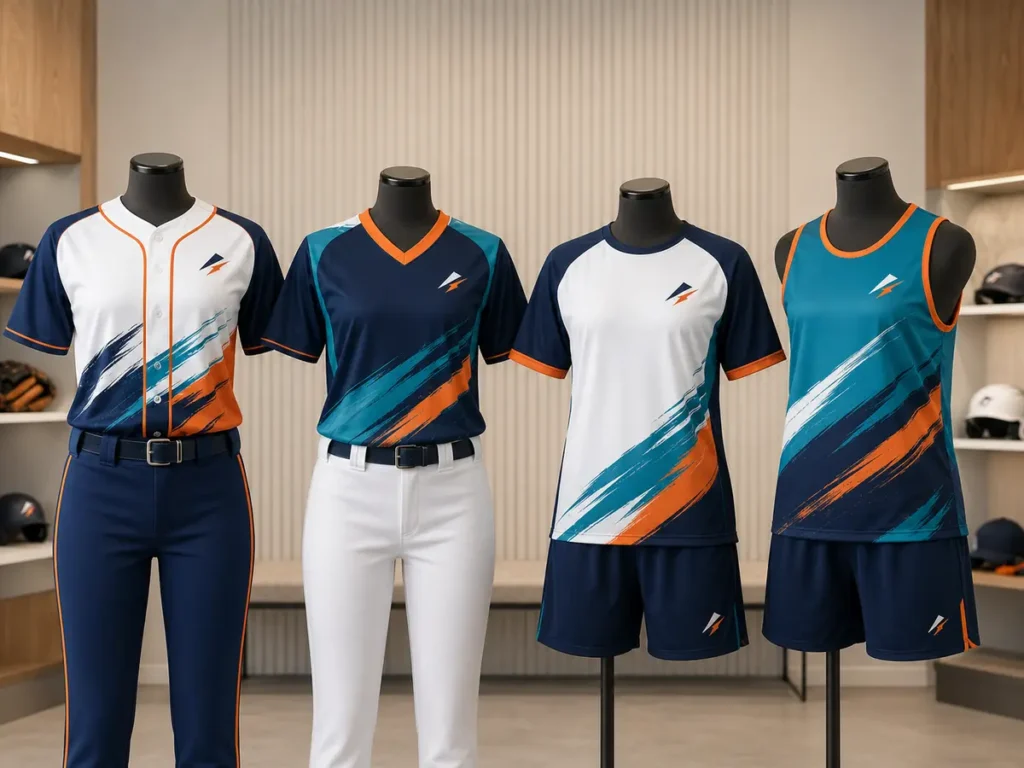
Choose the jersey opening, neckline and sleeve construction around climate, movement, branding space and league requirements.
How Should Buyers Compare Softball Jersey Fabrics?
Most custom softball jerseys use polyester-based fabrics, but the fiber name alone says little about performance. Two fabrics described as polyester can differ in weight, knit structure, stretch, opacity, hand feel, surface texture, and compatibility with decoration.
Ask for a fabric specification and physical swatch. Evaluate the following:
- Fabric weight: Lighter fabric may feel cooler but can become more transparent or less stable. Heavier fabric may provide coverage and structure but add warmth.
- Knit construction: Interlock, mesh, and other constructions behave differently. The supplier should explain where each fabric is used on the garment.
- Stretch and recovery: The jersey needs enough movement for throwing, batting, and fielding without remaining distorted after wear.
- Opacity: White and pale body panels should be checked over the intended sports bra or base layer.
- Surface and snag resistance: A very open or textured knit may require different care and may behave differently around hook-and-loop closures, fences, or rough equipment surfaces.
- Airflow: Mesh zones can add ventilation, but their position, openness, and color appearance should be approved.
- Decoration compatibility: Sublimation requires suitable polyester content and processing. Embroidery, appliqué, screen printing, and transfers impose different stability and heat requirements.
- Color appearance: The same color target can look different on smooth, textured, and mesh fabrics.
Avoid treating “moisture-wicking” as a complete specification. If this property is important, ask what fabric or finish provides it, whether it has supporting test data, and whether the performance is expected to change after laundering. Do not use a marketing term as a substitute for a measurable requirement.
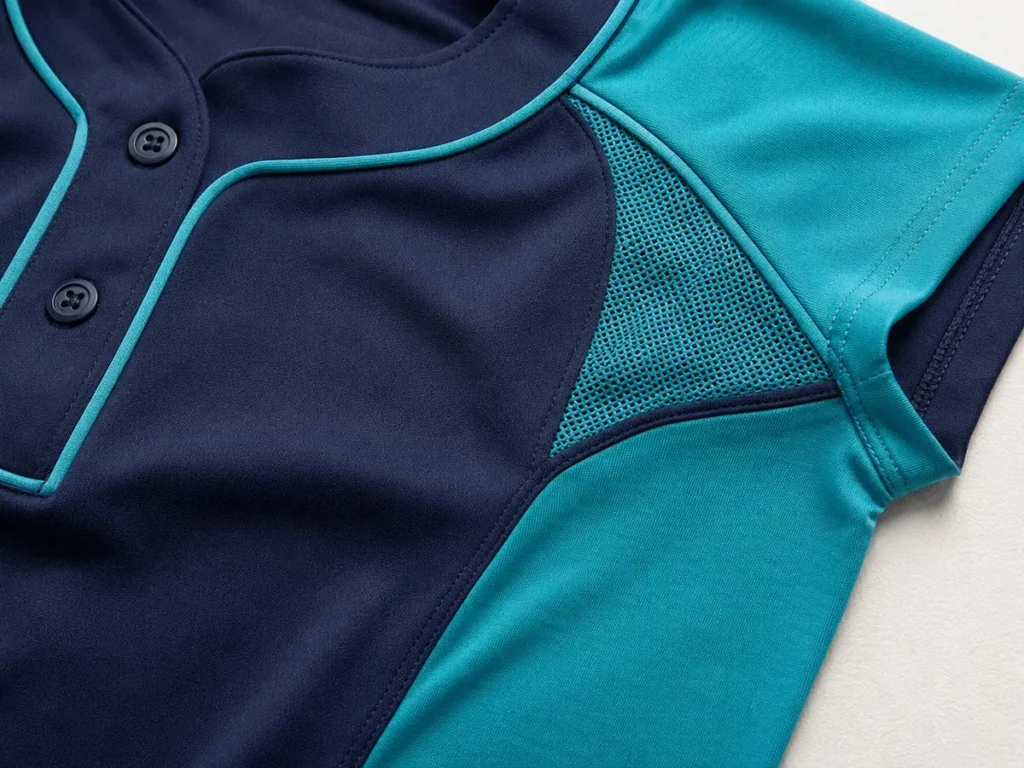
Fabric selection should be based on weight, stretch, opacity, hand feel, ventilation and decoration compatibility.
Sublimation vs. Embroidery, Heat Transfer, and Screen Printing
Decoration should be selected after the design, order quantity, fabric, intended use, and reorder needs are known.
| Method | Best suited to | Advantages | Points to approve |
|---|---|---|---|
| Full sublimation | Complex graphics, gradients, all-over color, names and numbers on suitable polyester fabric | Broad design freedom; decoration is integrated into the printed fabric surface | Color sample, white areas, seam alignment, artwork resolution, roster data, fabric compatibility |
| Embroidery | Crests, small logos, heritage details, premium accent branding | Textured, dimensional appearance | Stitch count, size, backing, puckering, weight, edge clarity, placement |
| Appliqué or tackle-twill-style decoration | Traditional team scripts and numbers | Layered athletic appearance | Material layers, edge stitching, weight, flexibility, wash behavior |
| Heat transfer | Names, numbers, sponsors, short runs, or selected detail applications | Flexible for personalization and late-stage additions | Film type, hand feel, pressing conditions, adhesion, edge lift, color migration |
| Screen printing | Simpler spot-color graphics and suitable order quantities | Efficient for repeat graphic areas under the right conditions | Ink system, color count, underbase, hand feel, registration, cure conditions |
Why Sublimation Is Common for Custom Team Softball Jerseys
Sublimation can integrate base colors, gradients, patterns, logos, sleeve graphics, player names, and numbers into one design. This makes it attractive for travel teams, league programs, and buyers who want many personalized pieces without separately stitching every graphic.
However, sublimation does not remove the need for quality control. Buyers must approve:
- color targets on the actual fabric;
- how artwork crosses side seams, sleeves, shoulders, or plackets;
- number legibility and placement;
- small-logo clarity;
- white or pale areas;
- roster spelling and number accuracy;
- variations between solid and mesh fabric zones.
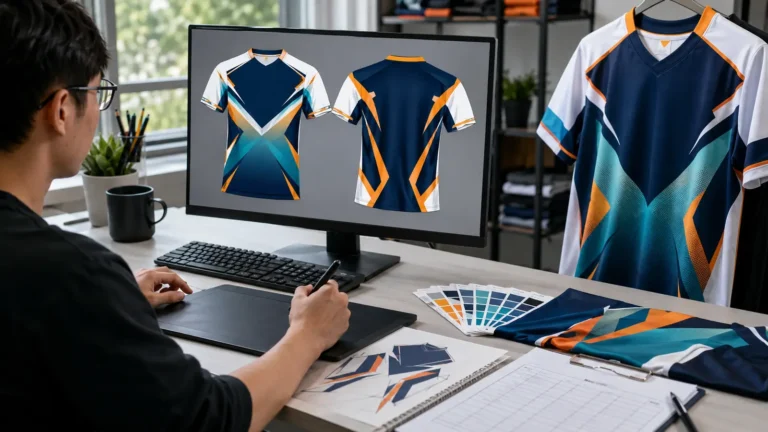
The digital mockup is an artwork communication tool, not proof of final color, fit, or construction.
When Dimensional Decoration Makes Sense
Embroidery or appliqué can support a traditional look, especially on button-front or presentation jerseys. The trade-off is added weight, stiffness, cost, and complexity. Large dense embroidery can affect drape and comfort, so the physical sample should show the actual design size and backing—not a smaller generic logo.
Heat transfer can be useful for sponsor marks, names, numbers, or low-volume additions, but the system must be compatible with the fabric and base color. Screen printing may be efficient for simpler graphics. In both cases, request an applied sample and define wash and appearance expectations before bulk production.
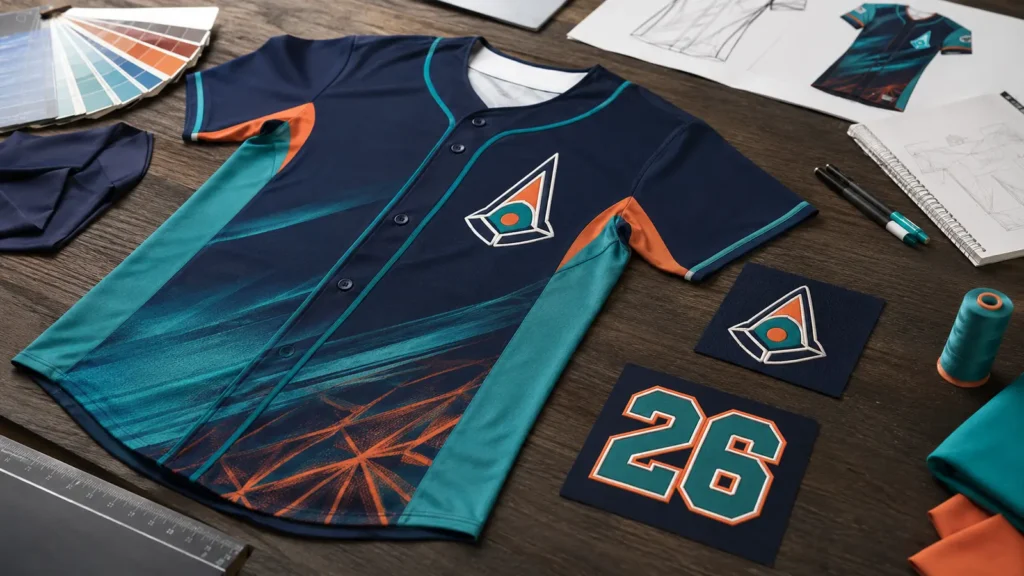
Decoration choice affects design freedom, hand feel, order complexity and suitability for player-by-player personalization.
Planning a custom softball jersey order? Send JIUMU your program level, total quantity, reference artwork, team colors, size breakdown, player names and numbers, packaging needs, and target delivery date. A complete brief makes fabric, decoration, sampling, and quotation decisions more precise. Explore custom team jerseys or contact JIUMU.
Fit, Cut, and Size Planning for Youth and Adult Rosters
A size label is not a measurement standard. One supplier’s adult medium can differ from another supplier’s medium in chest width, body length, shoulder, sleeve opening, and waist shape.
Start with the supplier’s finished-garment chart, not a familiar retail size. Confirm:
- whether measurements are body measurements or garment measurements;
- where chest width, body length, shoulder, sleeve, and hem are measured;
- the allowed production tolerance;
- whether women’s, unisex, youth, and extended-size patterns are separate;
- whether players will wear a base layer;
- whether the jersey is intended to be tucked or untucked;
- whether the cut is compression, close, athletic, regular, or relaxed.
For a new program or a supplier change, a size set is one of the most useful risk controls. Players can try on representative sizes before the roster is finalized. Record the chosen size against the player name and number, then have one coordinator approve the master roster.
Women’s Fit Is More Than a Smaller Unisex Jersey
A women’s-specific pattern may adjust chest shaping, waist, hip allowance, shoulder width, sleeve angle, and body length. Not every team needs the same silhouette, and some players may prefer a unisex cut. The useful question is whether the supplier can provide clearly measured options and whether the team can test them.
Youth League Size Collection
Youth leagues often face growth, late registration, coach pieces, and mixed youth/adult rosters. Build a deadline and exception process:
- Issue the size chart and measuring instructions.
- Hold a physical try-on session where possible.
- Freeze the roster on a stated date.
- Check duplicate and restricted numbers.
- Separate late additions from the approved bulk list.
- Define who pays for remakes caused by submitted roster errors.
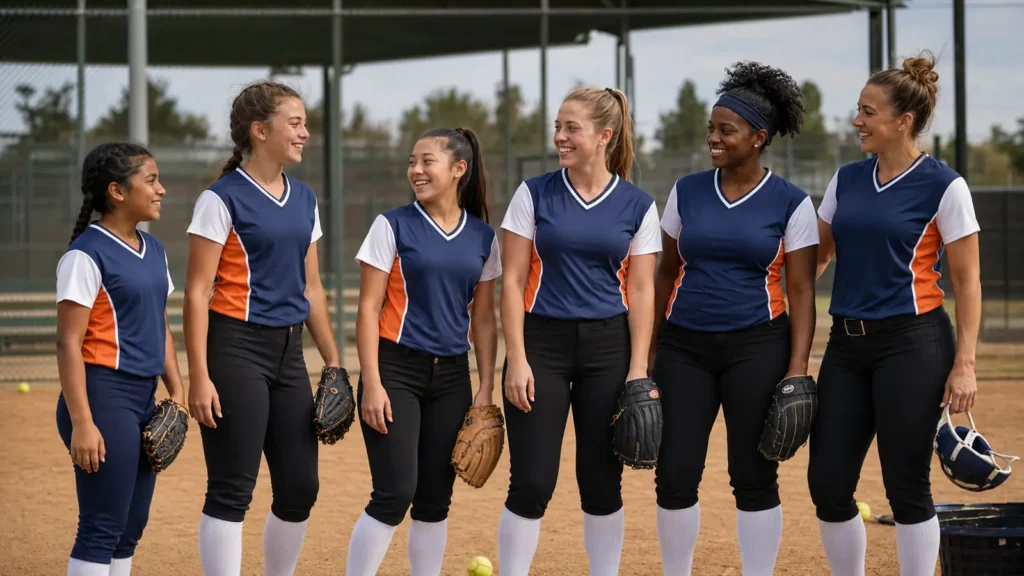
A useful size system must account for youth and adult patterns, movement allowance and how the jersey will be worn.
Construction Details That Influence Durability
Durability is a system of materials, construction, decoration, fit, use, and care. A buyer can still inspect concrete details before placing a bulk order.
Look at:
- seam type and stitch consistency;
- reinforcement at shoulders, plackets, side seams, and stress points;
- skipped stitches, loose ends, seam grin, and puckering;
- collar binding and stretch recovery;
- sleeve and hem finishing;
- alignment of color panels and printed graphics;
- button attachment and placket stability;
- embroidery backing and edge finish;
- transfer edges and surface adhesion;
- label placement and comfort.
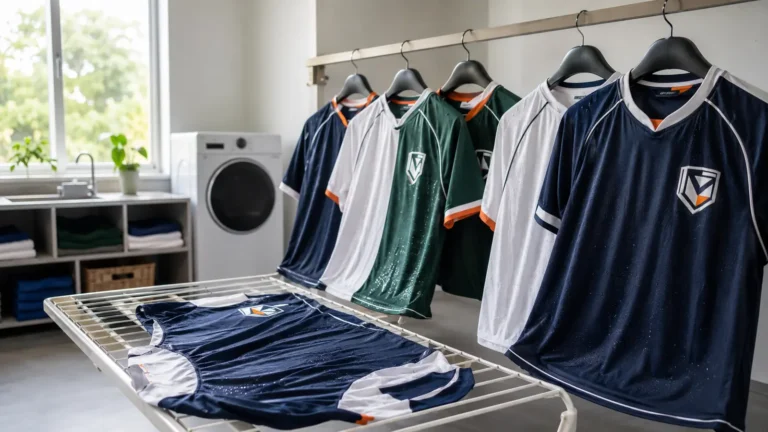
Fit also influences durability. A jersey that is too tight places more stress on seams and decoration. An oversized jersey can snag and interfere with movement. Care instructions should match the decoration and fabric system, and teams should distribute those instructions to players.
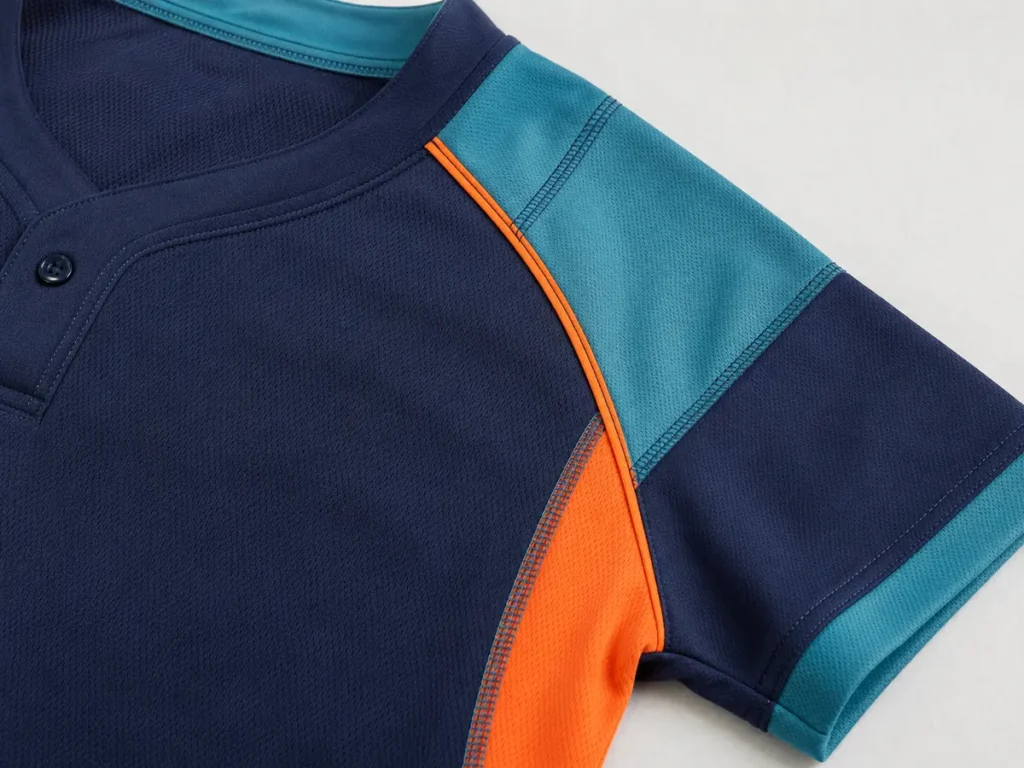
Sample approval should evaluate seam alignment, edge finishing, stretch recovery and decoration placement—not appearance alone.
Design, Color, Names, Numbers, and Private Labels
Custom design involves more than placing a logo on a template. A complete artwork brief should specify:
- official team name and approved logo files;
- color references, preferably with Pantone targets where appropriate;
- base, accent, collar, sleeve, side-panel, piping, and trim colors;
- front, back, sleeve, shoulder, and lower-hem artwork;
- player-name font, case, size, curve, and position;
- number font, outline, size, contrast, and front/back location;
- sponsor marks and permissions;
- league, school, memorial, or flag patches;
- manufacturer or private-label marks;
- neck label, size label, care label, hangtag, and packaging.
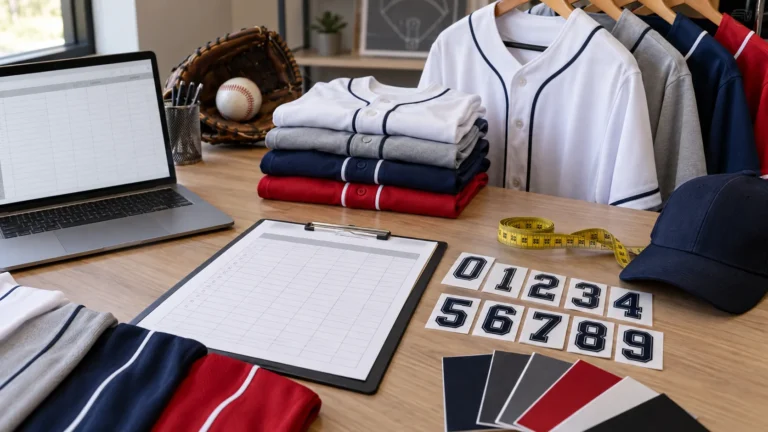
Keep a master artwork file and a locked roster spreadsheet. Names and numbers should not be copied manually between emails, messages, and mockups. Ask the supplier to return a final roster proof that can be checked row by row.
For leagues, use controlled templates. Each team can have a defined colorway and crest while sharing number dimensions, fonts, placement zones, label structure, and packing rules. This reduces approval time and makes the final league presentation more consistent.
Confirm the Governing Body Before Approving Artwork
Uniform rules are not universal. The official NCAA page identifies a 2026–27 softball rule book and publishes separate corrections and updates. USA Softball’s 2026 comparison of USA Softball, NCAA, and NFHS rules shows differences in uniform-number requirements and the treatment of 0 and 00. NFHS uniform guidance also addresses team color/style consistency, number contrast, patches, logos, ornaments, and accessories. Review the current NCAA resources, USA Softball’s 2026 rule comparison, and the applicable NFHS softball uniform guidance as starting points.
Before production, obtain written answers to these questions:
- Which rule book, state association, conference, tournament, or local amendment controls?
- What number size, contrast, location, and uniqueness rules apply?
- Are 0 and 00 treated as the same or different numbers?
- Are player names allowed?
- What marks, flags, memorial patches, sponsors, and manufacturer logos are permitted?
- Are there limits on patch size or location?
- Must team jerseys, pants, sleeves, undergarments, or headwear match?
- Are there restrictions on reflective, dangerous, or distracting elements?
- Who has authority to approve an exception?
- Does the team need approval from a school, league, sponsor, or licensing owner?
Rules and interpretations can change. The team or league—not the artwork vendor—should identify the controlling authority and approve the final design.
What Drives the Cost of Custom Softball Jerseys?
Unit price without a written specification is difficult to compare. Cost can change with:
- order quantity and size range;
- custom pattern or standard pattern;
- fabric type, weight, and panel combination;
- sublimation coverage and artwork preparation;
- embroidery, appliqué, transfer, or screen-print complexity;
- number of logos and placement areas;
- individual names and numbers;
- custom labels, hangtags, barcodes, and packaging;
- sample type and number of sampling rounds;
- inspection, testing, or documentation requirements;
- packing by player, team, or destination;
- shipping method, destination, duties, and delivery schedule.
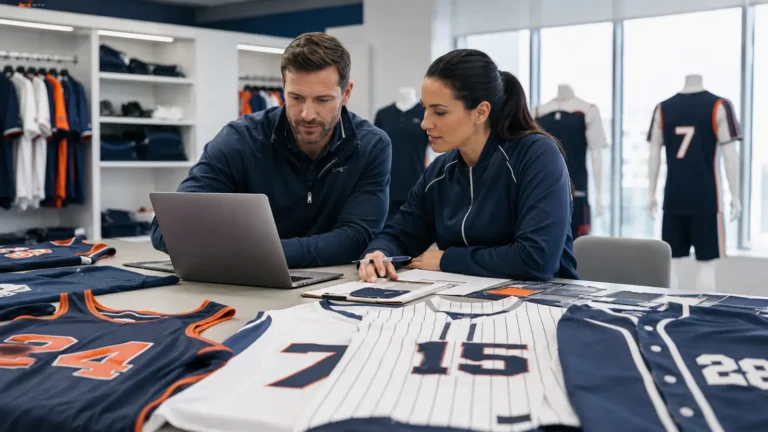
Ask suppliers to quote the same specification. A lower price may omit a size set, physical sample, custom label, individual packing, color standard, or freight. Create a comparison sheet that lists inclusions, exclusions, sample charges, revision policy, production basis, packing, shipping term, and quotation validity.
Sample Approval and Quality-Control Checklist
A sample should answer specific questions. “Looks good” is not an approval standard.
| Checkpoint | What to verify | Approval record |
|---|---|---|
| Artwork | Correct logo version, colors, fonts, names, numbers, sponsors, and placement | Signed or dated final mockup and roster |
| Fabric | Weight, knit, hand feel, stretch, opacity, ventilation zones, decoration compatibility | Approved swatch or sample reference |
| Fit | Finished measurements, wearing ease, youth/adult/women’s cut, tuck length | Approved measurement chart and fit notes |
| Color | Main and accent colors on each actual fabric zone | Physical color sample under agreed viewing conditions |
| Construction | Seams, collar, sleeves, hem, placket, buttons, reinforcement | Photos plus approved physical sample |
| Decoration | Sublimation clarity, embroidery backing, transfer edges, print registration | Method-specific sample |
| Personalization | Spelling, number assignment, size, position, duplicate-number check | Locked roster proof |
| Branding | Neck label, care label, hangtag, packaging and barcode where required | Packaging sample or artwork |
| Bulk inspection | Measurements, appearance, quantity, roster allocation, packing | Inspection checklist and packing list |
During bulk inspection, use the approved sample and specification—not memory—as the reference. The inspection plan should define sampling level or checking scope, measurement points, tolerance, color comparison method, defect classification, roster reconciliation, and packing verification.
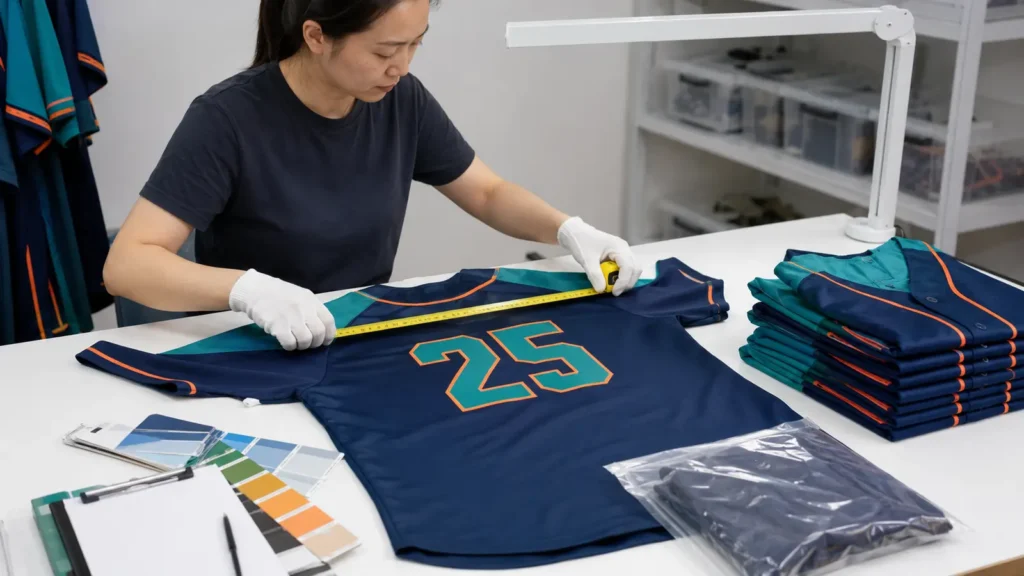
A documented inspection standard makes approvals clearer and helps protect repeat-order consistency.
A Practical Bulk-Order Workflow
1. Define the Program
State the buyer type, competition level, intended season, game or training use, roster count, age groups, destination, and target in-hands date.
2. Send the Product Brief
Provide reference images or a tech pack, preferred jersey style, fabric expectations, size range, colors, logos, decorations, labels, packaging, and estimated quantity.
3. Confirm Rules and Artwork Rights
The buyer should confirm the controlling uniform rules and permission to use school marks, league marks, sponsor logos, flags, mascots, and licensed artwork.
4. Review the Quotation and Development Scope
Check what the price includes: artwork, mockups, samples, custom pattern work, labels, packaging, inspection, and shipping. Confirm the typical MOQ for the selected structure. JIUMU’s typical MOQ is 50 pieces, subject to product structure and customization.
5. Approve Artwork, Fabric, and Size System
Approve color references, actual fabric swatches, finished-garment measurements, decoration placement, and roster fields before the physical sample is treated as final.
6. Approve the Physical Sample
Test the garment on relevant players. Review movement, length, neckline, sleeve opening, opacity, decoration, seam quality, and care. Record every approved detail.
7. Freeze the Roster
Use one controlled spreadsheet containing player name, printed name, number, size, cut, team, and packing group. Assign one authorized approver.
8. Produce, Inspect, and Pack
Bulk production should follow the approved sample and documents. Packing can be by player, team, coach, carton, or destination, but the method must be stated before production.
9. Retain Reorder References
Store artwork versions, fabric references, color approvals, size chart, measurement tolerances, label files, roster history, and approved sample details. Ask what may change between dye lots or production runs.
Questions to Ask a Softball Jersey Supplier
- Which jersey patterns and size ranges are available for youth, women, unisex, and extended sizes?
- Are the size-chart values body measurements or finished-garment measurements?
- What fabric options, weights, knit structures, and ventilation panels can be sampled?
- Which decoration methods are compatible with each fabric?
- Can you provide a physical color sample on the selected fabric?
- How are names and numbers proofed against the roster?
- What is included in the mockup and sample process?
- What measurement tolerances and appearance criteria are used in bulk inspection?
- How are late additions and replacement jerseys handled?
- How will repeat-order color and fabric consistency be managed?
- Can pieces be packed by player, team, or destination?
- Which private labels, hangtags, barcodes, and packaging options are available?
- What information can change the MOQ, production schedule, or quotation?
- What export and shipping support is available for the destination?
Common Buying Mistakes
Choosing by Mockup Alone
A mockup cannot prove fabric, fit, opacity, color, stitch quality, or transfer adhesion. Use it to approve artwork, then approve physical materials and a sample.
Sending an Uncontrolled Roster
Multiple spreadsheet versions create misspellings, duplicate numbers, wrong sizes, and packing errors. Use one locked roster and one approver.
Assuming All “Polyester” Is the Same
Specify weight, knit, stretch, opacity, surface, and panel placement. Request the actual fabric.
Using a Retail Size Chart
Fit should be based on the supplier’s finished-garment measurements and a size set where possible.
Ignoring Reorders
Record fabric, color, artwork, measurements, and roster history during the first order. A replacement jersey months later is much easier when the specification is retained.
Approving Before Checking the Rule Book
Number contrast, patches, logos, names, sleeves, and team consistency can be governed differently. Verify the current controlling rules before production.
Comparing Prices With Different Inclusions
Make sure each quote includes the same fabric, decoration, sampling, labels, packing, inspection, and shipping basis.
Why Work With JIUMU for Custom Team Softball Jerseys?
JIUMU is a B2B custom teamwear, logo apparel, hat, uniform, bag, and branded merchandise supplier established in 2010 and based in Guangdong, China. The company supports North American and European schools, sports teams, clubs, distributors, uniform dealers, promotional buyers, retailers, and private-label brands.
Relevant capabilities include:
- OEM and ODM product development;
- fabric sourcing and Pantone color matching;
- sublimation, embroidery, screen printing, and heat transfer;
- woven, rubber/PVC, and leather-style patches;
- digital mockups and physical samples;
- private labels, neck labels, woven labels, and hangtags;
- customized packaging;
- bulk production, quality control, and export support.
The typical MOQ is 50 pieces, subject to product structure and customization. Buyers can also coordinate jerseys with custom team uniforms, custom baseball caps, custom team bags, and custom team jackets.
The purpose of the development process is to turn a visual idea into controlled production information: approved fabric, measurements, artwork, decoration, roster, labels, packaging, and inspection criteria.
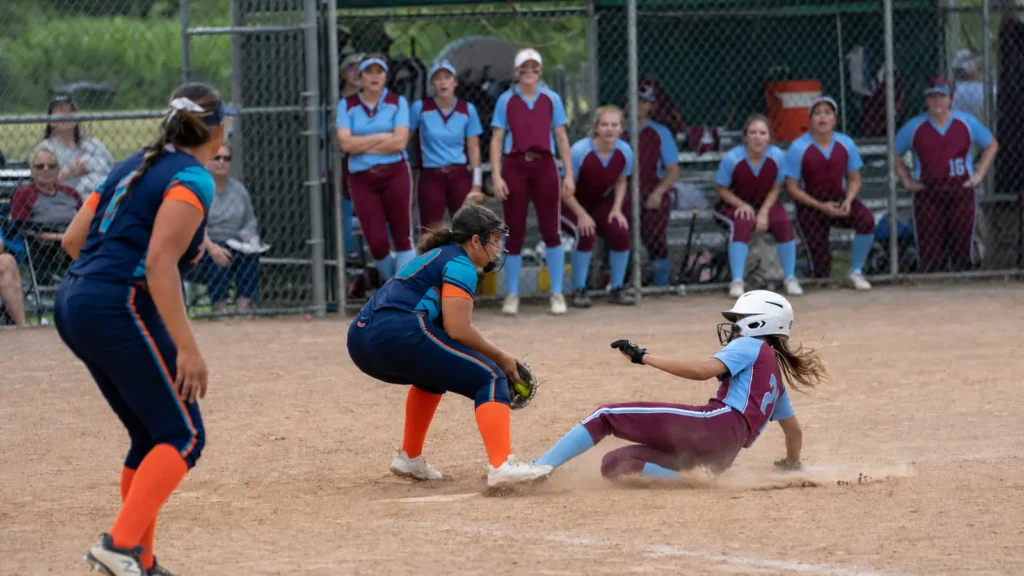
League-wide purchasing works best when teams share controlled colors, roster templates, deadlines and reorder rules.
Frequently Asked Questions
Final Recommendation
The best custom softball jerseys for teams and leagues are built from a controlled specification. Start with the playing environment and rule set. Then select the jersey style, actual fabric, fit system, decoration method, color standard, roster process, sample criteria, inspection plan, and reorder method.
For many teams, sublimation offers an efficient way to combine complex graphics with player names and numbers. For other programs, a simpler training jersey or a traditional button-front design with dimensional decoration may be a better match. The right answer depends on use—not on a generic ranking.
To request a quotation from JIUMU, send:
- team or league type;
- competition level and governing body;
- estimated quantity;
- jersey style and fit preference;
- size breakdown;
- reference artwork and color targets;
- names, numbers, sponsors, and patch requirements;
- label and packaging needs;
- shipping destination and target delivery date.
Request a custom softball jersey quotation: email zhengdong@jiumugear.com, contact JIUMU by WhatsApp or phone at +86 18507502899, or use the JIUMU contact page.
Sources
- NCAA Softball Playing Rules
- 2026 USA Softball, NCAA and NFHS Major Rule Differences
- USA Softball 2026 Official Rulebook
- NFHS Softball Uniform Guidance
About the JIUMU Team
JIUMU develops custom teamwear, logo apparel, hats, uniforms, bags and branded merchandise for B2B buyers in North America and Europe. The team focuses on specification clarity, sampling, customization, quality control and export support.