Baseball Cap Types Explained: Fitted, Snapback, Strapback, Trucker and Bucket Hats
Choosing a cap type is not only a style decision. For a team, retailer, promotional distributor, school, or private-label brand, the structure of a hat affects fit coverage, logo placement, ventilation, perceived value, inventory risk, packaging, and repeat-order consistency.
The terms fitted, snapback, strapback, and trucker do not describe mutually exclusive features in every case. A trucker cap, for example, may also use a snapback closure. “Baseball cap” is the broadest term in this guide, while “bucket hat” is an adjacent headwear category rather than a baseball-cap construction. Understanding these overlaps helps buyers write clearer specifications and compare quotations on the same basis.
Quick Answer: A fitted cap has a closed back and is produced in defined sizes. A snapback uses an adjustable plastic snap closure. A strapback uses an adjustable fabric or leather-style strap, often with a buckle or slide. A trucker cap is identified mainly by its mesh back and structured front, and it commonly uses a snap closure. A bucket hat has a soft crown and a brim that runs around the entire hat; technically, it is not a baseball cap, but it is often sourced alongside custom caps.
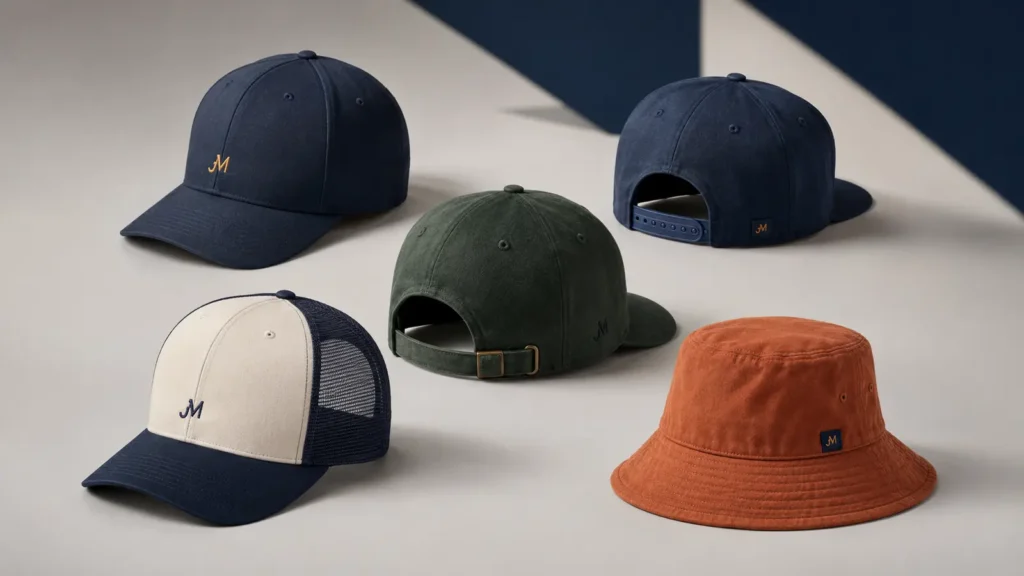
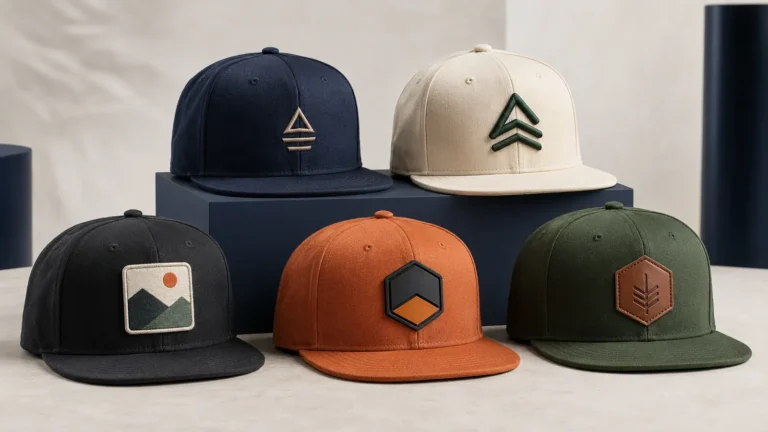
Fitted, snapback, strapback, trucker and bucket styles differ in fit, closure, ventilation and silhouette.
Why Baseball Cap Type Matters in Bulk Purchasing
Two hats can carry the same embroidered logo and still perform very differently in a sales program or team order. The difference often comes from the crown, closure, brim, panel construction, sweatband, and fabric—not from the decoration alone.
For B2B buyers, the cap type influences five practical decisions:
- Size planning: Adjustable caps reduce the number of stock-keeping units, while fitted caps require a size curve.
- Brand presentation: A structured front can support a bold raised logo; a soft unstructured crown usually creates a more relaxed appearance.
- Use environment: Mesh panels improve airflow, while dense woven fabrics offer a different hand feel and coverage.
- Target price: Closure hardware, fabric, panel construction, embroidery stitch count, patches, labels, and packaging all affect cost.
- Repeat orders: Approved measurements, materials, color standards, logo files, and packaging specifications should be recorded so later production matches the first order.
The best cap is therefore the one that fits the buyer’s use case, audience, brand position, and inventory model—not simply the style that looks most fashionable in a single photograph.
Baseball Cap Types at a Glance
| Type | Defining feature | Typical fit approach | Common crown and brim | Main B2B advantage | Main planning risk |
|---|---|---|---|---|---|
| Fitted cap | Closed back with no adjustment opening | Multiple exact or grouped sizes | Often structured; flat or curved brim | Clean silhouette and higher-end team or retail presentation | More size SKUs and greater inventory complexity |
| Snapback cap | Adjustable plastic snap closure | One adjustable size, sometimes youth/adult ranges | Frequently structured with a flat or slightly curved brim | Broad fit range and strong streetwear or merchandise appeal | Plastic closure quality and fit range must be checked |
| Strapback cap | Fabric, webbing, or leather-style adjustable strap | One adjustable size | Often low-profile or unstructured with a curved brim | Refined casual appearance and flexible closure options | Strap length, buckle finish, and back-opening shape vary |
| Trucker cap | Mesh back panels with a solid or foam front | Usually adjustable; snap closures are common | Structured front; curved or flat brim | Ventilation, visual contrast, and efficient promotional branding | Mesh, foam, and front-panel stiffness affect comfort and shape |
| Bucket hat | Soft crown with a 360-degree downward brim | Size ranges or adjustable internal features | Unstructured; all-around brim | Large lifestyle assortment opportunity and sun-coverage concept | Not a baseball cap; sizing, brim drop, and crown depth need separate specs |
This table describes common configurations, not universal rules. A custom program can combine features—for example, a five-panel cotton trucker cap with mesh back panels, a rope trim, a curved brim, and a snapback closure.
What Is a Fitted Cap?
A fitted cap has a closed back without a snap, strap, hook-and-loop tab, or other external adjustment system. Its fit comes from the size and shape of the crown and sweatband. Some designs include stretch material, but a fitted cap still needs a defined size range.
Fitted caps are often chosen for baseball teams, sports clubs, premium merchandise, streetwear collections, and retail programs because the uninterrupted back creates a clean silhouette. The absence of an opening also gives buyers another possible location for embroidery.
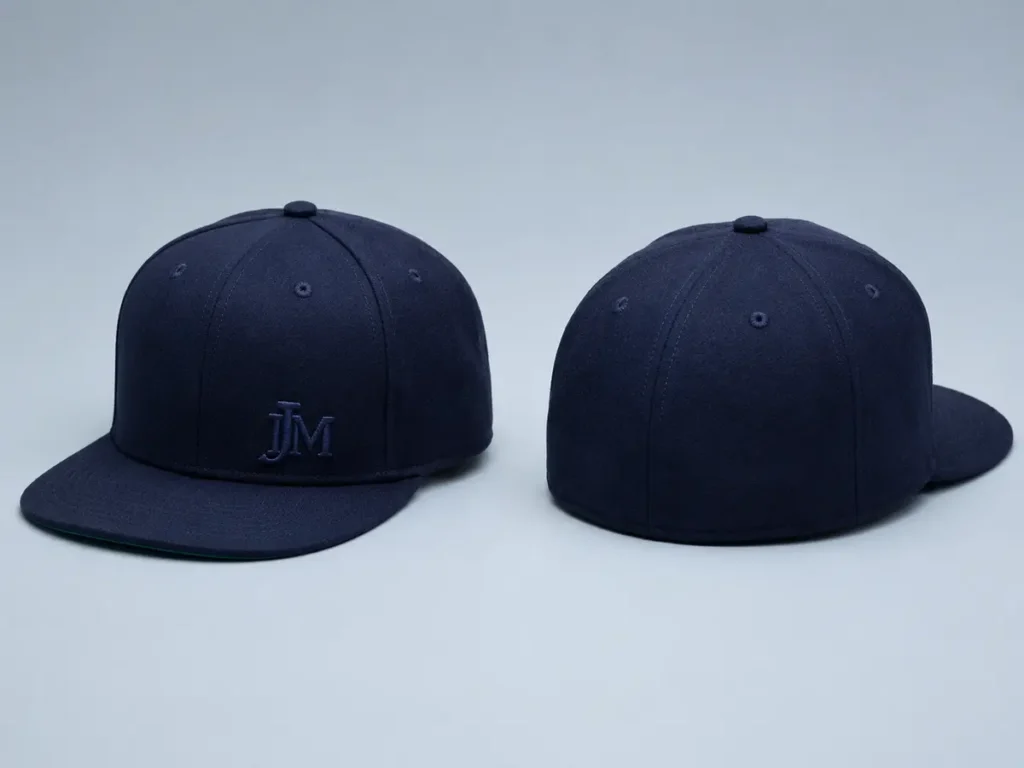
A fitted cap uses a closed back and relies on defined sizes rather than an adjustable closure.
Key fitted-cap specifications
- Size system: exact numeric sizes, centimeters, inches, or grouped sizes such as S/M and L/XL
- Crown profile: low, mid, or high
- Crown structure: structured or unstructured
- Number of panels: commonly five or six, depending on the design
- Brim: flat, pre-curved, or supplied with a shape that the wearer can curve
- Sweatband: standard woven, moisture-management, or stretch construction
- Back decoration: embroidery centered across the closed rear panels, if required
Best use cases
Fitted caps work well when the buyer can control sizing, collect head measurements, or forecast a reliable size curve. They are suitable for organized teams and established retail programs with historical sales data. They are less forgiving for one-size promotional giveaways because an incorrect size cannot be corrected with a closure.
Procurement point
Do not approve a fitted-cap sample based only on its circumference. Crown depth, sweatband elasticity, seam bulk, and how the cap sits above the ears also affect perceived fit. Approve at least one sample from each intended size group, and record the measuring method.
Explore JIUMU’s custom fitted hats for closed-back structures, size planning, embroidery, patches, labels, and private-label options.
What Is a Snapback Cap?
A snapback cap uses a plastic strip with interlocking snaps at the back. The wearer changes the circumference by connecting different snap positions. In current custom headwear programs, snapbacks are frequently paired with a structured crown and flat brim, although curved-brim and softer variants are also possible.
Snapbacks are popular for streetwear, team merchandise, event programs, promotional products, school spiritwear, and branded retail collections. Their adjustable fit can reduce SKU complexity compared with fitted caps.
Key snapback specifications
- Plastic closure color and finish
- Number of usable snap positions
- Adult, youth, or other fit range
- Crown height and front-panel stiffness
- Flat or curved brim
- Undervisor color
- Front, side, and back logo positions
- Eyelet color and top-button color
Best use cases
Choose a snapback when the project needs a recognizable casual or streetwear silhouette, a prominent front logo, and a flexible fit range. It can also be practical for mixed-size team merchandise and promotional distribution.
Procurement point
The closure is a functional component, not a minor trim. During sample approval, open and close the snaps repeatedly, check that the strip does not feel brittle, and confirm that the selected closure color matches the approved design. Also evaluate the smallest and largest practical settings rather than testing only the middle position.
See JIUMU’s custom snapback hats for structured crowns, custom colors, embroidery, patch techniques, and bulk-order support.
What Is a Strapback Cap?
A strapback cap uses an adjustable strap rather than a plastic snap. The strap may be made from self-fabric, woven webbing, or a leather-style material. It can close with a metal buckle, slide, clasp, or tuck-in mechanism.
Strapbacks are commonly associated with low-profile baseball caps, dad hats, lifestyle merchandise, golf-inspired collections, company uniforms, and understated private-label products. Compared with a plastic snap, a buckle-and-strap closure can create a more refined or heritage-oriented appearance.
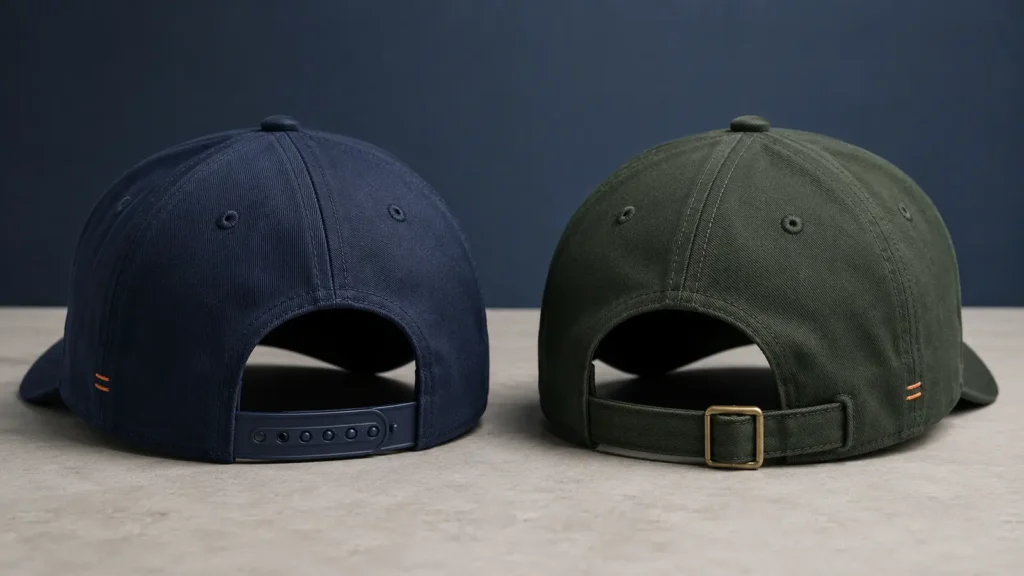
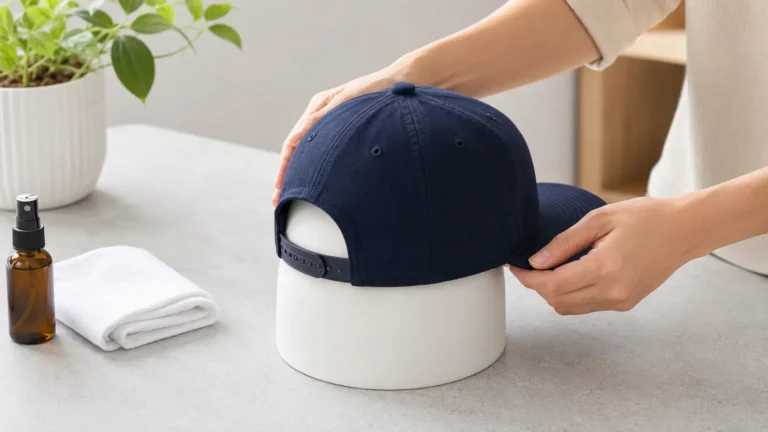
Snapback and strapback caps provide adjustable fit through different closure systems.
Key strapback specifications
- Strap material and width
- Buckle or slide material, shape, plating, and finish
- Maximum and minimum adjustable circumference
- Tuck-in slot or exposed strap-end treatment
- Reinforcement around the rear opening
- Logo placement on the strap, buckle, or back panels
- Colorfastness and edge finishing
Best use cases
Choose a strapback for brands that want a softer, more casual profile or a closure that can be coordinated with fabric and hardware details. It also suits corporate merchandise when the buyer wants a restrained appearance rather than the sportier look of a plastic snap.
Procurement point
“Strapback” is not a complete specification. State the strap material, hardware finish, adjustment method, opening shape, and desired excess-strap management. If the order uses plated metal hardware, approve the finish under neutral lighting and check for sharp edges or inconsistent plating.
What Is a Trucker Cap?
A trucker cap is defined mainly by its ventilated mesh back panels and solid front section. The front may be foam-backed or made from woven fabric. Many trucker caps have a snapback closure, which means one hat can correctly be described as both a trucker and a snapback.
Trucker caps are widely used for outdoor programs, workwear-inspired merchandise, team travel, events, food and beverage branding, agriculture-related promotions, fishing and lifestyle collections. The mesh creates airflow and a contrasting material story.
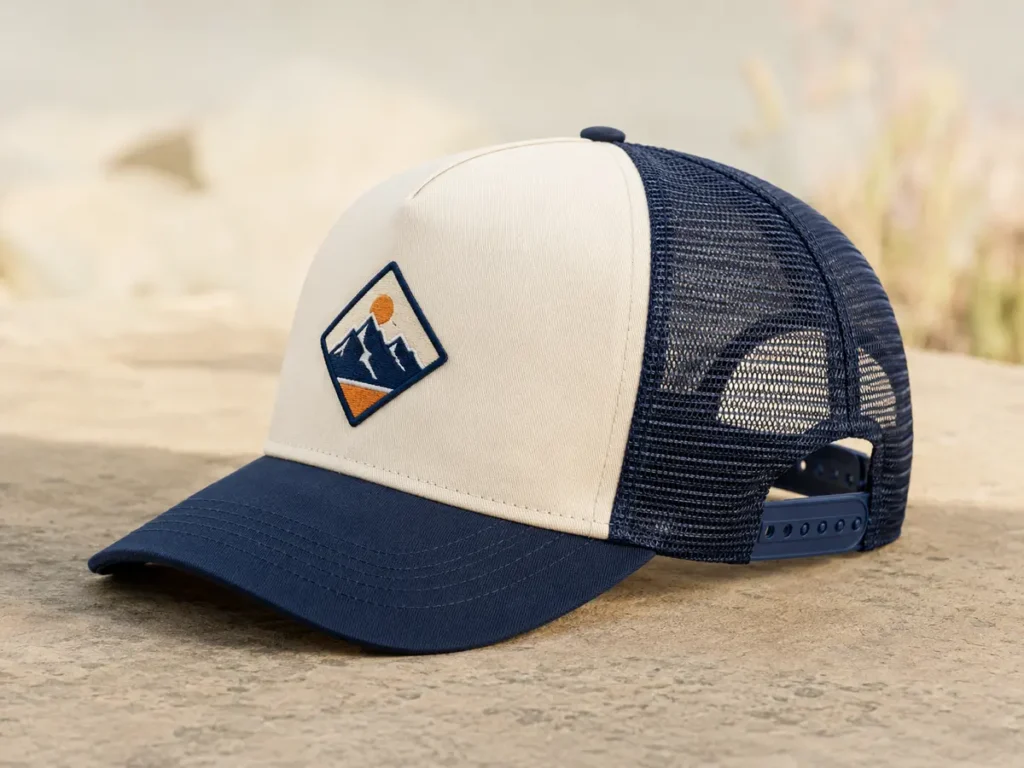
A trucker cap combines a solid branding area with ventilated mesh back panels.
Key trucker-cap specifications
- Front construction: foam, cotton twill, polyester, canvas, or another woven fabric
- Mesh fiber, color, hand feel, and openness
- Five-panel or six-panel pattern
- Seam position across the front decoration area
- Closure type and color
- Brim shape and visor material
- Sweatband construction
- Rope trim, piping, or contrast details, if required
Best use cases
Choose a trucker cap for warm-weather, outdoor, promotional, and lifestyle programs where ventilation and a distinctive front-versus-back appearance are valuable. A foam front can support certain printed or patch graphics, while a woven structured front may provide a different hand feel and embroidery result.
Procurement point
Ask whether the embroidery or patch will cross a seam. On a six-panel cap, the center-front seam can affect very small lettering and fine detail. A five-panel front may provide an uninterrupted logo area, but the crown shape and fit will differ. The mesh should also be assessed for edge softness, recovery, and color consistency.
Browse JIUMU’s custom trucker hats for mesh-back structures, foam or fabric fronts, snap closures, embroidery, and custom patches.
Is a Bucket Hat a Baseball Cap?
No. A bucket hat is a separate headwear construction. It has a soft crown and a brim that extends around the full circumference instead of projecting mainly from the front. It does not use the typical crown-and-visor structure of a baseball cap.
It appears in this comparison because distributors, apparel brands, schools, clubs, and promotional buyers often source bucket hats and baseball caps in the same headwear collection. The two categories can share fabrics, colors, labels, patches, and packaging, but their patterns and fit specifications are different.
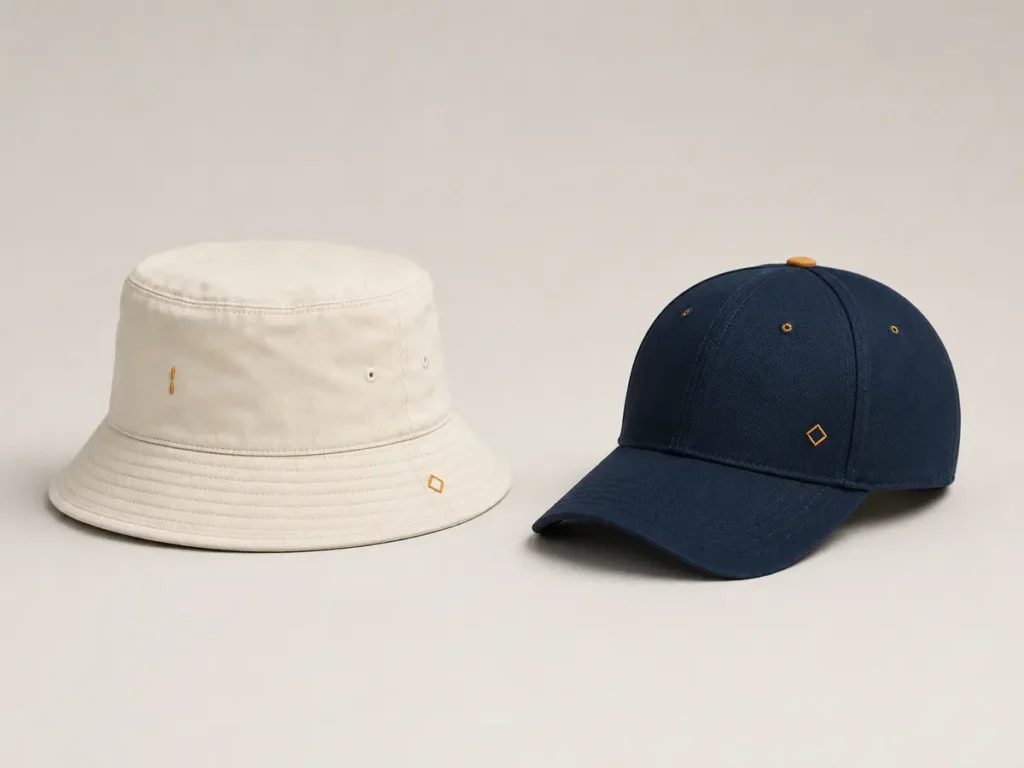
Bucket hats are a separate headwear construction often sourced alongside custom baseball caps.
Key bucket-hat specifications
- Crown circumference and depth
- Brim width, angle, and stiffness
- Number and placement of ventilation eyelets
- Lining or unlined construction
- Chin cord, toggle, or internal adjustment, if needed
- Packability requirements
- Embroidery, patch, woven label, or print position
Best use cases
Bucket hats fit festival merchandise, outdoor programs, school and club apparel, resort collections, lifestyle retail, and coordinated promotional kits. Their all-around brim creates a distinct visual category and a useful surface for color blocking or repeated graphics.
Procurement point
Do not reuse a baseball-cap size chart without verification. Bucket-hat crown depth and brim drop change how the style sits on the head. Approve fit samples in each intended size and evaluate the brim after packing and recovery.
How Crown, Closure and Brim Work Together
Cap names are useful shortcuts, but buyers should specify the product as a system.
Crown profile
- Low profile: Sits closer to the head and often supports a relaxed, understated look.
- Mid profile: Balances front logo visibility with broad everyday wearability.
- High profile: Creates more vertical branding space and a stronger structured silhouette.
Crown structure
A structured crown contains reinforcement that helps the front hold its shape. It is useful for bold embroidery, patches, and uniform presentation. An unstructured crown collapses more easily and creates a softer appearance. Neither is automatically better; the choice should match the design intent.
Brim shape
A flat brim supports streetwear and modern merchandise directions. A curved brim is common in team, corporate, golf, workwear, and casual programs. Buyers should define brim length, width, curve, stitching rows, top color, and undervisor color.
Closure
The closure determines adjustability and contributes to the visual identity. A snap closure is functional and sporty. A self-fabric strap can appear more integrated. A metal buckle can add a refined detail. Hook-and-loop closures may suit some uniform or promotional programs but should be specified by construction and finish rather than by a generic label alone.
Materials and Their Procurement Implications
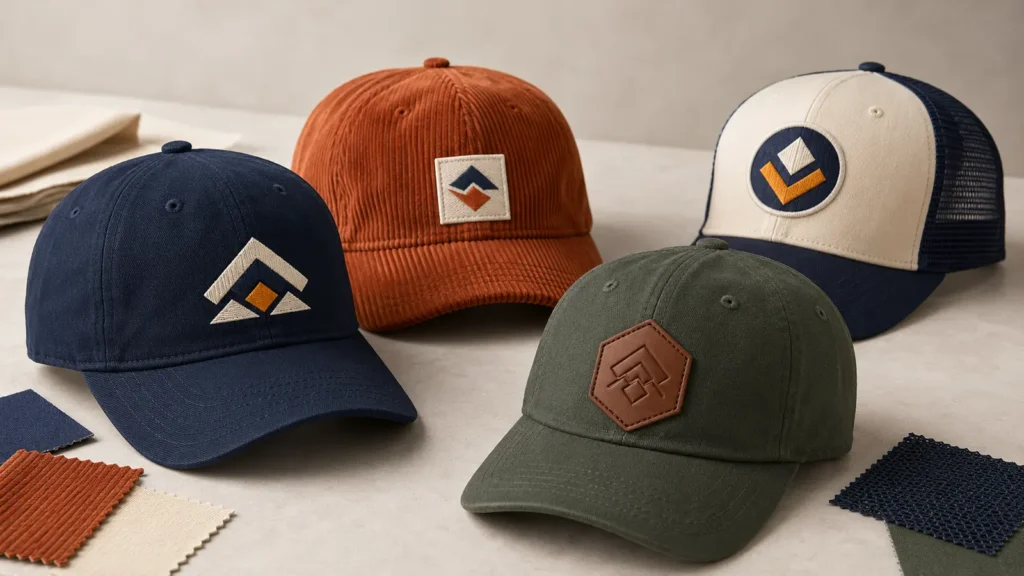
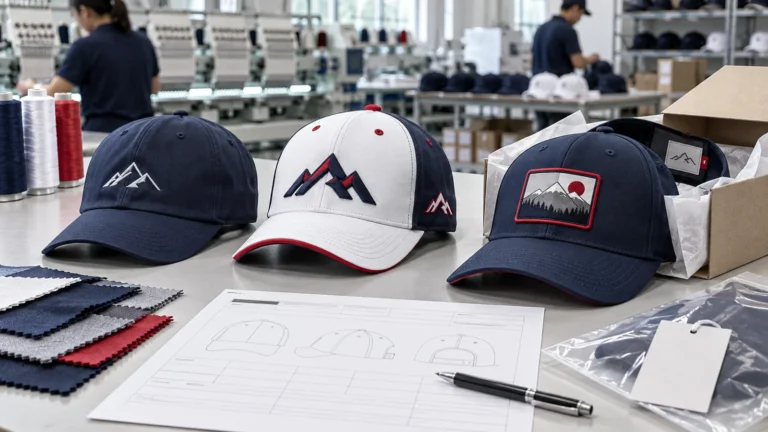
Material and decoration choices should be tested together during custom cap development.
| Material or component | Common reason to select it | Points to confirm during development |
|---|---|---|
| Cotton twill | Familiar hand feel and broad color options | Weight, weave, shrinkage behavior, dye consistency, and structure |
| Polyester | Color control, durability, and performance-oriented options | Finish, sheen, breathability, moisture behavior, and heat sensitivity |
| Wool blend | Traditional fitted or heritage-inspired appearance | Exact fiber content, hand feel, labeling, color consistency, and care requirements |
| Nylon or ripstop | Lightweight outdoor or technical direction | Coating, crinkle, water-resistance claim basis, seam behavior, and logo method |
| Corduroy or denim | Textured lifestyle and seasonal collections | Wale or denim weight, wash variation, embroidery stability, and shade tolerance |
| Mesh | Ventilation in trucker and performance caps | Fiber, openness, softness, recovery, color, and edge finishing |
| Foam front | Shape and a smooth promotional graphic surface | Thickness, recovery, lamination, odor, and compatibility with decoration |
| Sweatband | Fit, comfort, and moisture contact | Width, elasticity, fiber, seam placement, color, and branded label integration |
For the U.S. market, most textile and wool products require labels that identify fiber content, country of origin, and the responsible manufacturer or marketer, according to the U.S. Federal Trade Commission’s textile labeling guidance. Buyers should confirm the rules that apply to their product, destination, sales channel, and claims with qualified compliance advisers.
Which Cap Type Offers the Best Branding Space?
| Branding objective | Strong starting option | Why | Watch point |
|---|---|---|---|
| Large front embroidery | Structured snapback or woven-front trucker | Firm front supports a prominent mark | Center seam may interrupt fine details |
| Clean back embroidery | Fitted cap | Closed rear panels provide a continuous area | Curved seams limit very wide artwork |
| Small refined logo | Strapback or low-profile cap | Suits tonal embroidery and small patches | Soft crown may pucker with dense stitching |
| Large patch | Five-panel trucker or five-panel snapback | Uninterrupted front panel can simplify placement | Patch stiffness must match crown shape |
| All-over or repeated print | Bucket hat or suitable panel cap | Multiple fabric areas can carry a pattern | Pattern matching and seam registration add complexity |
| Side identity mark | Fitted, snapback, or structured baseball cap | Side panel can hold a small icon or wordmark | Eyelets and seams reduce usable area |
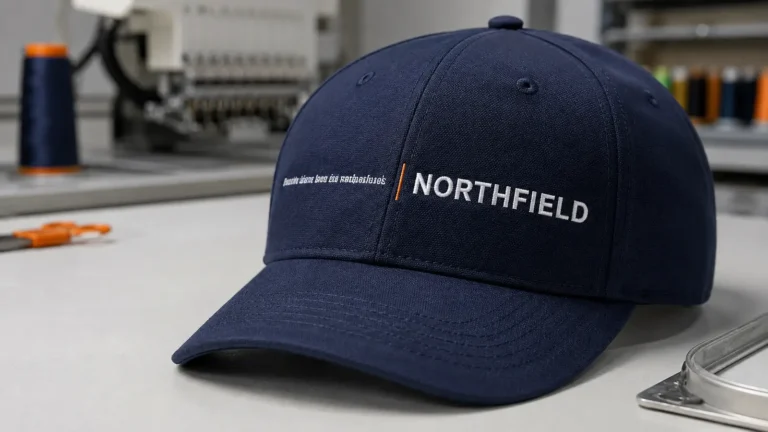
Logo method should follow the artwork and material. Flat embroidery works for small text and detailed linework within stitch limits. 3D or puff embroidery creates height but needs bolder shapes and adequate spacing. Woven patches can reproduce finer detail than some embroidery applications. Rubber/PVC patches create a dimensional technical look. Leather-style patches suit outdoor and heritage directions. Printing or heat transfer may work for gradients and fine graphics, depending on the fabric.
Planning a custom cap range? Send JIUMU your target cap type, quantity, size range, fabric, colors, logo file, decoration method, packaging needs, destination country, and required delivery date. We can use that information to prepare a clearer development route and quotation. Request a custom cap quotation.
How to Choose the Right Cap Type for Your Buyers
Sports teams and clubs
Fitted caps can create a coordinated on-field or premium team look when player sizes are known. Adjustable baseball caps and snapbacks simplify supporter merchandise and mixed-size orders. Trucker caps can work for travel, outdoor events, or casual fan merchandise.
Schools and youth programs
Adjustability usually reduces sizing risk, but youth and adult patterns should not be treated as interchangeable. Confirm minimum and maximum circumference, crown depth, brim dimensions, and applicable product requirements for the destination market.
Corporate and promotional programs
Strapbacks and classic curved-brim baseball caps support a restrained uniform or gift aesthetic. Trucker caps create a more outdoor or workwear-oriented identity. Snapbacks suit campaigns that want a bold front logo and youth-focused silhouette.
Retail and private-label brands
Select the cap type as part of the brand architecture. A fitted cap can support a size-led premium range; snapbacks reduce SKU count; strapbacks communicate refined casual styling; trucker caps create a material contrast; bucket hats extend the assortment beyond baseball-cap construction.
Distributors and uniform dealers
Prioritize repeatable specifications, broad fit coverage, packaging efficiency, and easy reorder identification. A style code should connect the approved sample, bill of materials, measurement chart, artwork, color references, and packaging details.
Fit and Size Planning
Fit is one of the largest sources of preventable dissatisfaction in a headwear order. Start with the target head circumference, but do not stop there.
Record:
- Intended wearer group
- Head-circumference range
- Finished inside circumference and measuring method
- Crown depth
- Front-panel height
- Brim length and width
- Sweatband width and elasticity
- Closure range, if adjustable
- Fit comments from sample testers
For a fitted-cap program, build the order quantity by size rather than dividing units evenly without evidence. For an adjustable cap, confirm that the closure range actually serves the intended users. A cap may technically close at the largest setting but still feel too shallow or narrow in the crown.
Construction Details That Affect Durability and Shape
Look beyond the front logo. During sampling and quality control, inspect:
- Panel symmetry and seam alignment
- Consistent crown height and brim curve
- Secure top button and eyelets
- Even rows of visor stitching
- Smooth sweatband attachment
- Reinforcement around the rear opening
- Closure security and hardware finish
- Embroidery backing and trimmed threads
- Patch edge adhesion or stitching
- Label placement and legibility
- Color consistency among crown, brim, mesh, thread, closure, and trims
- Recovery after normal packing and handling
Ask the supplier to document measurement tolerances before bulk production. Tolerances should reflect the material and construction rather than an unrealistic expectation that every soft textile item will be numerically identical.
What Drives the Cost of Custom Caps?
Price is influenced by the complete specification:
- Order quantity and number of colorways
- Number of sizes
- Fabric type, weight, finish, and availability
- Structured versus unstructured construction
- Custom dyeing or color-matching requirements
- Closure and metal hardware
- Embroidery area, stitch count, number of locations, and 3D foam
- Patch material and mold or tooling needs
- Printed panels or pattern registration
- Custom labels, hangtags, stickers, and packaging
- Sample rounds and testing requirements
- Inspection level, freight method, destination, and delivery schedule
Compare quotations only after confirming that each supplier is pricing the same bill of materials, logo method, size range, packaging, and delivery term.
Sample Approval and Quality-Control Checklist
Use a written approval sheet rather than approving from chat images alone.
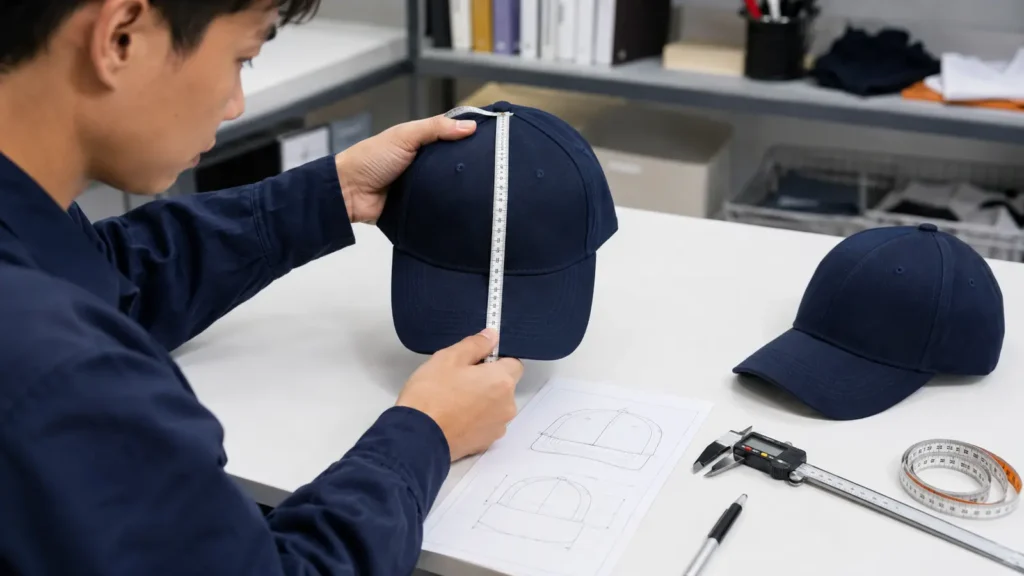
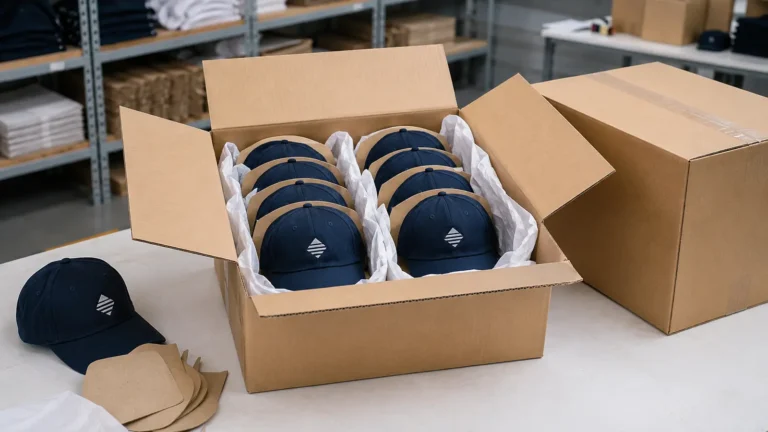
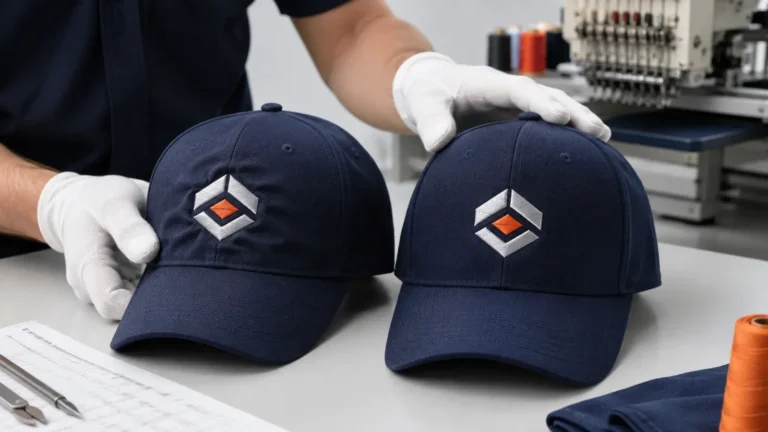
Written measurements, closure checks and approved samples support consistent bulk cap production.
- Measure the sample: Record circumference, crown depth, front height, brim length and width, and closure range.
- Check the silhouette: View the cap from the front, side, rear, and top.
- Wear-test the fit: Test intended size groups, not only one convenient wearer.
- Review colors: Compare fabric, mesh, thread, closure, and trims under controlled lighting.
- Inspect the logo: Check placement, size, stitch density, edges, backing, and legibility at normal viewing distance.
- Operate the closure: Repeat adjustment and inspect stress points.
- Review labels and packaging: Confirm fiber wording, country-of-origin information, brand details, barcodes, and pack quantities as applicable.
- Approve changes in writing: Mark the sample as approved, approved with corrections, or rejected; attach dated photos and measurements.
- Retain a reference sample: Use an approved sample or sealed standard to compare bulk production and later repeat orders.
What to Send for an Accurate Quotation
Provide as much of the following as possible:
- Cap type and reference images
- Intended wearer and market
- Quantity by color and size
- Crown profile and structured/unstructured preference
- Panel count
- Fabric composition, weight, finish, and color
- Brim shape and undervisor color
- Closure type, material, and color
- Vector logo file and exact decoration size
- Decoration technique and positions
- Label, hangtag, barcode, sticker, and packaging requirements
- Required sample type
- Target delivery date
- Shipping destination and preferred trade term
- Applicable testing, labeling, or documentation requirements
If a specification is still open, label it as an option to be quoted rather than allowing suppliers to make different silent assumptions.
Questions to Ask a Custom Cap Supplier
- Which measurements define this style, and what tolerances will apply?
- Can you provide adult and youth patterns where required?
- Which fabrics, mesh types, sweatbands, closures, and hardware are available?
- How will you manage color matching across fabric, mesh, thread, plastic, and labels?
- Which logo method best fits the artwork and front-panel construction?
- Will the logo cross a center seam or interfere with an eyelet?
- What sample stages are available before bulk production?
- How are approved changes recorded?
- What in-process and final inspections are performed?
- How are cartons packed, labeled, and identified by style, color, and size?
- What information is retained to support repeat orders?
- Which labeling or testing responsibilities belong to the buyer, importer, or supplier?
Common Buying Mistakes
- Treating “baseball cap” as a complete technical specification
- Assuming every trucker cap is a separate category from snapbacks
- Calling a bucket hat a baseball cap without clarifying construction
- Approving a fitted cap in only one size
- Selecting logo art before checking front-panel seams and available area
- Comparing prices for different fabrics, closures, embroidery sizes, or packaging
- Using screen colors as the only color standard
- Ignoring rear-opening reinforcement and closure quality
- Adding dense embroidery to a soft crown without testing puckering
- Omitting labels, barcodes, pack ratios, and carton marks from the quotation
- Approving appearance without recording measurements
- Failing to retain an approved reference for repeat orders
Why Work With JIUMU on Custom Headwear?
JIUMU was established in 2010 in Guangdong, China and supports B2B custom teamwear, logo apparel, hats, uniforms, bags, and branded merchandise. The service is designed for schools, sports teams, clubs, distributors, uniform dealers, promotional product companies, retailers, and private-label brands in North America and Europe.
Available development options include OEM and ODM support, embroidery, sublimation, screen printing, heat transfer, woven patches, rubber/PVC patches, leather-style patches, fabric sourcing, Pantone color matching, private labels, hangtags, packaging customization, digital mockups, physical samples, bulk production, quality control, and export support.
The typical MOQ is 50 pieces, subject to the cap structure and customization. Buyers can explore JIUMU’s custom baseball caps or review the broader custom hats collection.
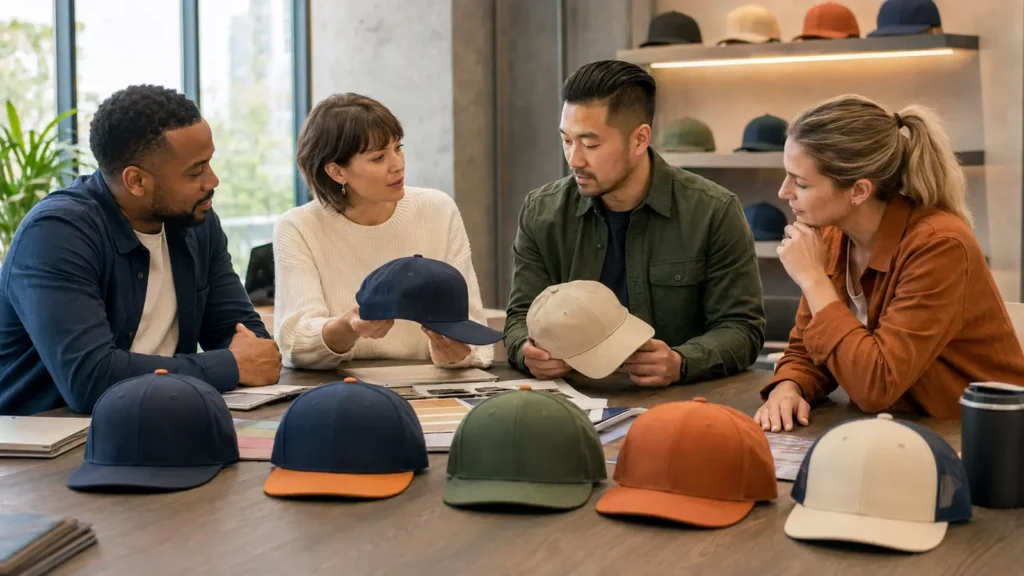
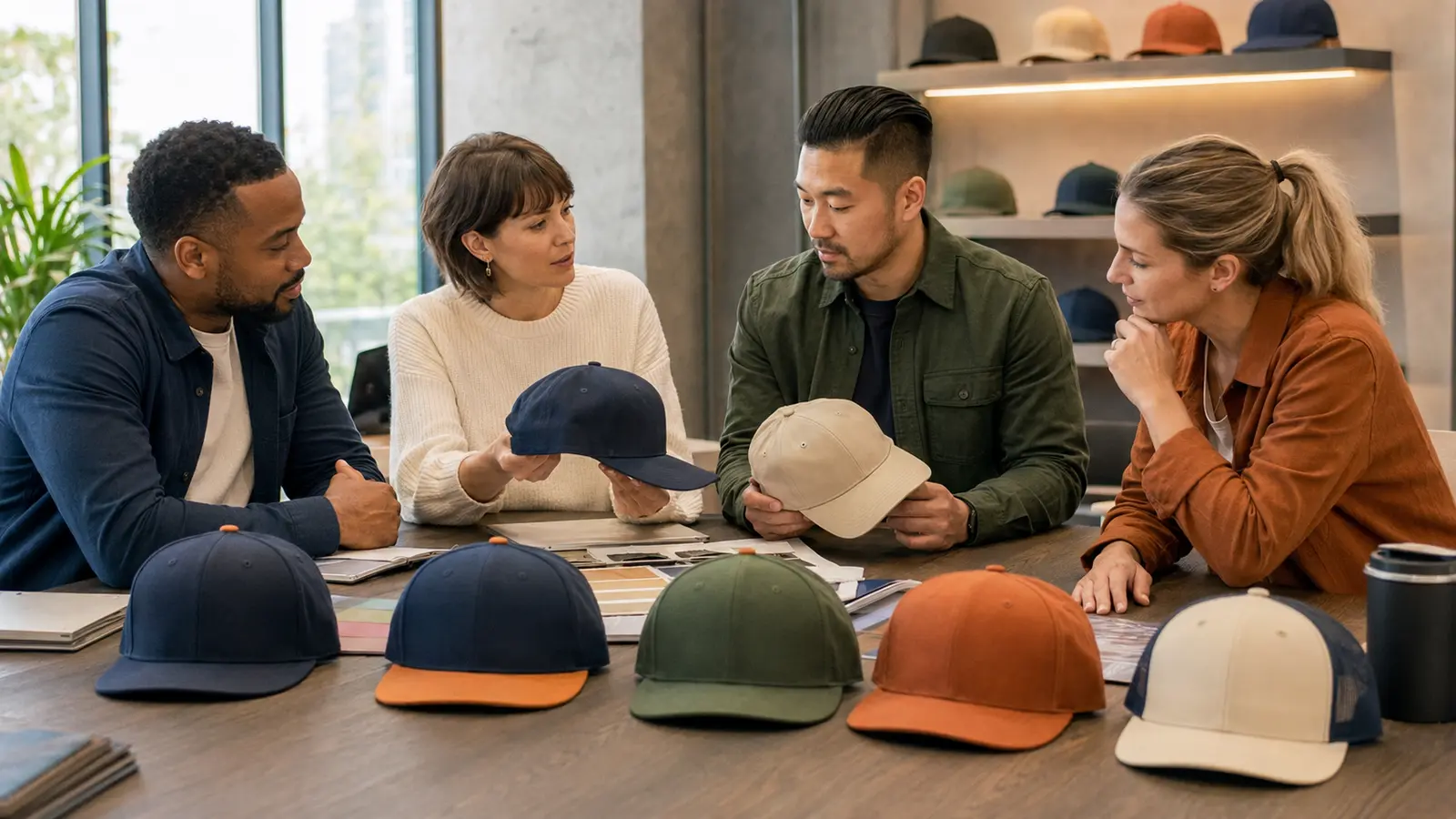
The right cap type depends on wearer, use environment, brand position, fit strategy and inventory plan.
Frequently Asked Questions
Final Recommendation
Choose the cap type by working backward from the wearer, use environment, brand position, fit strategy, decoration, inventory model, and reorder plan.
- Select a fitted cap for a clean closed-back presentation when you can manage sizes.
- Select a snapback for adjustable fit and a bold team, retail, or streetwear direction.
- Select a strapback for adjustable fit with a refined casual closure.
- Select a trucker cap for mesh ventilation and a distinctive outdoor or promotional look.
- Select a bucket hat when the collection needs an all-around brim and a separate lifestyle headwear silhouette.
Then convert the style name into a complete written specification. Crown profile, panels, fabric, brim, closure, sweatband, measurements, logo method, labels, packaging, tolerances, and sample approval are what make a design repeatable.
About JIUMU
JIUMU is a Guangdong-based B2B supplier of custom hats, teamwear, logo apparel, uniforms, bags and branded merchandise. Established in 2010, JIUMU supports teams, schools, clubs, distributors, uniform dealers, promotional buyers, retailers and private-label brands.