How to Wash and Clean a Baseball Cap Without Ruining It
A baseball cap is a shaped textile product, not flat laundry. Its crown may contain stiffening, its visor may use plastic or paperboard, and its decoration may include embroidery, printing, or patches. A method that cleans the fabric can still distort the crown, warp the brim, transfer dye, or damage the logo.
The best answer to “How do I wash a baseball cap?” therefore begins with inspection, not immersion. For a team, school, retailer, promotional company, or private-label brand, clear care instructions also reduce avoidable damage and inconsistent presentation.
Quick Answer: What Is the Safest Way to Clean a Baseball Cap?
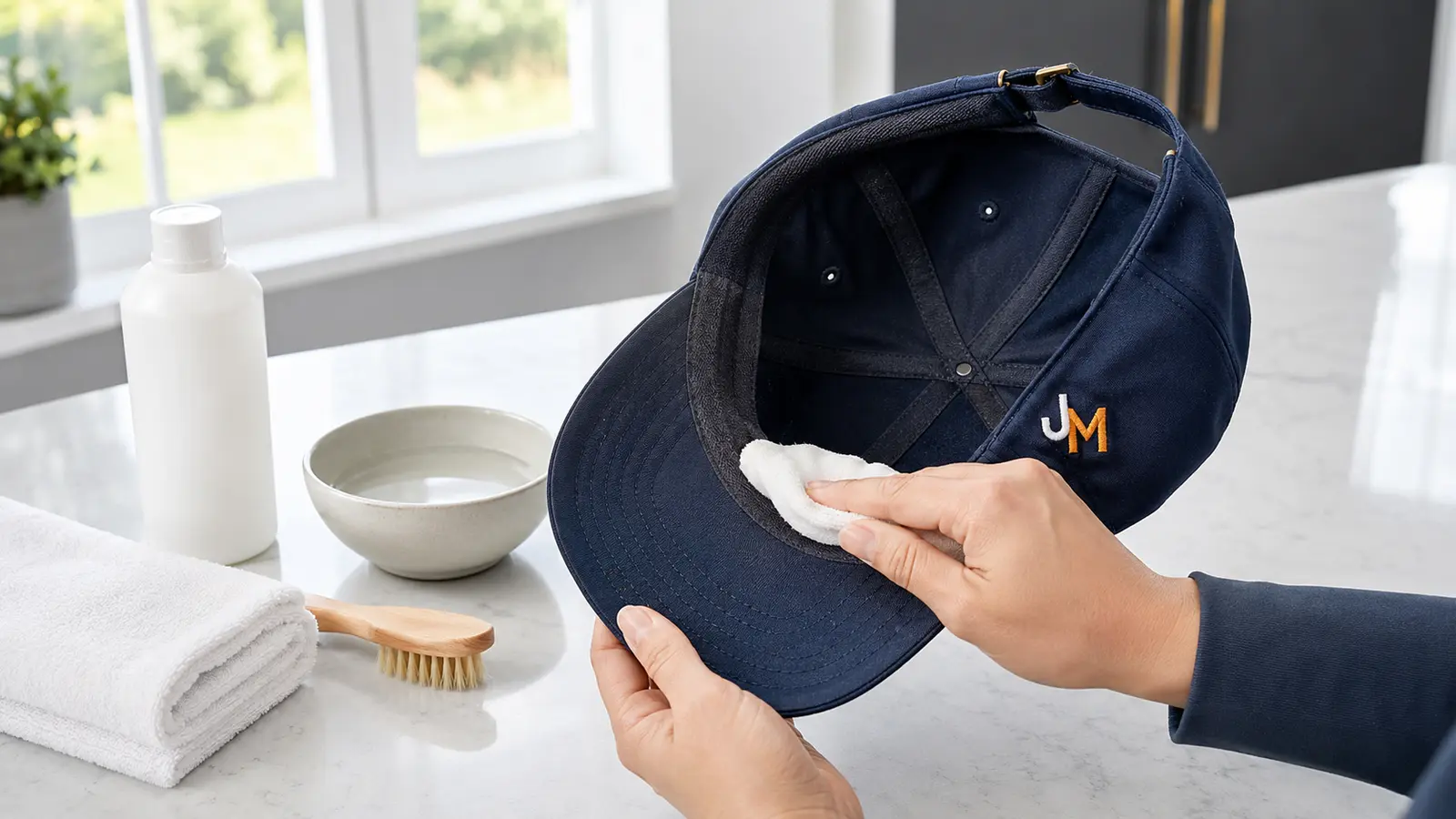
The safest default is to check the care label, test for colorfastness, remove loose dust, and spot-clean the cap with cool water, a small amount of mild color-safe detergent, and a white cloth or soft brush. Support the crown while cleaning, avoid bending the brim, blot away excess moisture, reshape the cap, and let it air-dry on a rounded form away from direct heat and strong sunlight.
Do not automatically put a cap in a washing machine, dishwasher, or tumble dryer. A full hand wash is appropriate only when the care instructions, fabric, brim insert, and decoration can tolerate immersion. Wool, vintage caps, leather or suede details, unknown brim materials, delicate patches, and caps with unstable dyes need more conservative treatment.
This cautious approach is consistent with New Era’s product-care guidance, which recommends spot cleaning cotton, polyester, and wool fabrics or blends with a damp cloth and mild, color-safe detergent, followed by natural air drying in shape.
Why Can Washing Ruin a Baseball Cap?
Cleaning problems usually come from the interaction of water, detergent, movement, and heat with the cap’s construction.
- Crown structure: Structured caps often contain buckram or another stiffening layer behind the front panels. Rubbing, spinning, or crushing can crease it. Unstructured caps can still shrink, twist, or dry with uneven panels.
- Brim construction: Modern caps commonly use plastic visor inserts, while some older or lower-cost products use paperboard. Plastic can warp under heat; paper-based inserts can swell or delaminate when saturated. Treat an unknown brim as non-immersible.
- Fiber behavior: Cotton may shrink or release dye; wool can felt under heat and friction; corduroy can develop flattened pile; mesh may snag or stretch.
- Decoration: Embroidery, transfers, printing, woven patches, rubber/PVC patches, and leather-style labels do not tolerate the same cleaners or temperatures.
- Sweatband soil: Body oils, salts, sunscreen, hair products, and dust concentrate in the band. Excess water can carry that soil into adjacent panels.
Choose the Cleaning Method Before You Add Water
Use the following decision table as a starting point. The sewn-in care label or supplier’s written instruction takes priority.
| Cap condition or construction | Recommended starting method | Avoid unless explicitly approved | Main risk |
|---|---|---|---|
| Light dust or surface soil | Dry brush or lint roller, then spot clean if needed | Full immersion | Unnecessary wetting and color change |
| Local food, dirt, or sweat mark | Colorfastness test, then spot clean | Strong stain remover applied directly | Fading or a visible cleaning ring |
| Washable cotton or polyester cap with known plastic brim | Controlled hand wash after testing | Hot water and aggressive scrubbing | Shrinkage, dye release, brim distortion |
| Structured fitted or snapback cap | Spot clean while supporting the crown | Machine wash or crushing | Buckram creasing and loss of profile |
| Wool or wool-blend cap | Follow label; use mild wool detergent and minimal agitation | Standard alkaline detergent, rubbing, heat | Felting, shrinkage, distortion |
| Vintage cap or unknown brim insert | Dry cleaning by a suitable specialist or conservative spot cleaning | Soaking, dishwasher, washing machine | Cardboard failure and permanent shape loss |
| Cap with leather, suede, or delicate patch | Clean each material according to its own instructions | Immersion and general-purpose stain remover | Staining, hardening, delamination |
| Printed or heat-transfer decoration | Gentle spot clean around decoration | Heat, solvents, stiff brush | Lifting, cracking, or color loss |
What You Need
Prepare the simplest possible kit:
- A clean white microfiber cloth
- A soft-bristle toothbrush or dedicated garment brush
- A small bowl or clean basin
- Cool to lukewarm water
- A mild, color-safe liquid detergent
- White absorbent towels
- A rounded bowl, clean hat form, or bundled towel for reshaping
- Cotton swabs for narrow seams, if needed
A white cloth makes dye transfer visible. A liquid detergent is easier to dilute and rinse than undissolved powder. Avoid chlorine bleach, concentrated degreasers, fabric softener, and products containing unknown solvents unless the cap’s care instructions specifically permit them.
Step 1: Inspect the Baseball Cap Before Cleaning
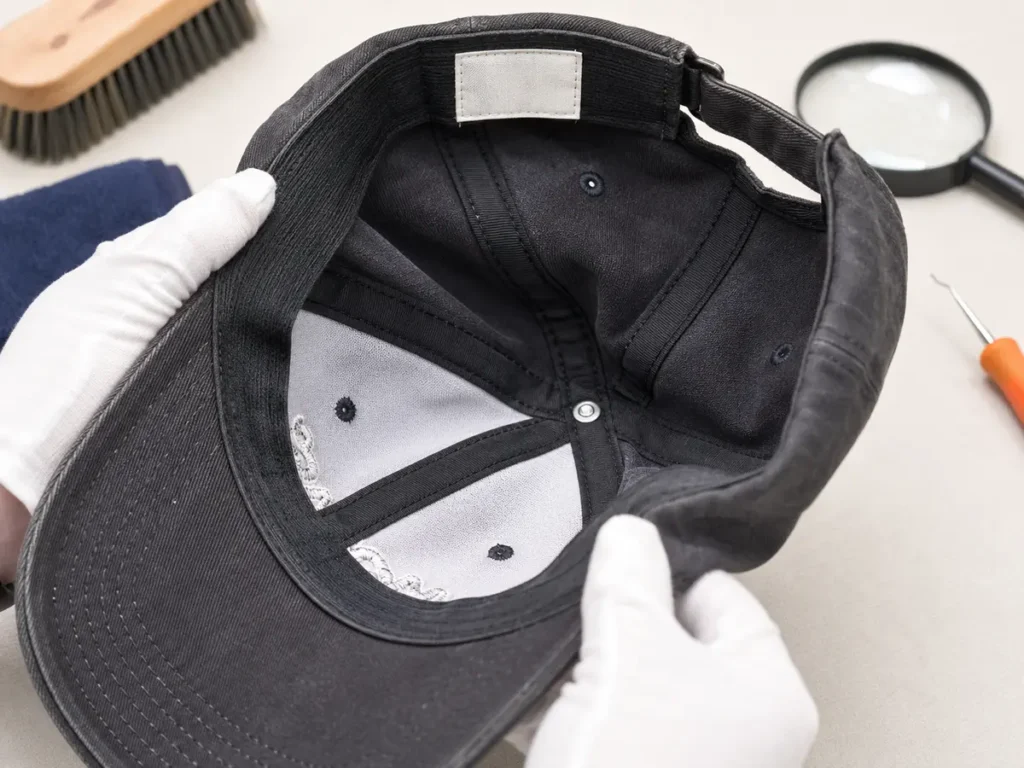
Take two minutes to answer six questions.
1. What does the care label say?
Look for hand-wash, machine-wash, temperature, bleaching, drying, and dry-cleaning instructions. If the label says “spot clean only” or “do not wash,” do not override it because another cap survived a different method.
2. What is the shell material?
Identify cotton, polyester, wool, a blend, corduroy, denim, nylon, or another fabric. If the cap has several materials, follow the requirement of the most delicate visible component.
3. Is the crown structured?
Pinch the front panel lightly from inside. A firm front may indicate buckram or fused support. Do not fold, twist, or scrub a structured crown flat.
4. What is inside the brim?
The label may not identify the insert. A vintage cap, unknown promotional cap, or cap that feels papery should not be soaked. When uncertain, keep the brim as dry as possible.
5. Which decoration methods are present?
Check the front, side, back, closure, and inside. Note embroidery, printed graphics, heat transfers, woven labels, leather-style patches, rubber patches, metallic threads, and stickers. Remove only temporary packaging stickers if the owner wants them removed; do not pull at stitched or bonded components.
6. Is the dye stable?
Mix a drop of detergent in water. Apply it with a cotton swab to a hidden area, such as the underside of the sweatband. Wait several minutes, blot with a white cloth, and let the test area dry. If color transfers or the shade changes, stop and use a specialist cleaner or ask the supplier for guidance.
Step 2: Remove Loose Dust First
Brush the cap gently before applying moisture. Work with the fabric grain and use very light pressure around embroidery and patches. Dust left on the surface can turn into gray slurry and spread during wet cleaning.
For lint, use a low-tack lint roller or a clean piece of low-adhesion tape. Do not use sticky tape on brushed fabric, aged printing, loose embroidery, or delicate patch surfaces.
Step 3: Spot-Clean the Cap—the Safest General Method
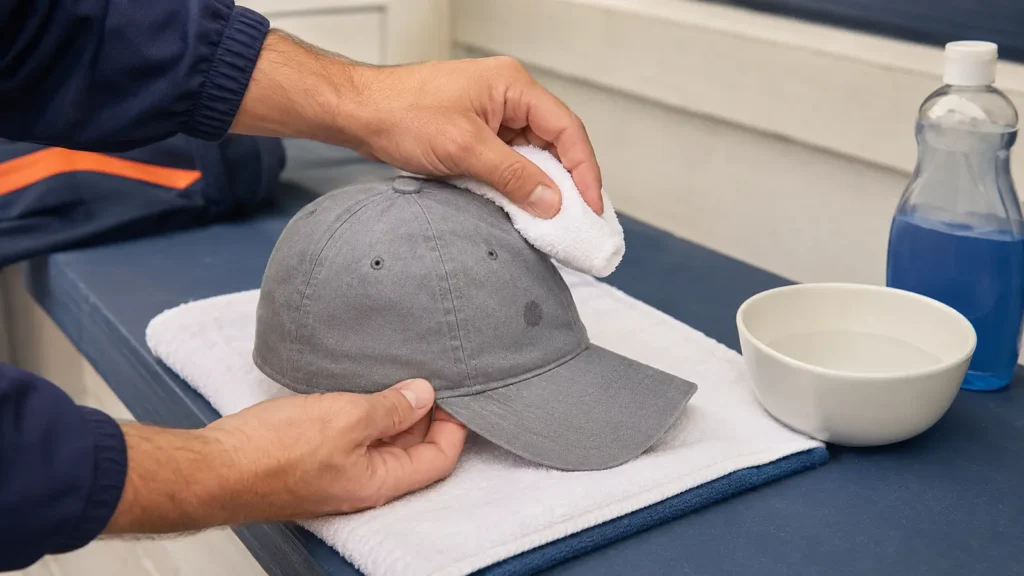
Spot cleaning limits water exposure and mechanical stress. It is the right first method for most caps with localized soil.
Make a weak cleaning solution
Add a small amount of mild liquid detergent to cool water. You need lightly soapy water, not foam. Excess detergent takes longer to remove and can leave a stiff or visible residue.
Support the cap
Place a clean bundled towel inside the crown or hold the cap from inside. This prevents the cleaning hand from pushing a permanent crease into the front panels.
Dab before you scrub
Dip a white cloth into the solution and wring it until damp, not dripping. Dab the stained area from the outside edge toward the center. This reduces spreading. For soil trapped in a seam or textured sweatband, use a soft brush with short, light strokes.
Work in small sections
Clean one panel or section of the sweatband at a time. Avoid creating a hard wet boundary, which can dry into a ring. Feather the edge with a clean damp cloth.
Remove detergent
Use a second cloth dampened with plain cool water to blot away the cleaning solution. Repeat with clean areas of the cloth until no foam or slippery residue remains.
Blot, reshape, and air-dry
Press the cap gently between white towels. Do not wring it. Return the crown and brim to their intended shape, then dry as described later in this guide.
Step 4: Hand-Wash Only When the Cap Can Be Immersed
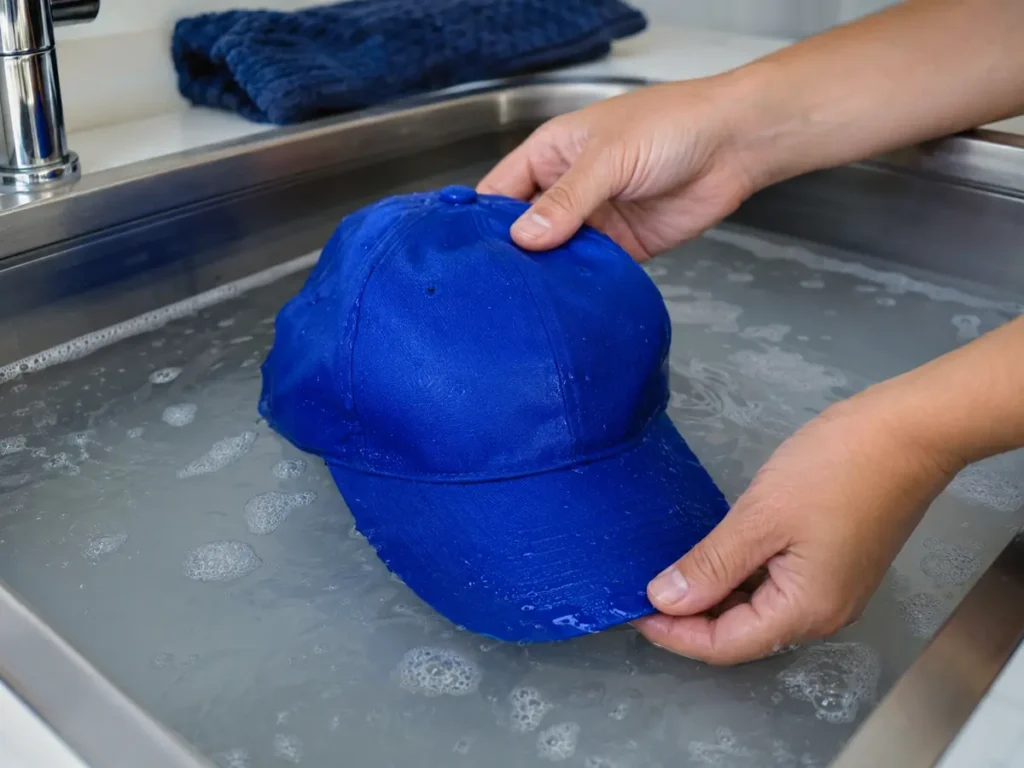
A controlled hand wash can clean broader soil more evenly than repeated spot treatment, but it is not universal. Use it when the care label permits washing, the cap is colorfast, the brim insert is water-safe, and all decoration methods can tolerate immersion.
- Prepare cool or lukewarm water. Hot water increases the risk of shrinkage, dye movement, adhesive failure, and visor deformation.
- Dilute a small amount of mild detergent completely. Do not pour concentrate directly on the cap.
- Keep the brim supported. Lower the crown into the water without folding or twisting the visor.
- Gently move the cap through the solution. Use your fingertips or a soft cloth on soiled areas. Avoid long soaking. As a conservative working range, inspect after a few minutes rather than leaving the cap unattended.
- Rinse thoroughly with cool water. Support the cap throughout. Do not wring, twist, or pull the closure.
- Blot with towels. Press out water without flattening the crown.
- Reshape immediately. Correct the panel alignment and brim curve before drying.
Whirlpool’s published cap-care guide also favors hand washing, reshaping, and air drying, while noting that method choice depends on the cap. See its baseball-cap washing guidance.
How to Remove Sweat Stains Without Creating a New Problem
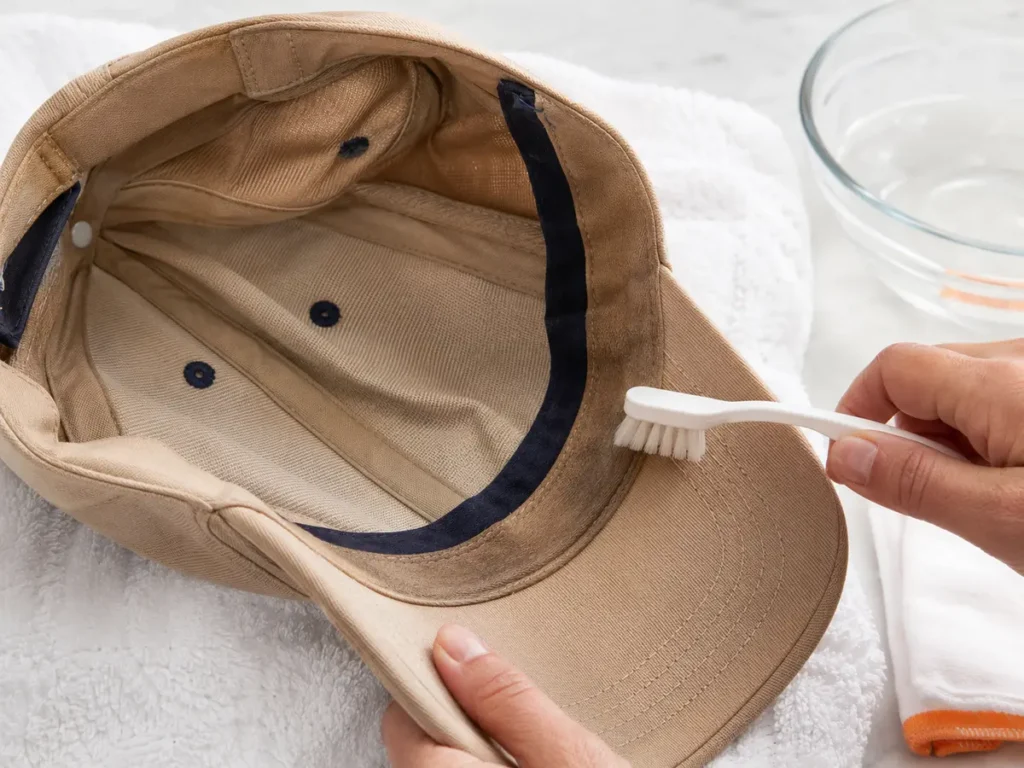
Sweat stains are a combination of salts, oils, skin products, and environmental soil. The yellow or dark mark may also include dye change, which cleaning cannot always reverse.
Start with the sweatband
Fold the sweatband outward only as far as the construction comfortably allows. Place a towel behind it to stop dirty solution from reaching the crown. Apply diluted mild detergent with a damp cloth or very soft brush. Work in short sections and blot frequently.
Allow short contact time
For a persistent mark on a washable, colorfast fabric, let the diluted solution remain for a few minutes before blotting. Do not let concentrated detergent dry on the cap.
Rinse by blotting
Use a fresh cloth dampened with plain cool water. Repeat until residue is gone. A stiff band after drying usually indicates remaining detergent.
Treat home remedies cautiously
Some cap-care articles recommend baking soda pastes or stronger stain treatments. These may work on certain washable materials, but they can also alter dark dyes, leave residue, or create a lighter ring. Test any treatment in a hidden area and follow the cap supplier’s instruction. For wool, use a suitable mild wool detergent; Woolmark advises gentle washing in lukewarm water around 30°C when a wool garment’s care claim allows hand washing.
If the stain remains after a gentle cycle of treatment, allow the cap to dry and reassess. Repeated wet scrubbing can do more harm than a faint residual mark.
Material- and Decoration-Specific Cleaning Decisions
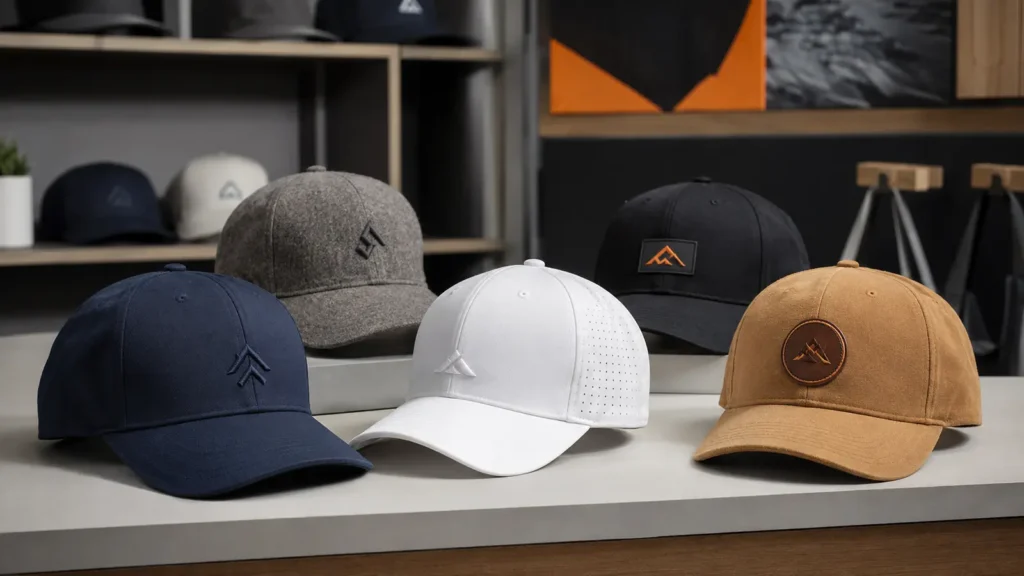
| Material or feature | Practical care approach | What to watch |
|---|---|---|
| Cotton twill | Spot clean first; controlled hand wash only if approved | Shrinkage, fading, water rings |
| Polyester performance fabric | Mild detergent and cool water; rinse oily residues well | Heat deformation, finish damage, odor trapped in band |
| Wool or wool blend | Follow label; use wool-suitable detergent and minimal movement | Felting, shrinkage, surface pilling |
| Corduroy | Dab with the wale; use a very soft brush after drying | Crushed pile and directional shading |
| Denim or washed cotton | Test dye transfer carefully | Fading and color movement into thread or patches |
| Mesh or perforated panels | Support while cleaning and avoid snagging | Stretching, torn holes, delamination |
| Flat or 3D embroidery | Blot around stitches and brush gently with thread direction | Snagged thread and detergent trapped in dense stitching |
| Heat transfer or printed logo | Spot clean; keep heat and solvents away | Cracking, lifting, surface abrasion |
| Woven patch | Clean the patch and shell gently as a combined area | Edge fraying or dye transfer |
| Rubber/PVC patch | Wipe with mild solution if approved | Heat deformation and adhesive failure |
| Leather or suede detail | Use material-specific care; keep general wash solution away | Darkening, hardening, water spots |
Three cases need extra caution:
- Fitted caps: Their circumference and crown geometry are precise, so spot cleaning is the conservative choice unless broader washing is approved.
- White caps: Visible soil does not make bleach automatically safe. Chlorine can weaken fibers, yellow synthetics, and alter logos. Use only label-approved products.
- Vintage caps: Unknown dyes, aged thread, foam, paper-based visor inserts, and brittle printing increase risk. Do not soak a valuable vintage cap; consult a specialist.
Can You Wash a Baseball Cap in a Washing Machine?
Sometimes—but only when the care label or supplier confirms it, the materials are machine washable, the brim uses a water-safe insert, and the decoration can tolerate the cycle.
If machine washing is explicitly allowed:
- Use cold water and a delicate cycle.
- Place the cap in a protective hat cage or mesh bag that does not crush the crown.
- Wash it alone or with lightweight, color-compatible items.
- Use a small amount of mild detergent.
- Remove it immediately after the cycle.
- Reshape and air-dry; never tumble-dry unless the label specifically permits it.
Machine agitation and spinning create risk without offering much advantage for a single cap. For structured, fitted, vintage, wool, or heavily decorated caps, spot cleaning or controlled hand cleaning is usually the better decision.
Should You Put a Baseball Cap in the Dishwasher?
We do not recommend the dishwasher as a general cap-care method. Dishwasher cycles are designed for hard food-contact surfaces, not shaped textiles. Heat, water pressure, rack contact, and dishwasher detergent can affect dye, adhesive, brim shape, and decoration. Food residue and cleaning a wearable textile should also remain separate processes.
A cap cage does not make an incompatible detergent, temperature, or material safe. Use the care label and a textile-appropriate method instead.
How to Dry a Baseball Cap Without Losing Its Shape
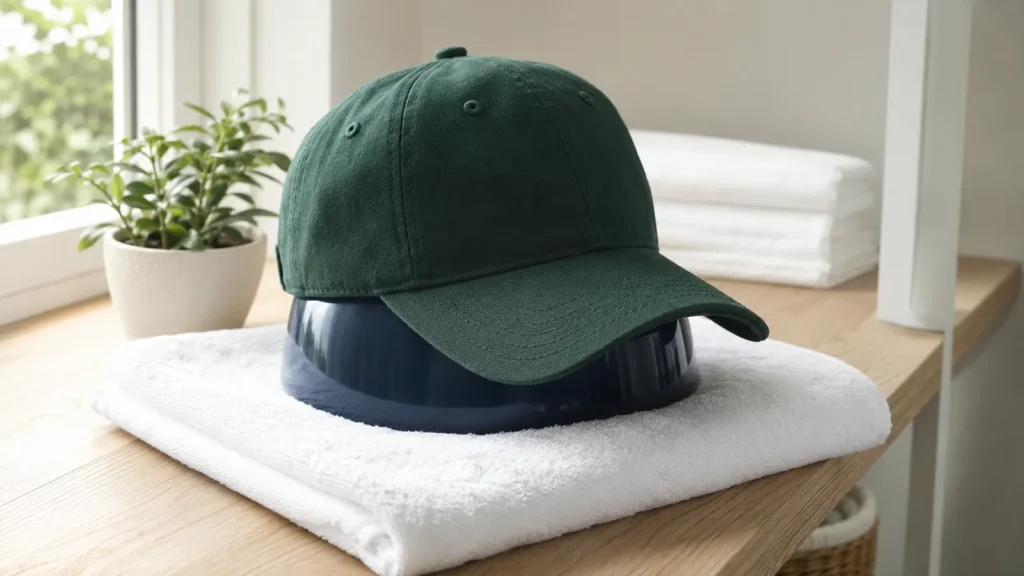
Drying is part of the cleaning process, not an afterthought.
- Blot excess water. Use a white towel and gentle pressure.
- Re-form the crown. Align the front panels and smooth creases while the fabric is damp.
- Set the brim curve. Return it to its original curve with your hands. Do not force a flat brim into a curve or bend a curved visor sharply.
- Use a rounded support. Place the cap over a clean bowl, purpose-made form, or bundled towel that matches the crown without stretching it.
- Air-dry in moving room air. Choose shade and moderate temperature.
- Avoid direct heat. Do not use a tumble dryer, hair dryer, radiator, heated rack, or hot car.
- Avoid prolonged strong sun. UV exposure and heat can produce uneven fading or shrinkage.
- Wait until fully dry. Wearing or stacking a damp cap can set creases and trap odor.
New Era’s guidance likewise recommends natural air drying in the cap’s normal position to reduce stretching and misshaping.
Ten Common Baseball Cap Cleaning Mistakes
- Ignoring the care label. Similar-looking caps can use different internal materials.
- Skipping the colorfastness test. Dark cotton, denim, and contrast panels can transfer dye.
- Using too much detergent. Residue attracts soil and makes sweatbands stiff.
- Pouring cleaner directly on the cap. Concentrate may create a pale spot.
- Scrubbing embroidery aggressively. The brush can fuzz or snag thread.
- Soaking an unknown brim. Paper-based inserts may not recover.
- Twisting or wringing the cap. This distorts the crown and visor.
- Using hot water or heat drying. Heat raises the risk of shrinkage and deformation.
- Drying the cap flat and crushed. Damp fabric can set in the wrong shape.
- Trying several stain chemicals at once. Mixed treatments make color and material reactions harder to control.
A Practical Cap-Care Program for Teams, Schools, and Brands
For a single cap, care is personal maintenance. For a 50-piece, 500-piece, or repeat-order program, care becomes a product-specification and communication issue.
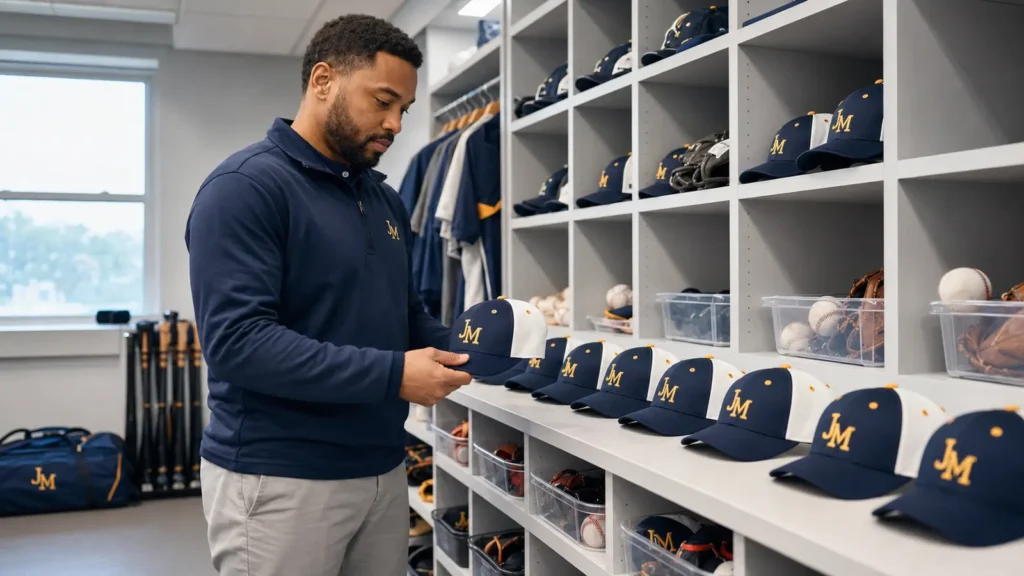
Standardize the material and decoration
If different production runs use different shell fabrics, sweatbands, threads, or patch constructions, one care instruction may no longer fit the entire program. Record the approved bill of materials and decoration method for repeat orders.
Approve care guidance and retain reference samples
Ask the supplier for care language before bulk production. It should reflect the actual cap and cover water temperature, cleaning method, bleaching, drying, and patch or visor limitations. Keep an approved pre-production sample and a bulk reference for comparison if a complaint occurs.
Give end users a short care card
A useful card can say:
- Check the sewn-in label.
- Spot clean with cool water and mild detergent unless otherwise stated.
- Do not bleach.
- Do not twist or machine-dry.
- Reshape and air-dry.
- Contact the team or brand before treating an unusual stain.
Teams can also keep a small care kit and clean caps in small batches grouped by construction and color.
How Cap Specifications Affect Long-Term Care
Care performance begins before production. Buyers should treat the following as procurement decisions:
- Shell fiber and finish: Confirm whether the fabric is pre-washed, brushed, coated, or moisture-managing.
- Color standard: Use approved lab dips or material swatches and define acceptable shade variation.
- Visor insert: Ask whether it is plastic or paper-based and whether immersion is permitted.
- Front-panel support: Confirm structured or unstructured construction and the stiffening material.
- Sweatband: Specify fiber, color, thickness, and expected use conditions.
- Embroidery: Review stitch density, backing, thread type, and puckering.
- Patch attachment: Confirm sewn, heat-applied, or adhesive-assisted construction.
- Care label: Approve wording, symbols, language, and placement.
- Packaging: Prevent caps from being crushed in storage or shipment.
Planning a custom cap program? Explore JIUMU custom baseball caps and send your cap style, quantity, colors, logo file, material preference, closure, packaging needs, and target delivery date for a specification-based quotation.
Sample Approval and Quality-Control Checklist
Before approving a custom baseball cap for bulk production, review both appearance and care-related construction.
| Checkpoint | What to inspect | Why it matters for cleaning and use |
|---|---|---|
| Fabric and color | Fiber content, hand feel, shade under neutral light | Determines detergent, water, and color-transfer risk |
| Crown structure | Profile, panel symmetry, buckram or support | Shows how easily shape may be creased |
| Visor | Insert type, curve, edge stitching | Determines immersion and heat sensitivity |
| Sweatband | Material, seam quality, color | Receives the most frequent cleaning |
| Embroidery | Thread coverage, backing, loose ends, puckering | Dense areas can trap detergent or snag |
| Patch or transfer | Edge bond, stitching, surface integrity | Weak edges may lift during cleaning |
| Label | Accurate fiber and care information | Gives users the correct method |
| Trial care check | Supplier-agreed cleaning test on a sample | Confirms that written care advice is realistic |
| Post-dry measurement | Circumference and profile after approved test | Identifies shrinkage or distortion before bulk order |
| Packaging | Crown support and carton loading | Prevents shape damage before the cap is worn |
Do not create a care claim from a sample test alone if production materials will change. Reconfirm when fabric, dye lot, patch supplier, adhesive, or visor construction changes.
What to Send a Custom Cap Supplier for a Quotation
For an accurate quotation, provide:
- Buyer type and destination market
- Cap style: baseball cap, fitted cap, snapback, trucker cap, dad cap, or performance cap
- Structured or unstructured crown
- Panel count and profile
- Curved or flat brim
- Closure type and size range
- Estimated order quantity and repeat-order plan
- Shell fabric, sweatband, and mesh preferences
- Pantone or physical color reference
- Vector logo file and decoration position
- Embroidery, printing, woven patch, rubber/PVC patch, or leather-style patch preference
- Private label, hangtag, barcode, and packaging needs
- Target delivery date and destination
- Required care-label language
- Reference images or a tech pack
Questions to Ask Before Ordering Custom Baseball Caps
- What are the exact shell, sweatband, mesh, and visor materials?
- Is the brim insert plastic, paper-based, or another material?
- Is the front crown structured, and what support is used?
- Which cleaning method will be printed on the care label?
- Has the proposed fabric and decoration combination been evaluated using that method?
- Can the supplier provide a physical sample before bulk production?
- How will Pantone color and repeat-order shade consistency be managed?
- Which logo method is most appropriate for the intended cleaning frequency?
- How are caps supported and packed to prevent crushing?
- Which specifications will be recorded for future repeat orders?
Why JIUMU for Custom Baseball Caps and Teamwear?
JIUMU has supported B2B custom headwear, teamwear, logo apparel, bags, and branded merchandise programs since 2010. The company works with sports teams, schools, clubs, distributors, promotional product companies, retailers, and private-label brands in North America and Europe.
Relevant capabilities include:
- OEM and ODM product development
- Custom baseball caps and other headwear styles
- Logo embroidery, screen printing, heat transfer, and sublimation
- Woven, rubber/PVC, and leather-style patch options
- Fabric sourcing and Pantone color matching
- Private labels, woven labels, hangtags, and custom packaging
- Digital mockups and physical samples
- Bulk production, quality control, and export support
- Typical MOQ from 50 pieces, subject to the cap structure and customization
For teams that need more than caps, JIUMU can coordinate headwear with baseball team uniform packages to improve logo, color, packaging, and reorder consistency.
Frequently Asked Questions
Final Recommendation
The best way to clean a baseball cap is the least aggressive method that removes the soil. Begin with inspection and dry dust removal. Spot-clean with cool water and mild detergent while supporting the cap. Use a full hand wash only when the complete construction is known to be washable. Keep heat, twisting, harsh chemicals, and uncontrolled machine action out of the process. Reshape the cap while damp and let it air-dry on a rounded support.
For professional buyers, apply the same logic at the specification stage. Confirm the shell, sweatband, visor insert, structure, decoration, care label, sample test, and packaging before bulk production. Clear decisions before ordering make aftercare easier for every wearer.
Request a JIUMU custom cap quotation. Share your reference image or tech pack, order quantity, colors, size or closure, fabric, logo method, packaging requirements, destination, and target delivery date through the JIUMU contact page, by WhatsApp/phone at +86 18507502899, or by email at zhengdong@jiumugear.com.
Sources and Further Reading
- New Era Customer Care — Product care guidance
- New Era Europe — Cap care guide
- The Woolmark Company — How to wash wool
- The Woolmark Company — Washing instruction symbols explained
- Whirlpool — How to wash a baseball cap
Care note: Materials, dyes, adhesives, visor inserts, and decorations vary. The sewn-in care label and the cap supplier’s written guidance override general instructions.
About JIUMU
JIUMU Editorial Team develops practical B2B guidance for custom hats, teamwear, logo apparel and branded merchandise. JIUMU has served professional buyers since 2010.
About JIUMU · Contact JIUMU