How to Choose Backpack Lining and Reinforcement Materials
Backpack buyers naturally focus on the outer fabric, zipper, color, and logo. Yet many failures begin inside the bag: a lining tears at a pocket corner, a laptop sleeve is padded but rests directly on the floor, a base board curls, foam becomes permanently compressed, or a shoulder-strap anchor pulls through an insufficiently reinforced panel.
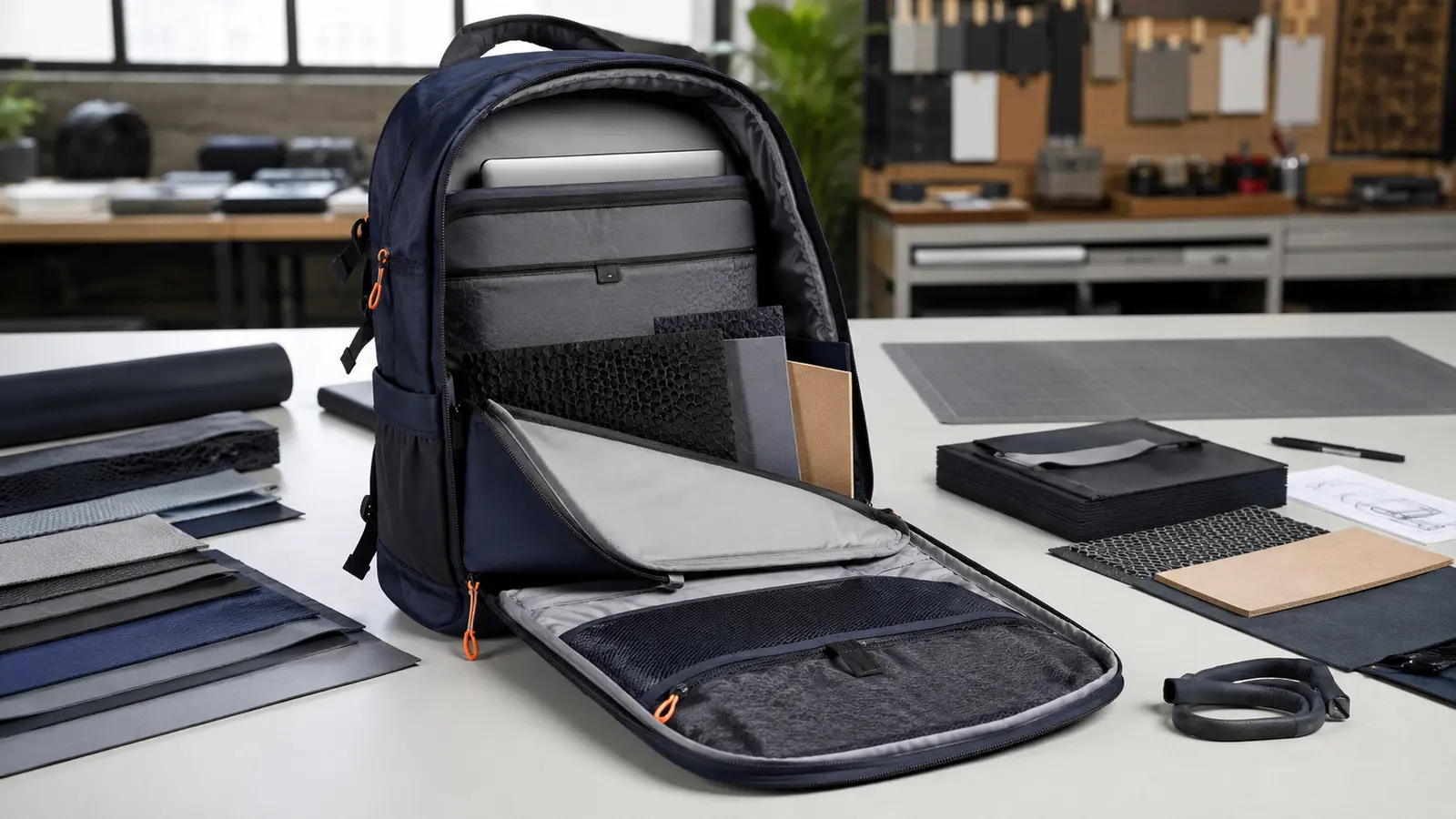
Lining and reinforcement should therefore be specified as a material system, not as vague instructions such as “use thick foam” or “reinforce the bottom.” Each layer has a different job. Lining covers and organizes the interior. Foam cushions. EVA can add firmer resilient padding. Mesh manages contact and airflow. Structural sheets maintain shape or spread load. Webbing, patches, bartacks, and backing layers reinforce concentrated stress.
This guide helps schools, sports organizations, distributors, promotional buyers, retailers, and private-label brands choose those layers and document them for sampling and bulk production.
Quick Answer
Choose backpack lining and reinforcement materials by defining the use, carried load, compartments, impact risk, desired structure, cleaning method, target weight, and price level. Polyester lining is a versatile default; nylon may be selected when a particular lightweight or abrasion-performance specification is required; and RPET can support a verified recycled-content program. Use soft foam for comfort, denser EVA for controlled padding, spacer mesh for ventilated contact surfaces, and PE or PP sheets for shape and load distribution. Specify composition, construction, weight or thickness, density or hardness where relevant, color, location, dimensions, tolerances, and test method in the tech pack.
Think in Five Internal Material Layers
The internal construction becomes easier to specify when divided into five functional layers.
| Layer | Primary purpose | Typical materials | Common failure if underspecified |
|---|---|---|---|
| Interior surface | Cover seams, organize contents, improve appearance and cleaning | Polyester, nylon, RPET woven lining | Tearing, fraying, staining, color transfer, sagging |
| Cushioning | Absorb minor impact, protect contents, improve comfort | PU foam, PE foam, EVA, felt or nonwoven padding | Bottoming out, permanent compression, uneven thickness |
| Ventilation/contact | Reduce a clammy feel and create airflow channels | Spacer mesh, tricot, air mesh | Snagging, abrasion, rough hand feel, delamination |
| Structural support | Maintain shape, distribute load, stabilize the base or back panel | PE sheet, PP board, fiberboard in selected dry applications | Warping, sharp edges, cracking, excessive stiffness |
| Stress reinforcement | Spread concentrated forces at anchors and openings | Webbing, backing patches, extra fabric layers, bartacks, Box-X seams | Strap pullout, handle failure, seam tearing |
Adding more material to every layer does not automatically improve the backpack. It can increase weight, reduce usable volume, make sewing difficult, create stiff transitions, and raise cost. The better approach is to strengthen the locations that face real load or impact.
Does Every Backpack Need a Lining?
No. Some simple drawstring bags, dry-bag-style products, lightweight promotional sacks, or deliberately minimalist backpacks may use a single-layer or bound-seam interior. A lining becomes valuable when the product needs organized pockets, a finished appearance, separation from coatings or foam, protection of internal components, custom branding, or easier replacement of an interior surface specification.
An unlined construction exposes seam allowances, coated fabric backs, reinforcement patches, and hardware attachments. It may be lighter and easier to inspect, but it can look less refined and may offer fewer organization options. A lined construction hides structural work and supports pockets, but it also adds material, labor, cleaning considerations, and a second surface that can tear.
The decision should be based on product architecture rather than the assumption that all premium bags must be lined.
Polyester, Nylon, and RPET Lining Compared
Polyester Lining
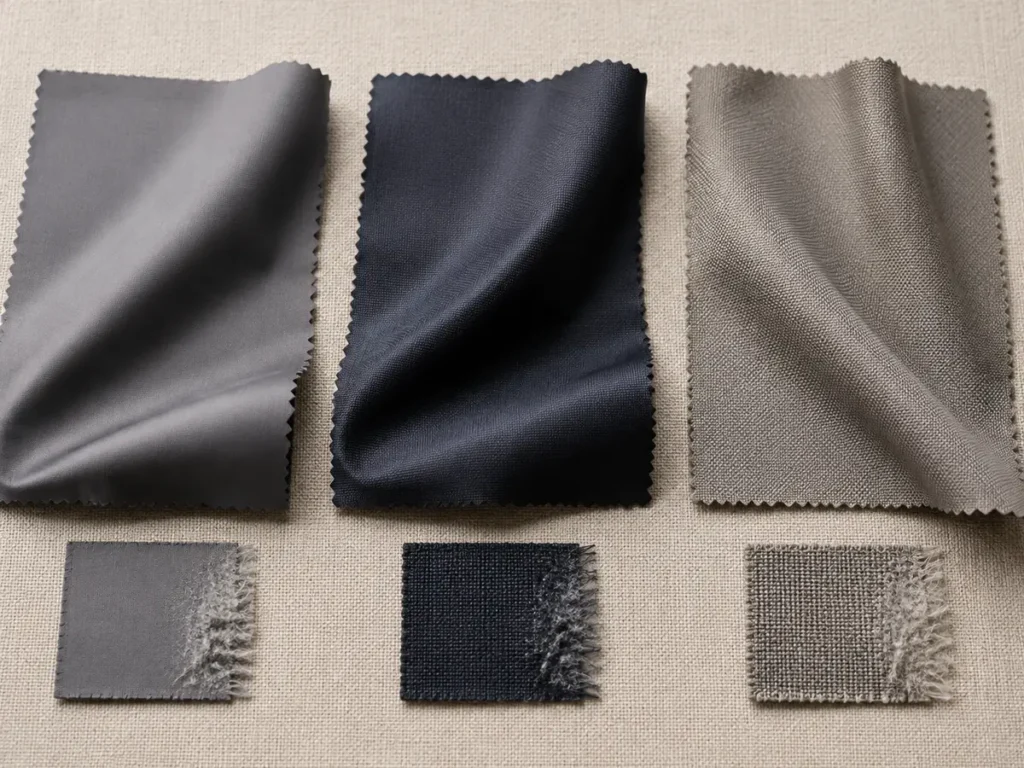
Polyester is a common lining choice because it is widely available in different weights, weaves, colors, coatings, and printed constructions. It can support school, sports, commuter, promotional, and retail backpacks. A smooth woven polyester can make contents easy to insert and remove, while a heavier or denser construction can improve perceived substance.
Do not specify only “210D polyester lining.” Denier describes yarn linear density, not finished fabric weight, weave density, tear strength, abrasion result, colorfastness, or coating. Two fabrics with the same denier description can perform differently.
Nylon Lining
Nylon can be selected when a buyer wants a particular hand feel, lightweight construction, or tested abrasion and tear performance. It may be used in technical, travel, or higher-spec bags. Nylon is not automatically stronger than every polyester lining; the yarn, weave, weight, finish, and test result determine actual performance.
Confirm color migration or staining risk with adjacent materials, especially for light interiors, strong colors, or prolonged damp contact. Coating and finishing choices may also affect hand feel and cleanability.
RPET Lining
RPET is polyester made with claimed recycled inputs. From a construction perspective, it can be woven and finished for many of the same roles as conventional polyester. From a sourcing perspective, the critical difference is traceability.
Textile Exchange explains that the Global Recycled Standard and Recycled Claim Standard use chain-of-custody systems to verify and track recycled materials through the supply chain. A yarn or fabric description alone does not prove that a specific order qualifies for a certified product claim. Buyers should confirm scope certificates, transaction documentation where applicable, material percentage, labeling rules, and the final product’s eligibility.
Lining Selection Table
| Criterion | Polyester | Nylon | RPET polyester |
|---|---|---|---|
| Availability | Broad | Broad but style-specific options may vary | Depends on verified supply chain and order requirements |
| Weight range | Lightweight to substantial | Lightweight to substantial | Similar possibilities to polyester when available |
| Printing | Suitable constructions can support transfer, screen, or other printing | Method depends on fabric and finish | Similar to polyester but claim and supply chain must be controlled |
| Abrasion and tear | Must be verified for exact construction | Must be verified for exact construction | Must be verified; recycled claim does not replace performance testing |
| Cleaning | Often easy to wipe when smooth and appropriately finished | Depends on weave and finish | Depends on final fabric construction and finish |
| Main procurement risk | Assuming denier equals performance | Assuming fiber name guarantees superiority | Making an unsupported recycled-content or certification claim |
Specify Lining Weight, Construction, Color, and Finish
Fabric Weight and Density
A heavier lining may feel more substantial and resist some forms of handling, but excess weight can make the interior bulky. Very light lining can sag into compartments or become damaged by sharp items. Record mass per unit area when possible, along with yarn or denier description, weave, and approved physical swatch.
For abrasion, name the method and endpoint. ISO 12947-2 describes a Martindale method for determining specimen breakdown for many textile fabrics, but it excludes coated fabrics when evaluating the coated surface. This matters because a buyer must choose a method applicable to the actual lining construction rather than copying a generic cycle number.
Light vs Dark Interior Colors
Light gray, beige, or bright lining can improve visibility inside a deep backpack, making small items easier to find. Dark colors hide marks and coordinate with many outer fabrics. Strong custom colors can reinforce brand identity but may require colorfastness and staining checks against light contents or outer materials.
Approve color under agreed lighting and compare bulk against the physical standard. Screen colors and digital mockups are not adequate final references.
Coated or Uncoated Lining
A light coating may add body, reduce fraying, or change water and stain behavior. It may also make the lining noisier, stiffer, or more prone to creasing. If the lining must be washable, wipeable, or water-resistant, state the required test rather than assuming any coating provides the result.
Interior Cleanability
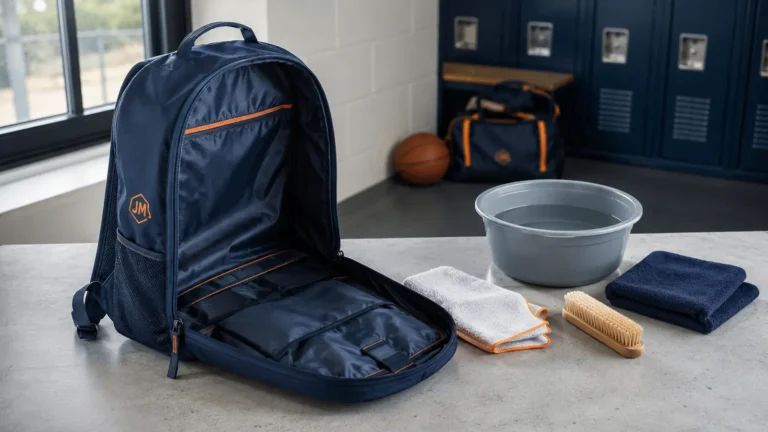
Define expected soil: pencil graphite, food, cosmetics, mud, sports gear, or ordinary dust. A smooth lining with accessible corners is usually easier to wipe than a rough fabric with deep folds. Removable base inserts and openable service seams can help repair or cleaning in some designs, but they also affect cost and assembly.
Care instructions must match all layers, adhesives, printed graphics, foam, board, and hardware—not only the lining fiber.
Foam, EVA, Mesh, and Structural Sheets
Soft Foam
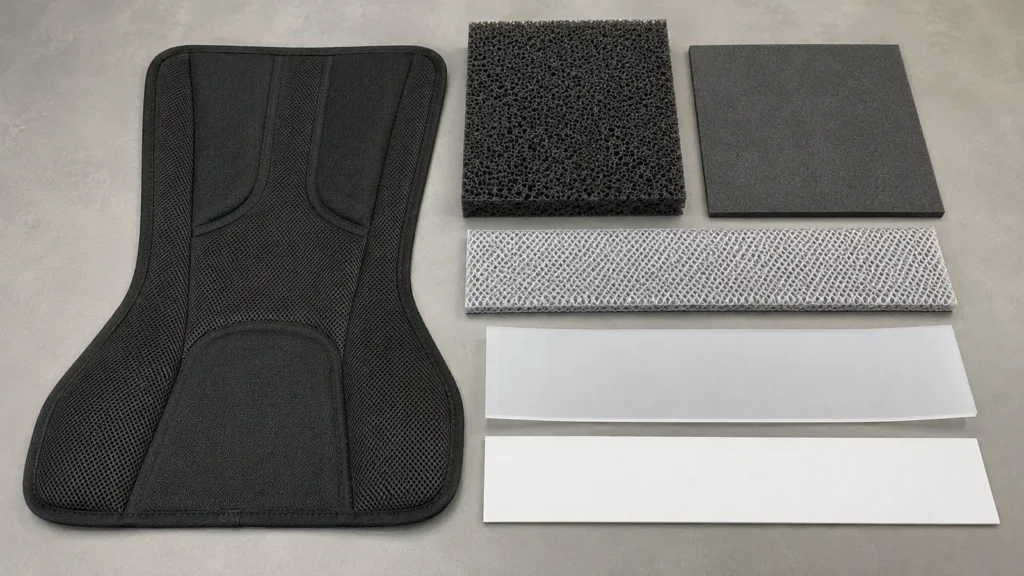
Polyurethane foam is commonly used for shoulder straps, back panels, sleeves, and quilted structure. It can create comfort with relatively low weight, but grades vary in density, firmness, compression recovery, cell structure, and aging. “Five-millimeter foam” specifies thickness only. It does not state how easily the foam compresses or whether it recovers after repeated loading.
EVA Foam
EVA can provide firmer, more controlled padding and shape. It is often used in protective panels, bases, molded or semi-molded components, and selected shoulder straps. Density, hardness, thickness, surface skin, color, odor, and compression behavior should be approved. Thicker or harder EVA is not automatically safer for electronics; an overly rigid layer may transmit impact or create hard edges if the design lacks clearance and load distribution.
PE Foam and Other Closed-Cell Padding
Closed-cell foams may be selected where buyers want low water absorption, shape stability, or particular cushioning behavior. They can feel firmer and may be less breathable. Compatibility with lamination, heat, folding, and the chosen sewing process should be checked.
Spacer Mesh and Air Mesh
Spacer mesh creates a three-dimensional textile layer used on back panels, shoulder straps, and contact surfaces. It can provide airflow channels and a cushioned surface, but it does not actively cool the wearer. Hole size, thickness, yarn texture, abrasion, snagging, edge finishing, and foam backing affect comfort and durability.
PE Sheets and PP Boards
Flexible polyethylene sheets can help spread load and stabilize back panels or bases. Polypropylene boards can create firmer structure. Thickness, grade, flex behavior, edge rounding, temperature performance, and placement must be stated. A sharp board corner can cut through lining, while an oversized board can prevent the backpack from flexing naturally.
Fiberboard and Cardboard
Paper-based boards may be used in certain low-cost, dry-use, presentation, or packaging-oriented products. They can provide economical structure but may be unsuitable where moisture, repeated flexing, washing, or long service life is expected. Buyers should not assume an unseen base board is plastic; specify the material.
Protection, Weight, Volume, and Cost Trade-Offs
| Design change | Protection or structure effect | Weight/volume effect | Cost/process effect |
|---|---|---|---|
| Heavier lining | More substantial interior and potentially better durability | Adds weight and seam bulk | Higher material use; sewing settings may change |
| Thicker soft foam | More initial cushioning | Reduces internal capacity and may compress over time | More material and handling difficulty |
| Denser EVA | Firmer shape and controlled padding | Adds stiffness and some weight | Higher material cost; cutting and edge control matter |
| Spacer mesh | Improves contact feel and creates air channels | Adds thickness at straps/back | Edge binding and lamination may add labor |
| PE/PP sheet | Spreads load and retains panel shape | Adds stiffness; can reduce packability | Requires die cutting, rounded edges, insertion or enclosure |
| Extra reinforcement patches | Strengthens local stress points | Small localized weight increase | Additional cutting, alignment, sewing and QC |
The goal is not to maximize each material. A school backpack may need a light lining, moderate bottom structure, and strong handle anchors. A commuter laptop bag may need a suspended sleeve and more defined back panel. A packable promotional backpack may deliberately avoid boards and thick foam.
What Padding Protects a Laptop?
Laptop protection depends on geometry as much as foam.
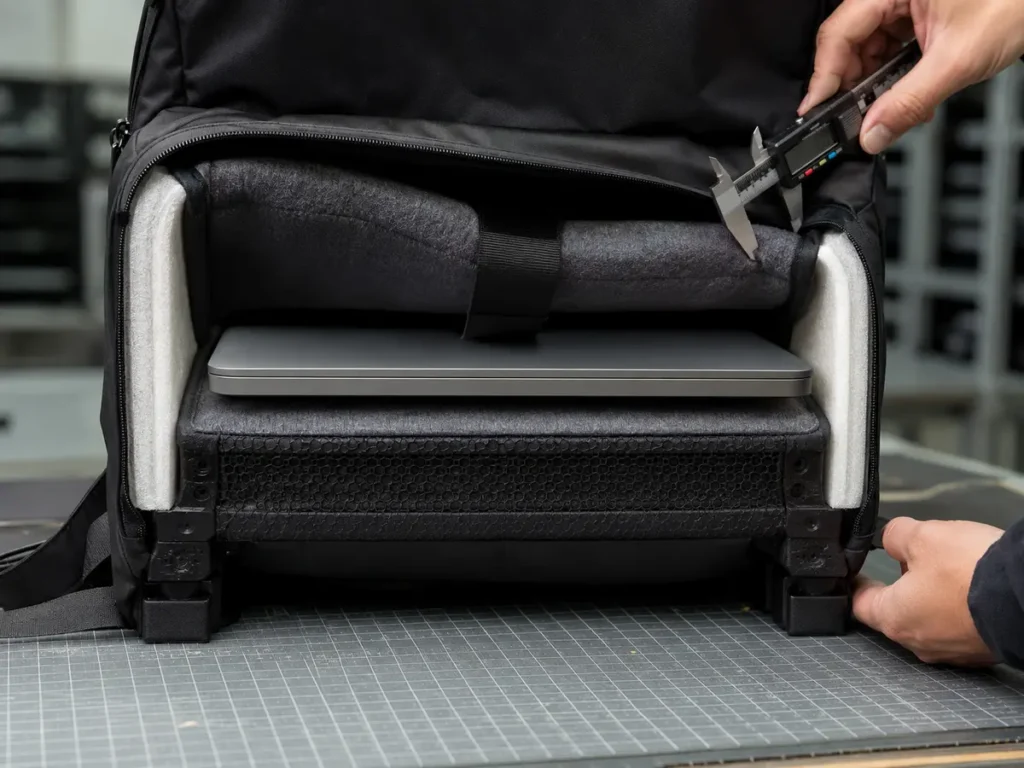
A useful laptop compartment can include:
- correctly sized front, back, and side padding;
- a suspended sleeve bottom that ends above the outer backpack base;
- a dense or layered bottom bumper;
- soft lining that avoids scratching under normal use;
- a closure that keeps the device from leaving the sleeve;
- separation from bottles, hard accessories, and zipper hardware;
- a rigid or semi-rigid panel where controlled load distribution is needed;
- sufficient opening clearance so the zipper does not rub the device.
The False Security of Foam Thickness
A thick sleeve can still fail if it is too large, leaves the corners exposed, or touches the ground through the bag base. A thinner multi-layer system with better fit and suspended clearance may protect more effectively in the intended scenario.
Record the target device envelope—maximum width, height, and thickness—rather than only a screen-size label. Screen inches do not define the body dimensions of every laptop.
Define a Loaded Validation
If impact protection is a sales requirement, agree on a prototype test using a suitable instrumented dummy or replaceable mass rather than a valuable laptop. Define load, bag fill, closure, orientation, drop height or handling sequence, surface, sample quantity, inspections, and acceptable damage. Do not borrow a generic “military-grade” statement without the exact applicable method and result.
Developing a custom laptop or school backpack? Send JIUMU the target device dimensions, load, bag size, material preferences, padding locations, quantity, logo files, packaging, test requirements, and delivery date. These inputs allow the internal structure to be reviewed before sampling through Contact Us.
How to Reinforce the Backpack Bottom
The bottom faces abrasion, localized impact, moisture, and the combined weight of the contents. Reinforcement may involve several layers rather than one board.
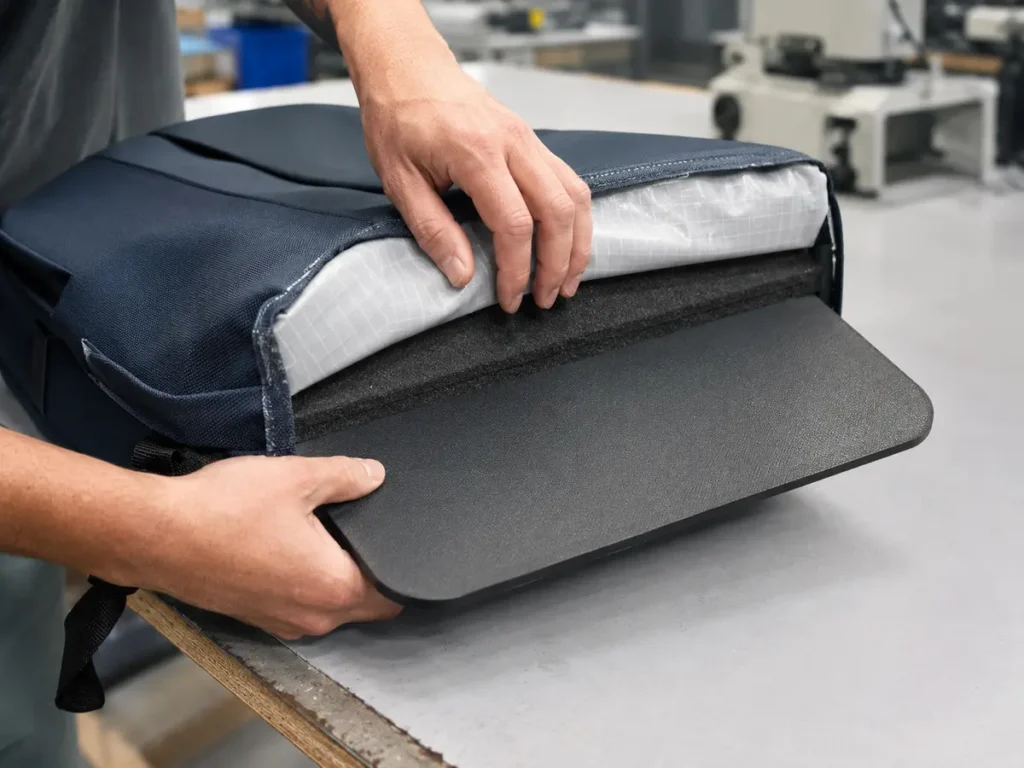
Options include:
- heavier or more abrasion-resistant outer base fabric;
- doubled outer fabric at wear zones;
- inner foam for minor impact and shape;
- removable or enclosed PE/PP base board;
- raised laptop sleeve or internal false bottom;
- protective feet for selected luggage-style designs;
- binding or reinforcement at high-wear corners;
- water-resistant coating or seam strategy appropriate to the use.
The base board should have rounded corners and enough clearance to avoid cutting the seam. If removable, define the access pocket and orientation. If permanently enclosed, make sure it cannot rotate or buckle. Test the completed loaded bag because an isolated board does not reveal seam or corner stress.
Shoulder Straps, Handles, and Back Panels
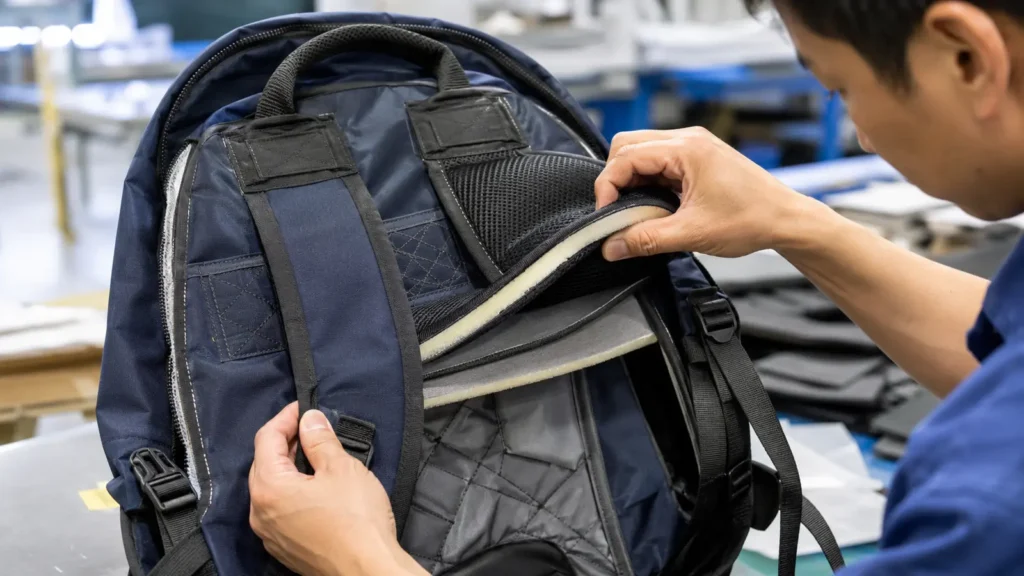
Shoulder-Strap Anchors
Shoulder straps transfer the full carried load to a small area. Reinforcement can include extended strap tails, internal webbing, backing patches, multiple stitch rows, bartacks, or Box-X patterns. The best construction depends on fabric, webbing, foam, seam geometry, and load direction.
Avoid ending foam or a structural sheet directly at the highest bending point. A sharp stiffness transition can concentrate stress. Inspect both the visible seam and the internal load-spreading layer.
Top Handles
A top handle may experience a higher instantaneous load when a filled backpack is lifted quickly. Attach the handle to a load-bearing panel or internal webbing path, not only to lining. Check grip comfort, fold direction, reinforcement length, and clearance from the zipper.
Back Panels
Back-panel construction can combine soft foam, spacer mesh, structural sheet, quilting, and channels. More thickness can improve shape but may trap heat or add unnecessary weight. Define whether the objective is comfort, ventilation, laptop protection, shape, or all four; then assign each layer a purpose.
Custom-Printed Lining
Custom lining can turn an ordinary interior into a private-label feature. Repeating logos, geometric patterns, school colors, or tonal brand motifs can be printed on suitable polyester or other lining fabrics.
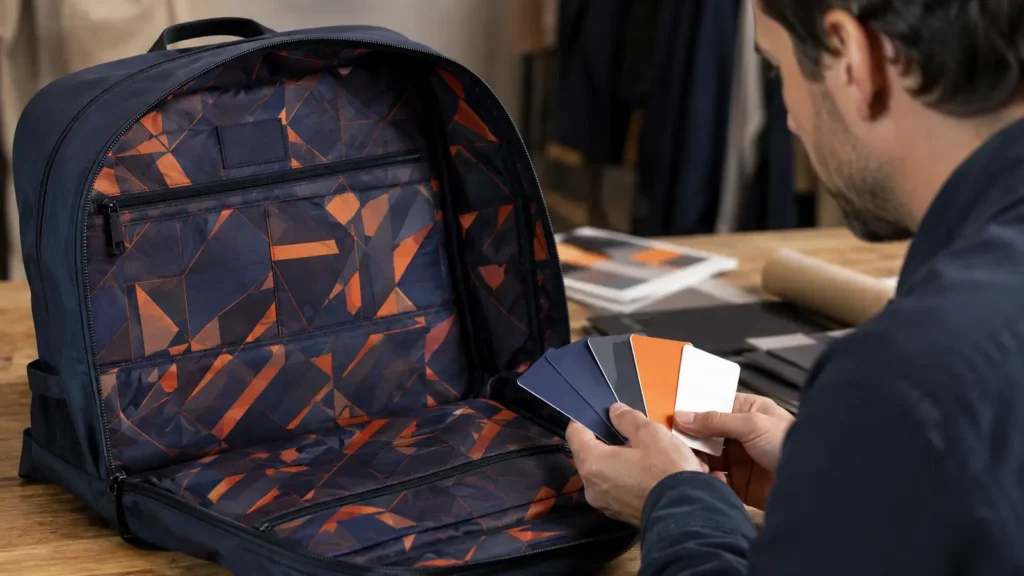
Before approval, confirm:
- print method and compatible fabric construction;
- repeat size, direction, and placement priority;
- Pantone or physical color references;
- visible pattern alignment at large pockets where required;
- rub, staining, and care performance;
- show-through on light or thin fabric;
- print hand feel and effect on coating;
- artwork ownership and production-ready file format;
- MOQ, setup cost, sampling, and possible overage.
Random-cut repeat prints normally cannot place every logo in exactly the same position on every bag. If a centered interior mark is required, use a separately positioned print, patch, or label and define its placement tolerance.
How to Write These Materials in a Tech Pack
A usable tech pack connects each material to a drawing callout and bill-of-materials code.
Required Material Fields
| Field | Example of useful specification | Avoid |
|---|---|---|
| Component/location | Main lining; laptop sleeve; shoulder strap; base | “Inside material” |
| Material composition | Woven polyester; verified RPET polyester; EVA | “Fabric” or “foam” |
| Construction | Plain weave; spacer mesh; closed-cell sheet | “Durable type” |
| Weight/thickness | Agreed g/m² or mm with tolerance | “Heavy” or “thick” |
| Density/hardness | Supplier grade and agreed test where relevant | “High density” alone |
| Color/finish | Physical standard, coating, print, texture | Screen screenshot |
| Dimensions | Pattern piece, board size, suspended clearance | “Fit laptop” |
| Attachment | Seam, lamination, pocket insertion, bartack | “Fix securely” |
| Test/acceptance | Named method, sample condition and pass criteria | “Good quality” |
| Reference control | Swatch ID, sample version, supplier code | Unversioned photo |
Laptop Compartment Specification
Record the target device envelope, sleeve internal dimensions, closure, front/back/side/bottom padding, material thickness and grade, suspended-bottom clearance, structural panel, lining, corner construction, and test protocol. Include a sectional drawing rather than only front and rear views.
Reinforcement Callouts
Mark handle anchors, shoulder-strap roots, compression straps, bottle pockets, D-rings, zipper ends, base corners, and any area carrying hardware. Show reinforcement material dimensions and stitch pattern. “Bartack all stress points” is insufficient if the drawing does not define the stress points.
Sample Approval Checklist
- Verify every lining, foam, mesh, sheet, board, webbing, and backing material against the BOM.
- Measure lining and reinforcement thickness or weight using the agreed method.
- Inspect interior color, print repeat, shade, stains, coating, odor, and surface defects.
- Confirm laptop sleeve dimensions and suspended-bottom clearance with a safe dummy.
- Load the backpack and check bottom stability, panel shape, and board movement.
- Inspect shoulder-strap and handle anchors from both sides before the lining is fully closed when possible.
- Check that structural sheet edges cannot cut lining or create pressure ridges.
- Compress and flex padded areas to observe recovery, wrinkling, delamination, and noise.
- Operate pockets and zippers while loaded; internal thickness can reduce clearance.
- Review interior cleanability using the agreed method and soils where necessary.
- Complete abrasion, seam, load, or handling tests specified for the project.
- Record revisions and approve a versioned Golden Sample.
Bulk Production Quality Control
Incoming Materials
Verify supplier code, composition, weight, thickness, density or hardness, color, print, coating, width, and lot. For claimed recycled content, review the required chain-of-custody documents for the actual order. Segregate substituted or unapproved materials.
In-Line Inspection
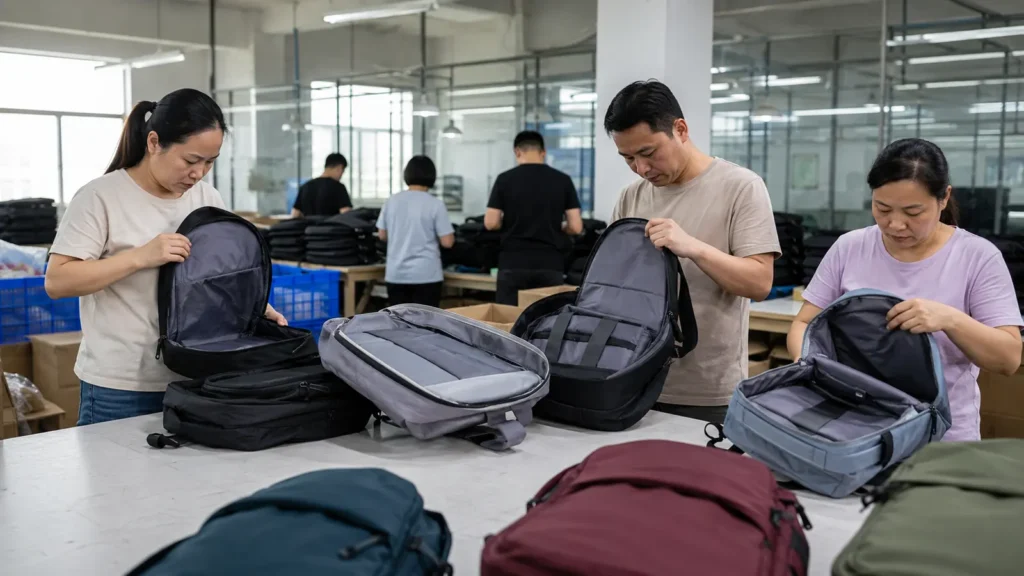
Many reinforcement parts become invisible after assembly. Inspect board dimensions, rounded corners, foam coverage, strap backing, handle reinforcement, sleeve suspension, and seam construction at defined hold points before lining closure. Photographic records can support traceability but do not replace physical inspections.
Final Inspection
Check interior cleanliness, loose threads, exposed sharp edges, lining tears, pocket dimensions, print orientation, foam position, board movement, and shape. Use a representative load and open every selected compartment. Sample across colors, material lots, production times, and cartons.
Nonconforming Material or Construction
Contain affected units, identify the material lot and production window, determine whether the issue is substitution, cutting, lamination, sewing, compression, or assembly, and approve a corrective action. If internal replacement requires opening finished seams, check that the repair does not weaken the exterior or change appearance.
Bulk Interior QC Checklist
- Correct lining fiber, construction, weight, color, print, coating, and lot
- Correct foam/EVA type, thickness, density or hardness, and coverage
- Spacer mesh is smooth, correctly oriented, and securely edge-finished
- Structural sheets and boards match size, thickness, material, and corner shape
- Laptop sleeve dimensions, padding and suspended clearance match the approved sample
- Shoulder straps, handles and hardware anchors include specified backing
- Bottom reinforcement is centered, stable and free from sharp edges
- Lining has no tears, stains, skipped seams, puckering, exposed foam, or excessive sagging
- Printed lining has acceptable shade, repeat direction and rub performance
- Interior is clean and accessible for intended care
- Selected finished bags pass specified loading and handling checks
- Results identify SKU, color, material lot, carton, inspector and disposition
Questions to Ask a Backpack Supplier
- What exact lining construction, mass, yarn description, finish, and supplier code are proposed?
- Which abrasion, tear, seam, colorfastness, or cleaning tests are applicable?
- What foam or EVA grade, thickness, density, and hardness will be used at each location?
- What material and thickness form the base and back structural sheets?
- How are board edges rounded and prevented from moving?
- What device dimensions and suspended clearance define the laptop sleeve?
- How are shoulder straps and handles connected to load-bearing panels?
- What documentation supports an RPET or certified recycled-content claim?
- Can custom lining be printed, and what are the artwork, MOQ, color, and repeat constraints?
- Which internal components are inspected before the lining is closed?
For related procurement guidance, compare the Backpack Materials guide, explore the planned Custom Laptop Backpacks page, review Quality Control, and see Manufacturing Capabilities. Confirm the laptop-backpack URL is live before publishing.
Common Procurement Mistakes
Writing only material names. “Nylon lining” and “EVA padding” do not define weight, grade, thickness, color, or performance.
Using denier as a durability guarantee. Denier describes yarn linear density, not the complete fabric result.
Padding the laptop sleeve without suspending it. The device can still strike the floor through the bag base.
Adding a rigid board with sharp corners. The reinforcement can become the cause of lining failure.
Attaching handles to lining. Load-bearing components need a path into the structural panel or reinforcement.
Making an RPET claim without traceability. Product-related claims require the applicable documentation and chain of custody.
Approving hidden parts verbally. Record internal components in the BOM, sectional drawings, hold-point photos, and Golden Sample.
How JIUMU Supports Custom Backpack Development
JIUMU provides OEM and ODM development for custom bags and branded merchandise, including material sourcing, logo application, private labels, packaging, digital mockups, physical samples, bulk production, and quality-control support. For internal construction, the most useful starting information is the intended use, carried items, target load, bag dimensions, device envelope, desired structure, material preferences, quantity, logo, packaging, test requirements, and delivery date.
Sampling can then verify the interaction of outer fabric, lining, pockets, foam, board, mesh, straps, seams, hardware, and decoration. Custom print, special foam grades, certified material programs, additional tests, and complex hidden reinforcement may affect MOQ, cost, and lead time and should be discussed before quotation.
Frequently Asked Questions
Final Recommendation
Specify the backpack interior as a layered engineering system. Choose the lining for surface durability, visibility, cleaning, and branding; foam or EVA for controlled cushioning; mesh for contact comfort; structural sheets for shape and load distribution; and local reinforcement for strap, handle, base, and hardware forces. Put every material, dimension, location, tolerance, and test in the tech pack, verify hidden parts during assembly, and retain an approved Golden Sample for bulk comparison.
For a custom backpack quotation, send JIUMU your reference images or tech pack, dimensions, compartments, intended contents, load, laptop envelope, lining and padding preferences, required reinforcement, quantity, colors, logo files, packaging, tests, destination, and delivery date. Contact JIUMU to review the structure and sampling plan.
Technical References
- ISO 12947-2:2016, Martindale Abrasion—Determination of Specimen Breakdown
- ASTM Textile Standards and Test Methods
- Textile Exchange: Recycled Claim Standard and Global Recycled Standard
- Textile Exchange: Chain of Custody
About JIUMU
JIUMU is a Guangdong-based B2B supplier of custom teamwear, hats, bags and branded merchandise, established in 2010. Final materials, tolerances, claims and tests should be approved for the actual project.