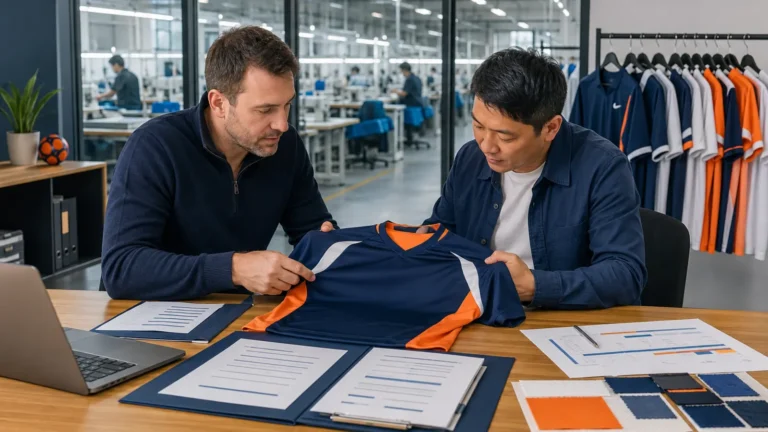
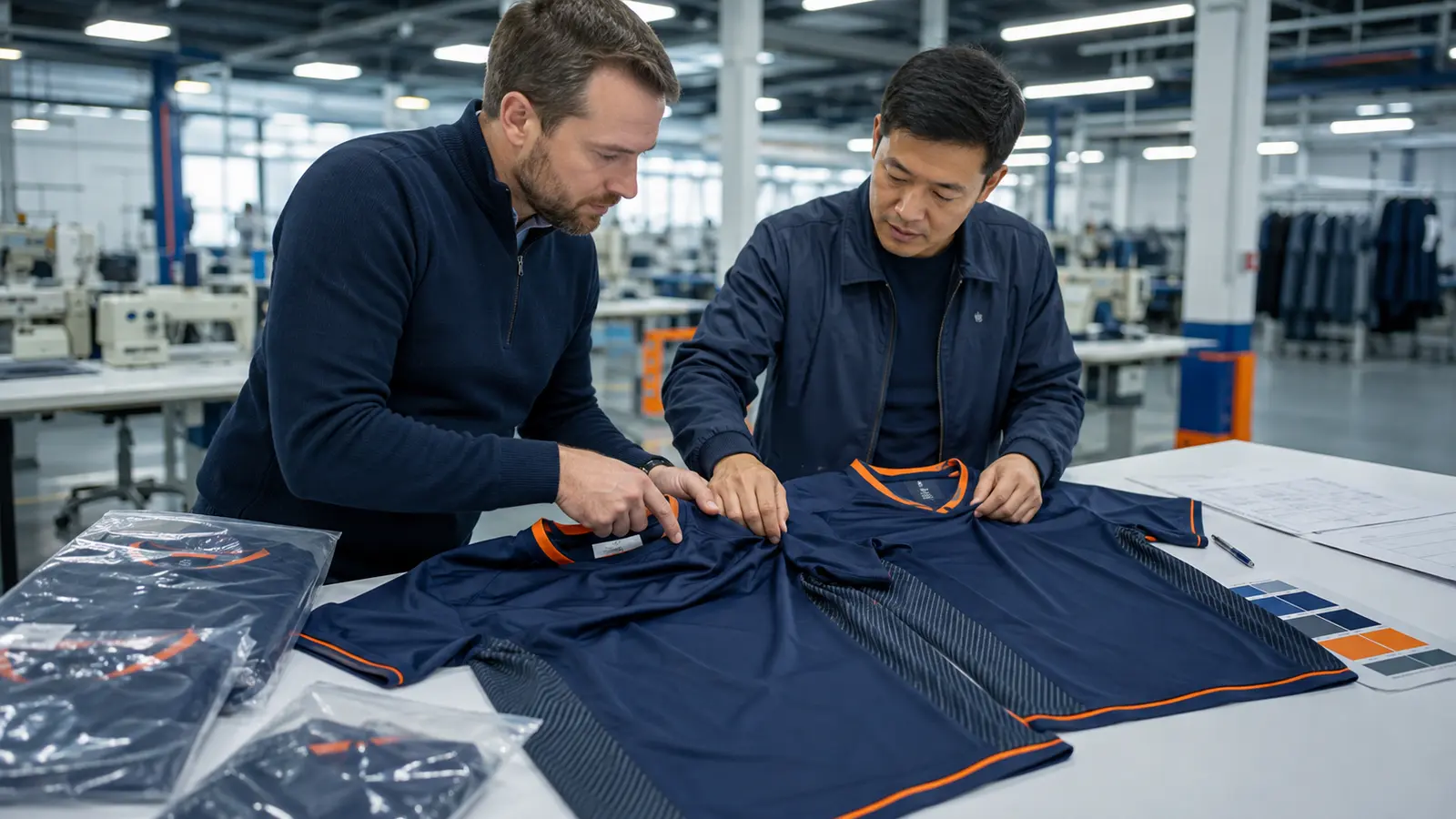
How to Maintain Color and Size Consistency on Repeat Apparel Orders
Direct answer: To maintain color and size consistency on repeat apparel orders, preserve the first order as a controlled production baseline—not merely an old purchase order. Retain the approved fabric and color standard, material supplier and article number, dye-lot records, original master pattern, graded pattern version, measurement method, approved size chart and Golden Sample. Before every repeat order, compare the new requirement with that baseline, identify unavoidable material or process changes, approve fresh bulk-intent fabric and a pre-production sample, and inspect the new production against the current approved references.
“Same as last order” is not a complete specification. The same style number can produce a visibly different navy jersey or a different-fitting hoodie when the fabric lot, dyeing conditions, finish, shrinkage, pattern version, cutting method or heat process changes. A repeat order therefore needs a reconfirmation process:
First-order records → master pattern → approved size specification → Golden Sample → fabric/color standard → repeat-order reconfirmation → incoming and inline QC.
This guide is for sports teams, schools, apparel brands, uniform dealers, distributors and private-label buyers reordering jerseys, training apparel, team uniforms and hoodies. It explains what Pantone can and cannot control, how dye lots affect color, how to preserve original patterns and size standards, and what should be reconfirmed before repeat production begins.
Consistency does not mean that every unit or every production run will be physically identical. Textile and sewn-product manufacturing includes controlled variation. The objective is to define the approved baseline, agree appropriate tolerances and detect meaningful changes before they reach the customer.
Repeat-Order Consistency at a Glance
| Baseline element | What to retain from the first order | What to reconfirm before the repeat order | Release evidence |
|---|---|---|---|
| Fabric identity | Supplier/mill, article, composition, construction, GSM and finish | Availability, source, bulk-intent quality and raw-material lot | Current BOM and approved swatch |
| Color | Pantone target, lab dip/strike-off, approved fabric cutting and shade record | New lab dip or bulk cutting when lot/process changes | Signed physical color standard |
| Pattern | Master pattern and graded pattern version | Correct version, approved changes and file integrity | Pattern release record |
| Measurements | Size chart, point-of-measure method, grading and tolerances | Current size range, fit comments and tolerance agreement | Approved spec and size set |
| Finished appearance | Golden Sample and decoration approvals | New pre-production sample against retained reference | Signed PPS/repeat-order sample |
| Production inputs | Dye lots, trims, heat settings and process notes where relevant | New lot/process differences and risk | Reconfirmation checklist |
| Quality control | First-order inspection results and accepted deviations | Incoming, pilot, inline and final checkpoints | Current inspection reports |
Why Repeat Orders Can Look or Fit Different
A reorder often appears simple because the artwork and style have already been approved. In practice, time separates the two production runs. Materials, operators, equipment, software and buyer requirements can change.
The original fabric lot has been consumed
Fabric from the first production run is usually no longer available. A new dye lot must be produced or purchased. Even when the mill and article number remain the same, raw-material lots, dye recipes, water, machinery and finishing conditions can create variation.
The material article has changed
The mill may revise or discontinue a quality. A distributor may supply a similar article under the same general description. A garment described only as “100% polyester interlock” can therefore return with different weight, luster, stretch, opacity or shrinkage.
The physical reference was not retained correctly
A showroom garment may be worn, washed or exposed to sunlight. A fabric swatch can fade or absorb moisture. If the only reference is an old photograph, accurate comparison becomes difficult.
The factory uses a different pattern file
The sales team may refer to the correct style while the pattern room retrieves an earlier or locally modified version. A pattern may have been corrected during first-order sampling without the final revision being archived clearly.
Fabric shrinkage and processing differ
Finished measurements depend on more than paper dimensions. Fabric relaxation, washing, steaming, printing, sublimation and heat-transfer processes can change dimensions. A new fabric lot with different shrinkage can alter the garment even when the same pattern is cut.
Measurement methods are inconsistent
Two inspectors can obtain different results if one stretches the garment, measures from a different point or allows the sample to rest differently. The point-of-measure diagram and method are as important as the numeric target.
An old deviation becomes an accidental standard
The first bulk order may have included a one-time accepted exception. If the repeat purchase order simply says “same as last order,” the supplier may repeat the exception even though the buyer expected the original specification.
Buyer requirements have quietly changed
A team may update player sizes, fabric preference, sponsor logos, packaging or delivery needs. These changes should be separated from the unchanged baseline instead of mixed into informal messages.
Pantone Is Important—but It Is Not the Entire Color Standard
Pantone provides a common language for a target color. It does not guarantee that every substrate, dye lot or production method will look identical.
The same Pantone target can appear different on:
- polyester interlock and polyester mesh;
- body fabric and rib trim;
- sublimated areas and piece-dyed fabric;
- embroidery thread and heat-transfer film;
- matte and glossy surfaces;
- fabric viewed under daylight, store lighting or stadium lighting.
Pantone should be one layer in a color-control system. The physical approved result on the intended substrate should be another.
Recommended color baseline
For the first order, record:
- the exact Pantone system and reference used as the target;
- the fabric supplier/mill and article number;
- the approved lab dip or strike-off code;
- a retained fabric cutting from the approved bulk lot;
- a Golden Sample showing color in the completed garment;
- thread, rib, transfer and trim standards where coordination matters;
- viewing or instrumental method if the buyer has a formal protocol.
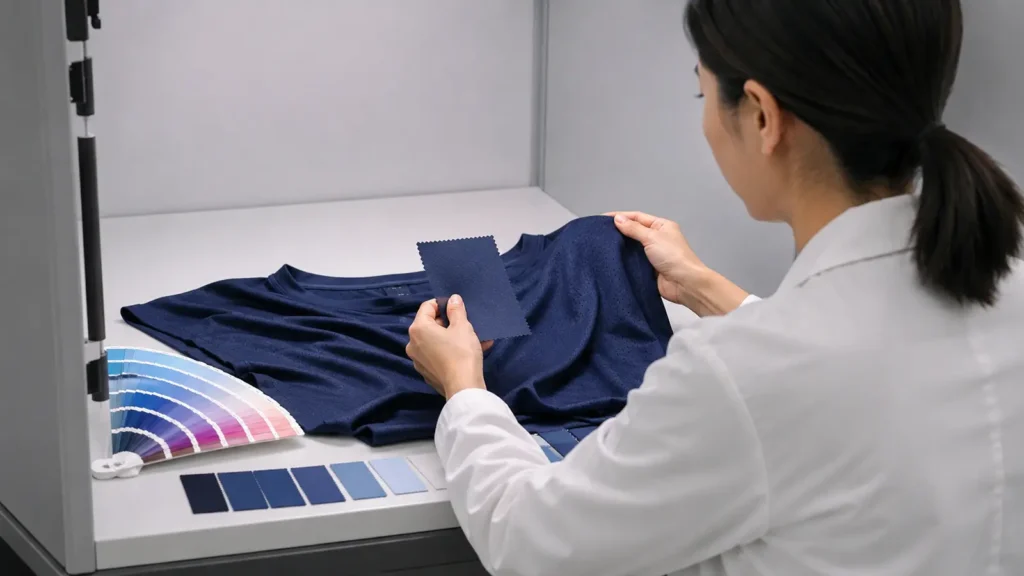
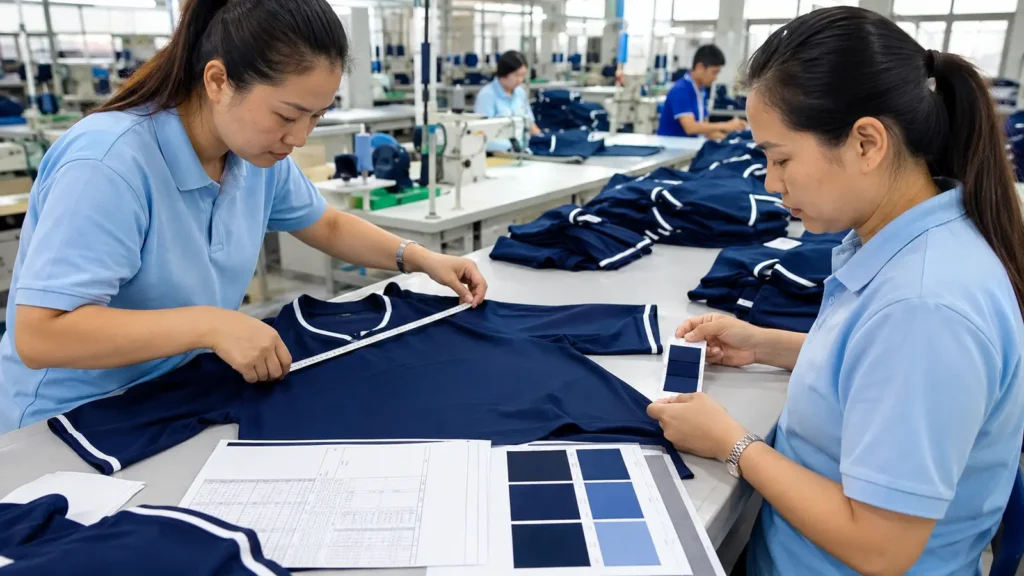
For the repeat order, do not rely on the Pantone number alone. Compare the new lab dip, strike-off or bulk cutting with the retained approved fabric standard. Review the completed pre-production garment because construction, backing and adjacent colors can change visual perception.
Understand Dye Lots and Shade Variation
A dye lot, sometimes called a dye batch, is material processed together under a defined dyeing operation. Fabric from one dye lot is generally more likely to be visually consistent than fabric from separate lots, but variation can still occur within a roll or between rolls.
Four shade relationships to control
| Shade relationship | What it means | Main risk | Practical control |
|---|---|---|---|
| Repeat order versus retained standard | New lot compared with first-order approved color | Overall color drift | Approve new lab dip/bulk cutting against physical standard |
| Dye lot versus dye lot | Material from separate dye batches | Garments in one delivery look different | Avoid mixing where possible; approve and map each accepted lot |
| Roll versus roll | Rolls within one declared lot | Shade bands across cut components | Shade-sort and record rolls before cutting |
| Within one roll | Color changes along length or across width | Panels within one garment mismatch | Inspect fabric and segregate affected sections |
| Component versus component | Body, rib, mesh, thread or print | Coordinated parts do not look intentional | Approve component set on actual materials |
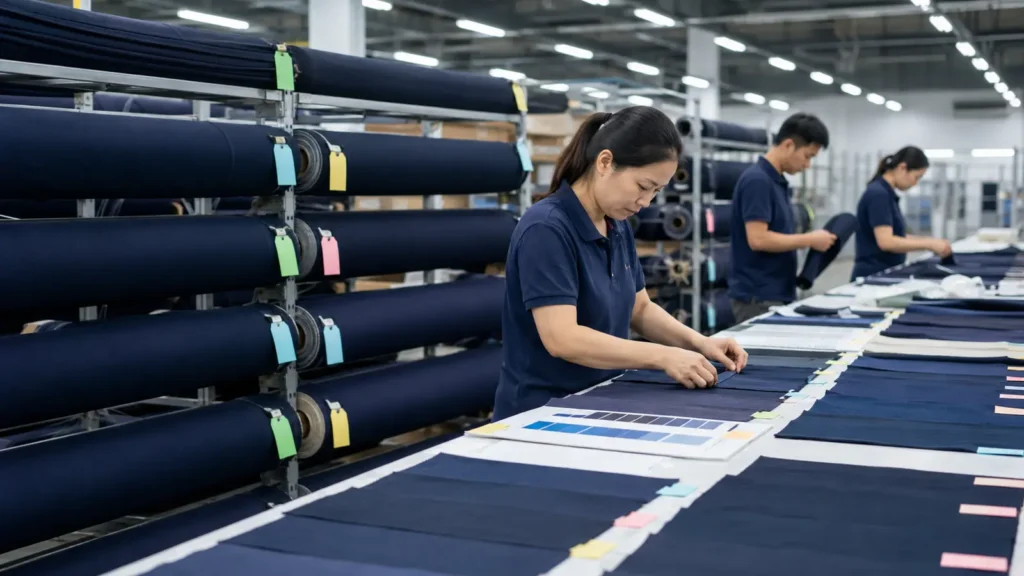
The supplier should identify dye lots and roll numbers during receiving. If a repeat order requires more than one lot, the buyer and factory should decide how to allocate lots. Team uniforms intended to be worn together may require stricter grouping than individually distributed promotional garments.
Preserve raw-material and roll records
Useful records include the mill or distributor, article number, production or dye-lot number, roll number, received quantity, usable width, shade group and cutting allocation. These records help determine whether a complaint affects one lot, one roll, one size bundle or the whole order.
If the buyer needs future replenishment to coordinate with existing uniforms, state this at quotation. The supplier may recommend ordering extra units, reserving greige goods, buying one larger dye lot or accepting a new coordinated shade rather than promising an impossible exact match months later.
How to Define Color Tolerance Without Using a Universal Number
Buyers often ask for a single ΔE limit. ΔE is a numerical expression of color difference calculated from instrumental measurements, but one universal value is not appropriate for every order.
Acceptance depends on factors such as:
- the color and its visual sensitivity;
- the color space and calculation formula;
- instrument type, geometry, calibration and aperture;
- illuminant and observer settings;
- fabric texture, luster and direction;
- sample conditioning and measurement method;
- whether the comparison is against Pantone, a lab dip or retained bulk fabric;
- product use and buyer expectation.
A dark navy knitted fabric, fluorescent trim and smooth printed film cannot automatically share the same numeric tolerance. Instrumental data can support decisions, but trained visual evaluation on the actual material remains important for textured apparel.
A workable approval process
- Define the physical standard and instrument method before production.
- Ask the mill or supplier to report new submissions consistently.
- Evaluate the lab dip or strike-off visually and instrumentally where required.
- Approve the selected option by code and date.
- Check the first bulk lot and shade continuity.
- Record whether acceptance applies to one lot, one order or future repeats.
Do not establish a color tolerance only after the bulk result is known. If the buyer does not have an instrumental protocol, use controlled physical approval and clear visual acceptance criteria rather than borrowing a number from an unrelated fabric.
Lock the Fabric Identity for Every Repeat Order
Color and size consistency are connected through fabric. A new material can dye differently and shrink differently, changing both appearance and measurements.
The repeat-order BOM should reconfirm:
- fabric ID and garment location;
- supplier or mill;
- article number;
- fiber composition;
- knit or weave construction;
- finished target GSM and agreed tolerance;
- usable width;
- stretch and recovery where relevant;
- surface finish and handfeel;
- shrinkage or dimensional-stability requirement and method;
- color target and approved physical standard;
- dye lot or raw-material lot when available;
- substitution approval status.
If the original article is unavailable, treat the proposed replacement as a development change—not an invisible repeat. Review a new swatch, color submission, shrinkage behavior, decoration compatibility and pre-production garment. See How to Prevent Fabric Substitution in Bulk Apparel Production for a detailed material-control process.
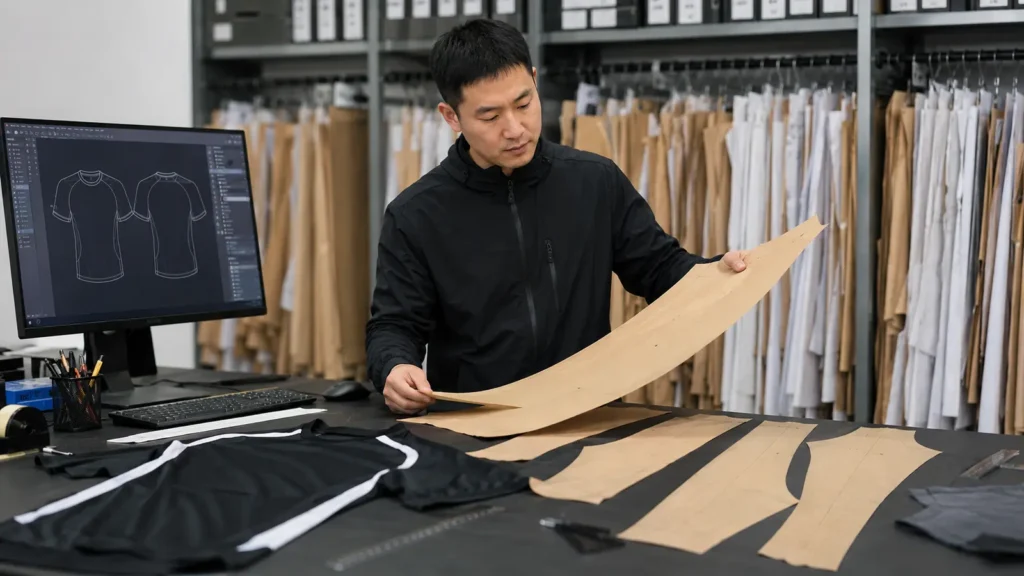
Preserve the Original Master Pattern
The master pattern is the controlled geometry from which garment pieces and size grades are produced. A Golden Sample shows the assembled result, but it cannot replace the pattern file. Measuring an old garment and recreating the pattern introduces avoidable error.
What the pattern archive should contain
- brand, style name and style number;
- base size;
- pattern version and release date;
- unit of measurement;
- seam allowance and notches;
- fabric direction, stretch direction or grainline;
- cut quantity and component name;
- shrinkage or process compensation where applicable;
- graded size set or grading rules;
- software format and printable/exported backup;
- approver and link to the approved size specification.
Use one released pattern version for production and mark old versions as superseded. If a correction is made after the fit sample, update the pattern, measurement chart and revision log together.
Control pattern changes on reorders
A repeat order may legitimately need a fit update. Perhaps the team wants a longer body or a youth size range. Record these as explicit changes from the baseline. Do not overwrite the original pattern without preserving its history, especially when some customers may still reorder the older fit.
Preserve the Approved Size Specification and Measurement Method
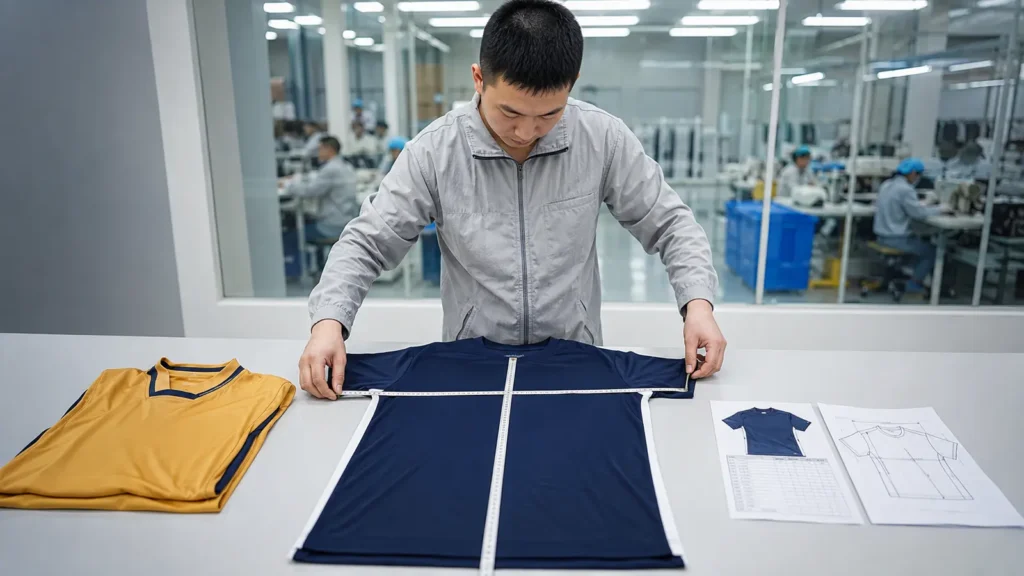
A size chart is not only a list of numbers. Every point of measure must have a defined location, garment condition and method.
For example, “chest 54 cm” is ambiguous. A clearer instruction is: “Half chest measured straight across, 2.5 cm below the armhole, garment laid flat without stretching.”
Size baseline records
| Control item | First-order record | Repeat-order check |
|---|---|---|
| Point-of-measure code | Diagram and unique code | Same diagram/version used by sample room and QC |
| Measurement method | Start/end points, garment condition and handling | Inspectors use the same method |
| Base-size target | Approved finished measurement | New size-set sample compared with target |
| Grading | Change between sizes | New order size range uses released grade |
| Tolerance | Point-specific permitted deviation | Still appropriate for fabric/process and buyer use |
| Accepted exception | One-time first-order decision | Not repeated unless specifically approved |
| Shrinkage basis | Pre/post treatment condition | New fabric tested or confirmed consistently |
Tolerance must be point-specific
Large body measurements, small neck openings and logo placement do not require the same tolerance. Fabric stretch, garment size, seam construction and measurement repeatability matter. State a separate tolerance for each critical point of measure.
Do not use tolerance to hide systematic size drift. If every size is consistently smaller than target, the process or pattern should be corrected even when some individual measurements remain near the permitted range.
Measure samples under comparable conditions
Agree whether garments are measured before or after washing, steaming or conditioning. Allow elastic and stretch materials to relax. Avoid comparing a freshly heat-pressed garment with a long-stored Golden Sample without considering process and condition.
How Fabric Shrinkage and Heat Processes Change Size
Even when the same pattern is used, finished measurements can change because the material and process change.
Important influences include:
- fabric relaxation before cutting;
- washing or pre-shrinking;
- dyeing and finishing tension;
- sublimation temperature and dwell time;
- heat-transfer application;
- fusing or bonding;
- steaming and pressing;
- moisture and storage;
- cutting direction and fabric distortion.
For sublimated teamwear, artwork placement and finished size may both depend on heat behavior. A different fabric article or heat setting can change dimensions. Confirm the bulk-intent fabric and process during repeat-order sampling rather than assuming the old pattern alone guarantees fit.
Where dimensional stability is important, define the test or buyer protocol, conditioning and acceptance method. Do not present one shrinkage percentage as a universal requirement for all teamwear.
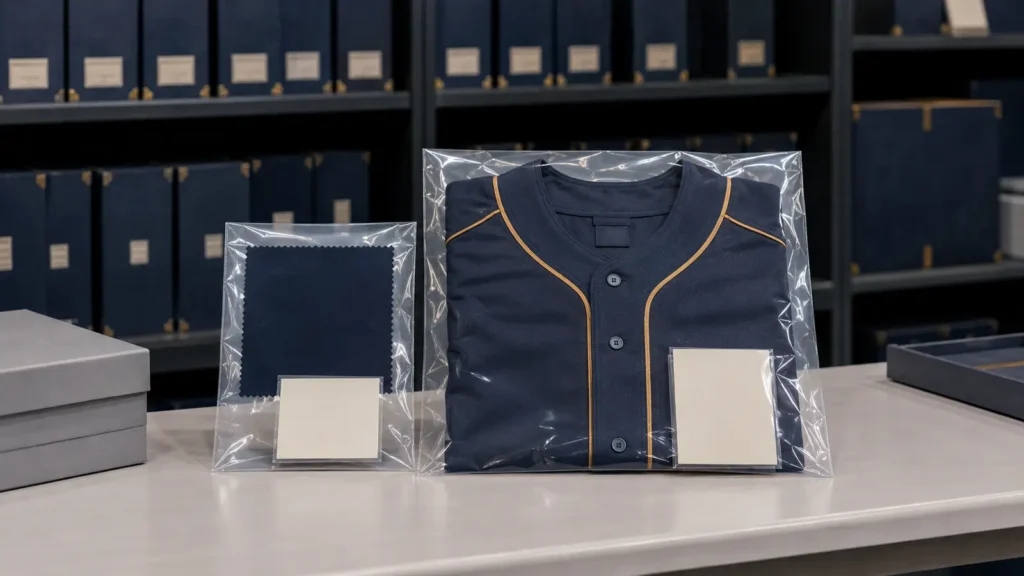
Use Both a Golden Sample and a Golden Fabric Swatch
The two references serve different purposes.
- Golden Fabric Swatch: controls material identity, color, texture, luster, handfeel and finish.
- Golden Sample: controls assembled appearance, fit, construction, decoration, labels and overall workmanship.
The Golden Sample should be tagged with style number, colorway, size, approval date, Tech Pack version, pattern version and fabric ID. The fabric swatch should include supplier/article, composition, construction, GSM, finish, color approval and date.
Retain equivalent controlled references at buyer and supplier where practical. Store them away from sunlight, moisture, dust and repeated handling. Do not use the Golden Sample as a showroom or wear-test item.
Recognize reference aging
Physical standards can age. White may yellow, dark colors may fade, elastic may relax and surfaces may become polished through handling. Record approval photographs, but do not use screen images as the primary standard. Before a long-gap repeat order, check whether the retained reference remains suitable or whether a fresh controlled reference should be established.
Reconfirm the Order Before Repeat Production
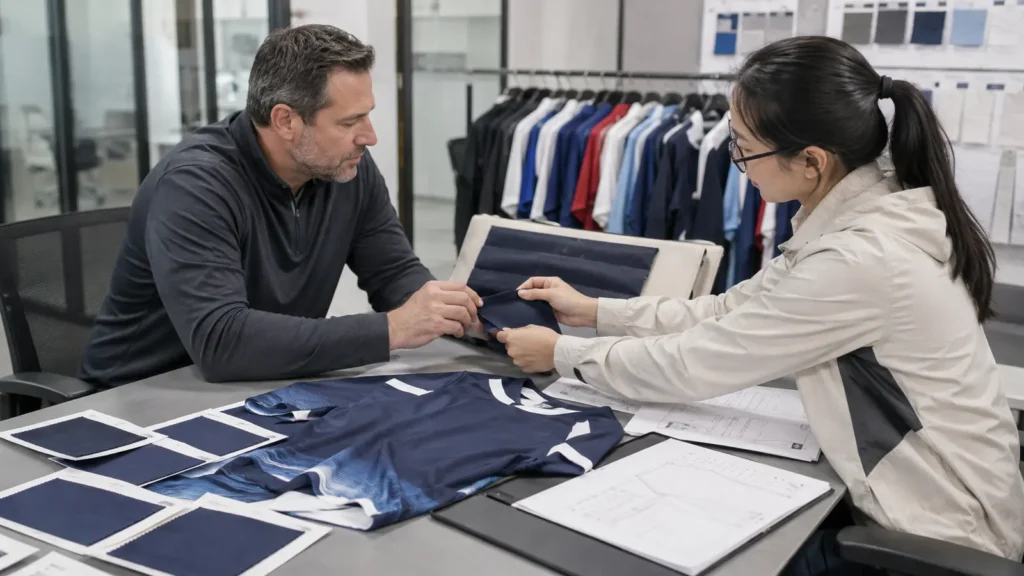
Every repeat order should start with a structured comparison between the previous approved baseline and the new purchase requirement.
Repeat-order reconfirmation checklist
| Item | Previous approved baseline | New repeat-order requirement | Action before release |
|---|---|---|---|
| Style/pattern | Pattern version and base size | Same or revised | Confirm released pattern and revision history |
| Size range/ratio | Previous size chart and quantities | New player/customer breakdown | Approve current size set and ratio |
| Fabric | Mill, article, GSM, finish | Availability and proposed lot | Approve same article or develop alternative |
| Color | Pantone + physical standard | New lab dip/bulk cutting | Approve against retained reference |
| Dye lots | Previous lot record | Expected new lot(s) | Plan shade grouping and cutting allocation |
| Decoration | Artwork, process, size and position | Sponsor/player/artwork changes | Approve current artwork proof/strike-off |
| Labels/packing | Previous approved versions | Legal, barcode or assortment changes | Approve current files and packed sample |
| Accepted deviations | One-time documented exceptions | Repeat or return to original target | Obtain explicit decision |
| Delivery | Previous calendar | Current need date | Confirm materials, approvals and capacity |
| QC | Previous findings and limits | Current risk/inspection scope | Issue repeat-order QC plan |
The checklist should end with a current version number and written acknowledgement. Do not allow old email attachments to remain the production authority.
When is a new sample necessary?
A new pre-production sample is strongly justified when:
- fabric source, article, lot behavior or finish changes;
- color is newly dyed or visually critical;
- pattern or grading changes;
- size range expands;
- artwork, decoration process or heat exposure changes;
- labels or packaging change;
- the gap since the previous order is long;
- first-order feedback requires correction;
- the retained Golden Sample is no longer reliable.
For a low-risk exact repeat with controlled inputs, the buyer and supplier may agree on a reduced approval path. Record that decision rather than assuming it.
Inspect the Repeat Order at the Right Stages
Final inspection alone is late. Build checks around the points where color and size can still be corrected.
Incoming material control
Verify fabric supplier/article, composition records, GSM, width, finish, dye-lot/roll identity, shade and defects according to the agreed plan. Segregate unapproved or unclear material before cutting.
Pilot or size-set sample
Produce representative sizes using bulk-intent material and the released pattern. Compare measurements with the current specification and inspect grading. A base-size sample alone may not reveal grading errors at the smallest and largest sizes.
First-piece and decoration checks
Confirm sublimation, print or transfer colors, logo size and position, heat effects and panel matching. Review coordinated components such as rib and mesh.
Inline inspection
Measure garments from active production across sizes, operators, lines or bundles as relevant. Look for trends, not only isolated failures. Confirm lot/shade allocation and compare visual appearance with approved references.
Pre-shipment inspection
Verify quantity, assortment, workmanship, measurements, color/shade grouping, decoration, labels and packing. Use the current repeat-order release package, not an outdated first-order file.
What to Do When the Repeat Order Differs
Stop treating the discrepancy as a matter of memory. Identify which baseline changed and whether the change is acceptable.
| Difference | Immediate control | Investigation | Decision record |
|---|---|---|---|
| New color differs from retained standard | Hold affected lot | Check dye lot, material article, finish and approval code | Approve new coordinated standard, redye or reject |
| Roll shades differ | Shade-sort and block mixed cutting | Verify lot and roll records | Allocate accepted groups or reject affected rolls |
| Garments are systematically smaller | Stop affected output | Check fabric shrinkage, pattern version, heat process and method | Correct process/pattern and resample |
| One size grades incorrectly | Hold that size/bundle | Compare graded pattern and marker with released version | Correct grade and recut/resample |
| Golden Sample conflicts with spec | Stop release and compare history | Identify last authorized change | Issue a corrected current baseline |
| Original material unavailable | Treat as development change | Evaluate proposed alternative | Approve one-time or permanent revision in writing |
State whether an accepted change applies only to the current lot or becomes the new standard. If it becomes permanent, update the Tech Pack, BOM, pattern, size chart, physical references and revision log together.
Common Repeat-Order Mistakes
Writing only “same as previous order”
The phrase does not identify which previous file, sample, pattern, lot or exception controls production. Reference exact versions and physical standard IDs.
Keeping only a sales sample
A handled showroom sample may not remain stable. Maintain a controlled Golden Sample and fabric swatch.
Assuming the same mill article means the same color
A new dye lot still needs color evaluation. Article identity controls the material quality, not the exact outcome of every dyeing run.
Using Pantone without a physical standard
Pantone is the target. The approved fabric cutting records the accepted result on the actual substrate.
Recreating patterns from an old garment
This introduces measurement and construction errors. Archive the released digital/master pattern and its grading.
Applying one size tolerance everywhere
Tolerance should be defined by point of measure and product behavior. It should not excuse systematic drift.
Repeating a one-time exception
An accepted first-order deviation is not automatically the new standard. Mark whether each approval is one-time or permanent.
Skipping sampling because the style is familiar
Material, color, process, size mix or time gap may change the risk. Use a documented decision on the required approval path.
Questions to Ask the Manufacturer Before Reordering
- Is the original fabric mill and article still available?
- Will the repeat order use a new dye lot or multiple lots?
- Which physical color and fabric standards are retained?
- Which master pattern and graded version will production use?
- Were any first-order deviations accepted only once?
- Has the fabric finish, shrinkage or heat process changed?
- Will a new lab dip, strike-off, size set or pre-production sample be submitted?
- How will roll shades be mapped and allocated during cutting?
- Which measurements will be checked inline across the size range?
- Who can approve a repeat-order change, and how will it be recorded?
How JIUMU Supports Repeat Teamwear Programs
JIUMU Gear develops custom teamwear, hats and bags for B2B buyers. For repeat jerseys and apparel, a controlled Tech Pack, BOM, artwork set, size specification and approved samples help the team compare the new order with the prior baseline. Material availability, new color lots, current size quantities and requested changes should be reconfirmed before production release.
JIUMU reports an approximately 200-person operation, around 25,000 square meters of production space and average monthly capacity of approximately 30,000 pieces. Actual scheduling, material reservation, sampling and inspection scope depend on product design, quantity, fabric, decoration and approval timing.
Related resources include Manufacturing Capabilities, Quality Control, How to Make Sure Bulk Production Matches Your Approved Sample, the Custom Apparel Sample Checklist and How to Prepare a Tech Pack for Custom Teamwear and Hats.
Final Repeat-Order Release Checklist
- The previous approved order and current repeat order are identified.
- Current Tech Pack, BOM, artwork and purchase-order versions match.
- Original master pattern and graded version are confirmed.
- Size chart, measurement methods and point-specific tolerances are current.
- First-order one-time deviations are separated from permanent standards.
- Fabric mill/supplier, article, construction, GSM and finish are reconfirmed.
- New dye lot and roll/shade controls are planned.
- New color is approved against the retained physical standard.
- Golden Sample and Golden Fabric Swatch are identified and suitable for comparison.
- Bulk-intent pre-production or size-set sample is approved as required.
- Incoming, first-piece, inline and final QC checkpoints are defined.
- Changes are approved in writing as one-time or permanent.
- Updated standards are archived for the next repeat order.
To prepare a repeat teamwear order, contact JIUMU Gear with the previous purchase order, current quantity and size breakdown, required delivery date, style/Tech Pack version, artwork changes and photographs or IDs of retained approved samples.