How to Prevent Fabric Substitution in Bulk Apparel Production
Direct answer: To prevent fabric substitution in bulk apparel production, the buyer must lock the fabric in three forms: a written specification, an approved physical reference and a controlled approval process. Record the mill or material supplier where required, article number, fiber composition, fabric construction, weight, usable width, color, finish, performance requirements and approved sample ID in the Tech Pack and Bill of Materials. Attach a signed Golden Fabric Swatch to the purchase agreement, prohibit unapproved changes in writing, and inspect incoming rolls before cutting. If any characteristic differs, quarantine the material and require a written deviation request before production continues.
No single sentence can eliminate substitution risk. The strongest control is a connected evidence chain:
Tech Pack/BOM → approved fabric standard → purchase contract → incoming inspection → production traceability → deviation control.
This guide is written for apparel brands, sports teams, schools, uniform dealers, distributors and private-label buyers sourcing custom jerseys, teamwear, hoodies and related garments. It explains why changes occur, how to define fabric without ambiguity, how to retain a Golden Fabric Swatch, what to write in purchasing documents and how to check bulk material before it reaches the cutting table.
Fabric substitution in this article means a material change that has not been disclosed and approved through the agreed process. Not every change is deliberate misconduct. A mill may discontinue an article, a dye lot may fail, stock may run out or the original specification may be commercially unavailable. The buyer still needs written disclosure and approval before the change is used.
Fabric Substitution Control at a Glance
| Control stage | Buyer requirement | Supplier confirmation | Approval evidence |
|---|---|---|---|
| Technical specification | Composition, construction, GSM, width, finish, color and performance | Exact available article and achievable tolerances | Current Tech Pack and BOM |
| Physical standard | Representative fabric on the intended color and finish | Same material will be used for sample and bulk | Signed Golden Fabric Swatch |
| Purchase authority | No change without prior written approval | Authorized contact and deviation procedure | Contract, PO and acknowledgement |
| Incoming inspection | Check documents, roll labels, shade, weight, width, handfeel and defects | Lot details and inspection access | Incoming-material report |
| Production traceability | Approved lot linked to cutting and order | Roll/lot records retained | Cutting records and roll map |
| Deviation control | Quarantine first; approve, reject or resample in writing | No use before disposition | Signed deviation record |
The controls reinforce one another. A detailed BOM without a retained swatch may not capture handfeel. A swatch without an article number may not identify the mill quality. A contract clause without incoming inspection may discover the problem only after thousands of panels have been cut.
Why Might a Factory Change Fabric?
Buyers often assume that substitution always happens because a factory wants to reduce cost. Cost pressure is one risk, but it is not the only cause. Understanding the cause helps the buyer design a realistic approval process instead of relying only on warnings.
The original fabric is no longer available
The nominated mill may discontinue an article, change its production schedule or reject an order below its minimum. A quoted stock fabric may sell out between sampling and deposit payment. If the buyer did not reserve the material or identify a permitted alternative, the garment factory may look for the closest available option to protect the delivery date.
The bulk quantity does not meet the mill MOQ
A garment order of 100 pieces may require far less fabric than a mill’s custom dyeing or knitting minimum. A sample room can sometimes purchase a few meters from stock, but the same color or finish may not be available for bulk. The risk increases when a buyer approves a sample made from unreserved development fabric.
The approved color fails in bulk dyeing
A lab dip is a small color trial. Bulk dyeing can still create shade variation, especially when raw-material lots, machines, recipes or finishing conditions change. A responsible supplier should report the issue and request approval. An uncontrolled supplier may select another available fabric to avoid redyeing or delay.
Lead-time pressure encourages shortcuts
If artwork, fit or color approval is late but the required shipping date is unchanged, the production team may face pressure to start. A substitute stock fabric can appear to be the fastest solution. Buyers should therefore connect the final delivery date to timely approvals and prohibit the assumption that silence means consent.
The specification is too vague
When a purchase order says only “100% polyester, navy,” many different fabrics technically fit that description. The supplier may not view a different knit, weight or finish as a substitution because those characteristics were never locked. Ambiguous specifications create disputes even when neither party intended to mislead.
Information is lost between sales and production
The salesperson may understand the approved fabric, but the bulk team may receive an old BOM or an unmarked swatch. A version-control failure can look like deliberate substitution. The remedy is a controlled current file, a physical reference ID and written production release.
A lower-cost material improves factory margin
Unauthorized cost reduction is also possible. A lower GSM, cheaper fiber blend, different finish or non-nominated mill can reduce material cost. This is why the buyer should not rely solely on the supplier’s description. Specifications, physical standards, traceable records and inspection must work together.
Why “100% Polyester” Is Not a Complete Fabric Specification
Fiber composition is only one attribute. Two fabrics can both be labeled 100% polyester yet differ noticeably in appearance, durability, stretch, breathability, print performance and price.
Consider these variables:
- filament or spun yarn;
- yarn count and filament structure;
- interlock, jersey, mesh, pique or woven construction;
- target weight in grams per square meter;
- finished usable width;
- mechanical or elastane stretch;
- brushing, peaching, wicking, anti-pilling or other finish;
- surface texture, luster and handfeel;
- opacity and color depth;
- dimensional stability after washing;
- sublimation, screen-printing or embroidery compatibility.
A 140 gsm polyester mesh and a 180 gsm polyester interlock may have the same fiber-content statement, but they are not interchangeable in a baseball jersey. The mesh may be more open and transparent. The interlock may feel denser and provide a smoother surface for decoration. Even two 160 gsm interlocks may differ in stretch, sheen and snag resistance.
For blended apparel, composition alone can also be insufficient. A cotton/polyester fleece may have different face yarn and backing yarn arrangements, brushing levels and shrinkage behavior. If a functional claim matters, state the required performance and the verification method rather than assuming it follows from the fiber name.
How to Lock the Fabric in the Tech Pack and BOM
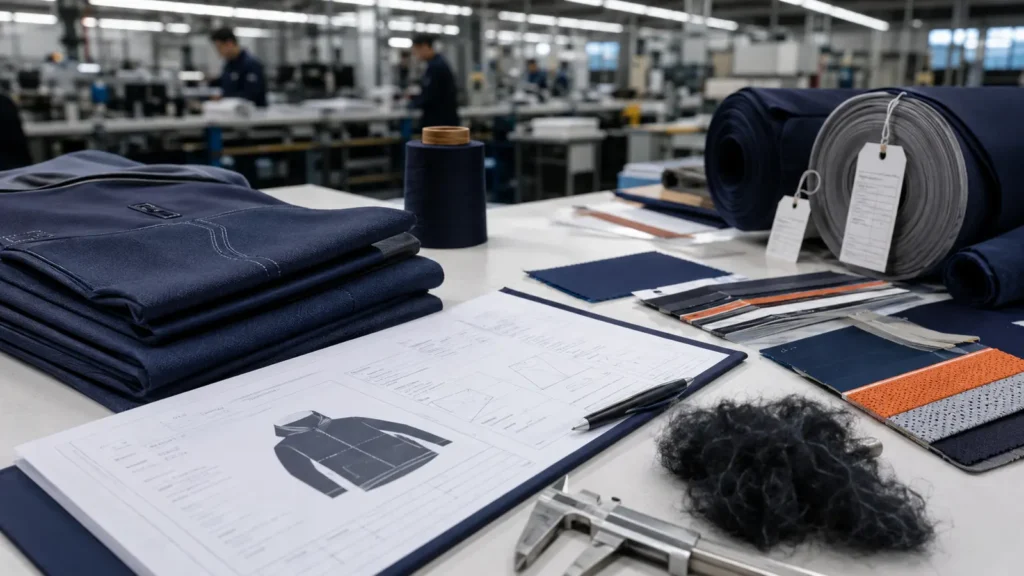
The Bill of Materials should give each fabric a unique item ID and connect it to the garment location, colorway and approved reference. Avoid free-text notes scattered across email threads.
Recommended fabric specification fields
| Field | What to record | Why it matters |
|---|---|---|
| Fabric ID | For example, FAB-01 | Connects drawings, BOM, swatch and inspection |
| Garment location | Body, sleeve, rib, lining or panel | Prevents one fabric being approved for the wrong component |
| Mill/supplier | Nominated or disclosed source | Supports traceability and source control |
| Article number | Mill quality or supplier code | Identifies the actual material, not only a description |
| Fiber composition | Exact declared blend | Supports labeling and material control |
| Construction | Interlock, jersey, mesh, woven twill, etc. | Controls structure and appearance |
| Target GSM | Finished weight and agreed tolerance | Reduces risk of lighter replacement |
| Usable width | Finished usable width | Affects consumption, markers and cost |
| Color standard | Pantone target plus approved physical reference | Separates target from actual approval |
| Finish | Brushed, peached, wicking, anti-pilling, etc. | Controls handfeel and performance |
| Performance | Test property and buyer requirement where needed | Makes functional expectations inspectable |
| Approved sample ID | Golden Swatch number and approval date | Links specification to physical evidence |
| Substitution status | “No substitution without written approval” | Defines authority |
Identify the source at the right level
There are three common sourcing-control levels:
- Nominated mill and article: the buyer requires a specific mill and quality code.
- Approved supplier article: the garment factory proposes a disclosed source and code, which the buyer approves.
- Performance specification: the buyer permits the supplier to source any material that meets all written and physical requirements.
The first option offers stronger source identity but can increase MOQ, lead time and price. The third offers flexibility but requires better incoming verification. Choose the control level according to risk, order size, repeat potential and the importance of consistency across seasons.
If a certificate or recycled-content claim is required, define which material and transaction evidence must accompany the order. Do not assume a factory-level certificate automatically proves that every fabric lot or finished product carries the claimed status.
How to Create and Keep a Golden Fabric Swatch
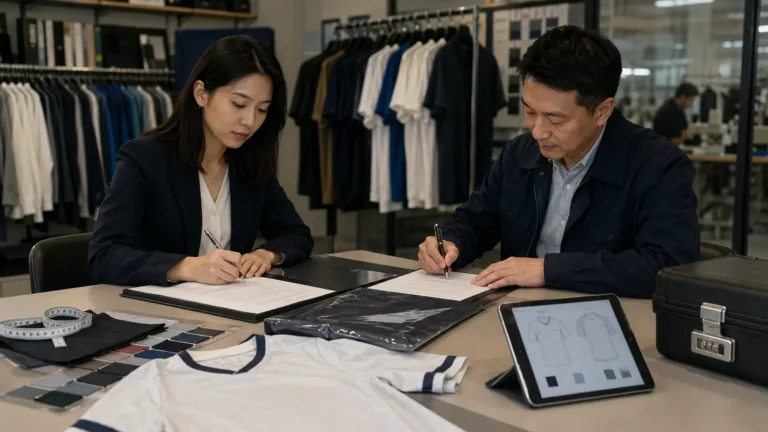
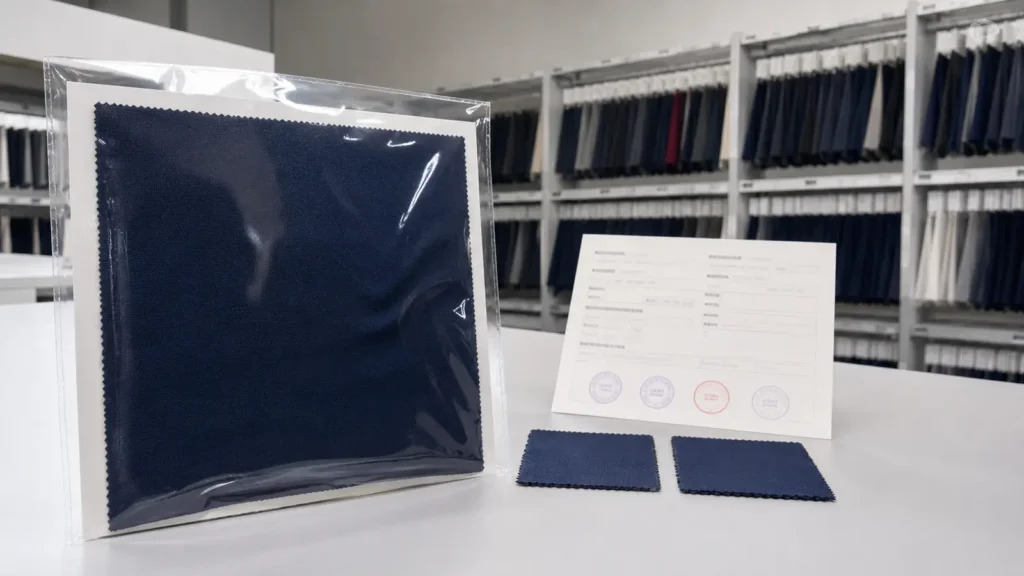
A Golden Fabric Swatch is the approved physical fabric reference used to compare bulk material. It captures characteristics that are difficult to communicate fully through text, such as handfeel, surface texture, luster, drape and visual color.
The swatch should be large enough for meaningful comparison. A tiny cutting may not show knit structure, stretch, directional appearance or shade. The suitable size depends on the material, but both parties should be able to handle and inspect it without damaging the reference.
Information to attach to the swatch
- buyer and supplier names;
- purchase order or development project;
- style number and fabric ID;
- garment location;
- mill or material supplier;
- article number;
- composition, construction and target GSM;
- color name and reference;
- finish;
- swatch approval date;
- tech-pack version;
- printed names/signatures or controlled digital approval reference;
- status: approved, conditional or rejected.
Prepare at least two equivalent approved references where practical: one retained by the buyer and one controlled by the supplier. A third can remain with an inspection provider or nominated mill for high-risk programs. Protect the swatch from sunlight, moisture, dust and frequent handling. Store it in a labeled opaque sleeve or controlled sample archive.
The physical swatch should not be treated as permanent proof that never changes. Some colors can fade and finishes can age. Record approval photos under consistent lighting, but do not use the photograph as the primary color standard. For repeat orders months later, compare the retained reference with a fresh production submission and decide whether reapproval is necessary.
Link the swatch to the garment Golden Sample
The approved pre-production garment should use the approved bulk-intent fabric. Record the same fabric ID on the garment sample tag and the swatch label. This connects material approval to fit, construction, decoration and finished appearance.
How to Lock Fabric Color Correctly
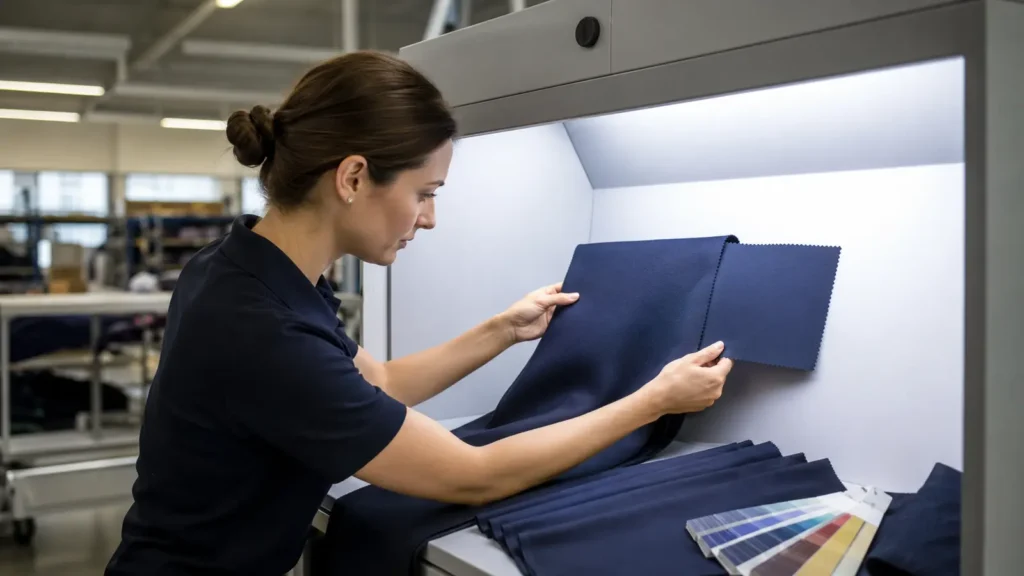
Pantone is useful as a communication target, but a Pantone number does not by itself lock the appearance of bulk fabric. Color changes with fiber, texture, luster, dye process, finishing and lighting. A screen display is even less reliable.
Use a layered color approval:
- State the Pantone system and reference where appropriate.
- Review a lab dip or strike-off on the intended fabric quality.
- Approve one physical option and identify it with a unique code.
- Compare the first bulk dye lot with the approved standard.
- Check roll-to-roll and within-roll shade variation before cutting.
If the order combines jersey fabric, rib, embroidery thread and printed transfer, decide whether each component must match exactly or coordinate visually. Different substrates may not appear identical even when suppliers aim at the same Pantone target.
For critical programs, define the viewing environment or instrumental method with qualified technical support. Do not copy a color-difference tolerance from an unrelated product and assume it is appropriate. The material, color, measurement instrument, customer expectation and agreed standard all affect acceptance.
Add a No-Substitution Requirement to the Contract and PO
The technical package states what is required. The contract or purchase order should state who has authority to approve a change and what happens when the approved material is unavailable.
The clause should cover more than fiber content. A change to mill, article, yarn, construction, GSM, width, color, finish or performance can affect the product even if the label composition remains unchanged.
Reference no-substitution clause
The Supplier shall not change or substitute any approved fabric, mill, material supplier, article number, fiber composition, yarn, fabric construction, finished weight, usable width, color, finish, treatment or performance characteristic specified in the current approved Tech Pack, Bill of Materials, purchase order, Golden Fabric Swatch or approved pre-production sample without the Buyer’s prior written approval. If the approved material becomes unavailable or unsuitable, the Supplier shall stop the affected work, identify and segregate the proposed alternative, disclose the reason for the change and all price, lead-time, appearance, performance, labeling and compliance effects, and provide representative samples and supporting records for review. Silence, schedule pressure, verbal discussion or acceptance of an earlier unrelated sample shall not constitute approval. Use of an unapproved substitute does not waive the Buyer’s inspection or contractual rights.
This wording is a procurement reference, not legal advice. Contract enforceability, remedies, governing law, inspection rights and damages should be reviewed for the buyer’s transaction and jurisdiction by a qualified professional.
Make approval authority explicit
Name the buyer roles permitted to approve changes. A designer’s comment about appearance should not automatically approve a material-source change. Specify that approval must be written and must identify the affected style, fabric ID, color, quantity and version.
Connect the clause to remedies and process
The agreement should address inspection access, rejection, replacement, rework, delay responsibility and documentation. However, aggressive remedies are not a substitute for early detection. It is usually faster and less costly to quarantine fabric before cutting than to argue about completed garments.
Incoming Fabric Inspection Before Cutting
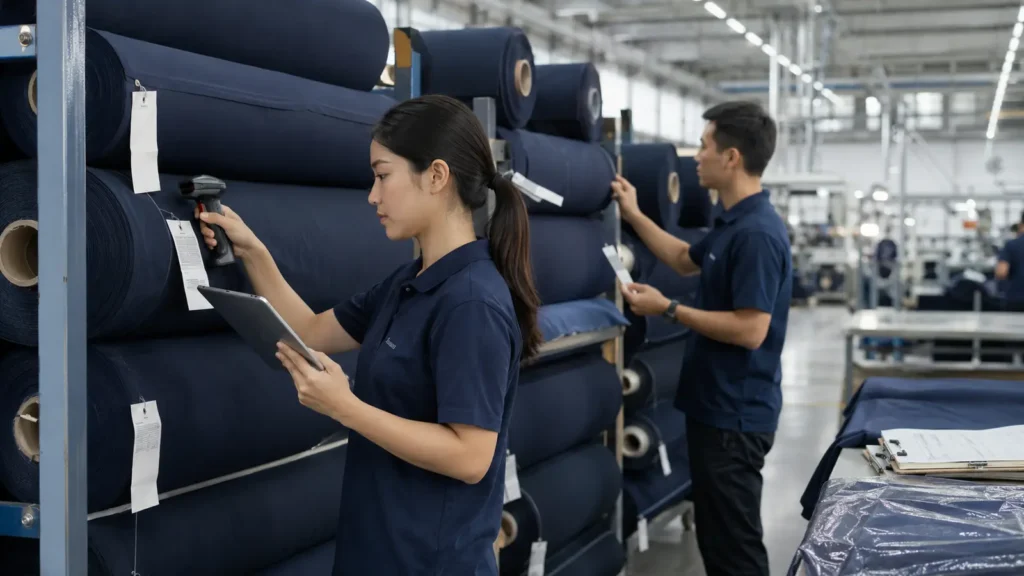
Incoming inspection is the operational checkpoint that verifies whether delivered bulk fabric matches the released specification and physical standard. The material should remain identifiable and, for controlled programs, unavailable for cutting until inspection disposition is recorded.
Step 1: Check receiving documents
Compare the delivery note, packing list, purchase order, fabric ID, supplier, article number, color, lot number, roll count and total quantity. Investigate missing or inconsistent identifiers before opening production.
Step 2: Inspect roll labels
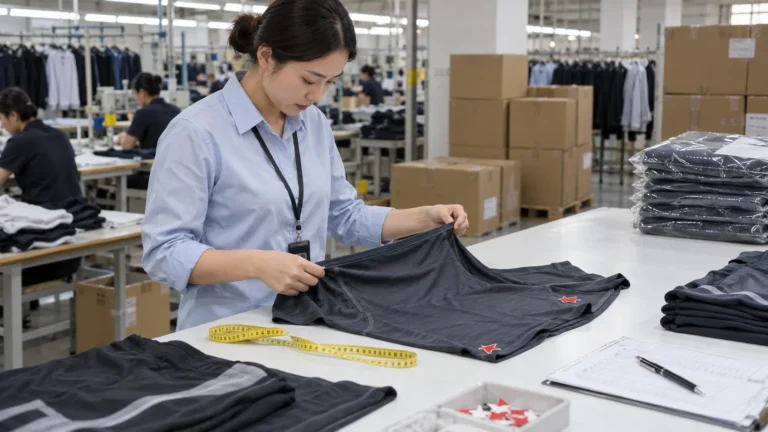
Photograph representative labels and record mill, article, dye lot, roll number, gross/net quantity and width where shown. Labels alone do not prove conformity, but they support traceability and can reveal an unexpected source immediately.
Step 3: Separate dye lots
Do not mix dye lots without evaluation. Record which rolls belong to each lot. If multiple lots are accepted, plan garment components and cutting to reduce visible shade mismatch within a finished garment or coordinated set.
Step 4: Compare appearance and handfeel
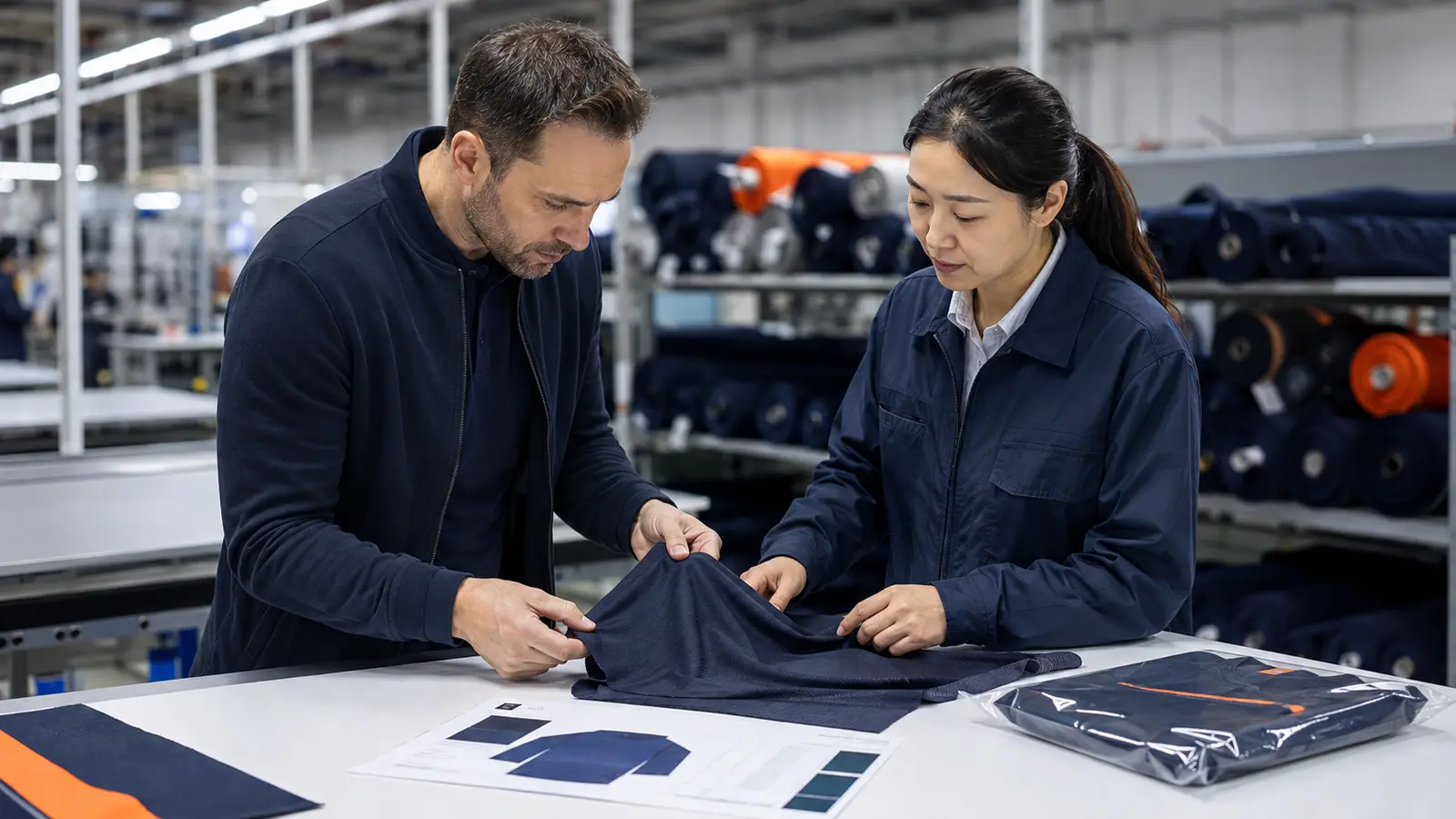
Under suitable lighting, compare bulk fabric with the Golden Swatch for shade, texture, luster, opacity, surface finish, stretch and handfeel. Use trained reviewers and consistent handling. A subjective check should be supported by measurable tests when the risk warrants it.
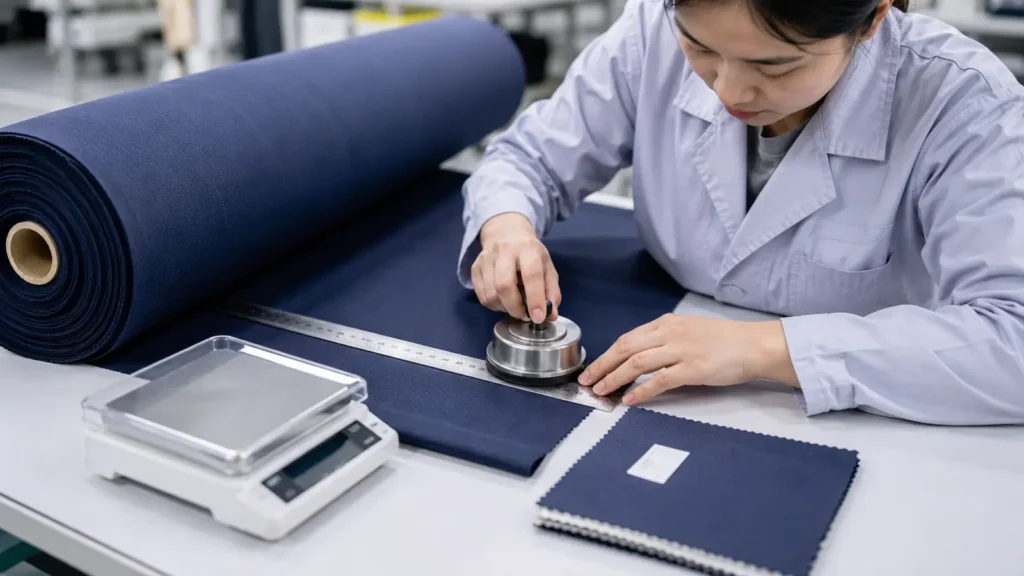
Step 5: Verify GSM and usable width
Use an agreed sampling and conditioning procedure. Record individual results rather than only an average. GSM can vary within a roll and can be influenced by moisture and conditioning. Measure usable width, not simply total edge-to-edge width, when damaged or distorted edges cannot be included in the marker.
Step 6: Review defects and roll condition
Check holes, stains, barre, streaks, bowing, skew, crease marks, color variation, coating defects, contamination and other relevant faults. Decide the inspection system and acceptance criteria before the material arrives; do not invent them after seeing a problem.
Step 7: Perform risk-based verification
Depending on the order, buyer requirements and destination market, verification may include composition analysis, dimensional stability, colorfastness, pilling, stretch/recovery, snagging, bursting strength or other relevant properties. Use an appropriate qualified laboratory when independent or standardized testing is required.
Step 8: Release, conditionally release or quarantine
The inspection record should identify the inspected lots, samples, results, reviewer, date and disposition. Only authorized personnel should change the status. A conditional release must state the limitation and affected quantity.
Incoming Fabric Inspection Checklist
| Check | Compare against | Evidence to retain | Possible disposition |
|---|---|---|---|
| Supplier and article | Approved BOM | Delivery documents and roll-label photos | Release or quarantine |
| Composition declaration | Tech Pack and labeling requirement | Supplier document; test report if required | Release, test or reject |
| Construction | Approved description and swatch | Close-up photo/sample | Release or technical review |
| GSM | Approved target and agreed tolerance | Individual readings and method | Release, segregate or reject |
| Usable width | BOM/consumption basis | Width readings by roll/sample | Recalculate or reject |
| Color/shade | Golden Swatch and approved lot | Shade grouping and photos | Release, segregate or resubmit |
| Handfeel/finish | Golden Swatch | Reviewer record and retained cutting | Release or resubmit |
| Surface defects | Agreed inspection criteria | Roll inspection report | Grade, claim or reject |
| Performance | Buyer protocol where applicable | Qualified test report | Release, corrective action or reject |
| Quantity/lot trace | PO and delivery note | Receiving and roll map | Reconcile before cutting |
What to Do If the Bulk Fabric Does Not Match
Do not allow production urgency to turn a detected difference into an informal approval. Use a documented deviation process.
1. Stop and quarantine
Physically identify and segregate the affected rolls. Change the system status so the cutting team cannot release them accidentally. If some material has already been issued, identify the affected bundles and stop further processing.
2. Define the difference
State the affected fabric ID, supplier, article, lot, rolls, quantity and characteristics. Replace statements such as “fabric feels wrong” with observations and results: lower measured GSM, different knit face, warmer shade, reduced usable width or missing finish.
3. Investigate the source
Determine whether the cause is an unapproved source, wrong warehouse issue, mill variation, incorrect labeling, finishing problem or outdated production file. The corrective action depends on the cause.
4. Submit a written deviation request
The supplier should disclose why the approved material cannot be used, the proposed alternative, quantity affected and impacts on price, lead time, appearance, fit, decoration, performance, labeling and compliance. Provide representative material and, when needed, a revised garment sample.
5. Approve or reject through authorized channels
Approval should identify exactly what is accepted. A buyer may approve a one-time lot for one purchase order without approving it as the new standard for repeat orders. Update the BOM and revision log only if the standard itself changes.
6. Preserve evidence
Retain comparison cuttings, photographs, labels, measurements, test results, correspondence and disposition. Evidence supports corrective action and prevents the same issue being debated again on the next order.
| Detected condition | Immediate action | Buyer decision needed | Production release evidence |
|---|---|---|---|
| Wrong article/source | Quarantine all affected rolls | Reject or evaluate alternative | Written deviation approval |
| GSM outside requirement | Hold affected lot and verify method | Accept exception, rework or reject | Signed inspection disposition |
| Shade differs from standard | Segregate by lot/shade | Approve, redye or reject | Approved shade band/lot |
| Width lower than specified | Stop marker planning | Recalculate consumption, price and capacity | Revised written agreement |
| Finish/handfeel differs | Compare and test as appropriate | Resample or reject | Approved replacement swatch |
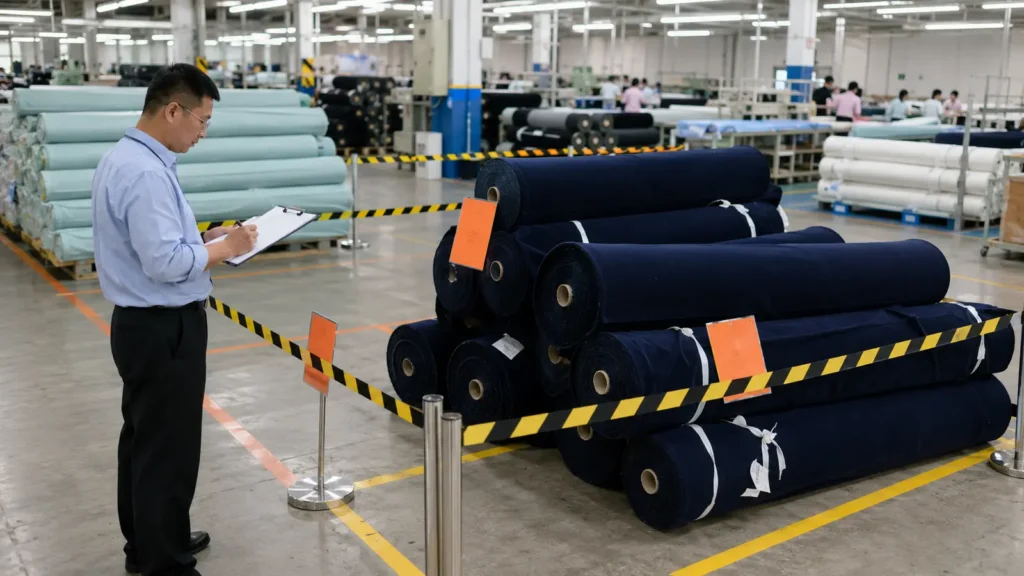
| Mixed traceability | Block cutting until lots are identified | Decide usable lots | Completed roll map |
Maintain Traceability from Fabric Roll to Finished Order
Traceability does not need to be complex for every order, but the supplier should be able to connect received material to the relevant purchase order, fabric ID, dye lot and production batch.
Useful records include:
- approved BOM and Tech Pack version;
- supplier purchase order for fabric;
- mill or distributor delivery note;
- roll labels and receiving photos;
- incoming-inspection report;
- roll and dye-lot map;
- cutting issue records;
- inspection samples and retained cuttings;
- deviation requests and approvals;
- pre-production and Golden Sample IDs;
- final inspection report.
For repeat programs, compare the new lot with both the current approved standard and recent acceptable production. If the buyer wants season-to-season consistency, state that requirement at quotation because reserving greige goods, ordering one dye lot or nominating a mill can affect MOQ, cash flow and lead time.
Common Buyer Mistakes
Approving a garment without approving its fabric identity
A good-looking sample does not prove that the same article is reserved for bulk. Record the fabric ID, source/code and Golden Swatch before releasing production.
Treating GSM as the only quality measure
Weight matters, but construction, yarn, finish, stretch, surface and performance also affect the garment. A substitute can match GSM and still be materially different.
Using a Pantone number as the final standard
Pantone communicates direction. Approve color on the actual fabric and retain the physical reference.
Allowing verbal approval
Phone calls and chat messages can be misunderstood. Confirm the decision in a controlled written record that identifies style, fabric ID, lot and quantity.
Inspecting only finished garments
After cutting and decoration, material replacement is expensive to correct. Incoming control provides a much earlier decision point.
Setting unrealistic delivery dates
If approvals consume the material-booking window, the original fabric may become unavailable. Build fabric reservation, lab dips, testing and reapproval into the schedule.
Copying universal tolerances
GSM, shade and performance acceptance should fit the product, material, method and buyer risk. Confirm the protocol rather than copying a number from another fabric.
Questions to Ask an Apparel Manufacturer
- Will the sample and bulk use the same mill, article and finish?
- Is the sampled fabric stock, reserved or subject to a new production run?
- What are the mill MOQ and dye-lot constraints?
- Which fabric details will appear in the BOM and order acknowledgement?
- Can both parties retain a signed Golden Fabric Swatch?
- How are incoming rolls identified, inspected and blocked before release?
- Who may approve a substitute, and how is approval recorded?
- Can the supplier trace dye lots into cutting batches?
- Which tests are routine, and which require buyer instruction or an external laboratory?
- How will a fabric change affect price, delivery, labeling, decoration and performance?
How JIUMU Supports Fabric Approval and Bulk Control
JIUMU Gear develops custom teamwear, hats and bags for B2B buyers. For apparel projects, a clear Tech Pack and BOM help the team confirm fabric construction, weight, color, finish, decoration compatibility and order feasibility before sampling. Buyers can submit nominated material information or review supplier-proposed options according to program requirements.
Before bulk release, the approved fabric reference should be connected to the current specification and pre-production sample. Incoming-material checks and production QC can then compare the received material with those approved references. The exact inspection and testing plan should be agreed for the order; JIUMU should not be presented as performing a particular laboratory test unless it is quoted and confirmed for that project.
JIUMU reports an approximately 200-person operation, about 25,000 square meters of production space and average monthly capacity of approximately 30,000 pieces. Actual capacity, material availability, lead time and inspection scope depend on product design, quantity, fabric, decoration and approval timing.
For related controls, see Manufacturing Capabilities, Quality Control, the Custom Apparel Sample Checklist, How to Make Sure Bulk Production Matches Your Approved Sample and How to Prepare a Tech Pack for Custom Teamwear and Hats.

Final Fabric Release Checklist
- Fabric ID and garment location are defined.
- Mill/supplier and article number are recorded at the required control level.
- Composition, construction, finished GSM and usable width are specified.
- Color and finish are approved on the actual fabric.
- Golden Fabric Swatches are labeled and retained by both parties where practical.
- The pre-production garment uses the approved bulk-intent fabric.
- The current BOM and Tech Pack versions are acknowledged.
- Contract and PO prohibit unapproved substitution.
- Approval authority and deviation process are defined.
- Incoming fabric inspection occurs before cutting.
- Roll, lot, shade, weight, width and defect records are retained.
- Nonconforming material is quarantined until written disposition.
- Accepted deviations identify style, lot, quantity and whether approval is one-time.
- Bulk and final QC compare production with the approved references.
To discuss a custom apparel order, contact JIUMU Gear with your product drawings, quantity, target fabric, color, decoration, destination market and required delivery date. If you already have an approved fabric, include its mill/article information and a controlled physical reference whenever possible.