Best Laptop Backpacks for School
School laptop backpacks are no longer simple book bags with a padded pocket added at the last minute. For schools, distributors, uniform dealers, promotional-product companies, and private-label brands, the right product must protect a device, distribute a changing daily load, survive repeated handling, and present a consistent identity across a bulk order. The best specification is therefore not the model with the longest feature list. It is the model that fits the students, devices, school routine, price position, and compliance responsibilities of a defined program.
This guide explains how professional buyers can compare laptop backpacks for secondary schools, colleges, academies, clubs, and branded student programs. It covers laptop fit, capacity, fabric, construction, comfort, customization, testing, cost drivers, sampling, and quotation preparation. It does not rank retail brands; it provides a repeatable sourcing method.
Quick Answer: For most secondary-school and college programs, start with a two-strap backpack sized around the actual device, a suspended or well-padded laptop sleeve placed against the back panel, organized space for books and accessories, wide adjustable padded straps, a padded back, reinforced load points, and a practical fabric selected for the target price and use. Approve the design through a physical sample with the real laptop, representative books, charger, and water bottle. Specify “water-resistant” only when the material and finished bag have been evaluated against an agreed test; a coated fabric alone does not make the complete backpack waterproof.
Why This Purchasing Decision Matters
A school backpack connects several requirements that can conflict. A larger cavity offers flexibility but encourages overpacking. Thick foam may feel protective but adds weight and can reduce usable space. A highly organized interior can improve daily use but adds material, sewing time, and failure points. A low unit price can become expensive if zipper, seam, color, or logo inconsistencies lead to claims, replacements, or rejected stock.
Professional buyers should translate “best” into measurable priorities:
- User: age range, approximate body size, commute, and school environment.
- Device: maximum laptop dimensions, not merely the marketed screen diagonal.
- Load: books, folders, lunch, sports kit, charger, and daily accessories.
- Channel: school issue, retail, promotional campaign, uniform program, or private label.
- Identity: school crest, sponsor mark, house color, student name, or no visible branding.
- Risk: destination-market product, labeling, chemical, and documentation obligations.
- Lifecycle: one event, one school year, multi-year use, or repeat-order program.
The American Academy of Pediatrics recommends two shoulder straps, wide padded straps, a padded back, use of all compartments, and positioning heavier contents close to the center of the back. Its backpack guidance also says a backpack should not exceed 15% of a child’s body weight. These recommendations are user guidance rather than a product certification, but they translate into sensible design choices: keep the empty bag efficient, provide stable organization, and avoid unnecessary hardware.
Laptop Backpack Types for School Programs
Different programs need different architectures. A single universal backpack may simplify purchasing, but segmentation is often more economical when younger students, older students, and staff carry different devices and loads.
| Type | Best fit | Typical strengths | Procurement cautions |
|---|---|---|---|
| Slim laptop daypack | Light digital-first schedules, staff, promotional programs | Lower empty weight, clean profile, efficient logo area | Limited book, lunch, and sports capacity |
| Standard campus backpack | Most secondary-school and college routines | Balanced laptop, document, bottle, and accessory organization | Confirm sleeve and folder dimensions together |
| Large project-load backpack | Technical programs, long commutes, mixed study and activity loads | More compartments and flexible storage | Higher material cost and risk of overpacking |
| Roll-top laptop backpack | Design-led college, cycling, or urban programs | Adjustable vertical capacity and contemporary look | Access can be slower; closure must be evaluated carefully |
| Convertible or travel-style model | Field courses, exchange programs, staff travel | Wide opening and packing visibility | More hardware, structure, cost, and empty weight |
| Wheeled laptop backpack | Specific accessibility or heavy-load programs where schools permit wheels | Moves load off shoulders | Heavier, more complex, and not permitted in every school |
A useful two- or three-size strategy
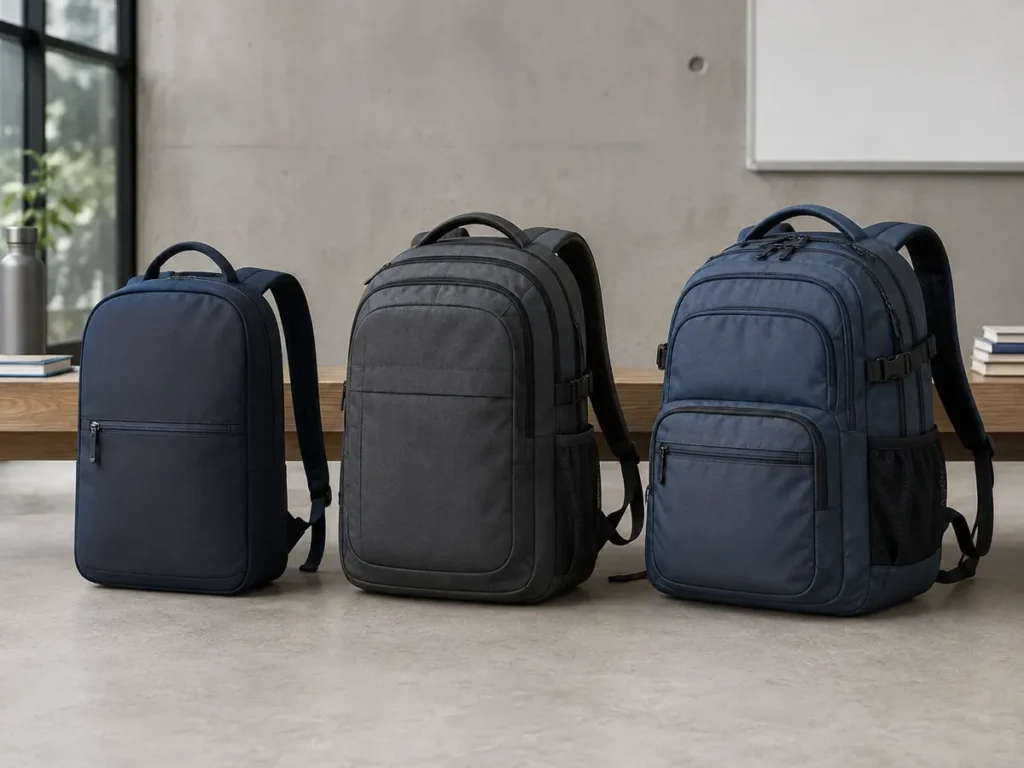
For a mixed program, consider a compact model for smaller devices and lighter schedules, a standard model for mainstream secondary-school or college use, and an expanded model only where the load supports it. This avoids forcing every user into the largest bag. It also allows buyers to keep the same exterior design language while changing body dimensions, sleeve size, or depth.
How to Specify Laptop Fit Correctly
“Fits a 15-inch laptop” is not a complete specification. The diagonal screen label does not define the external length, width, or thickness of the device. Bezels, chassis proportions, protective cases, and workstation designs vary. A sourcing brief should list the maximum physical device dimensions and whether a case remains on the laptop during storage.
The sleeve needs enough clearance for insertion without being loose enough to let the device move excessively. Buyers should also decide whether the sleeve will be:
- integrated into the main compartment;
- separated by its own zipper;
- suspended above the bottom;
- protected by bottom foam or a raised panel;
- closed with a hook-and-loop tab, elastic strap, or no tab; and
- lined with standard polyester, brushed fabric, or another specified material.
A suspended sleeve can reduce direct contact between the device and the ground when the bag is set down, but the suspension distance must be controlled. It is not a substitute for careful handling or product testing.
| Specification point | What the buyer should provide | What to verify on the sample |
|---|---|---|
| Device envelope | Maximum length × width × thickness, including case | Smooth insertion and removal without excess movement |
| Sleeve padding | Material, thickness or approved reference | Coverage around faces, edge feel, and compression after loading |
| Bottom protection | Suspension distance or padding construction | Device does not rest directly on the external bottom under normal placement |
| Opening | Zipper length and access direction | Corners do not catch; charger does not obstruct access |
| Separation | Dedicated compartment or internal sleeve | Books and bottles cannot press sharp items directly against the device |
Capacity and Organization: Design Around the Real School Day
Capacity in liters can help compare general size, but it should not replace an internal loading trial. Panel shape, padding, curves, dividers, and pocket placement affect usable space. Two bags with the same claimed volume can handle a binder or lunch container very differently.
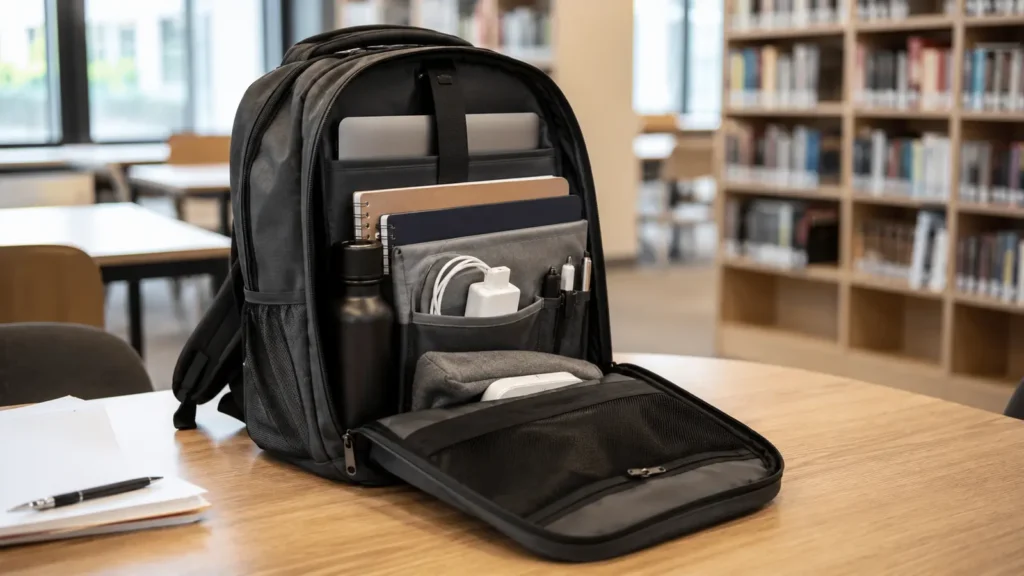
Create a representative load kit for sampling. It might include the approved laptop and case, a charger, two textbooks, a large folder or binder, notebook, pencil case, water bottle, lunch container, and a light garment. Photograph the packed sample and record which items are mandatory. This becomes more useful for repeat orders than a vague request for “large capacity.”
Place the laptop and heavier flat items nearest the back panel. Give small accessories a defined location so they do not collect at the bottom. External bottle pockets need a realistic diameter, height, and retention method. A pocket that looks neat when empty may not secure a filled bottle during movement.
Features translated into procurement decisions
| Feature request | Buyer benefit | Cost or risk question |
|---|---|---|
| Separate laptop compartment | Faster device access and separation from books | Adds zipper, lining, sewing, and potential water-entry path |
| Admin organizer | Keeps charger, pens, cards, and cables controlled | Too many small pockets add labor without improving use |
| Dual bottle pockets | Supports left/right use or bottle plus umbrella | Check elastic recovery, pocket depth, and loaded balance |
| Compression straps | Stabilize changing loads | Loose straps can snag; hardware and bartacks add cost |
| USB port | Marketing feature for some channels | Does not provide power; cable and port introduce components and claims |
| Reflective detail | Improves visibility when properly placed and illuminated | Define material, position, appearance, and any testing expectation |
Materials: Polyester, Nylon, Lining, Mesh, and Coatings
Fabric selection should start with an approved performance and appearance target, not fiber name alone. Denier is a yarn-size descriptor; it does not by itself guarantee abrasion resistance, tear strength, finished weight, hand feel, or water resistance. Weave, yarn quality, finishing, coating, and construction all matter.
Polyester
Polyester is widely used for school backpacks because it offers broad sourcing options, color flexibility, print compatibility, and practical cost positions. Options range from lighter woven fabrics to heavier textured constructions. A buyer should specify the chosen swatch, weight or construction reference, color standard, finish, and required evaluation rather than writing only “600D polyester.”
Nylon
Nylon can support lightweight or abrasion-focused designs, depending on construction, but it is not automatically superior. It can change cost, color appearance, print method, and minimums. Compare actual candidate fabrics under the same intended tests.
Lining and structure
The lining affects visibility, cleanability, sewing, and perceived quality. A light or contrasting lining can make small items easier to find. Foam and stiffeners determine shape and protection but add weight. Air mesh is commonly used on shoulder straps and back panels; its comfort depends on the complete padding geometry, not the mesh alone.
Coatings and water-resistance language
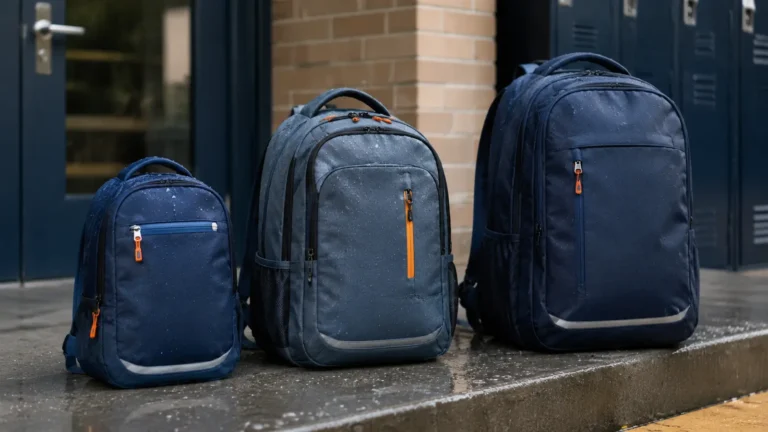
A PU or other backing can reduce water penetration through the fabric, yet seams, needle holes, zippers, openings, and construction remain possible entry points. “Waterproof backpack” should not be used merely because a fabric has a coating. Define whether the goal is resistance to a brief shower, fabric hydrostatic performance, spray resistance, or protection under a specific finished-product test. Then agree on method, duration, acceptance criteria, and sample conditioning.
Construction Details That Affect Durability
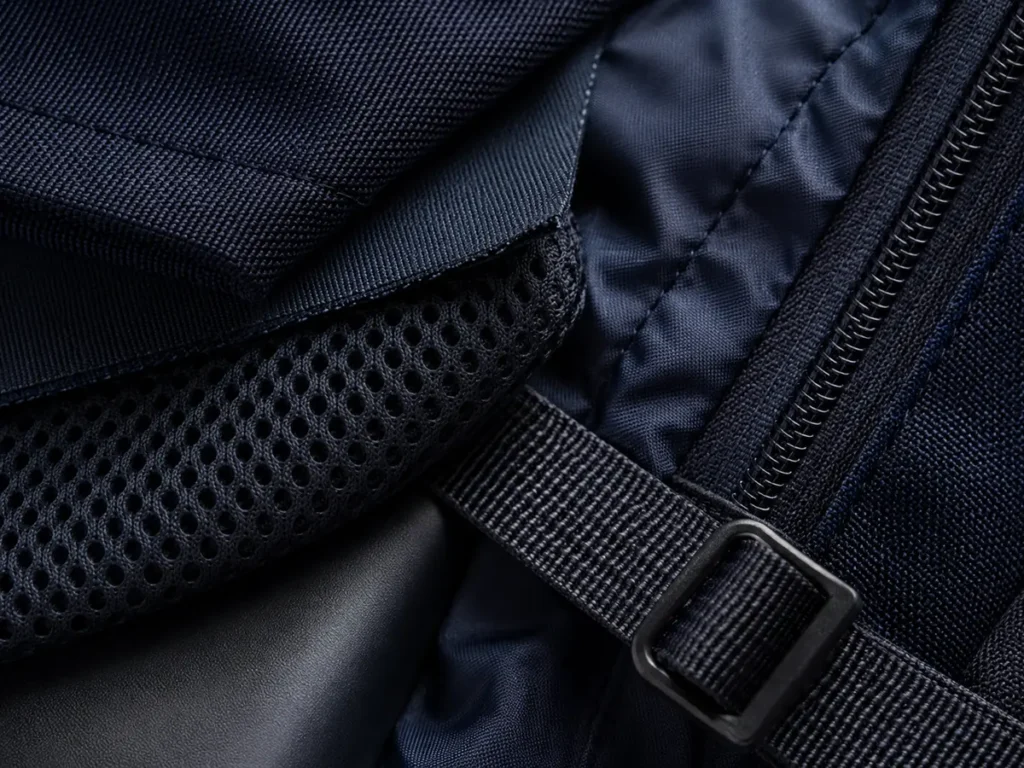
A fabric specification cannot compensate for weak load paths. The most important construction areas are where the shoulder straps join the body, the top handle, zipper ends, pocket corners, and seams carrying books and devices.
Ask the supplier to identify reinforcement methods on the technical drawing or approved sample. Depending on the design, these may include bartacks, box stitching, backing pieces, folded webbing, seam binding, or internal reinforcement panels. The correct method depends on material stack, seam direction, machine access, and intended load.
Inspect:
- strap symmetry and attachment position;
- stitch density and skipped or broken stitches;
- seam allowance and binding coverage;
- zipper alignment, end stops, sliders, and pullers;
- foam coverage and edge transitions;
- handle reinforcement;
- bottle-pocket elastic and recovery;
- internal loose threads and sharp edges;
- base shape when loaded; and
- finished dimensions at consistent measurement points.
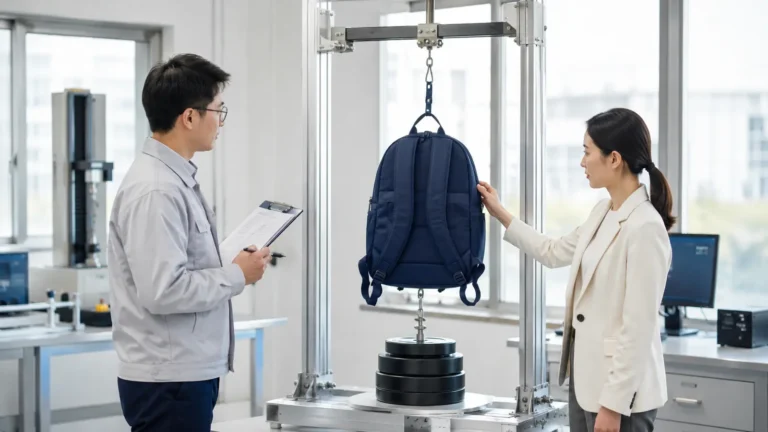
Zippers deserve particular attention because they are used repeatedly and can fail through component selection, poor alignment, excessive curves, or sewing distortion. Define the zipper type, gauge or approved component, puller, color, and testing expectation. Test the finished path, not just a loose zipper sample.
Comfort and Responsible Load Planning
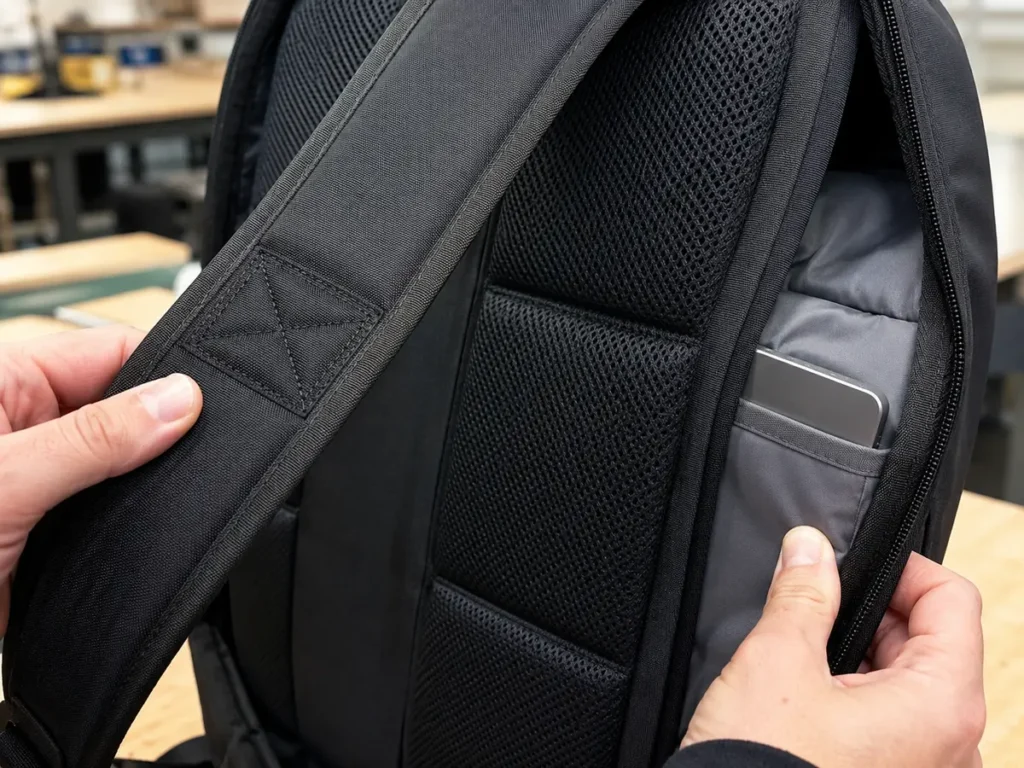
Comfort is a system of bag dimensions, empty weight, strap geometry, back-panel shape, load position, user size, and wearing adjustment. A “padded” label alone says little. Buyers should compare strap width, foam resilience, edge softness, adjustment range, and the position where straps meet the body.
For school-age users, a two-strap design supports more balanced carrying than a one-shoulder style. The American Academy of Pediatrics recommends using both straps and adjusting them so the pack sits close to the body. It also recommends organizing compartments and placing heavier items close to the center of the back. Buyers can enable these behaviors through sensible pocket placement and a clear user-care insert, while recognizing that final loading remains under user control.
Do not oversize the backpack “for future needs” without considering user size. Oversizing increases fabric and weight, may position straps poorly, and can encourage excessive loads. If the program covers a broad age range, approve fit on representative users or size forms and consider multiple sizes.
Customization and Private-Label Options
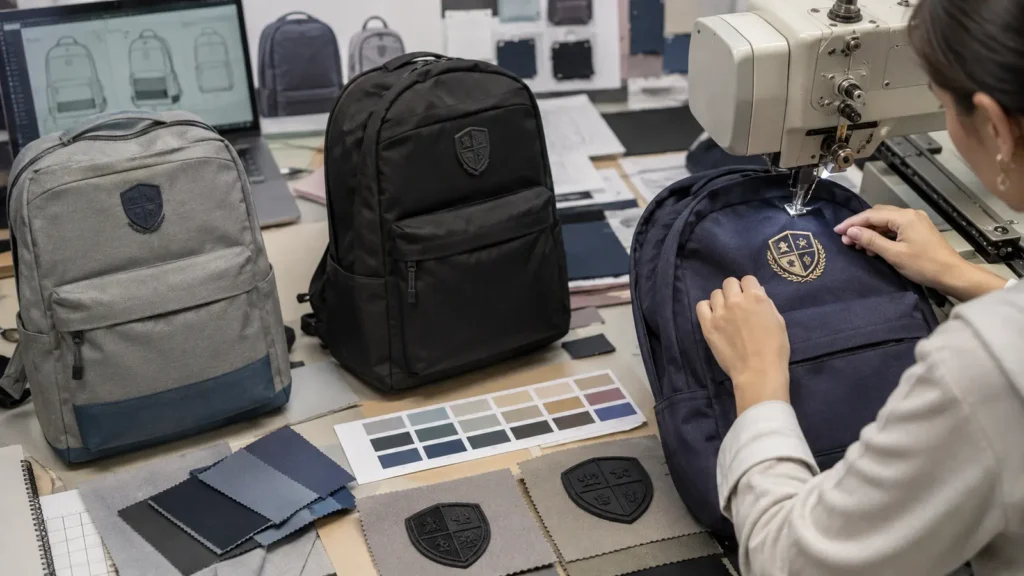
Customization should reinforce the program without compromising the functional panels. A logo centered on a curved, heavily padded, or frequently folded surface may distort. An oversized embroidery can stiffen the front pocket and increase stitch time. Start with the logo method and placement during pattern development rather than after the bag structure is fixed.
Common options include:
- direct embroidery for durable, dimensional identity;
- screen printing or heat transfer for suitable artwork and fabrics;
- woven patches for fine graphic detail;
- rubber/PVC or leather-style patches for a distinct material effect;
- private woven labels and internal identity labels;
- custom zipper pullers or webbing colors, subject to quantity and tooling;
- hangtags, barcode labels, polybags, cartons, and pack-out requirements; and
- Pantone-referenced color development, with material-dependent tolerances.
Artwork should be supplied as vector files where possible. The purchase specification should record final logo width and height, position measured from stable seams, thread or print colors, backing, and an approved physical strike-off or decorated sample.
Planning a school, distributor, or private-label backpack program? Send JIUMU your target quantity, device dimensions, bag dimensions or reference model, fabric direction, colors, logo artwork, packaging, destination, and required delivery date. JIUMU can review the concept for OEM/ODM development, sampling, customization, bulk production, quality control, and export support. Request a custom quotation.
Destination-Market Compliance and Labeling
Compliance is determined by the product, intended user, design, claims, destination, and sales channel. It should be reviewed before materials and decorations are locked.
For the United States, the Consumer Product Safety Commission explains that a backpack may be considered a children’s product when it is designed or intended primarily for children 12 years old or younger; size, themes, and decorations can affect that determination. Children’s products can involve specific lead, tracking-label, testing, certification, and record obligations. Phthalate rules have a defined scope and should not be applied casually to every textile bag component. The importer or responsible buyer should work with qualified compliance professionals and an accredited laboratory to identify applicable rules for the exact product.
Labeling also needs product-specific review. The U.S. Federal Trade Commission states that covered textile products generally require fiber content, country of origin, and manufacturer or responsible dealer identity, but backpack construction and exemptions must be assessed rather than assumed. Other destinations, including the United Kingdom, Canada, and European markets, have their own frameworks.
A strong sourcing brief therefore asks: Which regulations apply? Who is the responsible economic operator or importer? Which components and colorways require testing? What tracking, origin, material, packaging, recycling, or language marks are needed? Who holds reports and certificates? Do not print compliance marks until the requirement and authorized format are confirmed.
What Drives the Cost of a Custom Laptop Backpack?
Unit price reflects more than exterior fabric. The pattern, number of panels, pocket count, lining, foam, reinforcements, zippers, hardware, decorations, labels, packaging, testing, order quantity, color split, and delivery plan all contribute.
| Cost driver | Why it changes cost | Value-engineering approach |
|---|---|---|
| Body architecture | More panels and curves increase cutting and sewing | Preserve the load path while simplifying cosmetic seams |
| Compartments and zippers | Each opening adds components and labor | Keep only pockets tied to a real use case |
| Foam and structure | Thickness, density, and coverage affect material and handling | Specify protection zones instead of padding every panel |
| Decoration | Stitch count, color changes, patches, and tooling vary | Standardize logo size and choose a method matched to volume |
| Custom-dyed materials | May require higher minimums and longer development | Use stock colors for pilot orders where brand rules permit |
| Packaging and labeling | Individual packs, barcodes, inserts, and carton rules add work | Finalize retailer data before production |
| Testing and compliance | Scope depends on product and destination | Build a testing plan before ordering components |
| Color and SKU count | Small splits reduce production efficiency | Consolidate colors and use shared components |
The lowest quotation may omit a layer, reinforcement, test, label, or packaging step included elsewhere. Compare quotations line by line against the same specification and Incoterm. Ask whether sampling, artwork setup, tooling, third-party testing, freight, duty, and destination delivery are included.
Quality-Control Checklist for Bulk Orders
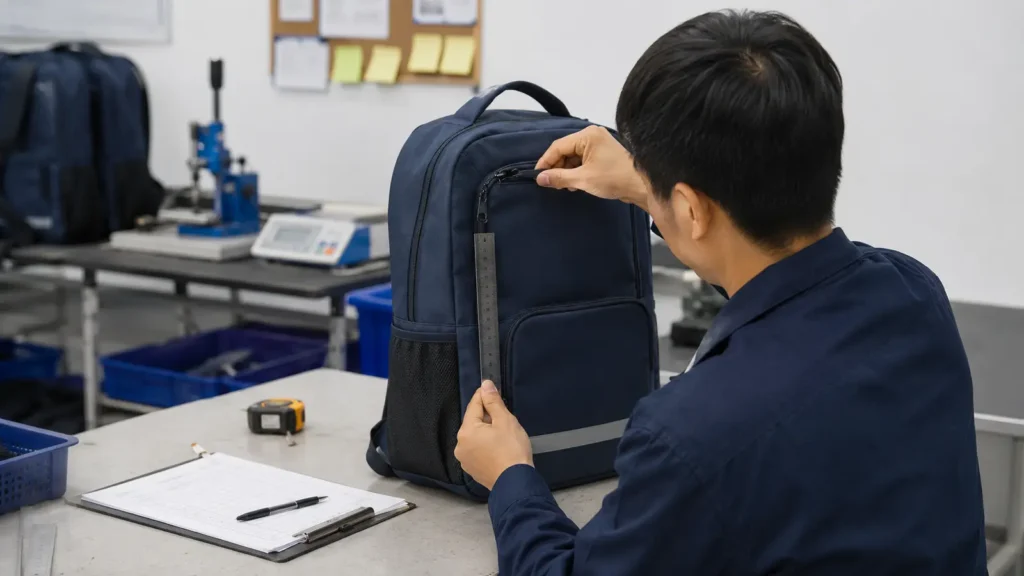
Quality control starts with a controlled specification and approved sample. An inspector cannot enforce “good padding” or “strong zipper” consistently without defined materials, measurement points, components, workmanship criteria, and tests.
Before production
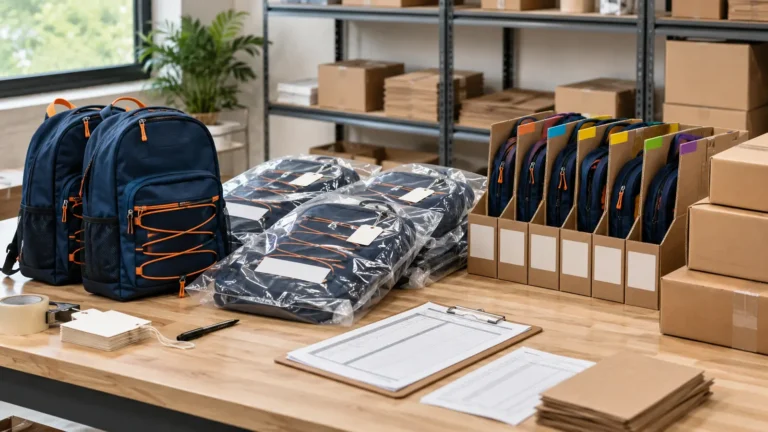
Approve the bill of materials, color references, logo artwork, dimensions, tolerance table, packaging, carton marks, and golden sample. Confirm which substitutions require written approval. If testing is needed, decide whether pre-production components, the finished sample, production units, or a combination will be submitted.
During production
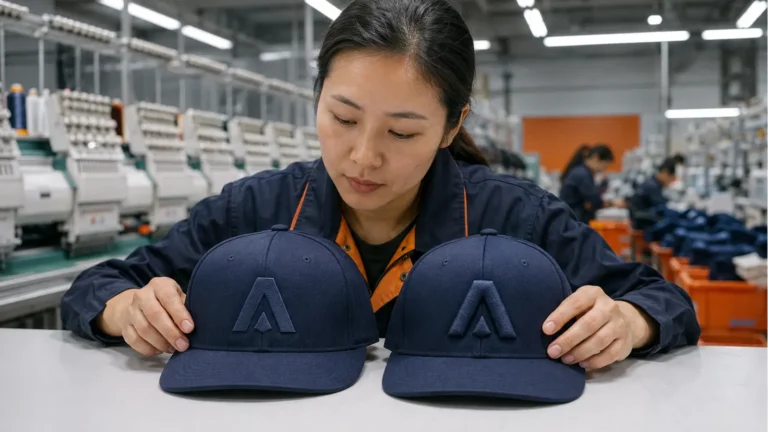
Review incoming fabric and component identity, color consistency under an agreed light source, cutting orientation, decoration position, reinforcement construction, and early finished units. Catching an incorrect zipper or logo position before the full run is more efficient than sorting finished goods.
Final inspection
Use a documented sampling approach appropriate to the buyer’s risk plan. Check quantity, assortment, appearance, workmanship, measurements, functional zipper and buckle operation, logo, labels, packing, carton data, and any agreed load or performance checks. Record defects by type and severity rather than relying on a general impression.
A Practical Bulk-Order Process
- Define the use case. Identify users, devices, representative load, channel, destination, quantity, target price position, and launch date.
- Choose the architecture. Select compact, standard, expanded, roll-top, or another relevant form. Remove features without a defined job.
- Prepare the specification. Record dimensions, materials, colors, components, logo, labels, packaging, and evaluation criteria.
- Review compliance. Determine destination and age-related obligations with qualified advisers before final material commitment.
- Develop artwork and mockup. Confirm logo method, size, placement, color, and visible brand details.
- Make and load-test a physical sample. Use the real device and representative contents; check access, balance, fit, and construction.
- Approve a golden sample. Sign and date the controlled reference and freeze approved changes.
- Confirm production and QC plan. Agree milestones, inspection criteria, testing, pack-out, and shipment documentation.
- Inspect and ship. Resolve nonconformities before release and retain records for repeat orders.
- Capture feedback. Track returns and field comments by defect or use pattern, then update the next specification.
What to Send for an Accurate Quotation
The fastest route to a comparable quotation is a structured inquiry. Send:
- buyer company, market, channel, and destination country;
- estimated total quantity and split by color or SKU;
- student age group and intended use;
- maximum laptop dimensions, including case;
- desired backpack dimensions or reference sample;
- representative load and required compartments;
- exterior, lining, foam, mesh, webbing, zipper, and hardware direction;
- logo vector file, size, placement, and preferred method;
- color standards or physical references;
- private labels, barcode, hangtag, polybag, and carton requirements;
- applicable test or compliance plan, if already defined;
- target delivery date and delivery location; and
- photos, tech pack, or physical reference, clearly noting which details must change.
If the design is not final, separate mandatory requirements from optional ideas. This allows the supplier to propose costed alternatives without changing the core function.
Questions to Ask a Backpack Supplier
- How will the proposed sleeve fit our maximum device dimensions and case?
- Which material and component references are included in the quotation?
- Where are the shoulder straps, handle, zipper ends, and load-bearing seams reinforced?
- Which dimensions and tolerances will appear on the production specification?
- How will color be approved across fabric, mesh, webbing, zipper, and decoration?
- What physical sample stages are recommended before bulk production?
- Which tests can be arranged for the finished design, and which laboratory will be used?
- How will changes after sample approval affect price, MOQ, and schedule?
- What inspections are performed during production and before shipment?
- Can packaging, labels, barcodes, and carton assortment follow our channel requirements?
- What files and samples are retained to support repeat-order consistency?
- Which Incoterm, payment terms, sampling charges, tooling, testing, and freight are included?
Common Buying Mistakes
Choosing by laptop screen size alone
External device dimensions vary. Provide a maximum three-dimensional envelope and test the actual device with its case.
Treating “600D” as a complete material specification
Denier does not define weave, weight, coating, colorfastness, abrasion, or tear performance. Approve a physical swatch and test plan.
Adding every marketable feature
Unused ports, straps, and pockets add weight, labor, failure points, and visual clutter. Every feature should have a user story.
Calling a coated bag waterproof
Finished construction includes seams, zippers, and openings. Use qualified water-resistance language tied to agreed evidence.
Approving only an empty sample
An empty backpack can look balanced while failing with the intended binder, bottle, charger, and laptop. Conduct a documented packing trial.
Leaving labels and compliance until the end
Requirements may affect components, artwork, tracking information, testing, and packaging. Review them before production.
Splitting a pilot order into too many SKUs
Multiple colors, sizes, and decorations dilute quantity and complicate consistency. Start with a focused assortment, then expand using actual demand data.
Why JIUMU Is Relevant to Custom School Backpack Programs
JIUMU is a Guangdong-based B2B supplier established in 2010, supporting custom teamwear, uniforms, hats, bags, and branded merchandise for buyers in North America and Europe. Its approved capabilities include OEM/ODM development, embroidery, printing and heat-transfer options, woven and rubber/PVC or leather-style patches, fabric sourcing, Pantone color matching, private labels, hangtags, packaging customization, digital mockups, physical samples, bulk production, quality control, and export support.
For a laptop backpack program, that capability set supports coordinated development from reference concept through branding and pack-out. JIUMU’s typical MOQ is 50 pieces, subject to the bag structure and customization. Buyers should confirm the MOQ, sample plan, price, testing scope, and production schedule for the exact specification.
You can also explore JIUMU’s custom team bags when the program includes sports or equipment bags, or contact the team with a backpack brief.
Frequently Asked Questions
Final Recommendation
Buyers searching for the best laptop backpacks for school should resist choosing from a feature checklist alone. Begin with the user, device envelope, representative load, and destination requirements. Select the simplest architecture that performs those jobs, then control its materials, load paths, logo, labels, packaging, sample, and inspection criteria.
A disciplined specification creates value in three ways: it removes features students will not use, protects important functions from cost cutting, and creates a stable reference for repeat orders. The physical loaded sample is the decision point. If the real laptop, books, accessories, and bottle fit comfortably; the straps and back panel suit the intended user; the construction meets the agreed evaluation; and the program’s compliance and branding details are documented, the product is ready to move toward controlled bulk production.
Request a custom school laptop backpack quotation. Email zhengdong@jiumugear.com or contact JIUMU by WhatsApp/phone at +86 18507502899. Include quantity, laptop dimensions, target bag size, reference photos or tech pack, colors, logo, packaging, destination, and required delivery date. Send your project brief.