Best School Backpacks for Boys: A Practical Buying Guide
Choosing the best school backpacks for boys is not simply a matter of selecting a popular color or adding a sports graphic. For schools, distributors, uniform dealers, promotional companies, and private-label brands, the real task is to match backpack size, carrying structure, materials, organization, appearance, and order specifications to the students who will use the bags.
A successful program also has to work commercially. The design must be manufacturable, decoration must remain consistent across a bulk run, the bag must survive realistic school use, and the final packaging and labeling must suit the destination market. This guide explains how professional buyers can turn a broad request for “boys’ school backpacks” into a clear, testable sourcing specification.
Quick answer: The best school backpack is appropriately sized for the student, uses two broad adjustable shoulder straps and a padded back, keeps heavier items close to the back, and has enough organization without unnecessary bulk. For bulk purchasing, buyers should also define fabric, reinforcement points, zipper and buckle expectations, logo method, color tolerances, packaging, testing requirements, and sample approval criteria before production.
What “Best for Boys” Should Mean to a Professional Buyer
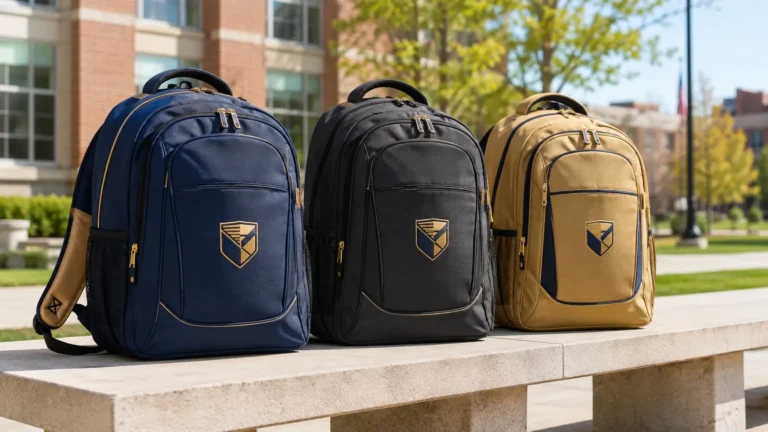
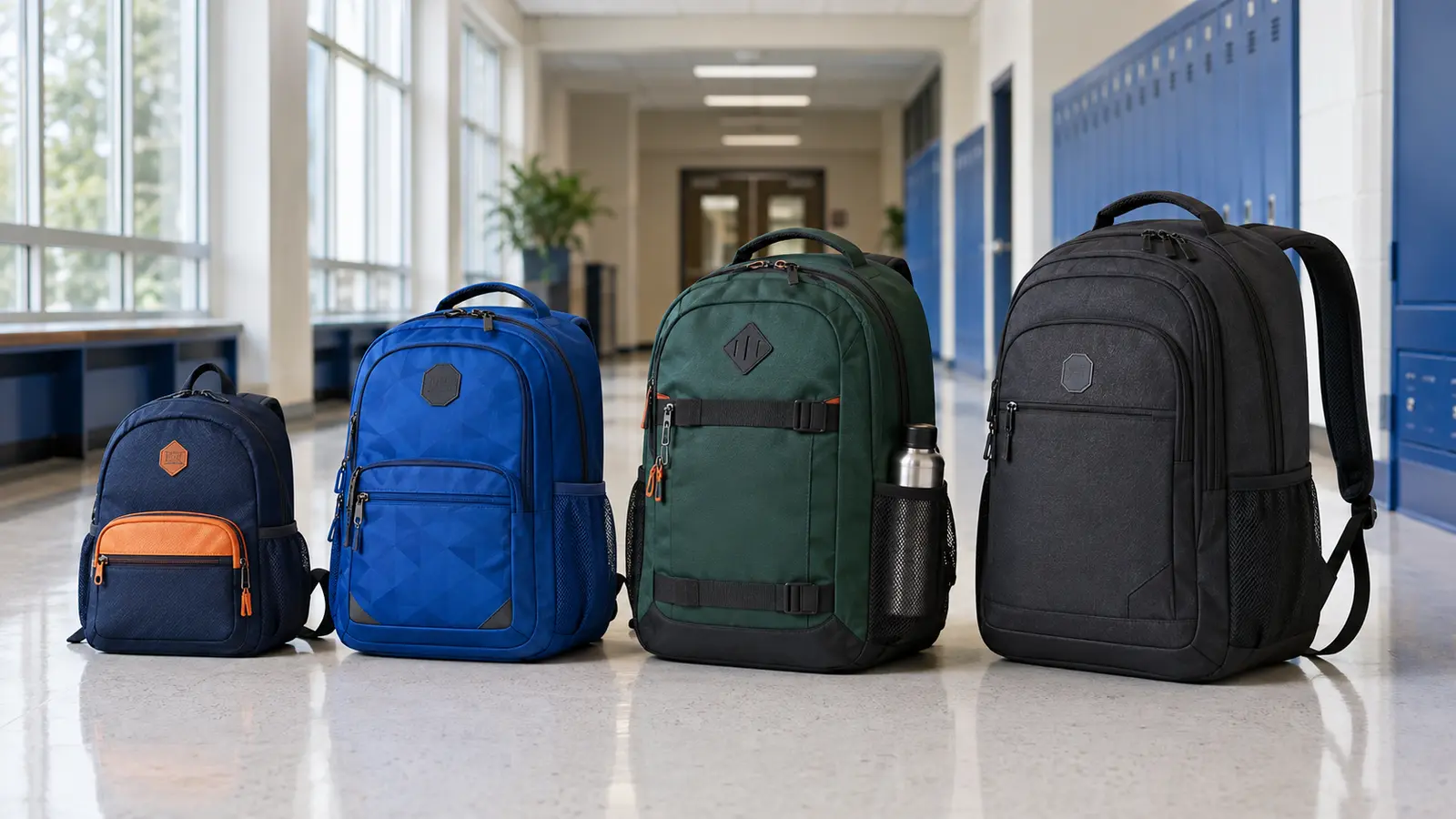
“For boys” often describes merchandising rather than a technical category. Some buyers want navy, royal blue, forest green, charcoal, sport-inspired details, geometric prints, or rugged styling. Those can be useful starting points, but they should not become rigid assumptions about every student. A stronger assortment offers several broadly appealing colorways and lets the school, retailer, or program choose the design direction.
Technical requirements should come first. Consider the age and body size of the user, the typical school load, the distance walked, whether a lunch box or device must fit, the school’s dress or branding policy, and how often the backpack is expected to be cleaned. Then use style, color, and decoration to make the product attractive.
This distinction matters in B2B buying. A visually exciting backpack that is too long for an elementary student, too small for a binder, or overloaded with fragile trim will create returns and complaints. A simple bag with the right proportions, usable compartments, reliable zippers, and a controlled logo application usually gives a program a better result.
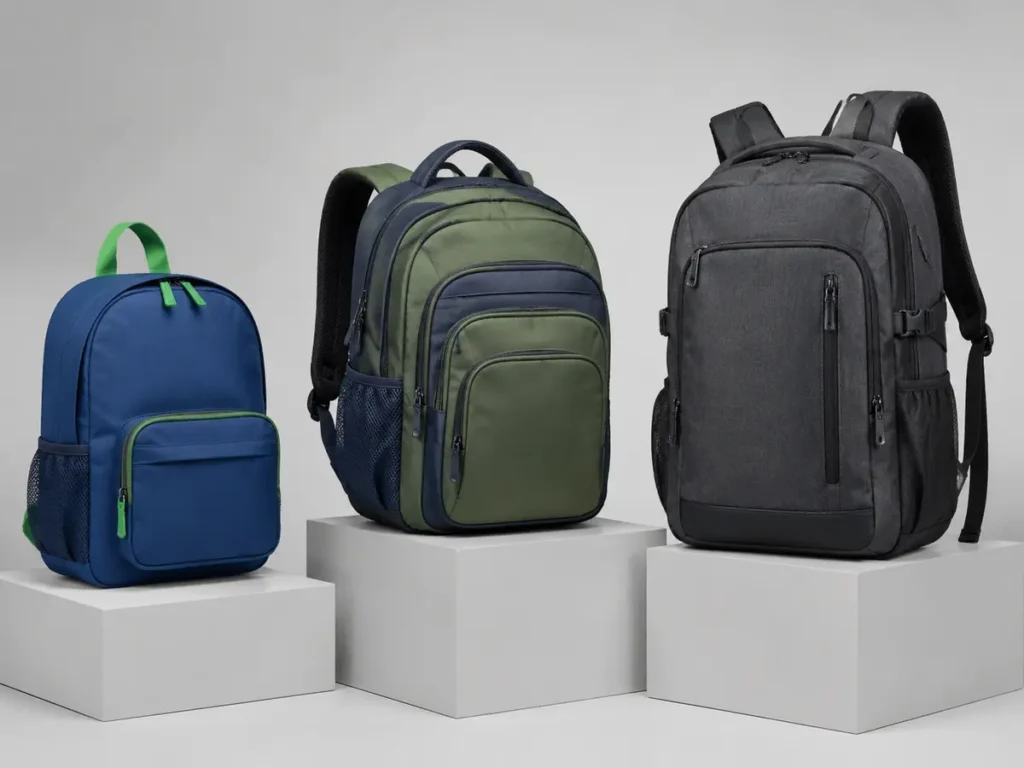
Decision Overview: Match the Backpack to the School Stage
Age labels are only planning references; actual school supplies and student dimensions vary. Confirm the required internal dimensions with representative contents, and approve the bag on real users or fitting forms before bulk production.
| School stage | Typical product direction | Useful organization | Key sourcing priority | Common mistake |
|---|---|---|---|---|
| Early elementary | Compact, lightweight body with simple opening | Main compartment, front pocket, bottle pocket, name-label area | Correct torso proportion and easy zipper pulls | Making the bag too deep or adding too many pockets |
| Upper elementary | Medium size with stronger base and more organization | Main compartment, front organizer, dual bottle pockets | Washability and reinforced stress points | Selecting only by stated liter capacity |
| Middle school | Medium-to-large bag for binders and changing schedules | Two main zones, organizer, device sleeve if needed | Load distribution, zipper quality, flexible storage | Using a small elementary pattern with extra pockets added |
| High school | Structured backpack for books, device, chargers, and activities | Padded laptop sleeve, document zone, accessory pocket, bottle pockets | Device protection and daily durability | Oversizing the pack “for more capacity” without controlling weight |
Size, Capacity, and Fit: Start With Contents, Not Liters
Capacity in liters can help compare models, but it does not tell the whole story. Two packs with the same nominal volume can load very differently because of their depth, taper, pocket layout, padding, and opening shape. A professional specification should include finished external dimensions and critical internal fit requirements.
Build a representative load list
Before requesting a quotation, photograph or list what the backpack must carry. That may include folders, a full-size binder, notebooks, a lunch container, a water bottle, a change of clothing, or a laptop. Give the supplier the device dimensions rather than only saying “fits a 15-inch laptop,” because screen classes do not define every device’s complete width, height, and thickness.
Ask for a packing demonstration during sample review. Check that the zipper can close without forcing the corners, that the contents do not create a hard bulge against the student’s back, and that the loaded bag remains stable when lifted by the top handle.
Evaluate fit on the intended user
The American Academy of Pediatrics recommends a backpack with two broad, padded shoulder straps and a padded back, and advises wearing both straps. It also recommends placing heavier items close to the center of the back and keeping the loaded backpack within a limited share of the child’s body weight. Because guidance and individual needs differ, schools and parents should apply their own policies and consult a health professional when a student has pain or specific needs.
For product approval, examine whether the shoulder straps adjust across the intended range, the bottom of the bag sits around the waist rather than far below it, and the pack does not extend excessively beyond the student’s torso. A sternum strap can stabilize certain larger or activity-oriented designs, but it should be correctly positioned, easy to operate, and justified by the use case.
Which Backpack Styles Work Best?
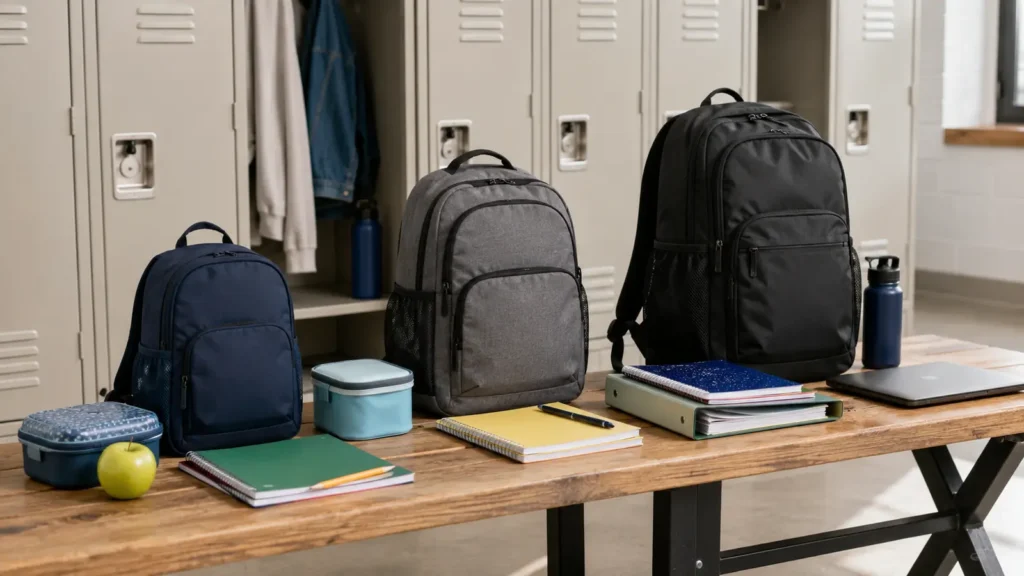
Classic two-strap daypack
The classic daypack is the most versatile format for school programs. Its rounded or softly structured main compartment is economical to produce, familiar to students, and compatible with embroidery, patches, or printed graphics. It works best when the front pocket and bottle pockets are scaled to the bag rather than copied from an adult travel pack.
Organizer backpack
An organizer backpack divides books, stationery, lunch items, cables, and small accessories. It suits middle- and high-school ranges, but every added pocket increases material, sewing operations, zipper use, weight, and inspection points. Buyers should ask whether each feature solves a real use need.
Laptop school backpack
A laptop-focused model adds a padded sleeve or separate device compartment. Define the maximum device dimensions, padding construction, closure, and distance between the device and the bottom edge. A “padded laptop sleeve” is not a drop-protection guarantee. If protection claims are important, agree on a relevant test method and acceptance criteria rather than relying on marketing language.
Sports-and-school hybrid
This format may include a larger opening, shoe or wet-item separation, ball-carry features, or exterior attachment points. It can serve school teams and after-school programs, but it should not become unwieldy for classroom use. Detachable or modular features may be more practical than permanently increasing the bag’s bulk.
Rolling backpack
Rolling models can help in specific environments, but they are heavier, more complex, and dependent on wheel, handle, and stair-use conditions. They require different testing and are not automatically the best solution for every student. Confirm school policies, routes, storage space, and maintenance expectations before including them in a range.
Materials: Translate Fabric Names Into Specifications
“Polyester” and “nylon” describe fiber families, not complete performance levels. Fabric density, yarn structure, weave, coating, finishing, backing, colorfastness, and seam construction influence the final result. Avoid assuming that a higher denier number alone guarantees a better backpack.
| Material or component | Why buyers choose it | What to specify or verify | Qualification |
|---|---|---|---|
| Polyester woven fabric | Broad color choice, common sourcing, practical cost | Construction, weight or denier, coating, color, abrasion and colorfastness requirements | Performance varies widely by construction and finish |
| Nylon woven fabric | Often selected for a strong, smooth, lighter-feel shell | Exact nylon type, construction, coating and test requirements | Usually raises cost; not automatically necessary |
| Ripstop-style weave | Visual and structural grid can limit propagation of small tears in some constructions | Fiber, yarn, grid construction, coating and test result | Do not claim “tear-proof” |
| Spacer mesh | Airflow and cushioning on back panels and straps | Thickness, hand feel, recovery, abrasion exposure and binding | Mesh can snag if placed on high-wear edges |
| Lining | Cleaner interior and support for pockets | Fiber, color, weight, seam finish and cleanability | Light colors show dirt; very thin lining may distort |
| Coated base panel | Helps manage contact with damp or dirty surfaces | Coating type, seam design, flexibility, cold performance if relevant | Coated fabric does not make the entire bag waterproof |
| Foam padding | Shapes the back, straps, handle and device sleeve | Material, thickness, density, recovery and placement | More thickness does not automatically improve comfort |
Water-related claims require precision. “Water-resistant fabric” may refer only to the textile surface, while water can still enter through zippers and seams. A fully waterproof claim demands a product-level design and relevant verification. For ordinary school bags, it is often clearer to specify a coated or water-repellent shell and communicate reasonable limitations.
Construction Details That Influence Durability
School backpacks experience repeated pull, swing, floor contact, overpacking, and zipper stress. Durability therefore depends on how the components are joined, not only on the shell material.
Shoulder-strap attachment
The upper strap joint is a critical load point. Review the attachment area, reinforcement material, stitch pattern, seam allowance, and alignment. A visible box-and-cross pattern or bartack can be useful, but the complete construction matters more than its appearance.
Top handle
Students and adults frequently lift a loaded bag by the handle. Specify whether the handle is intended for brief lifting or sustained carrying. Check its webbing, padding, anchoring, and the way its load transfers into the main body.
Zippers and openings
Assess zipper size, tape, slider motion, puller shape, end stops, and sewing alignment. The best zipper cannot compensate for a sharply curved path or a pocket that is under tension when normally packed. During approval, cycle the zipper with the bag empty and loaded.
Base and corners
The bottom panel and lower corners contact floors and often show wear first. Consider a reinforced or coated base, suitable piping or binding, and construction that does not expose vulnerable seams at the contact point. A dark base color can also improve the appearance after repeated use.
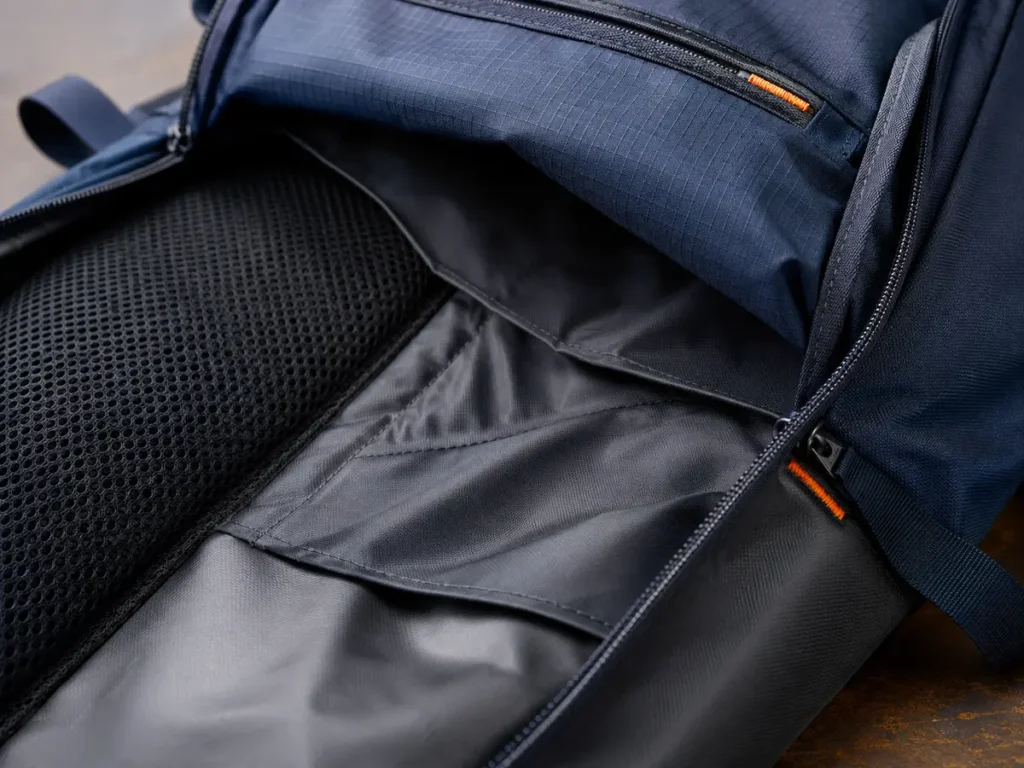
Internal seams and pocket edges
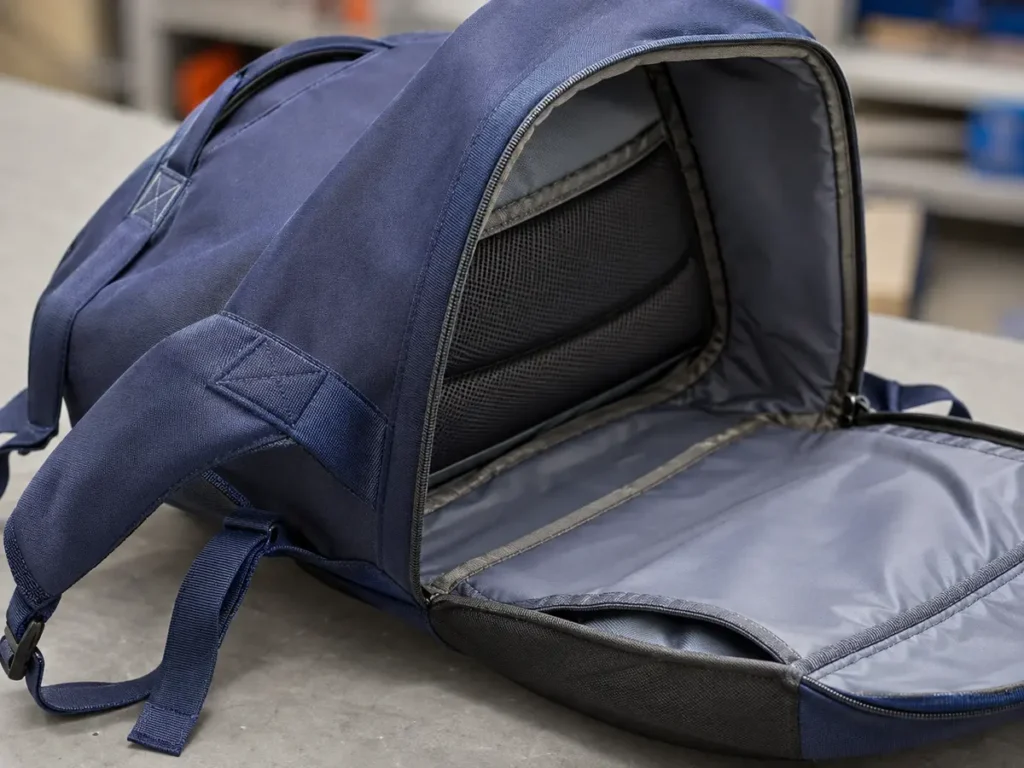
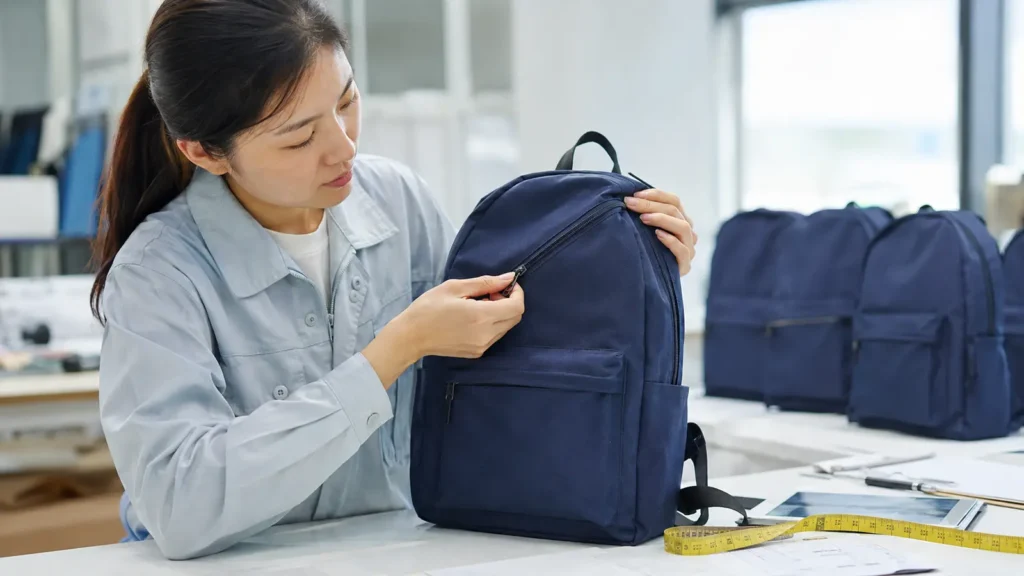
Open the sample and inspect binding, loose thread control, raw edges, pocket symmetry, and stress at organizer panels. A neat exterior can hide weak internal assembly. Define workmanship standards with photographs in the approved sample record.
Turn Features Into Procurement Decisions
Feature lists are useful only when tied to a use case and an acceptance check.
| Requested feature | Procurement question | Sample approval check |
|---|---|---|
| Dual bottle pockets | What bottle diameter and height must fit? | Insert the representative bottle and test retention while walking |
| Padded back | What padding construction and coverage are required? | Check surface smoothness, recovery, heat buildup, and fit |
| Organizer panel | Which items need dedicated storage? | Pack actual pens, charger, card, and keys; check access and snag risk |
| Reflective detail | Is visibility performance being claimed? | Specify material and relevant test requirement; do not approve by appearance alone |
| Name label | Is privacy a concern? | Place the label inside or in a controlled location and test ink compatibility |
| Laptop sleeve | Which exact device must fit? | Insert a device mockup and check bottom, side, and closure clearance |
| Easy-clean surface | What cleaning method will instructions permit? | Conduct the agreed cleaning trial and inspect color, coating, foam, and shape |
Custom Colors, Logos, and Private-Label Options
Customization can make a school backpack range distinctive, but decoration must suit the fabric and placement.
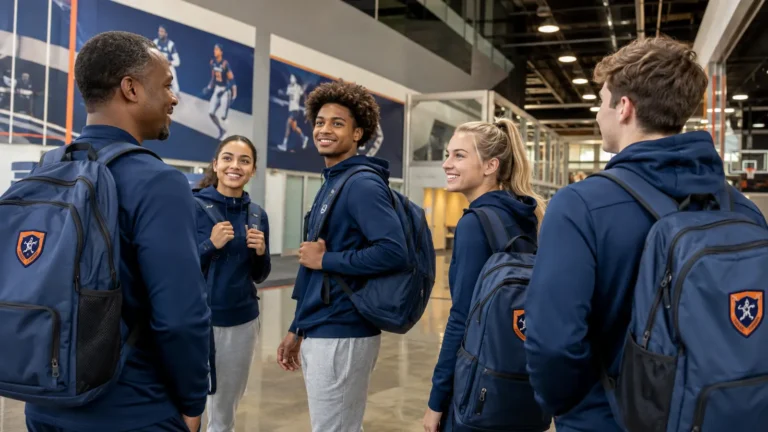
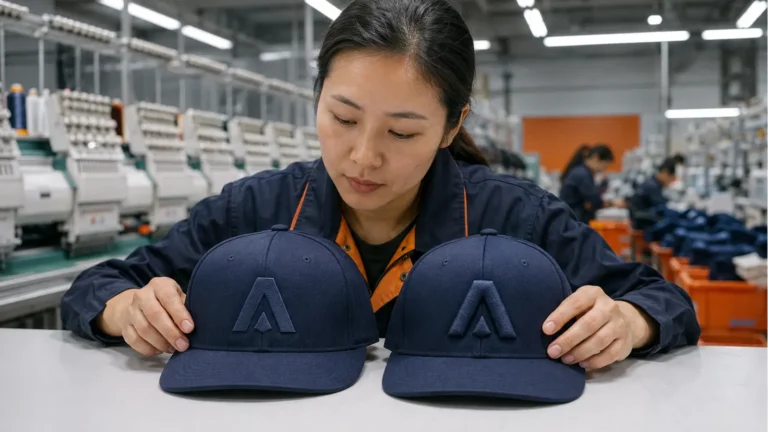
Embroidery gives a textured, durable appearance for crests and simple logos. Dense embroidery can stiffen or pucker lighter fabric, so confirm backing, stitch density, size, and position on a decorated sample.
Woven patches can reproduce fine graphic detail with a defined edge. Specify patch dimensions, border, backing, attachment stitch, and approved colors.
Rubber/PVC or leather-style patches create a dimensional branded element. Buyers should confirm material, thickness, flexibility, attachment method, target-market requirements, and how the patch behaves after cleaning.
Screen printing and heat transfer work for larger graphics or more economical programs, depending on design and fabric. Confirm adhesion, opacity, color, stretch behavior, surface texture, and cleaning limitations on the actual production fabric.
For a coordinated range, provide Pantone references as targets but approve color on the actual fabric and decoration method. The same target can appear different on woven polyester, embroidery thread, transfer film, zipper tape, and molded components.
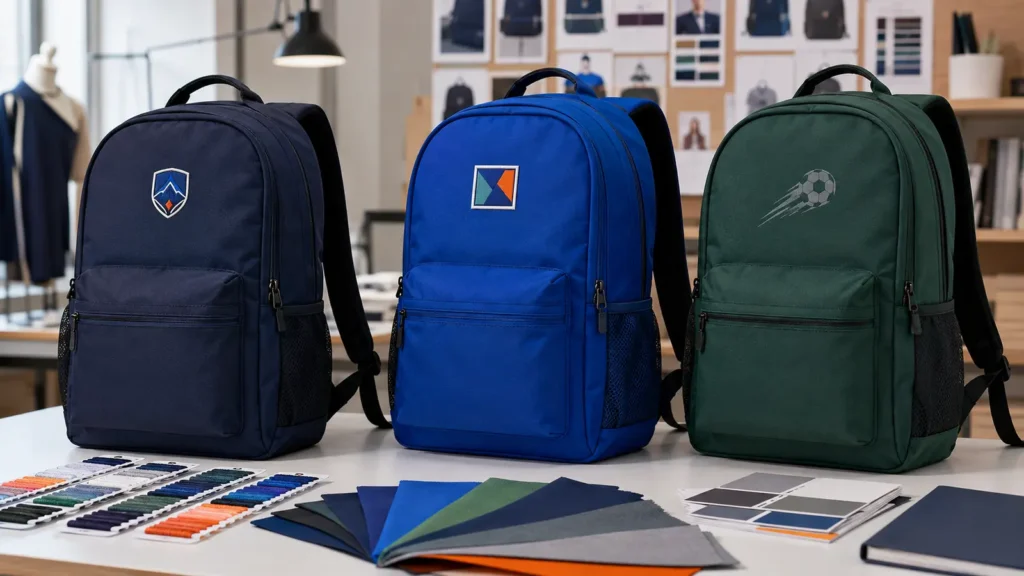
Planning a school, distributor, or private-label backpack program? Send JIUMU your target age group, quantity, dimensions, representative contents, colors, logo artwork, packaging, destination, and desired delivery date. Request a custom quotation or explore custom team bags.
What Drives the Cost of a Bulk School Backpack?
The unit price is shaped by the entire bill of materials and production route. Major drivers include shell and lining construction, bag size, number of panels, compartments and zippers, webbing and buckles, mesh and foam, reinforcement, logo method, custom-dyed components, labels, packaging, testing, order quantity, and shipping terms.
A lower quotation may represent a different specification rather than greater efficiency. When comparing suppliers, issue the same requirement sheet and ask each quotation to state inclusions, exclusions, sample fees, tooling where applicable, packaging, testing, Incoterm, and quotation validity.
Standardizing components across a range can control cost and repeat-order risk. For example, several age-based sizes can share a color palette, zipper family, webbing specification, logo method, and packaging system while using different patterns and internal organization. This creates a visually coherent program without forcing one bag to serve every student.
Sample Approval and Quality-Control Checklist
A digital mockup confirms artwork position and overall direction, but it cannot validate fit, fabric hand, zipper motion, pocket dimensions, or workmanship. Use a physical pre-production or approval sample when these factors matter.
During approval:
- Record the sample version, date, dimensions, weight, materials, components, and color references.
- Pack it with the agreed representative load and examine shape, balance, access, and closure.
- Fit it on users from the intended size range, with appropriate consent and supervision.
- Measure key points such as bag height, width, depth, strap range, pocket openings, and device sleeve.
- Inspect stitching, reinforcement, seam allowances, binding, zipper paths, loose threads, and symmetry.
- Compare decoration to approved artwork for position, size, color, and execution.
- Conduct agreed tests or use a qualified laboratory where regulatory or performance verification is required.
- Sign and retain an approved reference with a clear change-control process.
For bulk inspection, define sampling method and acceptance criteria before production. Check quantity, assortment, workmanship, dimensions, function, branding, labels, packaging, carton marks, and any agreed testing documentation. Requirements vary by destination and sales channel; the importer or brand owner should confirm applicable legal obligations with qualified specialists.
A Practical Bulk-Ordering Process
1. Define the user and channel
State whether the bags are for elementary students, a middle-school program, high-school retail, sports clubs, or a mixed-age district. Identify the destination countries and whether the bags will be sold, gifted, or included in a team package.
2. Build the product brief
Include finished dimensions, contents, compartment plan, device size, materials, padding, colors, hardware, logo, labels, packaging, quantity by color, and target date. Reference photos communicate direction, but mark which features are essential and avoid requesting copies of protected designs.
3. Review the quotation and feasibility feedback
Ask the supplier to flag features that affect cost, lead time, minimum quantity, or reliability. Resolve ambiguous phrases such as “heavy duty,” “waterproof,” or “large capacity” with measurable descriptions.
4. Approve artwork and materials
Check logo ownership, vector files, color references, decoration dimensions, placement, fabric swatches, trims, and label content. Confirm which elements are stock and which require custom development.
5. Approve a physical sample
Use a written comment sheet and consolidated feedback. Reconfirm any changes that affect dimensions, materials, cost, or timeline. Do not rely on scattered chat messages as the only approval record.
6. Confirm production, inspection, and shipment
Freeze the specification, assortment, packaging, carton marks, inspection plan, shipping term, documents, and delivery requirements. Build time for sample revisions and freight variability into the launch plan.
Questions to Ask a School Backpack Supplier
- Can you produce separate patterns for different age groups while keeping a coordinated appearance?
- Which parts of the proposed specification are stock, and which require custom sourcing or tooling?
- What is the minimum order quantity for the bag, color, and decoration method?
- How will finished dimensions and tolerances be measured?
- What reinforcement is used at shoulder straps, handles, base corners, and pocket openings?
- Which zipper, buckle, webbing, mesh, foam, lining, and shell options are included in the quotation?
- Can you provide a digital mockup and a physical sample before bulk production?
- How will color and logo consistency be controlled across the order and repeat orders?
- Which testing can be arranged for the destination market, and who is responsible for defining the required standard?
- What labeling, packaging, carton marking, inspection, and shipping documentation are included?
- How are approved changes documented, and what happens if bulk production differs from the signed sample?
Common Buying Mistakes
Buying by age label alone. “For ages 8–12” is not a complete size specification. Verify dimensions, contents, and fit.
Choosing the largest possible capacity. Extra volume encourages overpacking and can create poor proportions. Specify necessary contents and keep the body compact.
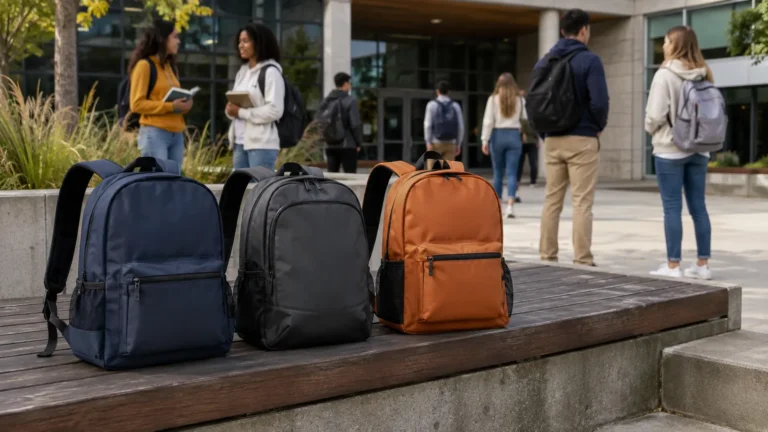
Treating color as the main definition of a boys’ backpack. Colorways should support merchandising, while performance and fit determine usefulness. Offer choice rather than relying on stereotypes.
Using vague material descriptions. “Premium Oxford fabric” is not enough. Define the fiber, construction, coating, weight or denier where useful, color, and performance requirements.
Ignoring the loaded sample. Empty bags can look excellent while zippers bind, bottle pockets stretch, or the back panel bulges once packed.
Adding too many features. Every panel, pocket, strap, and attachment adds weight, cost, and potential failure points. Retain features that solve a validated need.
Approving only a digital rendering. Mockups do not prove color on fabric, logo execution, pocket size, or sewing quality.
Making unsupported performance claims. Terms such as waterproof, orthopedic, eco-friendly, or indestructible need defined evidence and may create compliance risk.
Why Buyers Work With JIUMU
JIUMU is a Guangdong-based B2B supplier established in 2010. The company supports OEM and ODM development for custom teamwear, logo apparel, hats, uniforms, bags, and branded merchandise for buyers in North America and Europe.
Relevant capabilities include fabric sourcing, Pantone color matching, embroidery, screen printing, heat transfer, woven and rubber/PVC or leather-style patches, private labels, hangtags, customized packaging, digital mockups, physical samples, bulk quality control, and export support. The typical MOQ is 50 pieces, subject to product structure and customization.
That capability set is useful for schools, uniform dealers, distributors, promotional buyers, clubs, and private-label brands that need a backpack coordinated with uniforms, caps, jackets, hoodies, or team packages. Buyers can begin with a concept or reference image and then refine the specification through mockup and sample approval.
Frequently Asked Questions
Final Recommendation
The best school backpacks for boys are not defined by a single color, graphic, or capacity. They are defined by fit, necessary storage, dependable construction, clear material specifications, suitable customization, and documented quality control. Build the range around real users and representative school contents, then use design choices to create appeal and brand consistency.
For bulk sourcing, freeze every important requirement in a specification, approve a physical sample, and agree on inspection and packaging before production. This disciplined approach gives schools, distributors, uniform dealers, and private-label brands a stronger foundation for reliable launches and repeat orders.
Request a custom backpack quotation from JIUMU. Share your target age group, quantities, dimensions, contents, colorways, logo files, packaging, destination, and delivery date. Email zhengdong@jiumugear.com, contact WhatsApp/phone +86 18507502899, or use the JIUMU contact page.