Best School Backpacks for Girls: A Practical Buying Guide
Choosing the best school backpacks for girls is not mainly about finding a fashionable color or popular silhouette. For schools, distributors, uniform dealers, promotional suppliers, and private-label brands, the real task is to specify a backpack that fits the intended age group, organizes the expected daily load, survives repeated use, and presents the buyer’s identity consistently across a bulk order.
Girls in the same grade can differ greatly in height, torso length, routine, and what they carry. A useful collection therefore offers more than a “girls’ colorway.” It combines appropriate dimensions, adjustable support, practical access, durable materials, and a visual system that gives students genuine choice. This guide turns those needs into an order-ready specification.
Quick answer: The best school backpack is proportionate to the student’s torso, has two adjustable padded shoulder straps, rests close to the back, and provides enough organization without encouraging unnecessary weight. For bulk purchasing, select size tiers by school stage, define materials and reinforcement points, approve a fitted sample, and inspect dimensions, stitching, zippers, color, logo placement, and packaging before shipment. Color should be an option—not a substitute for fit and function.
What makes a school backpack suitable for girls?
A suitable backpack fits the student population rather than a gender stereotype. The correct starting point is the age range and typical school load. Elementary students usually benefit from a compact, lightweight structure with simple openings. Middle-school students often need more organization for subject changes, devices, and activities. High-school students may prioritize laptop protection, understated styling, and enough depth for longer days.
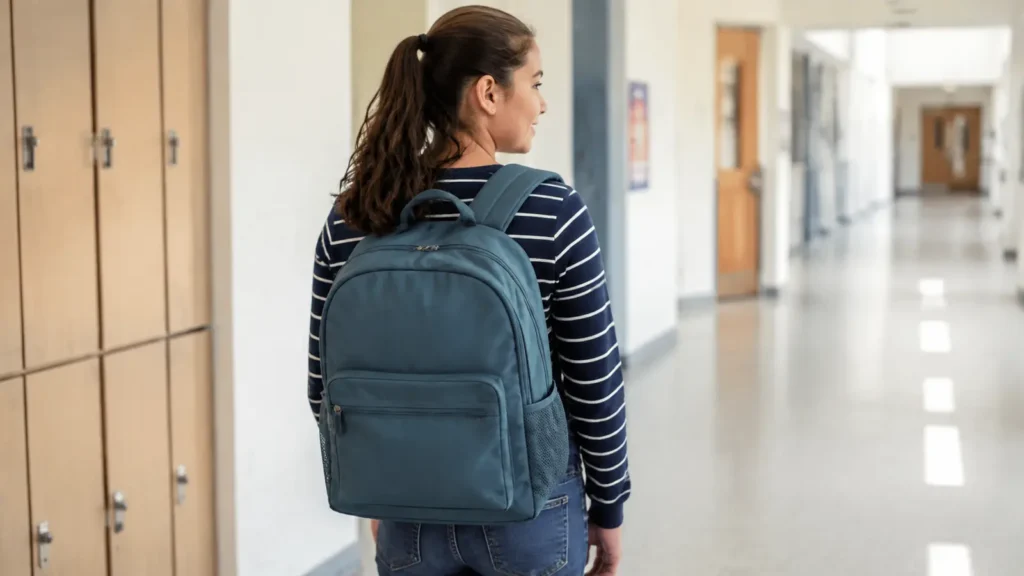
Fit also matters. The American Academy of Pediatrics’ HealthyChildren guidance recommends wide, padded shoulder straps, a padded back, use of both straps, and positioning the bag close to the body. It advises families to keep the loaded backpack below 15% of the child’s body weight and to place heavier items near the center of the back. These are use guidelines, not a reason to make medical claims about a product. Buyers can support better habits through proportionate capacity, balanced compartments, and easily adjustable straps.[^1]
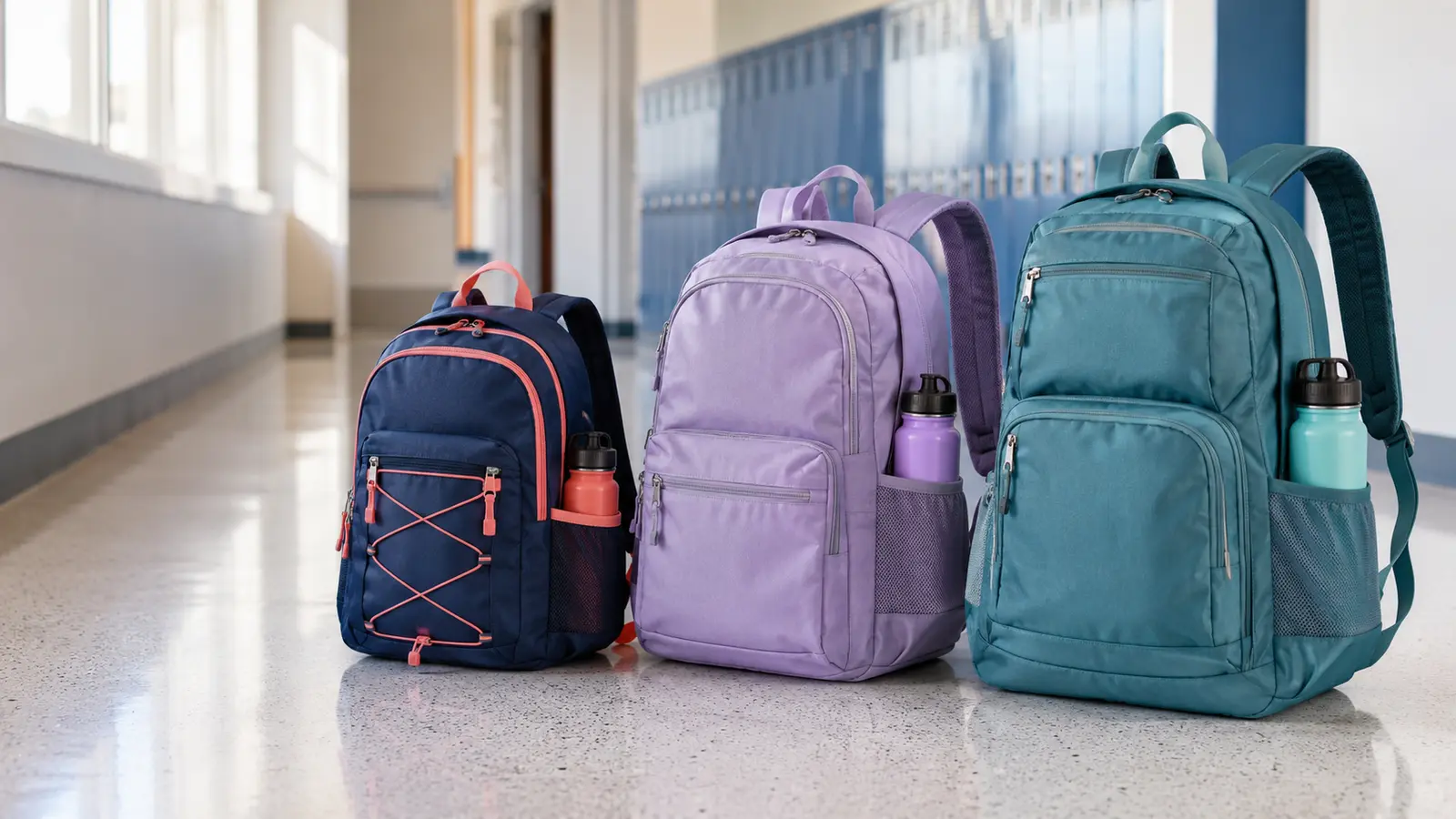
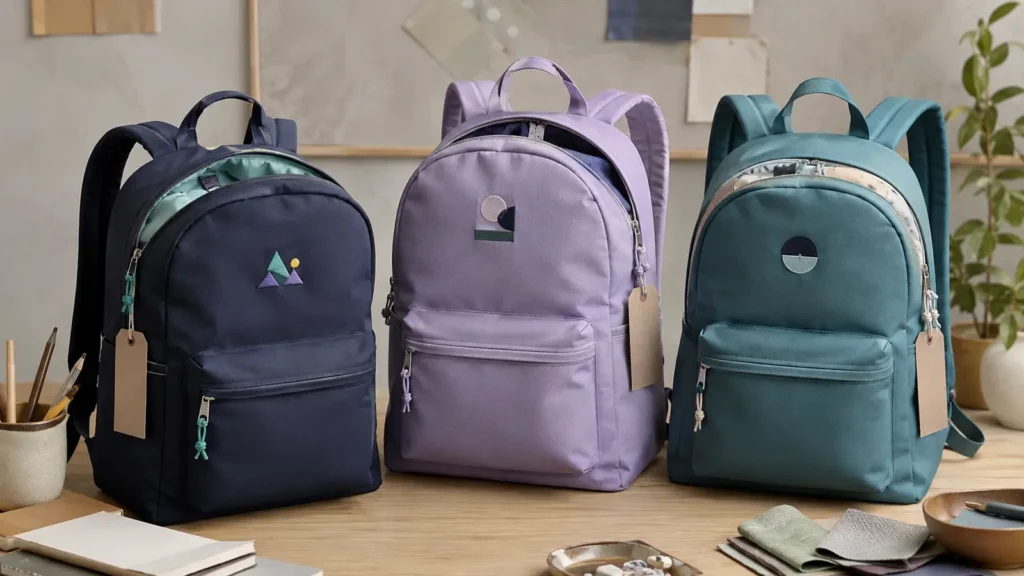
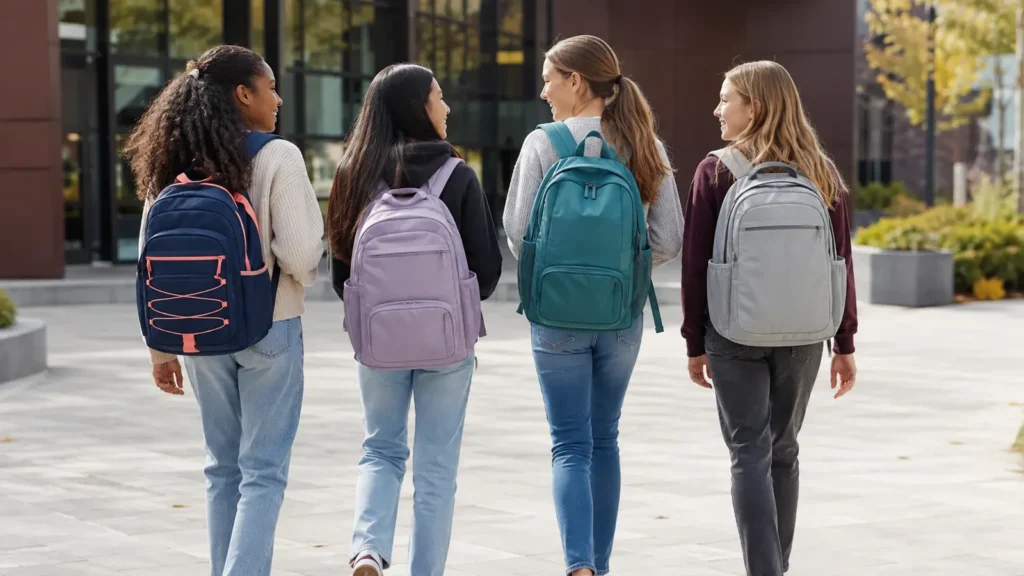
For a B2B collection, “for girls” can appropriately describe the intended shopper or school program, but it should not narrow the design to pink or decorative motifs. A stronger range may include navy, black, teal, berry, lavender, sage, coral, and school colors, with optional patches or personalization. The same construction quality should apply across every color.
Start with the school stage and daily use
The most reliable buying method is to define who will use the bag, what they will carry, and how they travel. A student who walks and uses public transit has different needs from a student who moves between a car, classroom, and locker. A one-device high-school program differs from an elementary program built around folders and a lunch bag.
Elementary school backpacks
An elementary design should be easy to understand at a glance. One main compartment, a front pocket, and one or two bottle pockets are often more useful than many small sections. Zipper pulls should be easy for smaller hands to grip. The empty bag should be light, and the body should not extend excessively below the waist when adjusted.
Rounded corners, a stable base, a visible name-label area, and a lining that can be wiped clean are practical details. If the program serves younger children, review removable decorations and small components with the destination market’s product-safety specialist. Avoid assuming that an attractive accessory is automatically appropriate for every age.
Middle-school backpacks
Middle-school students often carry mixed loads: binders, notebooks, a tablet or laptop, chargers, a water bottle, sports items, and personal supplies. A two-compartment structure can separate frequently accessed items from heavier books. An internal sleeve keeps a device or folder against the back panel, while a front organizer reduces loose items.
At this stage, style becomes more personal. A coordinated color system, replaceable patch area, initials, or discreet school branding gives choice without fragmenting the specification. Buyers should keep the same approved fabrics, hardware, and reinforcement across variants wherever possible.
High-school backpacks
High-school users generally need a more mature silhouette and stronger device organization. Specify the maximum device dimensions rather than relying only on marketing labels such as “15-inch sleeve,” because screen size does not define the complete device footprint. Ask the supplier for the usable sleeve width, height, depth, closure, and padding configuration.
A high-school bag may include a document section, internal cable pocket, dual bottle pockets, and a discreet external logo. Reflective accents can be considered for visibility, but any performance claim should be tied to an identified material and agreed verification method.
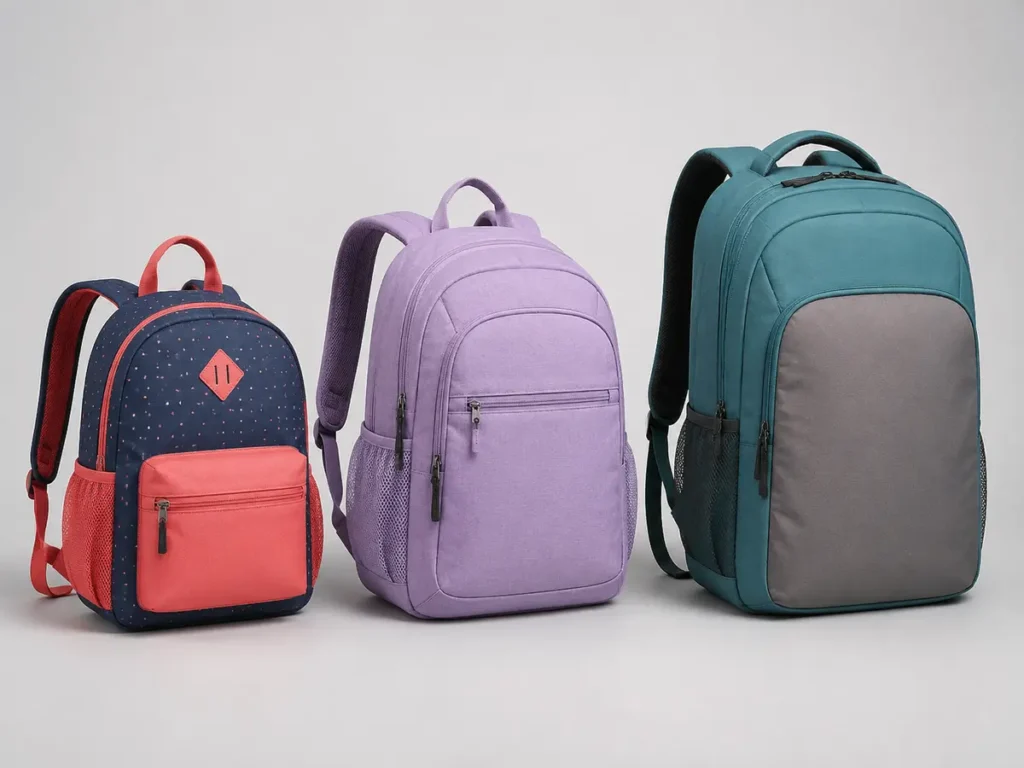
School backpack comparison by buyer need
| Buyer or program | Recommended structure | Useful features | Main approval risk |
|---|---|---|---|
| Elementary school | Compact body; one main compartment | Easy-grip pulls, name label, bottle pocket, wipeable lining | Oversized body or loose small decorations |
| Middle school | Two compartments; organizer panel | Device sleeve, key clip, dual bottle pockets, patch option | Excessive depth that invites overpacking |
| High school | Streamlined multi-compartment body | Measured laptop sleeve, document section, reinforced base | Sleeve dimensions that do not fit the actual device |
| School store | Shared core construction with color variants | School mark, initials, retail hangtag, barcode label | Too many low-volume variants |
| Uniform dealer | Repeatable program style | Controlled colors, stable trims, reorder records | Shade or component changes between orders |
| Promotional campaign | Simplified general-purpose style | Strong logo field, practical pocket set, individual packing | Decoration chosen before material compatibility is tested |
This table is a starting framework, not a universal size chart. Before confirming dimensions, compare sample bags against representative users, folders, binders, devices, and lockers used in the destination program.
Choose size and capacity without encouraging overpacking
Capacity labels can be helpful for comparison, but they are not enough by themselves. Two backpacks with the same nominal liter capacity may distribute that volume differently. A deep bag can pull the load farther from the body, while a tall bag may not fit a shorter torso. Professional buyers should approve external dimensions, usable internal dimensions, and the intended packing list together.
Use a real packing test
Create a reference load for each school stage. For example, an elementary test might include a standard folder, reading book, pencil case, lunch container, light layer, and bottle. A middle-school test could add subject notebooks and the actual device model. A high-school test might include a larger binder, device, charger, and document folder.
Pack the sample in a realistic order, with heavier items closest to the back. Check whether zippers close without force, bottle pockets retain the intended bottle, and the bag remains stable when set down. Then remove unnecessary items. The objective is not to maximize how much the backpack can swallow; it is to provide sufficient, organized space for the defined routine.
Approve fit as a range
Record the body height and width, back-panel height, strap length range, strap spacing, and sternum-strap range if used. Test the sample on several representative users with appropriate consent and supervision. The shoulder straps should adjust smoothly, lie comfortably, and allow the body to sit near the back. A single sample on a single mannequin cannot establish fit for a whole school.
Translate features into procurement decisions
Feature lists become useful only when connected to an actual decision.
| Feature | Procurement value | What to specify or test |
|---|---|---|
| Wide padded straps | Spreads contact across the shoulder area | Width, foam type/thickness, edge binding, adjustment range |
| Padded back panel | Improves structure and carrying comfort | Foam coverage, channel layout, lining, breathability language |
| Internal device sleeve | Holds the device near the back | Usable dimensions, padding, bottom clearance, closure |
| Dual bottle pockets | Supports balanced access and left/right choice | Bottle diameter, pocket depth, elastic recovery |
| Reinforced base | Reduces wear at a high-contact area | Base fabric, coating, seam position, corner construction |
| Organizer pocket | Reduces loose small items | Pocket count, openings, key clip, visibility |
| Reflective detail | May improve low-light visibility | Material location, width, color, agreed verification; avoid unsupported safety claims |
| Name label | Helps identify individual bags | Location, writing surface, privacy when worn |
A buyer should be able to trace every paid feature to a use case. If a pocket has no defined item, it may add cost, sewing time, and failure points without adding value. If a feature is important, put its measurable characteristics in the tech pack rather than leaving it in a reference photo.
Materials: select by performance, appearance, and program budget
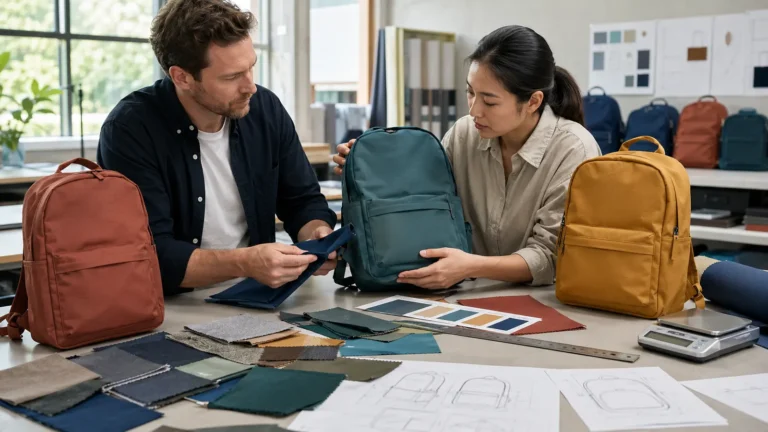
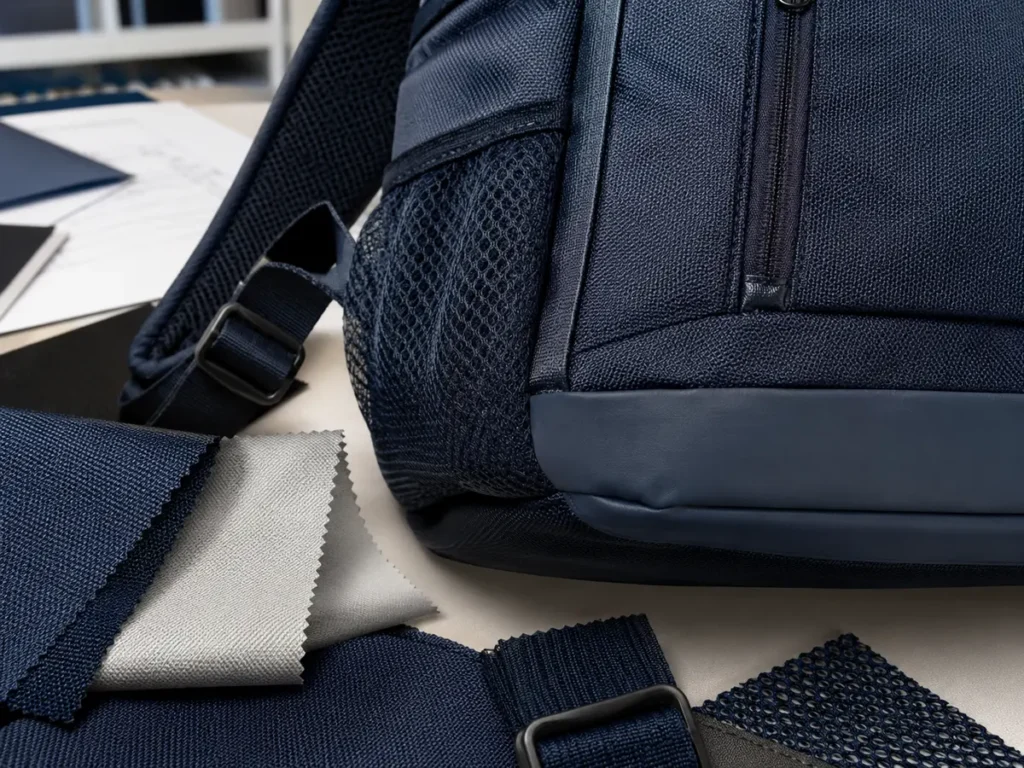
Backpack material names can sound precise while hiding important differences. “Polyester,” for example, does not state yarn size, weave, weight, backing, finish, colorfastness, or abrasion behavior. Ask for a swatch and a written material specification that can be referenced in sample approval and repeat orders.
Polyester and nylon fabrics
Polyester is widely used for school bags because it offers broad choices in texture, color, weight, finish, and cost. Nylon may be selected for a particular hand feel or performance profile, but fiber name alone does not determine durability. Compare actual constructions and test methods rather than assuming one generic fiber is always superior.
Denier is commonly used in sourcing conversations, but it describes yarn linear density, not complete fabric performance. A higher denier does not automatically guarantee a more durable finished backpack. Weave, coating, yarn quality, seam design, and use conditions also matter.
Lining, mesh, webbing, and foam
The lining affects cleanliness, appearance, and production consistency. Light-colored lining can make contents easier to see, while darker lining may hide marks. Mesh bottle pockets should be checked for snagging, stretch recovery, and seam capture. Webbing should match the adjuster dimensions and feed without slipping. Foam should be defined by placement, thickness, feel, and recovery requirements appropriate to the design.
Water-resistant is not waterproof
Many woven fabrics can be treated or backed to resist light moisture, but seams, zipper openings, and construction details affect the finished bag. Do not market a backpack as waterproof unless the complete product has an appropriate, documented basis for that claim. For ordinary school use, buyers can specify the expected exposure and agree on a practical test for the material or finished sample.
Recycled-content and chemical claims
If a program requires recycled content, restricted-substance compliance, or another sustainability attribute, define the claim, documentation, chain of custody, test scope, and responsible party before ordering. A supplier’s material description should not be converted into a broad marketing claim without evidence acceptable in the sales market.
Construction details that influence durability
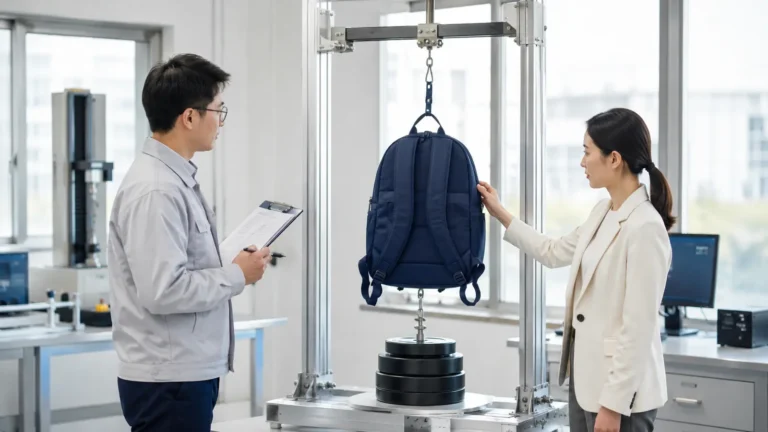
A strong fabric cannot compensate for weak attachment points. The most useful sample review focuses on how load travels through the product.
Shoulder-strap attachment
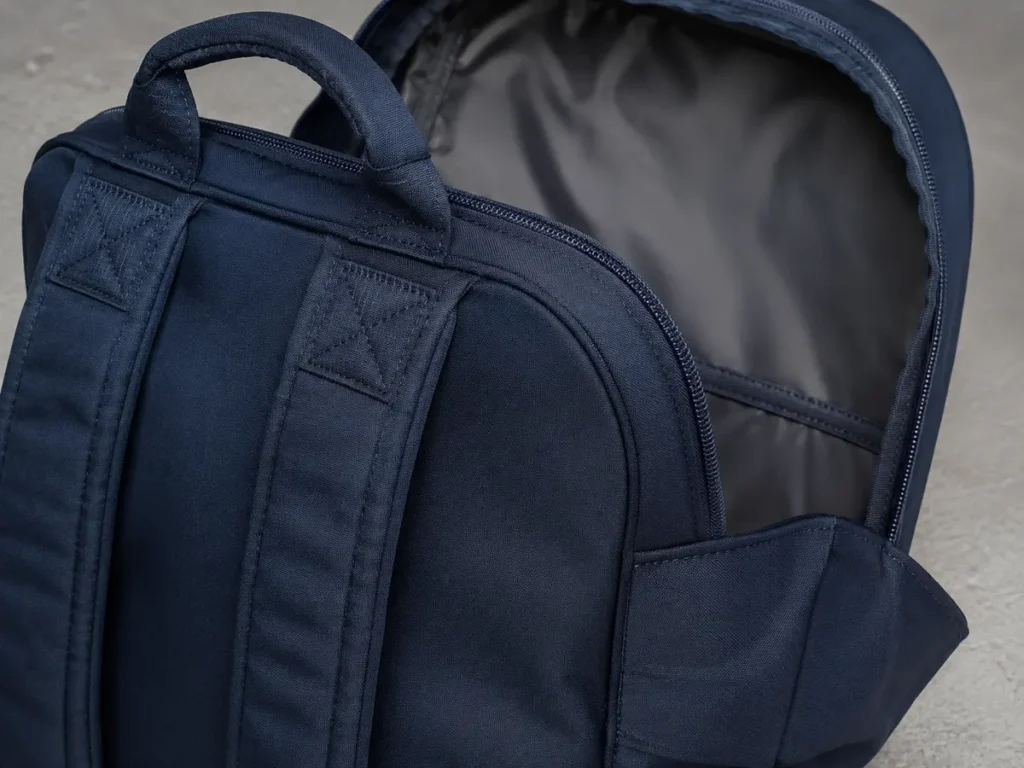
Inspect where each strap joins the upper body and lower side. Look for symmetrical placement, adequate seam allowance, reinforcement appropriate to the construction, and stitching that does not cut or distort the fabric. The exact reinforcement may use box stitching, bartacks, added backing, or another engineered method; the important point is that it is defined and repeatable.
Carry handle and hanging loop
Students frequently lift or hang a bag by its top handle. Check how the handle is anchored inside the seam and whether it interferes with the zipper. If the bag will hang on narrow hooks, confirm that the opening and construction suit the school environment.
Zippers and pulls
Specify zipper type, size, tape color, slider finish, pull style, and opening direction. Run the zipper around curves while the sample is packed. It should not repeatedly catch the lining or require excessive force. Custom pulls can strengthen identity but should remain practical and age-appropriate.
Seams, binding, and base corners
Review internal seams for complete binding or another approved finish. Pay special attention to base corners, bottle-pocket ends, and the top opening. Loose thread trimming is visible, but inconsistent seam allowance and missed reinforcement are more consequential. Include both cosmetic and construction tolerances in the inspection plan.
Design a girls’ backpack collection without stereotypes
A commercially useful collection balances choice with inventory control. Start with one or two core bodies, then vary color blocking, lining, zipper pulls, patches, or small accents. This creates a coherent family without requiring a completely different pattern for every design.
Consider a palette with three layers:
- Core neutrals: navy, charcoal, black, stone, or deep green.
- Expressive colors: berry, coral, teal, lavender, sky, or sage.
- Program colors: approved school or brand colors matched to a defined reference.
Graphic themes can include geometric forms, nature-inspired patterns, astronomy, sport, art, books, or abstract marks. Offer age-appropriate options and avoid assuming all girls want the same decoration. A discreet collection can coexist with a more expressive one while sharing the same base specification.
Customization and private-label options
JIUMU can support embroidery, screen printing, heat transfer, woven patches, rubber/PVC patches, leather-style patches, private labels, hangtags, packaging customization, Pantone color matching, digital mockups, and physical samples. The appropriate method depends on the fabric, artwork, order quantity, desired texture, cleaning expectations, and budget.
Embroidery
Embroidery provides texture and a durable, established school-uniform look. It works well for compact crests and names when the design is digitized for the actual size and fabric. Very fine lettering or large dense areas may require artwork simplification or reinforcement to control puckering.
Woven and molded patches
Woven patches can reproduce finer detail than many direct embroidery applications. Rubber/PVC patches provide a dimensional modern appearance, while leather-style patches can suit understated high-school or heritage-inspired collections. Confirm patch dimensions, border, backing, attachment method, color tolerances, and any age-related component concerns.
Screen print and heat transfer
Screen printing can be efficient for suitable artwork and quantities, while heat transfer supports certain detailed or multicolor graphics. Adhesion, flexibility, surface texture, placement near seams, and the specific bag material all influence the result. Approve the decoration on production-equivalent fabric, not only as an on-screen mockup.
Private labels and packaging
Define the main label, care or material information as applicable, country-of-origin marking, importer or responsible-party information, hangtag, barcode, individual bag, carton marks, and packing quantity. Requirements depend on the product construction and destination. For the United States, buyers should obtain current advice on applicable labeling and children’s-product obligations rather than assuming apparel rules automatically map to every bag.[^2]
Planning a custom school backpack program? Send JIUMU the target age group, estimated quantity, dimensions or reference sample, required compartments, material preference, colors, logo files, packaging, destination, and target delivery date. JIUMU can review the concept and prepare a quotation and sampling path. Request a custom quotation.
What drives the cost of a custom school backpack?
There is no responsible single per-piece price without a specification. Cost changes with the bag’s dimensions, panel count, fabric and backing, lining, foam, zipper and hardware choices, pocket structure, decoration, labels, packaging, quantity by color, sample requirements, inspection scope, and shipping terms.
Complexity is cumulative. A second main compartment adds panels, zipper length, sewing operations, and inspection points. A custom molded pull may involve development cost. Multiple low-volume colors can reduce purchasing efficiency. Individual names require data control and a personalization workflow that is different from one common school logo.
Buyers can manage cost without making the bag disposable:
- Keep a stable core body across several colorways.
- Prioritize reinforcement at real load points.
- Use pockets only when the use case is defined.
- Standardize common trims where they do not weaken the design.
- Separate must-have features from optional upgrades in the quotation.
- Confirm quantity per color and artwork version early.
- Approve packaging dimensions with freight efficiency in mind.
Ask suppliers to state what the quotation includes: sample charges, logo method, labels, individual packing, cartons, testing if requested, inspection, freight, duties, and taxes. Compare like with like.
Sample approval and quality control
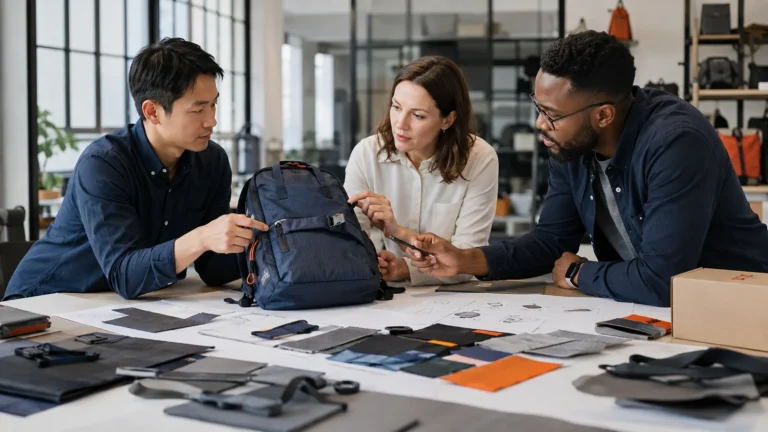
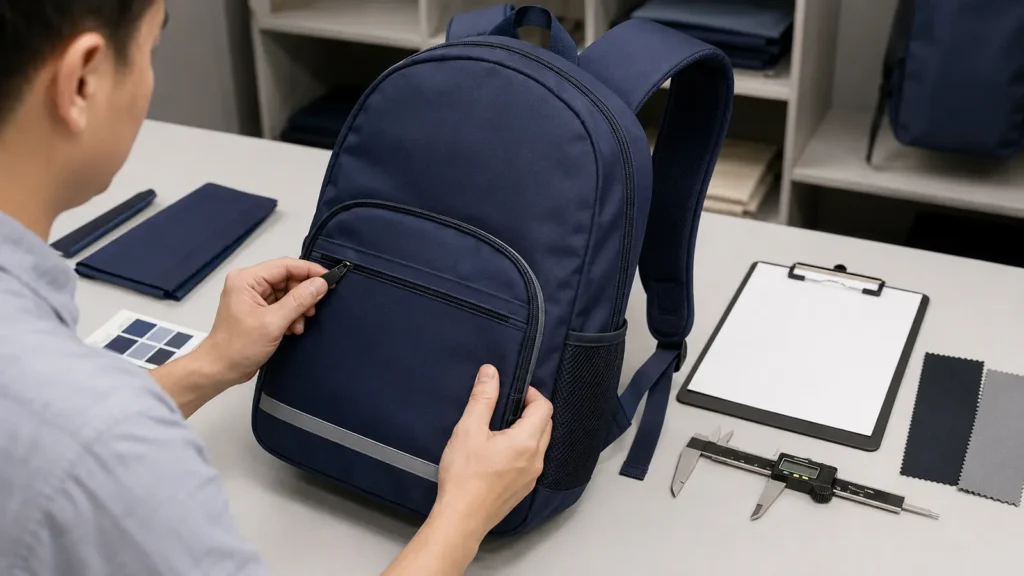
A digital mockup establishes layout and color direction, but it cannot prove fit, hand feel, zipper operation, capacity, or stitching. Use a physical sample to freeze the construction standard.
Build a sample approval record
The approval record should include dated photos, external dimensions, internal sleeve dimensions, weight, material references, approved color standard, logo size and location, zipper and hardware details, strap range, pocket measurements, label copy, packaging, and a list of corrections. Mark the final sample so it cannot be confused with an earlier version.
If the order contains several colorways, decide whether each needs a full sample or whether a shared construction sample plus color and decoration submissions is sufficient. High-risk differences—such as a different material or decoration process—deserve their own approval evidence.
Pre-production checks
Before bulk production, confirm that the material, trims, logo file, labels, size specification, color reference, and packaging are released. Resolve ambiguous comments such as “make it stronger” into a defined construction change. Agree on tolerances and the inspection method before goods are complete.
Finished-product inspection points
Check a representative sample using the agreed inspection plan:
- Overall dimensions and empty product weight.
- Fabric identity, color, hand feel, and visible defects.
- Symmetry of panels, straps, pockets, and logo placement.
- Stitch quality, seam security, reinforcement, and thread trimming.
- Smooth operation of every zipper and adjuster.
- Device sleeve and reference-load fit.
- Bottle-pocket dimensions and recovery.
- Decoration size, color, adhesion or stitching.
- Correct labels, hangtags, individual packaging, carton marks, and quantities.
- Odor, contamination, sharp points, broken components, or other obvious safety concerns.
Any performance test should identify the method, sample count, acceptance criteria, and responsible laboratory or inspection party. Avoid vague claims such as “tested quality” when no scope is stated.
Plan the bulk order step by step
1. Define the user and sales channel
State the school stage, destination market, approximate student height range, route to market, and whether the product is a school-issued item, uniform option, fundraiser, retail product, or promotional gift.
2. Create the reference packing list
Provide the actual folder, binder, device, bottle, or lunch-container dimensions. Identify which items must fit together and which must have a dedicated compartment.
3. Set the product architecture
Choose external dimensions, compartment count, device sleeve, bottle pockets, organizer, handle, straps, base structure, and optional sternum strap. Identify mandatory features and negotiable options.
4. Select materials and colors
Review swatches or equivalent references. Define shell, lining, mesh, webbing, foam, zippers, hardware, coating or backing, and color standard. Confirm whether a sustainability or compliance claim requires documentation.
5. Finalize branding and labels
Supply vector artwork where possible, Pantone references, decoration dimensions, placements, label copy, barcode data, and packaging artwork. Confirm ownership and authorization for all marks.
6. Approve the physical sample
Conduct the packing test, fit review, visual inspection, and construction review. Return one consolidated correction list, then approve a clearly identified final standard.
7. Confirm the order and production controls
Freeze quantities by color and artwork, commercial terms, production schedule, inspection arrangement, packing, shipping mark, shipping method, and destination documentation.
8. Inspect and retain records
Use the agreed checklist before shipment. Keep the tech pack, approved sample record, color references, inspection report, packaging file, and order-specific component list to support future reorders.
Questions to ask a school backpack supplier
- Can you develop the design from a reference image, physical sample, sketch, or tech pack?
- What is the usable internal size, not only the external size?
- How will the laptop or tablet sleeve be measured and padded?
- Which shell, lining, mesh, webbing, foam, zipper, and hardware specifications are proposed?
- How are shoulder straps, handles, bottle pockets, and base corners reinforced?
- Which decoration method is best for this fabric and artwork, and why?
- What color reference will be used for bulk production?
- What is the MOQ per design, color, and logo version? JIUMU’s typical MOQ is 50 pieces, subject to product structure and customization.
- What sample stages are recommended, and what is included in sample approval?
- Which tolerances and inspection criteria will be used?
- What labels, country-of-origin marks, packaging, and shipping documents are included?
- How will approved materials and components be recorded for a repeat order?
Common buying mistakes
Choosing by appearance before defining the load
A visually attractive bag may be too tall, too deep, or internally disorganized. Approve the intended contents and dimensions before refining decorative details.
Using one size for every school stage
One body rarely serves early elementary and high school equally well. Even if the collection shares design language, use age-appropriate size tiers or validate a deliberately broad fit range.
Treating “girls” as a color specification
Pink is not a technical requirement. Offer meaningful choice and keep function consistent. Let color and graphics support identity without restricting who can use the product.
Adding compartments without a purpose
Extra pockets can add cost, weight, sewing operations, and failure points. Map each section to a real item or routine.
Approving only a digital rendering
Renderings cannot verify capacity, fit, materials, hardware, or workmanship. A production-equivalent physical sample is essential for a custom order.
Accepting vague material names
“Durable polyester” is not a repeat-order specification. Record the approved fabric, backing, color, lining, mesh, webbing, and trim references.
Leaving packaging and labels until the end
Late barcode, label, or carton changes can disrupt production and shipping. Include them in the initial brief and sample review.
Why work with JIUMU on custom school backpacks?
Established in 2010 and based in Guangdong, China, JIUMU supplies custom bags, teamwear, hats, uniforms, and branded merchandise for B2B buyers in the United States, Canada, the United Kingdom, and Europe. Relevant buyers include schools, distributors, uniform dealers, promotional companies, retailers, and private-label brands.
JIUMU supports OEM and ODM development, fabric sourcing, Pantone color matching, embroidery, printing, heat transfer, multiple patch types, private labels, hangtags, packaging customization, digital mockups, physical samples, bulk production, quality control, and export support. The typical MOQ is 50 pieces, subject to the backpack’s construction and customization.
This capability is most useful when the inquiry is specific. Buyers can also explore JIUMU’s custom team bags and about JIUMU pages.
Frequently Asked Questions
Final recommendation
The best school backpacks for girls are not defined by one color, trend, or capacity number. They are defined by a clear match between student stage, torso fit, daily load, school environment, construction, and identity. Begin with representative contents and users, develop age-appropriate size tiers, specify materials and load points, and approve a physical sample against a written record.
For a bulk program, simplify where it improves consistency: share a core body across colors, standardize trims, and use decoration strategically. Do not simplify the controls that protect the result—measured fit, material references, reinforcement, sample approval, labeling review, and pre-shipment inspection.
Sources
[^1]: American Academy of Pediatrics, HealthyChildren.org, “Backpack Safety”: https://www.healthychildren.org/English/safety-prevention/at-play/Pages/Backpack-Safety.aspx
[^2]: U.S. Federal Trade Commission, “Threading Your Way Through the Labeling Requirements Under the Textile and Wool Acts”: https://www.ftc.gov/business-guidance/resources/threading-your-way-through-labeling-requirements-under-textile-wool-acts
About the author
JIUMU Content Team develops practical sourcing guidance for custom teamwear, hats, bags, uniforms and branded merchandise. JIUMU was established in 2010 in Guangdong, China.