Best Backpacks for Law, Medical and Nursing School: A B2B Buying Guide
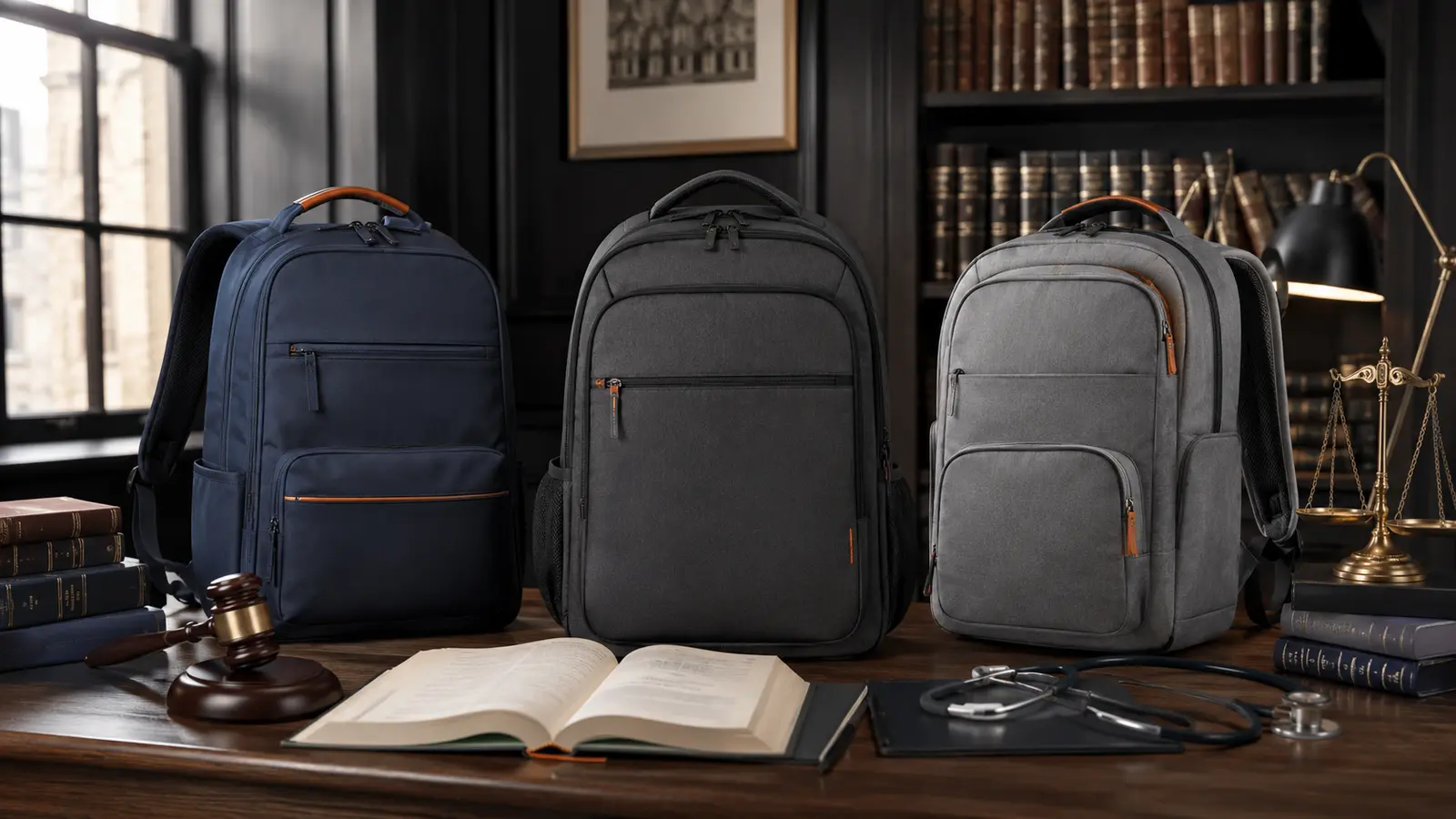
Graduate and professional students carry a different mix of materials from a typical school daypack. Law students may move heavy casebooks and a laptop between class, library and internships. Medical students balance digital devices, reference materials, a folded coat and carefully protected diagnostic tools. Nursing students often need academic supplies plus a separate organizer for clinical essentials. For schools, bookstores, uniform dealers and promotional buyers, the best backpack is therefore not one universal model. It is a program-specific specification that balances load management, organization, cleanability, professional appearance and reliable bulk production.
This guide explains how to compare the best backpacks for law, medical and nursing school, translate student routines into product requirements and prepare a clear custom-backpack request for quotation.
Quick Answer: For law school, prioritize a structured 24–30 L pack with a protected laptop sleeve, a reinforced base and space for dense books. For medical school, choose a 22–28 L professional pack with protected technology storage and removable organizers. For nursing school, choose a 24–30 L model with clear separation between academic items and a removable, wipe-clean clinical pouch. Capacity is only a planning range: approve the final size by packing a physical sample with the school’s real item list. Clinical students must follow their program and placement site’s infection-control and bag policies.
Why Professional-School Backpack Selection Matters
A program backpack is used repeatedly, seen across campus and often expected to remain presentable during placements, interviews or events. Procurement teams must consider more than appearance. A compartment that fits a laptop on paper may be too narrow after binding and padding are added. A bag with many pockets can become heavy before it is loaded. A fabric described as water resistant may slow light rain yet still allow water through seams and zippers. A clinical organizer may be easy to remove but unsuitable for a particular facility’s cleaning process.
The decision also affects brand perception and repeat orders. A school crest placed across a heavily curved front panel can distort. A color approved only on a screen may look different in production fabric. A zipper that performs well empty may bind after textbooks load the body. Good sourcing turns these risks into measurable approval points.
OSHA notes that carrying risk cannot be reduced to weight alone; frequency, posture, distance and how far the load is held from the body also matter. That makes balanced organization, close-to-back placement of dense items and comfortable two-strap carry useful design goals—not medical guarantees. Students should adjust and pack bags according to their own needs and seek appropriate professional advice if carrying causes pain.
Law vs Medical vs Nursing School Backpack Comparison
| Buyer criterion | Law school | Medical school | Nursing school |
|---|---|---|---|
| Typical priority | Dense books, laptop and polished commuting | Technology, notes, coat and protected instruments | Academic supplies plus clinical organization |
| Planning capacity | 24–30 L | 22–28 L | 24–30 L |
| Core layout | Wide main compartment, document zone, laptop sleeve | Laptop/tablet protection, organizer, coat space | Academic compartment, device sleeve, removable clinical pouch |
| Useful exterior | Strong top handle, bottle pocket, quick-access pocket | Discreet quick-access pocket, luggage pass-through | Bottle pocket, badge/keys pocket, easy-clean base |
| Material emphasis | Abrasion resistance and structure | Low-lint, clean-looking surfaces and protected storage | Wipe-clean organizer/lining and clear separation |
| Branding style | Restrained embroidery, woven label or tonal mark | Small institutional logo and professional colors | Program color coding, embroidery or patch |
| Main sampling test | Pack with actual casebooks and laptop | Pack with devices, coat and protected tools | Test clean/academic separation with program list |
These ranges are starting points, not universal promises. Book formats, laptop dimensions, clinical requirements and commuting patterns vary. A physical sample packed with representative contents is the most reliable capacity test.
Best Backpack for Law School
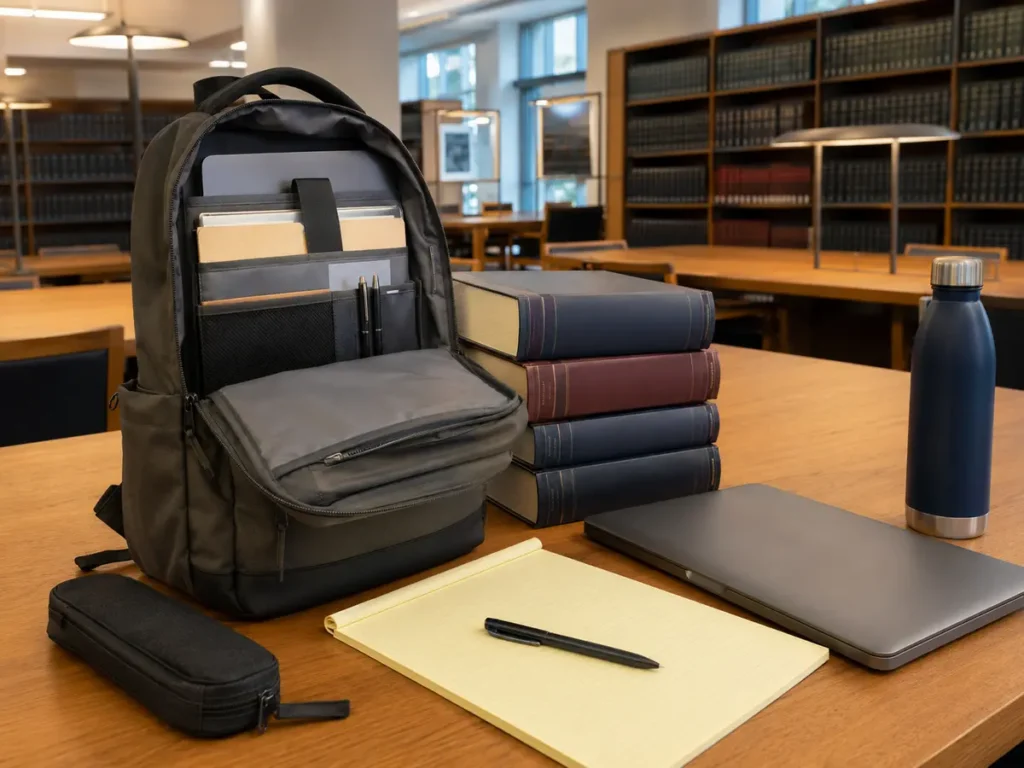
The best law school backpack behaves like a mobile study cabinet without looking like outdoor expedition gear. Dense books concentrate load, so the bag should hold its shape and keep the heaviest items close to the back panel. A wide-opening main compartment makes it easier to insert casebooks without forcing zipper corners.
Recommended Law School Features
- A suspended, padded laptop sleeve sized to the actual device list
- A structured main compartment that can accept thick books
- A reinforced base panel and reinforced shoulder-strap attachment points
- Two padded, adjustable shoulder straps and a padded back panel
- A document divider for legal pads, folders or loose papers
- A stable top grab handle for short moves
- A bottle pocket positioned away from electronics
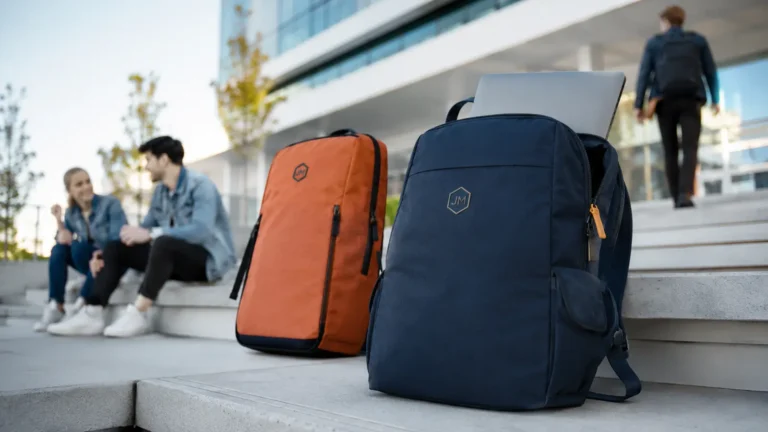
- A restrained exterior suited to class, interviews and internships
A larger capacity is not automatically better. Extra volume encourages overpacking and can make the loaded bag project farther from the body. Instead, prototype around a specific packing list. For a school bookstore, that might mean the most common laptop size, two representative casebooks, a legal pad, charger, bottle and small personal kit.
Law School Style and Branding
Navy, charcoal, black and deep olive are easy to coordinate with business-casual clothing. For school merchandise, a modest embroidered crest, woven badge or tonal mark usually looks more professional than a large print. Confirm artwork permissions before production; the bag supplier should not assume that a buyer owns an institution’s trademarks.
Best Backpack for Medical School
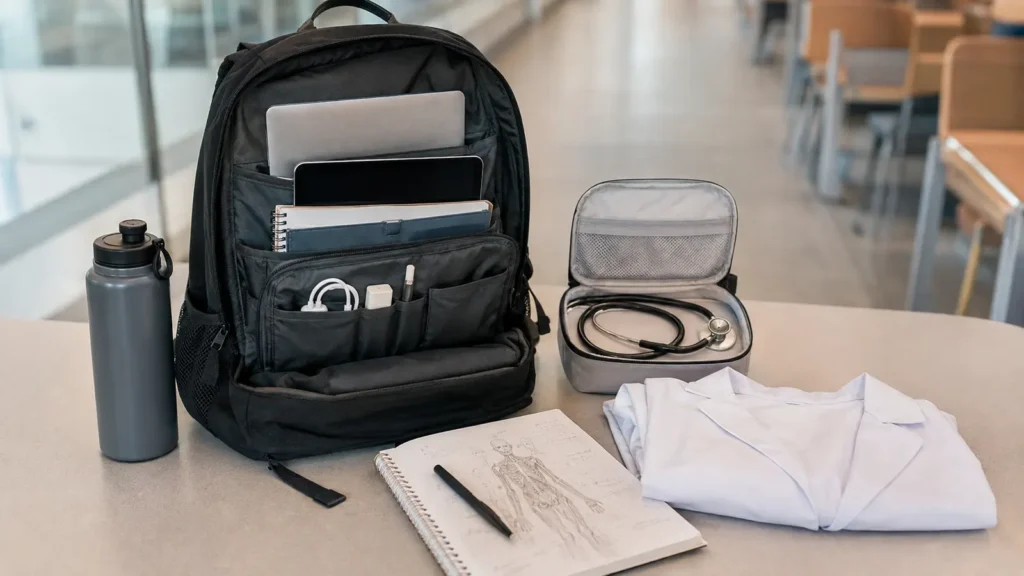
Medical education moves between lecture, lab, study and clinical environments. The backpack must organize devices and personal academic supplies without implying that an ordinary textile bag is sterile or suitable for every patient-care area. A protected instrument case or removable organizer is preferable to placing a stethoscope loosely beside food, cables and books.
Recommended Medical School Features
- Separate padded sleeves for a laptop and, when required, a tablet
- A removable organizer or dedicated protected case for permitted tools
- Space for a folded coat without crushing electronics
- Smooth, accessible lining in high-use pockets
- Cable, charger and small-accessory organization
- A stable bottle pocket and sealed-food zone away from devices
- A professional silhouette with minimal dangling straps
- A luggage pass-through for students who travel for rotations, if needed
CDC Standard Precautions require proper handling, cleaning and disinfection of patient-care equipment. That guidance applies to the equipment and care environment; it does not certify a backpack. Buyers should ask the school or placement facility what may enter clinical areas, where bags may be stored and how reusable items must be transported. If a program requires contaminated reusable equipment to be bagged for transport, provide a separate, compatible container rather than treating the backpack itself as the contamination-control barrier.
A Practical Two-Module Medical Layout
One effective concept is a clean academic body plus a removable equipment module. The main body holds electronics, study materials and personal items. The module holds only permitted, protected tools and can be removed before the student enters an area where backpacks are not allowed. This also lets procurement teams specify a more cleanable lining for the module without applying an expensive coating to every surface.
Best Backpack for Nursing School
Nursing students often need the most explicit zoning. A classroom day may involve a laptop and notes; a clinical day may add scrubs, shoes or program-approved tools. The design goal is not to carry every possible item in one cavity. It is to prevent casual mixing and make the permitted clinical module easy to identify, remove and manage according to school policy.
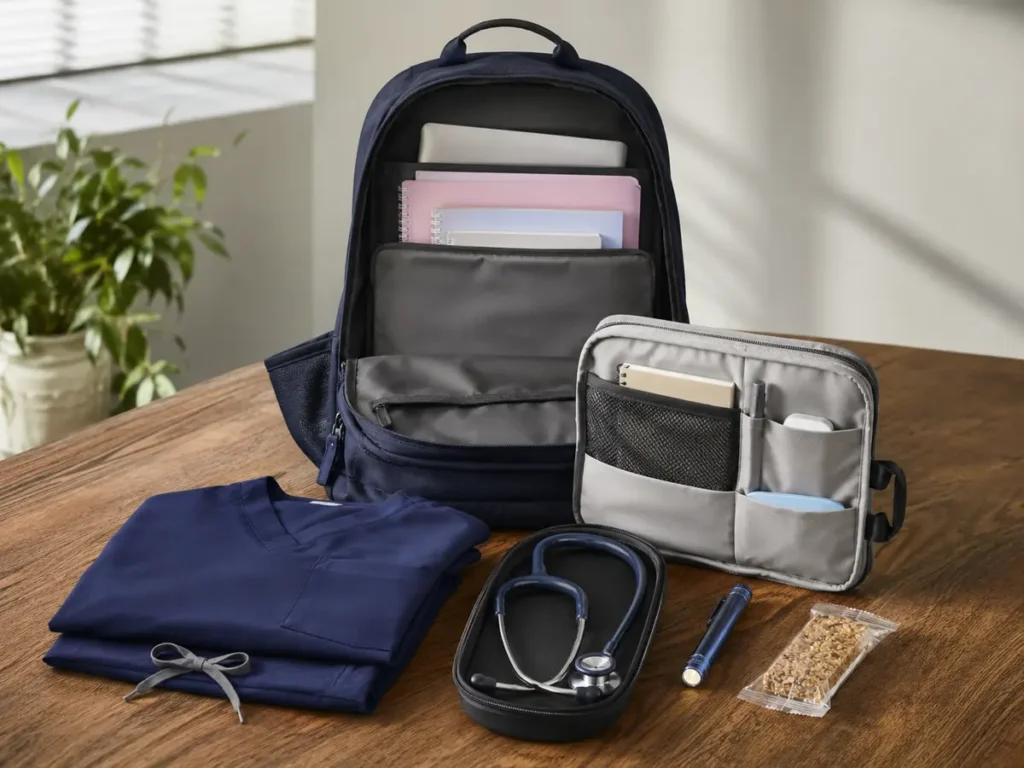
Recommended Nursing School Features
- A dedicated academic compartment for devices and coursework
- A removable organizer with smooth, wipeable interior surfaces
- A separate sealed pouch for permitted shoes or clothing, when requested
- Color-coded zipper pulls or lining to distinguish modules
- A quick-access pocket for nonclinical essentials such as keys
- Reinforced base and strap anchors for frequent commuting
- A name or ID location that does not expose unnecessary personal data
- Easy-to-read care instructions matched to the selected materials
The word “antimicrobial” should not be used casually. If a buyer requests an antimicrobial treatment, the supplier should identify the treatment, intended function, market, labeling and substantiation required. A simpler specification—removable organizer, smooth coated lining and documented cleaning compatibility—may be easier to verify. Never promise that a backpack prevents infection.
How to Choose Capacity and Fit
Capacity in liters is useful for comparison but does not reveal opening size, usable internal geometry or device fit. Two 26 L backpacks can behave differently because of foam thickness, curved panels and pocket construction. Build the decision around objects and measurements.
| Specification | What the buyer should provide | What to verify on the sample |
|---|---|---|
| Laptop fit | Device width, height and thickness; case included or excluded | Sleeve opening, corner clearance, suspension above base |
| Book load | Largest book dimensions and realistic quantity | Zipper closes without distortion; base stays stable |
| Clinical module | Exact permitted items and facility constraints | Module removes easily; contents do not migrate |
| Body fit | Intended adult size range and carry duration | Strap adjustment range, back-panel contact, no hard edges |
| Bottle storage | Common bottle diameter and height | Pocket retention, balance and separation from electronics |
| Overall dimensions | Locker, desk, travel or storage limits | Measure finished sample at normal fill level |
For bulk orders, create a “golden packing list” and photograph how it fits in the approved sample. This gives quality teams and repeat-order buyers a practical reference beyond a nominal liter figure.
Materials: Translate Names into Performance Requirements
Polyester and nylon are common backpack shell materials, but fiber name alone does not predict performance. Denier, weave, yarn quality, coating, finish and construction all matter. Buyers should request a swatch or sample and define the observable outcome they need.
Shell Fabric
Polyester can provide consistent color, broad availability and a useful cost-performance balance. Nylon may be selected when buyers prioritize a supple hand or particular abrasion performance. Recycled-content options require supply-chain documentation if a claim will appear on the product or marketing page. Do not approve a recycled claim solely from a verbal description.
Base and High-Wear Panels
The base sees floors, desk legs and repeated loading. A coated woven panel, dense abrasion-resistant fabric or replaceable protective structure can improve serviceability. The final choice should be checked for cracking, delamination, odor and color transfer under the buyer’s intended conditions.
Lining and Clinical Organizers
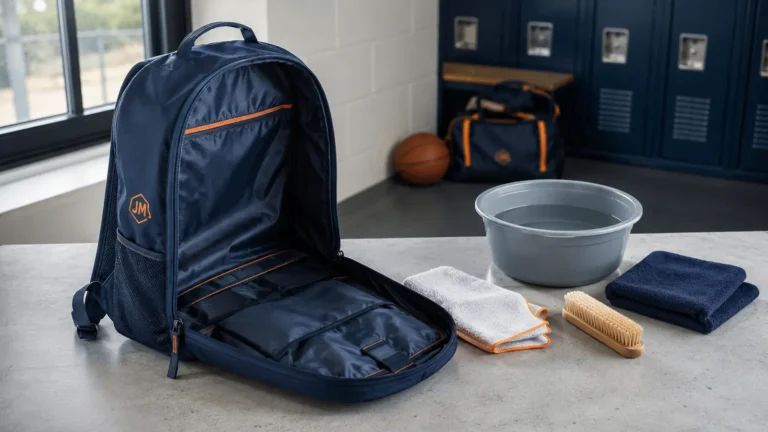
A light-colored lining improves visibility. For medical or nursing organizers, smooth coated surfaces may be easier to wipe than open mesh, but compatibility with a cleaning agent must be tested. Ask for the selected material’s care limits and follow the healthcare facility’s product instructions. CDC guidance emphasizes using cleaning and disinfecting products according to instructions; it should not be interpreted as approval of a specific bag material.
Water Resistance Is a System
A coated fabric may resist wetting while needle holes, zipper tracks and binding remain entry points. Use qualified wording such as “water-resistant shell fabric” only when supported. If the buyer needs a defined rain test, document the method, duration, spray direction, pass criteria and whether contents are included.
Construction Details That Buyers Should Inspect
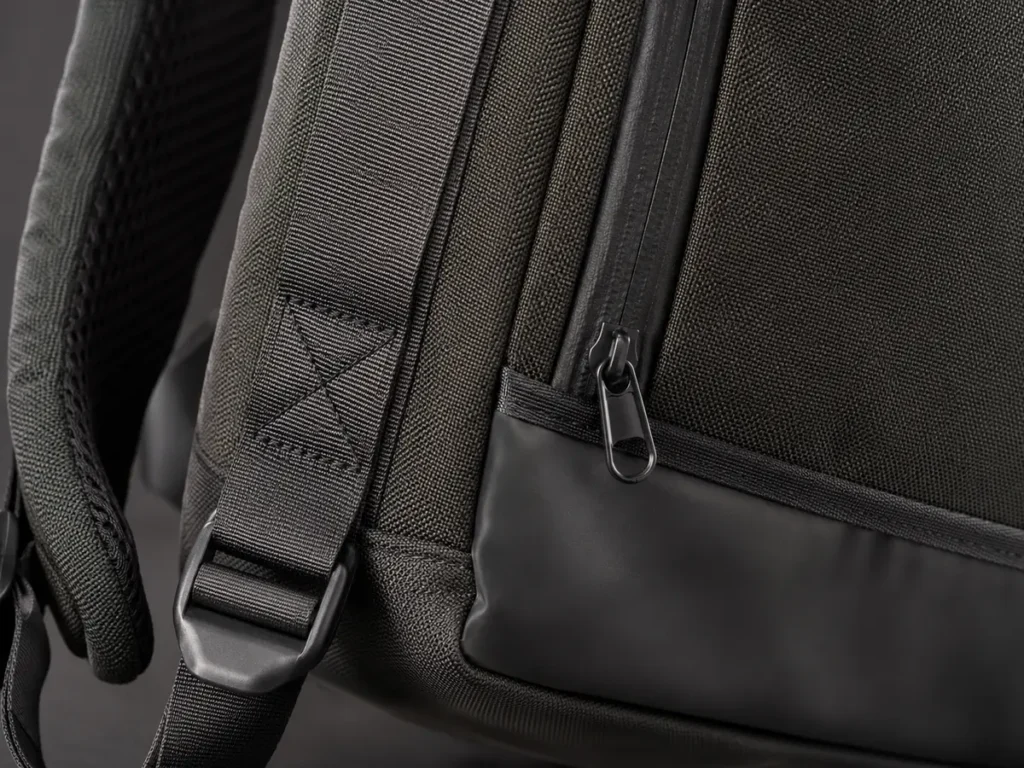
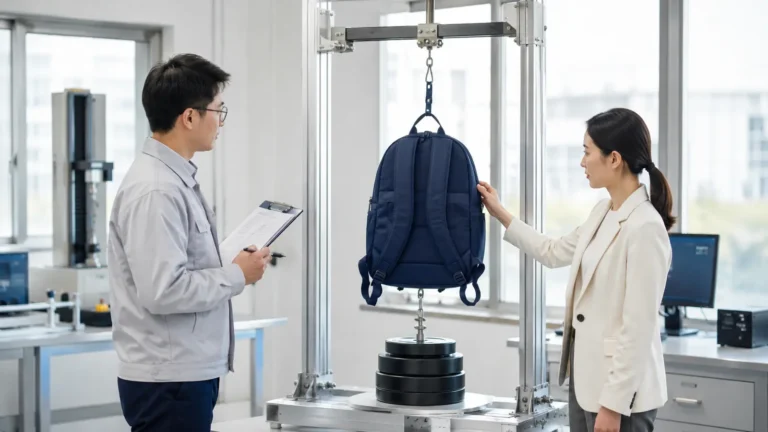
Start with the stress points: shoulder-strap anchors, top handle, base corners, zipper ends and pocket openings. Look for consistent stitch length, adequate seam allowance, secure backtacking or bar tacks where designed, and binding that fully encloses raw edges. Operate every zipper through its full path with the bag both empty and realistically loaded. Check whether zipper pulls strike adjacent hardware or catch the lining.
Foam should recover after compression and stay evenly positioned. A laptop sleeve should not rely on thin outer fabric as its bottom protection; suspending the sleeve above the base can reduce direct impact during ordinary set-down, although it cannot make a bag damage-proof. Confirm that hard internal organizers do not create pressure points against the wearer’s back.
Custom Branding and Private-Label Options
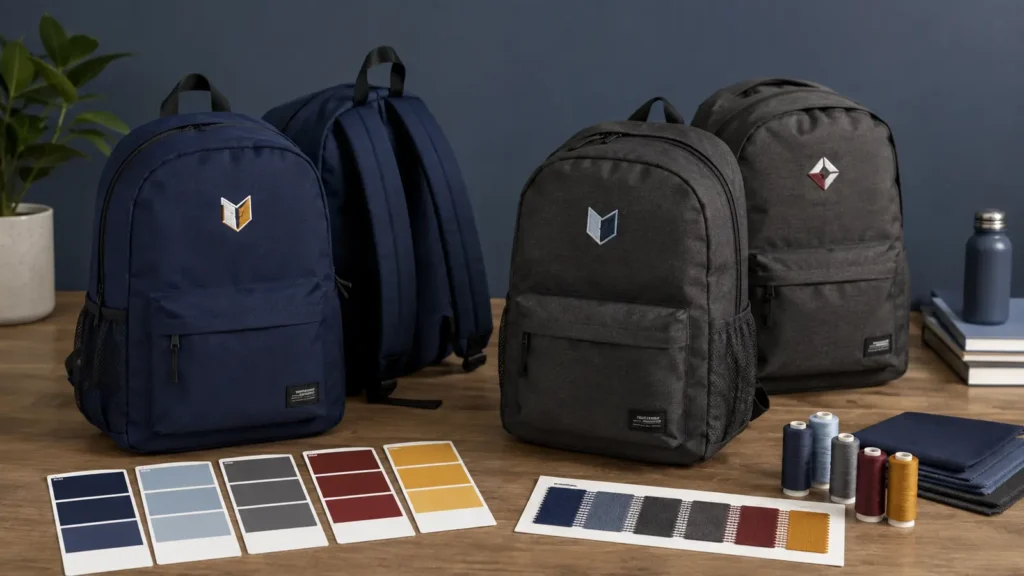
JIUMU can support OEM and ODM development, embroidery, screen printing, heat transfer, woven and rubber/PVC or leather-style patches, Pantone color matching, private labels, hangtags and customized packaging. The best method depends on artwork, panel structure, order quantity and cleaning expectations.
Embroidery offers a durable, dimensional look but adds stitches and backing. Fine lettering may fill in, and a dense design can stiffen lightweight fabric. Woven patches reproduce smaller details more efficiently. Rubber/PVC patches can create a modern dimensional mark, while heat transfer suits some multicolor graphics. Screen printing can be economical for suitable flat panels and quantities. Approve the decoration on the actual production fabric—not only on a digital mockup.
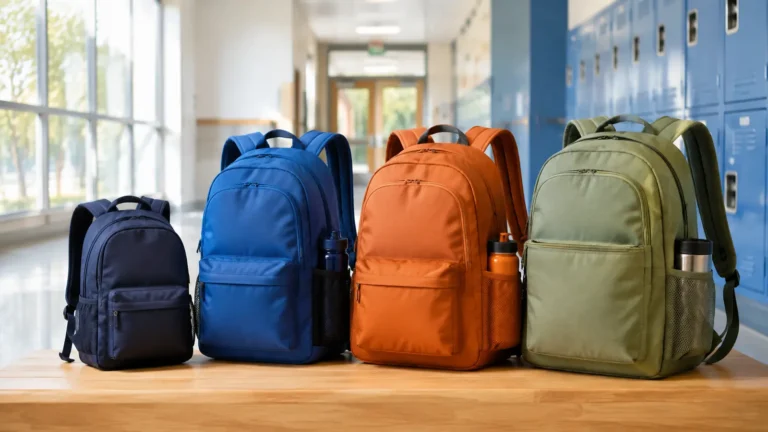
For professional programs, buyers may use color coding by cohort or department. Keep the main shell neutral and change zipper pulls, lining, woven labels or a small patch to simplify inventory. Record the approved color under the viewing conditions that matter and retain a physical standard for reorders.
Request a custom backpack quotation: Send JIUMU your target program, quantity, dimensions or capacity, packing list, laptop size, shell material, colors, logo file, decoration method, packaging and required delivery date. Start at Custom Team Bags or contact the team for a specification review.
Cost Drivers in a Custom Professional-School Backpack
Unit price is influenced by more than fabric. A buyer should expect changes based on:
- Pattern complexity and number of panels
- Shell, lining, coating and foam specifications
- Zipper, buckle and webbing grade
- Number and construction of organizers
- Laptop sleeve structure and base reinforcement
- Decoration type, size, colors and placement
- Private labels, hangtags and individual packaging
- Testing, inspection and documentation requirements
- Quantity, color split and shipping terms
A low initial unit price can be misleading if the quote omits removable pouches, packaging, inspection or delivery terms. Compare suppliers against the same bill of materials and Incoterm. JIUMU’s typical MOQ is 50 pieces, subject to product structure and customization; confirm the applicable minimum for the exact design.
Sample Approval and Quality-Control Checklist
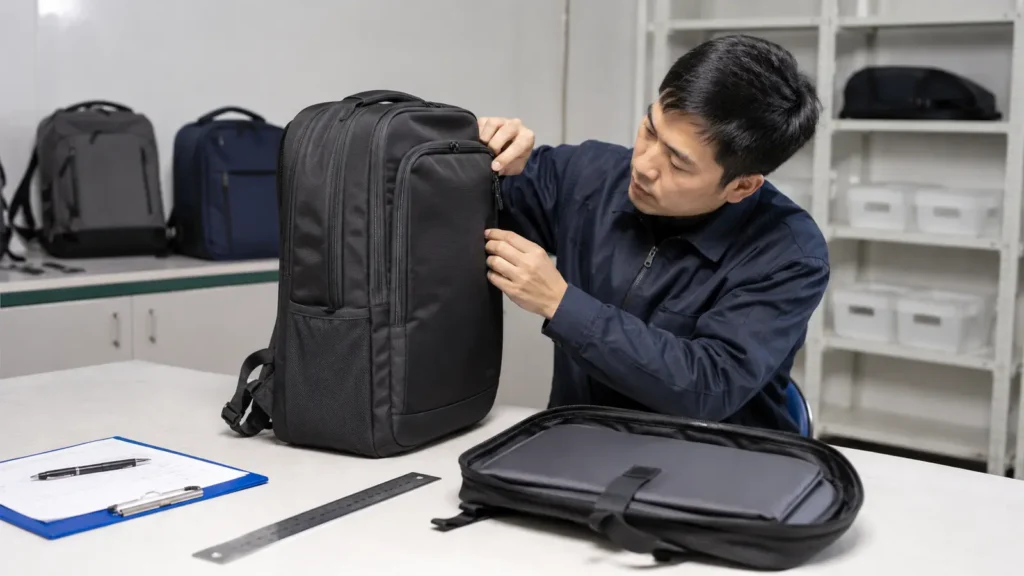
Treat the preproduction sample as a functional approval, not a color photo. Use a signed checklist and retain reference images.
- Measure finished height, width and depth using the agreed method.
- Pack the approved program-specific item list.
- Confirm laptop and tablet sleeves fit the named devices.
- Check strap adjustment, symmetry, padding and anchor construction.
- Load the bag realistically and cycle every zipper.
- Inspect base stability, lining, binding and internal pocket access.
- Compare shell, lining, zipper and logo colors with approved standards.
- Check logo size, position, stitch or print appearance and backing.
- Review removable organizers and cleaning instructions.
- Confirm labels, warnings, barcode, carton marks and packaging.
For production inspection, define what is critical, major or minor before goods are made. A missing laptop sleeve or wrong logo is not equivalent to a loose thread. If the buyer requests laboratory tests, identify the standard, sample preparation, pass criteria and responsible party in writing.
Bulk-Order Planning Process
1. Define the User and Program
Specify law, medicine, nursing or a shared graduate-school model. List where the bag will be sold or distributed and whether it is for daily study, orientation, alumni merchandise or a uniform program.
2. Build the Packing List
Use real object dimensions. Separate daily essentials from occasional items. For clinical programs, obtain written guidance from the school or placement partner rather than guessing what can enter care areas.
3. Approve the Product Brief
Record dimensions, materials, compartments, hardware, logo, colors, labels, packaging, target quantity and required delivery date. Mark uncertain items for sampling.
4. Review a Digital Mockup
Use the mockup to check proportion and logo placement. It is not proof of fabric color, capacity, hand feel or construction.
5. Test a Physical Sample
Pack it, wear it and photograph the result. Review with a small group representing procurement, program staff and intended users. Keep feedback tied to defined acceptance criteria.
6. Freeze the Specification
Approve the final sample and bill of materials. Changes after approval can affect price and timing, so document every revision.
7. Inspect and Plan Reorders
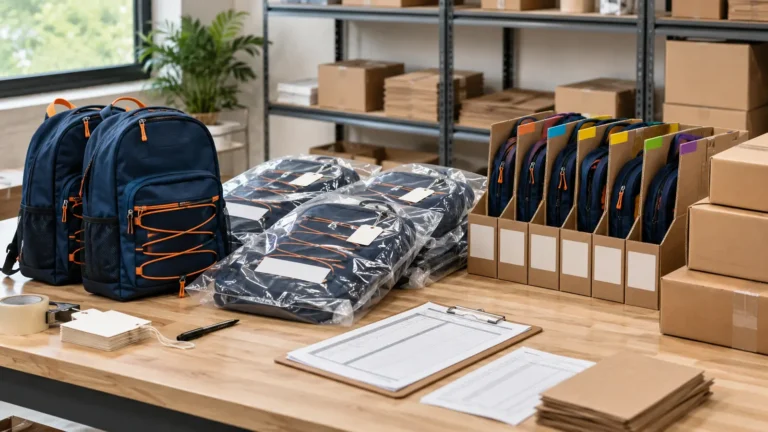
Use the approved standard during bulk inspection. Retain color references, artwork, measurements and packaging files so later orders can be compared consistently.
Questions to Ask a Backpack Supplier
- What finished dimensions and measurement tolerances will be documented?
- Which shell, lining, coating, foam and base materials are included?
- What device dimensions fit the finished laptop sleeve?
- How are shoulder straps, the top handle and base reinforced?
- Can the organizer be removed, and what cleaning limitations apply?
- Which logo method suits the selected panel and artwork?
- Will we receive a decorated physical sample before bulk production?
- How will color be approved and retained for repeat orders?
- What inspection standard and defect classification will be used?
- What is included in the unit price and shipping term?
- What MOQ applies to this structure and each color?
- Which packaging, labeling and export documents are included?
Common Procurement Mistakes
The first mistake is choosing only by liter capacity. Internal pockets and foam can reduce usable volume. Second is sending a generic “15-inch laptop” requirement without device measurements. Screen size does not define the computer’s external dimensions. Third is approving a clinical bag concept without the program’s storage and infection-control policy. Fourth is treating “waterproof,” “antimicrobial” or “recycled” as casual adjectives instead of claims that need definitions and support.
Other common errors include overloading the exterior with logos, splitting a small order across too many colors, omitting decoration from the physical sample and comparing quotations built from different specifications. A clear brief prevents more problems than a final inspection can repair.
Why JIUMU for Custom School Backpacks
Established in 2010 in Guangdong, China, JIUMU supplies custom bags, teamwear, logo apparel, hats, uniforms and branded merchandise for B2B buyers in North America and Europe. The team supports OEM and ODM development, fabric sourcing, Pantone color matching, multiple decoration methods, private labeling, customized packaging, digital mockups, physical samples, bulk quality control and export support.
For law, medical and nursing programs, that capability can be applied to a shared core backpack with program-specific organizers, colors or branding. Buyers can reduce development complexity while keeping each department identifiable. Claims about clinical suitability, cleaning or test performance remain subject to the final specification, sample and any agreed verification.

Frequently Asked Questions
Final Recommendation
The best backpacks for law, medical and nursing school are built from three different routines. Specify law bags around dense books and professional commuting; medical bags around devices, protected tools and removable organization; and nursing bags around clear separation between academic and program-approved clinical items. Then validate dimensions, loading, decoration, cleanability and construction on a physical sample.
For a quotation, send JIUMU a reference image or concept plus quantity, packing list, laptop dimensions, target size, materials, colors, logo, packaging, destination and required delivery date. Contact JIUMU by email at zhengdong@jiumugear.com or WhatsApp/phone at +86 18507502899.