Best Baseball Pants for Tournament Play: A B2B Team Buying Guide
Tournament baseball is harder on a uniform than a normal practice schedule. A player may warm up, compete, slide, sit in a dusty dugout, travel between fields, and play again before the first pair of pants has been properly washed. For a team manager, school, academy, uniform dealer, or sportswear brand, the purchasing question is therefore not simply, “Which pants look good?” It is, “Which specification will still fit, perform, and look consistent across a roster after repeated tournament use?”
This guide does not rank retail brands. Instead, it explains how professional buyers can define, compare, sample, and order custom baseball pants for multi-game competition.
Quick Answer: For most tournament teams, the strongest all-around specification is a midweight polyester or polyester-rich stretch fabric, an athletic cut with enough room through the seat and thigh, a double-layer knee, reinforced stress points, a gripper or structured elastic waistband, belt loops, secure front closure, and either a full-length or knicker silhouette selected for the team’s age group and uniform system. Order at least one approved sample size set, confirm the organizer’s current uniform rules, and plan spare pants for multi-day events.
Buying Baseball Pants for a Team or Tournament?
Compare custom baseball pants by fabric, fit, piping and size range, or build a coordinated baseball team uniform package. Send the roster quantity, age group, deadline and artwork for an order-specific recommendation.
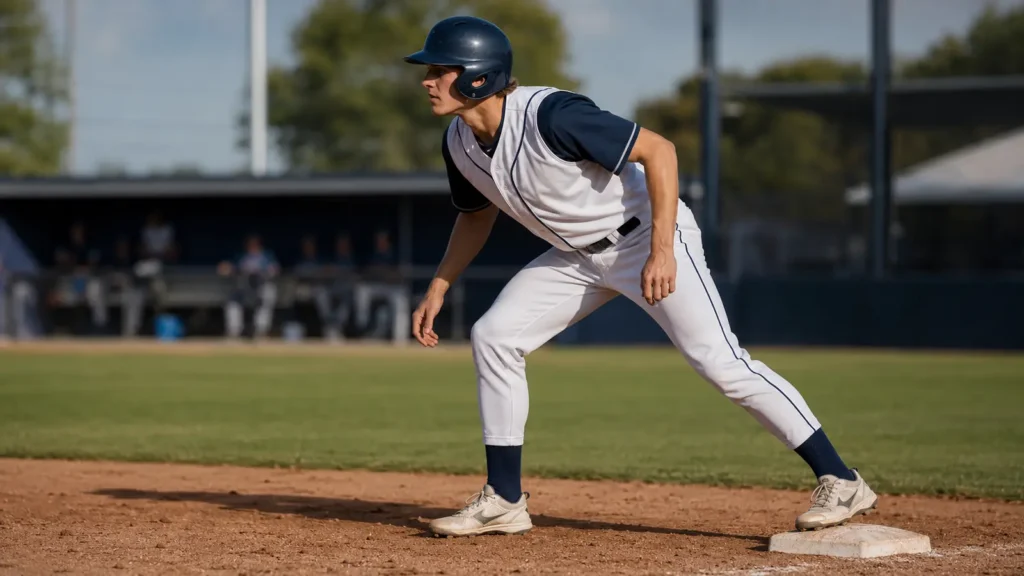
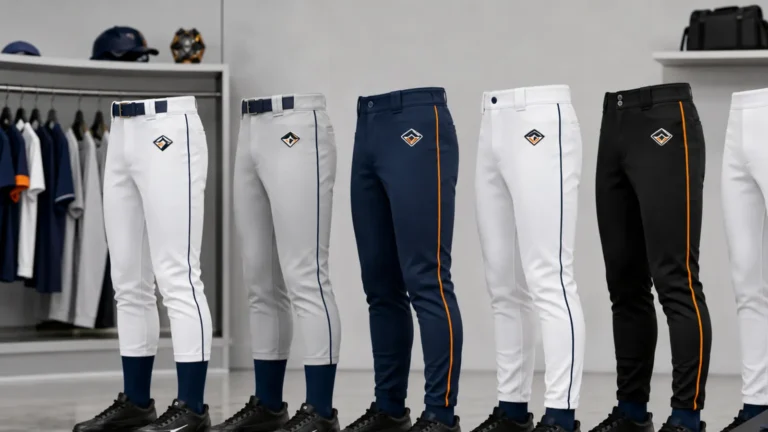
Tournament pants need to support movement, roster-wide fit and a consistent team appearance through a demanding schedule.
Why Tournament Baseball Pants Need a Different Buying Standard
A tournament schedule can mean several games in one weekend, short laundering windows, repeated sliding, long periods in heat, and limited access to replacements. These conditions expose unstable waistbands, restrictive rises, weak knees, transparent fabric and poor size grading quickly.
Teams also add players and reorder garments. If the supplier has not documented the fabric, pattern, piping, thread, trim, measurements and tolerances, later units may not match the original production.
For B2B buyers, “best” means the best controlled specification for the team’s competition level, climate, schedule, roster, care process and budget.
Tournament Baseball Pants Decision Overview
The following table summarizes the most important procurement priorities.
| Purchasing criterion | Recommended tournament direction | Why it matters | What to verify on the sample |
|---|---|---|---|
| Fabric | Midweight polyester or polyester-rich stretch woven | Balances structure, drying, opacity and movement | Hand feel, stretch recovery, opacity and post-wash appearance |
| Fit | Athletic cut with functional seat and thigh ease | Supports sprinting, fielding, catching and sliding | Deep squat, high knee, lateral lunge and running motion |
| Knee | Double-layer or reinforced knee panel | Adds material at a common abrasion zone | Panel coverage, seam comfort and puckering |
| Waistband | Structured elastic with belt loops; optional gripper | Helps the shirt stay tucked and stabilizes the pants | Roll resistance, grip, belt-loop spacing and closure |
| Closure | Zipper fly plus snap or button system | Provides secure entry and a professional uniform look | Pull strength, alignment and ease of use |
| Length | Full-length, knicker, or tapered ankle | Determines sock exposure, heat management and visual identity | Inseam, knee break, elastic opening and cleat interaction |
| Color | White, gray, cream, navy or approved custom color | Must match team identity and remain consistent across reorders | Lab dip or fabric swatch under indoor and outdoor light |
| Piping | Single, double or contrast side piping | Connects pants visually with jersey and socks | Width, placement, seam straightness and color match |
| Size system | Youth and adult graded measurements | Reduces exchanges and uneven appearance | Size-set measurements and roster try-on results |
| Spare ratio | Based on schedule, laundry access and roster changes | Prevents one damaged or dirty pair from disrupting the event | Replacement plan by size, not only total quantity |
Which Baseball Pant Style Works Best for Tournament Teams?
No single silhouette is best for every team. The right choice depends on the age group, visual identity, socks, climate, and the event’s uniform requirements.
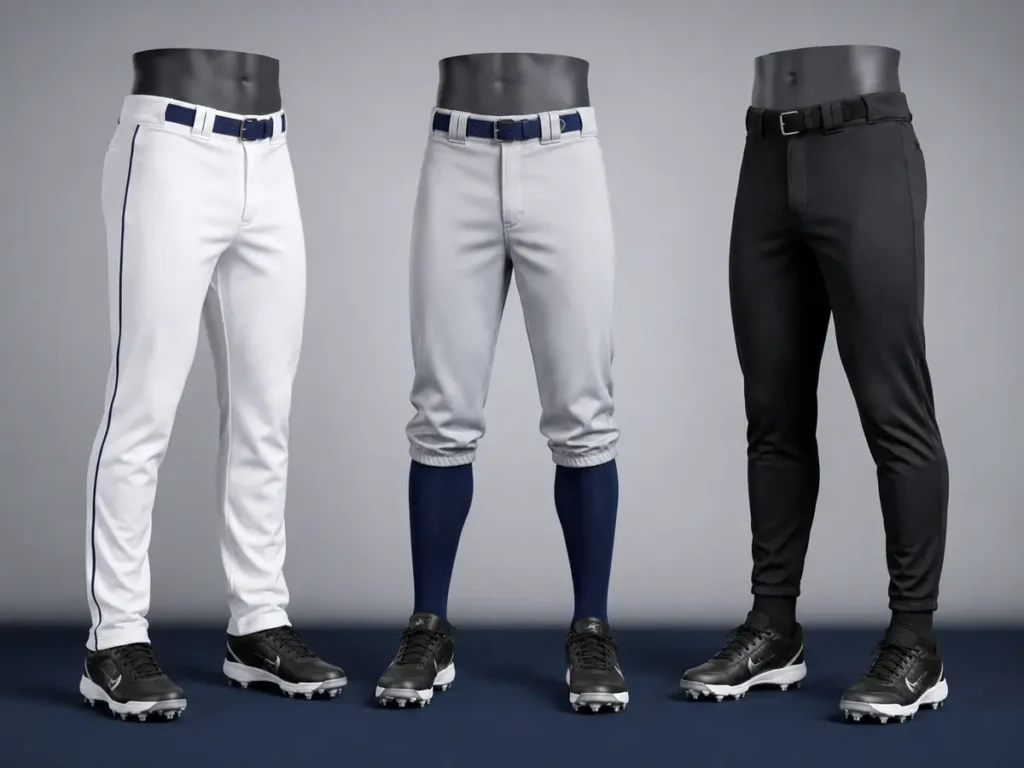
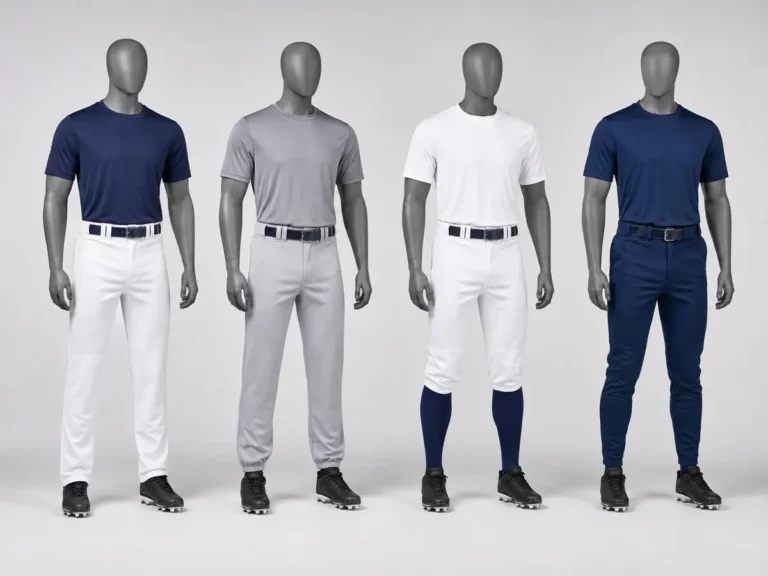
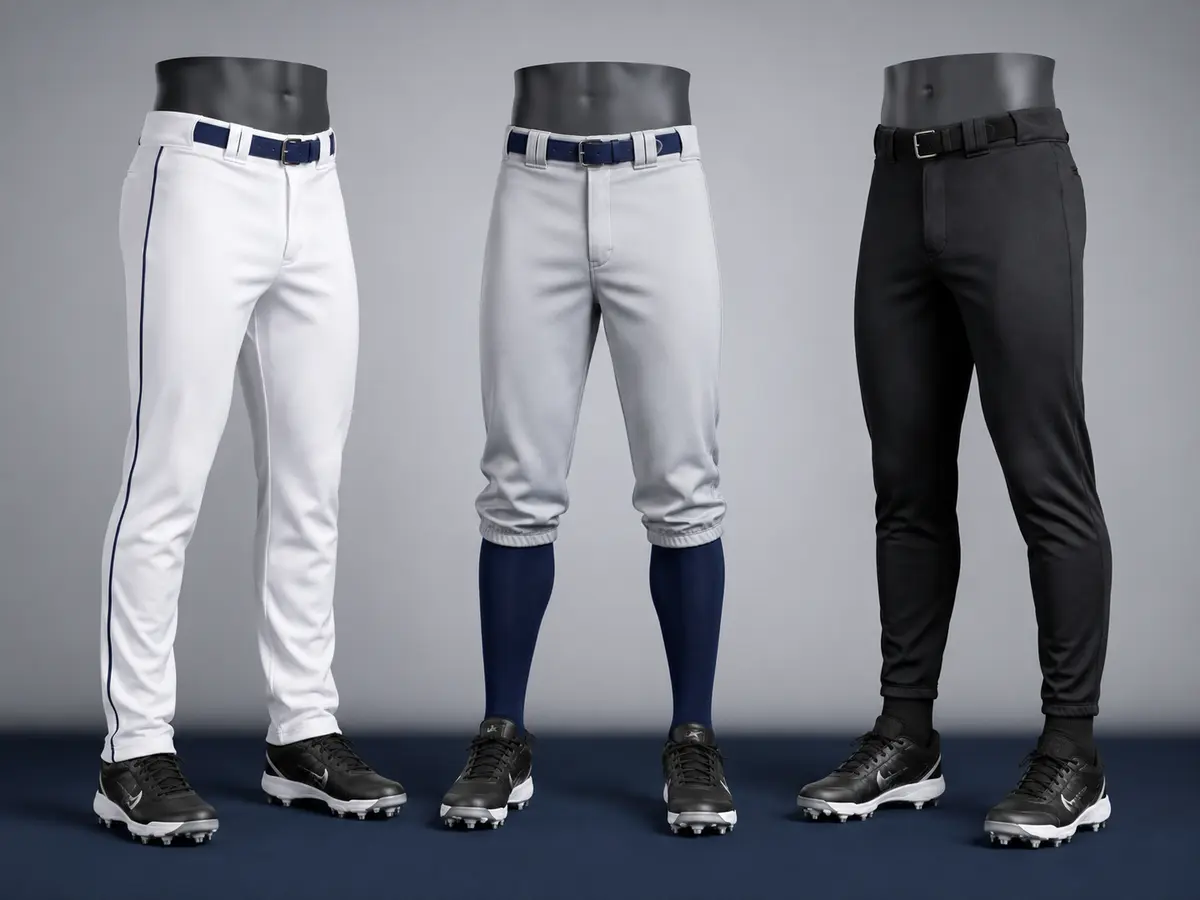
Compare the silhouette, ankle treatment and sock system before selecting one style for the roster.
Full-Length Baseball Pants
Full-length pants are widely used by youth, high school, college, club and adult teams. Check that the hem does not drag under the cleat. The lower leg should sit naturally over the sock without excessive fabric. This is often the safest default for mixed-position rosters because it does not depend on a precise high-sock presentation.
Knicker Baseball Pants
Knicker pants finish below the knee and are worn with visible high socks or stirrups. The critical measurements are finished length and elastic opening. Buyers should approve knicker length, sock height and jersey styling together; mismatched sock heights or shades become immediately visible.
Tapered or Elastic-Ankle Pants
Tapered pants narrow toward the lower leg and may include an elasticized opening, reducing hemming issues. Test the opening on different calf sizes and confirm that the design is acceptable under the competition rules.
Open-Bottom Versus Elastic-Bottom
Open-bottom pants allow hemming adjustments. Elastic-bottom pants simplify length control but may appear less traditional. Use planned inseam options for varied adult rosters and elastic or tapered openings when rapid youth outfitting is the priority.
| Style | Best fit for | Main advantage | Main procurement risk |
|---|---|---|---|
| Full-length straight | Broad team programs and classic uniforms | Familiar fit and wide size acceptance | Excess hem length or fabric bunching |
| Full-length tapered | Competitive clubs and modern uniforms | Clean lower-leg profile | Calf fit may vary across players |
| Knicker | Traditional teams and visible sock designs | Strong baseball identity and cooler lower leg | Incorrect finished length or sock inconsistency |
| Elastic ankle | Youth, practice-to-tournament programs | Easier length control | Elastic comfort and rule acceptance |
Fabric: Balance Durability, Mobility, Opacity and Drying
The fiber name alone does not determine performance. Polyester fabrics can differ in yarn, weave, weight, finish, stretch, opacity and recovery. Define the intended performance and request a physical swatch.
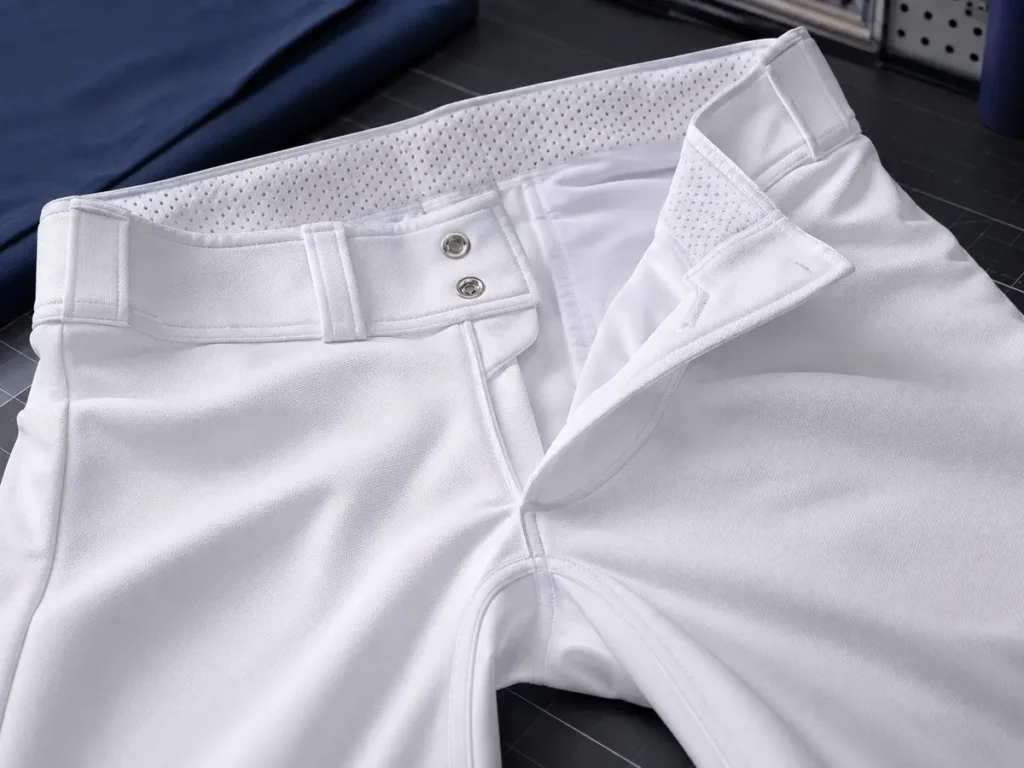
Evaluate the actual fabric and garment construction rather than relying on a generic fiber description.
Polyester Woven Fabric
Polyester woven fabric is a common base because it can provide structure, controlled stretch, color consistency and relatively quick drying. Ask for fabric weight, but do not choose by weight alone. Compare density, yarn strength, surface abrasion and garment construction.
Polyester With Mechanical or Elastane Stretch
A stretch component can improve comfort through the hip, seat, thigh and knee. Whether the stretch is mechanical or elastane-based, recovery matters: the pants should return toward their original shape. The care label must match the tested fabric and decoration system.
Mesh and Ventilation Zones
Breathable inner waistbands, gussets or localized panels can improve comfort, but they must not create transparency or weak seams. Keep them away from primary abrasion zones.
White-Pant Opacity
White pants require special attention. Check the approved sample under strong daylight and stadium-style lighting, in both standing and deep athletic positions. Fabric can appear sufficiently opaque when flat but reveal more when stretched across the seat or thigh.
Opacity is influenced by fabric density, color, texture, lining choices, fit, and the player’s base layer. Buyers should not rely on a digital mockup to approve this property.
Fit and Mobility: Build for Baseball Movements
Tournament pants should be evaluated through movements, not only static waist and inseam measurements.
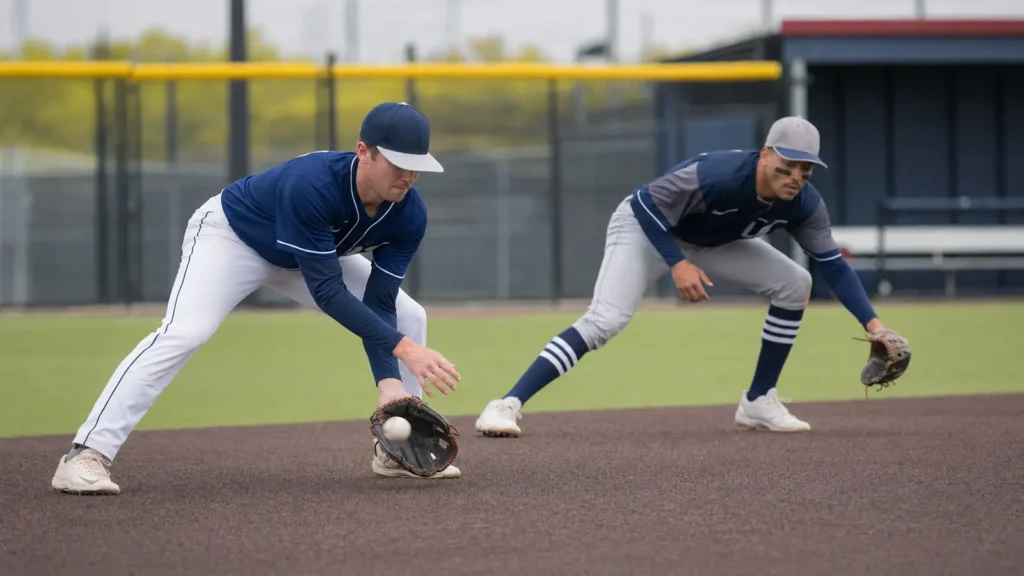
Fit approval should include baseball-specific movement across more than one body type.
The sample wearer should perform:
- a deep catcher-style squat;
- a lateral fielding lunge;
- a high-knee running movement;
- trunk rotation and a throwing stance;
- repeated waistband flexion.
The waist should remain stable without excessive pressure. The rise should provide coverage in a squat. The seat and thigh should have enough ease for movement without appearing oversized. The knee panel should bend naturally rather than forming a hard edge. Pocket bags should stay inside the garment.
Athletic Fit Versus Relaxed Fit
An athletic fit follows the body more closely and can look sharp in team photography. A relaxed fit provides more ease through the seat and thigh. Neither is universally superior. The roster’s age, body diversity, player preference, and position mix should guide the pattern.
A useful tournament program may offer one visual style with a consistent outer appearance but an inclusive size range. Do not solve size diversity by simply scaling every measurement in equal proportions. Proper grading adjusts waist, hip, rise, thigh, knee, inseam, and opening according to a defined rule.
Youth and Adult Size Grading
Youth sizes are not merely smaller adult sizes. Proportions change, and growing players often need room without an excessively long inseam. Ask the supplier for finished garment measurements, not only age labels such as “Youth Medium.”
For roster ordering, collect at least:
- natural waist or preferred waistband position;
- hip or seat circumference where relevant;
- inseam;
- height;
- usual baseball pant size;
- preferred silhouette;
- player name or roster ID.
A physical size set is the most reliable way to reduce exchanges. Players should try it over their expected base layers.
Construction Details That Matter Over Multiple Games
Durability is a system. Fabric strength cannot compensate for weak seam construction, and reinforced stitching cannot fix a pattern that creates constant stress.
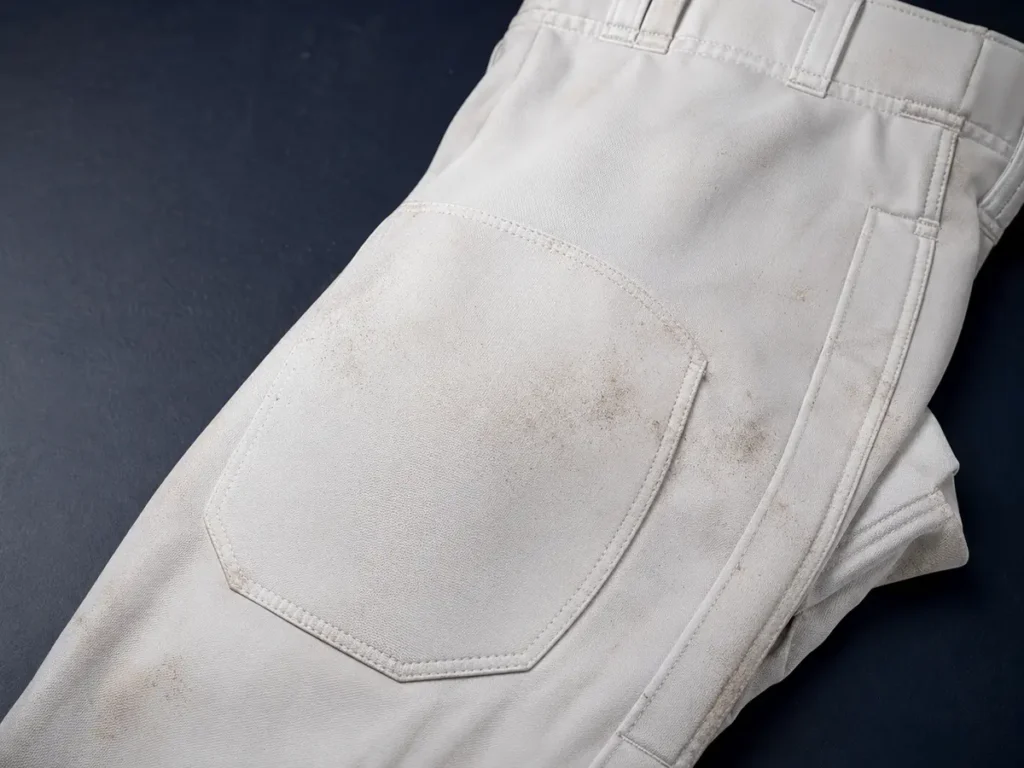
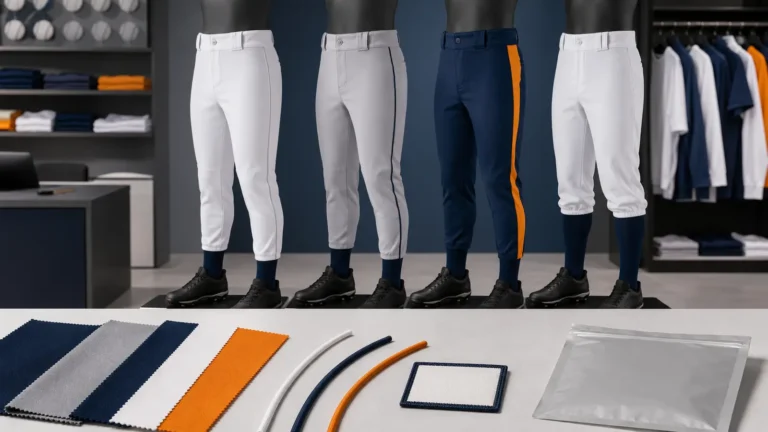
Review reinforcement coverage, stitch consistency and stress-point construction on the physical sample.
Double-Layer Knees
A double-layer knee adds material in an area commonly exposed to sliding and kneeling. Check where the panel begins and ends when the garment is worn. A panel that looks correct when flat may sit above or below the player’s functional knee zone.
The panel seam should lie smoothly, with no puckering or rough internal edge. For youth and adult patterns, the position should be graded rather than copied at one fixed distance.
Reinforced Seat and Stress Points
Depending on the design, the seat may use stronger seam construction or an additional layer. Belt loops, pocket corners, fly base, waistband ends, and high-tension seam intersections benefit from secure bartacks or equivalent reinforcement.
Inspect the underside as well as the exterior. Loose thread tails, uneven seam allowance, skipped stitches, and inconsistent overlocking are early warnings.
Seam Selection
The supplier should select seams appropriate to the fabric and stress direction. Define the required outcome: flat, secure, comfortable seams that remain intact through agreed movement and laundering checks.
For formal laboratory programs, purchaser and supplier can agree on relevant methods. ASTM D1683/D1683M describes measuring sewn seam strength in woven fabrics, while AATCC methods cover areas such as dimensional change and colorfastness. A named method is useful only when the test conditions, sample type, acceptance level, and responsible laboratory are also agreed.
Waistband, Belt Loops and Closure
The waistband is one of the most frequently handled parts of the garment. A tournament-ready design may include structured elastic, an internal gripper, wide belt loops, and a secure snap or button with zipper fly.
Confirm:
- waistband height and stretch;
- whether the inner grip is comfortable against the jersey;
- belt-loop width for the planned team belt;
- loop placement at the center back and side seams;
- snap alignment and pull resistance;
- zipper smoothness and locking behavior;
- closure durability after laundering.
Color, Piping and Team Uniform Coordination
Baseball pants are part of a system. White or gray pants may appear simple, but piping width, side-seam placement, belt color, sock height, and jersey trim determine whether the complete uniform looks intentional.
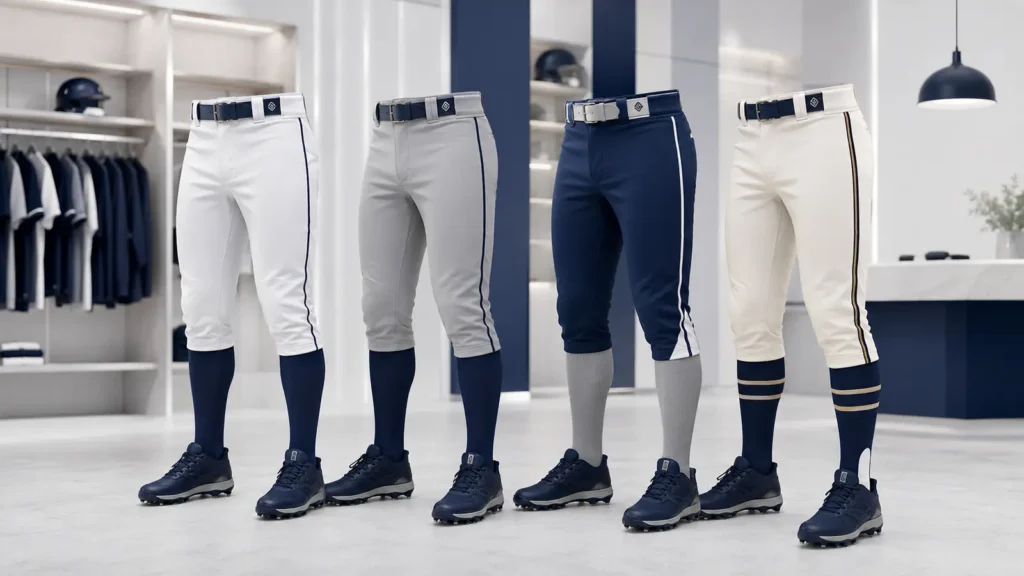
Approve pants together with the jersey, belt and socks to control the complete team appearance.
Common base colors include white, gray, black, navy and cream. Custom shades depend on fabric availability, quantity and color tolerance. Use a physical swatch, lab dip or sample viewed under more than one light source.
For piping, specify:
- single or double line;
- finished width;
- exact color reference;
- placement relative to the side seam;
- continuation through the waistband or pocket area;
- alignment at panel intersections;
- tolerance for waviness and left-right position.
Pant color must also be checked against tournament regulations. NFHS guidance for school baseball states that the official uniform includes pants and other visible components, while its 2025 interpretation clarified that team uniform pants extend below the knee. NFHS also announced expanded permission for school identity elements on uniform tops and/or pants for 2026. Because governing bodies and tournament operators can update their rules, buyers should obtain the current rulebook or event instructions before final approval rather than treating a supplier’s past experience as legal confirmation.
Little League likewise directs volunteers and parents to use its current rulebook resources. Its equipment guidance notes that pants, belts, and socks may be selected in colors decided by the team and league. That makes local confirmation essential when ordering for affiliated competition.
How Many Pairs Should a Tournament Team Order?
There is no universal spare ratio. Plan from the actual event schedule and the team’s laundry access.
For a single-day event, one game pair plus a size-based spare pool may be sufficient. For multi-day travel tournaments or doubleheaders, two pairs per player can reduce operational pressure. White pants, limited laundry access and uncertain weather may justify more.
Do not order spares only as a percentage of total units. Order them by likely replacement size. One spare in an uncommon size cannot solve a shortage in the roster’s most-used size.
A practical planning model considers:
- roster size and alternates;
- number of game days and possible games per day;
- color combinations required;
- expected laundry turnaround;
- field conditions and player growth;
- late roster additions and reorder lead time;
- budget for organized replacement stock.
Cost Drivers in Custom Tournament Baseball Pants
Pricing depends on specification, quantity, materials, trims, size range, customization, sampling, packaging and shipping. A low unit price is not the lowest total cost if it produces exchanges or inconsistent reorders.
Typical cost drivers include:
- fabric type, weight, stretch and availability;
- custom-dyed versus stock fabric colors;
- double-layer knee or seat construction;
- piping, contrast panels and added seam operations;
- custom waistband, gripper, label and trim requirements;
- youth-to-extended-adult size range;
- multiple colorways or small quantities per variation;
- private labels, hangtags and individual packaging;
- pre-production samples and revisions;
- inspection and third-party testing requirements;
- carton marking, shipping method and delivery schedule.
For comparable quotations, send the same specification to each supplier. If one quote uses a stock lightweight fabric and another uses a heavier stretch woven with reinforced knees, the prices do not represent the same product.
Planning a Tournament Baseball Pants Order?
Planning a tournament order? Send JIUMU your roster quantity, youth/adult size range, pant style, base color, piping colors, logo or label requirements, target event date, destination country, and reference images. JIUMU can prepare a custom quotation and confirm which details require a digital mockup, fabric swatch, or physical sample. Explore custom team uniforms or a baseball team uniform package.
Sample Approval and Quality-Control Checklist
Sample approval should be recorded, not handled through general comments such as “looks good.” Build a checklist that the buyer and supplier can use again during bulk inspection.
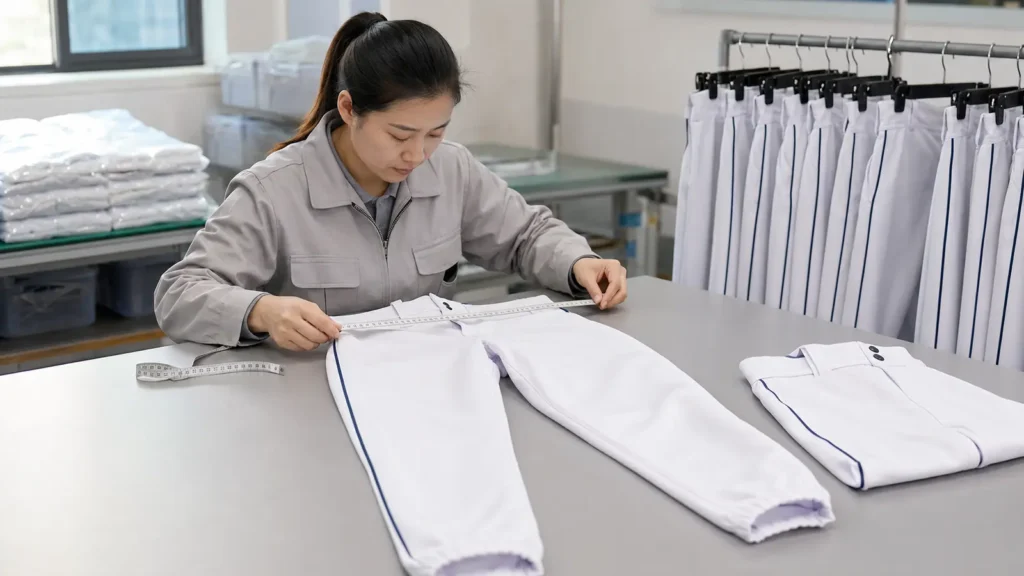
An approved sample, measurement chart and documented tolerances create a clear reference for bulk inspection.
Before Approving the Sample
Check the following:
- fabric composition, construction, weight and hand feel;
- base color and piping color against approved references;
- opacity in standing and stretched positions;
- waist, hip, rise, thigh, knee, inseam and leg opening;
- size-label accuracy;
- movement in a squat, lunge and running stance;
- waistband recovery and internal grip;
- belt-loop count, width and spacing;
- fly, snap or button function;
- pocket position and bag security;
- double-knee position and coverage;
- seam flatness, stitch density and skipped stitches;
- bartacks at defined stress points;
- left-right piping symmetry;
- garment appearance after the agreed wash procedure;
- private label, hangtag and packaging accuracy.
During Bulk Inspection
The inspection plan should define how units are sampled and what counts as a critical, major, or minor defect. Buyers may use their own system or agree on a recognized sampling approach with an inspection provider. The important point is to define acceptance before production is complete.
Measure garments from a relaxed, consistently positioned state. Use the same measurement method as the approved specification. If the waistband must be measured both relaxed and extended, define the extension force or method. Otherwise, two inspectors can produce very different results.
Keep one sealed or controlled approved sample as the reference for color, construction and workmanship. Product photography and digital mockups are helpful but should not replace the physical approval sample.
Useful Testing Discussions
Where the order value, buyer policy, or retail program justifies testing, discuss:
- dimensional change after laundering;
- colorfastness to laundering and perspiration;
- color transfer or crocking for dark colors;
- seam strength or seam failure;
- stretch and recovery;
- zipper and snap performance;
- abrasion behavior at the knee fabric;
- restricted-substance requirements for the destination and buyer.
AATCC publishes textile methods covering colorfastness, laundering, dimensional change and related performance areas. ASTM D1683/D1683M addresses failure in sewn seams of woven apparel fabrics. Do not state that a garment “passes AATCC” or “passes ASTM” without identifying the exact method, edition, conditions and acceptance criteria.
Bulk-Order Planning Process
1. Confirm the Competition and Deadline
Identify the governing body, age group, uniform restrictions, first wear date and delivery location. Allow time for sampling, revisions, production, shipping, customs and distribution.
2. Freeze the Pant Specification
Define silhouette, fabric, color, piping, waistband, closure, reinforcement, pockets, labels and packaging. Record each feature in a tech pack or specification sheet.
3. Approve Artwork and Color References
Provide vector artwork where possible. Use an agreed physical color reference and approve how it appears on the actual fabric or trim.
4. Approve a Size Set
Review at least representative youth and adult sizes, not only one medium sample. Run a roster fitting and record changes before bulk approval.
5. Confirm the Purchase Order Breakdown
The order should list units by style, color, size and packaging variation. Include spare units as separate planned stock. Confirm whether each garment needs a player name, roster identifier or only a generic size label.
6. Establish the Approval Record
Store measurements, sample photos, fabric and color references, artwork, packaging and written comments for production and reorders.
7. Inspect and Ship
Agree on in-process checks, final inspection, carton markings and shipping documents.
Information to Send for an Accurate Quotation
The fastest route to a useful quotation is a complete brief. Send:
- buyer and organization type;
- destination country and postal code;
- target in-hand date;
- total quantity;
- size breakdown or expected youth/adult range;
- full-length, knicker, tapered or other silhouette;
- preferred fabric or performance target;
- base color and physical color references;
- piping width, color and placement;
- waistband and closure requirements;
- knee and seat reinforcement;
- pocket configuration;
- logo, woven label or private-label artwork;
- hangtag and packaging requirements;
- applicable tournament or buyer compliance requirements;
- reference garment, tech pack, or clear front/back images;
- sample quantity and approval process.
If the final size breakdown is not ready, state that clearly and request an initial price range based on an estimated mix. The supplier can then revise the quotation when the roster is confirmed.
Questions to Ask a Baseball Pants Supplier
- What exact fabric construction and weight are included?
- Can you provide the same fabric and color for reorders?
- How is knee reinforcement positioned by size?
- Which measurements and tolerances are controlled?
- Can you provide youth and adult size-set samples?
- How do you check white opacity and dark-color transfer?
- What waistband, closure and piping options are available?
- Which steps require buyer approval?
- What inspection records can be provided?
- How are defects and urgent replacements handled?
- What records support a matching reorder?
- Which costs are excluded, and what assumptions support delivery?
Common Buying Mistakes
Choosing Only by Fabric Weight
Weight is useful, but it does not describe stretch recovery, opacity, surface abrasion, seam quality or fit. Approve the actual fabric and garment.
Approving One Size for the Entire Range
A medium sample cannot prove that youth, extended adult, short and long proportions are correct. Review the grading and representative size set.
Ignoring the Full Uniform
Pants can match a digital color code and still conflict with the jersey fabric, socks or belt. Approve the complete uniform system under real light.
Ordering No Size-Based Spares
A general spare percentage may leave the team without the size it actually needs. Use the roster distribution to plan replacements.
Treating a Digital Mockup as a Performance Sample
A mockup confirms visual direction. It cannot confirm opacity, mobility, hand feel, reinforcement placement or waistband behavior.
Forgetting Current Event Rules
Uniform rules differ by organization and may change. Obtain the current official rulebook or tournament instructions. Little League directs users to its current rulebook app, and NFHS publishes season-specific baseball rule information. Supplier guidance should not replace the event authority.
Leaving Reorder Details Undocumented
“Same as last time” is not a specification. Retain fabric, pattern, trim, color, measurements, packaging and approved-sample records.
Why JIUMU Is Relevant to Tournament Team Buyers
JIUMU is a Guangdong-based B2B supplier established in 2010, serving the United States, Canada, the United Kingdom and Europe. Its scope includes custom teamwear, uniforms, hats, bags and branded merchandise.
For tournament programs, the relevant advantage is coordinated specification management. Buyers can develop baseball pants together with custom team jerseys, custom baseball caps, team bags and other uniform components.
JIUMU supports OEM and ODM development, fabric sourcing, Pantone color matching, digital mockups, physical samples, private labels, hangtags, packaging customization, bulk quality control and export support. The typical MOQ is 50 pieces, subject to the pant structure, size breakdown and customization.
These capabilities support a workflow that converts tournament requirements into documented materials, colors, measurements, labels and packaging.
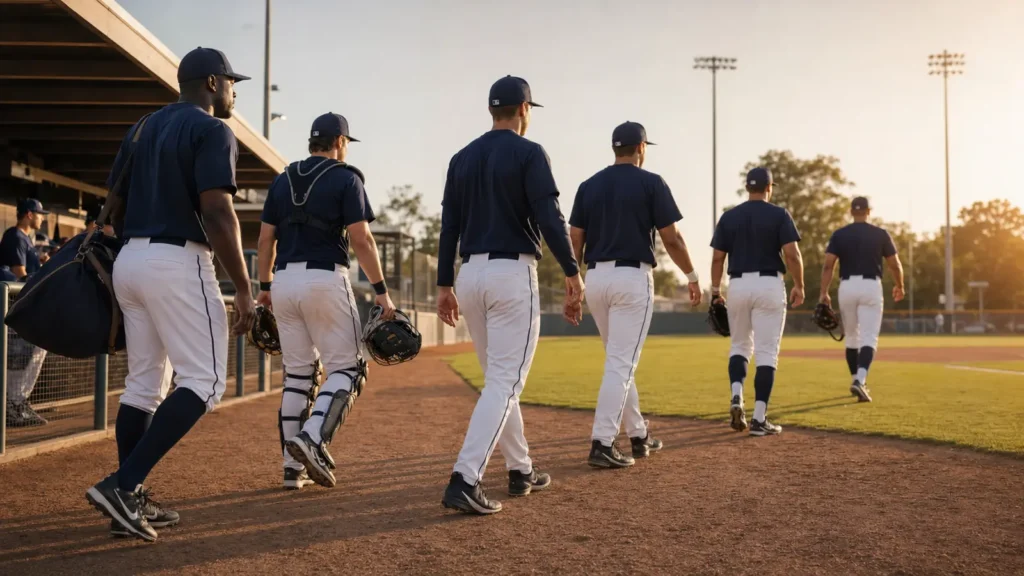
A documented specification helps the whole roster look consistent and makes future replacement orders easier to control.
Frequently Asked Questions
Final Recommendation
The best baseball pants for tournament play are not defined by a logo or one marketing feature. They are defined by how well the complete specification handles repeated movement, sliding, laundering, roster variation, uniform coordination and replacement planning.
Start with the competition rules and roster. Select the silhouette and fabric. Engineer the knee, waistband, closure and seams around real baseball movements. Approve color and piping with the whole uniform. Fit representative youth and adult sizes. Document every decision, inspect bulk production against the approved sample, and keep the record for reorders.
That process produces more dependable results than shopping by a generic “premium” description.
Request a Custom Tournament Baseball Pants Quotation
Share your quantity, size range, pant style, colors, piping, reinforcement, private-label requirements, target delivery date and destination with JIUMU. Include a tech pack, reference garment or clear front-and-back images if available. Contact zhengdong@jiumugear.com or WhatsApp +86 18507502899, or use the JIUMU contact page.
Sources and Rule References
- NFHS Baseball Uniform Rules
- NFHS 2026 Baseball Comments on the Rules
- NFHS 2025 Baseball Rules Interpretations
- Little League 2026 Rule Changes and Clarifications
- Little League Playing Rules
- Little League Equipment and Uniform Guidance
- AATCC Standard Test Methods and Procedures
- ASTM D1683/D1683M—Failure in Sewn Seams of Woven Apparel Fabrics
About JIUMU
JIUMU is a Guangdong-based B2B supplier established in 2010, supporting custom teamwear, uniforms, hats, bags and branded merchandise for buyers in North America, the United Kingdom and Europe.