How to Wear Baseball Pants with Socks, Belts and Team Jerseys
Baseball pants do more than complete a uniform. Their length determines how much sock is visible, their waistband affects whether a jersey stays tucked, and their piping often establishes the color that should be repeated in the belt or socks. A team can buy good individual garments and still look inconsistent when those details are selected separately.
For players, the solution is a repeatable dressing sequence: start with the correct base layer and socks, set the pant hem at the intended height, tuck the jersey smoothly, then add and adjust the belt. For team buyers, the same logic becomes a specification system covering pant cut, sock height, belt color, jersey hem allowance, sizing and sample approval.
Quick Answer
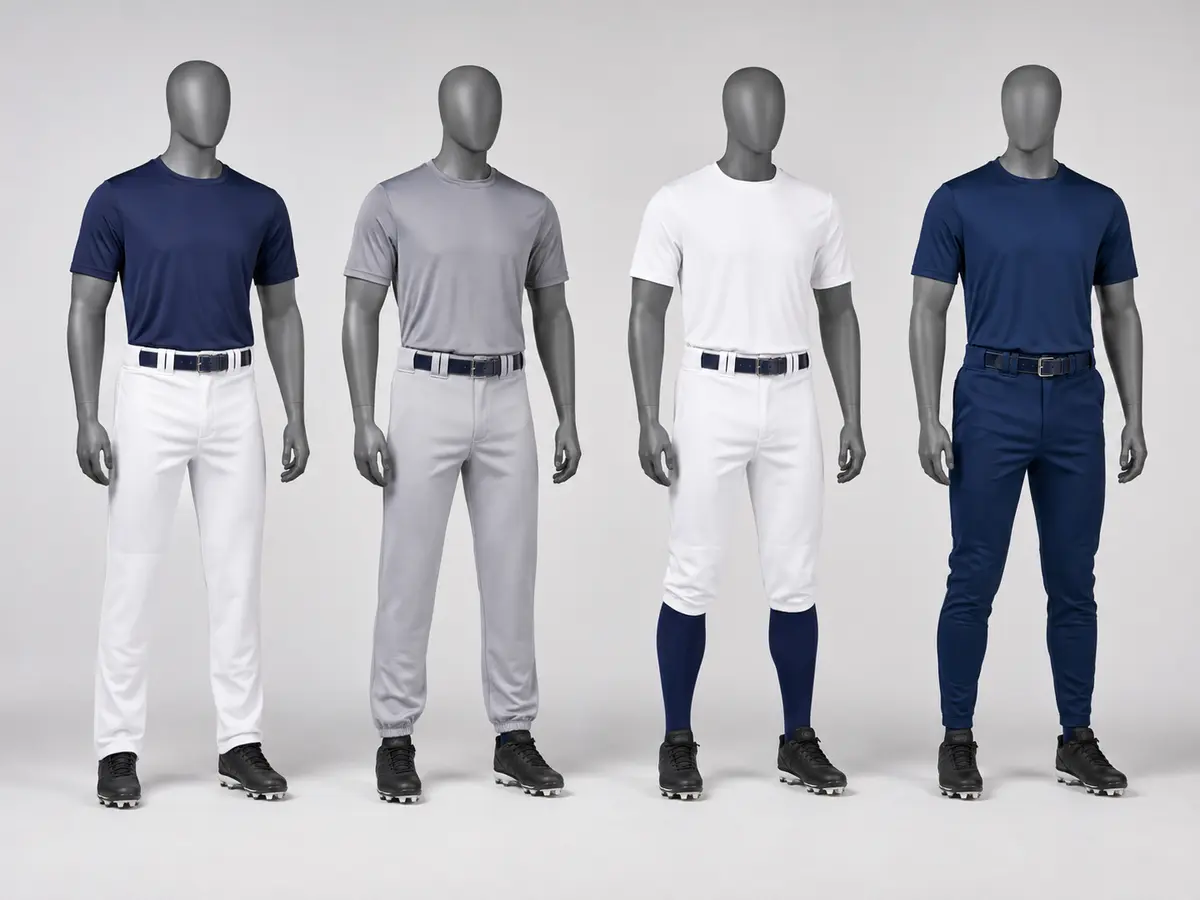
To wear baseball pants correctly, first confirm the style. Full-length open-bottom pants should fall cleanly over the top of the cleat without dragging under the heel. Tapered or elastic-cuff pants should sit securely at the ankle. Knicker pants should finish at or just below the knee, with over-the-calf socks pulled smoothly up underneath the elastic cuff. Put socks and any sliding layer on before the pants, tuck the team jersey evenly into the waistband, and thread a flexible baseball belt through every loop. Coordinate the belt and socks with one color already used in the jersey, pant piping or cap. Always follow the team or league uniform rule before choosing a personal variation.
Ordering Baseball Pants for a Complete Team Uniform
Before requesting a team quote, define the pant style, youth and adult size breakdown, fabric and stretch requirements, waistband and belt-loop construction, piping colors, sock style, jersey pairing, player quantity, destination, and required date. Approve pants, socks, belt, and jersey together to confirm proportion and color consistency.
Compare custom baseball pants and complete baseball uniform packages, then request a custom team quotation with your roster.
Why the Complete Uniform Matters
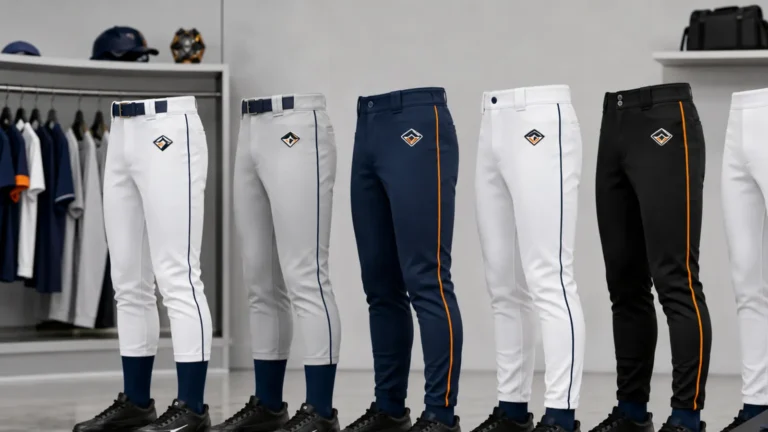
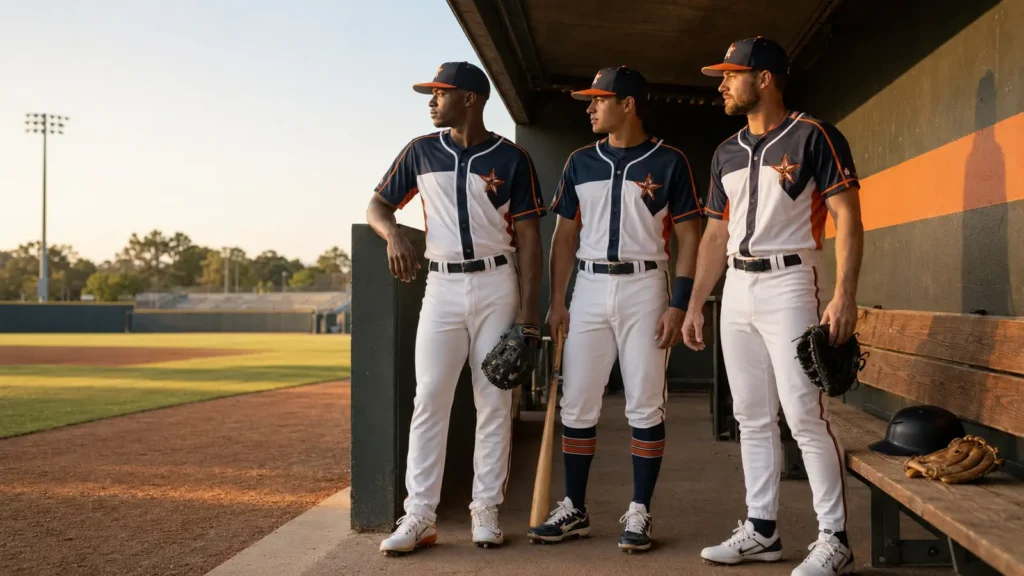
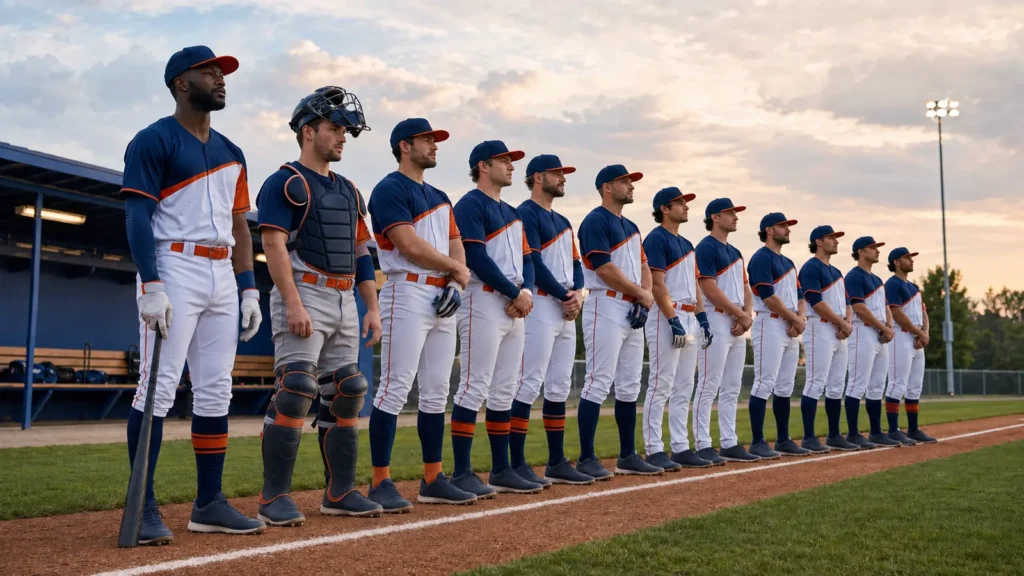
The best-looking baseball uniforms use repetition rather than too many colors. A navy jersey with orange trim, white pants with navy piping, navy socks and an orange or navy belt reads as one system. If every player chooses a different sock height, belt color or pant length, the same garments appear less organized.
Fit also affects performance. Pants that drag can catch under a cleat. Knicker cuffs placed too low can bunch behind the knee. An oversized waist tightened aggressively with a belt creates folds that press into the player during a swing or slide. A jersey with too little body length repeatedly pulls out of the waistband.
For procurement teams, these are not merely styling concerns. They affect the size ratio, pant pattern, waistband construction, sock specification, sample review and reorder consistency. The buyer should define how the full uniform is intended to be worn before approving its individual components.
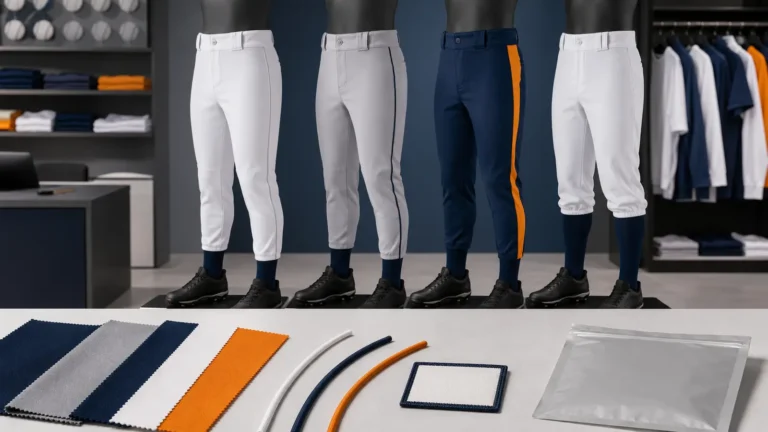
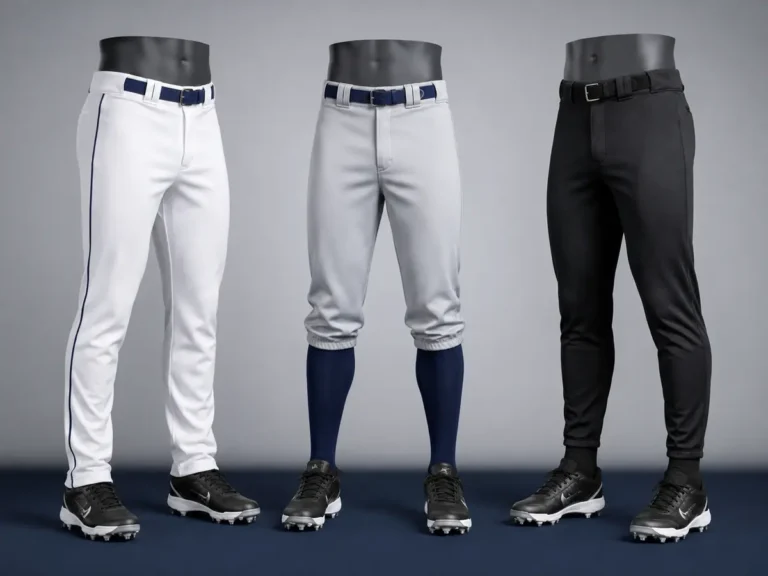
Baseball Pant Styles at a Glance
| Pant style | Correct hem position | Sock visibility | Best visual use | Important buying check |
|---|---|---|---|---|
| Full-length, open bottom | Light break over the cleat; heel remains clear | Low or none | Modern game uniform, cooler-weather coverage | Inseam, hem opening and no heel drag |
| Full-length, elastic cuff | Cuff sits at the ankle | Small amount | Secure, practical youth or training fit | Cuff recovery and ankle comfort |
| Pro-taper or jogger style | Close to lower leg and finishes at ankle | Small amount | Contemporary training or streamlined team look | Calf ease and stretch |
| Knicker | Elastic cuff at or just below knee | High | Traditional baseball look, striped socks or stirrups | Cuff grip, rise and correct inseam |
| Adjustable-length pant | Player sets hem between knee and ankle | Varies | Programs serving mixed player preferences | Adjustment system stays secure |
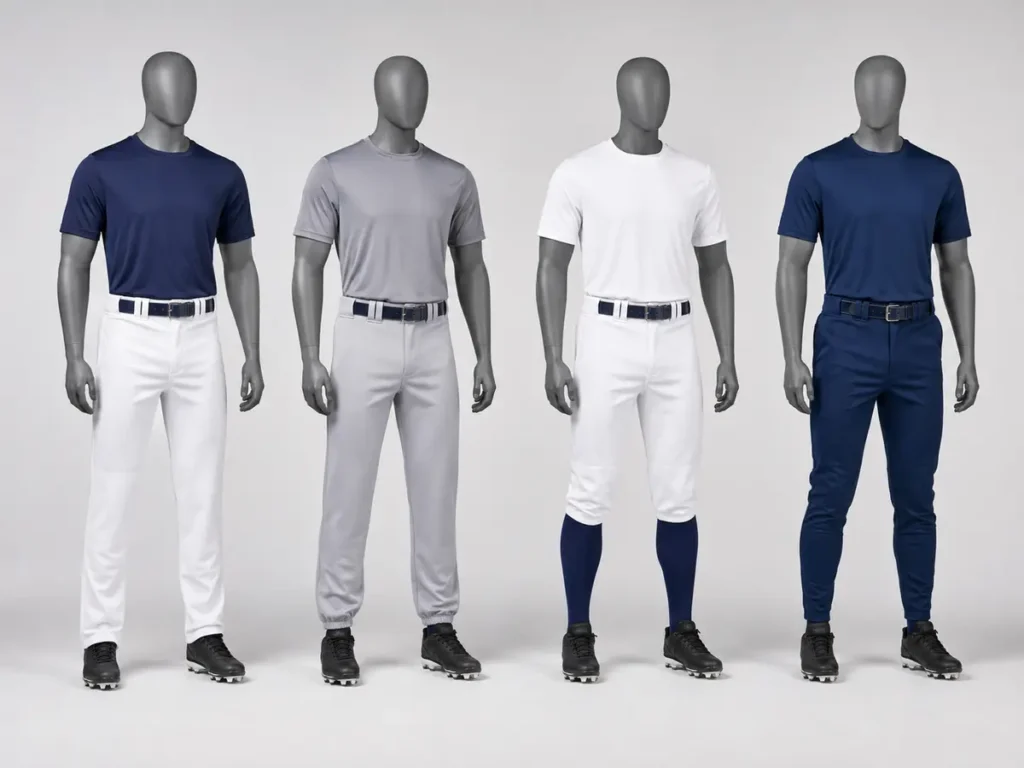
The terms used by suppliers are not always identical. “Pro-style,” “semi-relaxed,” “tapered” and “open bottom” can describe different pattern details from one manufacturer to another. A buyer should therefore approve a measurement chart and a worn sample, not rely on the style name alone.
Check Team and League Rules Before Styling
Uniform rules differ by competition, age group and local organization. Major League Baseball’s official rules state that players on one team must wear uniforms identical in color, trim and style. That professional rule is useful as a principle of visual consistency, but it should not be presented as the exact rule for every school or youth league.
Little League advises families that pant, belt and sock colors are decided by the team and local league. Its current rules page directs participants to the updated 2026 Rulebook App for the most recent division-specific requirements. School programs may also follow NFHS rules plus state or local policies.
Before ordering, confirm:
- whether all players must use the same pant color and cut;
- whether socks, belts and visible undershirts must match;
- whether jersey numbers, patches or sponsor marks have prescribed positions;
- whether pitchers face restrictions on distracting visible colors;
- whether home and away uniforms use different pants or jerseys; and
- whether the team supplies the full uniform or families buy selected accessories.
Treat the approved rule sheet as part of the tech pack. If a league changes a patch or color requirement, update the artwork and bill of materials before bulk production.
How to Wear Full-Length Baseball Pants
Open-bottom pants
Put on compression shorts or the approved protective layer, then baseball socks, then the pants. Fasten the front closure and assess the waist before adding the belt. The waistband should stay near the top of the hip without being held up only by the belt.
Stand in cleats and let the leg fall naturally. The front hem may create a slight break over the laces, but the back should remain above the ground and out from under the heel. Walk, squat and take several running steps. If the hem repeatedly slips below the heel, the inseam is too long or the opening is too wide for that player.
Do not solve excessive length by hiding a large roll inside the leg. A bulky fold can shift during play and produces an uneven team appearance. Hem the pants to the approved length or choose a better inseam.
With full-length pants, standard crew or over-the-calf baseball socks may be worn underneath even when very little sock is visible. The sock still protects the skin from seams and helps manage moisture. The color should follow the team specification because it may show during movement.
Elastic-cuff and tapered pants
An elastic cuff should sit at the ankle without digging into the Achilles area. Pulling the cuff several inches up the calf changes the intended fit and may create a tight pressure point. If a player wants a high-sock look, a knicker pattern is usually the cleaner choice.
A tapered leg should follow the calf without restricting a deep squat. Check that the fabric returns to shape after stretching. For team orders, test the smallest and largest common calf measurements because a pattern that looks good on a fit sample can feel too tight across a varied roster.
How to Wear Knicker Baseball Pants with High Socks
Knicker pants are designed to make socks part of the visible uniform. Use over-the-calf baseball socks long enough to extend above the pant cuff. Short crew socks often leave a gap or slide below the elastic.
The clean sequence is:
- Put on the approved base layer, cup or sliding shorts.
- Pull each sock fully over the calf and smooth out wrinkles.
- Put on the pants without rolling the sock down.
- Position the knicker cuff at or just below the knee.
- Confirm that several inches of sock remain beneath the cuff.
- Squat and run to check that the cuff does not migrate or pinch.
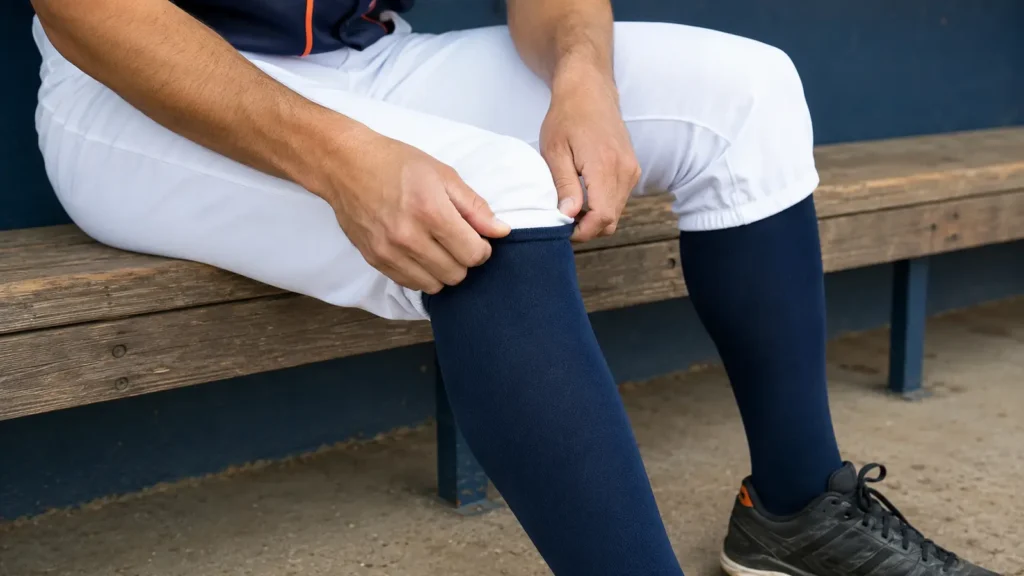
The sock should look intentional, not over-stretched. If the top band turns over or the heel pulls upward, use a larger sock or a longer leg length. For striped socks, align the stripe height across the roster. A stripe placed at mid-calf on one player and immediately below the knee on another weakens the team look.
Knicker cuffs should be symmetrical. One cuff placed above the knee and the other below it can restrict movement and looks unfinished. If the cuff slides, the issue may be weak elastic, an oversized leg opening or the wrong inseam—not a need to tape the garment.
How to Wear Baseball Stirrups
Traditional stirrups are worn over a solid sanitary sock. Pull the sanitary sock above the calf, then position the stirrup so the narrow strap runs under the arch and the larger colored section sits consistently on the leg. Put the knicker pants on last and set the cuff above the visible stirrup design.
Teams ordering stirrups should approve:
- overall stirrup length;
- cut height and orientation;
- sanitary sock color;
- stripe placement;
- youth and adult size ranges; and
- how much design should remain visible below the knicker cuff.
Stirrups should be optional only if the uniform policy allows mixed styling. Otherwise, some players in stirrups and others in solid socks create two distinct uniform systems.
How to Wear a Baseball Belt
A baseball belt is intended to stabilize the waistband and complete the color system. It should not compensate for pants that are several sizes too large.
After fastening the pants, tuck the jersey, then thread the belt through every loop. Keep the buckle centered and the elastic section flat. The belt should be snug enough to prevent waistband movement but not so tight that the waistband gathers into deep folds. A player should be able to rotate, bend and breathe normally.
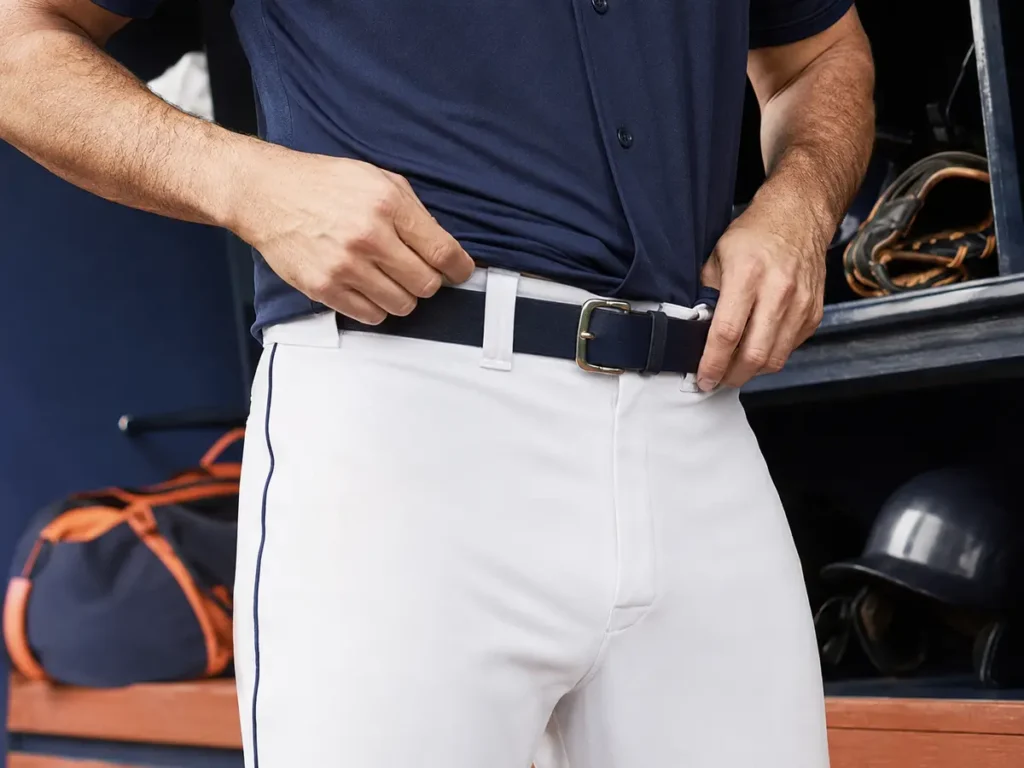
Most baseball belts use stretch webbing with a metal or covered buckle. For youth rosters, verify the adjustable length range rather than assuming one belt fits every player. Also check belt width against the pant loops. A belt that is too wide is difficult to thread; a very narrow belt can twist inside large loops.
Choosing the belt color
Use the belt to repeat an existing uniform color. The safest options are:
- match the dominant sock color;
- match the pant piping;
- match the cap crown or jersey body; or
- use the team’s accent color when it is already present in trim.
Avoid introducing a fifth color only through the belt. If the jersey is navy and white with orange trim, navy creates a controlled base while orange creates a stronger accent. Both can work when specified consistently across the team.
How to Tuck and Coordinate the Team Jersey
Baseball jerseys are normally worn tucked during games. Start with the pants fastened but the belt removed. Pull the jersey down, distribute the hem evenly around the body, and tuck small sections from front to back. Smooth excess fabric toward the side seams rather than forming one thick fold at the lower back. Add the belt after the tuck is even.
A silicone or grip element inside the waistband may help reduce jersey movement, but it cannot fix a jersey body that is too short. During sample fitting, have the player raise both arms, rotate as if swinging and bend into a fielding stance. The jersey should remain adequately tucked.
For button-front jerseys, keep the placket centered over the pant fly and belt buckle. For pullover or V-neck jerseys, use the center of the team wordmark or front panel as the alignment reference. Piping on the jersey and pants should meet visually even if the seams do not physically connect.
A simple three-color system
Choose:
- one primary color for the jersey body or cap;
- one neutral for pants or jersey panels; and
- one accent for piping, numbers, socks or belt.
Repeat each color deliberately. The accent does not need to appear on every component. Two or three controlled repetitions are usually stronger than using every color everywhere.
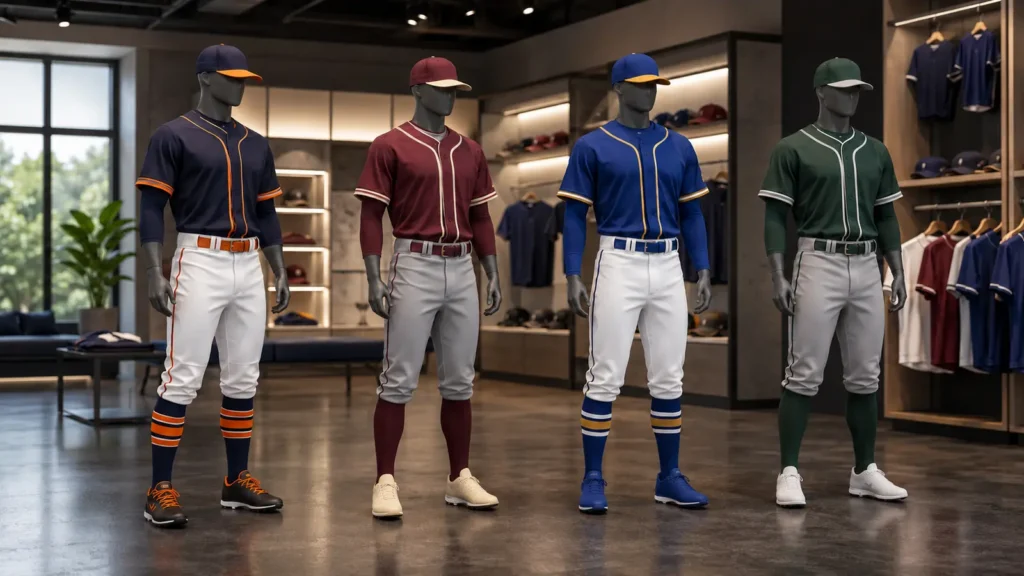
| Jersey and trim | Pants | Sock choice | Belt choice | Result |
|---|---|---|---|---|
| Navy jersey, orange trim | White with navy piping | Navy with optional orange stripe | Navy or orange | Clear, energetic team identity |
| Maroon jersey, cream trim | Gray | Maroon | Maroon | Traditional and restrained |
| Royal jersey, gold trim | White with royal piping | Royal with gold stripe | Royal | Bright club or school look |
| Forest jersey, white trim | Gray with green piping | Forest | Forest | Consistent neutral-away system |
| White jersey, navy lettering | White or gray | Navy | Navy | Simple system with easy reorders |
Fit and Sizing: What “Correct” Looks Like
Measure the waist around the position where the player will wear the belt, generally above the top of the hip bone. This is also the method described in Rawlings’ current baseball-pants sizing guidance. Measure the inseam from the crotch to the intended hem location. For knickers, record the finished inseam and cuff opening; for open-bottom pants, record the length while the player is wearing cleats.
Do not choose pants only from age, height or a casual jeans size. Baseball pants have different rises, seat ease and thigh shapes. Collect actual body measurements and compare them with the supplier’s finished-garment measurements and recommended ease.
Run a fit test:
- waistband stays in place before the belt is tightened;
- seat and thigh allow a deep squat;
- front rise does not pull during a fielding stance;
- pocket bags stay flat;
- knee reinforcement aligns with the knee;
- full-length hems stay clear of the heel;
- knicker cuffs stay in position; and
- white fabric remains adequately opaque over the approved base layer.
Youth programs sometimes add growth allowance. Add it selectively. Extra inseam can be hemmed, but excessive waist, rise or seat volume cannot be corrected neatly with a belt. A size run or roster fitting session reduces guesswork and emergency reorders.
Materials and Construction That Support the Fit
Polyester is widely used for baseball pants because it can combine durability, shape retention and relatively fast drying. The exact fabric specification still matters. Buyers should compare weight, weave or knit structure, stretch direction, opacity and surface resistance—not approve a garment simply because the fiber content says “100% polyester.”
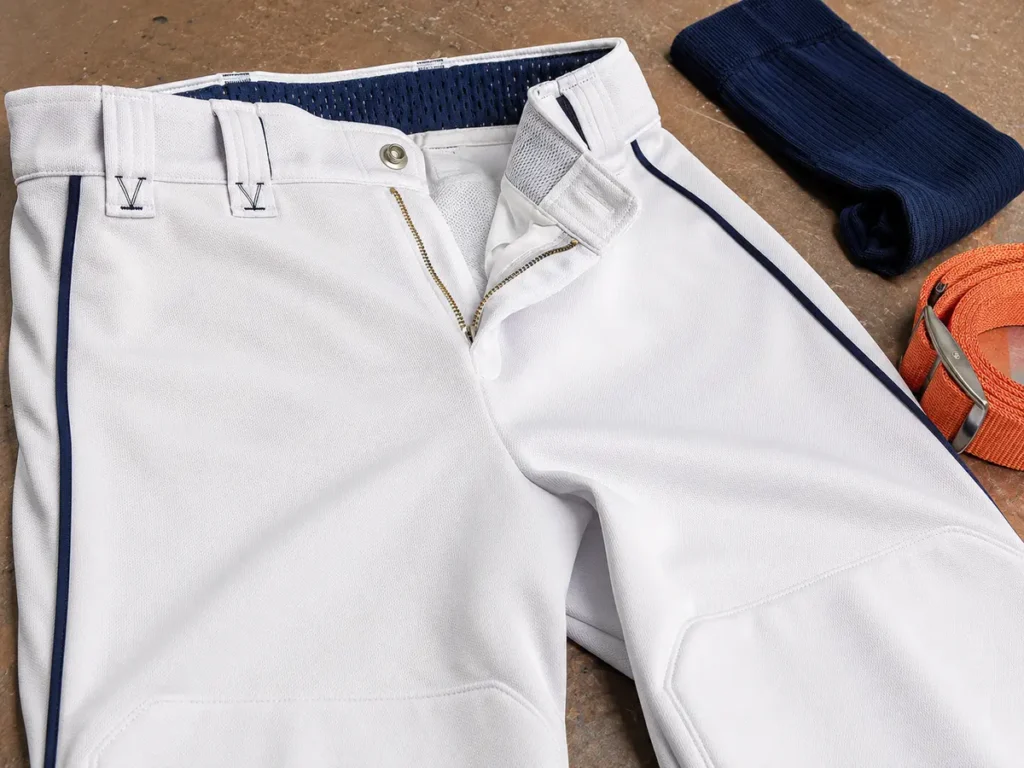
Look for reinforcement where the roster and playing level need it. Double-layer knees can extend useful life for players who slide frequently. Secure bartacks at belt loops and pocket openings reduce local failures. A waistband should recover after stretching and remain flat under a tucked jersey. Piping should be sewn consistently without twisting down the leg.
For white pants, inspect opacity under stadium-style light as well as daylight. Approve the color of base layers that players may wear beneath them. For sublimated or printed jersey panels used in the same set, compare navy, royal, red and other critical colors under multiple light sources because different fabrics reproduce color differently.
Translate Uniform Features into Buying Decisions
| Feature | Player benefit | Procurement decision | Sample test |
|---|---|---|---|
| Reinforced knee | More protection at a high-wear area | Single or double layer; panel position by size | Kneel, slide simulation and seam inspection |
| Stretch waistband | Comfort during rotation and squat | Elastic recovery and finished waist tolerance | Stretch repeatedly, then remeasure |
| Inner shirt grip | Helps retain tucked jersey | Grip material, width and wash durability | Swing and arm-raise fitting test |
| Adjustable belt | Accommodates waist variation | Youth/adult ranges and buckle finish | Fit smallest and largest target waist |
| Over-the-calf sock | Stable high-sock look | Leg length, circumference and top-band recovery | Wear through practice movement |
| Pant piping | Connects pants to jersey color | Width, placement and Pantone reference | Compare sample set under neutral light |
| Open-bottom hem | Modern full-length appearance | Inseam and opening by roster | Fit with actual cleat models |
Quality Control for a Complete Uniform Set
Quality control should evaluate the system, not isolated units. A navy sock, navy belt, navy piping and navy jersey may use different materials and still need to appear coordinated. Keep an approved physical sample or controlled color standard for repeat orders.
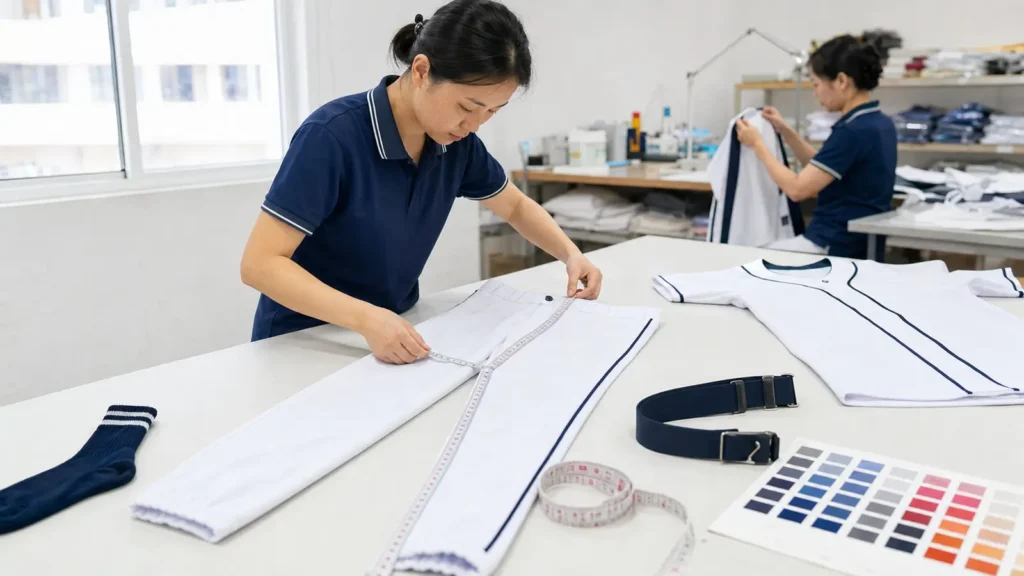
For pre-production and bulk inspection, check:
- garment measurements against the approved size chart and tolerance;
- waistband stretch and recovery;
- snap, zipper and buckle operation;
- belt-loop count, width, placement and bartacks;
- piping width, straightness and color;
- knee-panel position and symmetry;
- cuff opening and elastic recovery;
- sock length, foot sizing and top-band hold;
- jersey body length for a secure tuck;
- name and number spelling, position and sequence;
- color consistency across pants, socks, belts, jerseys and caps;
- visible stains, needle damage, skipped stitches and loose threads; and
- quantity, size assortment, player packing and carton marks.
Wash testing should follow the approved care method and evaluate shrinkage, color transfer, dimensional change, print or decoration appearance and waistband recovery. Test requirements depend on the material, decoration and destination market; agree on the method rather than using an unsupported blanket claim.
Sample Approval and Bulk-Order Planning
Start with a written uniform brief. Define the pant style, jersey type, sock height, belt color, player group, quantity and target use. Then provide artwork, color references and a roster estimate.
A practical process is:
- Confirm competition rules and uniform responsibility.
- Select the complete color system.
- Approve pant cut and jersey silhouette.
- Build a preliminary size chart and roster ratio.
- Review digital mockups for placement and color relationships.
- Make a physical sample in the intended materials.
- Fit the sample with socks, belt, base layer and cleats.
- Record every correction on one approval sheet.
- Approve a pre-production sample or sealed reference.
- Inspect bulk goods and verify player-level packing data.
The fitting step should use the complete set. Testing pants without the tucked jersey misses waistband bulk. Testing knickers without the final sock misses cuff interaction. Testing open-bottom pants without cleats misses the real hem position.
What to send for an accurate quotation
Send the supplier:
- total quantity and estimated size breakdown;
- youth, adult, women’s or mixed roster information;
- pant style, base color, piping and pocket requirements;
- jersey silhouette, fabric, decoration and sleeve length;
- team colors or Pantone references;
- logo files and placement dimensions;
- player names and numbers, if required;
- sock style, stripe design and size range;
- belt color, width and adjustment range;
- private label, hangtag and packaging needs;
- destination country or delivery location; and
- required in-hand date, including time for sample approval.
If the roster is not final, request pricing based on an estimated ratio and ask when personalization data becomes locked. This protects the schedule while avoiding false precision.
Common Mistakes to Avoid
Using the belt to fix the wrong waist size
A belt should stabilize the fit. Deep waistband folds indicate the pants are too large and can cause pressure or jersey bunching.
Choosing sock color after the pants are produced
Sock color should be reviewed beside pant piping, belt and jersey trim. “Navy” can vary substantially across materials and suppliers.
Assuming every “knicker” has the same length
Rise, inseam and cuff position vary by pattern. Approve measurements and a worn sample.
Letting full-length pants drag below the cleat
Excess fabric is untidy and can interfere with movement. Fit pants with cleats and hem them correctly.
Making the jersey too short for a reliable tuck
Evaluate body length during arm raises, swings and fielding movements. A grip waistband cannot replace adequate length.
Mixing personal preferences without a team policy
Full-length and knicker pants can coexist if the program intentionally permits both and controls the remaining colors. Unplanned variation usually looks inconsistent.
Approving colors only on a screen
Digital mockups are useful for placement but are not physical color standards. Review material samples or a finished uniform set.
Questions to Ask a Baseball Uniform Supplier
- What finished-garment measurements and tolerances apply to each size?
- How do your open-bottom, tapered and knicker patterns differ?
- Can you provide youth, adult and women’s fit options?
- What fabric weight, stretch and reinforcement choices are available?
- How do you control color across pants, socks, belts and jerseys made from different materials?
- Can the waistband include a jersey-grip treatment?
- What sock lengths and belt adjustment ranges are available?
- Can we approve a full physical uniform sample before bulk production?
- How are player names, numbers and size assortments checked?
- What is the cutoff for roster changes and personalization data?
- What private-label and player-level packaging options are available?
- How will repeat-order colors and measurements be matched to the approved order?
How JIUMU Supports Coordinated Baseball Teamwear
JIUMU is a Guangdong-based B2B custom teamwear and branded-merchandise supplier established in 2010. The company supports OEM and ODM development for schools, teams, clubs, distributors, uniform dealers and private-label brands in North America and Europe.
Relevant capabilities include fabric sourcing, Pantone color matching, sublimation, embroidery, screen printing, heat transfer, patches, custom labels, hangtags, packaging, digital mockups, physical samples, bulk production and quality control. The typical MOQ is 50 pieces, subject to product structure and customization.
For buyers building a coordinated baseball program, JIUMU can develop pants, jerseys and related teamwear around one approved color and measurement system. Explore custom team uniforms, custom team jerseys or a baseball team uniform package.
Planning a complete uniform? Send your target quantity, roster types, pant cut, jersey concept, colors, logos, player data, packaging needs and required delivery date. JIUMU can review the specification and prepare a custom quotation.
Frequently Asked Questions
Final Recommendation
The correct way to wear baseball pants begins with choosing the right cut. Full-length pants need a clean, heel-safe hem; tapered pants need calf mobility; and knickers need smooth over-the-calf socks and a stable cuff near the knee. The jersey should tuck evenly, while the belt fits flat and repeats an existing team color.
For a team order, convert that appearance into measurable specifications: pant inseam and opening, cuff position, sock length, belt range, jersey body length, color references and fit tolerances. Approve the complete set on a player before bulk production. That process produces a uniform that looks coordinated in a team photo and works through a full game.
Request a JIUMU quotation: email zhengdong@jiumugear.com or contact WhatsApp/Phone at +86 18507502899. Include quantity, sizes, pant style, colors, logos, player personalization, packaging and target delivery date.
Sources and Further Reading
- Official Baseball Rules — Rule 3.03, Player Uniforms
- Little League: Equipping a Little Leaguer
- Little League 2026 Rules, Regulations and Policies
- Little League Uniform Buying Tips
- Rawlings Baseball Pants Sizing Guide
- Under Armour Baseball Pants Guide
About JIUMU
JIUMU is a Guangdong-based B2B custom teamwear, logo apparel, uniform, bag and branded-merchandise supplier established in 2010. Typical MOQ is 50 pieces, subject to product structure and customization.