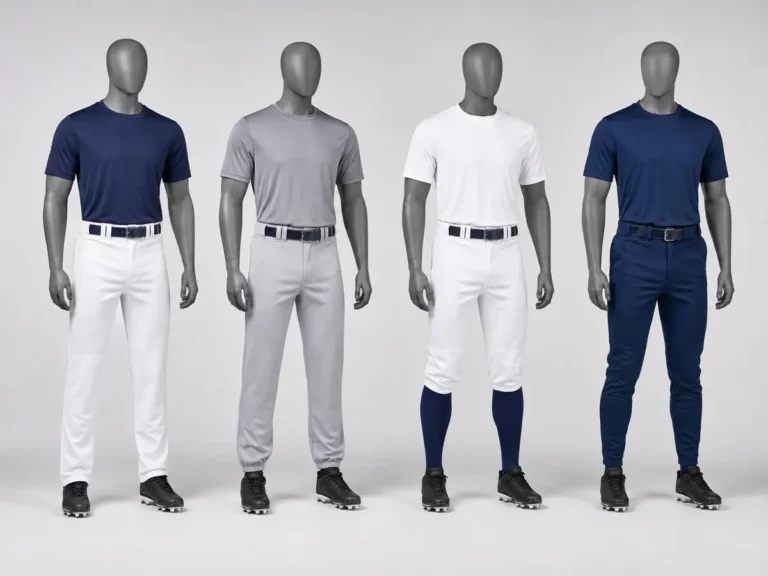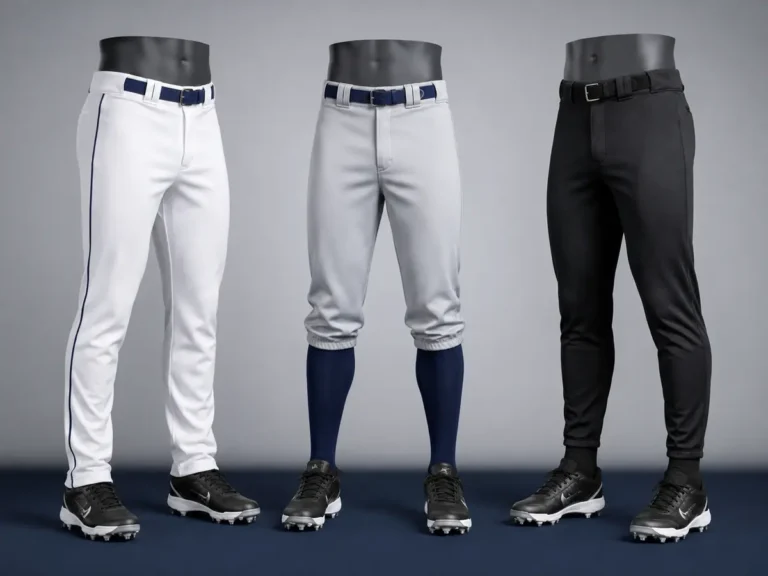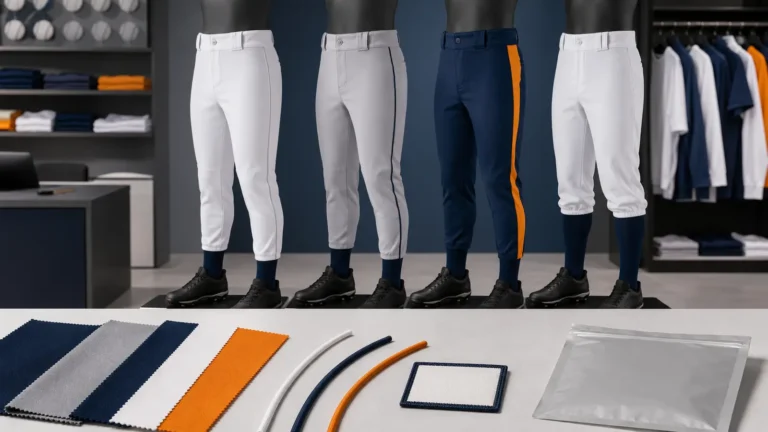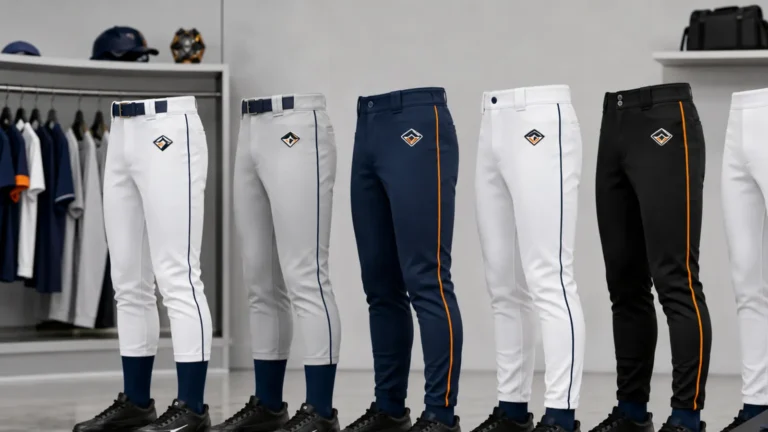
How to Clean White Baseball Pants and Remove Grass, Dirt, Clay, and Turf Stains
White baseball pants create a sharp, traditional team look, but they also show nearly every mark collected during a game. Grass pigments, loose infield dirt, iron-rich red clay, synthetic-turf residue, sweat, and ground-in soil can overlap on the same knee or lower leg. A normal wash cycle may lighten the surface while leaving a yellow, green, orange, or gray shadow behind.
The most reliable solution is not simply “use stronger bleach.” It is to identify the soil, remove loose material, pretreat the affected fibers, wash according to the care label, inspect the pants while they are still wet, and repeat treatment before applying dryer heat. This article explains that process for players and families, then turns it into a repeatable uniform-care system for coaches, schools, clubs, equipment managers, and baseball program buyers.
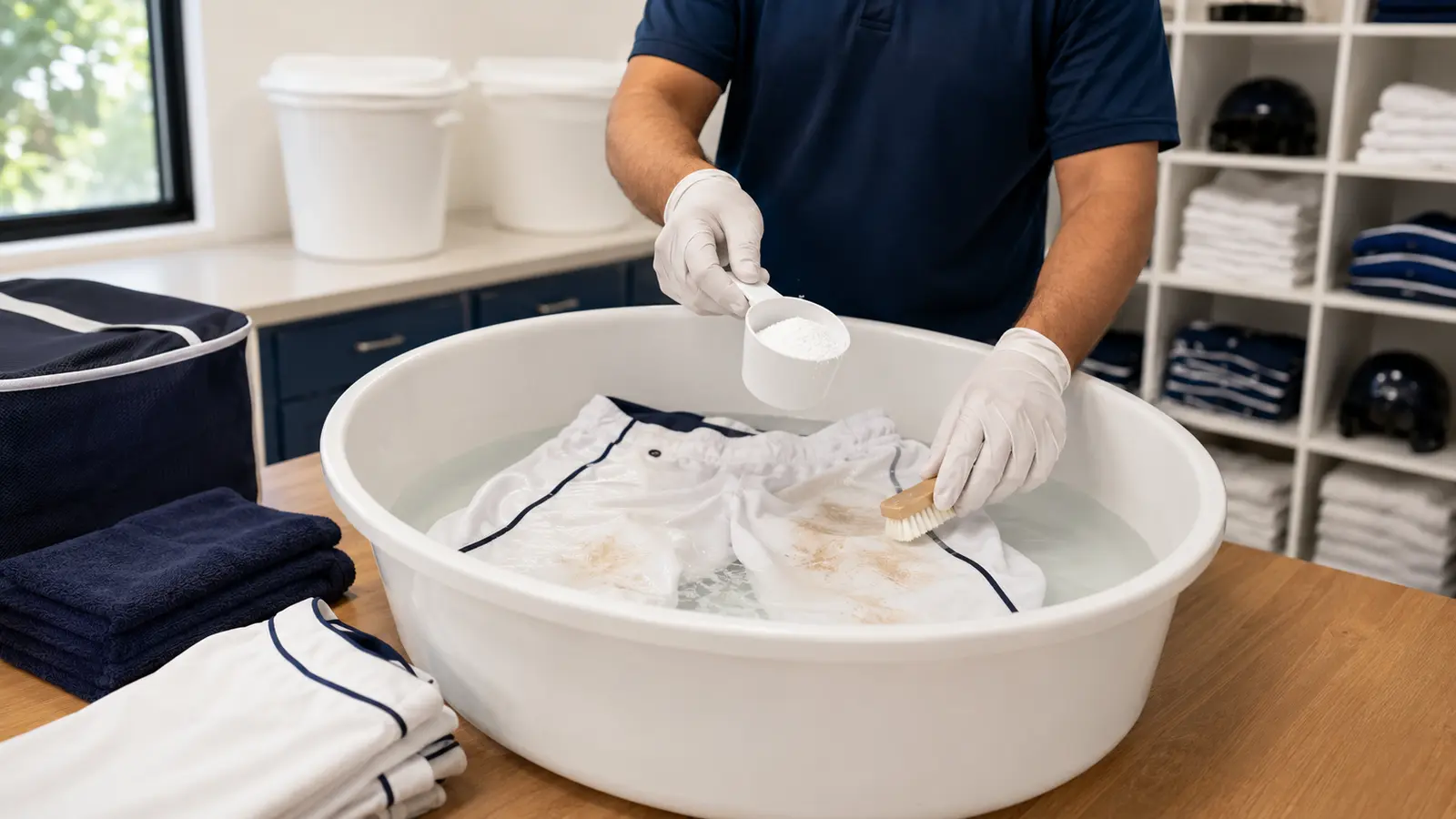
Quick answer: To clean white baseball pants, first let wet mud or clay dry, then brush or scrape off loose material. Rinse the stained area from the back with cool water. Apply a compatible enzyme detergent or laundry stain remover, gently work it in with a soft brush, and allow the product’s labeled contact time. For heavy soil, soak with an oxygen-based laundry product if the care label permits. Wash with detergent in the warmest water allowed by the garment label. Inspect before drying; if any stain remains, air-dry and repeat. Use chlorine bleach only when both the fiber content, trim, and care label allow it, and never mix bleach with ammonia, vinegar, acids, or other cleaners.
Why White Baseball Pants Need a Stain-by-Stain Method
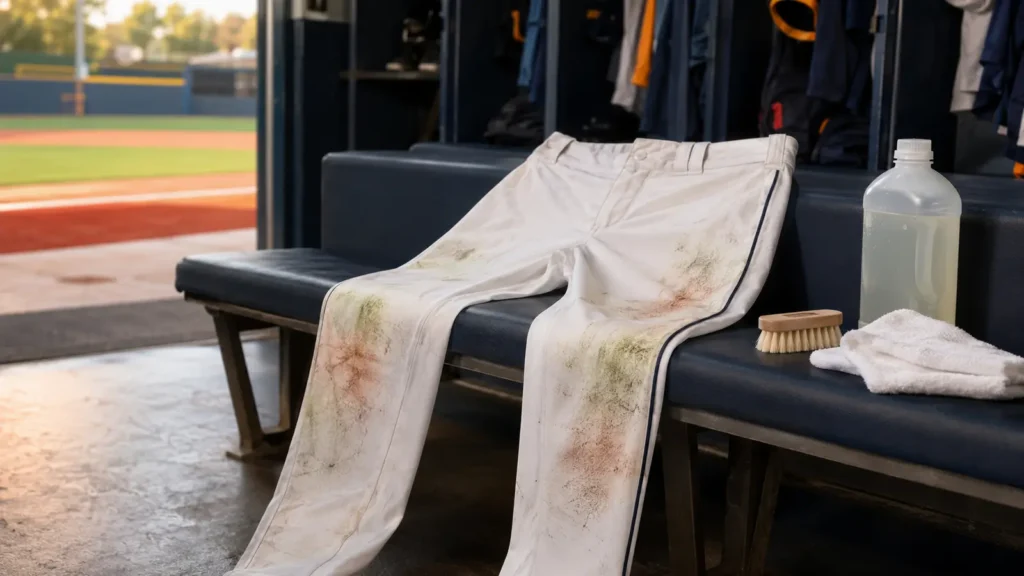
The word “dirt” hides several different cleaning problems. Grass residue can act like a plant-based dye. Dry infield dust may sit mostly on the surface, while wet clay can lodge fine mineral particles between yarns. Artificial-turf marks may include loose infill, field pigment, oily residue, or abrasion that resembles a removable stain but is partly physical wear.
That distinction matters because the first action for one soil can make another harder to remove. Rubbing wet clay, for example, can push it farther through the fabric. Sending a partly cleaned green stain through a hot dryer can make later removal more difficult. Consumer Reports advises checking a treated garment before machine drying because heat can set remaining stains (Consumer Reports).
For team buyers, fabric, reinforcement, trim colorfastness, care labeling, spare-stock planning, and a written laundry routine all affect the usable life of the program.
Identify the Stain Before You Treat It
Use the appearance and feel of the mark as a starting point. When several soils overlap, remove dry particles first and then treat the remaining discoloration.
| Stain type | Typical appearance | First action | Main treatment approach | Key risk |
|---|---|---|---|---|
| Grass | Green or yellow-green smear, usually at knees or hips | Rinse from the back with cool water | Enzyme-containing detergent or compatible stain remover; gentle brushing | Dryer heat before the pigment is removed |
| Loose dirt | Tan or gray dust with visible particles | Shake and brush outside | Detergent pretreatment followed by normal washing | Turning loose dirt into mud by soaking too early |
| Mud | Brown, tan, or gray caked soil | Let it dry, then brush or scrape | Rinse, pretreat, soak if permitted, and wash | Rubbing wet mud deeper into the weave |
| Red clay | Orange, rust-red, or reddish-brown mineral shadow | Dry, remove loose clay, rinse | Longer pretreatment or oxygen-based soak if permitted | Abrasive scrubbing and premature drying |
| Synthetic turf | Black/gray specks, streaks, or colored field residue | Brush away loose infill | Detergent pretreatment, blotting, and repeated gentle treatment | Mistaking abrasion or dye transfer for removable soil |
| Mixed game stain | Green, brown, red, and gray layers | Remove loose solids, then work from light treatment to stronger compatible treatment | Treat by residue type, rinsing between products | Combining cleaners or skipping a colorfastness test |
The American Cleaning Institute recommends sorting by color and care instructions, treating stains before washing, and selecting products and machine settings that fit the fabric (ACI Laundry Basics). Treat the care label as the controlling instruction. Product directions come next. Generic online tips should never override either one.
What You Need
Build a small uniform-care kit so treatment can start soon after the game:
- A soft-bristle laundry brush or clean soft toothbrush
- A dull plastic scraper or spoon for dried soil
- White absorbent towels
- Heavy-duty liquid laundry detergent, preferably with enzymes when compatible
- An oxygen-based laundry stain remover or laundry booster
- A plastic soaking basin reserved for laundry
- Measuring scoop or cup supplied for the chosen product
- Laundry gloves
- A drying rack or hangers
- A mesh bag for removable belts or small components, if their labels allow washing
You do not need every product for every load. The safer rule is to choose one compatible treatment, follow its label, rinse when directed, and reassess. More chemicals do not automatically produce a better result.
The Best General Method: Seven Steps
1. Read the care label and inspect the pants
Check fiber content, washing temperature, bleach symbol, drying instruction, and any warning about decorated or colored areas. White baseball pants are commonly made from synthetic performance fabrics, but fiber blends, stretch content, piping, elastic, labels, printed marks, and reinforced panels vary.
Look for torn seams, open hems, loose piping, or abraded knee panels before brushing. Aggressive treatment can enlarge existing damage. Remove a belt when practical and permitted so hardware cannot strike the washer or transfer color.
2. Remove loose soil before adding water
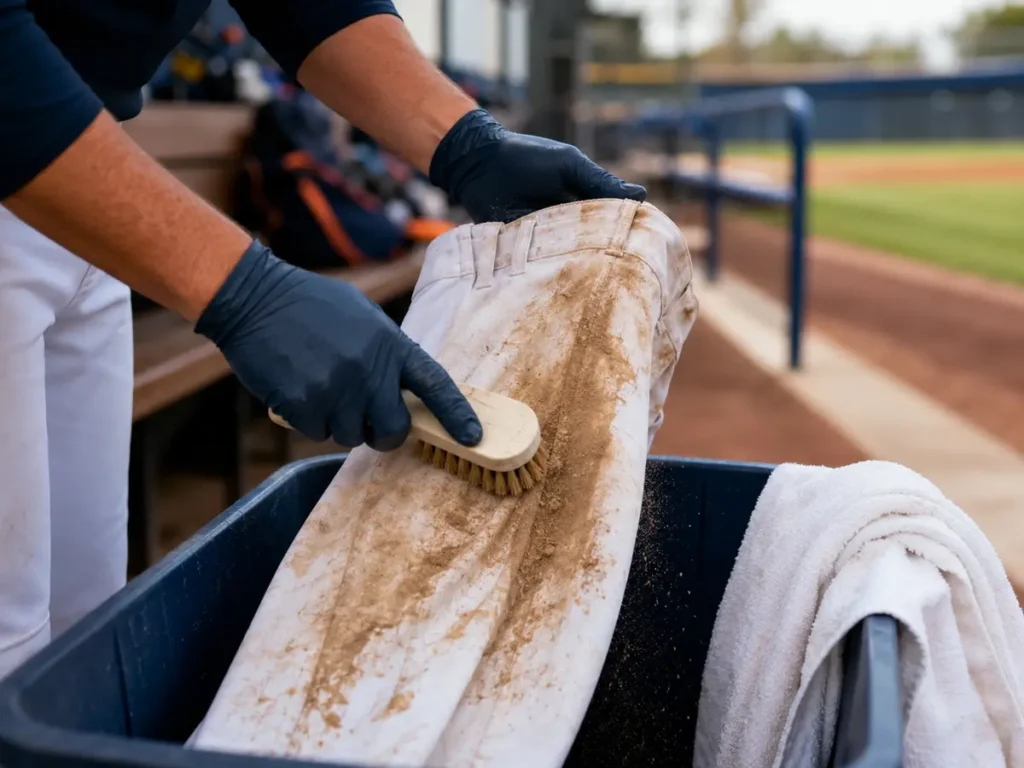
If the pants carry dry dust, shake them outdoors and brush from top to bottom. If mud or clay is wet and heavy, let it dry in a ventilated area first. Use a dull plastic edge to lift the crust without cutting yarns.
Clorox’s baseball-specific red-clay guidance likewise begins by scraping away dried mud or grass and rinsing the affected area before soaking (Clorox red-clay guide). The exact product and soak time should still follow the label for the product available in your market.
3. Rinse from the back
Hold the stained area face down and run cool water through the reverse side. This encourages soil to move back out through the path it entered instead of driving it farther inward. Avoid very hot water until the care label and stain type have been checked.
4. Pretreat
Apply a compatible liquid detergent or laundry stain remover to the affected area. Gently work it across the stain with your fingers or a soft brush; do not grind the fabric against itself. Tide’s general stain guide recommends applying liquid detergent directly and using gentle fabric-to-fabric action or a soft-bristle toothbrush (Tide stain-removal guide).
Allow only the contact time stated on the product label. Do not let a pretreatment dry on the fabric unless the directions specifically permit it.
5. Soak only when needed
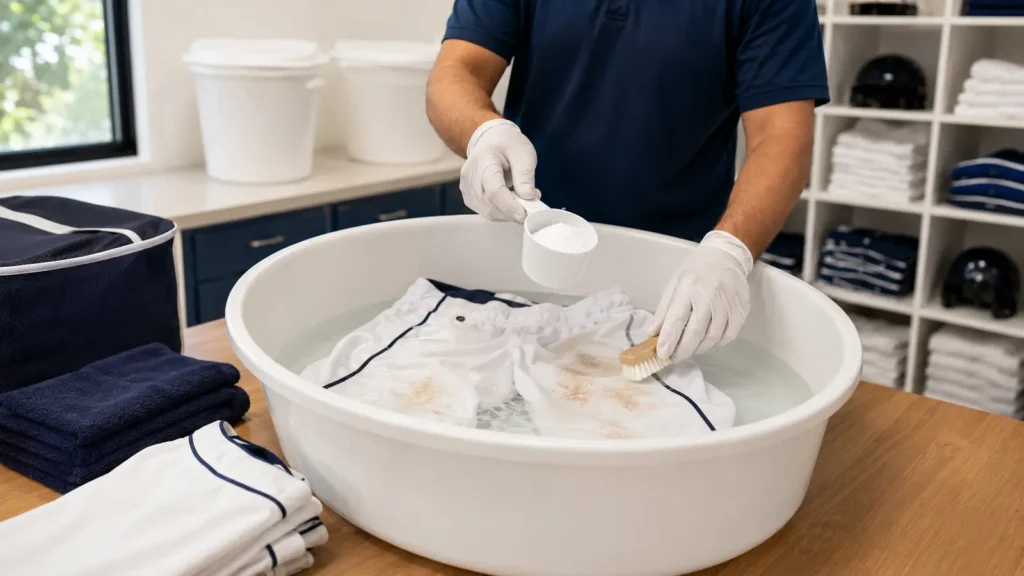
For heavy or set-in soil, use a clean basin and an oxygen-based laundry product if the garment label permits. Dissolve and measure it exactly as directed. Fully submerge the stained sections, observe the maximum soak time, and keep the container away from children and pets.
An oxygen-based product is often a practical first escalation because white baseball pants frequently contain colored piping, logos, elastic, or synthetic fibers that require more caution with chlorine bleach. “Color safe” is not a substitute for a hidden-area test or the care label.
6. Wash correctly
Wash white pants separately from dark jerseys, socks, belts, towels, or garments that may release dye or lint. Use the warmest water allowed by the care label, not the hottest setting available on the machine. Whirlpool similarly recommends following the garment tag and using the warmest permitted temperature when treating white garments (Whirlpool white-clothing stain guide).
Do not overload the washer. The pants need room to move and rinse. Use the detergent amount for the load size, water hardness, and soil level rather than adding an arbitrary extra dose. Too much product can be difficult to rinse and may leave residue.
7. Inspect while wet and air-dry if necessary
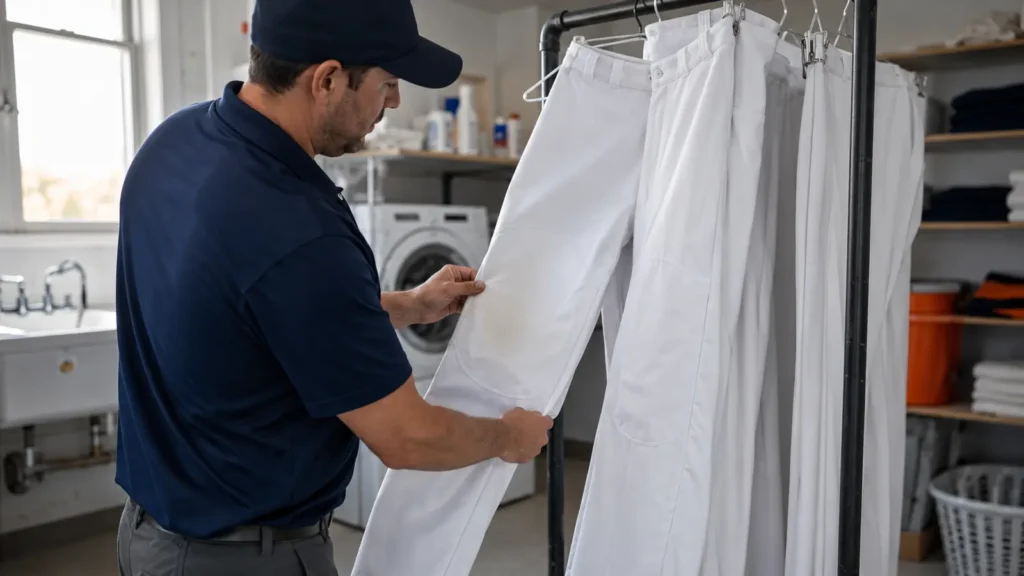
Check the knees, seat, lower legs, hem, piping, and pocket edges under bright light. If any green, orange, brown, or black shadow remains, do not use high dryer heat. Repeat the appropriate pretreatment or let the pants air-dry while deciding on the next step.
Once the stains are removed, dry according to the care label. Air-drying can simplify inspection and reduce unnecessary heat exposure. Reshape the waistband and legs before hanging.
How to Remove Grass Stains from White Baseball Pants
Grass stains combine plant pigment with crushed organic material and field soil. Tide notes that chlorophyll can behave like a dye and becomes more challenging after it has had time to set (Tide grass-stain guide).
- Rinse the green area from the reverse side with cool water.
- Apply an enzyme-containing detergent or a compatible grass-stain pretreatment.
- Use a soft brush to work across the yarn direction with light pressure.
- Allow the labeled pretreatment time.
- Rinse or transfer to the washer as the product directs.
- Wash at the warmest care-label-approved temperature.
- Inspect before drying and repeat if a green or yellow shadow remains.
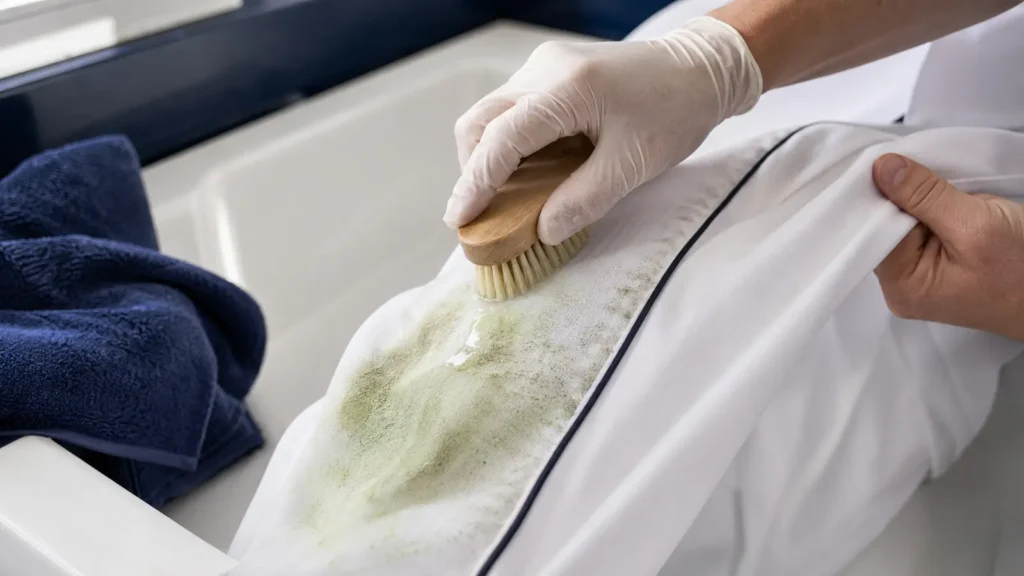
Do not begin by grinding a dry soap bar or stiff brush repeatedly into a stretch panel. Mechanical force may lift visible pigment while roughening the surface. That creates a dull gray area that no cleaner can reverse.
How to Remove Dirt and Mud
Loose dirt is the simplest soil when it stays dry. Brush it away before washing. Mud needs one extra step: let it dry completely so that a large share of the mineral load can be removed mechanically.
For remaining brown or gray discoloration:
- Scrape and brush away the dried layer.
- Rinse from the back with cool water.
- Pretreat with liquid detergent.
- Gently brush high-soil areas such as knees and hems.
- Soak with a compatible oxygen-based product if ordinary pretreatment is insufficient.
- Wash and inspect before drying.
Avoid using a pressure washer. It can distort the weave, abrade the finish, stress seams, and force soil through the fabric. It also produces inconsistent results across a team set.
How to Remove Red Clay Stains
Red clay can leave a persistent orange or rust-colored cast after the surface looks clean. The fine particles lodge within the textile structure, and the visible color may remain after a short wash.
Use a patient sequence:
- Dry the pants and remove as much loose clay as possible.
- Rinse the stained area from the back.
- Apply detergent or a product labeled for outdoor mineral soil.
- Gently brush, focusing on the boundary of the stain.
- Rinse and assess.
- If permitted, use a measured oxygen-based soak for the labeled duration.
- Wash separately and inspect in daylight.
- Repeat before using the dryer.
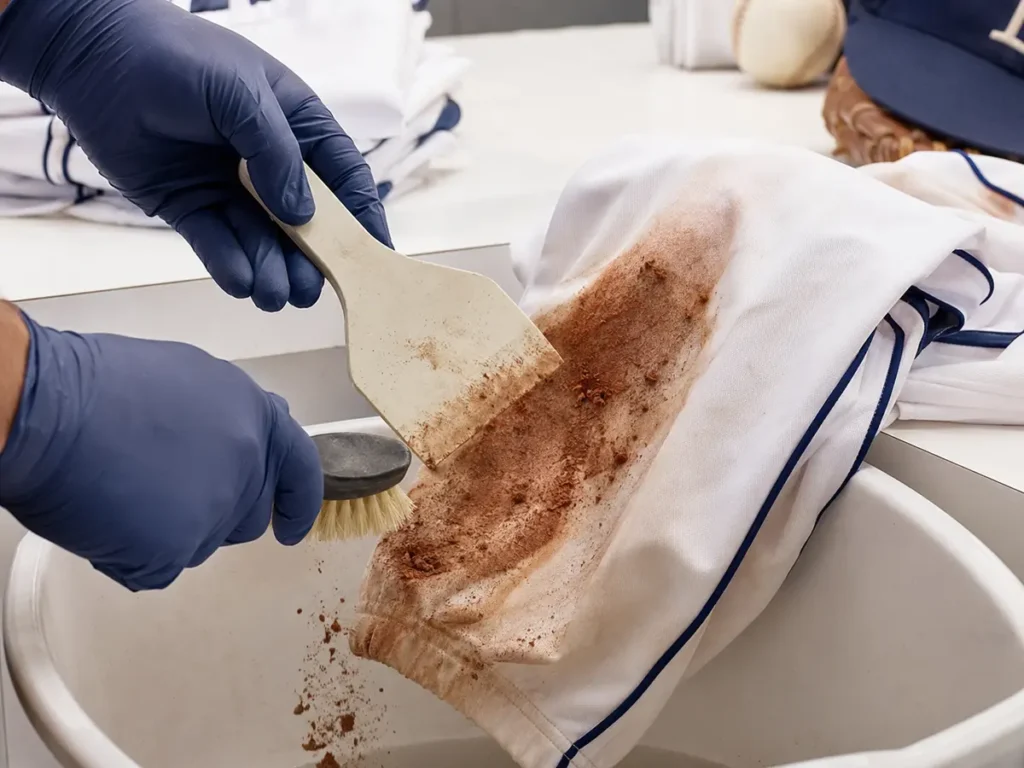
Some manufacturer instructions call for a long soak for severe red clay, but product concentrations vary. Never copy a scoop size or overnight soaking instruction from one product to another. Use the directions on the exact package in hand.
If an orange shadow remains after several careful treatments, decide whether it is residual mineral color, dye transfer, or fabric damage. Stronger scrubbing may make a worn knee look whiter temporarily while shortening its service life.
How to Remove Synthetic Turf Stains
Artificial-turf marks are less predictable than grass stains. A black or gray area may be loose rubber or alternative infill, fine field dust, transferred pigment, an oily contaminant, or physical abrasion. Start with the least aggressive method.
- Shake and brush away loose specks outdoors.
- Blot the area with a clean white towel to see whether residue transfers.
- Apply a small amount of compatible liquid detergent.
- Work gently with a soft cloth or brush.
- Rinse thoroughly.
- Repeat rather than increasing force.
- Wash and air-dry for inspection.
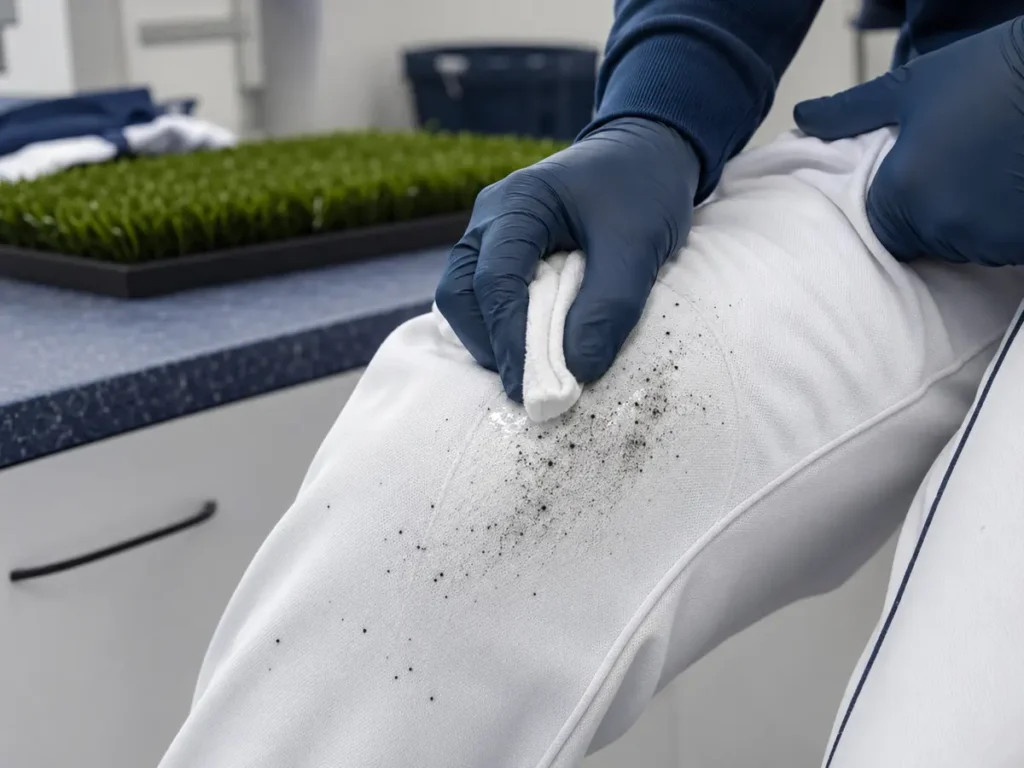
If a gray patch remains but no color transfers to a towel and the fibers look flattened or rough, the mark may be abrasion rather than removable soil. A stain-removal product cannot rebuild damaged fibers. Record recurring knee and seat abrasion during a sample wear test; the observation can guide fabric weight, weave, and reinforcement decisions on the next custom order.
Oxygen Bleach, Chlorine Bleach, Detergent, or Hydrogen Peroxide?
Choose by care label, stain type, and garment construction—not by the whiteness of the main fabric alone.
| Treatment | Useful for | Advantages | Main cautions |
|---|---|---|---|
| Enzyme-containing detergent | Grass, sweat, general game soil | Good first-line pretreatment; supports normal washing | Check label; do not allow pretreatment to dry unless permitted |
| Oxygen-based laundry product | Dinginess and many organic/mineral stains | Often suitable around some colored details when label permits | Measure exactly; test piping and decoration; observe soak limit |
| Chlorine bleach | Bleach-safe white fibers and colorfast trim only | Can whiten and remove compatible stains when used as directed | May damage unsupported fibers, colored trim, elastane, metal, or finishes; never mix |
| Hydrogen-peroxide laundry product | Some stains when specifically labeled for fabric use | Available in some color-safe formulations | Concentration and additives vary; hidden-area test required |
| Dishwashing liquid | Local oily soil only when garment and product allow | Can help loosen grease | Not a substitute for laundry detergent; overuse can create excessive suds |
When chlorine bleach may be appropriate
First confirm the care label permits bleaching and the fiber content is compatible. Then test colored piping, elastic, embroidery, labels, and hidden areas. Clorox’s baseball-pants guidance recommends checking both fiber compatibility and the colorfastness of stripes before using chlorine bleach (Clorox bleach test for baseball pants).
Use only the dilution, dispenser, cycle, and contact time on the current product label. Do not pour undiluted bleach directly onto the pants.
Critical chemical-safety rule
Never combine chlorine bleach with ammonia, vinegar, acids, or other household cleaners. The CDC warns that hypochlorite products can release toxic chlorine when mixed with acids or ammonia and may also damage fabrics (CDC chemical-safety guidance). Rinse the garment and container thoroughly when changing from one treatment system to another, and keep the room ventilated.
What to Do with Set-In or Previously Dried Stains
A stain that has passed through the dryer may still improve, but it usually requires repeated, controlled treatment.
- Rewet the area with cool water.
- Apply compatible detergent or stain remover.
- Use gentle brushing and the full labeled contact time.
- Rinse and compare the treated area under consistent light.
- Use an oxygen-based soak if allowed.
- Wash, air-dry, and repeat only while improvement continues.
Stop when the fabric begins to fuzz, thin, lose stretch, or show seam distortion. A faint shadow is preferable to structural damage during play.
For a team program, separate “game-ready,” “practice,” and “retired” pants. This keeps one difficult pair from consuming excessive labor while still extracting useful service from cosmetically imperfect garments.
Common Mistakes That Make White Baseball Pants Harder to Clean
Putting the pants directly into the washer
The machine must then manage loose clay, grit, grass matter, and embedded pigment at the same time. Dry removal and pretreatment reduce that burden.
Scrubbing wet clay
Wet clay spreads readily. Dry it first and remove particles before rinsing.
Using a stiff wire or hard utility brush
The fabric may become fuzzy, gray, or thin. Use soft bristles and moderate pressure.
Using hot dryer heat before inspection
Heat can make remaining stains harder to remove. Inspect while wet and air-dry when uncertain.
Treating “white” as automatically bleach-safe
Colored piping, elastic, stretch fibers, labels, logos, and thread may react differently from the white body fabric.
Mixing stain removers
Combining products creates safety and compatibility risks. Use one labeled system at a time.
Overloading the washer
Crowded garments cannot move and rinse effectively. Team laundry may require several smaller loads.
Washing white pants with dark socks or jerseys
Dye transfer can create a new problem while the original stains are being removed.
A Repeatable Laundry SOP for Teams, Schools, and Clubs
A written standard operating procedure makes results more consistent across coaches, parents, volunteers, and laundry staff.
Immediately after the game
- Place heavily soiled pants in a breathable, clearly designated bag or bin.
- Do not leave damp garments sealed in a team bag.
- Record unusual stains such as field paint, gum, oil, or blood for separate handling.
- Keep each player’s belt, name label, and uniform assignment organized.
At the laundry station
- Sort by care label, white versus colored components, and soil level.
- Dry and brush off mud or clay.
- Pretreat knees, seat, hems, and pocket edges.
- Use measured products and a timer.
- Wash similar garments together without overloading.
After washing
- Inspect under bright light.
- Route failed items back to pretreatment instead of the dryer.
- Check seams, zippers, snaps, belt loops, piping, elastic, and knee panels.
- Air-dry or machine-dry according to the label.
- Return each pair to the correct player or size group.
Simple team laundry record
| Field | Example entry |
|---|---|
| Garment ID | Adult M / Player 18 |
| Game surface | Natural grass and red clay |
| Main stain | Grass + clay at right knee |
| Treatment | Enzyme pretreatment; oxygen soak per label |
| Result | Game-ready after second wash |
| Damage noted | Light knee abrasion |
| Next action | Monitor; replace if seam opens |
This record is especially useful during sample testing and the first production season. It turns anecdotal complaints into purchasing data.
What Uniform Buyers Can Learn from Laundry Performance
Stain removal is partly a care issue and partly a specification issue. A buyer comparing custom white baseball pants should evaluate:
- Fiber content and stretch: Ask how the fabric and elastic components affect washing, bleaching, and drying.
- Fabric weight and weave: A denser or more substantial fabric may offer better coverage and durability, but performance must be confirmed with a sample.
- Knee and seat construction: Reinforcement location, layer count, seam type, and stitch quality matter where sliding creates repeated soil and abrasion.
- Piping and trim colorfastness: White pants may still contain navy, red, royal, or custom-color elements.
- Opacity when stretched: Evaluate in field lighting and after laundering.
- Dimensional stability: Measure waist, rise, inseam, thigh, and hem before and after a sample wash.
- After-wash appearance: Check puckering, twisting, surface fuzz, shade, and trim alignment.
- Care-label clarity: Instructions should match the approved fabric and decoration.
- Replacement consistency: Confirm whether the supplier can reproduce fabric, piping, color, and sizing for repeat orders.
The goal is not to claim that one fabric is “stain-proof.” It is to approve a uniform specification whose appearance, comfort, cleaning method, and replacement plan fit the team’s real operating conditions.
Sample Approval and Wash-Testing Checklist
Before a bulk order, request a physical sample in the proposed fabric, trim, and construction. Then document a practical test.
- Photograph the unused sample in daylight.
- Record garment measurements.
- Wear-test it on the team’s normal field surface.
- Apply representative soil to a spare swatch when available.
- Follow the proposed team cleaning SOP.
- Record the exact detergent category, water temperature, cycle, and drying method.
- Inspect stain release, whiteness, piping color, shrinkage, seam condition, pilling, and stretch recovery.
- Repeat across several wash cycles if the purchase volume or season length justifies it.
- Approve the sample, care instruction, and measurement tolerances in writing.
Do not ask a supplier to promise “easy cleaning” without agreeing on a method of evaluation. Define what acceptable after-wash appearance means for your program.
Questions to Ask a Baseball Pants Supplier
Use these questions during sourcing:
- What is the exact fiber composition and fabric weight?
- Does the fabric contain elastane or another stretch fiber?
- What washing, bleaching, and drying instructions are recommended?
- Can you provide a care-label draft before production?
- How is the knee area reinforced?
- Are piping, thread, labels, and logos tested for colorfastness under the proposed care method?
- Can we test a production-intent sample before bulk approval?
- What measurement tolerances apply after washing?
- How do you control white shade and trim color across production lots?
- Can replacement orders match the original fabric and piping?
- Can pants be packed by player, size, or team?
- What is the MOQ for our fabric, color, and construction?
- What information is required for a quotation?
- Which claims require third-party test documentation for our market?
Information to Send for an Accurate Quotation
For a custom program, send:
- Total quantity and estimated repeat-order quantity
- Youth and adult size breakdown
- Full-length or knicker style
- Preferred fit and measurement chart
- White shade and Pantone references for piping or panels
- Fabric composition, weight, stretch, and opacity requirements
- Knee and seat reinforcement details
- Waistband, belt-loop, zipper, snap, and hem construction
- Logo, label, player-number, or private-label requirements
- Packaging by player, team, size, or product category
- Destination country and delivery location
- Target in-hand date
- Reference image, tech pack, or approved sample
- Required test reports or compliance documentation, if applicable
For a complete program, also specify matching jerseys, caps, socks, belts, team bags, jackets, and warm-up apparel. Explore JIUMU’s custom team uniforms and baseball team uniform packages to plan the set as one coordinated project.
How JIUMU Supports Custom Baseball Uniform Programs
Established in 2010 in Guangdong, China, JIUMU supplies custom teamwear and logo apparel for teams, schools, clubs, distributors, promotional product companies, retailers, and private-label businesses in North America and Europe.
For baseball programs, JIUMU can support OEM and ODM product development, fabric sourcing, custom colors, logo application, labels, packaging, digital mockups, physical samples, bulk quality control, and export coordination. The typical MOQ is 50 pieces, subject to the product structure and customization.
The practical advantage of a one-stop project is specification coordination. Pants, jerseys, caps, socks, jackets, and bags can be planned around the same color references, logo files, player list, packaging logic, and replenishment requirements. Buyers should still approve each production-intent sample and any required testing documentation before bulk production.
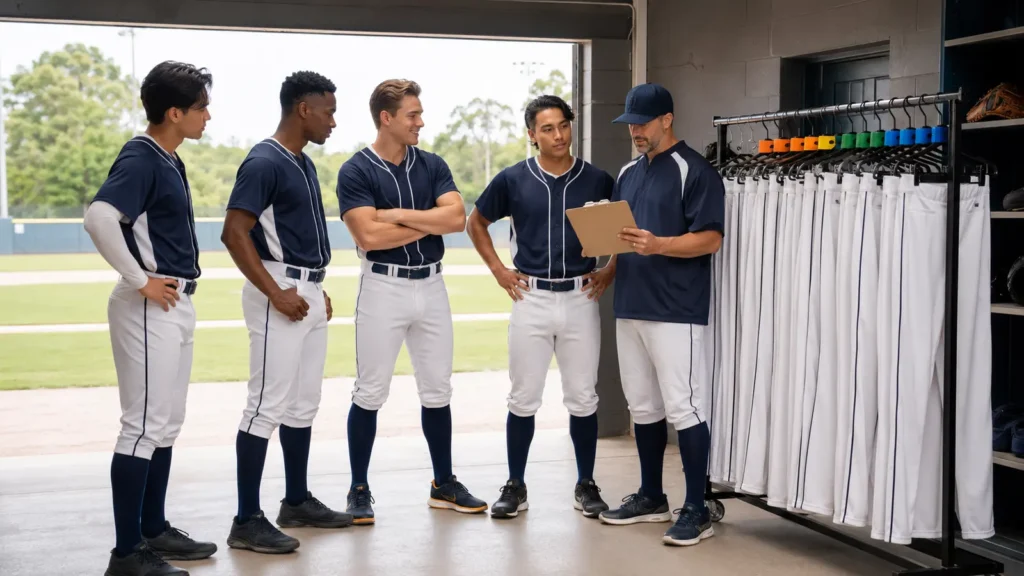
Planning a custom white baseball pants or complete team-uniform order? Send JIUMU your quantity, size breakdown, fabric target, piping colors, construction details, logo files, packaging requirements, destination, and target delivery date. Request a custom quotation.
Frequently Asked Questions
To develop custom white baseball pants or a coordinated baseball uniform package, share your reference images or tech pack, quantity, size list, fabric and fit requirements, piping colors, logo files, packaging method, destination, and target delivery date with JIUMU. Contact zhengdong@jiumugear.com or WhatsApp/Phone +86 18507502899, or use the JIUMU inquiry form.
Sources and Further Reading
- American Cleaning Institute: Laundry Basics
- American Cleaning Institute: Fabric Care
- Tide: How to Remove Grass Stains
- Tide: Stain Removal Guide
- Clorox: How to Get Red Clay Out of White Baseball Pants
- Clorox: How to Bleach White Baseball Pants
- Whirlpool: How to Remove Stains from White Clothes
- CDC: Cleaning Supplies and Equipment—Hypochlorite Safety
- Consumer Reports: Ultimate Stain-Removal Guide
Plan a Custom Baseball Uniform Program
Send JIUMU your quantity, size breakdown, fabric and fit requirements, piping colors, construction details, logo files, packaging method, destination, and target delivery date.
About JIUMU
Established in 2010 in Guangdong, China, JIUMU supplies custom teamwear, logo apparel, baseball uniforms, hats, bags, and coordinated merchandise for professional B2B buyers in North America and Europe.