Team Jersey Size and Fit Guide for Football, Soccer, Basketball and Hockey
Ordering custom jerseys for one player is simple. Ordering them for an entire football program, soccer club, basketball league or hockey organization is a data-management job. The buyer must translate different bodies, age groups, protective equipment and fit preferences into one production-ready roster.
This team jersey size guide explains how to measure players, compare four sport-specific silhouettes, approve a supplier’s size chart and reduce avoidable fit problems in a bulk order. It is written for schools, clubs, academies, uniform dealers, distributors and private-label buyers—not only for individual shoppers.
Quick Answer: Do not choose team jersey sizes from age, height or a familiar retail label alone. Record each player’s chest or bust, height and preferred fit; use the supplier’s current body-measurement and finished-garment charts; and test a physical sample in the intended base layers or protective equipment. Football and hockey jerseys require equipment-on fitting, while soccer and basketball jerseys are usually evaluated over the athlete’s normal game base layer. Approve both the fit and the graded measurements before bulk production.
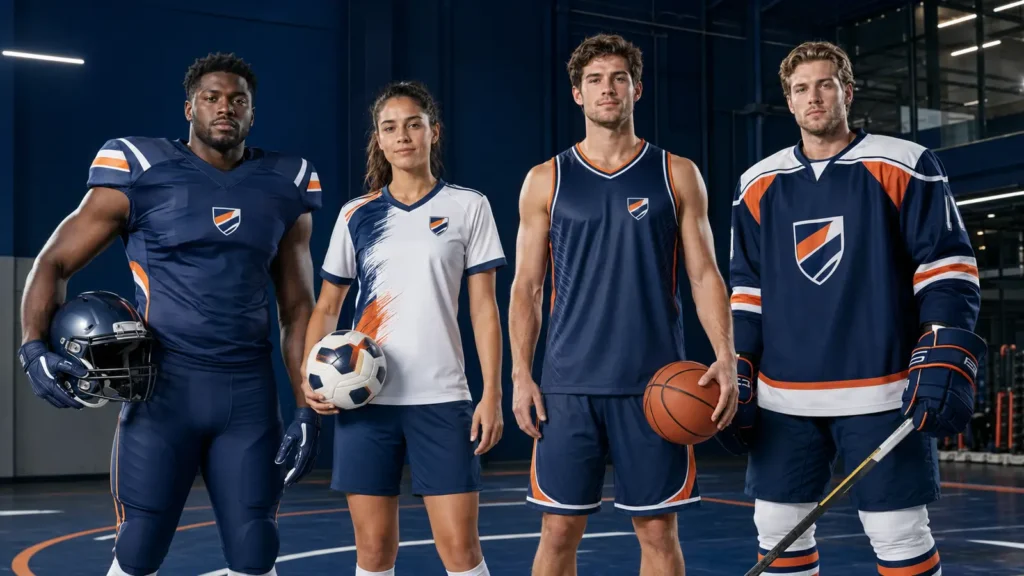
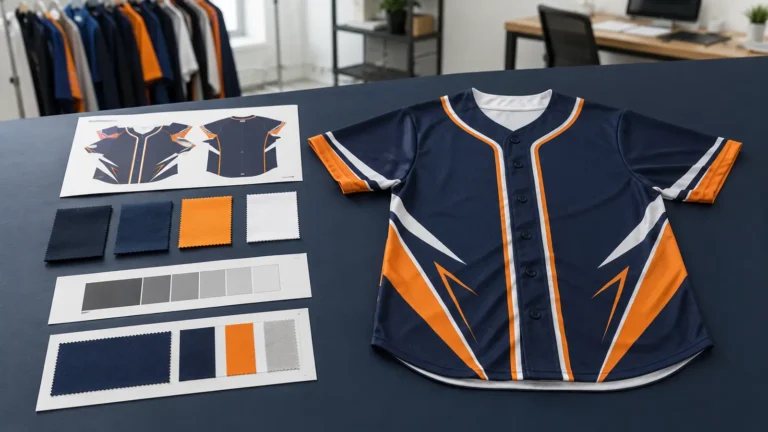
Four sports use different jersey silhouettes, so one generic “unisex jersey” size chart cannot reliably serve every program.
Why Team Jersey Fit Is a Procurement Issue
A jersey that looks acceptable while a player stands still can fail during play. An undersized football jersey may bind over shoulder pads. A loose soccer shirt may be comfortable but easy to grab. A basketball jersey can expose the torso when the player raises both arms if the body is too short. A hockey jersey can restrict stick handling if its shoulders, sleeves or armholes do not accommodate pads.
For the organization, incorrect sizing creates more than a comfort problem. It can cause:
- last-minute remakes and split shipments;
- mismatched replacement garments;
- wasted personalization for names and numbers;
- complaints from parents, athletes, coaches or retail customers;
- inventory that cannot be reassigned because it is player-specific;
- delays while a tournament or season start date remains fixed.
The goal is therefore not to find a universal S–3XL chart. The goal is to build a controlled process that connects a real player, an approved size specification and a final personalized garment.
Team Jersey Fit at a Glance
| Sport | Typical silhouette | What the jersey is worn over | Main fit risks | Best approval test |
|---|---|---|---|---|
| American football | Close to the body and shaped around pads | Compression layer and shoulder pads; sometimes additional protective components | Sleeve or armhole binding, excess body fabric, short hem, distorted graphics over pads | Full pads on; reach, catch, block stance and torso rotation |
| Soccer / association football | Athletic regular fit or slim fit | Lightweight base layer, sports bra or undershirt when used | Tight chest, restrictive shoulders, excessive length, loose neckline | Sprint posture, both arms overhead, forward reach and torso twist |
| Basketball | Sleeveless regular or relaxed athletic fit | Compression top or no upper base layer | Tight armholes, gaping neckline, insufficient body length, excess width | Shooting motion, rebound reach, defensive stance and full rotation |
| Ice hockey | Roomy, equipment-shaped fit | Shoulder pads and elbow pads; other protection remains under the uniform as required | Short sleeves, tight shoulders, narrow cuffs, insufficient sweep or body length | Full upper-body pads on; stick handling, shooting and arms overhead |
These are design tendencies, not fixed rules. Women’s, men’s, youth, goalie, replica, retail and game-performance jerseys can use different blocks. The approved supplier specification always controls the order.
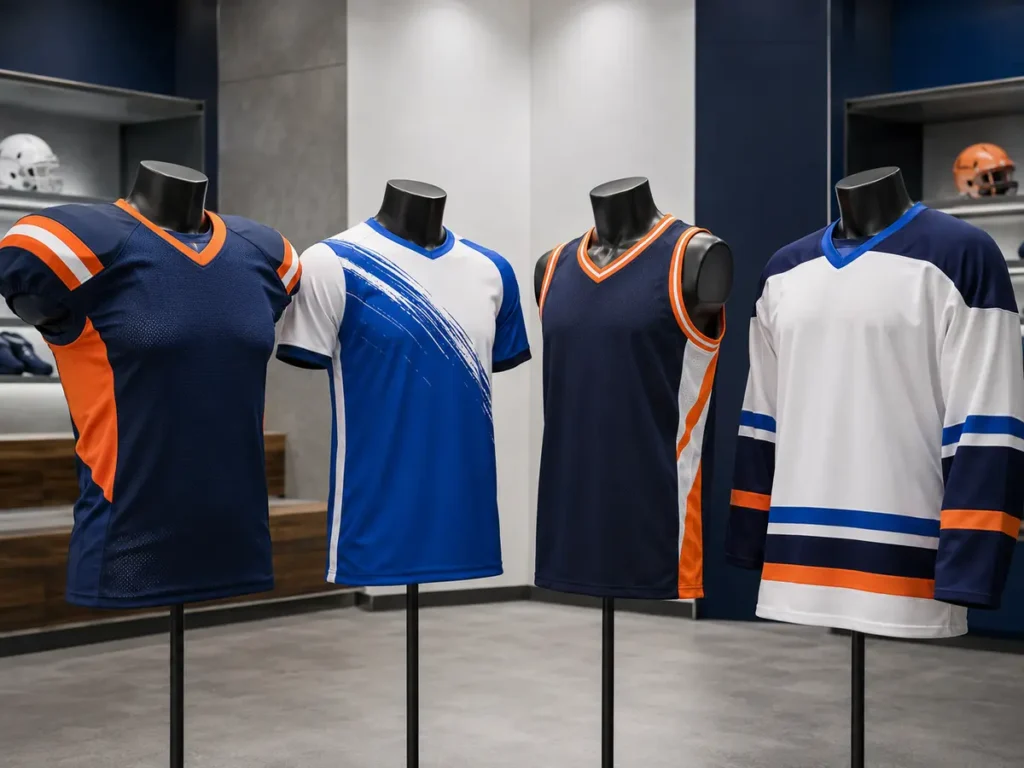
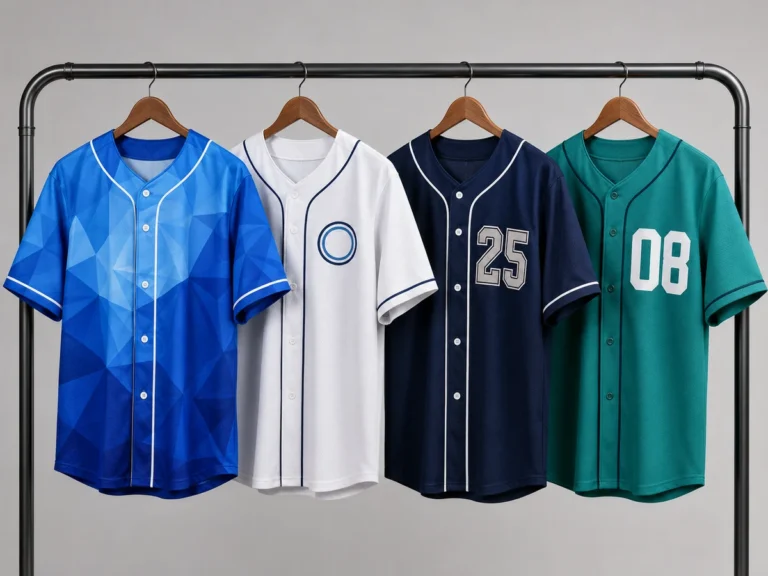
Football, soccer, basketball and hockey jerseys differ in sleeve, armhole, shoulder and body-volume requirements.
Start With Two Different Size Charts
Professional buyers should ask for two documents. They answer different questions.
1. Body-Measurement Chart
This chart maps body measurements to a recommended labeled size. For a top, chest or bust is normally the leading measurement. Nike’s current tops guidance instructs users to measure around the fullest part of the chest with the tape horizontal; adidas similarly directs users to measure the chest around its widest part and also records waist, hips, inseam and height for apparel sizing.
A body chart helps the team choose a starting size, but it does not tell the buyer the finished jersey width or length.
2. Finished-Garment Specification
This chart lists the jersey’s actual points of measure, such as:
- half chest measured flat;
- body length from high shoulder point;
- shoulder width;
- sleeve length;
- biceps or sleeve opening;
- armhole depth;
- bottom sweep;
- neck opening;
- basketball armhole drop;
- hockey cuff opening.
The difference between the body and garment measurements creates wearing ease. Ease cannot be applied identically across sports. A soccer jersey may need controlled ease for movement, while a hockey jersey needs enough three-dimensional volume for pads.
Buyer rule: Never compare a player’s full chest circumference directly with a jersey’s flat half-chest width without converting the units and confirming whether the garment measurement is taken flat, doubled or measured around.
How to Measure a Player for a Team Jersey
Use a flexible, non-stretch measuring tape. The player should stand naturally, breathe normally and wear the base layer intended for the sport. Keep the tape horizontal and snug without compressing the body.
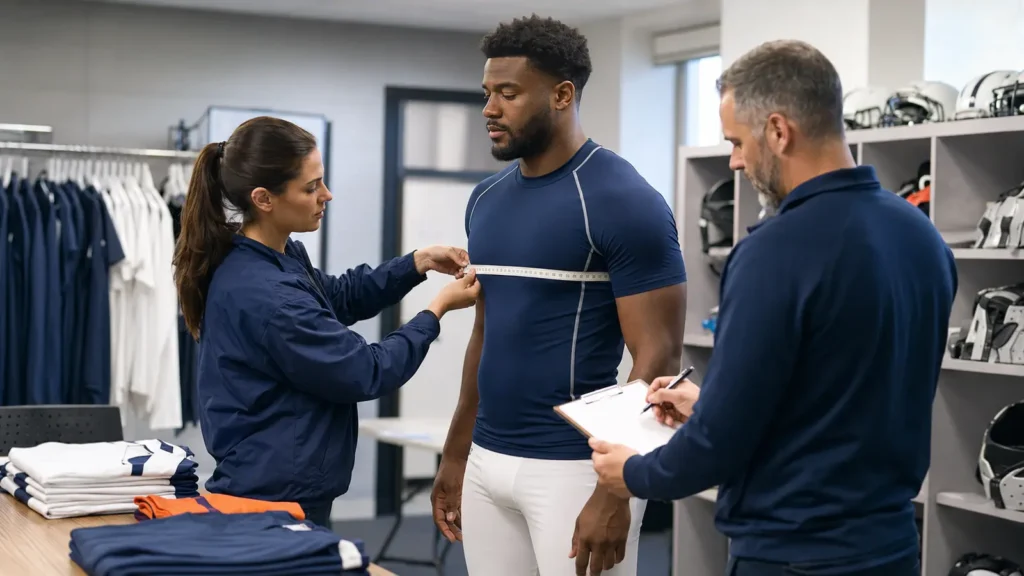
Record actual body measurements before mapping each athlete to the supplier’s current chart.
Core Body Measurements
| Measurement | Method | Why it matters |
|---|---|---|
| Chest / bust | Measure around the fullest point with the tape horizontal | Primary reference for most jerseys |
| Waist | Measure around the natural waist without pulling the tape tight | Helps identify body-shape exceptions and long or fitted silhouettes |
| Hip / seat | Measure around the fullest point with feet together | Useful for long jerseys or players whose lower torso drives the fit |
| Height | Stand straight without shoes and measure from head to floor | Helps check youth size bands and short/tall length needs |
| Shoulder width | Measure from shoulder point to shoulder point across the back, if the supplier requests it | Useful for fitted soccer blocks and padded football/hockey development |
| Arm length | Follow the supplier’s stated start and end points | Important for long-sleeve soccer and hockey jerseys |
| Torso length | Use the supplier’s method, normally from a defined shoulder point to the target hem | Helps prevent exposure or interference with pants and equipment |
Official consumer size guides are useful for measurement technique, but their size labels are not transferable to another supplier. A “large” can have a different body range, garment width or intended ease in another product line.
Measure the Equipment, Too
For padded sports, begin with correctly fitted protective equipment. USA Football’s equipment-fitting guidance records both chest and shoulder measurements when selecting shoulder pads. A jersey supplier then needs the approved pad model or at least the player’s dressed measurements over those pads.
For hockey, USA Hockey’s current Rule 304 states that protective equipment—apart from specified exceptions such as gloves, padded hockey pants, helmet/facemask and goalkeeper leg guards—must be worn under the uniform. That makes equipment-on jersey fitting essential, not optional.
Useful dressed measurements include:
- circumference around the largest part of the shoulder pads;
- width across the padded shoulders;
- sleeve path from the padded shoulder to the wrist or glove overlap;
- circumference over the elbow-pad area;
- torso length to the intended hem while wearing hockey pants or football pants.
Do not add an arbitrary number of inches or centimeters to a bare chest measurement. Pad geometry, jersey pattern and fabric stretch interact in three dimensions.
How to Measure a Sample Jersey
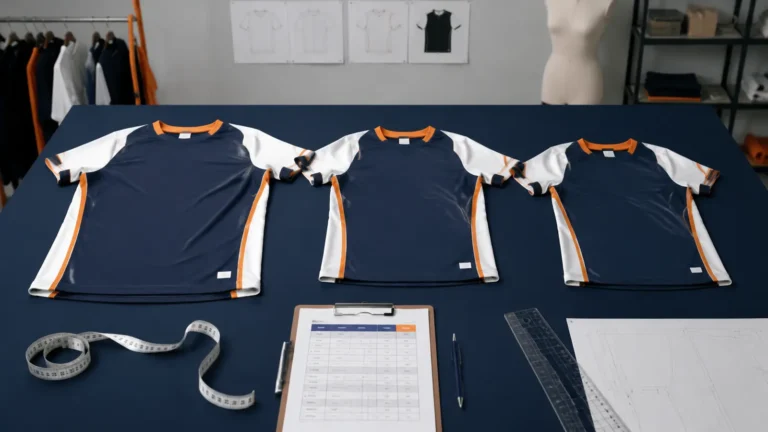
Lay the garment on a smooth table without stretching it. Close any buttons or placket, align the side seams, smooth wrinkles and use the exact points of measure in the supplier’s diagram.
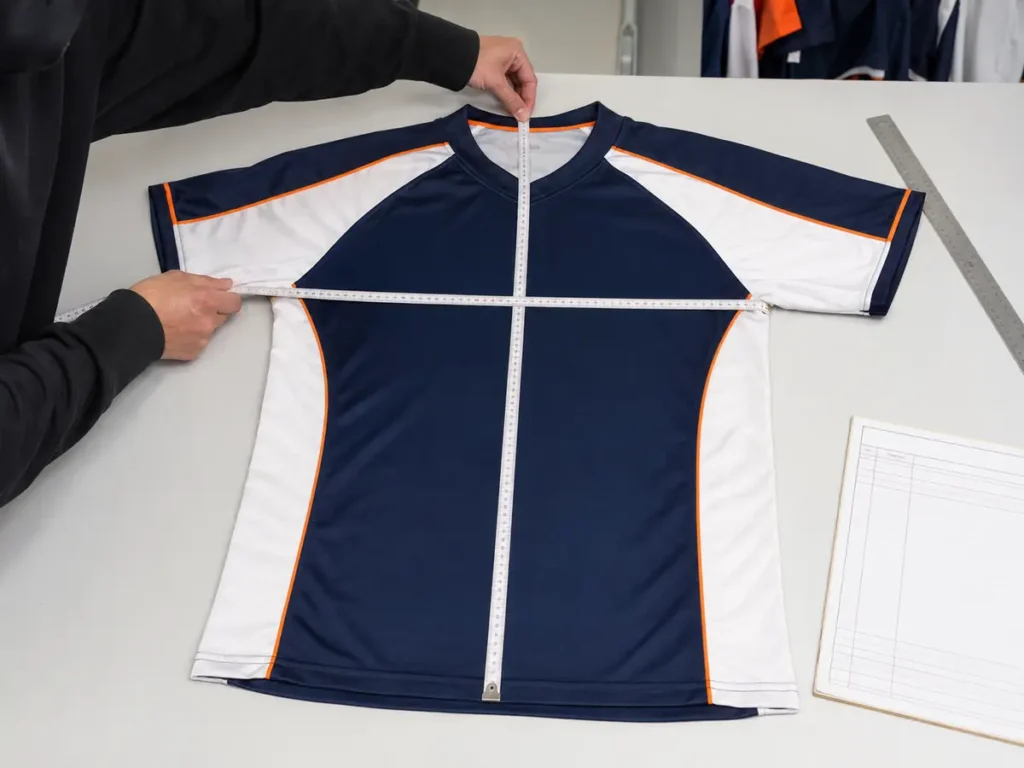
Finished-garment measurements should be taken at defined points and compared with the approved specification.
Common finished-garment checks include:
- Half chest: straight across, usually at a defined distance below the armhole.
- Body length: from the high shoulder point beside the neck to the hem.
- Shoulder: seam to seam, when the construction has conventional shoulder seams.
- Sleeve length: from the specified shoulder or center-back point to the sleeve edge.
- Armhole: straight or curved measurement according to the technical diagram.
- Bottom sweep: straight across the hem.
- Neck opening: measured along the seam or as width/drop, depending on the pattern.
Write the method directly into the tech pack. “Body length” is not precise enough if the buyer and supplier use different start points.
Football Jersey Size and Fit
An American football jersey is shaped by the pad package, position and competition level. A close game fit can reduce loose fabric, but close must not mean restrictive.
Football Fit Checks
- The shoulder area should sit smoothly over the pads without pulling the neckline backward.
- The sleeve opening should clear the pad cap and allow the player to raise both arms.
- The body should not create large folds that obstruct movement or personalization.
- The hem should remain covered or secured as required by the team’s uniform system.
- Front and back numbers should remain legible rather than wrapping excessively around the torso.
- Side panels and ventilation zones should stay aligned when the athlete adopts a football stance.
Test the jersey with the exact shoulder-pad style intended for play. USA Football’s pad-fitting process emphasizes chest and shoulder measurements, coverage and movement checks. Those steps address protective-equipment fit; the jersey then needs enough compatible room without compensating for an incorrectly fitted pad.
Football Buyer Decisions
A school purchasing for multiple age groups may need separate youth and adult pattern blocks. Do not automatically scale a youth jersey into adult sizes or assign a men’s block to every female athlete. Ask whether the supplier offers a women’s or shaped block, and confirm how the number area changes across small sizes.
Soccer Jersey Size and Fit
Soccer jerseys are commonly ordered in slim, athletic regular or relaxed team fits. The best choice depends on the level of play, climate, fabric stretch, buyer audience and whether the program expects a retail-friendly silhouette.
Soccer Fit Checks
- The shoulder seam or raglan line should sit naturally without pulling.
- The player should cross both arms, reach forward and raise both hands without chest binding.
- The hem should provide coverage during running and overhead movement.
- The neckline should lie flat without pressure or gaping.
- The torso should not be so loose that excess fabric interferes with play.
- Women’s and girls’ teams should evaluate a relevant fit block rather than relying only on a men’s unisex sample.
For a close-fitting sublimated jersey, fabric stretch and graphic distortion should be approved together. If side panels, gradients or sponsor placements deform on the body, changing only the artwork may not solve the underlying pattern issue.
Basketball Jersey Size and Fit
Basketball jerseys remove the sleeve but introduce other fit variables: armhole shape, neckline depth, shoulder-strap width and body length.
Basketball Fit Checks
- Armholes should allow an unrestricted shooting and rebounding motion without cutting into the front shoulder.
- The neckline should stay stable in defensive movement.
- The body should cover the torso when both arms are raised.
- The jersey should coordinate with the short waistband and any tuck requirement.
- Shoulder straps must leave enough uninterrupted area for decoration while staying proportionate across youth and adult sizes.
- Side-panel placement should remain balanced on different body widths.
A lifestyle or fan jersey may intentionally be oversized. A game jersey normally needs more controlled ease. Buyers selling both should create separate SKU names and size charts rather than use one ambiguous “regular fit” label.
Hockey Jersey Size and Fit
Ice hockey jerseys are designed around protective equipment. The player’s bare chest measurement is only a starting reference.
Hockey Fit Checks
- The shoulder and upper-chest area should cover the pad package without tension lines.
- The sleeve should cover the elbow pad and integrate with the glove as intended.
- Cuffs should not be so wide that they obstruct the glove, or so tight that they bind.
- Armholes and sleeve volume should support stick handling and shooting.
- The hem should sit correctly over hockey pants and remain stable in a skating posture.
- Front crests, sleeve numbers and back names should stay positioned correctly on the dressed body.
Goalie jerseys need a separate pattern and fitting process. Do not enlarge a skater jersey and call it a goalie cut without evaluating chest-and-arm protection, sleeve volume and competition requirements.
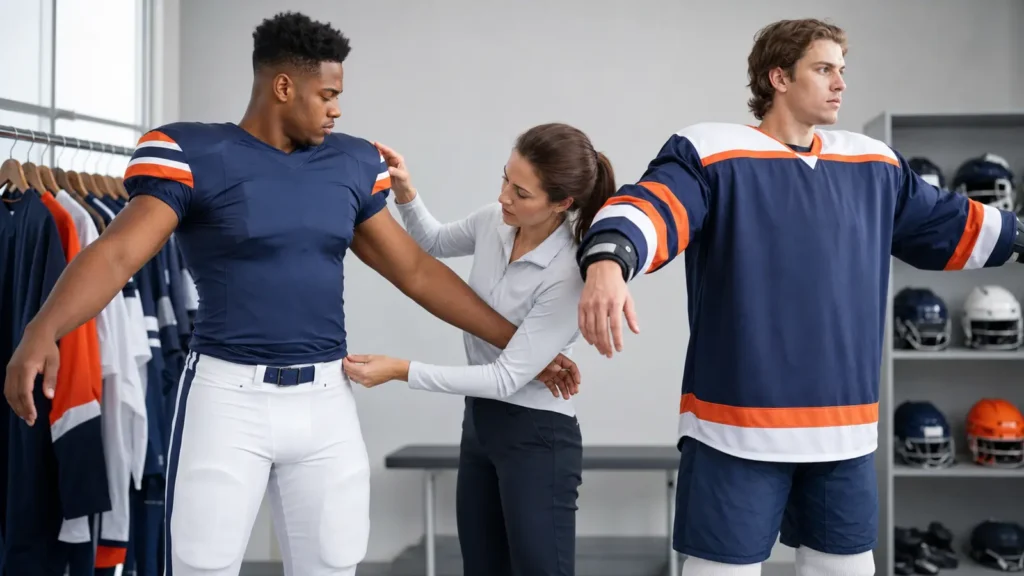
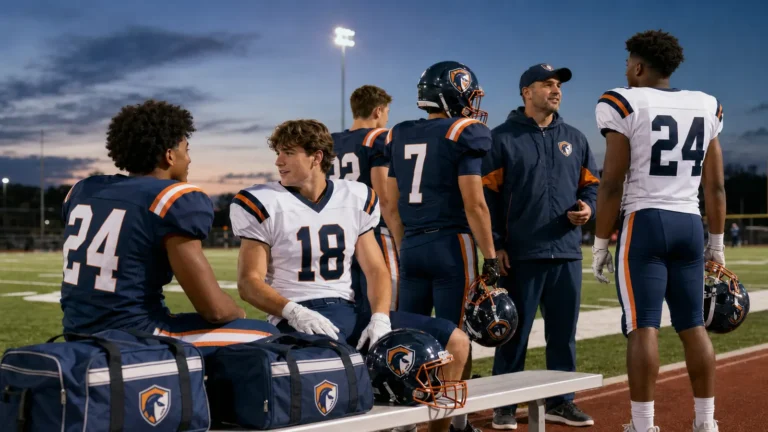
Football and hockey fit approval should be completed over the actual protective equipment.
Regular, Athletic, Relaxed and Oversized Fit
Fit names are descriptive, not standardized measurements. Define them through the garment specification.
| Fit term | Practical meaning | Suitable use | Procurement caution |
|---|---|---|---|
| Athletic / slim | Controlled ease and a closer torso | Performance soccer; selected basketball styles | Verify stretch, movement and body-shape coverage |
| Regular | Balanced room without obvious excess | Multi-level team programs and general game use | “Regular” still varies by supplier and sport |
| Relaxed | More chest, sweep or arm volume | Recreation, retail, layering or selected basketball fits | Check decoration scale and garment length |
| Equipment fit | Pattern shaped around pads | Tackle football and ice hockey | Must be approved with actual equipment |
| Oversized | Deliberately large silhouette | Fashion, fanwear and merchandise | Keep separate from performance roster sizing |
Use fit samples and numeric points of measure to eliminate interpretation. Words alone are not production tolerances.
Youth, Adult, Women’s and Inclusive Team Sizing
Age is not a measurement. Two 12-year-old players can have different chest, height and shoulder proportions. Youth programs should record measurements, then apply a documented growth policy.
Growth Allowance Without Guesswork
For a season-length program, choose the larger size when a player is genuinely between two supplier ranges and the larger sample still passes movement and safety checks. Do not oversize every child “to last longer.” Excess fabric can interfere with play, decoration placement and uniform appearance.
Nike’s current youth guidance recommends choosing smaller for a tighter fit or larger for a looser fit when a measurement is on a boundary; it also prioritizes the chest measurement when chest and waist indicate different top sizes. Use that as measurement logic—not as a substitute for the custom supplier’s chart.
Women’s and Shaped Blocks
A women’s block may change chest shaping, shoulder width, waist suppression, body length or armhole shape. Ask the team whether athletes want a shaped fit, unisex fit or a choice. If two blocks are offered, code them clearly in the roster, such as UNISEX-M and WOMENS-M; never send only M.
Extended Sizes and Adaptive Needs
Confirm the full graded range before collecting orders. Ask whether extended sizes require pattern, artwork or price adjustments. For athletes with accessibility or adaptive dressing needs, discuss closure, opening and mobility requirements before sampling rather than altering finished personalized garments.
Build a Reliable Team Size Roster
Use one row per garment, not one row per person, if athletes receive home, away, practice or goalkeeper versions in different cuts.
| Required field | Example format | Control purpose |
|---|---|---|
| Player ID | CLUB-024 | Prevents confusion between duplicate names |
| Display name | A. RIVERA | Matches approved personalization |
| Number | 18 | Checked for duplicates and sport rules |
| Sport / garment | Soccer home jersey | Connects the correct pattern |
| Fit block | Women’s athletic | Prevents ambiguous labels |
| Size code | W-M | Maps to approved supplier chart |
| Chest / bust | cm and/or in | Supports exception review |
| Height | cm and/or in | Supports length review |
| Equipment reference | Pad model/size or sample set | Required for padded-sport approval |
| Special note | Longer body approved | Records controlled deviation |
| Approval status | Player / coach / buyer approved | Creates accountability |
Lock spelling, number, size and quantity together. A size change after name-and-number application may require a full remake.
Sample Approval Before Bulk Production
A digital mockup approves design placement, not physical fit. Use a physical size set or at least the most critical sizes and body types.
Recommended Approval Sequence
- Approve the measurement diagram and unit system.
- Approve the body chart and finished-garment specification.
- Measure the samples at the defined points.
- Fit them on representative athletes in normal base layers.
- Fit football and hockey samples over actual pads.
- Perform sport-specific movements.
- Wash or condition a sample when care performance is part of the specification.
- Approve decoration position on both small and large sizes.
- Sign off the sample, tolerance and graded rules before bulk cutting.
Do not approve only a medium and assume every size will scale visually. Names, numbers, front crests and side graphics can become crowded on youth sizes or look undersized on extended sizes.
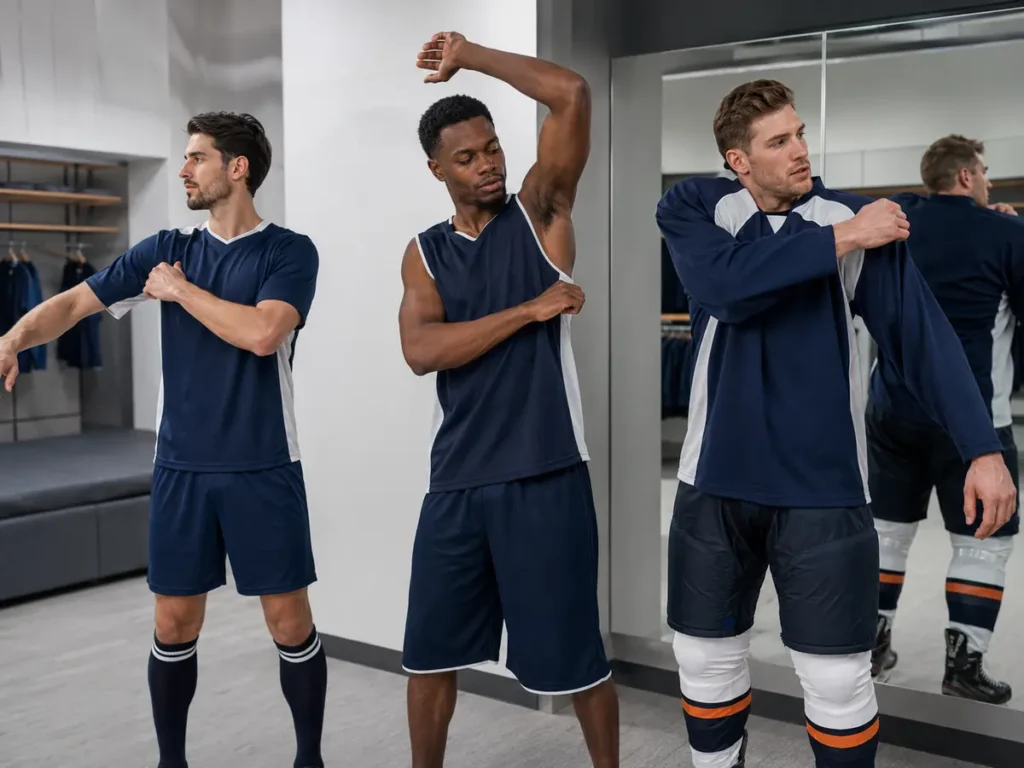
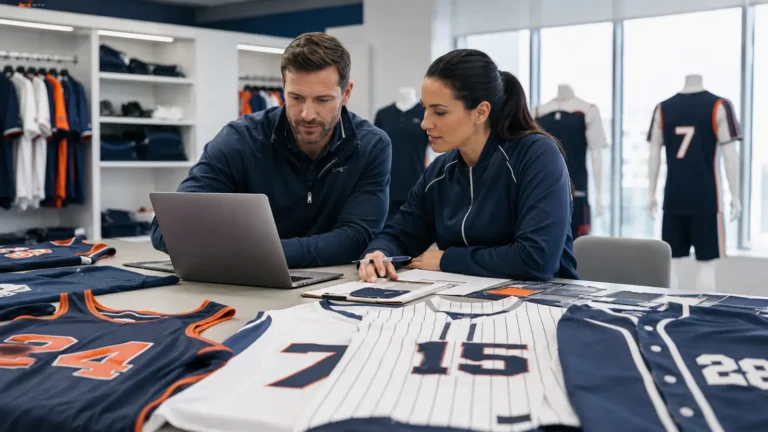
Movement testing reveals fit problems that a static chest measurement cannot show.
Quality Control for Bulk Jersey Sizing
Quality control should compare production against the approved sample and specification, not against memory or a website label.
Pre-Production Controls
- approved pattern version and revision date;
- confirmed size chart and points-of-measure diagram;
- fabric composition, weight, stretch direction and color;
- decoration size and position rules by size;
- tolerance agreement;
- wash-care method and any required evaluation;
- approved labels and packaging.
Production and Final Inspection
- measure a defined sample from each size;
- check chest, length, shoulder, sleeve, armhole and sweep as applicable;
- verify paired measurements and symmetry;
- inspect seam shape and puckering;
- confirm size labels match actual measured size;
- reconcile names, numbers, quantities and roster IDs;
- compare color and decoration across size runs;
- isolate nonconforming garments before packing.
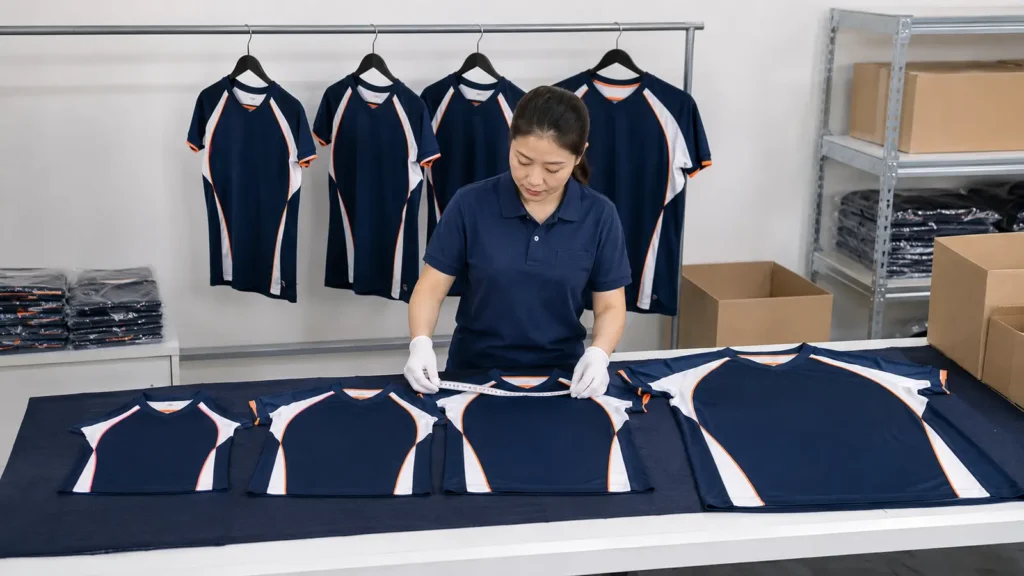
QC should verify graded measurements, construction and size labeling before personalized jerseys are packed.
For repeat orders, retain the approved spec, artwork, label files, color references and sample status. “Same as last order” is risky if the fabric, pattern or decoration process changed.
Common Team Jersey Sizing Mistakes
Using Another Brand’s Label
An athlete who wears a retail large may need a different size in a custom game jersey. Compare measurements, not letters.
Mixing Body and Garment Measurements
A 22-inch flat chest is not a 22-inch body chest. Label every number with its method and unit.
Measuring Over Casual Clothing
Hoodies, bulky shirts and everyday layers distort the result. Use the intended game base layer or actual pads.
Ignoring Sport-Specific Equipment
Bare-body sizing is inadequate for tackle-football and hockey approval.
Treating Youth Sizes as Ages
Age labels are shortcuts. Growth and body proportions vary widely.
Approving Only One Size
Artwork and fit can fail at the ends of the graded range even when the medium sample is correct.
Allowing Uncontrolled Roster Edits
Email fragments and chat messages create duplicate changes. Use one version-controlled roster and a final approval deadline.
Ordering Every Player One Size Larger
Blanket oversizing creates inconsistent appearance and may reduce performance. Resolve boundaries player by player.
Questions to Ask a Custom Jersey Supplier
Send these questions before requesting a final quotation:
- Is the size chart based on body measurements or finished garments?
- Can you provide the points-of-measure diagram and grading rules?
- Which fit blocks are available: youth, adult, women’s, unisex, goalie or tall?
- How should football or hockey buyers account for protective equipment?
- What sample sizes are available for a fitting set?
- What measurement tolerance applies to each point?
- Does the fabric stretch, shrink or relax under the approved care method?
- How are decoration size and position adjusted across the size range?
- Can replacement jerseys match the original fabric, shade and artwork?
- Which changes are still possible after sample approval?
- How should the roster identify fit block, size, name and number?
- Are extended or custom-length sizes subject to different requirements?
What to Send for an Accurate JIUMU Quotation
For a faster specification review, send:
- sport and jersey style;
- youth/adult and fit-block requirements;
- estimated quantity by size;
- team colors or Pantone references;
- logo files and decoration preference;
- player-name and number requirements;
- preferred fabric or performance target;
- reference garment, tech pack or measurement chart;
- protective-equipment information for football or hockey;
- packaging and private-label requirements;
- shipping country and target delivery date.
Planning a mixed-size team order? Share your roster structure, reference jersey, measurement chart and logo files with JIUMU. We can review the specification, identify missing fit decisions and prepare a custom quotation. Request a team jersey quotation.
Why JIUMU for Custom Team Jerseys
JIUMU supports B2B custom teamwear programs for schools, clubs, academies, distributors, uniform dealers and private-label brands in North America and Europe. Available capabilities include OEM/ODM development, sublimation, embroidery, screen printing, heat transfer, fabric sourcing, Pantone color matching, private labels, hangtags, packaging customization, digital mockups, physical samples, bulk quality control and export support.
The typical MOQ is 50 pieces, subject to the product structure and customization. For a multi-sport program, the practical benefit is specification coordination: fit block, size chart, colors, artwork, personalization and packaging can be reviewed as one controlled order rather than disconnected design files.
Explore custom team jerseys or custom team uniforms for related product options.
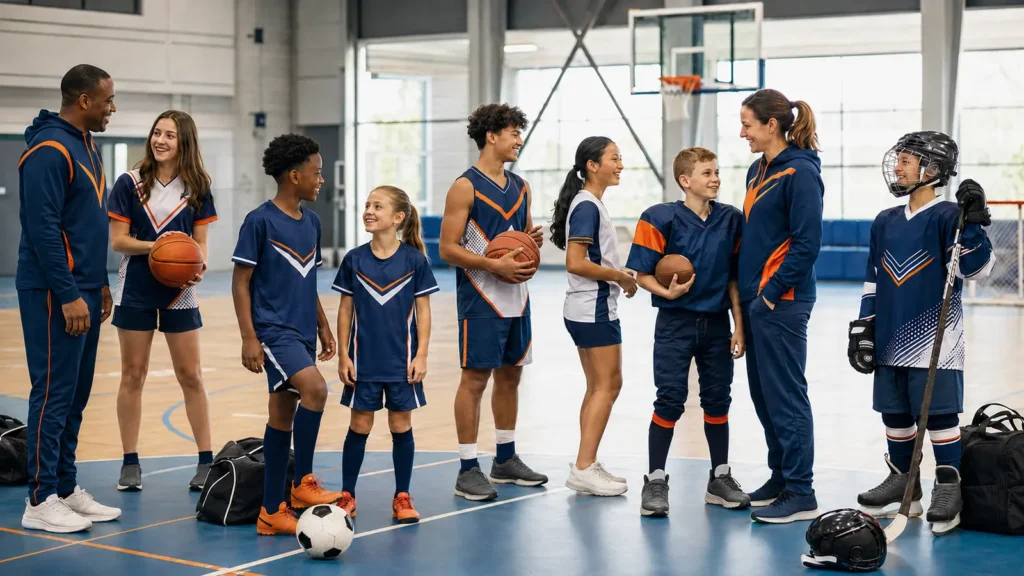
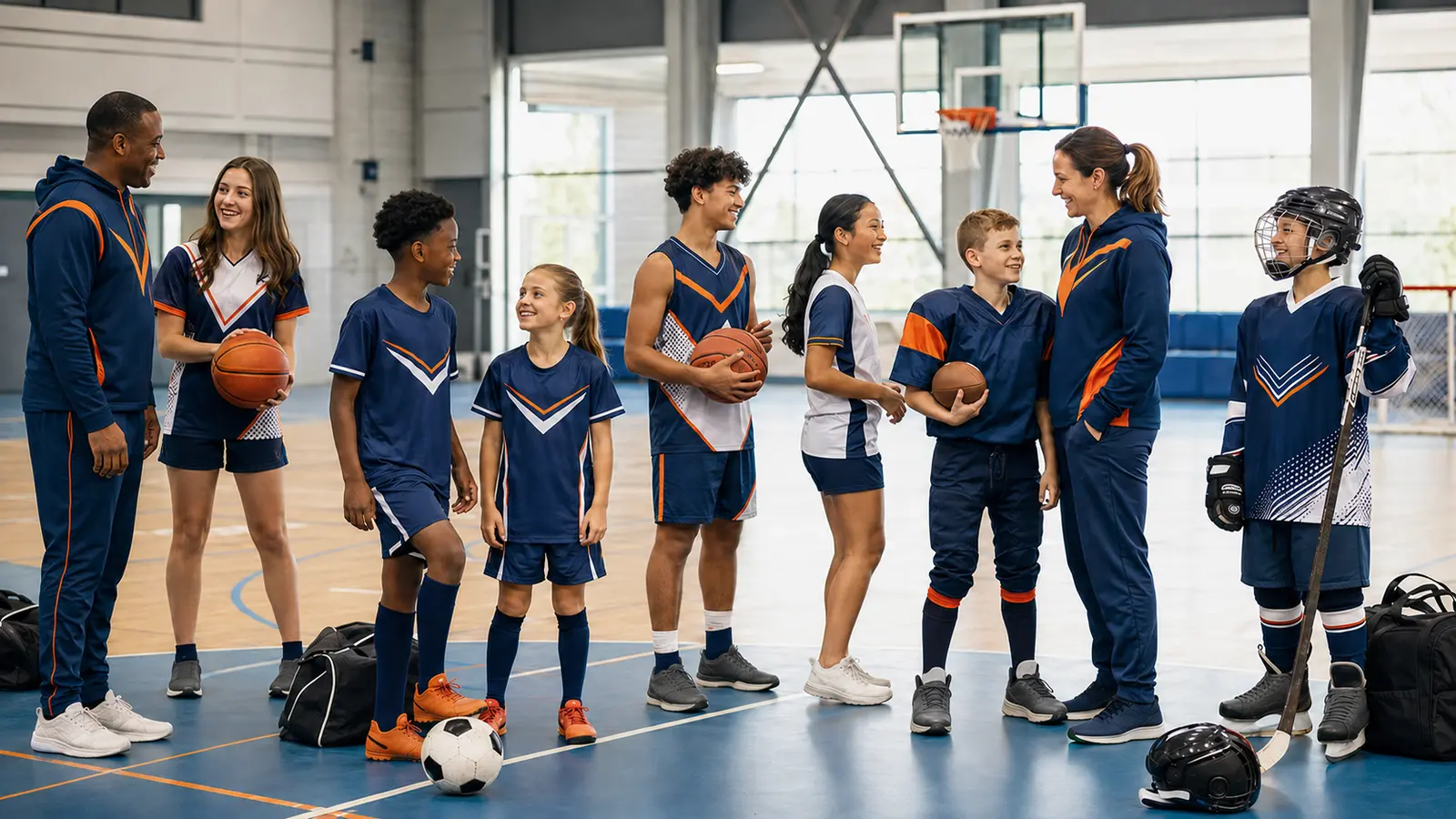
A controlled sizing process can support youth, adult and multi-sport programs without forcing every athlete into one fit block.
Frequently Asked Questions
Final Recommendation
The most reliable team jersey size guide is a process, not a generic S–3XL table. Measure the athlete, identify the sport-specific fit block, use the supplier’s current body and finished-garment charts, approve samples in real playing conditions and lock the roster before personalization.
For soccer and basketball, focus on chest, length, arm movement and the intended athletic or relaxed silhouette. For football and hockey, add full protective-equipment fitting. For youth and mixed teams, record measurements instead of assigning sizes by age or retail habit.
Ready to prepare a size-controlled bulk order? Send JIUMU your sport, quantity, roster structure, reference garment or tech pack, logo files, color requirements, packaging needs and target delivery date. Contact JIUMU for a custom team jersey quotation, email zhengdong@jiumugear.com, or use WhatsApp/phone +86 18507502899.
Sources and Measurement References
- Nike Men’s Tops & Tees Size Chart — chest, waist and hip measurement method and between-size guidance.
- Nike Boys’ Tops & Shirts Size Chart — youth measurement method and between-size guidance.
- adidas Men’s Shirts and Tops Size Chart — body measurement points for apparel.
- USA Football Equipment Fitting — chest, shoulder and movement checks for shoulder-pad fitting.
- USA Hockey Official Rules & Casebook 2025–2029, Rule 304 — protective equipment worn under the uniform, with listed exceptions.
This guide provides procurement and garment-fitting information. Competition uniform and equipment rules vary by league, federation, age group and season; confirm the rules that apply to your program before production.
JIUMU Teamwear Sourcing Team
JIUMU supports B2B custom teamwear specification, sampling, personalization, quality control and export coordination for schools, clubs, distributors and private-label buyers.