Printed vs Stitched Jerseys: Which Method Lasts Longer?
Choosing between printed and stitched jerseys is not simply a choice between a lower-cost method and a more durable one. “Printed” can refer to dye sublimation, screen printing, or a heat-applied film. “Stitched” can mean direct embroidery or a fabric appliqué such as tackle twill. These constructions react differently to laundering, abrasion, stretching, high heat, and long seasons of team use.
For a school, club, distributor, or private-label brand, the useful question is therefore not “Is printing or stitching better?” It is: Which decoration method will keep the required appearance on this fabric, for this sport, under the intended care routine and budget?
This guide compares five methods for custom team jerseys: sublimation, screen printing, heat transfer, embroidery, and tackle twill. It also explains what buyers should approve before bulk production so durability is treated as a measurable specification rather than a sales promise.
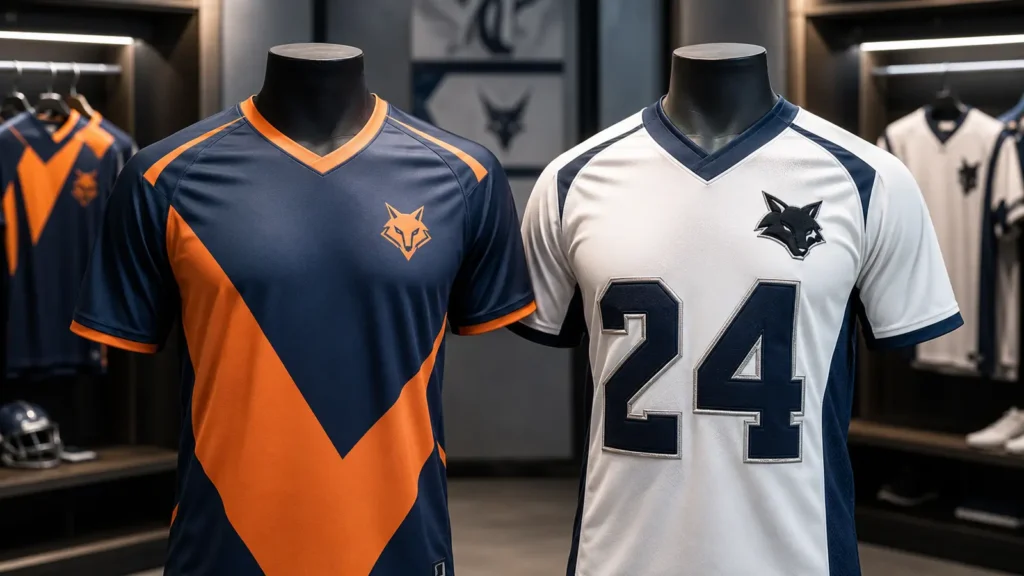
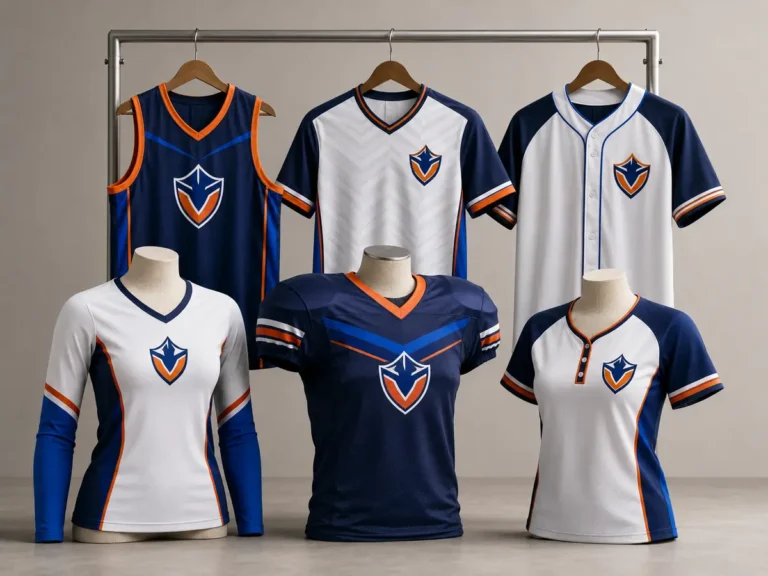
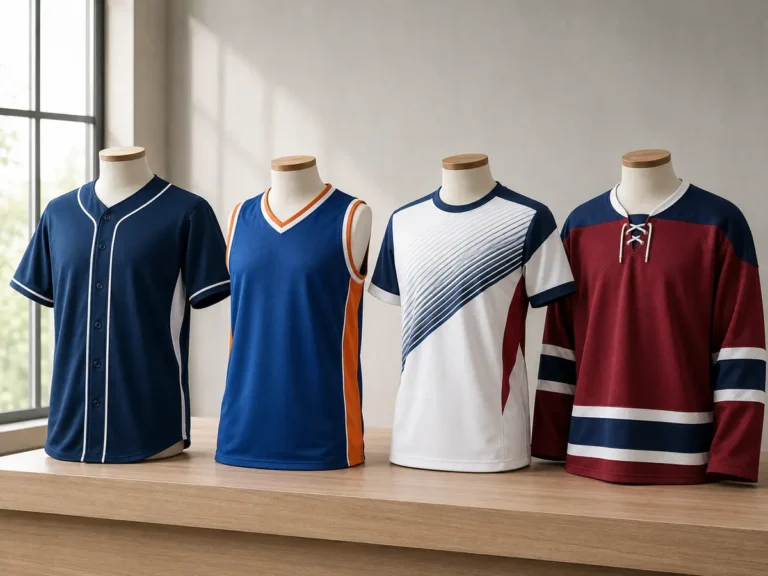
Printed and stitched custom team jerseys displayed side by side for a durability comparison
Quick Answer: Are Printed or Stitched Jerseys More Durable?
For full-color polyester performance jerseys, dye sublimation usually offers the best resistance to cracking and peeling because the dye is embedded into the polyester rather than added as a raised surface layer. For compact, dimensional logos, well-engineered polyester-thread embroidery can remain durable for years of team use. Tackle twill is a strong traditional choice for large names and numbers when its edges are properly sewn. Screen printing and heat transfer can also perform well, but their durability depends more visibly on ink or film selection, curing or pressing, fabric compatibility, and care.
No method wins every category. Sublimation does not create a raised heritage look and works best on light-colored polyester. Dense embroidery can distort light mesh. Tackle twill adds weight and seams. Surface prints can crack, lift, or abrade if their formulation and process are poorly matched to the jersey. The longest-lasting option is the one specified as a complete system: base fabric, decoration material, construction, artwork, application parameters, placement, and wash instructions.
Why Durability Matters in a Bulk Jersey Order
Decoration failure can require a replacement that matches an earlier production lot, creating administrative work and visible team inconsistency.
Professional buyers should define durability in observable terms:
- Will the color remain acceptable after the agreed care cycles?
- Can a printed layer resist cracking, edge lifting, and delamination?
- Can embroidery resist thread breaks, loose stitches, and backing failure?
- Can tackle-twill edges resist fraying and remain securely sewn?
- Does the decorated area stretch with the jersey without restricting movement?
- Does the fabric retain its shape and withstand sport-specific abrasion?
This definition turns a vague request for a “long-lasting jersey” into a sample approval and quality-control plan.
Printed vs Stitched Jerseys: At-a-Glance Comparison
| Method | How it is built | Main durability strength | Main risk | Best-fit applications |
|---|---|---|---|---|
| Dye sublimation | Heat converts dye to gas and embeds color into polyester | No raised layer to crack or peel; light hand | Best on white or light polyester; color control depends on fabric and process | Full-color soccer, basketball, baseball, softball, volleyball, and esports jerseys |
| Screen printing | Ink is pushed through screens and cured on the fabric | Strong spot-color coverage when the ink system is correctly cured | Under-cure, overheat, dye migration, cracking, or heavy ink deposit | Simple team graphics, training tops, promotional jerseys, selected polyester programs |
| Heat transfer | Cut or printed film is bonded using controlled heat, pressure, and time | Sharp names, numbers, and small-batch personalization | Edge lifting, scorching, dye migration, or film damage from unsuitable heat and care | Player personalization, short runs, sponsor marks, replacement jerseys |
| Direct embroidery | Thread is stitched through the jersey with backing or stabilizer | Dimensional logo with no printed film to peel | Puckering, stiffness, thread abrasion, skin-side discomfort, excessive weight | Compact crests, chest logos, premium staff or presentation jerseys |
| Tackle twill | Cut fabric letters or numbers are positioned and edge stitched | Traditional athletic appearance and replaceable layered construction | Fraying or separation if edges and stitch path are poorly executed | Baseball, football, hockey, varsity, heritage, and fanwear designs |
The table describes typical behavior, not guaranteed service life. A well-made heat transfer can outlast a poorly sewn appliqué. Compare production-representative samples, not only method names.
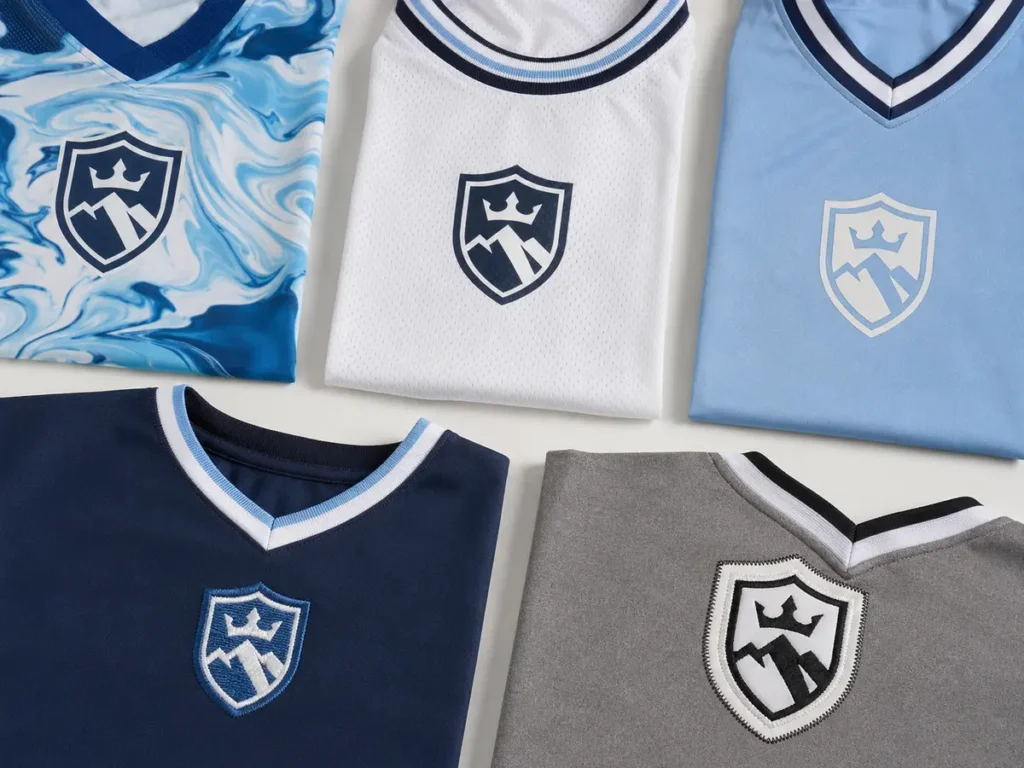
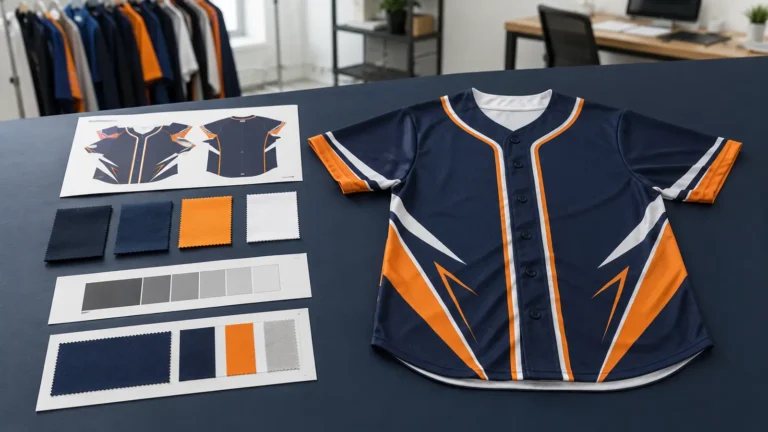
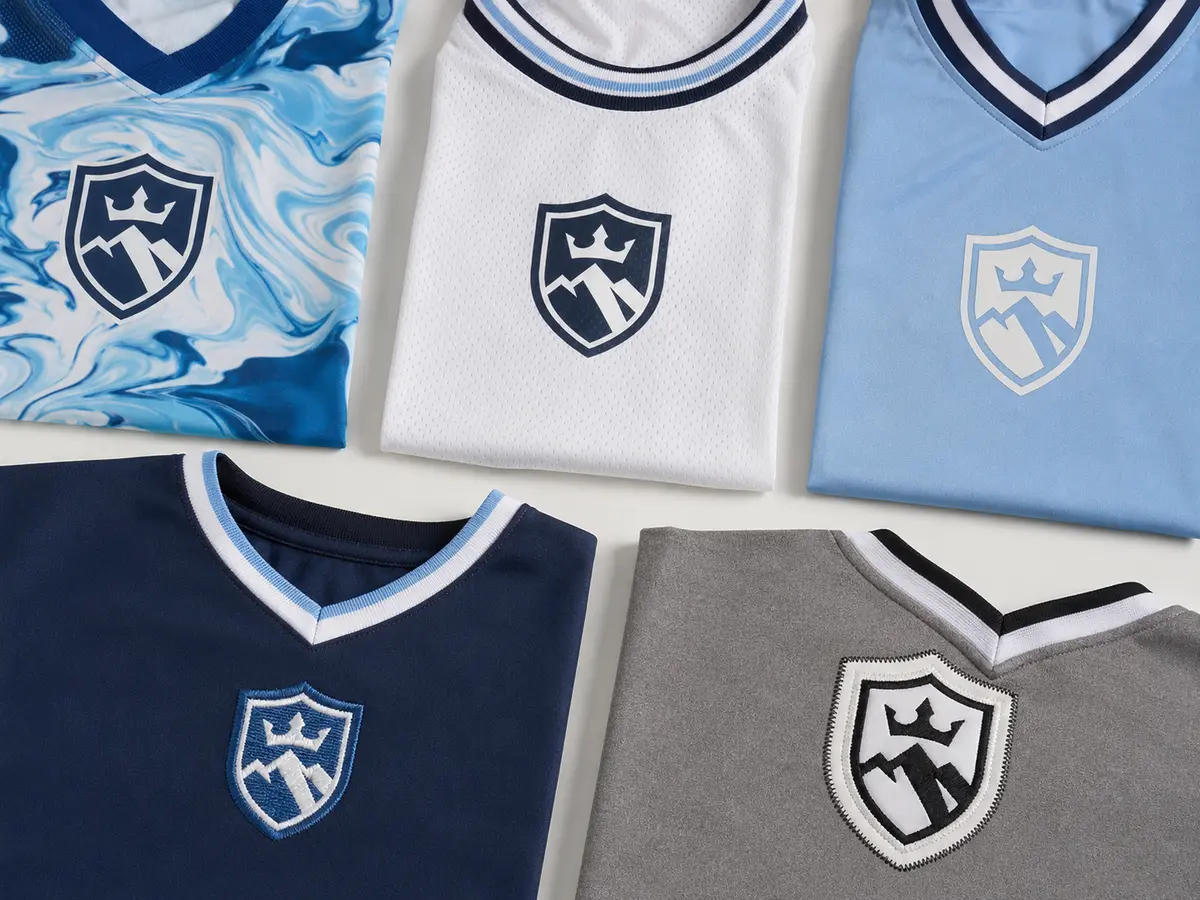
Five custom jersey decoration methods shown on separate realistic garment samples
Choosing a Jersey Decoration Method for Bulk Production
Send the jersey fabric, artwork, color count, logo dimensions, roster quantity, care requirements and target appearance. JIUMU can compare sublimation, embroidery, tackle twill, screen printing and heat transfer for your custom team jerseys.
What Does “Lasts Longer” Actually Mean?
Buyers often judge durability by laundering alone. Team jerseys face several other forms of wear, and each can produce a different winner.
Wash durability
Wash durability includes color change, cracking, peeling, delamination, edge fraying, loose stitches, puckering, and dimensional change. The care program must represent real use. A household cold wash is not equivalent to an institutional hot wash, chlorine exposure, or high-temperature tumble drying.
The U.S. Federal Trade Commission requires covered manufacturers and importers to provide care instructions and to have a reasonable basis for those instructions. When a garment contains several components, the evidence should support the care of the complete garment, not just the base fabric or thread alone. That is an important procurement principle even for orders sold outside the United States. FTC care-label guidance
Abrasion, stretch, and appearance
Jerseys rub against equipment, closures, benches, bags, and other garments. Raised stitches, appliqué edges, and surface prints can receive concentrated friction. Sublimated color avoids a separate layer, although the base fabric can still pill or snag. Stretch fabrics add another requirement: the decorated area must move and recover without cracking, lifting, or distorting. Buyers should therefore inspect the complete jersey after washing, stretching, and normal handling, not only whether the decoration remains attached.
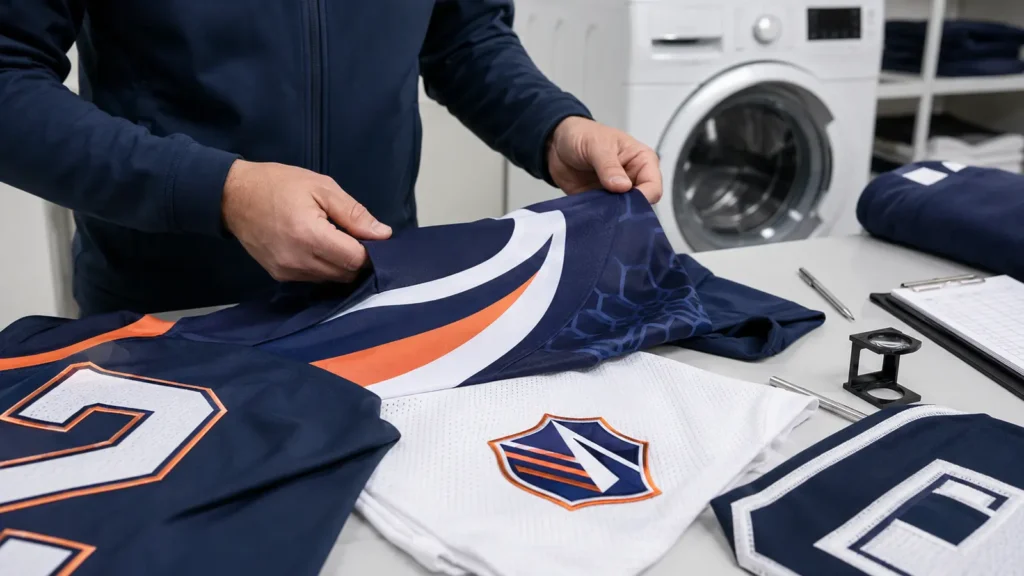
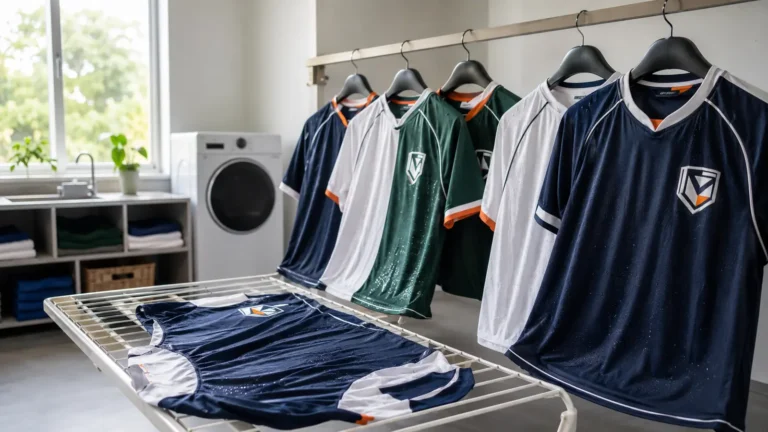
Custom jersey decorations being evaluated after washing and normal team use
How Each Jersey Decoration Method Performs
1. Dye sublimation: strongest against cracking and peeling
Dye sublimation uses heat and pressure to convert special ink into gas and embed it into a polyester surface. Epson describes the result as smooth to the touch because the color enters the polymer rather than forming a separate raised layer. This explains why a properly sublimated design does not crack or peel in the manner of a surface film. Epson dye-sublimation overview
For teamwear, logos, names, numbers, gradients, and patterns can be combined without extra thread or film layers, keeping the jersey light and flexible.
Its limitations matter. Conventional sublimation works best on polyester and is most predictable on white or light base material because the process does not add an opaque white ink layer. Very dark finished backgrounds are usually created by printing the light polyester fabric before panels are cut and sewn, not by printing light graphics over an already-dark garment.
Durability still depends on transfer parameters, ink, paper, fabric preparation, and color management. Inspect color consistency, ghosting, press marks, panel matching, and artwork crossing seams.
Choose sublimation when: the team wants full-color art, many player names and numbers, light weight, smooth hand, and strong resistance to surface cracking or peeling on polyester performance jerseys.
2. Screen printing: durable when ink, fabric, and cure are matched
Screen printing pushes ink through a prepared mesh stencil and then cures the ink. It can create opaque spot colors, traditional athletic graphics, and a controlled matte or gloss appearance. For the right design and volume, it can be commercially efficient.
Performance polyester is more complicated than a basic cotton T-shirt. Avient notes that printers must account for fiber content, temperature capability, and design. It recommends monitoring cure conditions, avoiding excessive heat, and using suitable low-cure or bleed-blocking systems where polyester dye migration is a risk. Avient guidance for polyester printing
Under-cured ink may not develop the intended adhesion and wash performance. Excess heat can create other problems, including fabric distortion or migration of dye from the jersey into a light-colored print. Ink deposit, mesh selection, underbase, flash sequence, stretch requirement, and final cure should all match the fabric.
A properly engineered screen print can serve a team program well, although a large ink area may feel heavier and less breathable than sublimation.
Choose screen printing when: the artwork uses a limited number of colors, the fabric has been tested with the selected ink system, the desired visual effect benefits from surface ink, and production volume justifies screen setup.
3. Heat transfer: precise and flexible for personalization
Heat transfer includes several product families: cut heat-transfer vinyl, printed transfer films, specialist low-temperature films, flock, and other materials. They should not be treated as one identical construction.
The decoration is applied with a defined combination of temperature, time, pressure, and peel method. STAHLS publishes different parameters for different materials and recommends production testing. Its care guidance for many transfer products includes washing inside out with mild detergent and avoiding bleach. STAHLS application and care guide
Heat transfer suits names, numbers, sponsor logos, short runs, and replacements. Thin stretch films can behave very differently from thick basic vinyl.
Common failure modes include lifted corners, incomplete bonding, press marks, film cracking, dye migration, scorching, and reduced elasticity. These often trace back to the wrong film for the fabric, uneven pressure, inaccurate platen temperature, moisture, seam interference, or care outside the recommended range.
Choose heat transfer when: the order needs variable names and numbers, short-run flexibility, detailed sponsor artwork, or replacement pieces—and the transfer has been tested on the exact jersey fabric.
4. Direct embroidery: a durable dimensional option for compact logos
Direct embroidery uses thread to build a design through the garment. It creates a tactile, dimensional appearance associated with premium crests, monograms, and staff apparel. There is no printed film edge to peel.
Polyester embroidery thread is widely used for sportswear because of its strength and care performance. Madeira states that polyester thread can generally be washed in warm or cold water with regular detergent and resists shrinking, while also advising users to follow the care requirements of the complete fabric-and-thread combination. Madeira polyester-thread guidance
Digitizing, stabilizer, needle, tension, hooping, and placement must suit the knit. A dense logo that works on a woven jacket can pucker open mesh, feel rough, add weight, or restrict movement.
Inspect small lettering, column width, registration, loose loops, thread breaks, backing edges, puckering, and how the reverse side contacts the wearer.
Choose embroidery when: the design is compact, dimensional branding is important, the jersey panel can support the stitch load, and the buyer accepts the added texture and weight.
5. Tackle twill: traditional athletic construction for names and numbers
Tackle twill is an appliqué method. Letters, numbers, or logo shapes are cut from twill fabric, positioned on the jersey, and usually secured with a zig-zag or satin edge stitch. Multiple layers can create a classic varsity or professional-team appearance.
STAHLS’ Poly-TWILL instructions state that the material must be sewn to prevent fraying and recommend a tight zig-zag or satin stitch around the edges. The guidance also emphasizes stitch path and needle position around corners and curves. STAHLS Poly-TWILL sewing guide
Twill reduces fill stitching in large shapes but adds material and edge seams. Tight corners, small details, layers, and lightweight fabrics need careful engineering; a poorly sewn edge can fray or lift.
Choose tackle twill when: the program values a traditional, layered athletic look for large numbers or wordmarks and accepts greater weight, sewing time, and construction complexity.
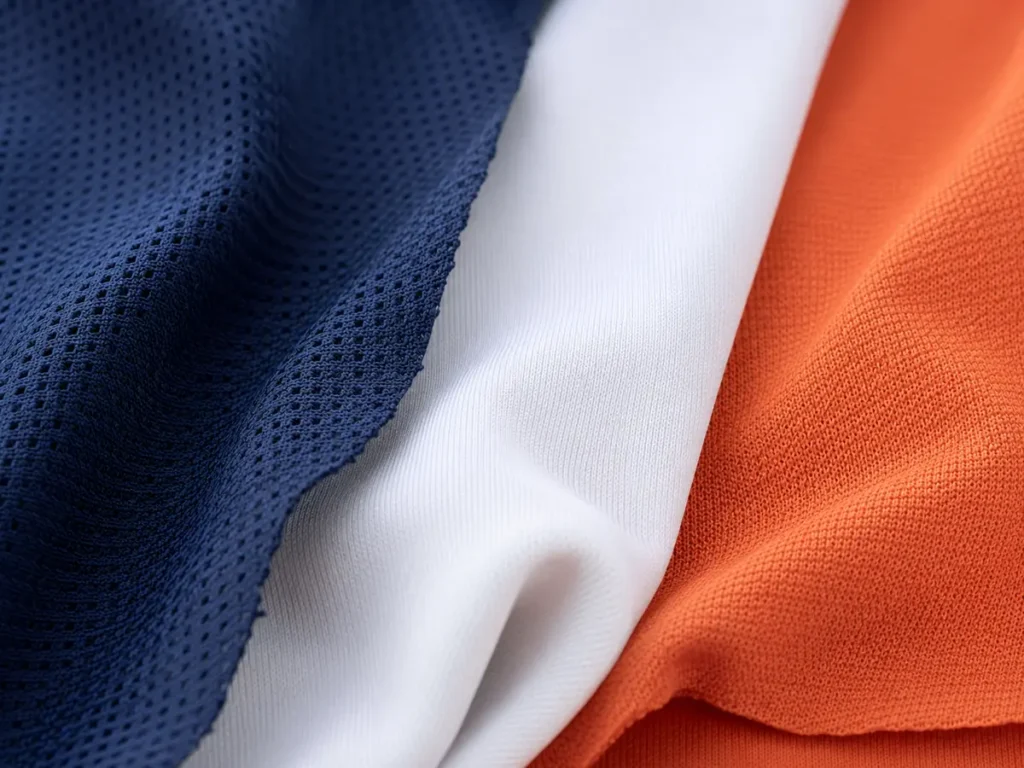
Close-up comparison of polyester mesh, interlock and stretch jersey fabrics
Which Method Lasts Longer by Failure Mode?
| Durability question | Usually strongest candidate | Why | Qualification |
|---|---|---|---|
| Resistance to cracking | Sublimation | No separate raised print layer | Base fabric and color can still wear or fade |
| Resistance to peeling | Sublimation or direct embroidery | Neither relies on a large bonded surface film | Embroidery can have loose or broken stitches |
| Traditional raised appearance | Embroidery or tackle twill | Thread and appliqué create physical dimension | Adds weight and may affect stretch |
| Fine full-color artwork | Sublimation | Complex color can be integrated into polyester | Best on light polyester and requires color-managed production |
| Fast variable names and numbers | Heat transfer or sublimation | Efficient personalization without individual screens | Transfer compatibility and press control remain critical |
| Limited-color bulk graphic | Screen printing | Efficient repeat print after setup | Cure, stretch, dye migration, and ink deposit must be controlled |
| Large heritage number | Tackle twill | Strong visual definition with sewn edges | Edge stitching and fabric support determine performance |
| Lightweight breathable front panel | Sublimation | Does not add a thick surface layer | Fabric selection still controls moisture and airflow performance |
This matrix should guide sampling, not replace it. Decoration area, fabric weight, mesh openness, stretch percentage, jersey color, and care method can change the result.
Best Method by Sport and Use Case
Soccer, basketball, volleyball, and esports
These programs often use lightweight polyester, full-color graphics, and many player numbers. Sublimation keeps decoration smooth; performance-rated transfers can handle late roster or sponsor updates.
Baseball and softball
Baseball buyers have wider aesthetic options. Sublimation supports complex graphics and easy roster personalization. Embroidery works well for compact chest crests. Tackle twill supports traditional front scripts, back names, and large numbers. The choice depends on whether the program prioritizes light performance construction or a classic raised uniform look. Explore JIUMU’s custom team jerseys and baseball team uniform packages when planning coordinated jerseys, pants, caps, socks, bags, and warm-up pieces.
American football and hockey
Large numbers and heritage styling make tackle twill attractive, but contact, pads, closures, and equipment can abrade edges. Evaluate the actual jersey and use context. Choose sublimation when lower weight and complex art matter more.
School and club multisport programs
A school purchasing several sports should not force one decoration method onto every jersey. A better strategy is to standardize brand colors, logo artwork, name and number conventions, and approval criteria, then choose a suitable method for each garment. This produces visual consistency without ignoring sport-specific performance.
Distributors and private-label brands
Commercial programs need repeatability. Retain artwork, color references, fabric codes, decoration specifications, measurements, packaging instructions, and the approved sample record for reorders.
Fabric Compatibility Can Change the Winner
Decoration and fabric are a system. Before approving a method, review these variables:
- Fiber content: Conventional sublimation is designed for polyester or polymer-coated surfaces. Other methods have broader substrate options but still require compatible ink, adhesive, thread, and temperature.
- Fabric color: Dark polyester can migrate dye into light screen prints or transfers. A blocker or lower-temperature system may be needed.
- Weight and openness: Lightweight mesh may show puckering under dense embroidery or adhesive show-through under some transfers.
- Stretch and recovery: The decoration must follow the fabric during wear and return without cracking, lifting, or causing distortion.
- Surface finish: Brushed, coated, water-repellent, or textured fabrics can change adhesion and print definition.
- Seams and panels: A heat press needs even contact. Thick seams, plackets, zippers, and piping can prevent uniform pressure.
- End-use care: The complete jersey must tolerate the approved washing, drying, and ironing instructions.
For U.S. programs, care labeling is not an afterthought. The FTC says covered businesses must have reliable evidence supporting the instructions and warnings for the garment as a whole. This is especially relevant when a jersey combines polyester fabric, elastic trim, transfer film, embroidery backing, buttons, or appliqué.
Cost Drivers: Compare the Complete Program
There is no universal price order. Cost changes with artwork, quantity, fabric, size range, player personalization, sampling, packaging, and quality-control requirements.
Sublimation consolidates colors and variable graphics but requires compatible polyester production. Screen printing adds setup by color and location. Heat transfer adds cutting or printing, positioning, and pressing. Embroidery is driven by digitizing and stitch count; tackle twill adds cutting, layering, and edge sewing.
Compare:
- Unit price at the actual roster quantity.
- Setup or digitizing costs.
- Cost of individual names and numbers.
- Sample and revision cost.
- Replacement-jersey process.
- Packaging and roster sorting.
- Freight and target delivery date.
- Expected service period and likely reorder volume.
A low initial price can be expensive if replacement graphics cannot match or if the decoration is unsuitable for the care routine.
Planning a bulk team order? Send JIUMU the sport, jersey reference, estimated quantity, size breakdown, fabric preference, logo files, player list, decoration preference, packaging needs, and target delivery date. JIUMU can review whether sublimation, screen printing, heat transfer, embroidery, or tackle twill fits the program before preparing a quotation.
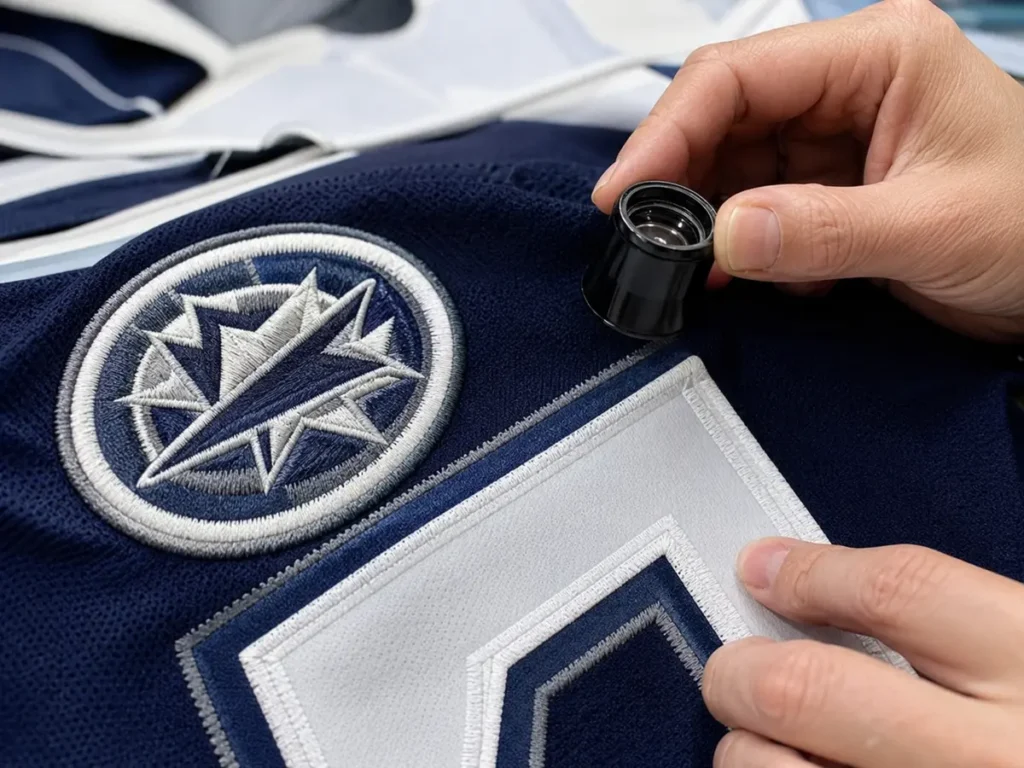
Technician examining embroidery stitches and tackle-twill edges on a custom jersey
How to Approve a Durable Jersey Sample
A digital mockup confirms artwork placement but cannot prove physical durability. Use a production-representative sample made with the intended fabric, color, decoration material, and application process.
Visual and dimensional checks
- Confirm garment measurements against the approved size specification.
- Measure logo, number, and name size and position from defined reference points.
- Compare color, fine details, registration, edges, and panel alignment against the approved standard.
- Look for puckering, scorching, press gloss, needle damage, loose thread, incomplete bonding, frayed edges, ink bleed, and dye migration.
Wear and stretch checks
- Put the sample on the intended size and move through sport-relevant positions.
- Stretch decorated areas within the garment’s intended use.
- Check whether dense decoration restricts movement or changes recovery.
- Evaluate skin-side comfort at embroidery backing and appliqué seams.
Agreed care evaluation
For important programs, retain one unwashed control sample and evaluate another sample after agreed laundering. Record the wash temperature, detergent, cycle, load, drying method, and number of cycles. Photograph the same locations under similar lighting before and after care.
Buyers that require standardized textile testing can discuss appropriate methods with a qualified laboratory. AATCC TM61 addresses accelerated colorfastness to laundering, while ISO 105-C06 covers resistance of textile color to domestic or commercial laundering. AATCC TM150 addresses dimensional change in garments after home laundering. These methods do not automatically create a jersey acceptance standard; buyer and supplier still need to agree on the specimen, method, rating, and pass/fail criteria. AATCC TM61 summary · ISO 105-C06:2010
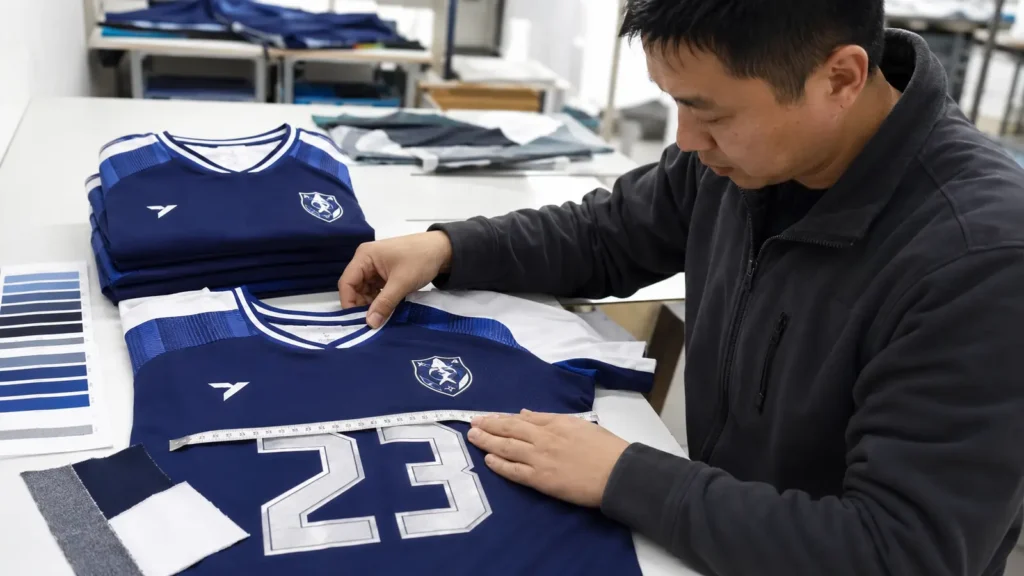
Quality inspector checking custom jersey measurements, print adhesion and stitching
What to Send a Supplier for an Accurate Quotation
Send a consolidated brief rather than a series of disconnected messages:
- Sport and player level
- Men’s, women’s, youth, or unisex fit
- Jersey style and reference images
- Estimated total quantity and size breakdown
- Reorder expectation
- Base fabric or performance requirement
- Team colors and color references
- Vector logo files and font requirements
- Front, back, sleeve, and sponsor placements
- Player names and numbers in a clean roster sheet
- Preferred decoration method, if already selected
- Neck label, woven label, hangtag, barcode, or private-label requirements
- Individual bagging, player sorting, or team-set packing
- Target country and delivery date
- Sample approval and testing expectations
JIUMU’s typical MOQ is 50 pieces, subject to product structure and customization. Complex mixed sizes, player personalization, multiple decoration methods, or special packaging should be included from the first quotation so the supplier can assess production steps accurately.
Questions to Ask Before Placing a Bulk Order
- What exact decoration construction is proposed—not just “printed” or “stitched”?
- What is the jersey’s fiber content, fabric code, weight, knit structure, and stretch behavior?
- Has the proposed ink, film, thread, backing, or twill been tested on this exact fabric and color?
- How will polyester dye migration be controlled for light graphics on dark garments?
- What curing or pressing variables are monitored during production?
- How are embroidery density and backing adjusted for lightweight mesh?
- How are tackle-twill inside corners and edges secured?
- Which care instructions apply to the finished decorated jersey?
- Can the supplier make a production-representative sample or size set?
- What visual and measurement criteria are checked before packing?
- How are personalized names, numbers, and sizes verified against the roster?
- What records will be retained to support consistent reorders?
Specific answers are more valuable than a generic promise that the decoration is “high quality.”
Common Buying Mistakes
Treating all printing as one method
Sublimation, screen printing, and heat transfer have different constructions and failure modes. A quote that says only “printed logo” is incomplete.
Assuming stitching cannot fail
Thread can break, backing can irritate, fabric can pucker, and appliqué edges can fray. Stitching is a production system, not an automatic guarantee.
Approving only a mockup
A digital proof cannot show hand feel, stretch, weight, puckering, edge adhesion, or dye migration.
Testing a different fabric or color
A transfer tested on white polyester may behave differently on a dark dye-sublimated fabric. Embroidery approved on interlock may not sit the same way on open mesh.
Ignoring the care label
High heat, bleach, ironing, or dry cleaning can affect decoration materials. The care instructions must reflect the complete garment.
Using decoration to compensate for weak artwork
Tiny text, narrow outlines, excessive color layers, and sharp inside corners can be difficult in thread or appliqué. Simplify the artwork for the selected method rather than forcing the same file into every process.
Comparing price without replacement planning
Ask how late roster additions and damaged jerseys will be reproduced. Color, fabric, font, and placement records matter for future matching.
Why JIUMU for Custom Team Jerseys
JIUMU is a Guangdong-based B2B supplier established in 2010, serving buyers in the United States, Canada, the United Kingdom, and Europe. Its approved capabilities include OEM and ODM development, sublimation, screen printing, heat transfer, embroidery, woven and rubber/PVC patches, leather-style patches, fabric sourcing, color matching, private labels, hangtags, packaging customization, digital mockups, physical samples, quality control, and export support.
That range is relevant to this comparison because the method should follow the buyer brief. JIUMU can discuss a smooth sublimated performance jersey, a compact embroidered crest, heat-applied personalization, a screen-printed training piece, or a coordinated program using different methods across jerseys, jackets, hoodies, hats, and bags.
Explore custom team uniforms for coordinated programs or review custom team jerseys for sport-specific options. Final specifications, availability, MOQ, and production arrangements should be confirmed for each order.
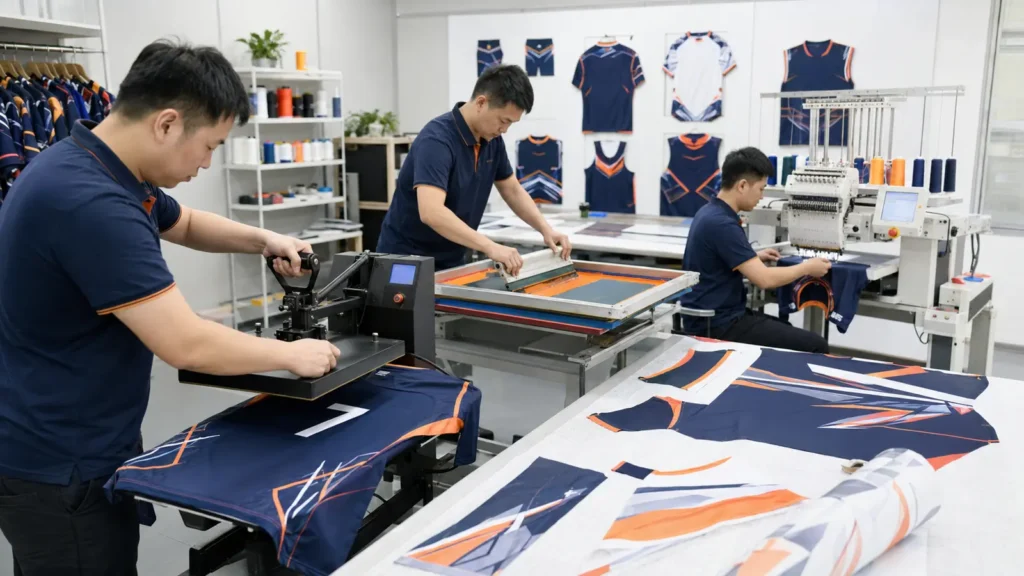
Original custom team jerseys in a clean customization workspace with printing and embroidery equipment
Frequently Asked Questions
Final Recommendation
If the top priority is a lightweight, full-color polyester jersey that resists surface cracking and peeling, start with dye sublimation. If the program wants a compact dimensional crest, evaluate polyester-thread embroidery on the actual fabric. If traditional large names and numbers define the look, test edge-stitched tackle twill. Use screen printing for suitable limited-color graphics when ink and cure are controlled, and use heat transfer for precise, flexible personalization when the selected film is proven on the jersey.
The most durable order matches method, fabric, and use case, then documents the approved sample, care instructions, quality criteria, and reorder specification.
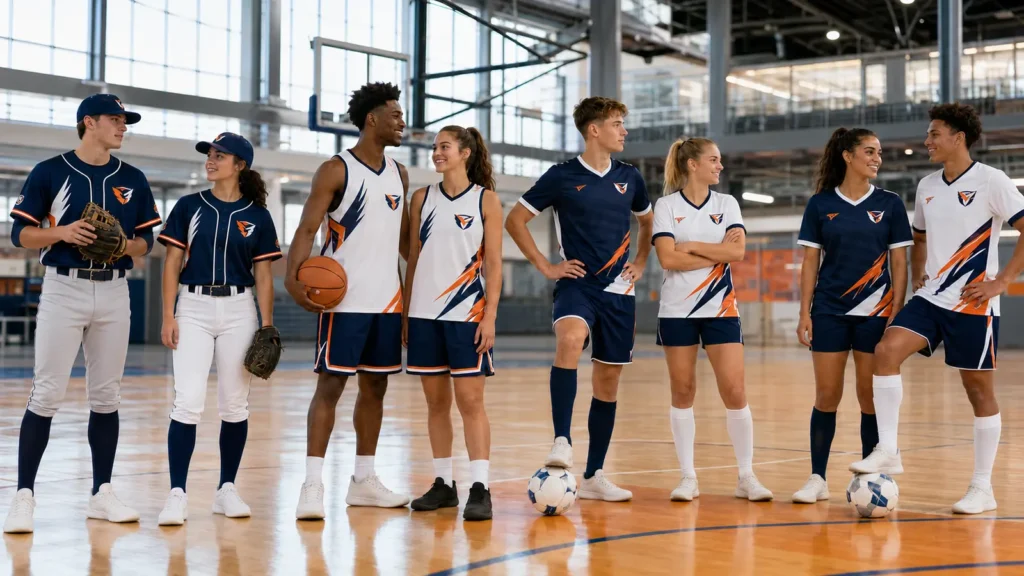
School and club athletes wearing coordinated original custom team jerseys in an indoor sports facility
About JIUMU
JIUMU is a Guangdong-based B2B supplier established in 2010, providing custom teamwear, logo apparel, hats, uniforms, bags, and branded merchandise for professional buyers in North America and Europe.