
How to Vet a Custom Apparel Manufacturer Before Paying a Deposit
Paying a deposit is the point where supplier research becomes financial exposure. Before that payment, a custom apparel manufacturer may have shown attractive product photos, a polished website, fast replies, and a competitive quotation. None of those items, alone, proves that the legal company exists in good standing, controls the production it describes, has relevant product experience, follows a repeatable sample-to-bulk process, or is asking you to pay the correct beneficiary.
Supplier vetting does not mean searching for one perfect certificate or one “proof” that eliminates every risk. It means building several independent checks that support the same conclusion: the company is identifiable, the people are connected to that company, the claimed production arrangement is understandable, the product and quality process are credible, the contract defines the order, and the payment instruction has been independently verified.
This guide gives startup brands, sourcing teams, distributors, schools, clubs, and private-label buyers a practical due-diligence process before sending a deposit for custom apparel, hats, uniforms, or bags.
Quick Answer: Before paying a custom apparel manufacturer, verify the supplier’s exact legal entity and registration status; determine whether it owns, operates, coordinates, or subcontracts the production site; conduct a buyer-directed live video walkthrough; review comparable products and the complete sampling/QC process; match the contract, invoice, and bank beneficiary; and document specifications, change approval, inspections, payment milestones, and remedies. For higher-risk orders, use an independent factory audit, sample testing, or pre-shipment inspection. No single check makes a transaction risk-free.
Start With a Risk-Based Supplier Vetting Plan
The amount of verification should match the commercial risk. A low-value sample order from a known platform does not need the same due diligence as a large private-label order involving custom molds, regulated claims, complex packaging, or an unfamiliar bank beneficiary.
Evaluate at least five dimensions: financial exposure, product complexity, compliance exposure, delivery consequences, and how difficult the goods would be to repair, resell, or replace.
| Risk level | Typical situation | Minimum verification before deposit |
|---|---|---|
| Lower | Paid sample, small development fee, standard decoration, limited deadline pressure | Legal entity check, verified contact, written sample scope, matching invoice and payment beneficiary |
| Moderate | First bulk order, custom fabric/color, private labels, meaningful launch date | All lower-risk checks plus live site walkthrough, comparable-product evidence, approved sample process, QC plan, signed specification exhibits |
| Higher | Large deposit, complex construction, strict compliance, retailer deadline, new beneficiary, tooling or long-lead materials | All moderate checks plus independent audit or inspection, legal/contract review, enhanced bank verification, staged payment and defined release conditions |
Do not lower your verification standard because the supplier creates urgency. Time pressure is itself a reason to slow the payment decision. The U.S. Federal Trade Commission advises businesses to establish clear invoice and payment-approval procedures and warns that scammers often impersonate trusted parties or pressure people to act before checking instructions. See the FTC small-business scam guidance.
Step 1: Verify the Legal Company and Business License
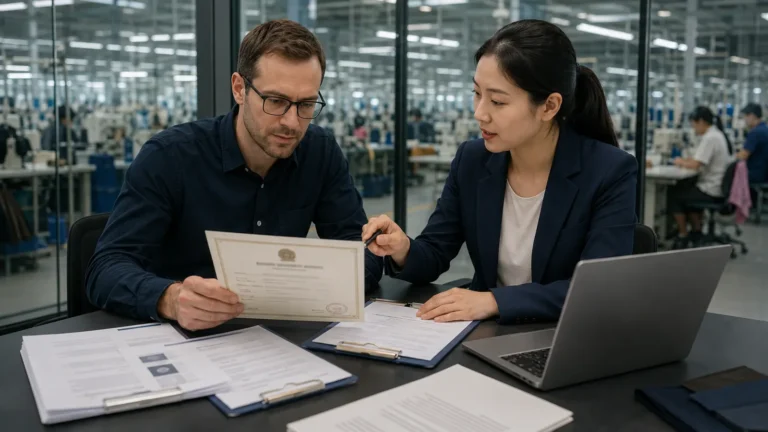
Ask for the supplier’s full legal name in its registration language, registered address, business registration number, legal representative or authorized signatory details, and a clear copy of the current business license or equivalent registration document.
For a mainland Chinese supplier, request the exact Chinese legal company name and Unified Social Credit Code. Search the official National Enterprise Credit Information Publicity System and compare the returned record with the license copy.
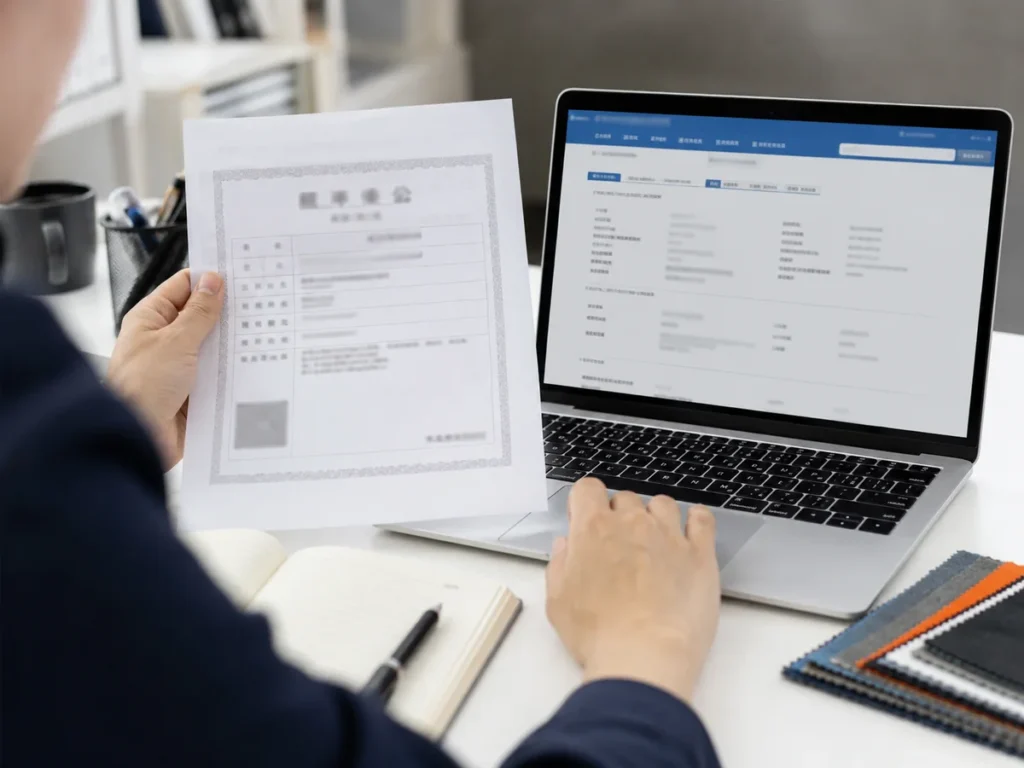
Check the following fields:
- exact legal name, not only an English brand or trading name;
- registration or unified credit code;
- current operating status;
- date of establishment;
- registered address;
- legal representative;
- registered business scope;
- material changes or abnormal-operation notices when available;
- consistency with the company named on the quotation, contract, invoice, email signature, website, and bank instruction.
What a Business License Does—and Does Not—Prove
A valid license is evidence that a legal entity is registered. It does not prove that the company owns a factory, employs the workers shown in a video, controls a particular production line, has sufficient capacity, owns the website you visited, or will perform the contract correctly.
The registered address may be an office, shared commercial address, industrial unit, or administrative address rather than the production location. The business scope may be broad. Treat the registry check as the identity layer, then verify operating capability separately.
If the legal name on the license differs from the brand name, ask for a written explanation of the relationship. If another company will sign the contract, receive payment, export the goods, or operate the production site, map every entity and its role.
Step 2: Understand the Supplier’s Real Production Model
The phrase “manufacturer” can describe several business models:
| Supplier model | What it may mean | What the buyer should verify |
|---|---|---|
| Owned and operated factory | Contracting company owns or directly operates the production site | Ownership/lease evidence, employees, equipment, product lines, site address |
| Trading company with dedicated sourcing/QC | Supplier coordinates production through partner factories | Partner-selection process, technical control, sample ownership, QC staff, disclosure of production location |
| Manufacturer with subcontracted processes | Core production is internal; printing, embroidery, dyeing, washing, testing, or packing may be external | Which steps are outsourced, approved subcontractors, transport/control points, responsibility for defects |
| Production management company | Supplier manages development, materials, factories, QC and export | Contractual responsibility, approved sites, documentation, escalation and inspection access |
| Agent or broker | Individual connects buyer and producer but may not control quality or contract performance | Authority, commission role, legal contracting party, payment route and access to production |
None of these models is automatically good or bad. A transparent trading or production-management company can provide strong product development and quality coordination. A factory can still have weak communication or quality systems. The risk comes from an undisclosed or misunderstood relationship.
Ask directly:
- Which legal entity signs the contract?
- At which address will each production stage occur?
- Which operations are internal and which are subcontracted?
- Who purchases fabric and trims?
- Who owns the approved sample and production specifications?
- Who performs in-line and final QC?
- Can the buyer or an auditor visit the actual production location?
- Who is responsible if a subcontractor causes delay or defects?
Step 3: Conduct a Buyer-Directed Live Video Factory Tour
A real-time video walkthrough is useful when an in-person visit is not practical. It can show whether the contact has live access to the site, whether current production activity matches the claimed product type, and whether the process flow is plausible.
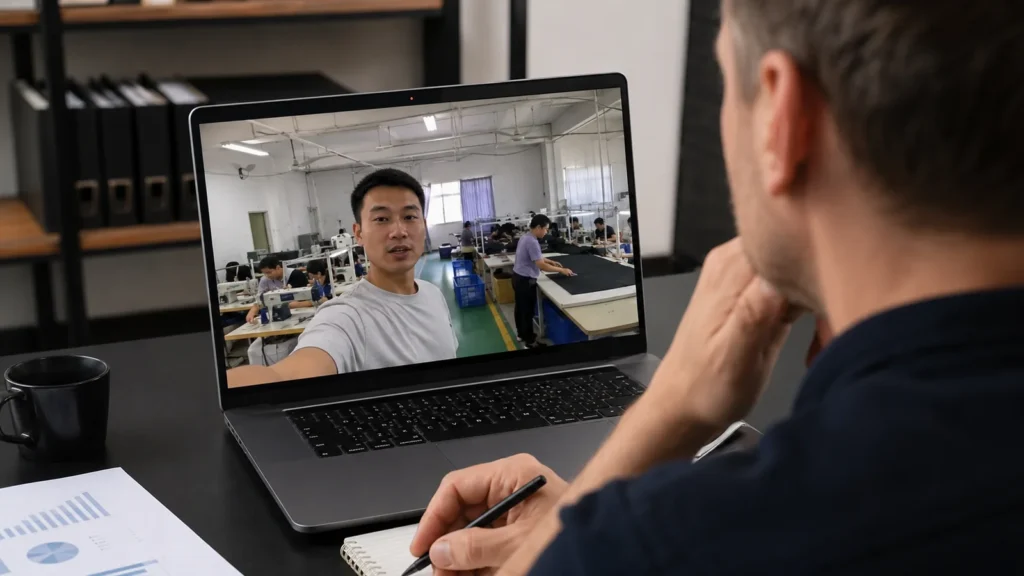
How to Make the Video Tour More Reliable
Schedule the call during normal operating hours. Ask the guide to begin outside the entrance and show the surrounding address or recognizable location indicators without exposing sensitive personal data. Request one continuous walkthrough rather than a series of edited clips.
Direct the route yourself. Ask to see:
- entrance and company identification;
- sample/development room;
- incoming fabric and trim storage;
- cutting or preparation area;
- sewing or assembly lines;
- embroidery, printing, sublimation, or patch processes if claimed onsite;
- work-in-progress products similar to your category;
- measurement and QC stations;
- rejected or repair area, if maintained;
- packing and carton storage;
- warehouse and shipment staging;
- production boards or records with confidential information covered;
- the person responsible for sample development and QC.
Ask spontaneous questions: “Please show the reverse side of that panel,” “Can we see where finished pieces are measured?” or “Please walk from sewing to packing without ending the call.” A legitimate supplier may protect customer confidentiality, but it should explain reasonable restrictions rather than replacing every live view with promotional footage.
Limitations of Video Verification
A video call can be staged, conducted at a third-party site, or limited to a small approved area. It does not prove legal ownership, financial health, capacity availability, social compliance, or control over future production. Use it as one evidence layer, not as a substitute for an audit, physical samples, or contractual controls.
Step 4: Verify the Actual Production Site and Process
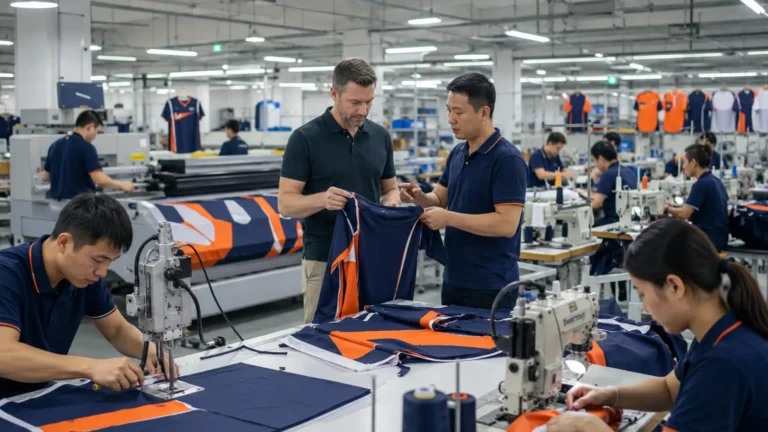
If the order value or risk justifies it, visit the site or arrange an independent audit. Compare the production address with the supplier’s disclosure, quotation, contract, audit scope, and shipping documents.
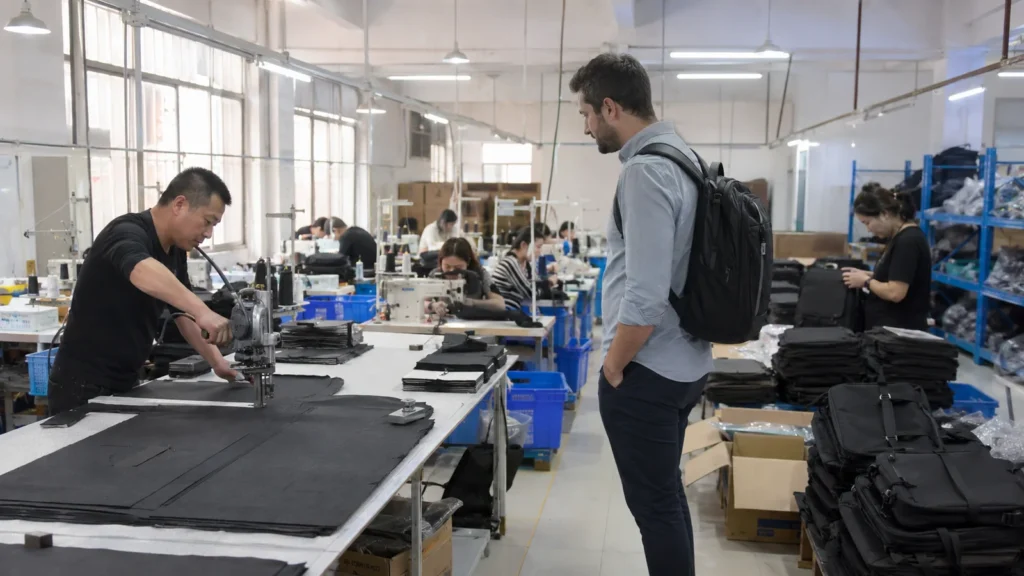
Focus on observable evidence rather than polished meeting rooms:
- Are the products being made relevant to your category?
- Does equipment match the claimed processes?
- Are materials and work-in-progress identified and separated?
- Are approved samples, specifications, and measurement tools available near production?
- Are defects recorded, segregated, corrected, and reinspected?
- Is finished inventory traceable to an order or production lot?
- Does packing match the supplier’s claimed export capability?
- Are outsourced processes openly identified?
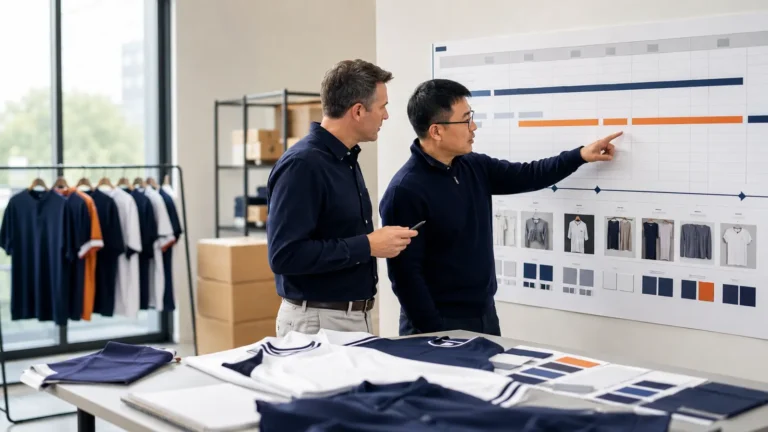
Capacity should be assessed against your order and schedule. A busy floor is not proof that capacity is available to you. Ask for a production plan showing material lead time, sample approval, bulk start, key operations, inspection window, packing, and shipment readiness.
Step 5: Review Experience With Similar Products
“We make apparel” is not sufficient evidence for a complex team jersey, structured cap, padded backpack, workwear hoodie, or private-label package. Relevant experience means familiarity with similar materials, construction, decoration, sizing, performance, labeling, and packaging risks.
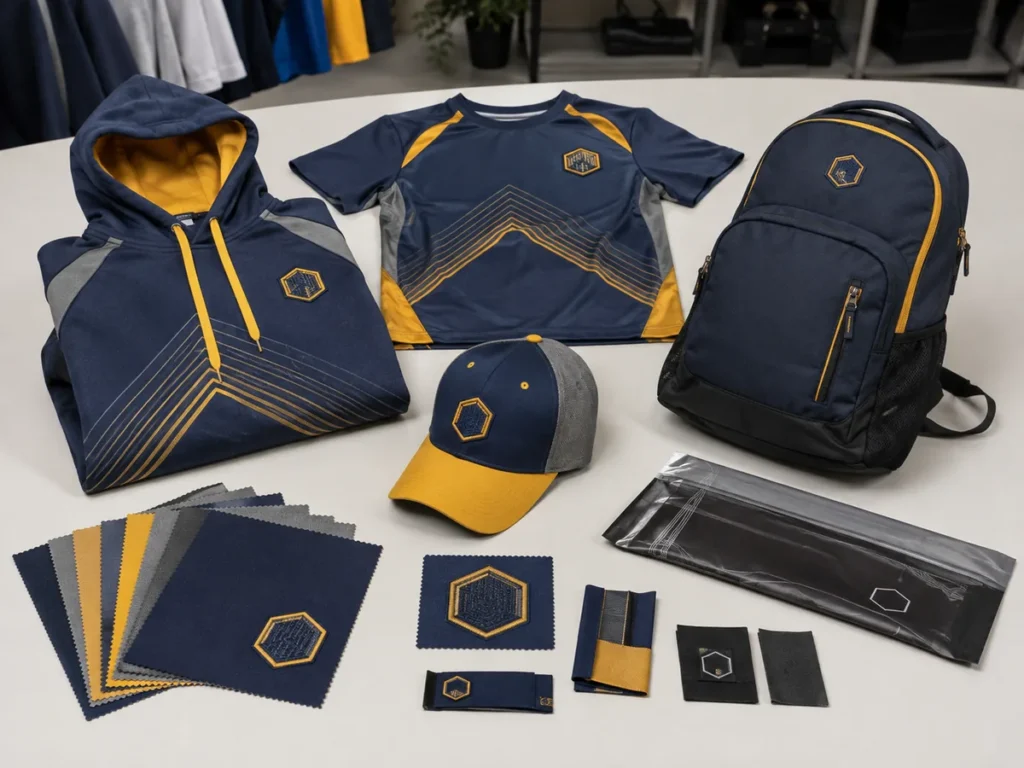
Ask the supplier to show unbranded or confidentiality-safe examples that are comparable in:
- product construction and number of panels;
- fabric type, stretch, coating, weight, or finish;
- embroidery, sublimation, screen print, heat transfer, or patch method;
- sizing and grading complexity;
- zipper, buckle, foam, webbing, rib, elastic, or other components;
- labels, hangtags, barcodes, polybags, inserts, and export cartons;
- target use, such as school teams, clubs, workwear, promotions, retail, or ecommerce.
Do not ask for another customer’s confidential tech pack, invoice, or branded product data. A supplier that protects customer confidentiality may be showing a positive control. Instead, evaluate physical workmanship, technical explanations, development records, and whether the team identifies realistic risks before you tell them the answer.
Use a Paid Sample as a Capability Test
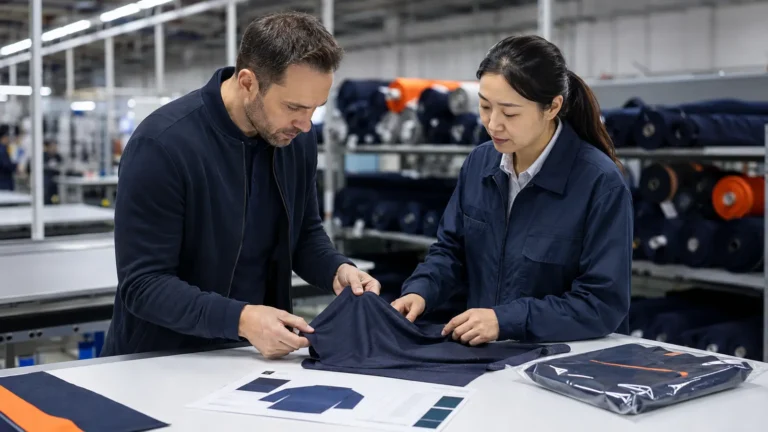
A sample order tests more than sewing quality. Observe whether the supplier asks useful questions, confirms artwork and materials, documents revisions, communicates trade-offs, meets the agreed sample scope, labels versions, and explains what will change in bulk production.
The sample should lead to a controlled final reference, not just an attractive prototype. Connect it to a bill of materials, measurements, artwork, color references, labels, packaging, and approval record.
Step 6: Audit the Sampling and Quality-Control Process
Ask the supplier to explain the entire path from inquiry to shipment. Strong answers identify decision points and records. Weak answers rely on phrases such as “our QC checks everything” without showing what is checked, when, against which reference, and who can stop production.
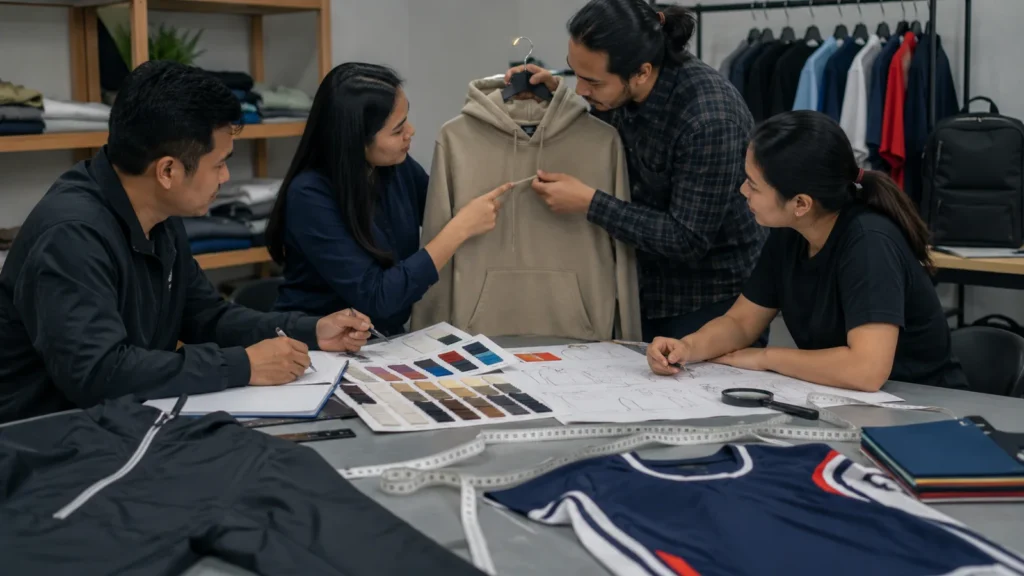
| Stage | Evidence to request | Key question |
|---|---|---|
| Requirement review | Inquiry summary, tech pack gaps, material and artwork questions | What must be confirmed before sampling? |
| Sample development | Version log, sample comments, material/decoration strike-offs | How are revisions controlled? |
| Final approval | Golden Sample, BOM, measurements, artwork, packaging approval | Which exact version authorizes bulk? |
| Pre-production | Meeting record, material approvals, first-piece requirement | How are teams aligned before repetition? |
| In-line QC | Inspection records, measurement points, defect examples | How is drift detected before completion? |
| Pre-shipment | Lot identity, sampling plan, checks, photos, release status | Who decides shipment is ready? |
| Corrective action | Containment, cause, rework, reinspection and approval records | What happens when a repeated defect appears? |
Review JIUMU’s Quality Control and Manufacturing Capabilities pages as examples of the information a buyer should request and verify.
Do not assume a generic AQL number or tolerance applies to every product. Define defect classes, measurement tolerances, functional checks, sampling method, inspection timing, report format, and release authority for your order.
Step 7: Confirm the Contracting Entity and Payment Beneficiary
Before sending money, place the business license, contract, quotation, commercial invoice or pro forma invoice, email domain, and bank instruction side by side.
Verify:
- the exact legal entity signing the contract;
- the entity issuing the invoice;
- the bank beneficiary name;
- the bank country and account location;
- the reason for any mismatch;
- whether an intermediary, export company, payment platform, or related entity is involved;
- who is legally responsible for the goods and refund obligations;
- whether the payment instruction came through an authenticated channel.
A beneficiary mismatch is not automatically fraudulent. Chinese suppliers may use an affiliated export company, Hong Kong entity, platform escrow, or authorized collection arrangement. But the relationship must be explained and documented before payment. Ask for a signed payment instruction or contract clause identifying the authorized beneficiary and the commercial reason.
Treat Any Bank-Account Change as a New Verification Event
Business-email compromise frequently involves a real transaction and a fraudulent message changing the beneficiary. Do not verify a new account by replying to the same email that announced the change. Call a previously verified contact using a number obtained independently—not a new number in the change request. Use two-person approval inside your company for new beneficiaries and account changes.
Wire transfers can be difficult to reverse. If fraud is suspected after payment, contact the sending bank or transfer provider immediately and request a stop or recall; also follow the relevant reporting procedures. See the FTC wire-transfer guidance.
Step 8: Use Third-Party Audits and Inspections When Risk Justifies Them
An independent firm can verify a physical site, assess selected systems, inspect products, witness loading, or perform specific testing. The value depends on the scope and timing.
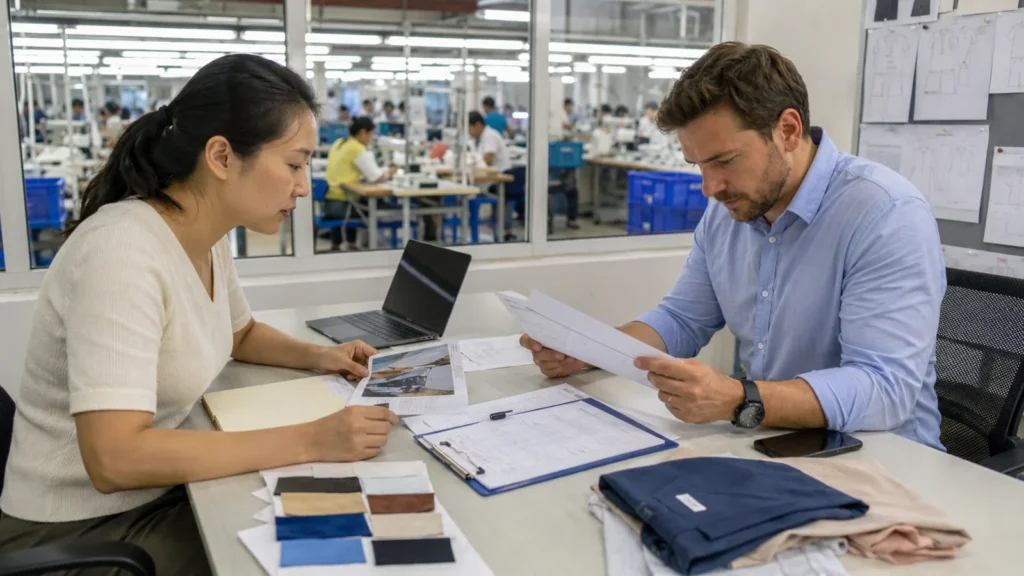
Common Third-Party Services
| Service | Best used for | Important limitation |
|---|---|---|
| Factory existence/verification visit | Confirm address, activity, equipment, staffing and general capability | Snapshot in time; does not guarantee future allocation or quality |
| Quality-system audit | Review document control, incoming inspection, process control, final inspection, corrective action | Scope must match the intended products and site |
| Social/compliance audit | Evaluate defined labor, health, safety or ethical criteria | Standards, validity and customer acceptance differ |
| Pre-production check | Verify materials, components, sample and readiness before production | Must happen before irreversible work |
| During-production inspection | Detect process and workmanship problems while correction is possible | Requires representative production progress |
| Pre-shipment inspection | Assess a defined finished lot before release | Sampling does not mean every unit is inspected |
| Container loading check | Verify quantity, carton condition and loading process | Does not replace product inspection |
| Laboratory testing | Evaluate defined material or product requirements | Report applies to the tested sample and method |
Give the inspector the purchase order, final specifications, Golden Sample information, defect definitions, required checks, packaging plan, and reporting instructions. A generic checklist may miss the features that matter most to your product.
Step 9: Put Product and Payment Controls Into the Contract
A quotation tells you price and broad terms. It is not a complete production agreement. For a meaningful first order, attach the technical and commercial exhibits that define what the deposit is funding.
Your agreement may need:
- exact buyer and supplier legal entities;
- product specifications, BOM, artwork and measurement table;
- approved sample and version;
- material, color, decoration, labels and packaging;
- prohibition on unapproved substitution or subcontracting where relevant;
- compliance responsibilities and required documents;
- quantity, price, currency, Incoterm, shipping documents and delivery schedule;
- inspection stages, sampling plan, defect classification and release criteria;
- buyer or third-party access for audit and inspection;
- change-order process and effect on price/lead time;
- ownership and permitted use of artwork, molds, labels and branded materials;
- handling of excess, defective, canceled or branded goods;
- rework, replacement, refund, credit, delay and dispute provisions;
- governing law, language, notice method and dispute-resolution mechanism;
- payment milestones and beneficiary details.
Obtain qualified legal advice for the transaction and jurisdictions involved. A contract cannot eliminate supplier risk, but clear obligations and evidence reduce ambiguity.
Structure Payment Around Verifiable Milestones
There is no universally safe deposit percentage or payment method. Terms depend on product, material commitments, tooling, relationship, platform, bargaining power and country. The risk-control principle is to connect payments to evidence and defined progress rather than to vague promises.
Possible milestones include final specification release, material purchase approval, approved pre-production sample, documented production progress, passed pre-shipment inspection, and shipment documents. Never use a milestone that the buyer cannot verify.
Twenty Questions to Ask Before Paying a Deposit
- What is your exact legal company name and registration number?
- Which entity will sign our contract and issue the invoice?
- Which entity owns the bank account receiving our payment?
- Why do any of those entities differ?
- At which address will cutting, sewing, decoration, QC and packing occur?
- Which processes are subcontracted?
- Can we conduct a continuous live walkthrough during operating hours?
- Can our representative or independent auditor visit the actual site?
- What comparable products can you show without violating customer confidentiality?
- Who reviews our tech pack and identifies missing specifications?
- How many sample stages are expected and what does each approve?
- How is the Golden Sample labeled, stored and connected to bulk production?
- How are fabric, colors, trims, logos, labels and packaging approved?
- Can any material or process be changed without our written approval?
- What is checked at first-piece, in-line and pre-shipment stages?
- What inspection records will we receive?
- How are defects contained, corrected and reinspected?
- What production dates and capacity are reserved for our order?
- What happens if shipment is late or inspection fails?
- Who must confirm any future change to beneficiary banking instructions?
Pre-Deposit Due-Diligence Checklist
| Check | Required evidence | Result |
|---|---|---|
| Legal identity | License copy plus official registry match | Pass / clarify / stop |
| Contact identity | Named staff connected to legal entity and verified channels | Pass / clarify / stop |
| Production model | Written map of internal and subcontracted processes | Pass / clarify / stop |
| Site evidence | Continuous video, visit or independent verification | Pass / clarify / stop |
| Relevant capability | Comparable samples and technical explanation | Pass / clarify / stop |
| Sampling process | Stages, revisions, cost, timing and approval rules | Pass / clarify / stop |
| QC process | First-piece, in-line, final checks and corrective action | Pass / clarify / stop |
| Final specification | Tech pack, BOM, artwork, measurements, packaging | Complete / open |
| Contract | Correct parties, obligations, inspection, remedies, dispute terms | Signed / legal review |
| Invoice | Matches final commercial terms and entity | Match / clarify |
| Beneficiary | Verified name, country, account and authorization | Match / independently confirm |
| Payment approval | Internal two-person review and saved evidence | Approved / hold |
| Third-party checks | Audit, inspection or testing scope when risk requires | Booked / not required |
If a critical check remains open, hold the deposit. Record why the item is open, who will resolve it, and what evidence is required.
Red Flags That Require More Investigation
One red flag does not always prove fraud, but several unexplained inconsistencies justify stopping the transaction.
- refusal to provide the exact legal company name or registration code;
- license information that does not match the registry;
- inability to explain the relationship between brand, factory, exporter and beneficiary;
- edited “live” tours or refusal to show buyer-requested areas;
- copied product photos with no technical knowledge;
- pressure to pay before specifications or sample scope are written;
- quotation substantially below material and process reality without explanation;
- personal bank account or unexpected foreign beneficiary without documentation;
- last-minute bank change sent only by email;
- requests for cryptocurrency, gift cards, split transfers or false invoice descriptions;
- refusal to permit reasonable third-party verification on a meaningful order;
- certificates or audit reports with mismatched names, sites, scope or dates;
- promises that every requirement is possible without asking technical questions;
- unwillingness to put material-substitution and inspection terms in writing.
How to Evaluate JIUMU Transparently
The same due-diligence standards should be applied to JIUMU. Buyers can review the Company Facts page for entity and business information, then compare those claims with documents and direct verification. JIUMU supports OEM/ODM development, fabric sourcing, Pantone color matching, embroidery, sublimation, screen printing, heat transfer, patches, labels, hangtags, packaging customization, physical samples, quality coordination and export support for custom teamwear, hats, bags and branded merchandise.
Ask JIUMU for information relevant to your specific order: contracting entity, production arrangement, sample stages, material approvals, decoration method, QC checkpoints, packaging, payment beneficiary and inspection access. The goal is not to ask a supplier to “trust us.” The goal is to make the order understandable and verifiable.
Planning a first order? Send your product category, reference images or tech pack, quantity, materials, colors, logo files, packaging, target market, delivery date, and required verification steps. Contact JIUMU to discuss the sample, documentation and inspection plan before payment.
Frequently Asked Questions
Final Recommendation
Do not search for one badge that proves a custom apparel manufacturer is safe. Build a chain of consistent evidence. Verify the legal entity. Understand the real production model. See the site live or independently. Test the supplier through comparable products and a controlled sample. Audit the QC process. Match the contracting entity, invoice and bank beneficiary. Put the product, inspection, change and payment rules in the contract.
Most importantly, pause when facts do not align. A legitimate supplier should be able to explain its structure, document its role, support reasonable verification and clarify how your deposit connects to materials, samples, production and delivery.